Other Minds 24 Revives the Quartets of Ivan Wyschnegradsky in San Francisco


I admit to some trepidation as I proceeded to the beautiful War Memorial Opera House in downtown San Francisco.  While I had heard of this composer, Ivan Wyschnegradsky (1893-1979), it was only through one work which was contained on a disc with other microtonal works by John Cage and Harry Partch performed variously by Joshua Pierce, Dorothy Jonas, and Johnny Reinhard (among others).  And microtonal music can be tedious in some hands.

OM 240001

This helpful sign in the elevator directed concert goers to the 4th floor recital room known as the Dianne and Tad Taube Atrium Theater

Adding to the sense of obscurity, the concert was in a small chamber music hall on the fourth floor.  Other events ran concurrently on this night.  The hall was nearly filled to its capacity of just under 300 people most of whom I would guess have never heard of this composer.  But they likely had heard of the Arditti Quartet and clearly put their trust in the amazing ear and mind of executive and artistic director Charles Amirkhanian to deliver a satisfying musical experience which he does most reliably.  This concert was no exception.

OM 240003

The stage awaits the performers with that OM logo projected on the floor.

The Arditti Quartet was formed in 1974 and quickly became known as one of the finest interpreters of contemporary string quartet music.  Their repertoire is vast and they do not shy away from technical difficulty or other artistic challenges.  In fact they had recorded the Wyschnegradsky Quartets but, sadly, that recording is out of print.  Even more interesting is the fact that tonight’s performance constitutes U.S. premieres for all the works on this concert except for the Haas Quartet (included at the suggestion of Mr. Arditti to fill out the program).  Another astonishing fact shared by Amirkhanian is that this is the only time that the quartet has been asked to play this music in concert.  There are plans to release those recordings in the near future pending negotiations with record companies.

OM 240006

Amirkhanian reminded the audience to silence those pesky cell phones.

Mention needs to be made of the talents of OM’s graphic designer (and stage manager among other duties), Mark Abramson.  His work on this and last year’s program booklets take things to a new level of excellence.  The program notes by Charles Amirkhanian, Randall Wong, and Blaine Todd are both lucid and comprehensive (a very necessary thing in dealing with new and obscure music).  And the photos of the composer and the performers along with some of the composer’s own art work make this another true collector’s item.  Previous programs were certainly well done but this is a step up.

OM 240010

The Arditti Quartet

I chose to just listen and to read the notes later rather than get caught up in details.  Indeed that was a good choice.  Wyschnegradsky’s approach to the use of microtones seems more focused on the possibilities of extending melodic language than the harmonic and my understanding of complex harmony is admittedly limited anyway.  Of course the harmony is necessarily different than the western models of the 18th and 19th centuries but the music, at least in the hands of such talented interpreter’s such as the Arditti speaks rather directly to the listener.

The music was presented chronologically in order of the years these pieces were composed (String Quartet No.1, 1923-4, rev. 1953-4), (String Quartet No. 2, 1930-1), (String Quartet No. 3, 1945, rev. 1958-9), and (Composition for string quartet, 1960, rev. 1966-70) completed the first half of the program.  There was surprisingly little in the way of dissonance and the quartet played with a palpable intensity and concentration creating very convincing performances.
 

OM 240019.JPG

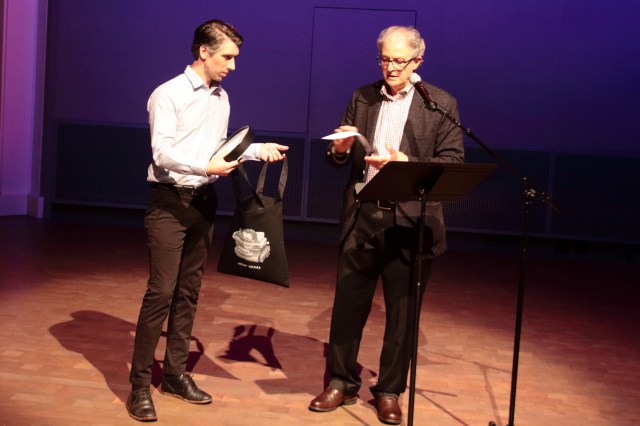
Blaine Todd holds the OM bag (a Carol Law design) as Amirkhanian picks two raffle winners after intermission.

The second half began with Wyschnegradsky’s last composition, a String Trio (1978-9).  Incomplete at the time of his death the trio was revised completed by Claude Ballif.  Again what one hears is not what you might expect from microtonality.  The composer has realized a uniquely effective way to use microtones.  Hearing this survey makes the composer’s vision clear and places him in the company of such as Alois Hába (1893-1973), Harry Partch (1901-1974), and Ben Johnston (1926- ) to name a few.  
OM 240020.JPG

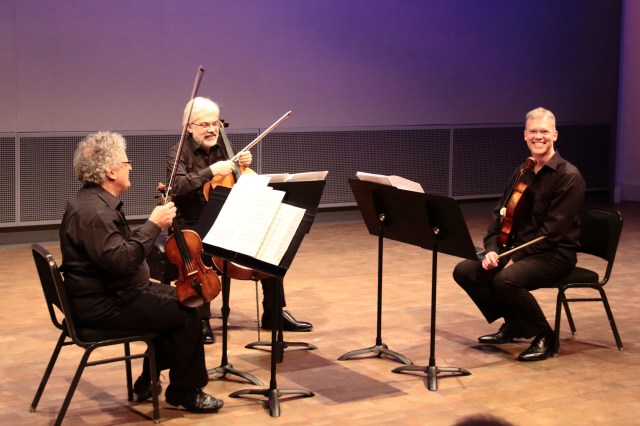
The Arditti Quartet sans second violin Asot Sarkissjian on stage to play the Wyschnegradsky Trio

The revelation for this listener was hearing a good sampling of the composer’s vision and a creative way to use microtones unlike any other composer really.  And it became clear too why Charles chose to revive this unique voice in the musical world.  This is beautiful music.

OM 240021.JPG

As mentioned earlier Mr. Arditti had remarked that the Wyschnegradsky Quartet and Trio music would not quite fill an evening and he suggested they play the Second String Quartet (of about 6 now I believe) by Austrian born composer Georg Friedrich Haas (1953- ).  It was the only work which was not a U.S. premiere.

Arditti’s ear for programming was finely as tuned as ever and this quartet provided a very satisfying finale to the evening filled with wonderful discoveries.  While this particular quartet uses some microtones the style is denser and more dissonant overall than the preceding music.  This is not to say that it was not entertaining, rather it is illustrative of the rich possibilities of microtonal composition.  The Arditti again shows itself to be at the forefront of the finest interpreters of the modern string quartet and clearly Haas is a name worth knowing as well.  Bravo!

OM 240022.JPG

The musicians acknowledge the standing ovation and warm applause

Save the dates June 15 and 16 for the last two concerts in this year’s Other Minds 24 program.

Jenny Q Chai brings Synaesthesia to CNMAT in Berkeley


choi20190001

All is set up in the diminutive performance space at CNMAT.

Jenny Q. Chai is a graduate of Curtis Institute and the Manhattan School of Music.  She is trained as a pianist but she is in the process of expanding that role somewhat.  Chai is one of an unusual group of people called “synaesthetes”, that is, people who see sounds and hear colors.  Her program tonight is entitled, “Sonorous Brushes”.

I am not a synaesthete and it is most likely that most of the audience was more like me.  The actual prevalence of synaesthesia in which stimulation of one sense (such as sound) simultaneously stimulates another sensory or cognitive pathway (such as color or emotion) is estimated to occur in about 4% of the general population (estimates vary).  This condition is unusual but is not pathological.  The interest or the challenge here is the artist’s attempt to convey her personal synaesthetic perceptions in a way that can be understood by those not similarly wired.

choi20190007

Chai spoke eloquently about her research to the audience.

The program was divided into sections.  In the first Chai performed some mostly conventional repertoire from the early twentieth century namely Debussy, Ravel, Messiaen.  The four Debussy pieces with which Ms. Chai opened this recital (two etudes, “Pour les huits doigts” and “Pour les quartes” and preludes 11 and 12 from book 2) left absolutely  and no doubt as to  and the artist’s virtuosity and interpretive skills.  She then launched into a Ravel homage by one Frederic Durieux followed by Ravel’s Oiseaux Tristes and a  truly athletic Messiaen piece.  Understandably these pieces inspired visual creations by this artist and seemed to be the seed for her ongoing research.

choi20190015

It is curious and somehow very fitting that this musical exploration begin with music that was inspired by the visual.  Impressionism was pretty much paralleled by the music which appears to have been inspired by the visual art, an early argument for synaesthesia.  There is little doubt that many artists (and non-artists) have had this condition for better or worse but it is likely that such unusual perceptions would have been classified as pathological and not the topic of polite conversation back in the 19th century and before.

choi20190008

On this night it would be not merely a topic of conversation but an introduction to research which began with a grant Chai received from the French government for research into synaesthesia and presenting these ideas to a wider audience.  Far from pathology, this could even be seen as a deficit in those who lack this ability.  The key then is to explore synaesthesia as a potential asset.  Of course a complete and detailed explanation was not the goal of the evening.  This was to whet our appetites.

choi20190010

Composer Jarosław Kapuściński explains some of the technology behind his compositions and the visual art that accompanied these performances.


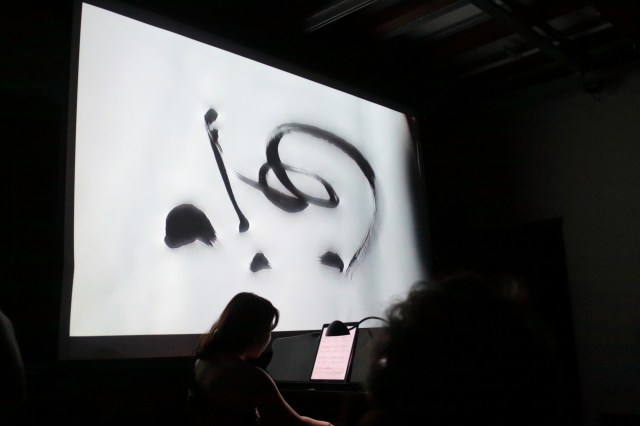
This next part of the program involved the work of Jarosław Kapuściński (Warsaw, 1964-) whose two pieces were slated for the last portion of the program.  He is, since 2016, the chair of the music department at Stanford University and no doubt spends time with CCRMA (Stanford’s equivalent of CNMAT) investigating music, sound and computers.  He spoke of being inspired by a calligrapher who was also well known to Ms. Chai, a Chinese woman and master calligrapher named Shanshan Zhao (the film was done at the Shanghai Conservatory of Music).  While he did not go into great detail the composer basically shared his visual inspirations and spoke a bit about how his composition program “listens” to the performer (see the photo with the two mikes inside the piano below) and responds in some way.  This sounds like another chapter in the book which includes David Behrman’s early computer/performer interactive experiments.  Some 50 years later (this piece, “Calligraphies for Ziqi” is from 2018 and got its US premiere here tonight).  Another generation shows its expertise.

choi20190003

Note the two black microphones inside the piano. No, its not the Russians.

The title, “Calligraphies for Ziqi” (2018) references Ziqi, a man whose listening was so perfect that the musician destroyed his instrument after Ziqi died because he knew he would never find a better listener.  This ancient Chinese story (approx 770-476 BC) is also about the merging of sound and image in its way.  Several calligraphies are displayed in process during the performance with the music reflecting the moods of the Chinese characters being displayed.  Each movement involves a different Chinese character and a different attempt at calligraphy.  There may be extramusical references here but the music does a satisfying job of standing with the visuals and further analysis can be left to musicologists and program annotators.

In addition Kapuściński is no stranger to Asian arts.  He has explored eastern musics and incorporated aspects of them into some of his works.  He is also no stranger to computers and their use in composition.  His appreciation of disparate artistic techniques effectively spanning 5000 years and utilizing them effectively is a mark of genius in this writer’s opinion.  This is a challenging piece for the soloist but it is a sensual journey for the audience.  While the geekier folks (this reviewer definitely included) would like to know much more about the technical aspects of this gorgeous music, suffice it to say that such knowledge is not a prerequisite for enjoying the art.

choi20190012

Chai playing the interactive piano part to the visuals in “Calligraphies for Ziqi” (2018), This was the California premiere.

This was followed by another visual/musical collaboration, Side Effects (2017) also by Kapuściński involves music set to videos by Kacper Kowalski who shoots from a perspective 150 meters directly above his subjects.  Think a latter day Koyaanisqatsi (do I need to footnote that reference?).  Again we see affecting music which captures the composer’s reaction to the visuals.  I didn’t get the sense that there was any computer interaction here, just some good music to some stunning visuals.

choi20190014

Chai playing the music to the visuals in “Side Effects” (2017)

The capacity audience (the room capacity is only 49) was very appreciative and gave a standing ovation which compelled no less than two encores.  Forgive your reviewer for not being able to recall the first but there seemed to be a new magic afoot when this pianist launched into the second, a wonderful rendition of the aria from Bach’s Goldberg Variations.  It was a loving and intense interpretation (no doubt full of colors as well) and it left the audience satisfied as a dessert would cap the climax of a fine meal.  Brava, Ms. Chai.  And thank you Mr. Kapuściński.

Blue Violet Duo: American Souvenirs


blueviolet

Blue Violet Records


This release actually makes a nice companion to the just recently reviewed Rachel Barton-Pine album. Both feature the classic chamber music combo of violin and piano and both bring life to American music that has languished for want of skilled and interested performers.  Let’s consider this release to be another selection in celebration of Women’s History Month.  Of course the only women here are the performers.  Alas no women made it into the mix this time.  But this is, after all, only their first release.
The Blue Violet Duo is just what is needed here.  These young artists make their recording debut with this fine selection of mid-twentieth to early twenty first century American music for violin and piano.  Included here are less familiar names such as Norman Dello Joio, Paul Schoenfeld, William Bolcom, and John Adams (if you know any names here you know this last one).  All are highly accomplished composers who work in basically a tonal language incorporating elements of blues and jazz.  Kate Carter plays violin and Louise Chan handles the keyboard in this interesting selection of lesser known but really entertaining and substantive music.  
The earliest work is the Variations and Capriccio (1948) by Norman Dello Joio (1913-2008). It sets the tone for this album of jazz influenced violin and piano music.  The two movements go through a variety of moods and demand a high level of virtuosity.
Next up is the wonderful Second Violin Sonata (1978) by William Bolcom (1938- ) who is known as much as a ragtime composer as well as classical.  His embrace of so called vernacular music is characteristic of much of his work. Carter and Chan appear to have a solid grasp of vernacular styles which they incorporate seamlessly as though they belonged (which, of course they do).John Adams (1947- ) is represented by his playful, Road Movies (1995). Adams’ take on pop and vernacular musical is somehow different and the listener will realize that one of the joys here is hearing the way in which these composers respond to their encounters with popular musics.  Adams also demands much of his musicians in terms of technical expertise but his music here always remains playful.
For the last selection Paul Schoenfeld (1947- ) was chosen and he is one that deserves more attention.  Like Adams he works as a classical composer who incorporates other styles into his work. Four Souvenirs (1990) makes a fitting finale to this collection.The real joy here is having such fine renditions of lesser known repertoire.  On hearing these pieces listeners will likely want to hear them again.  The hope is that these pieces will become more regularly performed.  The Blue Violet Duo has given this repertoire a boost in that direction.  Brava!


Jennifer Koh and Kaija Saariaho, a Glorious Collaboration


Cedille

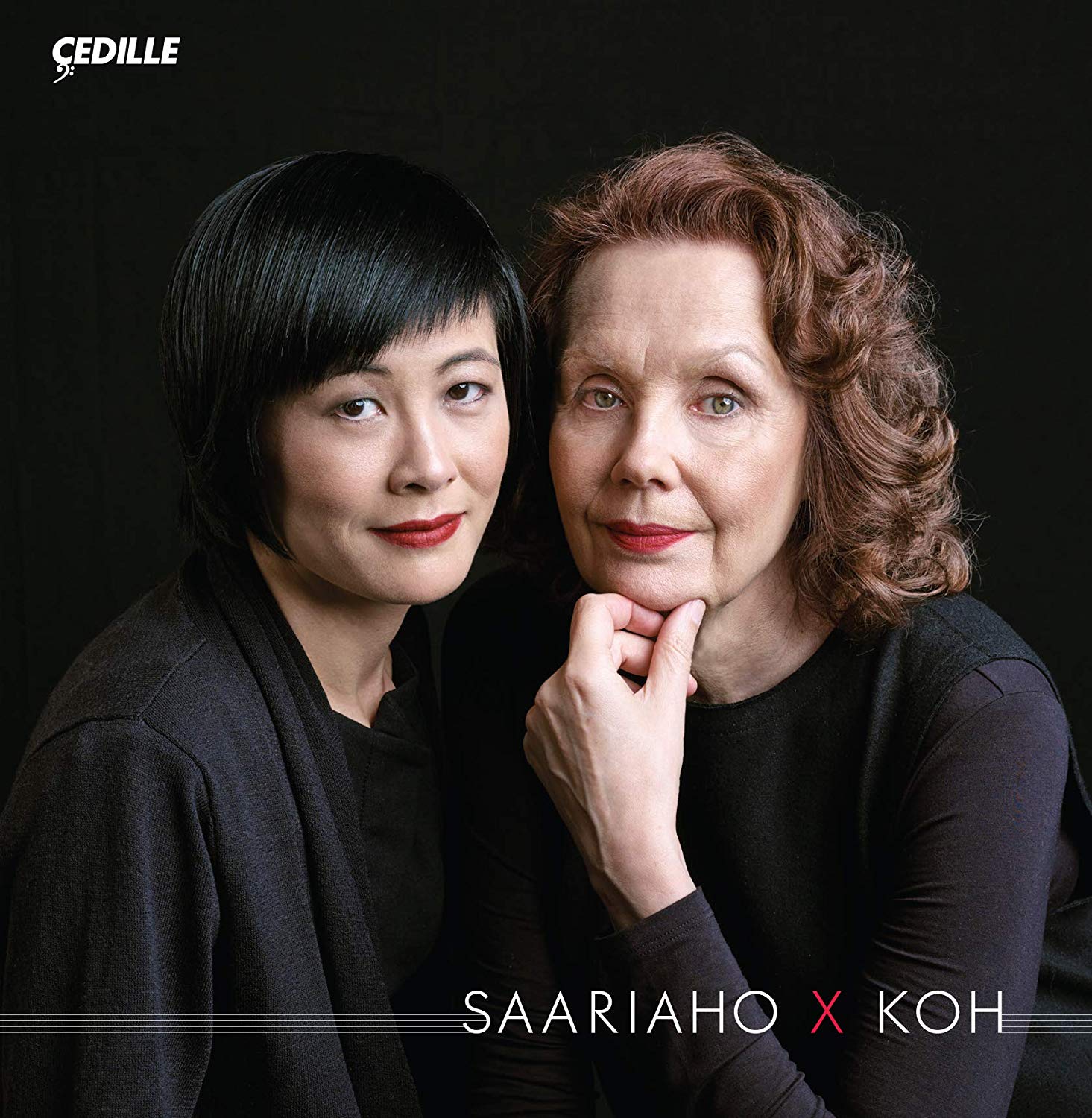
The arrestingly beautiful portrait that graces the cover of this album should be enough of  a cover to judge this release favorably. Just the presence of these two women suggests that you’re in for some serious music making. Add to that the fact that this is one of those impeccable Cedille releases and you know that you, the listener, will not be disappointed. Here is another offering for Women’s History Month (even though the disc was released in November, 2018).

Kaija Saariaho (1952- ) is possibly the hottest composer to come out of Finland since Sibelius. Her career has steadily grown and she has written for chamber ensemble, stage, and orchestra. It is somehow satisfying to have this little portrait of her work. (This reviewer’s first encounter with the composer was in 1987 when the Kronos Quartet premiered her Nymphea for string quartet and electronics.) Five works are selected here and, if you don’t know this composer’s work, think Debussy, Takemitsu, and their ilk. No electronics on this disc though. Her work is a unique expression and pretty much listener friendly whether or not she uses electronics.

There are four chamber music pieces and a nice new performance of her masterful violin concerto, “Graal Théâtre”. Saariaho is so prolific such that one can only do a sort of “snapshot” selection of her work on a single CD. A decent retrospective would likely require several more discs.

Jennifer Koh is without doubt one of the finest violinists working today, especially in contemporary music. She even broke ground in one of the coolest blind castings in contemporary performance playing Einstein in Glass’ opera, “Einstein on the Beach”. For those who are unfamiliar the role of Einstein requires a violinist wearing a wig who plays some mighty difficult violin music at different points during the opera. This writer heard her in performance of this role at the revival in Berkeley a few years ago and it is a mark of Koh’s expertise that she made the role her own. Her range (which includes more conventional repertoire like Mozart, Tchaikovsky, etc.) is simply astounding and her technical ability puts her in competition for an ever growing list of commissions and other works she has added to her repertoire.

On this CD we get to hear Koh in the intimate settings of chamber music where the skills of listening to others is so critical as the individual voices weave their parts though the texture. While Saariaho is basically a well trained modernist romanticism and perhaps impressionism still remain a part of her palette. Joining Koh in the chamber pieces are: Nicholas Hodges, piano; Hsin Yun Huang, viola; Wilhelmina Smith, cello; Anssi Karttunen, cello;

Of course the big showpiece here is the violin concerto from 1994. This large scale work is actually as lucid and detailed as her chamber music, albeit with a larger range of sounds. It is a masterful composition and this appears to be the second recording it has received though apparently the first recording of the version with reduced orchestra played by the Curtis 20/21 Ensemble conducted by Conner Gray Covington (another reason to want this album). I wasn’t able to locate the other recording with Gidon Kremer but it is a good sign when you have more than one top soloist recording your work. Brava Ms. Koh and Ms. Saariaho! This is a collaboration blessed by the Gods. Saariaho x Koh = bliss.

Post Holy Minimalism? New Music from Lithuania


Starkland ST-231

All ready for Women’s History Month is this fine offering which features a fine young woman composer from Lithuania. It comes on the radar of Starkland Records and, happily now, to a new listening audience.

I sincerely hope that no one takes umbrage at my off handed categorization of this music as related to minimalism but I’m not sure what else to call it. This 70 minute work is divided into 10 sections which have poetic titles. It is scored for piano, violin, cello, and electronic sound. It comes from an area of the world (Lithuania, Latvia, Estonia) where individual national identities have long been overshadowed by the annexation of the former USSR. In the last 20 years a style related to minimalism has emerged as a characteristic style from this region (primarily in the work of Arvo Part). Some of that is here but this music is at least a generation removed and has evolved its own identity at the hands of this new composer.

In an unusual (though not unprecedented) move this album was recorded and produced entirely by the composer in Lithuania. In addition some of her fine color photography is featured in the liner notes (which are mostly by the composer). The production values are very much consistent with the high quality one expects from the Starkland label. In addition it must be noted that this is the simplest and sanest packaging now being used for CDs. None of that fragile plastic and still a functional storage sleeve.

So the next question (also common with Starkland releases) is: Who is
Žibuoklė Martinaitytė ? Well she is one of the emerging generation of composers from Lithuania. That, along with her having studied with Bronius Kutavičius (I actually started his Wikipedia article many years ago but his and other articles on new Lithuanian composers is limited still) suggested to me that she may be of the branch of minimalism which hails from this part of the world (i.e. Estonia, Latvia, Lithuania). Wrong, but not entirely.

Like a lot of emerging composers we have here an artist fully schooled in a very wide range of musical techniques and possibilities. On first listen one hears elements of drone, ambient, minimalism, extended instrumental techniques, and mysterious but effective use of electronics with this small chamber ensemble. The effect is frequently almost orchestral but also capable of great stillness and silence.

In the liner notes by the composer she speaks of being inspired by her observations whilst visiting Notre Dame in Paris. She speaks of a rather impressionistic notion of hidden or lost beauty. So I guess that throws impressionism into the mix. The composition does have metaphorical devices which do suggest the emerging of ideas and themes from an initial chaos or, to use Ives term, a “silence of the druids”. One must get to the 4th track to really get a sense that there is actually a piano trio on this recording. Very effective actually and then it fades back into the chaos and then the silence.

The album opens with silence into which a drone gradually makes itself known. These meanderings take the listener on a journey which is essentially the artists sonic vision as she walked through and around the iconic cathedral. The listener doesn’t even hear really more conventional musical sounds until about track 4 and concepts like melody and harmony take on a different meaning in this context. It is a large arc of a composition that embraces both chamber and orchestral textures as it tells its sonic tale of the composer’s visions and returns to the chaos of the unfocused mind at the end.

This puts this work in the realm of the earlier release (also on Starkland) of Ingram Marshall’s Alcatraz (1982) and Eberbach (1985). Eberbach was later released with its originally intended photographic component along with Alcatraz on a recent DVD on Starkland. And Mr Marshall provides some insight and reassurance in his liner notes for In Search of Lost Beauty. He affirmed for this listener that one needs to listen more than once to perceive the beauty found herein.

Recorded and produced entirely in Lithuania the artists include Indre Baikstyte, piano; Ingrida Rupaite-Petrikiene, violin, and Povilas Jacunskas, cello. The recording, done in Lithuania was mastered by the always reliable Silas Brown back here in the United States assures the quality listeners have come to expect from this fine independent record label.