The Complete Works of Carl Ruggles (reissue)


At long last the 1980 CBS recording of The Complete Music of Carl Ruggles (1876-1971) has been reissued by Other Minds records (OM 1021/2-2).  I have owned the vinyl two disc set for many years having come across a review of it in a list of suggested recordings of American classical music in, of all places, The Whole Earth Catalog.  And it is definitely a vital part of any serious collection of American classical music.  Ruggles was one of a group collectively labeled, “The American Five”, a title intended to compare the group with the French “Le Six”, the “Russian Five” or the often cited “Three B’s” (Bach, Beethoven, Brahms).  The American group consists of Charles Ives, Henry Cowell, Wallingford Riegger, Carl Ruggles and John J. Becker who strove to define an American sound not beholden to the European models which had dominated the previous century.  Ruggles’ students included James Tenney and Merton Brown.

This album is a recording of Ruggles’ complete published works.  A recent recording of newly unearthed ephemera was recently released but the present record is everything that Ruggles acknowledged and approved.  It is a meager output for a man who lived to the age of 95 similar to the output of the equally important Edgard Varese whose complete works also fit on two vinyl records and the music is just as finely crafted.  The music here is likely not as familiar even to those who know the work of Ives and Cowell.  But make no mistake this is powerful and unique music that deserves more than just a casual listen.

It is thanks to the efforts of Michael Tilson Thomas, who first heard his teacher Ingolf Dahl conduct Ruggles’ three movement symphony, ‘Men and Mountains’ that inspired him to add Ruggles’ work to his repertoire.  But the connections do not stop there.  Thomas and producer Syrl Silberman of WGBH went to visit Ruggles in a rest home and introduced themselves by putting headphones on the composer and playing an air check of Thomas’ performance of Ruggles’ best known work, ‘Sun Treader’.  Thomas’  wonderful essay about that auspicious encounter is included in Wayne Smith’s beautifully designed booklet.  Also included are the original liner notes with Thomas’ essay, notes and analysis by pianist and Ives scholar John Kirkpatrick and an additional essay by Lou Harrison reprinted as well.  There is also an introduction written by Other Minds Associate Director Adam Fong, himself a student of James Tenney, which puts Ruggles in a wider historical perspective.

Executive producers Charles Amirkhanian and Adam Fong acquired permission from Sony Music to digitize the original master tapes working with a grant from the Aaron Copland Fund to bring this essential recording into the digital age.  And the performances by the acclaimed new music advocate Buffalo Philharmonic Orchestra (MTT was then its musical director), a brass ensemble led by Gerard Schwarz and none other than John Kirkpatrick on piano in the Four Evocations.  Michael Tilson Thomas accompanies soprano Judith Blegen in the little song, ‘Toys’ from 1919 which Ruggles wrote for his son.  Speculum Musicae accompany mezzo-soprano Beverly Morgan in ‘Vox Clamans in Deserto’ from 1923.  Trumpeter/conductor Gerard Schwarz leads a brass ensemble in the original 1921 version of ‘Angels’ for six trumpets as well as its 1940 revision for trumpets and trombones.  Even American choral music experts the Gregg Smith Singers come in to perform Ruggles’ last completed composition, ‘Exaltation’ from 1958, composed in memory of his late wife Charlotte.

The Buffalo Philharmonic with its long history of performing contemporary music under Lukas Foss and Michael Tilson Thomas does a wonderful job of handling the six orchestral works.  Best known of these is the tone poem ‘Sun Treader’ which Thomas had recorded earlier with the Boston Symphony in about 1970.  ‘Men’ from 1921, the three movement symphony ‘Men and Mountains’ from 1924, the orchestral version of the four ‘Evocations’ and the 1947 ‘Organum’ also receive very effective readings.  Michael Tilson Thomas is the conductor for all and he clearly knows and loves this music.

The sound is great and the performances are truly definitive coming from artists with varying levels of connection to the composer and  all clearly with a passion for this music.

In fact I can find only a handful of other recordings of Ruggles’ music.  Most are out of print and/or dated in sonic reproduction.  A notable exception is New World Records’, ‘The Uncovered Ruggles’, posthumous reconstructions done by John Kirkpatrick and performed and produced by Kirkpatrick student Donald Berman actually makes a nice companion to the release at hand here for the Ruggles fanatic. (I know they’re out there.)  And there are digital downloads of some out of print recordings as well.

So, as in their previous releases, OM records continues its traversal of sometimes difficult but always relevant music.  So order your copy today through Other Minds, Naxos Distribution or through Amazon.com.  You might be challenged but you won’t be disappointed.  This is a great recording.

Other Minds 17 Day 3


The final night of the 17th Other Minds Festival presented music by four composers and included two premieres of music commissioned by Other Minds.

The concert began with music by Finnish composer Lotte Wenakoski. This diminutive Finnish woman, who also sang quite beautifully during the panel discussion, works with barely audible sounds seeking inspiration ” on the borders of silence”. Her 2006-7 work Nosztalgiam (Hungarian for ‘my nostalgia’) was performed by the modular Magik*Magik Orchestra whose size varies according to the need of the pieces to be played. Tonight’s configuration for this piece consisted of 12 players playing woodwinds, brass and strings.

Fellow OM 17 composer John Kennedy, who is the conductor for the Spoleto Festival among others, conducted the chamber ensemble. Nosztalgiam (2007) is apparently a set of variations/deconstructions or meditations on two Hungarian folk songs (one of which she spiritedly sang during the preconcert discussion). The sometimes sparse and always delicate sounds expressed Wennakoski’s personal impressions of her time studying in Budapest in the late 1980s. It is difficult to assess this composer represented in this festival by a single work. But the sweet, delicate personally nostalgic sounds evoked by a variety of extended techniques suggest that seeking to hear more of her work would certainly be worth one’s effort. The sensitive and virtuosic performance was greeted warmly by audience and composer alike.

Next in this first half were two works by John Kennedy, conductor, composer, percussionist and promoter of New Music. Here is a man in a role similar to that of OM Festival director Charles Amirkhanian having a chance to be, so to speak, on the other side of the table. There are apparently no available commercial recordings of this man’s music but according to his web site (which does have some too brief sound samples) he has composed many works in all genres including theater, orchestral, solo and electronic. And he has received many commissions.

This night he was represented by two works, one of them an Other Minds commission. Both are hommages to the late John Cage. As I mentioned in an earlier blog Cage is also the inspiration/impetus behind Other Minds’ esthetic.

The first work, “First Deconstruction in Plastic” (the title a play on Cage’s First Construction in Metal), does double duty as an homage and as an environmental statement. Percussion duo Ryder Shelley and Andrew Myerson sat facing each other each with a collection of ‘found objects’ consisting of plastic buckets, bottles, shopping bags, etc. This well rehearsed duo gave an energetic and engaging performance which the audience clearly appreciated. But for this reviewer was left with the impression that this accomplished work, though no doubt intricate in it’s conception and satisfying to the musicians, failed to fully engage it’s audience. I was entertained but I did not particularly want to hear it again.

The second work, “Island in Time” (2012), was a world premiere. This, also dedicated to Cage, was a different matter. Scored for the unusual combination of bass clarinet, flute, cello and percussion (all members of Magik*Magik Orchestra) was an engaging though not derivative tribute to the influence of John Cage. The composer describes a process involving different types of temporal processes to structure the work. But the specifics of the processes are secondary here to the overall impact of the work. A meandering flow of sounds and tempi flowed beautifully reverently invoking the spirit and influence of Cage’s work. I have no doubt that the riches in this piece would continue to reveal themselves with repeated hearings. And though I have very little knowledge of this composer’s other work I have no doubt that it is likely to be quite compelling.

The musicians, clearly familiar with the work, gave a loving smooth reading of what appears to be a fairly complex work requiring serious concentration and collaboration. The audience, myself included, rewarded their efforts with enthusiastic applause.

In the second half of the program the next composer, who had performed the previous night in collaboration with Ikue Mori and Ken Ueno, was Tyshawn Sorey. This was to have been a solo performance as a percussionist but in the course of the discussion in last night’s pre-concert panel festival director Charles Amirkhanian mentioned that he had heard Sorey playing the piano earlier in the day. Amirkhanian remarked on the apparently eclectic nature of what he had played. Sorey responded saying that his piano playing is informed by the likes of Art Tatum, David Tudor, Cecil Taylor and Morton Feldman. He also mentioned deconstructing Boulez’ Second Piano Sonata (!) to inspire his compositional process. Eclectic indeed! And he easily consented to playing the piano in his segment of the program saying, “…if you are open to it, sure.”. Sorey exudes a sort of calm, friendly, matter of fact confidence in his skills.

So Sorey walked onto the stage which contained his percussion kit on one side and a concert grand piano on the other. He began with a percussion improvisation starting with a fortissimo strike on the side drum followed by some fevered loud work on tenor and snares as well. This then segued into some more delicate and complex soft sounds elicited from various cymbals and drums making frequent use of special techniques which brought forth some rich vibrant harmonics especially in the quieter moments. I couldn’t help being reminded at times of Han Benink’s performance at last years festival as he released a small sower of sticks onto a drum at one point. Sorey’s sheer energy and good humor were reminiscent (though not imitative). And, unlike Benink, Sorey never left the stage in the course of the performance.

Following the well received percussion set Sorey moved to the grand piano sitting confidently and commandingly at the keyboard and pausing as he focused on the task at hand. He started slowly with a few chords and before long launched into a dizzying and virtuosic flow of music reflecting the influences he mentioned. At first perhaps Morton Feldman, sometimes Pierre Boulez, a little Art Tatum, certainly some Cecil Taylor and then deftly playing sometimes inside the piano then back to the keyboard as part of the same unbroken musical phrase evoking the experimentalism of David Tudor. But the overall impression was not episodic imitation but rather an absorption and integration of all these techniques transcending genre and becoming, simply, inspired music making. The audience was transfixed and absorbed in the flow of the music and responded with cheers of “Bravo” and enthusiastic applause (I think they were pushing for an encore but time did not permit). Had I heard a recording of this without knowing the background I would have guessed this to have been an accomplished composed work by a master composer but this was an improvisation. I am surely going to seek recordings and follow this man’s career in the years to come.

The finale was another Other Minds commission this time from composer, vocalist and Berkeley music professor Ken Ueno. The piece, “Peradam” (2011) takes it’s title from the unfinished spiritual allegorical novel, “Mount Analogue” by the French surrealist writer and poet Rene Daumal (1908-1944). Peradam is a mythical diamond-like stone sought after on the similarly mythical mountain of the title.

Ueno’s work is scored, as is his practice, specifically for the skills of the formidably talented Del Sol Quartet who so ably played the Gloria Coates quartet the previous night. Specifically the specialized skill (in addition of course to their string playing) is the multiphonic throat singing capability of violist Charlton Lee. Ueno demonstrated his vocal skills on the previous night singing with the percussions of Ikue Mori and Tyshawn Sorey. In fact all the players were asked to sing as well as play their instruments for this performance. In addition there was video creatively projected onto the sound baffles at the rear of the stage.

The music was a post modern integrated amalgam of a wide variety of conventional and extended instrumental techniques along with singing at times (the throat singing is a strikingly unique timbre which commands attention when it emerges in the fabric of the piece). The quartet positioned themselves stage right to afford the audience a clear view of the projection across the three sound baffles at the back of the stage. They played with characteristic concentration and skill in what looks like a technically challenging piece of shifting moods and tempi to which the images responded.

The images, manipulated in real time and in coordination with the music with software written by video artist Johnny Dekam, were abstract mostly monochrome images that moved and transmuted hypnotically along with the music. Dekam, who has worked with a variety of pop acts like Eminem and Thomas Dolby, had collaborated with Ueno before. In the darkened theater the images dominated the visual field though the quartet could be seen as well.

It was a complex experience that could only be grasped, if at all, by going with the simultaneous flow of music and image. This piece will benefit from repeated listenings/viewings to more fully appreciate it’s intricacies. But this first performance clearly satisfied the mostly hard core new music fans audience. And while the direct John Cage associations were not as obvious it is clear that Ueno, Dekam and the Del Sols embody the open minded spirit of his work in this, his centennial year. This grand finale was appreciated in kind by the cheering audience successfully bringing to a conclusion the 17th always uncategorizably eclectic Other Minds Festival.
Other Minds 17. Day 2


The second night at Other Minds featured two different generations of composers. As is their practice Other Minds on this night featured two composers already established and fairly well known in new music circles as well as three up and coming artists.

The first performance was by San Francisco’s own champions of new music, the Del Sol Quartet. They performed the American premiere of American expatriate composer Gloria Coates’ String Quartet No. 5 composed in 1988. This and her 8 other quartets have been made available on the brave and progressive Naxos CD label. Coates also holds the record as the most prolific woman symphonist of all time with some 16 symphonies to her credit (many of those are available and well worth seeking on CD as Well).

String Quartet No. 5 is cast in three movements. By the composers description all of the movements are canons, a simple counterpoint form. But the result is hardly simple. Using microtonal glissandi, sometimes having instruments tuned a quarter tone apart and relying on creative ways of synchronizing the players individual tempos Coates achieved a complex sounding but friendly and approachable result. The quartet which lasted about 30 minutes would be a challenge for any ensemble but the Del Sol (which, except for the cellist, perform standing in a break with convention) clearly knew and liked the work and gave an intense and beautiful rendering sounding at times like there were more than four players. The piece has an almost romantic feel at times, cleverly incorporating melodies into a sound world uniquely the composer’s own (I am at a loss to identify a precedent). I sincerely hope that this work and her other works become better known in this, her native country. It is a tribute to the acumen of the Other Minds team that music like this is presented here. The audience greeted the performance very appreciatively.

Next up was Harold Budd on piano playing with Keith Lowe on double bass augmented with electronic effects. The piece, titled “It’s Only a Daydream” from 2011 is, by Budd’s description, entirely improvisational as is most of his music. Lowe began playing first with long sustained tones awash with rich harmonics. Budd’s piano then entered and we were transported to the familiar sound world which is Budd’s musical signature. Those who knew his collaborations with Brian Eno and his later solo works recognized his somber pretty ambient sounds. The two musicians were well matched and played a sort of jazz duet trading solos and accompaniments evoking a curiously nostalgic and hypnotic atmosphere of a strange dream-like lounge. Time seemed suspended and I don’t know exactly how long they played but when they finished the enthusiastic audience reception brought them back for a shorter encore, something I had never seen occur before at this festival.

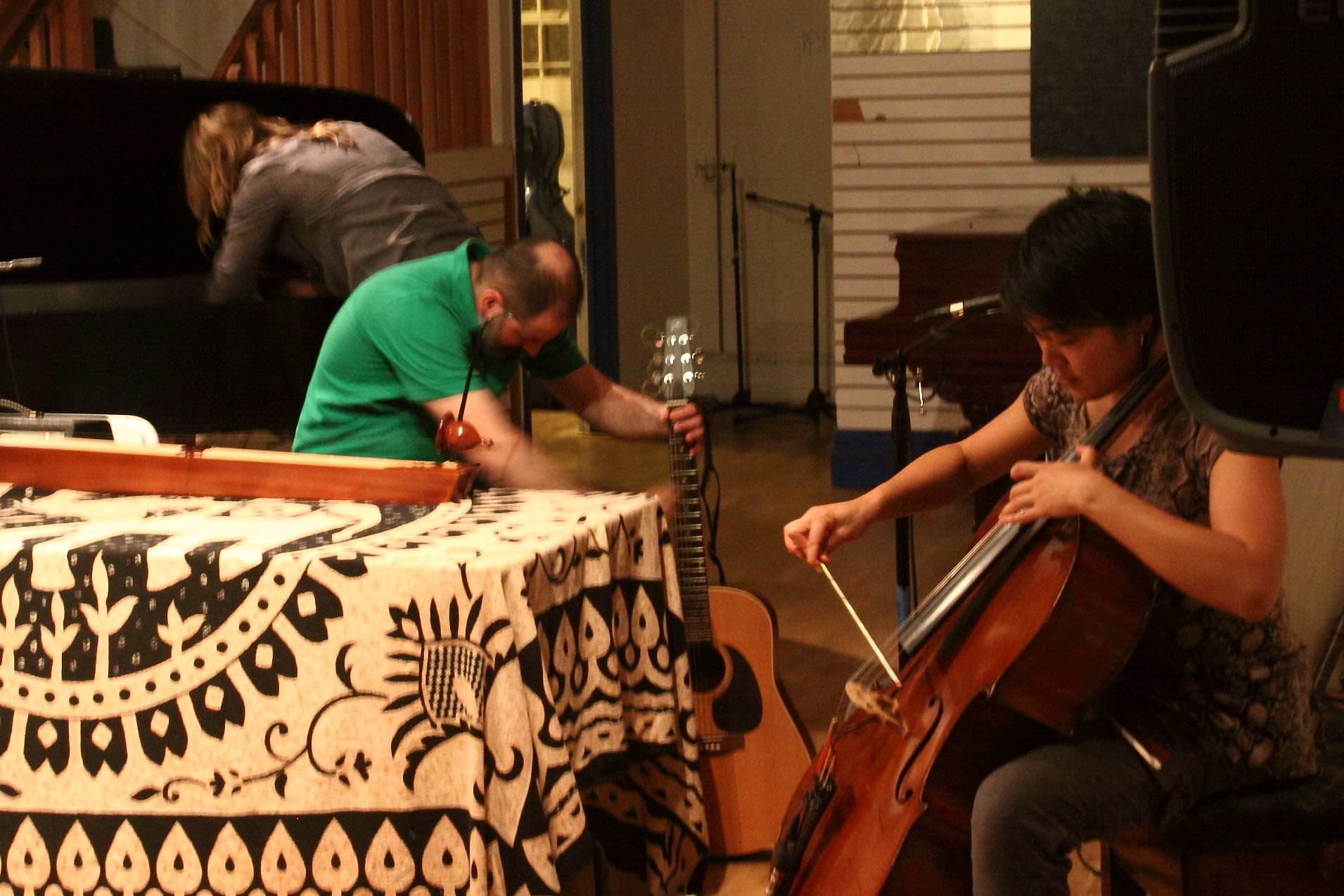
Following intermission Ikue Mori took the stage sitting at her laptop which controls her various electronic sounds. She played the laptop solo for a few minutes and was then joined by UC Berkeley faculty composer Ken Ueno on vocals. But ah, what unusual vocals. His extended vocal techniques seem to come equally from Tuvan throat singing, Buddhist chanting, David Hykes (of the harmonic choir), Meredith Monk, Diamanda Galas, Kenji Suzuki (of the band Can), Tan Dun (on Taoism) and God knows what else. After another few minutes Tyshawn Sorey, a doctoral candidate in composition at Columbia, seated himself quietly at his drum/percussion kit, then with an assertive fortissimo bang on the side drum confidently entered the energetic fray. Mori sat intently gazing at her computer screen and entering the sound changes for her part while Ueno, holding the microphone to his mouth with both hands issued passionate wordless vocalizations of endless variety and Sorey executed a similar endless variety of high energy acoustic percussion sounds.

Mori calmly issued computer commands to perform her Japanese/New York/ punk/free jazz/Stockhausen expanded percussions while the academic Ueno improvised intense growling, multiphonic, wild vocals with few pauses and Sorey got in touch with his AACM ancestors producing a unified three ring circus of wonderful musical mayhem transcending any concept of genre. Three different traditions, separate but working together. Metaphorical? You decide.

Well deserved and enthusiastic applause greeted the intense but calm Mori and the sweaty and apparently exhausted but satisfied Ueno and Sorey.

The relative order of Coates followed by the ethereal calm improvisations of Budd were but a distant memory (albeit a pleasant one) after the ritual emotional exorcism of the second half. This is the rich variety that characterizes these concerts. And now anticipation builds for tomorrow’s finale.

Other Minds Festival 17


Thursday night was the opening concert of Other Minds 17th annual series at the beautiful Kanbar Hall in the San Francisco Jewish Community Center which features a typically eclectic selection of new and recent music. Six countries are represented this year including the United States, Germany, Japan, Denmark, Norway and Finland.

This first night featured the palindromically named Norwegian ensemble Asamisimasa. They are a group of highly trained young musicians who dedicate themselves to the performance of post war avant garde and recent music (some written for them).

What makes them unique is their integration of traditional instruments with various types of electronics and techniques to modify and enhance their sound. They include standard video, digital processing and extended instrumental techniques as well as uncommon enhancements such as hand held megaphones and found sounds like tearing newspaper, spray cans and sliding blocks that rub on various surfaces.

The result was a wonderful embodiment of the post- Cagean musical esthetic which is the driving force behind Other Minds as they describe it in their mission statement. These dedicated skilled classical musicians played a program of a fellow Norwegian and a Danish composer. It was a performance that was adventurous, humorous and engaging.

The first half featured two works by Oivind Torvund. The first work from 2009 was “Neon Forest Space” for clarinet, cello, guitar/radio, percussion and pre-recorded media. Brief motivic segments, mostly by solo instruments, were strung together by a variety of sounds controlled by a musician who doubled as conductor. The overall impression was one of a spare impressionistic piece informed equally by the sound worlds of Pierre Boulez, Karlheinz Stockhausen and, according to the program, Black Flag.
The second piece was the world premiere of “Willibald Motor Landscape” written last year. This piece, using essentially the same instrumentation was built upon a recorded soundtrack of traffic sounds creating an impressionistic picture presumably of the road in the title.
The audience was very appreciative and we learned following intermission that all of the Oivind Torvund CDs had sold out! Welcome to America Mr. Torvund.

The second half of the night featured what was to have been a performance without pause of four pieces by Simon Steen-Andersen of Denmark. Unfortunately, following the performance of “Study for String Instrument #2” (for cello and whammy pedal, 2009), the cellist lost her footing on the darkened stage. The crashing sound seemed at first a part of the performance. But the lights were brought up quickly finding that the cellist was thankfully mostly unharmed and able to continue performing. However her cello had sustained a broken tuning peg. Charles Amirkhanian, the festival director tactfully asked the audience’s indulgence while another cello was obtained, a process which required only about 10 minutes (!). The cellist with the replacement cello returned to the stage to relieved and appreciative applause. Mr. Amirkhanian thanked the audience, who barely moved in the interim, for their patience.

The stage lights were darkened again and the ensemble restarted the piece which had been so briefly interrupted. From the microtonal glissandos duet of cello and whammy pedal they began the second piece, “Half a Bit of Nothing Integrated” (2007) for extremely amplified clarinet, percussion, cello and live video operated by the percussionist. In good humor and with professional showmanship the percussionist began by speaking, “Now where were we?”. And they performed with sounds of seemingly malfunctioning electronics evoking a post apocalyptic sound world which evoked worlds like that of “Blade Runner”.
This time there was no pause as they moved on with an illuminated stage to “On And Off And To And Fro” (2008). This piece featured megaphones operated by musicians who at times were miking the instrumentalists and at other times playing percussive effects with the microphones (blowing into them, scraping them, etc.) and playing quite skillfully with feedback created by holding the mikes various distances from the speakers. The sight of four musicians reading from scores and following a conductor with these megaphones evoked appreciative laughter from the audience. The final piece, “Study for String Instrument #3 (2011)”, was for cello and video. The cellist, Tanja Orning, played her instrument in non-melodic fashion with a bow which produced scraping sounds. Superimposed upon her was a video of her playing and the interest of the piece is a fascinating mostly visual duet between the live performer and the video. Her actions sometimes duplicated, sometimes opposed that of the video and the effect, sometimes humorously reminiscent of the Marx Brothers mirror routine, was an engaging and occasionally disturbing image (I’m not sure why it was disturbing actually).

Warm applause followed this lively and dedicated performance from this fine young group. All in all a very entertaining evening opening the always unpredictable and eclectic Other Minds Festival.

Hello world! This is “New Music Buff”


Welcome to my music blog. I am an avid listener, collector and supporter of music in general. I am particularly interested in new and cutting edge music.

What I offer here are informed opinions about what is essentially one of my hobbies. The blog title “New Music Buff” is intended to connote a somewhat casual perspective by an educated consumer.

I offer personal opinions which I hope will provoke discussion but also stimulate interest.

Thank you for reading.

Allan J. Cronin