A Piece of the Action, or How Other Minds Brought Out My Inner Trekkie


20130218-134428.jpg

I have been a fan of Other Minds for many years.  While I lived in Chicago I read the reports on the concert series with great interest and was fascinated with the choices of composers since they tended to mirror my own interests in new music as well as introduce me to tantalizing new artists.  I am not a professional musician but I have a long-standing passion for new music and attended many concerts of new music while I lived in Chicago reading liner notes and music history texts eager for more of the exhilarating experience of great new music as it was happening and wanting to know what was just around the corner.

I recall vividly New Music America 1982 which was held in Chicago and was hosted by Charles Amirkhanian, the executive and artistic director of Other Minds.  He spoke with authority and seemed to know just about every musician whose work I admired and countless whose work I hadn’t yet heard.  He conversed knowledgeably with the likes of John Cage, Robert Ashley, Glenn Branca, Meredith Monk, Tom Johnson, Robert Moran and the list goes on.
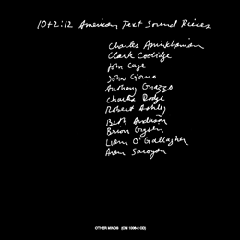
10+2 Anthology 10+2 Anthology

Early on I had purchased and listened with delight to the masterful spoken word anthology: 10+2: 12 American Text Sound Pieces [OM-1006-2] containing a couple of Amirkhanian’s compositions  alongside other contemporary masters of that genre in the original vinyl release and listened with great interest to the landmark recordings of Conlon Nancarrow’s Player Piano Studies [OM-1012-15-2] both discs largely the work of Mr. Amirkhanian who managed to get these recordings made in Mexico City on Nancarrow’s own player pianos.  So I have been familiar with him as both composer and producer.  He had been for many years the broadcast broker of contemporary music at KPFA in Berkeley where he served as music director from 1969 to 1992.

Charles Amirkhanian with Rex Lawson Charles Amirkhanian holding the microphone while Rex Lawson sings along with one of his piano rolls.

When I moved to the bay area in late 2008 one of my first priorities was to attend my first Other Minds concerts.  I saw the OM 14 concerts and was not disappointed.  But my recollection was that it was at OM 15 that I checked the little box on one of the audience surveys saying that I would be willing to volunteer for the organization.  I did not know what to expect but shortly after OM 15 I was contacted by the OM office and asked to provide a résumé.  Well I have worked my entire career as a psychiatric nurse so I added to that résumé that I had what I termed “extensive knowledge” (not to mention a near obsession) of new music.  I got a call back and wound up spending 4 hour shifts approximately weekly over much of the following two years doing various tasks but mostly scanning photos and other materials for use in their web page and archives.

Dohee Lee at OM 18 Dohee Lee at OM 18

My first direct interaction at the office was with Adrienne Cardwell, a pleasant, hard-working young woman who I would later learn was (and remains) the longest  tenured employee other than Mr. Amirkhanian and his co-founder (now President Emeritus) Jim Newman.  Adrienne is in charge of the massive archival goings on and would direct my tasks over the next 2 years.

I worked in the same room as Adam Fong, the associate director at the time (now director of the Center for New Music and a composer/musician in his own right).  I also had the pleasure of working with fund-raisers Emma Moon and later Cynthia Mei who are also highly accomplished musicians and arts advocates.  I had  the pleasure of meeting the Other Minds librarian Steven Upjohn and the hard-working OM radio host Richard Friedman as well as the opportunity to meet interns and even some very interesting scholars and musicians who visited the office while I was there.  In short it was a great volunteer experience which garnered me more than I originally bargained for.

Adam Fong performing at “Something Else” The F... Adam Fong performing at “Something Else” The Fluxus Semicentenary he produced in September, 2011 (Photo credit: Wikipedia)

In the course of those two years I had many conversations with the OM staff particularly with Adam and later Mr. Amirkhanian about music and programming as I went through scanning, filing and doing whatever tasks were needed at the times I was there.  I recall making some references to some relatively obscure composers which resulted in Charles asking me (somewhat rhetorically), “How do you know that?”.   I just replied that I read a lot but later gave some thought about the nature of my relationship with this fine organization as well as the nature of my interest in new music.

Ruggles_cover_1024x1024

In the ensuing two years I would have some fascinating experiences meeting some of my heroes in new music and dabbling in the inner workings of Other Minds.  My enthusiasm was responded to by the staff at OM by allowing me to work on some of their other projects.  I greatly enjoyed the opportunity to participate and I was thanked most wonderfully once from the stage of one of the OM concerts by Charles Amirkhanian and at least a few more times by having special thanks acknowledged in various concert programs and, most notably for me, in the liner notes of their CD release of the complete music of Carl Ruggles (OM-1020-21-2).  I knew and loved those recordings when they were released on vinyl and was ecstatic to participate in the work on the CD release.  It was great on vinyl and it’s even better on CD.

OK, here is where Star Trek comes in:

75px-Star_Trek_TOS_logo_(1)

After some reflection I came up with what I think is an apt metaphor that fairly accurately describes my experience of my relationship with Other Minds.  Some may recall (you can fact check this if you aren’t old enough to have seen the original broadcast) an episode of the original Star Trek series which was titled, “A Piece of the Action”.  The plot involved Captain Kirk and his crew beaming down to a planet where the inhabitants were living out the equivalent of prohibition era gangsters’ lives.  At one  point this little boy (that would be me in this metaphor) offers some information which would allow Kirk and his crew to get over on the bad guys but only at a price.  The price, he says, is, “a piece of the action”.   The resolution of the plot involves the Enterprise crew successfully resolving the conflict and the little boy being able to experience just a taste of the perceived glamour of the experience of the Enterprise crew (dressed as depression era gangsters to fit in), as Captain Kirk says to him in his best cool gangster voice, “There ya go, kid.  A piece of the action.”

Star_Trek_William_Shatner

I came away from my volunteer experience even more impressed and pleased with this organization and I continue to support them in any way I can.  My thanks to Captain Kirk and his crew for bringing out my inner Trekkie and for availing me of more than just one piece of the action.  You guys run a truly great ship.  Live long and prosper.

I look forward to the upcoming 20th Other Minds concerts.  More on that in blogs to come.


A Fitting 100th Birthday Celebration for Conlon Nancarrow


Nancarrow birthday cake.

Happy 100th Birthday to Conlon Nancarrow

October 27th, 2012 would have been the 100th birthday of composer Conlon Nancarrow.  While still not a household name his work has become better known through recordings and live performances over the last 30 years or so.  He spent the majority of his creative life working in relative obscurity in Mexico City. While known by some of his contemporaries his music first became widely known through a 1969 Columbia Records release, part of that label’s ‘Music of Our Time’ series curated by David Behrman.

The evening’s celebration of his 100th birthday I’m sure would have made him proud.  Curated by bay area new music advocates Other Minds and hosted by the Piedmont Piano Company in downtown Oakland was a sort of preview of the next weekend’s three day event.

In the beautiful space of that showroom the audience was treated to hors d’ouerves, wine before the concert.  The event opened with a portion of a film by Jim Greeson, a documentary about the life and music of Nancarrow that painted him as another (if the most radical) of the musicians who were born in Texarkana, Arkansas which claims Scott Joplin as one of it’s famous sons.  This was followed by pianola virtuoso Rex Lawson who played a few of Nancarrow’s early studies.

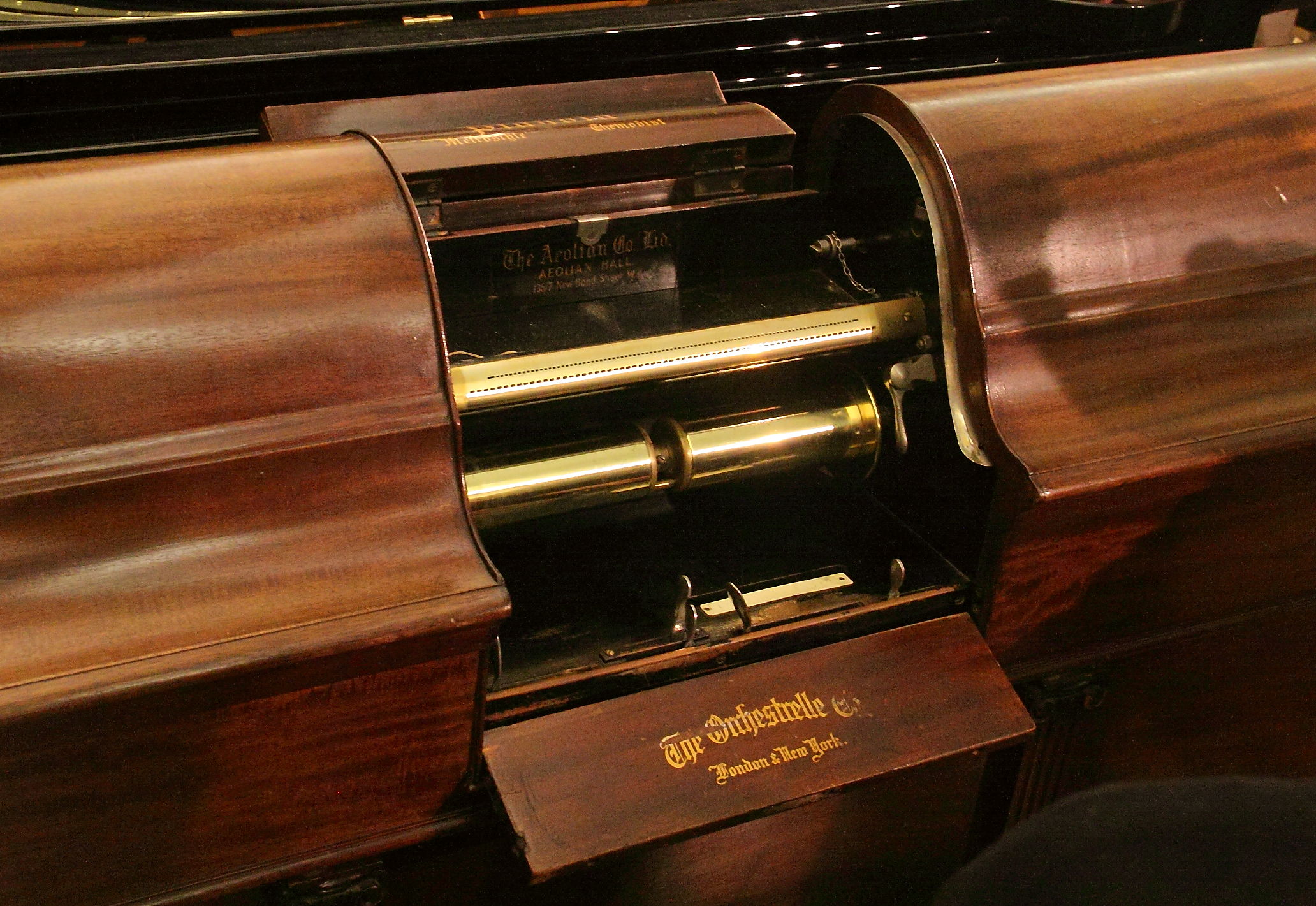
The pianola is not the same thing as a player piano, as Lawson informed the audience.  It is a device which fits over the keyboard of a traditional piano and depresses the keys based on the instructions of a paper roll inserted as one would in a player piano.  However the pianola allows the performer to vary dynamics and phrasing and actually perform the music.  And Lawson demonstrated this beautifully.

pianola

Pianola showing the place where the paper roll is inserted.

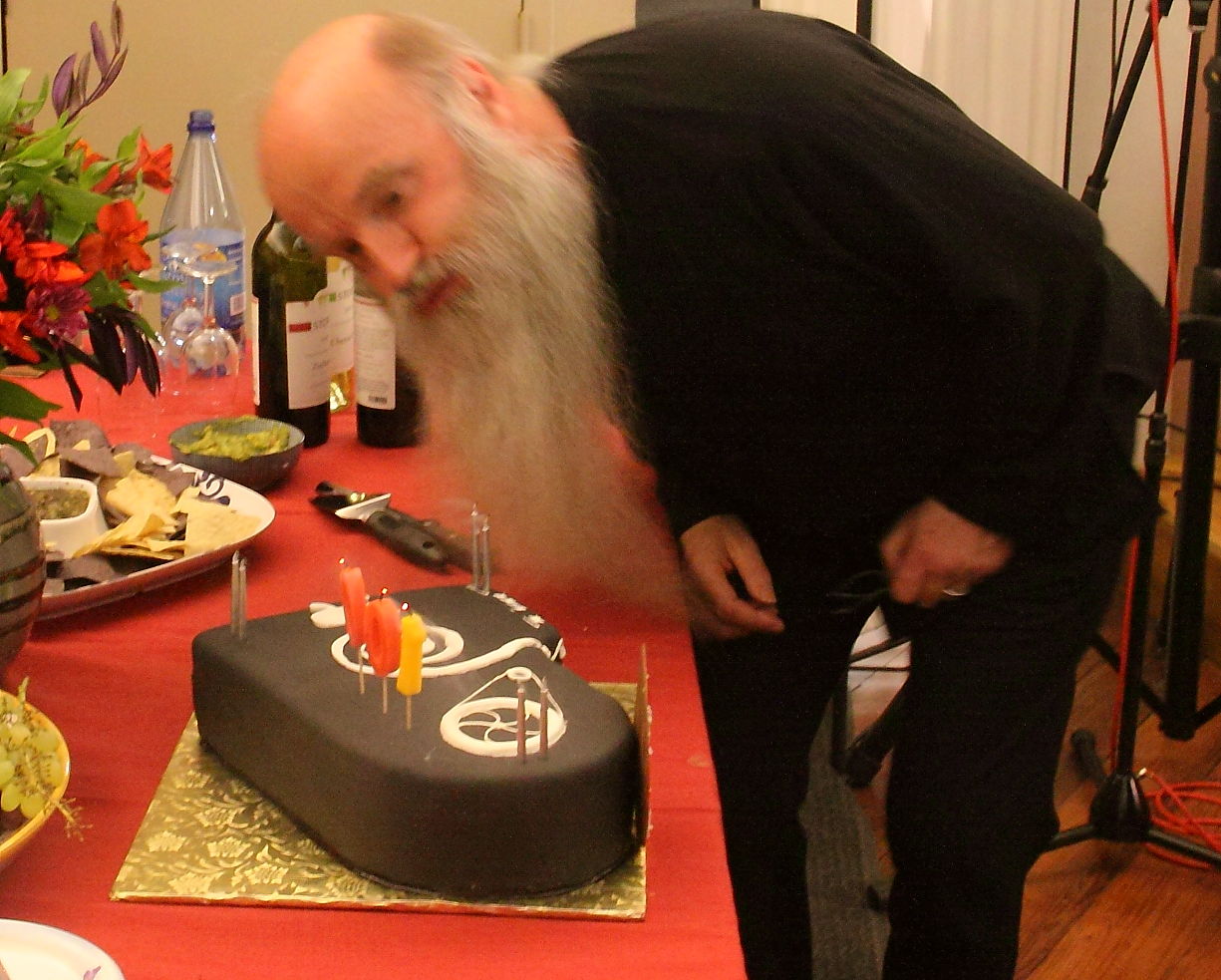
At the intermission birthday candles were lit and Lawson was accorded the honor of blowing them out in the late composer’s honor.  Nancarrow died in 1997 having lived to see a tremendous resurgence in interest in his music and an acknowledgement of his contribution to music.  His complex rhythm studies for player piano number just over 50.  And though he wrote some chamber and orchestral music as well, these are the pieces on which rest his fame as an innovator.

Rex Lawson blowing out the candles on Nancarrow's birthday cake.

Rex Lawson blowing out the candles on Nancarrow’s birthday cake.

Just prior to the intermission we were treated to the multi-talented artist an composer Trimpin‘s computer controlled pianola.  Attached to two pianos were devices for pressing the keys which were in turn controlled by a computer program.

Piano with Trimpin’s computer controlled pianola attached to the keyboard

Piano number two with Trimpin's computer controlled pianola attached to the keyboard

Piano number two with Trimpin’s computer controlled pianola attached to the keyboard

They played the massively complex Study No. 40b and did so very effectively.  The audience left their seats to stand around the two upright pianos which behind the seating area.  The sound cannot be described in words and the audience, some perhaps mystified, were very appreciative.  Trimpin later spoke of this work reconstructing one of Nancarrow’s abandoned project, a percussion orchestra controlled by a piano roll.  It was abandoned when Nancarrow realized that the technology could not perform the music accurately, something which is now possible with Trimpin’s research.  The results of that research, Trimpin: Nancarrow Percussion Orchestra / MATRIX 244 will be installed in the Pacific Film Archive and be available to the public from November 2nd to December 23rd.

Trimpin holding a prototype for Nancarrow's aborted percussion orchestra experiment's

Trimpin holding a prototype for Nancarrow’s aborted percussion orchestra experiment’s

After the candles were out the audience, led by Charles Amirkhanian, sang happy birthday which prompted Lawson to spontaneously run to one of the pianos to accompany the traditional song.  Charles Amirkhanian, composer, radio host and impresario produced the first complete recording of Nancarrow’s player piano studies (and the only recording made on Nancarrow’s player pianos in his Mexico City studio) in 1980 which brought the composer to a much wider audience and got him invited to the 1982 New Music America festival and later helped him get a Mac Arthur genius grant.  A chance find in a record store in Paris inspired Hungarian composer Gyorgy Ligeti to write his masterful piano etudes after hearing these recordings.

Charles Amirkhanian with Rex Lawson

Charles Amirkhanian holding the microphone while Rex Lawson sings along with one of his piano rolls.

Trimpin scanned all of Nancarrow’s piano rolls into a computer and made it possible for the music to be studied more widely as well as preserving it on a hard drive.  He went from the piano rolls which are essentially a digital medium the equivalent of punch cards for historians and those of us old enough to remember to digital storage on a magnetic drive.

As I noted at the beginning this was a most appropriate tribute occurring on Nancarrow’s actual birthday and featuring people like Amirkhanian, Lawson and Trimpin who were inspired by Nancarrow’s work and have done so much to bring it to light and to preserve it for posterity.

Following the intermission we were again treated to Rex Lawson who provided a perspective on the importance of player pianos and pianolas in early 20th Century culture.  He illustrated the function of the pianolist explaining as he said, “Why I need to be here at all…” by playing a Rachmaninoff polka first without any nuance executed by the pianolist and then with him demonstrating how the pianolist puts life into the piece, a world of difference.  He spoke of composers who actually wrote for the pianola.  It is different from writing for a pianist because the pianola is not limited to the size of one’s hand or the number of fingers one has.  It afforded composers a technology to write a more orchestral fabric.

He demonstrated with pieces by Sir Arnold Bax, an early 20th century British composer and by Stravisnksy (a marvelous arrangement of the scene from Petroushka when the puppet first comes to life).  He also spoke of now forgotten composers who had the career of being arrangers for the pianola.  While many homes had pianos and many could play the piano, the pianola allowed them to play larger and more difficult works beyond the skills of the average pianist and, frequently, beyond the skills of any human being.

The evening ended with another demonstration of Trimpin’s computer driven pianola this time playing one of Nancarrow’s early boogie woogie pieces.  And then there was time to speak with the artists and audience members who showed enthusiasm and interest.

Tonight’s event, we were told, was organized by Other Mind’s development director Cynthia Mei and she made a plea for funding this and next weekend’s events through Kickstarter (http://www.kickstarter.com/projects/otherminds/nancarrow-at-100-a-centennial-celebration?ref=card) where the rewards for participating in the funding range from mention in the program booklet to CDs, t-shirts and downloadable recordings of the performances.  This writer is a proud part of the kickstarter campaign and would like to encourage others as well.  We are honoring a true genius in American music and preserving his influence and legacy for future generations.  I think Mr. Nancarrow would have heartily approved.