The Biggest Sound, Paul Dolden’s Eclectic Musical Visions


This new Starkland release (due out on July 29th) is actually the second time that Paul Dolden‘s music has appeared on the label.  The groundbreaking Dolby 5.1 surround audio DVD with images,  Immersion (2001) contains his Twilight’s Dance (2000).

Paul Dolden is a multi-instrumentalist born in Ottawa, Ontario, Canada in 1956.  He has worked as a musician since age 16 playing violin, cello and electric guitar. His work has been described as post-modern, the new complexity, electroacoustic and ambient but none of these descriptors can give you a clue as to how his music actually sounds.  In addition to his instruments he makes extensive use of recording technology and sampling techniques.  But Dolden is not a tinkerer with a laptop and Garage Band software.  His music appears to stem from a variety of influences and ideas which embrace acoustic instruments, tape techniques, digital editing, alternate tunings, rock, classical, jazz and perhaps other influences as well. His album L’ivresse de la Vitesse (1994) was listed in Wire Magazines list of “100 Records That Set the World on Fire”.

L'ivresse


This was indeed his breakout release.  Two previous albums are essentially retrospectives of his work.  ‘Threshold of Deafening Silence’ (1990) contains works from 1983-1989.  And ‘Seuil de Silences’ (2003) contains works from 1986 to 1996.

Seuil de Silences (2003)

Seuil de Silences (2003)

Threshold of Deafening Silence (1990)

Threshold of Deafening Silence (1990)


He followed L’Ivresse with ‘Delires de Plaisirs’ (2005).  Both his biographical sketch on electrocd.com and his Wikipedia page were both created by Jean-François Denis, the Montreal based producer of the empreintes DIGITALes label which released most of Dolden’s recordings along with a treasure trove of music by mostly Canadian electroacoustic composers.  There is a great deal more to Canada than hockey.  There is a rich musical culture which inscrutably is very little known in the United States.  This new release would be welcome if only for its making some of the best of that culture better known.

Delires de Plaisirs (2005)

Delires de Plaisirs (2005)

Dolden has written over 30 commissioned works for various ensembles from chamber groups to symphony orchestras.  His works have been played by the Espirit Orchestra (Canada), Phoenix Orchestra (Switzerland), the Stockholm Saxophone Quartet and the Bang on a Can All Stars.  He has been most favorably profiled in The Village Voice and Wire Magazine.

So this Starkland release is the fifth CD devoted entirely to Dolden’s work.  His work appears in several collections, most notably the sadly out of print  Sombient Trilogy (1995) which places Dolden’s work in context with many of his peers including Maggi Payne, Dennis Smalley, Stuart Dempster, Elliott Sharp, Ellen Fullman, Maryanne Amacher and Francis Dhomont among many others.  Perhaps the San Francisco based Asphodel records will re-release this set or it could even wind up on one of those treasure troves of the avant-garde like Ubuweb or the Internet Archive.  It is worth seeking out.

Dolden’s work is pretty consistently electroacoustic, meaning it contains live musicians along with tape or electronics.  And while this is still true on the disc at hand ‘Who Has the Biggest Sound?’ would be difficult to stage in a live setting.  Its dense complexities would require very large forces.  The specter of Glenn Gould and his ultimate reliance on studio recordings rather than the unpredictable nature of live performance looms here.

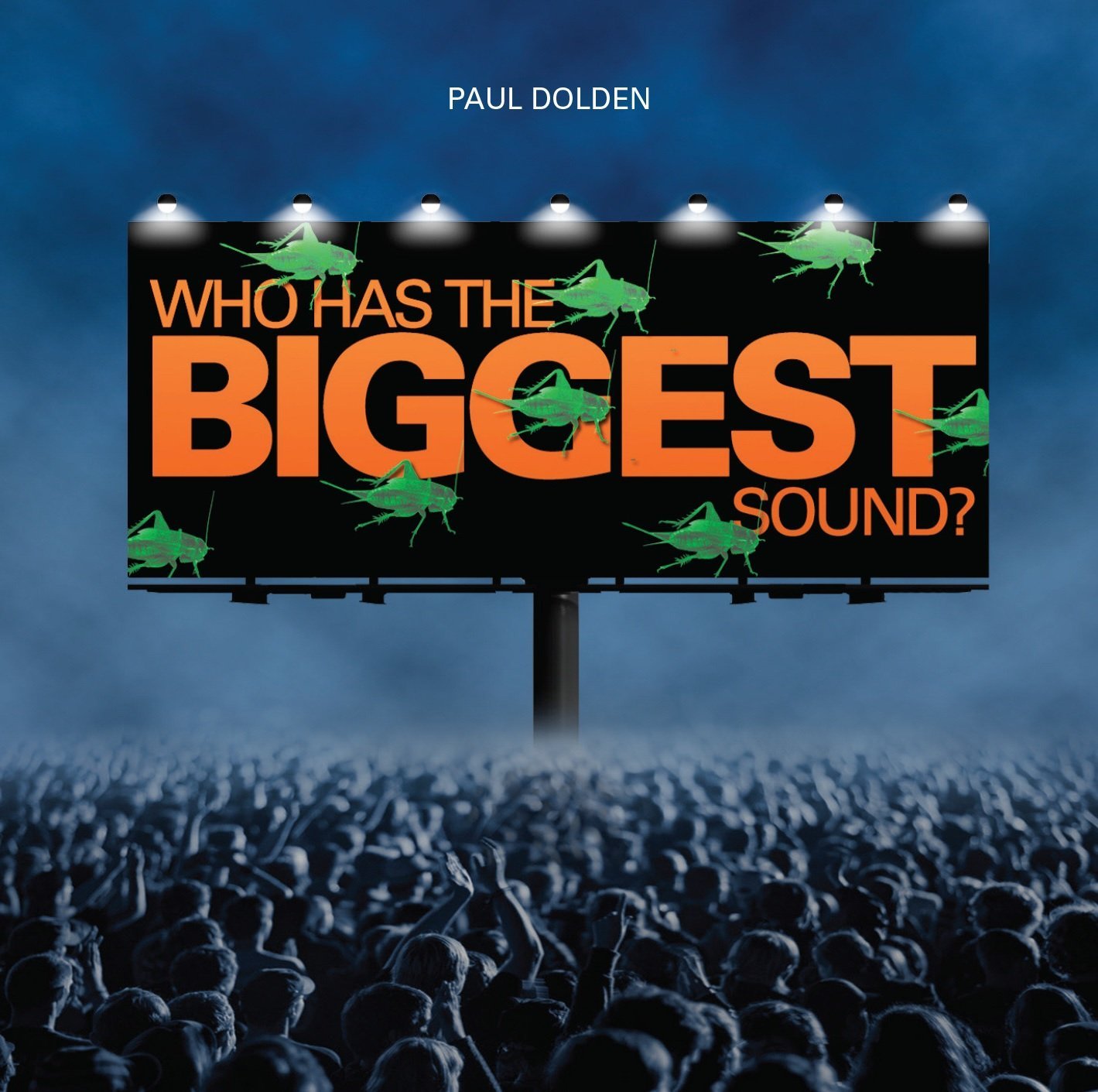
The album is very competently composed, produced, mixed and mastered by Paul Dolden.  The recording is consistent with the high sonic standards by which Starkland is known.  Executive producer Tom Steenland contributes the appropriately enigmatic cover art.  Starkland’s genius here is in promoting this amazing artist.

Back cover

Back cover

This disc contains two very different works, each in several sections. ‘ Who Has the Biggest Sound?’ (2005-2008) is the major work here.  Dolden’s intricate methods are put to very effective use in this sort of virtual electronic oratorio describing the search for the sonic Holy Grail with mysterious poetic titles to each of the 15 different sections.  In my notes taken during multiple listenings (this is not a piece I think most listeners will fully grasp the first time through, I certainly did not) I struggled to describe this music.

In it I heard some of the collage-like elements of John Cage’s Roaratorio and Alvin Curran’s Animal Behavior.  Certainly there are elements of free jazz and the sort of channel changing style of music by the likes of Carl Stalling and John Zorn.  I flashed back to the overwhelming complexity of a live electronic performance I once heard by Salvatore Martirano and felt nostalgic for the sounds of Robert Ashley’s similarly electroacoustic operas.

Repeated listenings revealed more depth and coherence.  Dolden reportedly spent hundreds of hours in the studio mixing this magnum opus so I didn’t feel badly that it initially eluded my intellectual grasp.

The second work ‘The Un-Tempered Orchestra’ (2010) is described in the liner notes as owing a debt to Harry Partch and while that’s certainly true I would suggest that it owes a debt to other masters of microtones such as  Ben Johnston, Alois Haba, Ivan Wyschnegradsky and perhaps even La Monte Young, Tony Conrad, James Tenney and John Schneider among many others.  It is cast in six sections which, curiously, do not have the poetic titles accorded to the sections of the previous work and which are generally ubiquitous in Dolden’s output.

That being said, Un-Tempered Orchestra in its six brief sections shares much of the same sound world as the former work.  It is more intimate in style and is similarly difficult to anchor in any specific tradition.  It is in part an homage to Bach whose Well-Tempered Clavier celebrated the introduction of equal temperament tuning which would become the standard tuning system for the next 200+ years.  This is a deconstruction, if you will, of that system and explores some of the endless possibilities of alternate tunings.

This is a fascinating and intriguing release which will spend many more hours in my CD player.  It is a great new addition to the quirky but ever interesting catalog of Starkland Records and a welcome example of a composer at his peak.  It is available though the Starkland Records website as well as through Amazon.  Highly recommended.


Alvin Curran at 75, Experimentalism with an Ethnic and Social Conscience


English: The American composer Alvin Curran pl...

English: The American composer Alvin Curran playing the shofar in his composition “Shofar 3,” for shofar and live electronics (2007). Photo taken at a concert of Curran’s music in Warner Concert Hall, Oberlin Conservatory of Music, Oberlin College, Oberlin, Ohio, United States. (Photo credit: Wikipedia

Alvin Curran (1938- ) is an American composer currently living and teaching in Rome whose career began as an expatriate artist working with the cutting edge improv electronics group Musica Elletronica Viva (MEV) in 1966. He turns 75 on December 13, 2013.

Curran was born in Providence, Rhode Island.  His father was a musician in a dance band and he learned to play piano and trombone early on.  He was exposed to big band music, jazz, traditional Jewish music and western classical music during his formative years.  Following his father’s example he also played in dance bands during boat crossings of the Atlantic.  He earned a B.A. in music from Brown University in 1960 where he studied composition with Ron Nelson.  He went on to complete his M.M. at Yale in 1963 were he studied with Elliott Carter and Mel Powell.

A 1964 Ford Foundation grant allowed him to go study in Darmstadt where he met the likes of Stravinsky, Xenakis, Berio, Yuji Takahashi, Andriessen, Remo Remotti, and above all Frederic Rzewski.  He joined with Rzewski,  Richard Teitelbaum and Allan Bryant, all fellow expatriate American musician/composers, with whom he formed the legendary ‘Musica Elettronica Viva‘ or MEV.  This was in early 1966 where their use of largely home made electronics in their improvisational ensemble live performances preceded the days of easily obtainable and operated electronic musical instruments. That wouldn’t begin to happen until about 1964 when Don Buchla, in collaboration with Ramon Sender, Morton Subotnick and the San Franciso Tape Music Center created the first modular instrument, the “music easel” later known as the ‘Buchla Box’ and Robert Moog on the east coast developed the “Moog” synthesizer.  Curran crossed paths with many of these people during his tenure teaching (1999-2006) at Mills College in Oakland where the San Francisco Tape Music Center had been integrated into the Mills Center for Contemporary Music.

Curran says that during all his years in Rome he met and interacted with many in the Italian avantgarde and new music circles like Franco Donatoni and Guiseppe Chiari.  He was mentored by the reclusive (think Thomas Pynchon) Giacinto Scelsi who held regular salons at his villa.  It was in these days that Curran developed his individual style further.  He lived and taught in Rome from 1966 to 1999 and was very active on the European scene.  After his teaching stint at Mills College Curran returned again to Rome.

Buchla 100 series modular synthesizer at NYU

Buchla 100 series modular synthesizer at NYU (Photo credit: Wikipedia)

In addition to electronics he uses acoustic instruments ranging from conventional instruments such as piano, strings, woodwinds, voices, etc. to the ancient shofar and environmental sounds including site-specific sound installations, multi-media works and film scores.  His works include the massive set of piano pieces ‘Inner Cities’ (1993-2010) which lasts about 6 hours in a complete performance, the early multi-media Songs and Views from the Magnetic Garden (1973), Maritime Rites (1984) written to be played by musicians in boats in various harbors incorporating, of course, the ambience of the given harbor’s acoustic properties.  Maritime Rites has been performed in its various incarnations in Central Park in New York as well as Philadelphia, Berlin and Sydney.

In a wonderful interview from 2003 with the ever vigilant composer/journalist Frank Oteri (published online at New Music Box) he was asked about the political and ethnic/religious content of his music.  Curran replied that he did not set out to express these things as aspects of himself, that the pieces  just happened due to an inspiration at the time.  He says that he is composing all the time and his influences are as wide ranging as his teachers and his milieu.  His style varies widely in part due to his many influences but also because a given style seems to work for the piece.  It sounds as though music is channeled through him.

Unfortunately, as with most expatriate composers, his music is generally less well known in his native country but there are quite a few recordings including some recent releases of some out of print recordings.  In addition there are quite a few videos on YouTube including pianist Kurt Jordan’s live performance of Inner Cities 1-13 from 2009 at Azusa Pacific University which is more than the previously complete recording by Daan Vandewalle who recorded 1-11 (as of 2010 there are 14 parts according  to Curran’s official web site).   As is frequently the case with much contemporary music YouTube provides a great resource, especially for the casual and/or cash-strapped listener.  It is a really good way to get familiar with this man’s diverse and fascinating music.

Not infrequently his music takes on sociopolitical issues as well as inspiration from the composer’s Jewish heritage.  His Schtetl Variations (1987), dedicated to Morton Feldman is an improvisatory meditation on these poor villages of eastern Europe and Russia (think of Fiddler on the Roof) which became the settings for the notorious anti-semitic pogroms. A later piano piece called 11 Schtetl Settings (1988) continues his exploration of this part of his ancestry.  Animal Behavior (1992) for sampler keyboard and optional percussion is a pretty transparent indictment of 1990s American politics.  And the list goes on.

His “Nineteen Eighty Five: Piece for Peace” (1985) involved three ensembles performing at 3 different radio stations in Venice, Amsterdam and Frankfurt (which was simulcast by all three countries) is a a sort of precursor to what is perhaps his most integrated and powerful political composition, his ‘Crystal Psalms’ of 1988.  Here the historical, sociopolitical, ethnic and even geographical are joined to the avant garde in a stunning sonic commemoration and condemnation of the fascism and genocide that characterized the horrors of the second world war.

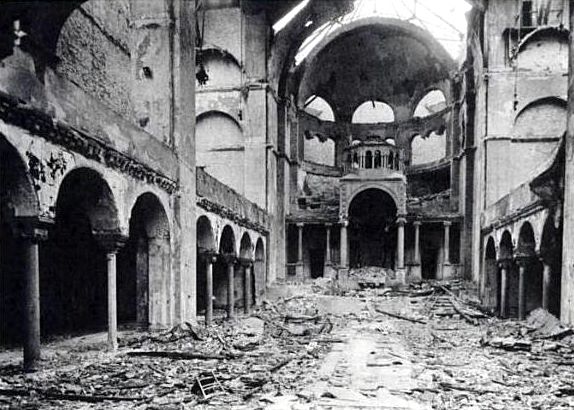
Interior of a Berlin Synagogue after Kristallnacht

Interior of a Berlin Synagogue after Kristallnacht

Seventy Five years ago this November (9th and 10th) Jewish shops and synagogues were vandalized and looted over those two nights throughout much of Nazi Germany and Austria in a most extreme incarnation of the “pogroms” that became known as “Kristallnacht” or the “Night of Broken Glass“.  It was one of the first major and overt expressions of Hitler’s genocidal plans then still being formulated. Unfortunately this event continues to be imitated by like-minded hateful individuals and groups worldwide. So the sociopolitical context of this musical work written for the 50th anniversary of that event sadly has an ongoing relevance for our contemporary world even 25 years after its creation.

At its most basic level this piece is a sort of concerto for six instrumental ensembles playing in radio stations in six different countries live mixed by the composer and broadcast throughout Northern Europe on October 20th of 1988. There is no text as such but the sounds of people praying and the apparently random Hebrew letters and German numbers are scattered throughout the piece along with environmental and found sounds on the tape Curran prepared which plays throughout the performance as a sort of political pedal point.

English: "Hebrew alphabet" in Hebrew...

English: “Hebrew alphabet” in Hebrew, modern serif typeface. (Photo credit: Wikipedia)

The liner notes of the recording describe the piece as “radio concert for six choruses; six sextets each including a quartet (violas, cellos, bass clarinets, bass flutes, trombones, tenor sax/tuba) plus accordion and percussion; tape.”  All were individually conducted with the conductors coordinated by a click track and mixed live by the composer. The recording on New World records is the document of that broadcast.

The effect is that of a collage connected by the electronic nervous system, the radio stations, which link the various performances.  The program is largely implicit here and listening to this piece evokes images that can vary from one listener to the next as any great piece of art provokes different experiences. The sound images here are not pretty and the work is very emotionally intense. Those images are guided by the tone of the music and fueled by the cryptic words and sounds mixed in with the live performances.  It is, in effect, his Mitzvah to the memories of the fallen.  You will not come away unmoved.

Kristallnacht occurred in November of 1938, a month before Curran was born but  the impact of that action continues to resound from that generation to this.  As a politically aware artist he was compelled to respond and he did so in a most emphatic, creative and powerful manner.  Perhaps it is the inherited duty of one generation to exorcise the demons and the atrocities of the previous ones.  Curran has certainly contributed most memorably to such an effort with this work.

Thank you, Mr. Curran, for your prolific and varied contributions to music and your efforts through your art to exorcise the demons of our collective past.  I wish you a happy 75th birthday and wishes for many more creative years to come.

Music 109, Alvin Lucier’s personal view of the post 50s avant garde


20130604-083336.jpg

This little volume is an endearing record of an undergraduate course, a music appreciation course designed for students with an interest in the music of the avant-garde of the 1960s, 70s and 80s taught by a man who was an integral part of that era as a composer, performer and teacher. The class, which he taught at Wesleyan University was reportedly very popular continues to be offered today. And this book is required reading for fans of new and experimental music.

In just over 200 pages Professor Lucier takes the virtual class of readers through a very personal journey of the music, experiments and performances of some of the highlights of some of the major works and composers of this time period. And he manages to navigate all this wildly experimental music in a way that is understandable to a general audience (remember that this is an undergraduate course for non music majors).

What makes this book so special and unique is its personal nature (Lucier was a composer, performer, organizer and interpreter of much of the music) and the particular networks to which he connects. Few historians save for Kyle Gann pay significant attention to the techniques which arose from the orbit of Ann Arbor, Michigan and composers like Robert Ashley, Gordon Mumma and Lucier himself among many others. But this group is indeed an orbit and not a universe unto itself. David Tudor, for example, crossed paths with these composers as well as, more famously, with John Cage and the New York School.

This delightfully readable volume narrates Lucier’s vast experience with and love for a variety of experimental trends. Lucier writes of his own works and places them within the contexts of fellow innovators including the above mentioned artists as well as diverse voices such as Pauline Oliveros, Philip Glass, Steve Reich, LaMonte Young, Roger Reynolds, Gordon Mumma, Robert Ashley, Earle Brown, Morton Feldman, John Cage, Christian Wolff, David Tudor, Karlheinz Stockhausen and many others. This personal inside view makes for entertaining and compelling reading which provides a historical context as well as insights to the “method behind the madness” of a diverse and innovative time in music history.

Except for Kyle Gann’s fine volume on Robert Ashley this is the only book length treatment (known to this reviewer) of artists connected with the ONCE festival and the Sonic Arts Union. Lucier’s place in music history is connected across east coast academia as well as far less academically connected groups like these. This book connects some of those dots placing an important perspective on this era.

Earlier this year I had the pleasure of speaking with Paula Matthusen, a composer who now teaches at Wesleyan. In fact she has inherited this delightful and inexplicably popular course. She told me that not only does the course continue to be popular, many of the students come in with some level of experience of this music and a desire to know more. How cool is that?

Matthusen shares many of her teacher (Lucier’s) concepts in her own work but she is clearly the next generation in experimental music reminding us that art of the era documented is receding into the past yet we hardly know it. And how can we appreciate the latest work without some understanding of how we got there? Lucier’s book provides a great introduction and hopefully will encourage more attention to this important and fascinating time in American music history.

Black Classical Part Four


As promised in a previous blog I am here continuing a little personal survey of recordings of music by black classical composers in honor of Black History Month. I suppose it is worth adding that I pursue these recordings because they present interesting and exciting repertoire that has not gotten the circulation it deserves. Sadly this is most likely the result of the failure of producers, performers audiences and investors to look at the value of the art itself, looking instead through the lens of racial prejudice. I hope that readers of these blogs will avail themselves of this music, these performers, these recordings and maybe come to realize that those old prejudices serve only to limit one’s world view and prevent a rewarding artistic experience. Art, like people, must come to be valued by its own merits, not limited on the basis of skin color. MLK definitely phrased that more elegantly.

20130218-185316.jpg

And further proof of such valuable art can be found in a series of recordings on the Chicago-based label Cedille. In fact their website cedillerecords.org contains a link to the six albums of music by black composers they have thus far issued.

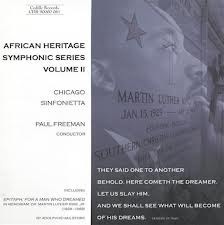
Building on the work he had begun with the Black Composers series for Columbia in the 1970s conductor Paul Freeman released three CDs in the Cedille series called ‘African Heritage Symphonic Series’. With the orchestra he founded Freeman presents music by Samuel Coleridge-Taylor, Fela Sowande, William Grant Still, Ulysses Kay, George Walker, Roque Cordero, Adolphus Hailstork, Hale Smith, David Abel’s, David Baker, William Banfield and Coleridge-Taylor Perkinson. Freeman released a CD dedicated exclusively to the music of Coleridge-Taylor Perkinson as well.

Violinist Rachel Barton-Pine released a disc of violin concertos by 18th and19th century black composers on Cedille and there is a disc of choral music which includes music by black composers.

Let’s turn now to the Albany www.albanyrecords.com label where you can find more of the artistry of Paul Freeman in 18 albums where he presents neglected music of the 20th century by a wide variety of composers black and white. Most of it is by American composers and much of that in styles related to the mid-century styles of the likes of William Schuman, Aaron Copland and their students. While these discs include music by many of the previously mentioned black composers there are no duplications of works or performances. I have heard but a few of these discs but what I have heard is enough to convince me to plan to purchase the others. Freeman, in addition to bringing the music of black composers to the listening audience has done a fine job of documenting many whose work has been little heard until now.

20130218-183122.jpg

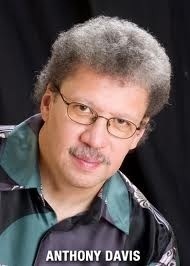
Another composer who fits more or less into the context of the conventions of the western concert traditions whose work has informed my listening is that of Anthony Davis (1951- ). While he has played with musicians from more experimental traditions the influence of the western concert traditions is more easily heard.

His study of jazz as well as western classical and eastern gamelan are all evident in his work (though not necessarily all at the same time). The New York City Opera produced his, ‘X, the Life and Times of Malcolm X’ in 1986 and the Lyric Opera of Chicago produced ‘Amistad’ in 1997. He has written concertos for piano and for violin as well as music for orchestra and smaller ensembles. At the time of this writing he is professor of music at the University of California San Diego.

So far the music we have discussed has been of the sort more commonly heard in concert halls these days. Freeman’s efforts have seemingly jump-started the recording industry to pay some attention to the music of black and other neglected composers. Certainly there is much more gold to be mined there. But we have yet to address the contemporary scene, the new and creative artists who are bringing innovative ideas and sounds and advancing the musical arts for subsequent generations. Following on the innovations of great jazz artists such as Charlie Parker, John Coltrane and Ornette Coleman (among many) there was increasing focus on techniques being used by contemporary “classical” composers

20130218-190530.jpg

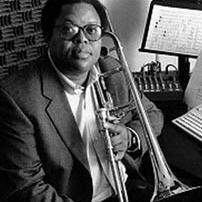
To these ends there is no better place to start than with the AACM, the American Association of Creative Musicians. Founded in Chicago in 1965 this collective has strived to bring various elements of black culture in an incredibly eclectic and experimental milieu which has had and continues to have an influence on music, musicians and audiences. This collective was finally given a proper overview in George Lewis’ book, ‘A Power Stronger Than Itself’. Lewis, a trombonist, composer and currently professor of music at Columbia University in New York was a member of the AACM.

The AACM was not the only such collective but it was one of the most visible, at least to me. And it continues to develop and evolve bringing the complex and innovative musical ideas evolving from the black roots of jazz to a level of recognition and respect formerly accorded pretty much exclusively to European academic models. The AACM, dubbed “Great Black Music” also strives to retain the identity of black music by black peoples of the world looking to non-western models that predate European colonialism marrying them to the best of European models as absorbed by the diaspora. Many of their members now hold academic positions including Roscoe Mitchell, Anthony Braxton, Wadada Leo Smith and Nicole Mitchell.

20130218-190751.jpg

Perhaps the best known ensemble to come out of the AACM is the flexibly-membered Art Ensemble of Chicago. Their album ‘Third Decade’ released in 1984 is representative of their work and also marks a sort of end to one creative era for this flexibly-membered group. Most listeners will hear this as progressive jazz and it certainly has those elements. But repeated listenings reveal many layers to this work. And this is but one of a large catalog of albums as diverse as they are numerous (about 50 albums and still counting). More on their work at their website www.artensembleofchicago.com.

20130218-190928.jpg

Another prominent figure that was a member of AACM is Anthony Braxton, saxophonist, composer, chess master who dislikes the term ‘jazz’ in reference to his music. He is currently professor of music at Wesleyan University. And indeed his music which ranges from solo saxophone work to small ensemble and orchestral music and opera are difficult to classify. His experimentalism is related to but not derivative of the work of John Cage. It would be impossible to represent his musical output in a single album but the solo saxophone ‘For Alto’ (1968) and ‘Creative Orchestra Music’ (1976) are good places to start in his discography of well over 100 albums. His website tricentricfoundatio.org offers many of his recordings for sale and even offers free downloads of bootleg recordings.

20130218-185224.jpg

<a

For the sake of brevity I will discuss only one more artist in this blog entry, Julius Eastman (1940-1990). He was a composer, vocalist, pianist and dancer. As a vocalist he sang and recorded the music of Meredith Monk, Peter Gordon, Morton Feldman, Arthur Russell and Peter Maxwell-Davies. He was very much a part of the avant garde downtown scene in New York of the 1970s.

At the time of his sad death from a heart attack at the age of 49 there were but a few recordings of his work (collected in a nice 3 CD set on the New World label). And many of his scores were lost when he was unceremoniously evicted from his apartment. The composer Mary Jane Leach is attempting to collect and preserve his legacy and has made many of his extant scores on her website http://www.mjleach.com/eastman.htm.

Without a doubt there are many more black classical and avant-garde artists I have yet to discover. I welcome suggestions and I hope that the preceding ideas will stimulate and encourage others to explore these artists and works.

The Future Was Noise


Luciano Chessa’s book, ‘Luigi Russolo, Futurist: Noise, Visual Arts and the Occult is as of this writing the only book available about the Italian futurist composer other than the composer’s writings themselves.   I purchased this book with a sense of excitement having read about Russolo (1885-1947) in various references in books on 20th century music and being puzzled as to why this subject had not been dealt with in any real detail.

Well that is now no longer the case.  Chessa’s book, published in March of this year fills this scholarly musicological gap quite well.  The book provides a comprehensive picture of the cultural milieu of the Italian Futurist movement embracing visual as well as musical arts as it developed in the early twentieth century prior to, during and after the first world war and into the second.

The cultural milieu was heavily steeped in the Theosophy movement, an exploration of various ecstatic and esoteric spiritual practices which flourished as the practice of Spiritualism was waning in popularity.  Both practices shared an interest in the after life but Theosophy was perhaps more comprehensive as adherents explored various eastern religions and practices in search of answers about consciousness before, during and after life itself as well as the interactions between the material and the spiritual.  Both Spiritualism and Theosophy along with the immediate thought content philosophical theories of Henri Bergson (1859-1941) informed the futurists as they, along with the rest of society began to explore the impact and implications of the industrial revolution and discoveries like electric light, recording machines, x-rays and radio.

Having only a slight acquaintance with Theosophy and practically no acquaintance with Italian visual arts in the early twentieth century required a bit of time for me to absorb.  But there is no question that these are essential to understanding the genesis and practice of the ‘art of noises’ as Russolo named it in his 1913 manifesto.

Chessa recounts an era in which this philosophy along with fascism were the formative underpinnings of the futurist movement at the dawn of the twentieth century.  In only 230 pages of text (and 64 pages of notes and references)  he provides a wealth of information most of which was new to this writer and will likely be unfamiliar to the average reader as well.  This book opens virtually a whole new world begging to be researched and understood both for the arts the produced in that era as well as its influence on later developments in both art and music.

The futurists attempted to create new art forms that would more directly express or represent ‘thought forms’ as described by the theosophists and the world of the spirits.  The industrial age, mechanization, new media like recordings and radio transmission, x-rays all held a mystique which resulted in the questioning of philosophy and religion as well as politics much as the atomic bomb and, later, computers would shake beliefs and ideas in the latter half of the twentieth century.

Prior to the publication of this book Chessa had recreated the lost ‘Intonarumori’ which were destroyed and/or lost during the second world war.  Only one sound recording exists of this music and even the scores have been lost but Chessa has essentially resurrected the noise machines, performed with them and has had music written for them as well.  This is music which in 1914 and 1921 that provoked riots comparable to the 1913 performance of Stravinsky’s ‘Rite of Spring’ and presaged the work with noise by the likes of George Antheil and later John Cage.

There is no explaining the neglect of this area of art and music history but there is joy in this wonderful book which is both an intriguing tale and a fine reference work for further research.  One wonders if Chessa might now embark on further explorations of this era and perhaps even a biography of Russolo but the essential ground work has been laid here for many researches to come on this fascinating era.

The book is available in hard cover, paperback and kindle editions.  This reviewer downloaded the kindle edition which has been produced with the same care as the print editions.


Experimentalism Otherwise, a significant new book on the New York progressive music scene in thec1960’s


I posted my blog review of the Carl Ruggles CD release on Amazon so I decided it would be reasonable to take an earlier review from Amazon and post it to my blog. So having made this guilty disclaimer, here is my review of a great book I came across in the fall of 2011:

For those interested in contemporary music and the New York avant garde of the early to mid 1960’s this is a book that is hard to put down. Each of the first four chapters is devoted respectively to: The New York Philharmonic’s 1961 performance of John Cage’s ‘Atlas Eclipticalis’; Henry Flynt and his rejection of mainstream avant garde trends (Stockhausen, Boulez, etc.); The (short lived) Jazz Composer’s Guild; and the performances of cellist Charlotte Moorman. A final chapter is devoted to a summary analysis which further connects these performers and events to the work of the ONCE Festival, Sonic Arts Union and (surprisingly but most appropriately) to the influence of these avant gardists on the subsequent work of Iggy Pop.

Nearly every significant figure of the avant garde is mentioned or quoted and the views of the general public as well as more specialized critics (which, of course, includes various members of the avant garde) are included in the course of the discussion and analysis. In addition to John Cage we hear from the likes of Morton Feldman, Christian Wolff, David Tudor. The Henry Flynt chapter necessarily involves various figures associated with the Fluxus movement and related projects. The Jazz Composer’s Guild chapter includes Bill Dixon, Roswell Rudd, Michael Mantler, Carla Bley, Paul Bley, Amiri Baraka, George Lewis, the AACM. And the chapter on Moorman includes Nam Jun Paik as well as John Cage and various Fluxus artists. The final chapter connects to others not so closely associated with New York such as Robert Ashley, Gordon Mumma, the ONCE Festival, Sonic Arts Union and finally to MC5, John Sinclair and Iggy Pop.

While there is some musical analysis here the author seems primarily concerned with analyzing these events and people and placing them more clearly within the political, social and cultural contexts in which they existed and to which they reacted. And indeed he finds highly relevant connections to civil rights issues and political conflicts and social movements as well as musical and performance movements and practices.

The analysis in terms of the likes of Pierre Bordieu, Franzt Fanon and Michel Foucault may be a bit difficult for those who have no familiarity with their works but his analysis is fascinating and his writing style is very lucid. This is an intelligent book not aimed at a narrow specialist audience. I believe that he succeeds in producing a fresh, important and valuable perspective on the people, the music, the events and the responses to them which will continue to prove useful in present and future analyses of the state of contemporary music and performance.

Finally the book is full of references comprising at least a third of the volume which serve both to support and illustrate Mr. Piekut’s theses and also to provide easy access to further reading and research.

In the time since I published this review Mr. Piekut has come to the United States and is now an Assistant Professor at Cornell University. I will certainly continue to follow the work of this young scholar. And I eagerly anticipate his next project. Perhaps he will see fit to turn his analytical insights to more of America’s too little known avant garde music movements and provide some much needed documentation. And hopefully his students will be motivated to explore these as well.

It is worth noting that the ‘Other Minds’ people in San Francisco have recently chosen to make this book available at a discount on their website. They stock a small but carefully selected cache of books related to new music and their inclusion of this one suggests that they find it a significant volume. In addition they are also stocking local artist/composer/professor Luciano Chessa’s new book on Luigi Russolo, the early twentieth century Italian artist best known for his advocacy of the use of noise as a musical element. In fact I have it cued up in my reading list and plan a future review.

The Complete Works of Carl Ruggles (reissue)


At long last the 1980 CBS recording of The Complete Music of Carl Ruggles (1876-1971) has been reissued by Other Minds records (OM 1021/2-2).  I have owned the vinyl two disc set for many years having come across a review of it in a list of suggested recordings of American classical music in, of all places, The Whole Earth Catalog.  And it is definitely a vital part of any serious collection of American classical music.  Ruggles was one of a group collectively labeled, “The American Five”, a title intended to compare the group with the French “Le Six”, the “Russian Five” or the often cited “Three B’s” (Bach, Beethoven, Brahms).  The American group consists of Charles Ives, Henry Cowell, Wallingford Riegger, Carl Ruggles and John J. Becker who strove to define an American sound not beholden to the European models which had dominated the previous century.  Ruggles’ students included James Tenney and Merton Brown.

This album is a recording of Ruggles’ complete published works.  A recent recording of newly unearthed ephemera was recently released but the present record is everything that Ruggles acknowledged and approved.  It is a meager output for a man who lived to the age of 95 similar to the output of the equally important Edgard Varese whose complete works also fit on two vinyl records and the music is just as finely crafted.  The music here is likely not as familiar even to those who know the work of Ives and Cowell.  But make no mistake this is powerful and unique music that deserves more than just a casual listen.

It is thanks to the efforts of Michael Tilson Thomas, who first heard his teacher Ingolf Dahl conduct Ruggles’ three movement symphony, ‘Men and Mountains’ that inspired him to add Ruggles’ work to his repertoire.  But the connections do not stop there.  Thomas and producer Syrl Silberman of WGBH went to visit Ruggles in a rest home and introduced themselves by putting headphones on the composer and playing an air check of Thomas’ performance of Ruggles’ best known work, ‘Sun Treader’.  Thomas’  wonderful essay about that auspicious encounter is included in Wayne Smith’s beautifully designed booklet.  Also included are the original liner notes with Thomas’ essay, notes and analysis by pianist and Ives scholar John Kirkpatrick and an additional essay by Lou Harrison reprinted as well.  There is also an introduction written by Other Minds Associate Director Adam Fong, himself a student of James Tenney, which puts Ruggles in a wider historical perspective.

Executive producers Charles Amirkhanian and Adam Fong acquired permission from Sony Music to digitize the original master tapes working with a grant from the Aaron Copland Fund to bring this essential recording into the digital age.  And the performances by the acclaimed new music advocate Buffalo Philharmonic Orchestra (MTT was then its musical director), a brass ensemble led by Gerard Schwarz and none other than John Kirkpatrick on piano in the Four Evocations.  Michael Tilson Thomas accompanies soprano Judith Blegen in the little song, ‘Toys’ from 1919 which Ruggles wrote for his son.  Speculum Musicae accompany mezzo-soprano Beverly Morgan in ‘Vox Clamans in Deserto’ from 1923.  Trumpeter/conductor Gerard Schwarz leads a brass ensemble in the original 1921 version of ‘Angels’ for six trumpets as well as its 1940 revision for trumpets and trombones.  Even American choral music experts the Gregg Smith Singers come in to perform Ruggles’ last completed composition, ‘Exaltation’ from 1958, composed in memory of his late wife Charlotte.

The Buffalo Philharmonic with its long history of performing contemporary music under Lukas Foss and Michael Tilson Thomas does a wonderful job of handling the six orchestral works.  Best known of these is the tone poem ‘Sun Treader’ which Thomas had recorded earlier with the Boston Symphony in about 1970.  ‘Men’ from 1921, the three movement symphony ‘Men and Mountains’ from 1924, the orchestral version of the four ‘Evocations’ and the 1947 ‘Organum’ also receive very effective readings.  Michael Tilson Thomas is the conductor for all and he clearly knows and loves this music.

The sound is great and the performances are truly definitive coming from artists with varying levels of connection to the composer and  all clearly with a passion for this music.

In fact I can find only a handful of other recordings of Ruggles’ music.  Most are out of print and/or dated in sonic reproduction.  A notable exception is New World Records’, ‘The Uncovered Ruggles’, posthumous reconstructions done by John Kirkpatrick and performed and produced by Kirkpatrick student Donald Berman actually makes a nice companion to the release at hand here for the Ruggles fanatic. (I know they’re out there.)  And there are digital downloads of some out of print recordings as well.

So, as in their previous releases, OM records continues its traversal of sometimes difficult but always relevant music.  So order your copy today through Other Minds, Naxos Distribution or through Amazon.com.  You might be challenged but you won’t be disappointed.  This is a great recording.

Other Minds 17 Day 3


The final night of the 17th Other Minds Festival presented music by four composers and included two premieres of music commissioned by Other Minds.

The concert began with music by Finnish composer Lotte Wenakoski. This diminutive Finnish woman, who also sang quite beautifully during the panel discussion, works with barely audible sounds seeking inspiration ” on the borders of silence”. Her 2006-7 work Nosztalgiam (Hungarian for ‘my nostalgia’) was performed by the modular Magik*Magik Orchestra whose size varies according to the need of the pieces to be played. Tonight’s configuration for this piece consisted of 12 players playing woodwinds, brass and strings.

Fellow OM 17 composer John Kennedy, who is the conductor for the Spoleto Festival among others, conducted the chamber ensemble. Nosztalgiam (2007) is apparently a set of variations/deconstructions or meditations on two Hungarian folk songs (one of which she spiritedly sang during the preconcert discussion). The sometimes sparse and always delicate sounds expressed Wennakoski’s personal impressions of her time studying in Budapest in the late 1980s. It is difficult to assess this composer represented in this festival by a single work. But the sweet, delicate personally nostalgic sounds evoked by a variety of extended techniques suggest that seeking to hear more of her work would certainly be worth one’s effort. The sensitive and virtuosic performance was greeted warmly by audience and composer alike.

Next in this first half were two works by John Kennedy, conductor, composer, percussionist and promoter of New Music. Here is a man in a role similar to that of OM Festival director Charles Amirkhanian having a chance to be, so to speak, on the other side of the table. There are apparently no available commercial recordings of this man’s music but according to his web site (which does have some too brief sound samples) he has composed many works in all genres including theater, orchestral, solo and electronic. And he has received many commissions.

This night he was represented by two works, one of them an Other Minds commission. Both are hommages to the late John Cage. As I mentioned in an earlier blog Cage is also the inspiration/impetus behind Other Minds’ esthetic.

The first work, “First Deconstruction in Plastic” (the title a play on Cage’s First Construction in Metal), does double duty as an homage and as an environmental statement. Percussion duo Ryder Shelley and Andrew Myerson sat facing each other each with a collection of ‘found objects’ consisting of plastic buckets, bottles, shopping bags, etc. This well rehearsed duo gave an energetic and engaging performance which the audience clearly appreciated. But for this reviewer was left with the impression that this accomplished work, though no doubt intricate in it’s conception and satisfying to the musicians, failed to fully engage it’s audience. I was entertained but I did not particularly want to hear it again.

The second work, “Island in Time” (2012), was a world premiere. This, also dedicated to Cage, was a different matter. Scored for the unusual combination of bass clarinet, flute, cello and percussion (all members of Magik*Magik Orchestra) was an engaging though not derivative tribute to the influence of John Cage. The composer describes a process involving different types of temporal processes to structure the work. But the specifics of the processes are secondary here to the overall impact of the work. A meandering flow of sounds and tempi flowed beautifully reverently invoking the spirit and influence of Cage’s work. I have no doubt that the riches in this piece would continue to reveal themselves with repeated hearings. And though I have very little knowledge of this composer’s other work I have no doubt that it is likely to be quite compelling.

The musicians, clearly familiar with the work, gave a loving smooth reading of what appears to be a fairly complex work requiring serious concentration and collaboration. The audience, myself included, rewarded their efforts with enthusiastic applause.

In the second half of the program the next composer, who had performed the previous night in collaboration with Ikue Mori and Ken Ueno, was Tyshawn Sorey. This was to have been a solo performance as a percussionist but in the course of the discussion in last night’s pre-concert panel festival director Charles Amirkhanian mentioned that he had heard Sorey playing the piano earlier in the day. Amirkhanian remarked on the apparently eclectic nature of what he had played. Sorey responded saying that his piano playing is informed by the likes of Art Tatum, David Tudor, Cecil Taylor and Morton Feldman. He also mentioned deconstructing Boulez’ Second Piano Sonata (!) to inspire his compositional process. Eclectic indeed! And he easily consented to playing the piano in his segment of the program saying, “…if you are open to it, sure.”. Sorey exudes a sort of calm, friendly, matter of fact confidence in his skills.

So Sorey walked onto the stage which contained his percussion kit on one side and a concert grand piano on the other. He began with a percussion improvisation starting with a fortissimo strike on the side drum followed by some fevered loud work on tenor and snares as well. This then segued into some more delicate and complex soft sounds elicited from various cymbals and drums making frequent use of special techniques which brought forth some rich vibrant harmonics especially in the quieter moments. I couldn’t help being reminded at times of Han Benink’s performance at last years festival as he released a small sower of sticks onto a drum at one point. Sorey’s sheer energy and good humor were reminiscent (though not imitative). And, unlike Benink, Sorey never left the stage in the course of the performance.

Following the well received percussion set Sorey moved to the grand piano sitting confidently and commandingly at the keyboard and pausing as he focused on the task at hand. He started slowly with a few chords and before long launched into a dizzying and virtuosic flow of music reflecting the influences he mentioned. At first perhaps Morton Feldman, sometimes Pierre Boulez, a little Art Tatum, certainly some Cecil Taylor and then deftly playing sometimes inside the piano then back to the keyboard as part of the same unbroken musical phrase evoking the experimentalism of David Tudor. But the overall impression was not episodic imitation but rather an absorption and integration of all these techniques transcending genre and becoming, simply, inspired music making. The audience was transfixed and absorbed in the flow of the music and responded with cheers of “Bravo” and enthusiastic applause (I think they were pushing for an encore but time did not permit). Had I heard a recording of this without knowing the background I would have guessed this to have been an accomplished composed work by a master composer but this was an improvisation. I am surely going to seek recordings and follow this man’s career in the years to come.

The finale was another Other Minds commission this time from composer, vocalist and Berkeley music professor Ken Ueno. The piece, “Peradam” (2011) takes it’s title from the unfinished spiritual allegorical novel, “Mount Analogue” by the French surrealist writer and poet Rene Daumal (1908-1944). Peradam is a mythical diamond-like stone sought after on the similarly mythical mountain of the title.

Ueno’s work is scored, as is his practice, specifically for the skills of the formidably talented Del Sol Quartet who so ably played the Gloria Coates quartet the previous night. Specifically the specialized skill (in addition of course to their string playing) is the multiphonic throat singing capability of violist Charlton Lee. Ueno demonstrated his vocal skills on the previous night singing with the percussions of Ikue Mori and Tyshawn Sorey. In fact all the players were asked to sing as well as play their instruments for this performance. In addition there was video creatively projected onto the sound baffles at the rear of the stage.

The music was a post modern integrated amalgam of a wide variety of conventional and extended instrumental techniques along with singing at times (the throat singing is a strikingly unique timbre which commands attention when it emerges in the fabric of the piece). The quartet positioned themselves stage right to afford the audience a clear view of the projection across the three sound baffles at the back of the stage. They played with characteristic concentration and skill in what looks like a technically challenging piece of shifting moods and tempi to which the images responded.

The images, manipulated in real time and in coordination with the music with software written by video artist Johnny Dekam, were abstract mostly monochrome images that moved and transmuted hypnotically along with the music. Dekam, who has worked with a variety of pop acts like Eminem and Thomas Dolby, had collaborated with Ueno before. In the darkened theater the images dominated the visual field though the quartet could be seen as well.

It was a complex experience that could only be grasped, if at all, by going with the simultaneous flow of music and image. This piece will benefit from repeated listenings/viewings to more fully appreciate it’s intricacies. But this first performance clearly satisfied the mostly hard core new music fans audience. And while the direct John Cage associations were not as obvious it is clear that Ueno, Dekam and the Del Sols embody the open minded spirit of his work in this, his centennial year. This grand finale was appreciated in kind by the cheering audience successfully bringing to a conclusion the 17th always uncategorizably eclectic Other Minds Festival.

Other Minds 17. Day 2


The second night at Other Minds featured two different generations of composers. As is their practice Other Minds on this night featured two composers already established and fairly well known in new music circles as well as three up and coming artists.

The first performance was by San Francisco’s own champions of new music, the Del Sol Quartet. They performed the American premiere of American expatriate composer Gloria Coates’ String Quartet No. 5 composed in 1988. This and her 8 other quartets have been made available on the brave and progressive Naxos CD label. Coates also holds the record as the most prolific woman symphonist of all time with some 16 symphonies to her credit (many of those are available and well worth seeking on CD as Well).

String Quartet No. 5 is cast in three movements. By the composers description all of the movements are canons, a simple counterpoint form. But the result is hardly simple. Using microtonal glissandi, sometimes having instruments tuned a quarter tone apart and relying on creative ways of synchronizing the players individual tempos Coates achieved a complex sounding but friendly and approachable result. The quartet which lasted about 30 minutes would be a challenge for any ensemble but the Del Sol (which, except for the cellist, perform standing in a break with convention) clearly knew and liked the work and gave an intense and beautiful rendering sounding at times like there were more than four players. The piece has an almost romantic feel at times, cleverly incorporating melodies into a sound world uniquely the composer’s own (I am at a loss to identify a precedent). I sincerely hope that this work and her other works become better known in this, her native country. It is a tribute to the acumen of the Other Minds team that music like this is presented here. The audience greeted the performance very appreciatively.

Next up was Harold Budd on piano playing with Keith Lowe on double bass augmented with electronic effects. The piece, titled “It’s Only a Daydream” from 2011 is, by Budd’s description, entirely improvisational as is most of his music. Lowe began playing first with long sustained tones awash with rich harmonics. Budd’s piano then entered and we were transported to the familiar sound world which is Budd’s musical signature. Those who knew his collaborations with Brian Eno and his later solo works recognized his somber pretty ambient sounds. The two musicians were well matched and played a sort of jazz duet trading solos and accompaniments evoking a curiously nostalgic and hypnotic atmosphere of a strange dream-like lounge. Time seemed suspended and I don’t know exactly how long they played but when they finished the enthusiastic audience reception brought them back for a shorter encore, something I had never seen occur before at this festival.

Following intermission Ikue Mori took the stage sitting at her laptop which controls her various electronic sounds. She played the laptop solo for a few minutes and was then joined by UC Berkeley faculty composer Ken Ueno on vocals. But ah, what unusual vocals. His extended vocal techniques seem to come equally from Tuvan throat singing, Buddhist chanting, David Hykes (of the harmonic choir), Meredith Monk, Diamanda Galas, Kenji Suzuki (of the band Can), Tan Dun (on Taoism) and God knows what else. After another few minutes Tyshawn Sorey, a doctoral candidate in composition at Columbia, seated himself quietly at his drum/percussion kit, then with an assertive fortissimo bang on the side drum confidently entered the energetic fray. Mori sat intently gazing at her computer screen and entering the sound changes for her part while Ueno, holding the microphone to his mouth with both hands issued passionate wordless vocalizations of endless variety and Sorey executed a similar endless variety of high energy acoustic percussion sounds.

Mori calmly issued computer commands to perform her Japanese/New York/ punk/free jazz/Stockhausen expanded percussions while the academic Ueno improvised intense growling, multiphonic, wild vocals with few pauses and Sorey got in touch with his AACM ancestors producing a unified three ring circus of wonderful musical mayhem transcending any concept of genre. Three different traditions, separate but working together. Metaphorical? You decide.

Well deserved and enthusiastic applause greeted the intense but calm Mori and the sweaty and apparently exhausted but satisfied Ueno and Sorey.

The relative order of Coates followed by the ethereal calm improvisations of Budd were but a distant memory (albeit a pleasant one) after the ritual emotional exorcism of the second half. This is the rich variety that characterizes these concerts. And now anticipation builds for tomorrow’s finale.