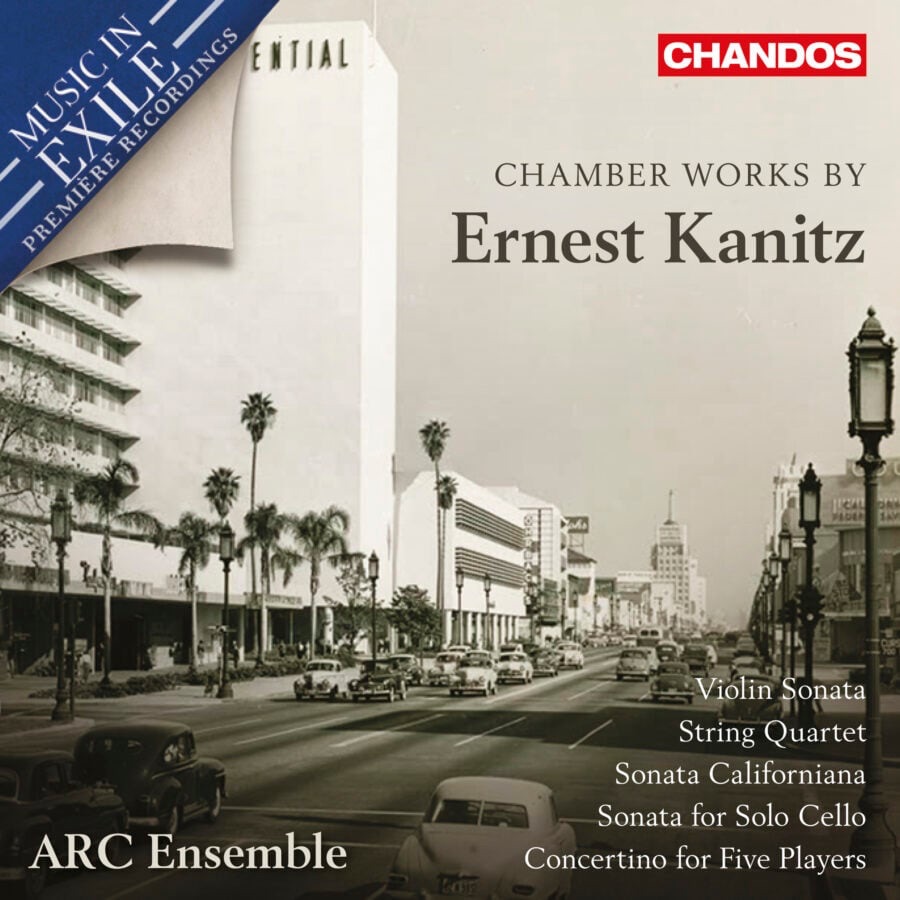
Ernest Kanitz, Rescued from Exile


This latest release in the amazing survey series “Music in Exile” by the passionately dedicated ARC Ensemble along with the fine tuned musico-archeological ear of producer Simon Wynberg continues to to pursue their angle on lost, suppressed, neglected music. That music earned its anonymity due to sociopolitical pressures that forced these composers to flee their homes simply to survive fascist regimes (and hopefully pursue their chosen careers). The suppression of the arts is a hallmark of oppressive regimes and this project aims to rescue music that has fallen into disuse because of that. This latest release most beautifully continues this fine and essential project.
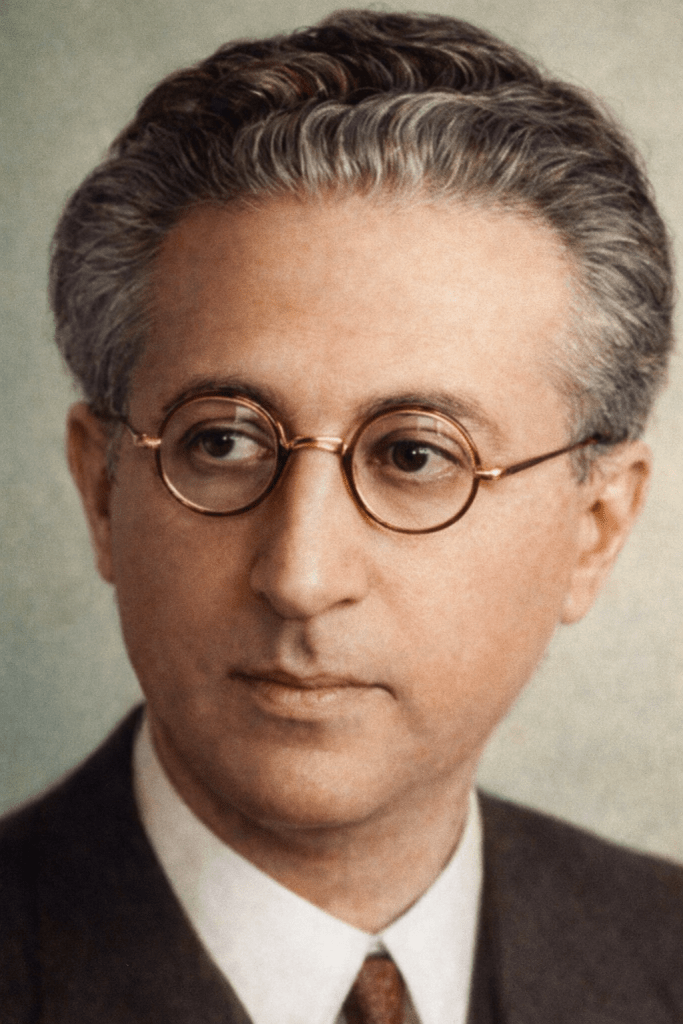
Ernest Kanitz (colorized by this reviewer)

This Austrian composer born in 1894, was from a wealthy Jewish background but, like many in this time and place, converted to one or another form of Christianity. Famed composer Franz Schreker became one of his mentors.

His father died in 1918 and both his mother and later, his sister died by suicide before he made the decision, in 1938, to leave Germany. He landed first in Manhattan, and later Los Angeles where he was able to continue to pursue his life as teacher and artist. He taught at USC for many years and received several commissions for music which received performances.

There are five works on this CD which were written between 1921 and 1956, reflecting his initially romantic style to something like neoclassicism. His prolific output includes chamber music, orchestral music and opera. He was apparently actively composing from 1918 until his death. The works are sequenced (with one exception) in their order of composition.

Kanitz was of Jewish ancestry and converted to Christianity in 1914 (not an uncommon practice at the time) but this did not protect him from the Nazi purges and he left Austria for America where he found significant success teaching and composing. He taught at USC for some 14 years.

The first work on the recording, a Violin Sonata from 1921, demonstrates a sort of post romantic style. This charming work in three movements demonstrate the composer’s early style and his mastery of the chamber music idiom. It is the only pre-war piece on this recording. And is a work that might be favorably paired with similar works by Brahms, Debussy, and Franck. It has a late romantic feel and is a nice showcase for both pianist and violinist.

It is hard to imagine the social and artistic milieu of 1921. The post Wagner/Brahms styles were fading into post romantic, increasingly experimental with harmony but not yet fully confronting Schoenberg’s twelve tone methods, a move which ultimately provoked as much controversy as creativity that brought the world into the “modern” era. James P. Johnson’s “Charleston” dominated the popular repertoire of dance bands as the world began its recovery from the horrors of the First World War. And the concert halls were increasingly dominated by the expansion of romantic harmonies striving toward new means of expression to reflect the angst of social struggles.

The second work is a substantial String Quartet (dedicated to Ernst Toch, another exile) dating from 1945. It is cast in four movements and adheres to a late romantic style. The first movement, subtitled “Elegy” in which he succeeds in making the key of D major sound sad. The second movement is a lighter Rondino which lightens the mood. There follows a set of variations on an old Viennese tune (the meaning of the tune must have sounded quite different to the composer in 1945). The variations go through several moods on this tune that must have carried a bittersweet nostalgia for him. The quartet comes to a conclusion in the longest movement, the finale. It strikes a rather bright, sometimes playful mood and brings this substantial work (his only essay in the genre) to a satisfying end.

The next three tracks are given to Kanitz’ Sonata for solo cello, a genre that only came into the repertoire as viable concert music after Pablo Casals brought the neglected Bach solo cello suites successfully to the concert stage and subsequently made the first recordings of that music in the late 1930s. Solo cello music has grown as an audience pleasing form increasingly in the twentieth and twenty first centuries. This work from 1955 is a significant addition to the that repertoire.

The delightful Concertino for Clarinet, Violin, Viola, Double Bass, and Piano (1957) shows Kanitz in an inventive mode with this gentle, playful, and lyrical work. There’s three movements (Overture, Air, and Fugue) that demonstrate the composer’s considerable grasp of harmony, structure, and counterpoint. The Quartet may be the standout work in this collection, but this work also deserves more attention.

Kanitz shows a touch of modernism in his writing for the saxophone (the instrument was not common in the context of the classical concert hall at the time of its composition) in the last offering on this 9th volume of Music in Exile. There’s three movements (Sky and Water, Fragrance, Light; Lament; and, Hollywood). The Sonata for Saxophone and Piano (1948) is in a way, the composer’s paean to his California home in exile.

This wonderful sampling is a taste that of Kanitz’ work that this writer hopes will result in recordings of more of this man’s work.

The musicians include:

Chamber: ARC Ensemble

Erika Raum violin

Marie Bérard violin

Steven Dann viola

Thomas Wiebe cello

Joaquin Valdepeñas clarinet (in the Concertino)

Kevin Ahfat piano (in the California Sonata)

with special guests

Wallace Halladay saxophone (in the California Sonata)

Anna Štube violin (in the violin sonata)

Joel Quarrington double-bass (in the Concertino)

Frederick Block (1899-1945) Chamber Music: A New “Music in Exile” Release


CHANDOS CHAN20358

By whom? This is latest release in this fascinating series that seeks to record music that has been neglected. Music in Exile shares a kinship with Decca’s “Entartete Musik” (Degenerate Music) series, among others. That series focused on music and composers judged inferior by the leaders of the Third Reich. Their suppression of music paralleled their suppression of visual art which suppressed works purported to be “degenerate” and presumably toxic to their political goals. That meant, in the case of music, essentially two categories. The largest is the suppression of Jewish composers (regardless of style and/or content) and also musical modernism that the regime did not understand. Similar suppression occurred under Stalin in Russia.

But Music in Exile casts a wider net. One does not need a totalitarian regime to cause suppression. Economic and performance opportunities are mediated by many factors and music gets neglected for many reasons, some far less onerous than directed political oppression. This music which was composed for general performance has no overt political agenda, rather it is the victim of political and economic agendas.

That, in a nutshell, is the essence of the choices of repertoire that ARC (Artists of the Royal Conservatory) director, Simon Wynberg makes to create this fascinating and historically significant recording project. Of course neither suppression nor neglect confer values by themselves. I mean, the thrill of finding a major masterpiece is certainly the driving force but, even if these recordings ultimately only fill the gaps in the list of historical recordings, the opportunity for listeners to hear them is the point here. That said, I am appending a list of this ensemble’s discography (kindly supplied by promotional staff) thus far:

ARC ENSEMBLE DISCOGRAPHY


On the Threshold of Hope, Mieczyslaw Weinberg Chamber Music (2006)
with Richard Margison, tenor
RCA Red Seal (Sony) 82876-87769 2 (GRAMMY and JUNO nominations, 2007)
Right through the Bone: Julius Röntgen Chamber Music (2007) RCA Red Seal (Sony) 88697-158372 (GRAMMY nomination, 2008)
Two Roads to Exile: Walter Braunfels String Quintet, Adolf Busch String Sextet (2010) RCA Red Seal (Sony) 88697-64490 2


Music in Exile: Chamber Works by Paul Ben-Haim (2013) Chandos 10769
Music in Exile: Chamber Works by Jerzy Fitelberg (2015) Chandos 10877 (GRAMMY nomination, 2016)
Music in Exile: Chamber Works by Szymon Laks (2017) Chandos 10983 (JUNO nomination, 2018)
Music in Exile: Chamber Works by Walter Kaufmann (2020) Chandos 202170 (OPUS Klassik nomination, 2020)
Music in Exile: Chamber Works by Dmitri Klebanov (2021) Chandos 20231 (JUNO nomination, 2022)
Music in Exile: Chamber Works by Alberto Hemsi (2022) Chandos 20243 (JUNO nomination, 2023)
Music in Exile: Chamber Works by Robert Muller-Hartmann (November, 2023) Chandos Records
All titles produced by David Frost and engineered by Carl Talbot

Now comes the latest release, all premiere recordings, of chamber music by “Frederick [Friedrich] Block [Bloch]” (1899-1945). This series is a real “feather in the cap” of the wonderful Chandos label whose curatorial choices are always intelligent and wide ranging.

This latest release is another triumph, another unveiling of some truly fine music which, thanks to the passion of researcher/producer Simon Wynberg and the fine musicians of the Toronto Conservatory, are now available in definitive performances lovingly documented in high quality recordings. Even if these works never again have performances or recordings (something this writer doubts), they will have a life heretofore denied them in the lasting medium of recorded sound. In addition to the music, Wynberg pens some profoundly useful program notes that help provide flavor and context to this all but forgotten composer. Wynberg notes that, while Block’s archive was acquired by the New York Public Library and carefully preserved, this recording represents the first serious effort to explore his ultimate legacy. All works are world premiere recordings.

Four works, all but one written in the interwar years (1918-1939), an era in which American composer Aaron Copland suggested that there remain many works which deserve attention. How right he was.

The disc opens with the substantial four movement Piano Trio No. 2 Op. 26 (1930). Frederick Block was not a modernist or innovator but that is not a bad thing. Block was a fan of Gustav Mahler’s music and, as such, a proponent of a similarly post romantic ethic. Here we have a highly entertaining work which is challenging to performers but wonderfully entertaining to audiences.

The first movement signals a post Brahmsian style with highly virtuosic writing and a slightly extended harmonic language just enough to let the listener know that the 19th century has indeed passed.

It is followed by a playful, brief scherzo-like movement followed by a lovely, sometimes mournful adagio and a truly fun last movement deriving inspiration from tango music but still firmly ensconced in classical traditions going back to the classical era of Mozart and Haydn.

It left this listener longing to hear Maestro Block’s first essay in this form (and sparked curiosity about his other unheard music). Perhaps a future release will expand the exploration and documentation of this forgotten master still further.

Next up is String Quartet Op. 23 (1929-30) cast in the classical four movements. Again the harmonic language is just noticeably post romantic (and quite beautiful). It is easy to imagine this work included in a satisfying evening of chamber music. It is melodic and requires significant performance skills but poses little challenge to the engaged listener.

The Suite for Clarinet and Piano Op.73 (1944), written at the height of the Second World War, consists of 5 brief movements (the longest clocks in at just over 3 minutes and the entire suite at just shy of 8 minutes). It is as lively and engaging as imaginable, suggesting no echoes of the still ongoing world war. It is sort of a delightful palate cleanser for the closing work on the disc.

And the closing work is in a form born in the romantic era with Schubert’s “Trout Quintet” (1819) being the shining emblematic work in that genre. Other well known examples include the quintet by Robert Schumann (1842) and that of Johannes Brahms (1864). Now I don’t mean to suggest that Block’s entry in the genre will give these classics serious competition but this 1929 entry would do well in a pairing with one or all of the aforementioned classics.

Block’s Piano Quintet is cast in three movements and is a beautiful example of some of the best post romantic pieces for this chamber grouping. As with the previous works on this recording, this one delights the ear with rich melodic and harmonic gestures that would likely please a chamber music audience.

This disc makes a strong case for further curatorial efforts by Mr. Wynberg and the fine musicians of the Royal Conservatory in Toronto. This is a wonderful release which adds some substantial pieces to the chamber music repertory. It is also, in its way, a strong advocacy of musical art as well as a condemnation of those people and forces which cause the oppression of artistic expression.

In addition to Simon Wynberg’s scholarly curatorial efforts, thanks are due to the following musicians of the Royal Canadian Conservatory: Erica Raum and Marie Bérard, violins; Steven Dann, viola; Tomas Wiebe, cello; Joaquin Valdepeñas, clarinet; and Kevin Ahfat, piano.

If you’re a chamber music fan and/or a supporter of the arts, you owe it to yourself to check this one out. You won’t be disappointed.