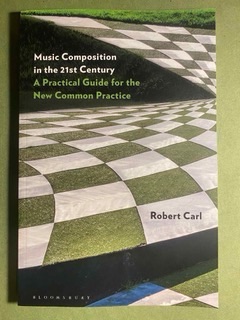
Robert Carl’s “Music Composition in the 21st Century”, a guidebook for the avid listener with essential insights into the composer’s own methods


Composer/musicologist Robert Carl gives his perspective of the “new common practice”, a term which attempts to describe the current state of compositional and performance practices. I first heard that term from Alvin Curran, a composer who indulges (most successfully) in a wide variety of musical practices. And the term appears now to be generally accepted by contemporary musicians and music journalists as a way to give a name to this historical moment in music history.

That’s great but Carl’s book goes beyond mere academic musical history and invites listeners of all stripes to experience and engage with these interesting, increasingly divergent practices. His lucid writing gave this reviewer marvelous insights into the current “scene”, the variety of music and performances that adventurous listeners will encounter.

Professor Carl’s earlier publication presented a comprehensive analysis (the last word in this writer’s opinion) of Terry Riley’s manifesto of minimalism, “In C”. That book provided me with insights to a work I thought I knew well. Well, I like it even more after reading that book. And his friendly, knowledgeable writing is very much evident in this most recent tome from one of the finest writers on the subject.

Robert Carl (1954- ) is a prolific composer and a wonderfully readable scholar of music. His music partakes creatively from a wide variety of musical practices so, in that time honored adage, he “writes what he knows”. His passion for new music feeds directly to my insatiable curiosity for what the heck they’re all doing these days. It is an adventure worth your time and Carl is a dutiful docent, offering context and analysis for the eternally curious. You will not be disappointed.
When in Rome…an Alvin Curran Retrospective Installation in Rome


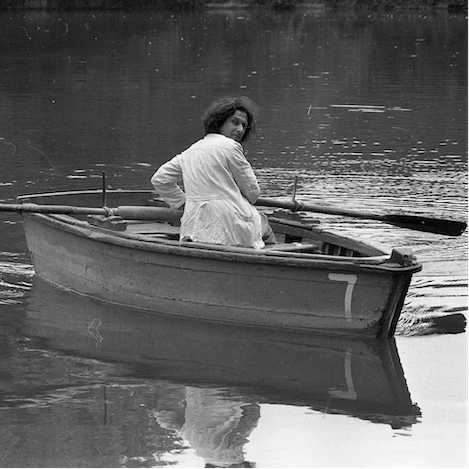
Alvin Curran, Rome, 1980. Adriano Mordenti

Just had to post this for all my readers and friends but especially those living near or able to get to Rome. Curran’s wife, Dr. Susan Levenstein, graciously sent this announcement to me. She is an American physician (and webmaster).Her very entertaining memoir, “Dottoresa” is her accounting of moving her practice to Italy.

Alvin Curran, (1938- ) is the co-founder of the seminal live electric music performance group, “Musica Elletronica Viva” along with his late colleagues Frederic Rzewski (1938-2021) and Richard Teitelbaum (1939-2020). The group formed in 1966 and later included kindred spirits including George Lewis and Garrett List among others. The group did its final tour in 2016.

Click on Curran’s name to look at his fascinating and well organized website which gives a fairly comprehensive accounting of the incredible range of musical styles and a very large bevy of collaborators.

Curran discussing some of his work with interviewer Charles Amirkhanian in Berkeley in 2016 (photo by Allan J. Cronin)

Curran, who taught at the venerable Mills College in Oakland, California is an always welcome visitor in the Bay Area. While he has made his home in Italy for many years now, he is truly an artistic citizen of the world. The warm and affable composer exudes an infectious enthusiasm which doubtless is why he has so many collaborators. His aesthetic which he documented in an article called, “The New Common Practice” in 1994 documents his all inclusive style, one that is very difficult to convey. His works include music for piano, chamber ensembles, orchestra, and even things most folk never thought of as musical.

He is a giant in late twentieth and early twenty first century music and this retrospective is most welcome.

“HEAR ALVIN HERE

ALVIN CURRAN

…a retrospective

part of the #CHAMBERMUSIC series

The show consists in a listening room where a new sound work plays continuously—a mixtape comprising fragments from many different compositions, improvisations, and installations. It leads the audience on an autobiographical listening journey, freely mixing styles, periods, and languages, from free improvisation to Fluxus to Artificial Intelligence, from compositions for shiphorns to works for hundreds of musicians, from Sargentini’s L’Attico and the Beat 72 to MAXXI and the Tate, from Angelo Mai and The American Pavilion of Expo 58 to No Mans Land and the Théâtre de Chaillot.

The Museum of Contemporary Art of Rome (MACRO), Via Nizza, 138

inauguration September 20, 2023, from 6 pm to 9 pm

running until March 17, 2024

***************

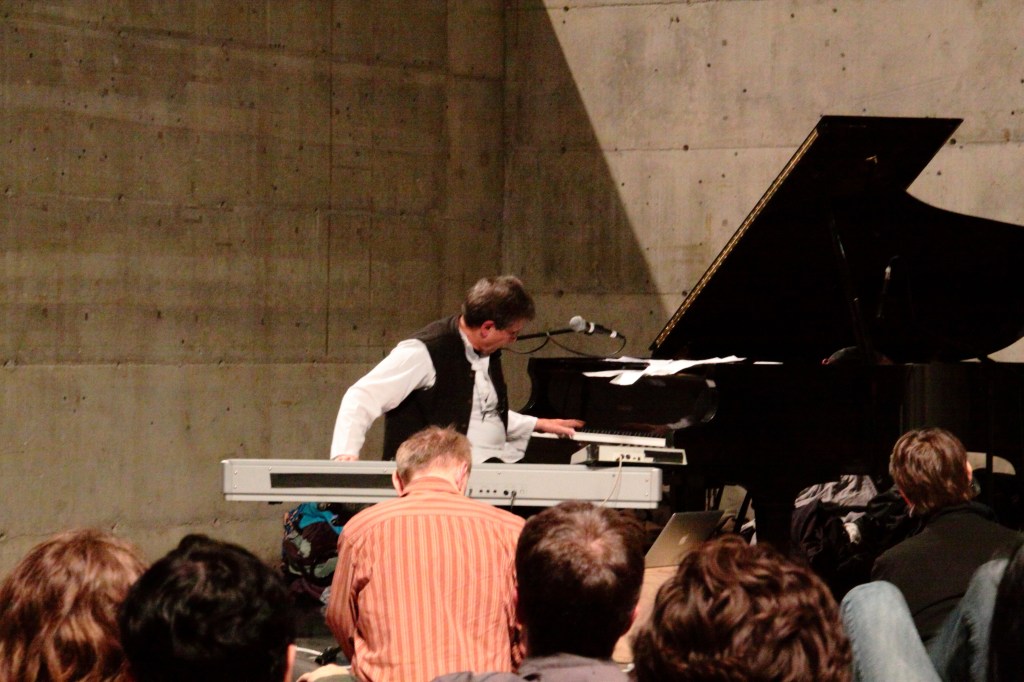
Curran in performance at the Pacific Film Archive in Berkeley in 2014.