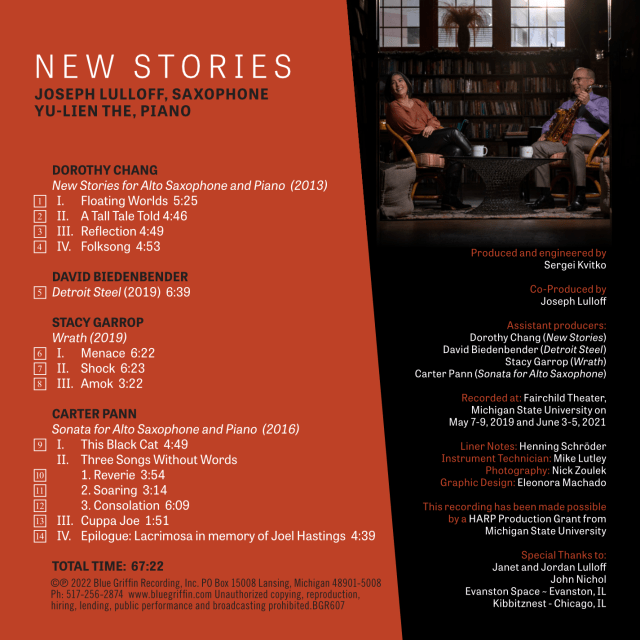
Joseph Luloff: New Stories for Saxophone and Piano


Blue Griffin

Joseph Lulloff (1960- ) is an internationally known artist with at least 10 CDs currently available. He is on the woodwind faculty of Michigan State University. Lulloff reportedly started playing saxophone in part to deal with asthma (a useful adjunct to pharmaceutical treatment) and has made quite a career since. Lulloff is a new name to this writer but, after hearing this latest release, a name that will trigger alerts on my listening radar. He, like most saxophone soloists working today, is equally comfortable and competent in both jazz and classical idioms for his instrument.

The present release is a collection of works, all written for the Joseph Lulloff. Four works are presented by four composers, two of which (Dorothy Chang and David Biedenbender) are new names to this listener. Overall this is one exciting release with deeply substantive music which makes a case that tonality and quasi romantic writing are not dead, just evolving.

Pianist Yu-Liien The is a fellow faculty at Michigan State and one who is clearly a sympathetic collaborator. The Netherlands born pianist has a wide range of international performances to her credit and is a major asset in the interpretation of the works on this CD. Their friendly collaboration is reflected well in the album cover photo by Nick Zoulek.

The recording itself is lucidly captured by producer/engineer Sergei Kvitko. Subtlties of both the saxophone and the piano come across clearly and this album is rife with subtle but very effective inflections of tone. It is a warm listening experience.

tracklist

Dorothy Chang contributes the work from which the album derives its title. New Stories (2013) is a four movement work that is major opus, practically a concerto in all but name. At ca. 20 minutes total duration it reveals several moods and many challenges for the performer. This American composer writes in the useful liner notes that she attempts to utilize Chinese elements in her composition. These are not immediately apparent to this listener’s ears but what is apparent is the composer’s ability to create a very compelling listening experience.

The four movements include: “Floating Worlds”, an ethereal melodic/impressionistic movement which demonstrate the soloist’s fine and nuanced breath control and ability to integrate microtonal and multiphonic inflections in this relaxing movement punctuated with mildly dissonant piano chords. It is followed by “Tall Tale”, a scherzo-like movement which demands intricate interplay between the saxophone and the piano. The third movement, “Reflection”, is a somber solo for the saxophone, almost a cadenza. It is a lyrical slow movement that is relaxing for the listener but a challenge for the soloist, one that Lulloff handles effortlessly. The last movement, titled “Folksong” is a playful, busy movement that also incorporates a solo cadenza-like passage. It is a challenging interplay between saxophone and piano with rhythmic intricacies that sound difficult to execute. All in all a large and substantial work that almost begs to be orchestrated. But it stands clearly on its own very satisfyingly as a chamber work.

David Biedenbender is a composer new to these ears. His “Detroit Steel” is a solo saxophone work, a paean of sorts to the workers of the steel industry. This is the shortest work on the album but Biedenberger manages to create a cohesive soliloquy that sustains attention for the entirety of its 6 minute duration. Doubtless there are references in the work that were not immediately obvious to this reviewer but, like its companions on this release, it is an appealing sonic document.

Stacy Garrop, whose work has received praise in several reviews on this blog, again does not disappoint in her three movement, “Wrath” (2019), another concerto like work which is, according to the composer’s liner notes, is a sort of reimagining of an earlier work, “Tantrum” (2000), also for saxophone and piano. Written for Mr. Lulloff, Wrath is perhaps a representation of the composer’s evolving style and maturity.

The work is is three movements (Menace, Shock, and Amok). The sinister first movement gives way to the second, “Shock” which is more like a post shock experience (PTSD perhaps) seemingly reflecting some resolution of said shock presumably from the encounters in that sinister first movement. The finale, “Amok” picks up in a way from the menace of the first movement in a sort of return to that first movement in a cohesive transformation of that makes for a very satisfying finale. Garrop’s work seems to these ears to have a cinematic dimension and that is also the case here.

The album concludes with a large work by Carter Pann, an American composer whose star is steadily rising. The work, “Sonata for Alto Saxophone and Piano” (2016) is a four movement work which, despite its ordinary sounding title, is quite a fascinating piece. It shares a similar sound world to that of Paul Creston and mid 20th century neoromantics. The four movements (the second broken into three separate songs without words) are:

  1. Black Cat, apparently a set of variations which give the saxophone time to shine.
  2. Songs Without Words, three separate songs ranging from the melodic, romantic “Reverie” to the “Soaring”, a faster piece, and “Consolation”, a slow contemplative piece.
  3. Cuppa Joe, fast virtuosic scale work with manic piano accompaniment, sort of a scherzo.
  4. Epilogue Lacrimosa (In memoriam Joel Hastings), a somber homage to the Canadian pianist who championed Pann’s work.

This is a very exciting release by two fine musicians whom listeners will want to keep on their radar. This album is a significant contribution to the chamber literature for saxophone and a pretty wild listening experience.

75 Years of Classical Music in Israel


Utter the name “Israel” and probably only a handful of people will think, “classical music”. As a lifelong new music fan I’ve made many wonderful discoveries by looking at work done by composers in countries that aren’t part of the typical America, Germany, Italy, France, Russia nexus. Throw in the Nordic countries, Canada, and Australia more recently and you have perhaps 90% of what is marketed (even if not efficiently distributed) as new classical music. Israel, at 75, remains a young country but its participation with world class classical composers and musicians is among their proudest contributions to the world at large and those contributions are both extensive and interesting.

Neuma 177

This fine release gives only the briefest taste with a curious selection of pieces that will likely lead listeners to the “more where that came from” path to discover a huge trove of music that really needs to be heard. The only problem with this release is that it’s not a 20 or 30 CD box set of representative western classical music from a comparatively new country in a very old artistic/cultural hotbed.

This fine Neuma release is actually a very nice taste whetting collection of three generations of Israeli composers. I wish I could call it “representative” but that would be a tall order. It is an intelligent selection that will hopefully inspire further exploration of Israel’s classical music artistic legacy. Israel is, in many ways, a country of challenges and this release is, similarly, an extension of this country’s challenges to the canon of western art music in its way and a gentle nudge to curious listeners.

Professor Robert Fleisher (photo: Darsha Primich, courtesy Navona Records)

This project began with a 1986 Israel residency by American composer/musicologist (now Professor Emeritus at NIU) Robert Fleisher. The culmination of this residency resulted in his marvelous book, “Twenty Israeli Composers” (1997) and all but one track on this disc from an earlier concert at NIU in 1987. which was fortunately recorded rather nicely. You can download the book for free by clicking on the title above. Fleisher wrote the very useful liner notes which are also available as a free download. Those two sources can help guide the avid listener to a wider range of music from Israel’s first 75 years.

Track list

German refugee Paul Frankenburger (1897-1984), better known as Paul Ben-Haim is doubtless the one name in this collection that listeners may have heard. He emigrated to the (then British Mandate of Palestine) in 1933 just ahead of the onslaught of the Third Reich in Germany. He Hebraicized his name when he became an Israeli citizen at that country’s inception in 1948. Truly, he was there at the beginning.

His pupils Tvi Avni, Eliahu Inbal, Henri Lazarof, Ami Maayani, Ben-Zion Orgad, and Shulamit Ran (to name just a few) all went on to make significant impacts on the musical world. Some made their careers in Israel, others established the Israeli artistic diaspora but that is another story.

The disc opens with one of Ben-Haim’s finest and best known compositions, his 1943 protominimal “Toccata” for piano. This brief piece is a virtuoso showpiece that this listener found immediately appealing having heard it played as an encore after a concerto performance. Here, a wonderful rendition by Liora Ziv-Li makes a strong case for this piece to be heard more often. This first release of this live performance is, happily, not the only recording of the work. Ben-Haim whose style is of a post romantic/nationalistic style somewhat like an Israeli Aaron Copland, creative and nationalist with just a dash of liturgical. His work is fairly well represented on recordings and on YouTube but he is far less known outside his adopted country where his pedagogy also sowed further seeds.

This second track is one of two (with Tsippi Fleischer’s “The Gown of Night”) that did not appear on the 1987 concert referenced in the intro. Bashrav (2004) by Betty Olivero (the first Israeli born composer represented on this recording) was recorded in Tel Aviv in 2020. The inclusion of this work can stand as a challenge to get listeners to hear one of the finest living composers from Israel. Olivero (1954- ) is very well known in Israel but less so elsewhere despite the fact that some major American orchestras have embraced her work. She is a lyrical and substantive composer whose work is quite appealing. Bashrav is an instrumental chamber orchestra piece based on a Turkish/Iranian musical form from which the work’s title is drawn. It was commissioned and first performed by the San Francisco Contemporary Chamber Players. This is the first commercial recording.

Now we come to another name changer. Tzvi Avni (1927- ) was born Hermann Jakob Steinke in Saarbrucken, Germany. He, like Ben-Haim (with whom he later studied) fled Germany (in 1935) for the safety of the British Mandate of Palestine and took a name reflecting his adopted national alliance. Avni is probably the second best known Israeli composer outside of Israel. His somewhat Stravinskian (to this listener’s ears) neoclassicism is another voice seriously in need of a wider hearing. His brief Capriccio (1955/1975) for piano has had several recordings and performances and the release of this live recording provides an opportunity to hear the work as well as the opportunity to hear another artist’s interpretation of the work. Avni had the foresight to tap into the emerging world of electronic and computer music and added a stint at the justly famed Columbia Princeton Electronic Music Studio to his musical training. Sadly, though he may have name recognition, his representation in recordings is nothing short of abysmal.

Ami Maayani (1936-2019) is, in this writer’s opinion, the third best known composer of those represented here outside of Israel. He was the founder of several fine Israeli music ensembles including the Israel Youth Orchestra. Like Avni, he chose to supplement his traditional music studies at the fledgling Columbia Princeton Electronic Music Center. He also counts Paul Ben-Haim among his teachers. His musical style derives from Arabic traditional music (one of the few folk musics routinely incorporating the microtonal quarter tone) as well as Ashkenazi and Sephardic folk music. In addition to training in music, he studied architecture and has written several books.

While he has written more experimental work, the majority of his available music sounds basically tonal with folk and sometimes electronic elements. Maayani was a prolific composer who, like his “best known” colleagues, suffers from a distribution problem. His architectural work is represented in several portions of Israel’s infrastructure. His three volume study in Hebrew of Richard Wagner challenged Israel’s (understandable) dislike of Wagner’s music. And now time is nigh for a fair reckoning of Maayani’s own music. This is not the first recording of his Arabesque No. 2 (1973) scored for flute and harp. His sister Ruth Maayani (1948-1921), herself an accomplished musician plays the harp in this 1987 performance. His orchestral work, “Qumran” (1970) was the first Israeli composition to be performed in Germany after World War II (even that took nearly thirty years to achieve).

Now we come to another refugee from early to mid century European fascism. Abel Ehrlich (1915-2003) was born in east Prussia and took a more circuitous route to Israel, arriving in the Palestine Mandate in 1939. Unlike some of his predecessors he made no changes to his name. He did study at the Eretz-Israel Conservatory in Jerusalem and went on to write music and teach at Israel Conservatory, the Rubin Academy of Music, Jerusalem; the Rubin Academy of Music, Tel Aviv; Bar-Ilan University and Oranim Academic College. He was of an age that didn’t create a web page but even Wikipedia has very little to say about him except that he was recognized during his lifetime with various prizes and I was able to find this laudatory 2004 concert review in Ha’aretz which reports a count of some 3500 compositions (sic)! It also makes mention of one of his best known compositions, his 1953 “Bashrav” for solo violin. This is a piece based on the Arabic musical form for which it is named. Astute listeners/readers will recognize the name from the earlier Betty Olivero work with which it shares both its name and structure. Would that a performance could have been included here but listeners can easily find several recordings of that other Bashrav on YouTube.

Abel is represented on this recording by two works, both from 1986 and both world premiere recordings from the 1987 concert that forms the core of this album. Track five documents a piano work called, “The Death of Dan Pagis”. It is a sort of lament for Pagis (1930-1986) some of whose poetry Abel set musically but was sadly never heard by the poet. Track eight gives us a hearing of Ehrlich’s “The Dream About Strange Terrors” for two flutes. Both are brief but effective works and, like much of the music here (and a lot of art) seem to be a form of sublimation, a Freudian derived term which refers to an adaptive psychological mechanism, a transformation of pain, anxiety, anger, etc. into something positive. The otherwise informative liner notes say little about these two works but given the composer’s history, both works would seem to fall into that category. Both are in a sort of mid century post romantic style that challenge the performers but speak pretty directly, in a musical sense, to the listener.

Track six introduces us to another native born Israeli composer, Tsippi Fleischer (1948- ). This one is a graphic score which is realized electronically. “The Gown of Night” (1988) is a setting of a poem. It is performed in the original Arabic. The English translation is below.

THE GOWN OF NIGHT
Muhammad Ghana’im


The gown of night
Envelops the desert
Engulfing tent and well
From the boundaries of night
The howling of jackals descends
To raise the dawn
Engulfing tent and well
Then came the dawn …

A portion of the graphic score is reproduced in both physical and digital formats of the album. It is one of the pieces that has actually been released before but those releases on small limited distribution independent labels has likely remained obscure to all but the most tenacious listeners and collectors. It is a fine example of purely electronic music and was composed using recordings of Bedouin children reciting the poem.

I was astounded and oh so pleased to learn that all of Fleischer’s recorded output (including liner notes) is available for free downloads via her website the link for which can be accessed by clicking on the composer’s name in this review. Well, brava Maestra Fleischer for striking a blow against obscurity.

Arie Shapira (1915-2013) is another substantial and prolific composer with no personal website, no government generated website, no publisher generated website, and a way too brief Wikipedia page. In fact Professor Fleisher’s book remains the “go to” resource for this man’s work. A quick look on the discogs site, not surprisingly, list only two CD releases.

He is represented in this collection by “Off Piano” (1984) written for the Michal Tal who performs it here. The 1984 premiere was broadcast by Israeli media. This all too brief work immediately suggested the pianistic fireworks of Frederic Rzewski.

Tracks nine, ten, and eleven comprise the second largest offering by time of all the composers on this album. The “Three Romances” (1986) for piano by Ari Ben-Shabetai (1954- )The works, premiered in 1986 and were written for Liora Ziv-Li whose 1987 performance are on the present disc. Ostensibly an homage to Robert Schumann’s similarly titled work are a modernist and highly virtuosic set of pieces.

Lastly we have by far the longest offering of music of all the represented composers with Oded Zehavi’s “Wire” (1986) for chamber orchestra and soprano (Zehavi plays the piano part in the ensemble). Born in 1961, he is by far the youngest composer this collection. Wire is a setting of a poem in Hebrew by Chaya Shenhav, English text given below.

Chaya Shenhav, “Strange Brightness,”
(‘Thread: Poems’), Hakibbutz Hameuchad
Publishers Ltd, 1984, p. 22; Translated by
Oded Zehavi. ©All rights reserved.


In those awful shadowless
minutes before sunset
when greenish lights rise
from the valley
When the trees on the slopes
glow with a sudden great light
but beingless, perhaps,
And the children slowly climb the path,
their faces shining with a strange brightness . . .
Call out to them quickly, “speak,” “shout,”
like the partridges screaming in the valley
scream,
You see, you know, don’t you?
that they are moving away

This release is a testament to Professor Fleisher’s musicological efforts that help raise awareness that Israel has some truly world class composers of new classical music. It is also a fine place for listeners to begin their explorations of this repertoire.

Longleash: Incorporating the Modern


longleash

The strikingly beautiful cover art reminiscent of Magritte is eye catching and make this reviewer nostalgic for the days of the 12×12 format of LP covers.  (Album Artwork: Pink Lady (2015), Scarlett Hooft Graafland, Album Design: Laura Grey).  It is, perhaps by virtue of its nod to modernism, a metaphor for the content of this album as well as being its title.

Longleash is apparently the oh so clever operations name of a CIA project whose goal was to help proliferate American modern art in the cold war era.  These days I guess that would be “weaponizing” art.  And this modern piano trio has (curiously) elected this for their stage name.

Well the content of this album is nowhere near your traditional piano trio and may even seem subversive to some listeners.  Longleash are modernist throughout.  Pala Garcia, violin; John Popham, cello; and Renate Rohlfing, piano self-identify as a group with “traditional instrumentation and a progressive identity.”  Indeed they have chosen a rather young and pretty much unknown group of composers: Francesco Filidei (1973- ) is the oldest of the group followed by Clara Iannotta (1983- ), Juan De Dios Magdaleno (1984- ), Christopher Trapani, and Yukiko Watanabe.

Despite the varied backgrounds these composers seem to share a particular segment of a modern aesthetic.  They seem fond of judicious use of extended instrumental techniques and quasi-minimalist cells but their styles are quite listenable.  They seem to have aspects of pointillism, the occasional terseness of Webern, some rhythmic intricacies and the occasional nod to a melody.  In short they seem schooled in the variety of techniques which rose largely out of the twentieth century but seem beholden to none of them seeking instead to judiciously use their skills to create their own unique sound worlds.

There are five works on eight tracks and none of them can be easily described except to say the the combination of listening with the aid of the liner notes can be helpful.  That is not to say the works cannot stand on their own.  That is a useful experience in itself.

I suppose it might be best to say that these works will likely evoke a variety of reactions from various listeners.  This is the sort of album, at least for this listener, that benefits from a direct concentrated listen without distraction but it is also worth experiencing as background music, letting the experience creep in where it might while you do other things.  And then a read through the liner notes to try to divine the composers’ intents.

I’m not being facetious here.  I think this is a very intriguing album but one which is difficult to characterize in words and one which is beyond this writer’s expertise in terms of any useful analysis.  Also the newness of these voices does not allow one to place these works even within the contextual canon of each individual composer’s work.  We have free floating modernism which, as was thought in the cold war days, may invade one’s intellect in subversive ways.

The review immediately preceding this one, Soft Aberration, features this piano trio on it’s first track.  Now Scott Wollschleger is very closely associated with the Manhattan School of Music.  What is curious here is that Longleash has managed to find the present disparate group of emerging composers with no directly discernible connections to the Manhattan School but with a clear affinity for the same sound world.  It is the luck of the draw that these reviews have appeared in this sequence but the similarities are striking.  So if you like the spare sounds of the New York School (John Cage, Morton Feldman, Earle Brown, Christian Wolff) and their successors in people like Scott Wollschleger, Reiko Futing, and Nils Vigeland (who, along with Pala Garcia provides the useful liner notes) then this will be your cup of tea.  But even if you don’t know these folks you are still in for a fascinating journey of cutting edge ideas by emerging composers.  And even if it is not “weaponized art” subverting your mind to western ideology you can be assured that it is genuine and uplifting work done by some wonderful performers of composers you will likely hear from again very soon.


Rhys Chatham’s Pythagorean Dream


pythdream

Foom FM007CD

Rhys Chatham is responsible for one of my most read posts, the fabulous Secret Rose performance reviewed here and here.  An album released around the same time is reviewed here.  These reviews reflect the music most people think of when they hear Chatham’s name: alternate tunings, large groups of multiple guitars, sometimes groups of brass and woodwinds (Chatham plays trumpet and flutes as well) in a sort of wall of sound.

For this release Chatham has chosen to go solo, sort of.  In Pythagorean Dream he uses digital delay in a real time performance allowing him to achieve a similar sound world while maintaining control over the performance in the manner of a solo performer.

Regardless of the instrumentation Chatham has always been interesting and that has not changed in this release.  He uses Pythagorean tuning (hence the title) in this work which is split over three tracks for a total of about 55 minutes of impressionistic musings in the key of Pythagoras, so to speak.

The first track has some trumpet sounds softly at the beginning but focuses on the electric guitar building his choirs of instrumental sounds using his effects pedal.  This is the familiar Chatham multiple guitar sound.  The second track presents his musings with flute, alto flute and bass flute with a guitar cadenza.  Here he reminds this listener at times of the work of LaMonte Young with sustained tones and then plays some jazz like riffs over these before the final cadenza with the guitar.  The third track, according to the liner notes, is the whole of the brass intro to the piece and is presented as a “bonus track” and is entitled Whitechapel Brass Variations. This track, unlike the previous two, is a live (as opposed to studio) performance and is a good opportunity to hear Chatham’s skill with trumpet.  It is a fearless performance.  He manages to pursue his experiments without sounding experimental.

The overall effect of this piece, with drones, hints of free jazz and memories of minimalism is mesmerizing and appears to be the next logical step in his development as a composer and performer.  A few years ago Tony Conrad released an album inspired by the same tuning system and called that album, “Slapping Pythagoras”.  Chatham, by contrast, seems more concerned with soothing him.

The brief but informative liner notes are by the composer and the recording is lucid with Chatham doing the engineering and the mastering.  This album is a must for all Rhys Chatham fans and a nice intro to his current work for those who have not heard this important composer’s work..

Other Minds 21, the Dawn of a New Chapter and the Raising of the Dead


BHM160008

Charles Amirkhanian with the composers of OM 21

Much needed rain pummeled the city by the bay on all three days of OM 21 dampening, perhaps, some attendance but not the enthusiasm of the audience or the performers.  In most ways this concert was a continuation of the celebration begun last year commemorating 20 years of this festival.  Returning this year were Gavin Bryars (OM7) and Meredith Monk (OM1).

Until last year no composer had appeared more than once at this series.  For those unfamiliar with OM it is worth noting that the process has been for the 8-10 selected composers spend a week at the Djerassi Arts Center in Woodside, California sharing and discussing their work before coming to San Francisco for performances of their work.

As it turns out this year’s concert series will be the last to follow that format.  Apparently OM has become the victim of gentrification and has had to move out of its Valencia Street offices and will now opt for various concerts throughout the year as they have done but without the big three-day annual festival and the residency at Djerassi.

The archives of OM are now going to be housed at the University of California Santa Cruz where they will reside along with the Grateful Dead archives.  I do believe that Mr. Amirkhanian lived near Phil Lesh of the Grateful Dead when he lived in San Francisco some years ago so it seems fitting that these two archives will peacefully coexist in that space (also coming to UCSC will be OM 21 composer Larry Polansky though not in an archive).

This is certainly a change but this is a festival which has endured various changes in time and venue led throughout by the steady hand of the Bill Graham of contemporary music concerts, Charles Amirkhanian (both men have had a huge impact on music in the bay area as well as elsewhere and it is worth noting that the Contemporary Jewish Museum will have a tribute to Graham this year).

Actually Other Minds traces its provenance to the Telluride, Colorado Composer to Composer festival (also led by Amirkhanian) and later morphed into OM with the leadership of president (now emeritus) Jim Newman back in the early 1990s.  There is a short excellent film describing OM’s history on Vimeo here.

It is the end of a chapter but, as Amirkhanian explained, there are many exciting concerts coming up which will keep Other Minds in the earshot of the astute contemporary music aficionados on the west coast.  Next year, for example, will include several very exciting concerts celebrating the 100th birthday anniversary of beloved bay area composer Lou Harrison.

My apologies for the delay in posting which was due to both the richness of the experience and the exigencies of my day job and other responsibilities.  I hope that readers will find this post to have been worth the wait.

BHM160009

Nordic Voices

Starting our rainy day were the extremely talented singers known as Nordic Voices.  Lasse Thoresen‘s Solbøn ( Sun Prayer) (2012) and Himmelske Fader (Heavenly Father) (2012) both required keen listening and required the use of extended vocal techniques such as multiphonics.  The singing appeared effortless and even fun for the ensemble but that speaks more to their expertise and preparedness than any ease in terms of the score.

It is always difficult to judge a composer’s work by only a small selection from their output  but Thoresen’s virtuosity and subtle use of vocal effects suggests a highly developed artist and it would seem worth one’s time to explore more of this gentleman’s oeuvre.
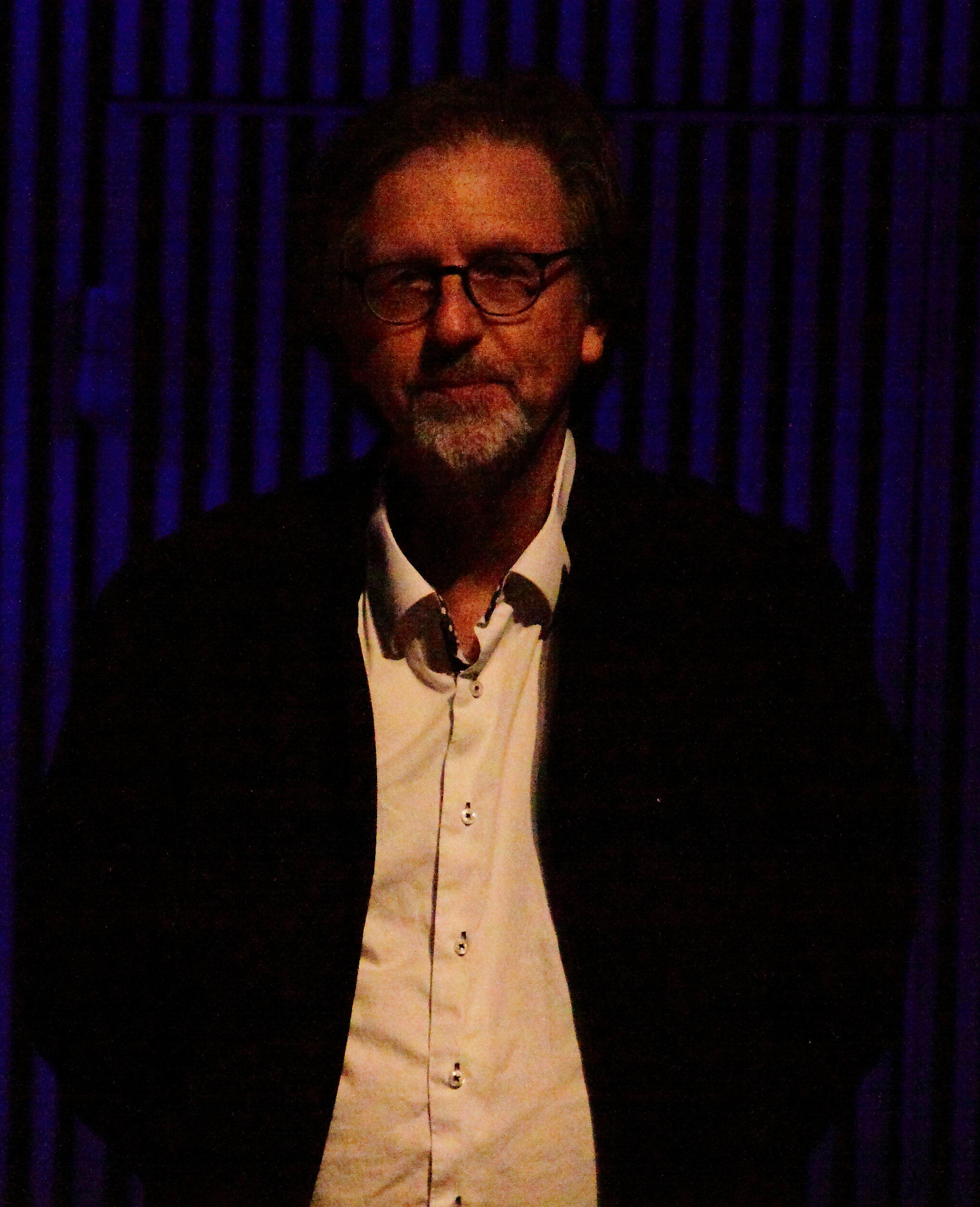
BHM160010

Lasse Thoresen takes the stage to acknowledge the applause.

Next was an unusual, humorous/dramatic work by Cecile Ore called Dead Pope on Trial (2015/16) with a libretto by Bibbi Moslet.   This Other Minds commission was given its world premiere at this concert.  The work is based on the story of a medieval pope who was taken from his grave no fewer than six times for various perceived offenses.  It is a mix of irony and humor in a sort of madrigal context.  The work was in English and had the nature of a conversation between the singers.  No doubt a challenging piece, it was sung very well and the composer seemed as pleased with the performance as much as the audience.

BHM160011

Cecile Ore smiling as she acknowledges the applause for the wonderful premiere performance of her new work, Dead Pope on Trial.

As if in a demonstration of sheer stamina in addition to virtuosity Nordic Voices took the stage again, this time for some Madrigals (2002/2016) by returning artist Gavin Bryars.  Bryars is no stranger to Other Minds or to madrigals and such older musical forms from the renaissance and before.  He has extensively explored vocal writing and medieval harmonies in many previous works.  Though categorized as being a “minimalist”, Bryars actually has produced a huge range of music in all forms including opera, chamber and orchestral music.

His madrigals have been written for the Hilliard Ensemble and each book is distinguished by the madrigals having been written on a specific day of the week.  The first book on Mondays, etc.  They are settings of Petrach’s sonnets and are sung in the original Italian of his day.  On this night we were treated to four madrigals from Book Two and the premiere of a madrigal from Book Four.  That madrigal was dedicated to Benjamin Amirkhanian, the father of Charles Amirkhanian who celebrates his 101st birthday this summer.

I had the opportunity to meet and speak briefly with the affable Mr. Bryars.  His generous spirit pervaded our conversation and he spoke very highly of both his visits to Other Minds.  If you don’t know this man’s music you are doing yourself a great disservice.

BHM160016

A very pleased Gavin Bryars deflects the applause and adulation to the amazing Nordic Voices for their astounding performance of five of his madrigals.

The singers of Nordic Voices sustained a high level of virtuosity as well as sheer stamina as they sang for nearly two hours in the opening pieces of this concert series.  No time was lost setting the stage for the performance of the next piece, another premiere, Algebra of Need (2016) for electronic sampling and string quartet by Bang on a Can member Phil Kline.

BHM160045

FLUX Quartet playing at SF Jazz, 2016

The Flux Quartet was featured in the next two (and last) works on this long program.  Algebra of Need is Kline’s meditation on the words and the cadences of the iconic writing and voice of the late William S. Burroughs (gone 19 years as of this writing).  The familiar voice seemed to go in and out of clearly audible, at times mixed more closely with the string writing in this intense homage.

BHM160014

A satisfied looking Phil Kline leans in to embrace the first violin of the Flux Quartet after their premiere of his Algebra of Need.

The Bang on a Can collective was also represented tonight by Michael Gordon.  The Sad Park (2008) for string quartet and electronics put a most decidedly disturbing conclusion on the evening.  This piece, which samples the voices of children (one of them Gordon’s) as they spoke of their experience of the 9/11 Twin Towers attacks.

The effect was, as no doubt intended, harrowing leaving a pretty strange and unsettling feeling as we walked away from the concert into the still rainy night.
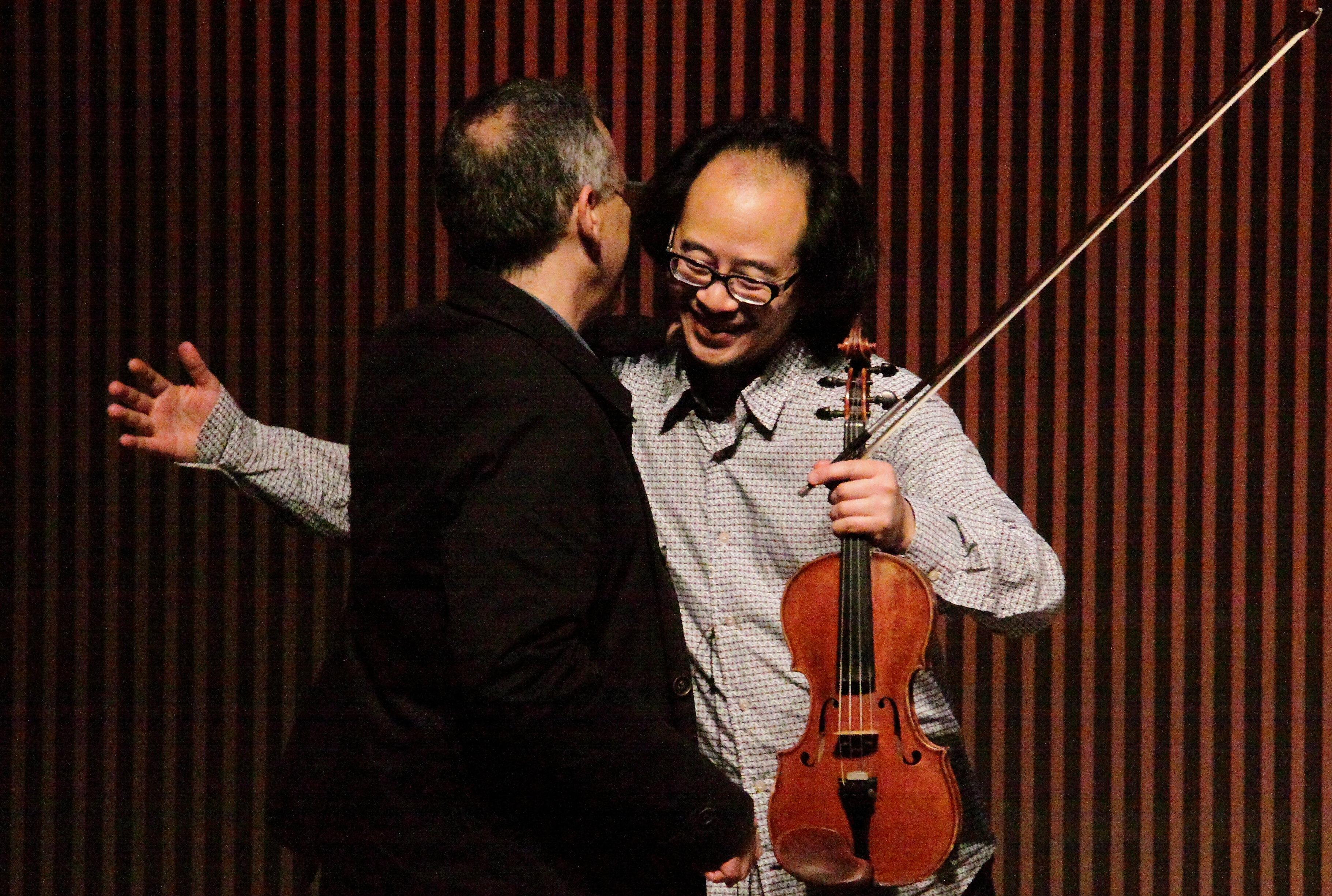
BHM160017

Michael Gordon embraces the FLUX Quartet’s first violin after a stunning performance of The Sad Park.

The rain continued on Saturday but the crowd was noticeably larger for the second night which opened with the usual panel discussion.

BHM160030

left to right: Meredith Monk, John Oswald, Nicole Lizee, Eliot Simpson, Larry Polansky, Oliver Lake and Charles Amirkhanian in a panel discussion prior to the concert

This evening began with a performance by the wonderful bay area violinist Kate Stenberg of a piece which was a sort of antidote to the somber, The Sad Park from the previous night.  Again the composer was Michael Gordon and the piece was Light is Calling (2004), a collaboration with filmmaker Bill Morrison.  Though hardly a happy piece Light is Calling is perhaps elegiac and the composer seems to achieve some of his stated intent to find some healing in the wake of a disaster to which he was all too close.

BHM160031

Kate Stenberg plays violin beneath the projection of a Bill Morrison film in Michael Gordon’s, Light is Calling

BHM160032

Michael Gordon and Kate Stenberg accepting the applause of an appreciative audience.

Next up was John Oswald, a Canadian composer whose career took off in infamy when his Plunderphonic CD, released to radio stations in the early 1980s, became the subject of legal battles over the meaning of copyright law in light of digital sampling.  Fortunately Oswald won the right to publish his work and his Plundrphonics concepts now underlie much of his compositional process.  Until this night I had not heard any but his Plunderphonic CDs so the introduction to his live music was a revelation.

BHM160033

Pianist and (at least here) multi-instrumentalist Eve Egoyan performing with a Yamaha Disklavier and other instruments.

The first piece she did was called Homonymy (1998/2015) was originally written for chamber orchestra and was then transcribed for Egoyan and her prepared disklavier et al.  It is a piece based on linguistic elements and with a visual component as well.

BHM160034

Eve Egoyan performing Homonymy with overhead projections.

Nicole Lizee’s David Lynch Etudes (2015) was the next piece  and also made use of the projection screen.  The subtitle of the piece indicates it is for “disklavier and glitch”.  Well life imitated art as some sort of glitch prevented the projection from functioning at first but this was rather quickly resolved and we were treated to excerpts of scenes from several David Lynch films with the piano playing some of the rhythms of the dialog in an exchange that puts this writer in the mind of music like Scott Johnson’s “John Somebody” and Steve Reich’s incorporation of speech rhythms in works like, “The Cave”.

Nicole Lizee is a Canadian composer and was the youngest composer on this year’s program.
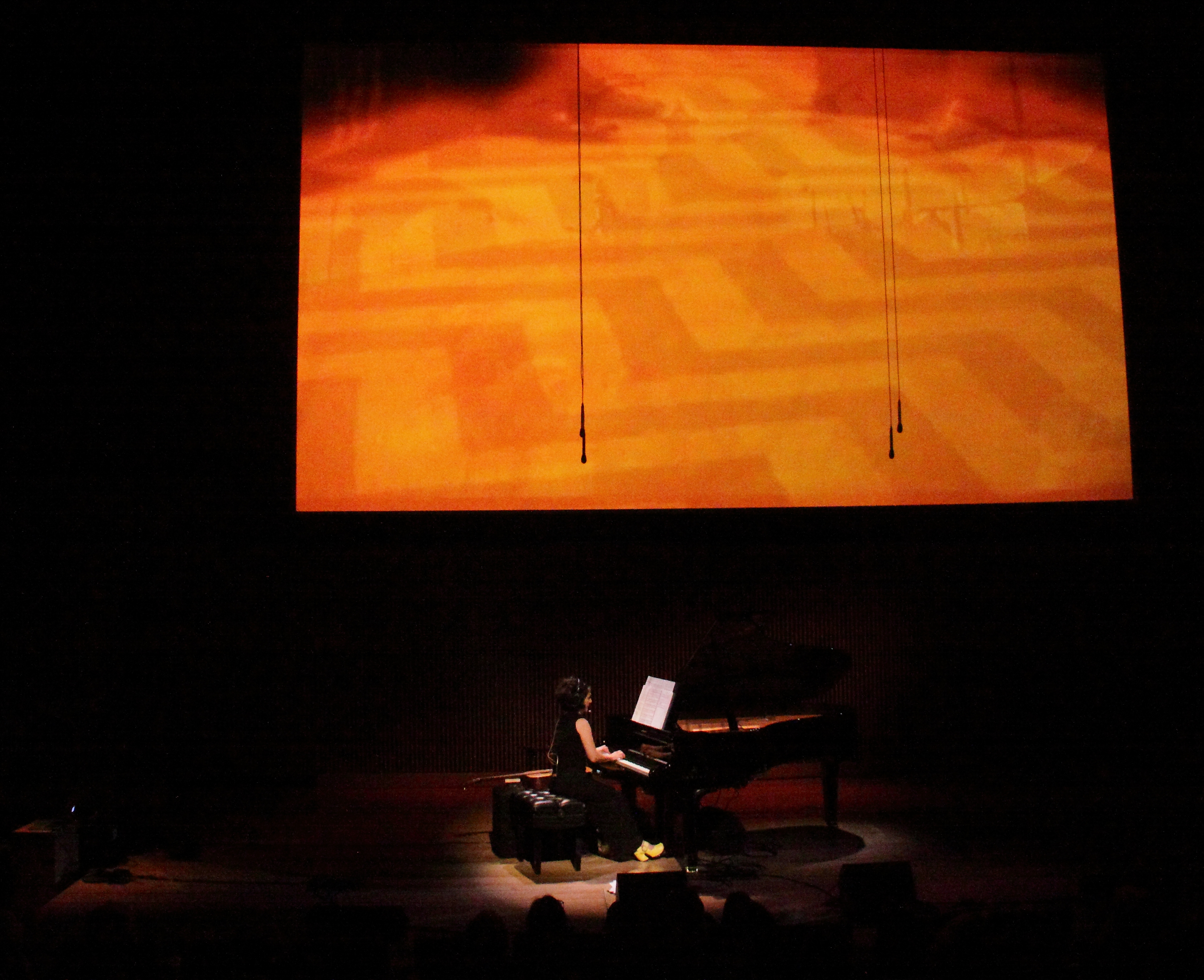
BHM160035

Eve Egoyan playing Nicole Lizee’s David Lynch Etudes with projected scenes/glitches from Lynch’s films.

The work is one of a series of pieces inspired by films and was executed with apparent ease by pianist Eve Egoyan who played the disklavier (both the keyboard and directly on the strings), a guitar and perhaps other gadgets .  The piece kept her quite busy and the associations I described above sound nothing like this work actually.  These etudes were a unique, typically Other Minds sort of experience, one that expands the definition of musical composition.

BHM160036

Nicole Lizee (l) with Eve Egoyan absorbing the audience’s appreciation of the David Lynch Etudes.

Two more John Oswald compositions graced the program next.  Palimpia (2016) is a six movement piece for disklavier with pianist playing as well.  Oswald says it is actually his first composition for piano.

BHM160046

John Oswald embracing pianist Egoyan and enjoying the audience applause for his work.

Well I did say there were two more Oswald pieces but this last one was a masterful plunder by this truly unusual composer.  Here Oswald conjured the playing as well as the image of the late great Glenn Gould who was seen actually playing Invaria (1999) with the disklavier performing along with the film of Gould performing this music.  It was, for this writer, a spellbinding experience.  He has raised the dead in the name of music.  Wow!  It was an amazing and heartfelt homage to a fellow great Canadian musician.

BHM160038

Glenn Gould playing John Oswald

Larry Polansky (1954- ) is well known as a teacher and as a composer but one is hard pressed to find much in the conventional discography of his work.  The few discs out of his amazing electronic music (and one disc of piano variations) represent only a small fraction of his output and represent only one genre of music which he has mastered.  However the astute listener needs to be advised to look online to look, listen and hear some of the bounty of his creative output.  Check out the following sites: Frog Peak Music (Polansky’s publishing site which includes music and scores by a great many interesting composer in addition to himself and Dartmouth Page (which contains link to various recordings, writings, computer software, etc.

BHM160039

Giacomo Fiore (left) and Larry Polansky playing Polansky’s ii-v-i (1997)

As an amateur musician who has enough trouble simply tuning a guitar it made my knees weak to watch these musicians effortlessly retune as they played.   Polansky’s experimentation with alternate tunings is an essential part of many of his compositions.
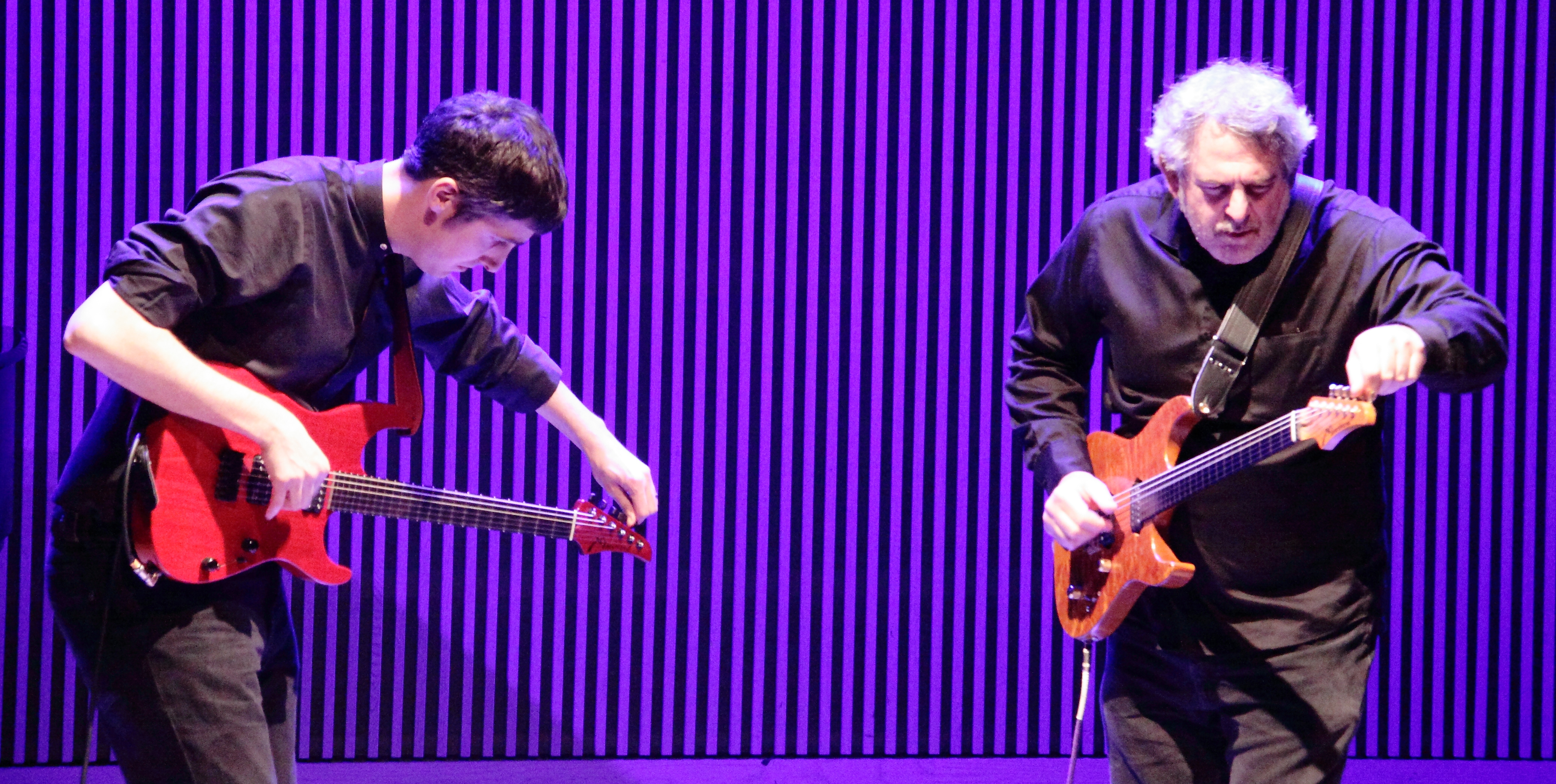
BHM160040

Fiore and Polansky changing their tunings mid-phrase in a stunning demonstration of virtuosity with pitch changes.

The program then moved from the electric to the acoustic realm with Polansky’s folk song arrangements.  Eliot Simpson, the pedagogical progeny of the great David Tanenbaum (who played these concerts last year at OM 20), played the just intonation National Steel Guitar and sang.

Let me say just two things here.  First, these are not arrangements like Copland’s Old American Songs and second, I will never hear these folk songs quite the same way again.  Polansky’s interest in folk music and Hebrew cantillation along with alternate tunings produces what the ears hear as perhaps a different focus.  In these pieces he did not stray too far from the original (as he does in his Cantillation Studies) but one is left with distinctly different ways of hearing and thinking about this music and the listener is left richer for that.  It is a journey worth taking and Simpson played with both passion and command.

Eliot Simpson playing a selection of Larry Plansky's Songs and Toods

Eliot Simpson playing a selection of Larry Plansky’s Songs and Toods

Polansky returned to the stage for a performance of his 34 Chords (Christian Wolff in Hanover and Royalton) (1995). Again we were treated to the virtuosic use of alternate tunings performed live (and again with live re-tunings) by the composer.

Oliver Lake delivering a blistering free jazz improvisation.

Oliver Lake delivering a blistering free jazz improvisation.

Continuing with the solo performer theme we were privileged to hear the virtuosic jams of Oliver Lake (1942- ) whose long career is legendary in the jazz world.  The “mostly improvised” (according to the composer) Stick was played on two different saxophones in what appeared to be as intense an experience for the performer as it was for the audience.

Oliver Lake takes a final bow at the end of the second concert of OM 21

Oliver Lake takes a final bow at the end of the second concert of OM 21

The emotional workout was received warmly by the audience.

Charles Amirkhanian introduces Meredith Monk on the final day of OM 21

Charles Amirkhanian introduces Meredith Monk on the final day of OM 21

There was no panel discussion on the third day of OM 21.  This matinée was dedicated entirely to the work of Meredith Monk (1942) who, fittingly was one of the featured artists in the first Other Minds gathering in 1993.  Now a recipient of the National Medal of the Arts this beloved artist returns to OM 21.  Though the rain continued the house appeared to be full.
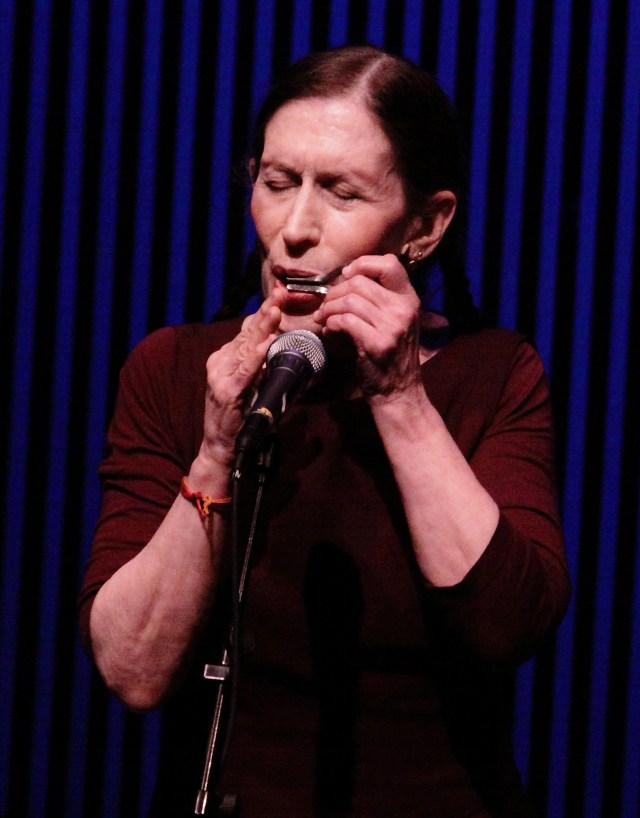
Meredith Monk playing a Jaw Harp in one of her early solo songs.

Meredith Monk playing a Jaw Harp and singing in one of her early solo songs.

Monk played a selection of material from various periods in her career in a mostly chronological survey which she called The Soul’s Messenger.  She began with selections from her solo songs and proceeded to her voice and piano music, then to her work with multiple voices and instruments.
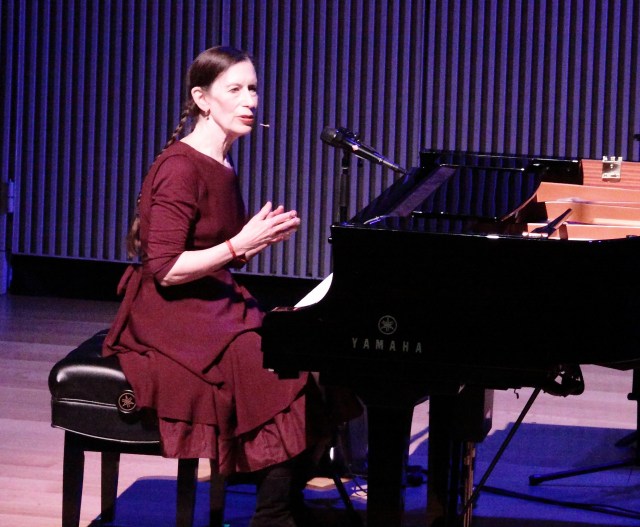
Meredith Monk performing her signature Gotham Lullaby

Meredith Monk performing her signature Gotham Lullaby

Most of the audience seemed to have a comfortable familiarity with the individual works she offered on this night which effectively gave a picture of her career.  Monk was in good voice and appeared to enjoy her performance.

Long time collaborator Katie Geissinger and Allson Sniffin joined in the next selection

Long time collaborator Katie Geissinger and Allson Sniffin joined in the next selection

The stage was set to allow for the dance/movement that is an essential part of Monk’s works.  She originally trained as a dancer.

Monk and long time collaborator Katie Geissinger reacting to the appreciative audience

Monk and long time collaborator Katie Geissinger reacting to the appreciative audience

In addition to the grand piano the stage was set with two electronic keyboards, an essential sound in many of Monk’s works.

Monk at one of the electronic keyboards

Monk at one of the electronic keyboards

Woodwind player Bodhan Hilash joined the ensemble for the last set of pieces.

From left: Bodhan Hilash, Meredith Monk, Allison Sniffin and Katie Geissinger

From left: Bodhan Hilash, Meredith Monk, Allison Sniffin and Katie Geissinger

The audience gave a standing ovation at the end resulting in 3 curtain calls.

Left to right Allison Sniffin, Meredith Monk, Katie Geissinger and Bodhan Hilash receiving a standing ovation.

Left to right Allison Sniffin, Meredith Monk, Katie Geissinger and Bodhan Hilash receiving a standing ovation.

And the properly prepared artist came back for an encore of her song Details.

Meredith Monk performing an encore at the final concert of OM 21

Meredith Monk performing an encore at the final concert of OM 21


It was a fitting finale to a great OM 21, fitting to have this artist who appeared on the first iteration of Other Minds returning now crowned with a National Medal of the Arts and clearly beloved by the audience.  Her music like her lovely smile fade to the edge of memory like that of the Cheshire Cat on a truly triumphant finale.

And, despite some format changes, who knows what treasures continue to lie in store?  I will be watching/listening and so, apparently will many others.  Keep an eye on www.otherminds.org .  I know I will.


Peace through “A Sweeter Music”


President Lyndon B. Johnson signs the 1964 Civ...

President Lyndon B. Johnson signs the 1964 Civil Rights Act as Martin Luther King, Jr., and others, look on. (Photo credit: Wikipedia)

Album cover

Album cover

It is fitting that this CD, this music has been released in the 50th anniversary year of the March on Washington and just prior to the 50th anniversary of the Civil Rights Act of 1964.  The series of 18 pieces in this major commissioning project by the wonderful bay area pianist, producer and new music advocate Sarah Cahill called “A Sweeter Music”, its title taken from a phrase in Martin Luther King, Jr.’s 1964 Nobel Prize lecture.  Though only 8 composers are represented on this recording this is a fine document of some truly wonderful and heartfelt music.  And Cahill’s introductory note indicates that there are plans to record the other ten pieces as well.

The project was planned to include video projections by Cahill’s husband, the skillful video artist John Sanborn.  The first formal performance took place on the Berkeley campus and the video projections across three screens added a dramatic perspective on the various pieces.  I was present at the first performance in Berkeley and later at a small multi-purpose hall in Point Reyes in the north bay.  At the smaller venue the projections were limited to a single screen but the images still added to the impact.  At the time of this writing Sanborn has posted some of these videos on You Tube ( http://www.youtube.com/user/sanborn707?feature=watch).

Still from one of Sanborn's videos.

Still from one of Sanborn’s videos.

Each of the recitals contained a selection of the pieces commissioned.  Sarah Cahill kindly provided the complete list which includes: Be Kind to One Another by Terry Riley, Peace Dances by Frederic Rzewski, There is a Field by Jerome Kitzke, Dar al-Harb by Preben Antonsen, The Olive Branch Speaks by Mamoru Fujieda, The Long Winter by Phil Kiline, Two, Entwined by Paul Dresher, War is Just a Racket by Kyle Gann, B’midbar by Larry Polansky, drum no fife by The Residents, Devotion to Peace by Michael Byron, Sonamu by Carl Stone, After the Wars by Peter Garland, A New Indigo Peace by Pauline Oliveros, Movement (Deep in My Heart) by Ingram Marshall, Study War No More by Bernice Johnson Reagon, toning by Yoko Ono and excerpts from Steppe Music by Meredith Monk.

The pieces represented on this recording are a diverse set including those by Frederic Rzewski, Terry Riley, Meredith Monk, Yoko Ono, The Residents, Phil Kline, Kyle Gann, and Carl Stone.  Missing from this disc, and planned for a future release, are the pieces by Jerome Kitzke, Larry Polansky, Pauline Oliveros, Preben Antonsen,  Sanborn’s images definitely enhanced the experience of the music and this writer hopes that some day this music might be released in a DVD format with those images but the pieces here stand easily on their own merits.

The disc opens with Terry Riley’s ‘Be Kind to One Another (rag)’ (2008-10).  Riley takes his title from a statement made by Alice Walker which followed the 9/11 attack on the World Trade Center.  Rather than express an anti-war stance Riley harkens to the days of his youth when he played barrel house piano music while he studied composition.  This is a jaunty and entertaining but substantial piece which expresses the wish for kindness.  It is a challenging work to play but not to hear.

‘Steppe Music’ (1997) is apparently a reworking of a 30 minute piano piece (the piece at hand lasts about 8 minutes) commissioned by Sarah Cahill for another masterful pianist, Nurit Tilles.  Meredith Monk is of course best known for her extended vocal techniques and dance/theater pieces.  Little of her piano music has been recorded and one hopes that there will be more to come.  This is a less literal contribution which, the composer says, is about “color, texture, resonance, and gesture…”.  Like her performance pieces this is music about images which evoke emotion and it is unlike any of Monk’s recorded piano music.

The seven ‘Peace Dances’ (2007/8) were written by a composer/pianist well-known for his political statements in music as well as for his virtuosic music.  Frederic Rzewski is probably best known for his massive set of variations on the protest song ‘El Pueblo Unido Jamas Sera Vencido‘ (The People United Will Never Be Defeated) commissioned in 1976 for Ursula Oppens.  His catalog contains a great deal of music with explicit and implicit political references.  Rzewski’s music sounds deceptively simple but is in fact very challenging to play.  These are part of a much larger set of compositions called “Nanosonatas”.  The dances here contain a variety of musical and political references that will entertain and frustrate musicologists for years to come but present the listener with some welcome additions to the repertoire.  Cahill plays them effortlessly and repeated listenings reveal more of the rich textures.  Rzewski’s inspiration, like that which inspired this series, is rooted in the same struggles as represented by Martin Luther King, Pete Seeger, gospel music and contemporary folk music.  The last of these dances was a birthday present for the 100th birthday of Elliott Carter.

Kyle Gann’s ‘War Is Just a Racket’ (2008) is written for speaking pianist.  He takes Christian Wolff’s ‘Accompaniments’, which was written for Frederic Rzewski in 1972 requiring the pianist to sing and speak as well as play.  It reminds this writer of Rzewski’s own ‘De Profundis’ of 1992 for speaking pianist using a text by Oscar Wilde.  Gann takes as his text a very interesting text by one General Smedley Butler who gave this speech in 1933.  Like Rzewski, Gann is no stranger to politics in his music.  This addition to the “speaking pianist” repertoire is spoken with feeling by Cahill as she pounds out the angry chords and melodies.  This is perhaps the most literal of the pieces on the disc and probably the least friendly to a conservative audience.

Sonamu (2010) was written by Carl Stone for piano and electronics.  It’s not the electronics your grandmother listened to either.  Stone uses a computer to perform “spectral convolution”, a process, the composer explains, which isolates various aspects of the sounds to “…shape and enclose the pitch and harmonies of separate voices…”.   The intention stated by Stone is to evoke ghosts and memories of the aftermath of war.  This most complex and abstract piece reminds me of the ghost electronics compositions by Morton Subotnick.  This piece requires repeated listenings and would no doubt be enhanced by Sanborn’s images.

Composer Phil Kline describes a process of using various musical fragments edited together to evoke images of living in a land under siege.  Kline was an eyewitness to the World Trade Center disaster and his personal experiences contained metaphorically in ‘The Long Winter’ (2009) have a memorial-like quality.  In the liner notes he describes his fantasy images leading to the realization that he (and we) do live in a land (or perhaps a world?) under siege.  The piece is in two sections ‘Crash’ and ‘Embers’.

Yoko Ono’s ‘Toning’ (2008) purports to be an effort to heal both performer and audience through sound.  As with much of her work this piece has an anti-art quality like the work she produced for the Fluxus performances.  This is perhaps the technically simplest of the pieces on this recording.  I think that reactions will vary to this music much the way that they vary to Ono’s oeuvre.  Those familiar with her work will see the threads that connect and others may simply dismiss her work entirely.

The enigmatic San Francisco based group “The Residents” aspire to anonymity as individuals in the hope that their audiences will focus on their art.  This is clearly one of their performance art pieces and is fairly explicit in its anti-war stance.  It consists of recorded voices and sounds in addition to the live piano performance and demonstrates the eclectic range involved in these commissions.

This CD was recorded at the recital hall at the University of California at Santa Cruz by Tom Lazarus.  It was released as another of the fine recordings of contemporary music on the Other Minds label with Charles Amirkhanian of ‘Other Minds’ as executive producer.  It is a major addition to the recordings of this political classical genre and a significant contribution to the solo piano repertoire as well as a snapshot of an eclectic range of contemporary music of the moment.  Highly recommended.

Music 109, Alvin Lucier’s personal view of the post 50s avant garde


20130604-083336.jpg

This little volume is an endearing record of an undergraduate course, a music appreciation course designed for students with an interest in the music of the avant-garde of the 1960s, 70s and 80s taught by a man who was an integral part of that era as a composer, performer and teacher. The class, which he taught at Wesleyan University was reportedly very popular continues to be offered today. And this book is required reading for fans of new and experimental music.

In just over 200 pages Professor Lucier takes the virtual class of readers through a very personal journey of the music, experiments and performances of some of the highlights of some of the major works and composers of this time period. And he manages to navigate all this wildly experimental music in a way that is understandable to a general audience (remember that this is an undergraduate course for non music majors).

What makes this book so special and unique is its personal nature (Lucier was a composer, performer, organizer and interpreter of much of the music) and the particular networks to which he connects. Few historians save for Kyle Gann pay significant attention to the techniques which arose from the orbit of Ann Arbor, Michigan and composers like Robert Ashley, Gordon Mumma and Lucier himself among many others. But this group is indeed an orbit and not a universe unto itself. David Tudor, for example, crossed paths with these composers as well as, more famously, with John Cage and the New York School.

This delightfully readable volume narrates Lucier’s vast experience with and love for a variety of experimental trends. Lucier writes of his own works and places them within the contexts of fellow innovators including the above mentioned artists as well as diverse voices such as Pauline Oliveros, Philip Glass, Steve Reich, LaMonte Young, Roger Reynolds, Gordon Mumma, Robert Ashley, Earle Brown, Morton Feldman, John Cage, Christian Wolff, David Tudor, Karlheinz Stockhausen and many others. This personal inside view makes for entertaining and compelling reading which provides a historical context as well as insights to the “method behind the madness” of a diverse and innovative time in music history.

Except for Kyle Gann’s fine volume on Robert Ashley this is the only book length treatment (known to this reviewer) of artists connected with the ONCE festival and the Sonic Arts Union. Lucier’s place in music history is connected across east coast academia as well as far less academically connected groups like these. This book connects some of those dots placing an important perspective on this era.

Earlier this year I had the pleasure of speaking with Paula Matthusen, a composer who now teaches at Wesleyan. In fact she has inherited this delightful and inexplicably popular course. She told me that not only does the course continue to be popular, many of the students come in with some level of experience of this music and a desire to know more. How cool is that?

Matthusen shares many of her teacher (Lucier’s) concepts in her own work but she is clearly the next generation in experimental music reminding us that art of the era documented is receding into the past yet we hardly know it. And how can we appreciate the latest work without some understanding of how we got there? Lucier’s book provides a great introduction and hopefully will encourage more attention to this important and fascinating time in American music history.