Black Composers Since the 1964 Civil Rights Act


In this, the 50th anniversary year of the landmark 1964 Civil Rights act I have decided to do a survey of black composers who have come of age in the aftermath.  The push for equal rights in the way people are treated, given access to voting, education, business and financial opportunities was the spirit of that legislation.  Though many speak of a “post-racial” America it is clear from any fair analysis that we have a long way to go.

President Lyndon B. Johnson meets with Civil R...

President Lyndon B. Johnson meets with Civil Rights leaders Martin Luther King, Jr., Whitney Young, James Farmer (Photo credit: Wikipedia)

I am beginning a series of articles in honor of Black History Month and in honor of this legislation which attempts to address this inequality. Each article will feature a composer or composers whose work I personally find interesting and worth promoting and which was written or premiered in or after 1964.  I will not necessarily limit myself to Americans both because that would be unnecessarily constricting and inconsistent with the spirit of Black History Month and because non-American black composers suffer similar obscurity and may have even benefited from the 1964 legislation.

Civil Rights Act of 1964

Civil Rights Act of 1964 (Photo credit: Wikipedia)

Whether the legislation has improved the opportunities for black composers is, of course, open to debate but the quality of these artists stand alone on their own merits.  They may have had opportunities not available to their predecessors and this may be a positive result of this legislation.  But the fact that awareness of their work is limited and promoted in relatively obscure contexts such as this blog suggests that true equality in the area of recognition of artistic merit remains elusive (though the availability of recordings of the music of black composers has certainly increased) .  Curiously the United States has chosen the shortest month of the year to celebrate Black History whereas England, who abolished slavery before the U.S., celebrates it in October.  Yes, it’s only 3 days, but the irony is hard to miss.

The pioneering work of musicologist Dominique-Rene de Lerma has done a great service in promoting the work of black composers internationally.  He was involved in the production of the landmark series for Columbia Records along with the great (now retired) conductor Paul Freeman recording a variety of music from black composers world-wide. I had discussed this set in a blog last year and it is worth mentioning that the complete set of recordings has been reissued on 9 vinyl discs as a result of a Ford Foundation grant and remains available through the College Music Society in Missoula, Montana for $35.  This beautifully produced box set deserves an honored place in any record collection.

This pioneering set has inspired similar series by Albany Records and Cedille Records which have made recordings available of some very attractive music of black composers which deserves a wider audience.  It is largely these sets and the writing of Professor de Lerma which serve as the source for the series I am doing on this blog.

The internet site africalssical blog is also a very useful resource which is updated frequently and reports the work of black musicians working in the so-called classical world.  It is difficult and perhaps superfluous to try to separate jazz and classical so I will include composers without concern for specific genre categories except, perhaps, pop composers whose work is well-represented in the mainstream.

Pioneering black musicians like Natalie Hinderas, Martina Arroyo, Marian Anderson, Dean Dixon, William Grant Still and their like paved the way for their successors such as Kathleen Battle, Jessye Norman, Paul Freeman, George Walker and others whose stars became visible to the casual onlooker.  Of course there are fine black classical artists whose talents remain too little known.  How many people know Awadagin Pratt, Mark Doss, Michael Morgan and other active black musical artists?  It takes much more work for listeners to find and appreciate their talents.

It takes even more work to find black composers, especially if they are not also performers.  Most people, even most musicians, would have difficulty naming a single black classical composer.

I contacted several prominent black musicians to pose the question of how the Civil Rights Act of 1964 has impacted black classical composers.  To date I am pleased to say that I have received two gracious replies.  The first is from Michael Morgan who currently serves as conductor of the Oakland East Bay Symphony, the Sacramento Philharmonic and the Festival Opera in Walnut Creek.  He has numerous recordings to his credit as well.  Maestro Morgan replied as follows:

Michael Morgan (1957- )

Michael Morgan (1957- )

“I don’t believe the 64 Civil Rights Act has impacted black composers directly, however, the national conversation it inspired did cause performing arts groups (and their philanthropic supporters) to look for new ways to expand their audiences into communities not traditionally as well represented in concert halls. Orchestras are still making efforts (some more sincere than others) to connect with various minority communities. Unfortunately, rather than sprinkle such efforts throughout their seasons, some have opted for the annual Martin Luther King or Black History Month (or Cinco de Mayo, or Chinese New Year, etc. etc.) concert resulting in less sustained contact than might otherwise be possible. Such concerts have, however, been something of a boon for black composers, performers and conductors who find themselves at least included on orchestra programs on those annual occasions.

There may have been a more direct impact on the integration of some concert halls in particularly segregated cities, but the performing arts have historically been somewhat ahead of society in general in terms of promoting fully integrated events, at least in communities where there was significant acceptance of such integration.”

Morgan’s practical approach to programming is evident here and the point is well-taken that consistent programming of minority composers would result in a more sustained impact than simply having focused efforts during given months or weeks.  In fact this notion has convinced me that my blogs on the subject might be more effective if I were to spread them throughout the year, something which I will now incorporate.  My previous blog post on black classical conductors which included Maestro Morgan has been one of my most frequently viewed posts and I will expand on that subject in the months to come.
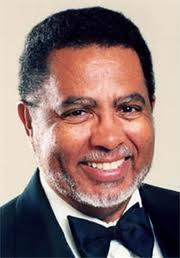
Adolphus Hailstork

Adolphus Hailstork

The second reply was from eminent composer Adolphus Hailstork who was the subject of my first blog post for black history month from last year.  He replied very thoughtfully as follows:

“Fifty Years After the 1964 Civil Rights Act

Having grown up in New York State and not experienced “legalized” segregation as practiced in the South, I had enjoyed as a youth, all the rights and privileges of American citizenship due me. There were no “colored” this and “white” that signs or classrooms, or lunch counters, etc. So the Civil Rights Act of 1964 did not have a direct effect on my life at that time.

(I much later came to appreciate the value of the changes in the south when I came to live there as a working adult.)

Actually, it was the assassination of Dr. King that opened doors to my beginning my doctorate degree that same year when I got out of the army (1968).

Also, that tragic event influenced the unfolding of my career, because it led to an interest in the music of African-American classical composers for the honoring of Dr. King’s birthday celebration in January and, by extension, the heightened interest in such music during the February Black History Month observance.

I believe the history of African-Americans is tragic, heroic, triumphant, and, of course, filled with awesomely dramatic stories. It is an honor to attempt in some small way to pay tribute through music to our story.”

Clearly Dr. Hailstork notes the difference between his experiences in the north where he was born and was able to see the profound contrast he experienced working in the south at Old Dominion University in Virginia particularly during the early civil rights struggles and their aftermath.  The emotional impact of the assassination of Dr. Martin Luther King in the same year he concluded his military service  is noted as a formative issue as well.

One can easily hear the deep emotional impact of which he speaks in works like his second symphony from 1999 which reflects his feelings after having visited the slave markets of West Africa and his American Guernica (1983) which is about the Birmingham 16th Baptist Church bombing which killed 4 little girls in 1963.  Other works such as his Epitaph for a Man Who Dreamed, In Memoriam Martin Luther King, Jr. (1979) also reflect the impact of these events on him personally and reflect what he describes as his feeling of honor in being able to pay tribute to these tragedies describing them aptly as “our story”.

I think it is important to begin to see the tragic and triumphant events of the civil rights era as our American story and not just as the story of black Americans.  Indeed these events are part of our collective history as human beings and as Americans.  These are stories that need telling and re-telling as a part of the healing process and the exorcising of the evil deeds of our collective past.

Enhanced by Zemanta

MLK, the Classical Playlist


President Lyndon B. Johnson meets with Martin ...

President Lyndon B. Johnson meets with Martin Luther King, Jr. (Photo credit: Wikipedia)

There is no doubt that rhythm and blues is the soundtrack of the Civil Rights Movement but in this, the 50th anniversary of the 1964 Civil Rights Act, I am issuing a programming challenge to the classical music world.  Hey there all you classical music stations, both internet based and broadcast.   Hey there Spotify and Pandora.  Have you explored the music written for and about the Civil Rights era?  Well, here’s your chance.

I begin my programming day with Joseph Schwantner’s “New Morning for the World” (“Daybreak of Freedom”), written in 1982.  Comparisons to Copland’s “Lincoln Portrait” are made due to the similarity in character and the use of a narrator.  The other work on this  Oregon Symphony CD under the late great James De Preist is  a work by an older composer Nicolas Flagello.  The cantata, “The Passion of Martin Luther King” from 1968, was composed in the shadow of the assassination of Dr. King and first performed in 1969.  Both works deserve more hearings for their musical accomplishments as well as for the subject of their dedications.

Description unavailable

Description unavailable (Photo credit: pennstatenews)

Moving on to the next segment I will move on to Adolphus Hailstork‘s 1978 “Epitaph for a Man Who Dreamed”  followed by William Grant 1930 Symphony No. 1 “Afro-American”.  Still is rightfully known as Dean of Afro-American composers.  A contemporary of Aaron Copland, his accomplishments established without a doubt the place in classical music for black composers.  Hailstork acknowledges his debt to the older master.  He is the next generation of black musicians contributing to the repertoire.  I will conclude this segment with Hailstork’s Symphony No. 2 which contains his impressions upon visiting the slave market areas of western Africa, places where began the shameful history of black slavery.

And on we go now to Luciano Berio’s 1968 “O King”, a chamber piece later incorporated into his masterwork, “Sinfonia” of the same year.  I program the version from Sinfonia, it’s my favorite rendering.  The vocal parts of this piece are solely comprised of the name “Martin Luther King”.  Also from 1968 there is Michael Colgrass’ “The Earth’s a Baked Apple” which is subtitled, “A Musical Celebration in Honor of Dr. Martin Luther King, Jr.” (psst, I have a bootleg of it).

We move on to afternoon programming featuring Anthony Davis’ opera, “X”, based on the life of Malcolm X.  This is  a work that deserves a new production.  Following this I will move on to Duke Ellington‘s 1943 “Black, Brown and Beige” Suite and then his “Three Black Kings” titled in French with rhyming wordplay as “Les Trois Roi Noir”.

Album cover

Album cover

The program would be incomplete without programming the wonderful Other Minds CD of Sarah Cahill’s album “A Sweeter Music” featuring a diverse collection of compositions written for her on commission by Terry Riley, Meredith Monk, Frederic Rzewski, Kyle Gann, Carl Stone, Phil Kline, Yoko Ono and The Residents.  The title is taken from Dr. King’s Nobel Prized lecture in which he refers to peace as “a sweeter music”.

Dizzy Gillespie

Cover of Dizzy Gillespie

I will end my fantasy program with Dizzy Gillespie’s “Brother K’ and Hale Smith’s “In Memoriam Dr. Martin Luther King, Jr.”  But fear not I leave you with a useful reference I have recently discovered.  “A Catalog of Music Written in Honor of Martin Luther King, Jr.” edited by Anthony McDonald.

Stay tuned for more on these subjects coming up during February for Black History Month.  Peace, Dr. King.

A mural painted on the side of the African Ame...

A mural painted on the side of the African American Museum depicts the Hough riots, the civil rights movement and a family looking towards a bright new future for the city and the community. (Photo credit: Wikipedia)


Enhanced by Zemanta

Alvin Curran at 75, Experimentalism with an Ethnic and Social Conscience


English: The American composer Alvin Curran pl...

English: The American composer Alvin Curran playing the shofar in his composition “Shofar 3,” for shofar and live electronics (2007). Photo taken at a concert of Curran’s music in Warner Concert Hall, Oberlin Conservatory of Music, Oberlin College, Oberlin, Ohio, United States. (Photo credit: Wikipedia

Alvin Curran (1938- ) is an American composer currently living and teaching in Rome whose career began as an expatriate artist working with the cutting edge improv electronics group Musica Elletronica Viva (MEV) in 1966. He turns 75 on December 13, 2013.

Curran was born in Providence, Rhode Island.  His father was a musician in a dance band and he learned to play piano and trombone early on.  He was exposed to big band music, jazz, traditional Jewish music and western classical music during his formative years.  Following his father’s example he also played in dance bands during boat crossings of the Atlantic.  He earned a B.A. in music from Brown University in 1960 where he studied composition with Ron Nelson.  He went on to complete his M.M. at Yale in 1963 were he studied with Elliott Carter and Mel Powell.

A 1964 Ford Foundation grant allowed him to go study in Darmstadt where he met the likes of Stravinsky, Xenakis, Berio, Yuji Takahashi, Andriessen, Remo Remotti, and above all Frederic Rzewski.  He joined with Rzewski,  Richard Teitelbaum and Allan Bryant, all fellow expatriate American musician/composers, with whom he formed the legendary ‘Musica Elettronica Viva‘ or MEV.  This was in early 1966 where their use of largely home made electronics in their improvisational ensemble live performances preceded the days of easily obtainable and operated electronic musical instruments. That wouldn’t begin to happen until about 1964 when Don Buchla, in collaboration with Ramon Sender, Morton Subotnick and the San Franciso Tape Music Center created the first modular instrument, the “music easel” later known as the ‘Buchla Box’ and Robert Moog on the east coast developed the “Moog” synthesizer.  Curran crossed paths with many of these people during his tenure teaching (1999-2006) at Mills College in Oakland where the San Francisco Tape Music Center had been integrated into the Mills Center for Contemporary Music.

Curran says that during all his years in Rome he met and interacted with many in the Italian avantgarde and new music circles like Franco Donatoni and Guiseppe Chiari.  He was mentored by the reclusive (think Thomas Pynchon) Giacinto Scelsi who held regular salons at his villa.  It was in these days that Curran developed his individual style further.  He lived and taught in Rome from 1966 to 1999 and was very active on the European scene.  After his teaching stint at Mills College Curran returned again to Rome.

Buchla 100 series modular synthesizer at NYU

Buchla 100 series modular synthesizer at NYU (Photo credit: Wikipedia)

In addition to electronics he uses acoustic instruments ranging from conventional instruments such as piano, strings, woodwinds, voices, etc. to the ancient shofar and environmental sounds including site-specific sound installations, multi-media works and film scores.  His works include the massive set of piano pieces ‘Inner Cities’ (1993-2010) which lasts about 6 hours in a complete performance, the early multi-media Songs and Views from the Magnetic Garden (1973), Maritime Rites (1984) written to be played by musicians in boats in various harbors incorporating, of course, the ambience of the given harbor’s acoustic properties.  Maritime Rites has been performed in its various incarnations in Central Park in New York as well as Philadelphia, Berlin and Sydney.

In a wonderful interview from 2003 with the ever vigilant composer/journalist Frank Oteri (published online at New Music Box) he was asked about the political and ethnic/religious content of his music.  Curran replied that he did not set out to express these things as aspects of himself, that the pieces  just happened due to an inspiration at the time.  He says that he is composing all the time and his influences are as wide ranging as his teachers and his milieu.  His style varies widely in part due to his many influences but also because a given style seems to work for the piece.  It sounds as though music is channeled through him.

Unfortunately, as with most expatriate composers, his music is generally less well known in his native country but there are quite a few recordings including some recent releases of some out of print recordings.  In addition there are quite a few videos on YouTube including pianist Kurt Jordan’s live performance of Inner Cities 1-13 from 2009 at Azusa Pacific University which is more than the previously complete recording by Daan Vandewalle who recorded 1-11 (as of 2010 there are 14 parts according  to Curran’s official web site).   As is frequently the case with much contemporary music YouTube provides a great resource, especially for the casual and/or cash-strapped listener.  It is a really good way to get familiar with this man’s diverse and fascinating music.

Not infrequently his music takes on sociopolitical issues as well as inspiration from the composer’s Jewish heritage.  His Schtetl Variations (1987), dedicated to Morton Feldman is an improvisatory meditation on these poor villages of eastern Europe and Russia (think of Fiddler on the Roof) which became the settings for the notorious anti-semitic pogroms. A later piano piece called 11 Schtetl Settings (1988) continues his exploration of this part of his ancestry.  Animal Behavior (1992) for sampler keyboard and optional percussion is a pretty transparent indictment of 1990s American politics.  And the list goes on.

His “Nineteen Eighty Five: Piece for Peace” (1985) involved three ensembles performing at 3 different radio stations in Venice, Amsterdam and Frankfurt (which was simulcast by all three countries) is a a sort of precursor to what is perhaps his most integrated and powerful political composition, his ‘Crystal Psalms’ of 1988.  Here the historical, sociopolitical, ethnic and even geographical are joined to the avant garde in a stunning sonic commemoration and condemnation of the fascism and genocide that characterized the horrors of the second world war.

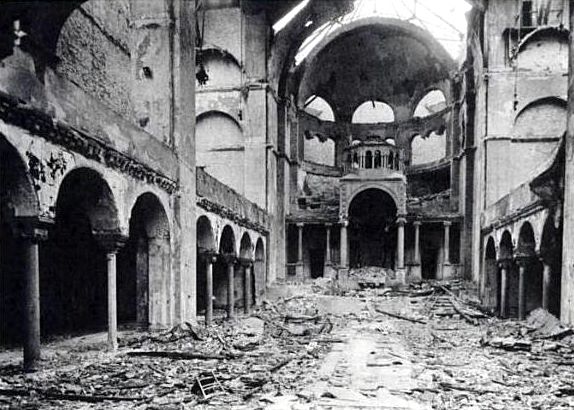
Interior of a Berlin Synagogue after Kristallnacht

Interior of a Berlin Synagogue after Kristallnacht

Seventy Five years ago this November (9th and 10th) Jewish shops and synagogues were vandalized and looted over those two nights throughout much of Nazi Germany and Austria in a most extreme incarnation of the “pogroms” that became known as “Kristallnacht” or the “Night of Broken Glass“.  It was one of the first major and overt expressions of Hitler’s genocidal plans then still being formulated. Unfortunately this event continues to be imitated by like-minded hateful individuals and groups worldwide. So the sociopolitical context of this musical work written for the 50th anniversary of that event sadly has an ongoing relevance for our contemporary world even 25 years after its creation.

At its most basic level this piece is a sort of concerto for six instrumental ensembles playing in radio stations in six different countries live mixed by the composer and broadcast throughout Northern Europe on October 20th of 1988. There is no text as such but the sounds of people praying and the apparently random Hebrew letters and German numbers are scattered throughout the piece along with environmental and found sounds on the tape Curran prepared which plays throughout the performance as a sort of political pedal point.

English: "Hebrew alphabet" in Hebrew...

English: “Hebrew alphabet” in Hebrew, modern serif typeface. (Photo credit: Wikipedia)

The liner notes of the recording describe the piece as “radio concert for six choruses; six sextets each including a quartet (violas, cellos, bass clarinets, bass flutes, trombones, tenor sax/tuba) plus accordion and percussion; tape.”  All were individually conducted with the conductors coordinated by a click track and mixed live by the composer. The recording on New World records is the document of that broadcast.

The effect is that of a collage connected by the electronic nervous system, the radio stations, which link the various performances.  The program is largely implicit here and listening to this piece evokes images that can vary from one listener to the next as any great piece of art provokes different experiences. The sound images here are not pretty and the work is very emotionally intense. Those images are guided by the tone of the music and fueled by the cryptic words and sounds mixed in with the live performances.  It is, in effect, his Mitzvah to the memories of the fallen.  You will not come away unmoved.

Kristallnacht occurred in November of 1938, a month before Curran was born but  the impact of that action continues to resound from that generation to this.  As a politically aware artist he was compelled to respond and he did so in a most emphatic, creative and powerful manner.  Perhaps it is the inherited duty of one generation to exorcise the demons and the atrocities of the previous ones.  Curran has certainly contributed most memorably to such an effort with this work.

Thank you, Mr. Curran, for your prolific and varied contributions to music and your efforts through your art to exorcise the demons of our collective past.  I wish you a happy 75th birthday and wishes for many more creative years to come.

Not Another Minimalist! (NAM): New and Lesser Known Minimalists


Philip Glass portrait

Philip Glass portrait (Photo credit: DailyM = Differentieel + JeeeM)

I have been a fan of so-called minimalist or pattern music for quite a number of years.  Since my first encounter with this type of music in the late 1970s I have listened with interest and been fascinated to hear how each composer expressed their own voice within that general rubric.  Though many have eschewed the label ‘minimal’ and argued over the alternate label ‘pattern music’ there are recognizable characteristics which continue to bind, however loosely,   Perhaps that is just another way of saying that I “know it when I hear it” but I think readers tend to get the general idea and I am open to discussion on what music I should include or exclude from these categories.

Kyle Gann

Kyle Gann (Photo credit: Wikipedia)

Anyway the point of this rambling little  post is to introduce a recurring series of posts about my personal discoveries in said genre.  You can be assured that I have scoured high and low but lay no claim to being either definitive or comprehensive.  What will follow will be an ongoing series of posts identifying the music of one composer or group whose music sounds minimalist or pattern based at least to my ears and which I find pleasing and/or significant in some way.  I will head each post with the identifying acronym NAM (Not Another Minimalist!).

Michael Nyman in Sant Cugat del Vallès

Michael Nyman in Sant Cugat del Vallès (Photo credit: Wikipedia)

The most useful books for me on this subject for me are those by Kyle Gann, Tom Johnson, Michael Nyman, Wim Mertens and Robert Fink.  I am listing these as my primary influences and do not mean to discount important works by other writers on the subject.  Gann’s ‘American Music in the Twentieth Century'(1997) and the collection of articles, ‘Music Downtown'(2006) remain among the most lucid descriptions and analyses of minimalist music.  He also maintains a blog with pretty regular posts at (http://www.artsjournal.com/postclassic/).  Gann’s work might not have been possible without the work of fellow composer and journalist Tom Johnson whose collection of reviews, ‘The Voice of New Music’ (1991) is one of the most important collections of reviews of the burgeoning ‘downtown music’ scene in New York in the 70s and 80s where purveyors of this genre first displayed their wares .  Both ‘Music Downtown’ and ‘The Voice of New Music’ are collections of reviews of concerts and events written for the Village Voice.

UCLA professor and music critic Robert Fink on...

UCLA professor and music critic Robert Fink on the “Different Strokes” panel at the 2009 Pop Conference, Experience Music Project, Seattle, Washington. (Photo credit: Wikipedia)

Michael Nyman’s book, ‘Experimental Music: Cage and Beyond'(1974) is among the earliest to describe this music and its context.  Wim Merten’s ‘American Minimal Music'(1988) is a great analysis of the essential canon.  Unfortunately these have been difficult to find lately and hopefully some reissues including digital formats may be forthcoming.

Robert Fink is a musicologist at UCLA.  His book, ‘Repeating Ourselves’ provides one of the most wide-ranging and comprehensive analyses of the concept of minimalism and pattern music.  He works across all music genres and cultural practices to identify a sort of minimalist ethic and has done much to shape my thinking in this area.

There are certainly many other fine books on the subject and that itself may need to be the subject of a future post.

I don’t like all music in this category (or any category for that matter) but it is the one which feels kind of like a personal discovery to me and a genre that continues to interest me.   And I can report that there is a good deal of music  outside the classic canon of minimalism that is definitely worth the effort to find.  And there are pieces of music written before the 1960s which appear in hindsight to have been sorts of precursors to this style.

This will be an occasional series of posts and I have decided to gather them under the somewhat facetious acronym of NAM (Not Another Minimalist) for the sake of easy reference should any reader actually find these posts useful.  My intent is both to share my discoveries and to generate debate and comment about this type of music.  I want to explore and share artistically interesting developments that lie outside the Reich/Glass/Riley/Young canon of minimalism.  As always I welcome discussion and feedback.

In the Mood for Food, a unique underground dinner/concert series returns to the east bay


The door is open to the underground restaurant.

The door is open to the underground restaurant.

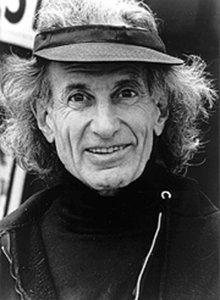
This past Monday October 7th there was a gathering of twelve people at a small loft space in West Oakland.  This is not a neighborhood known for about anything but light industry and cheaper rents.  But there are gems to be found in nasty old Oakland, CA and this is one of them.  It was the return of an irregular (approximately monthly) series of dinners and dinner concerts hosted by local vegan caterer and chef extraordinaire (and shakuhachi teacher as well) Philip Gelb.  These concerts, according to Mr. Gelb, were inspired by the Creative Music Studio which flourished in Woodstock, New York from 1971 to 1984 which featured many of the brightest and most innovative musicians in jazz, free improvisation and experimental music.  But the inclusion of such high quality creative cooking is unique here.

View through a glass, lightly.

View through a glass, lightly.

It has been many months since he last hosted one of these at his loft space.  Phil has chosen to combine his substantial cooking talents with his interest and connections with the music community to create this unique blend of freshly shopped and created vegan dishes with local and visiting musical talent.  This series, dubbed “In The Mood for Food”, is named after one of his favorite films, “In the Mood for Love” by Wong Kar-Wai.  The series has occurred more or less monthly for the last 8 years. To date I have enjoyed the creative and varied multi-course meals (which are frequently themed to the season or to the performer’s preferences) and have enjoyed both dinner conversation and performances by Pauline Oliveros, Terry Riley, Stuart Dempster, Gyan Riley, Tim Rayborn, Michael Manring, Barre Phillips, Mark Dresser, Amy X Neuberg and Pamela Z to name just a few.

The meals are always multi-course, locally created, sourced and shopped meticulously by Phil himself.  He serves only farm fresh ingredients, never canned or packaged and the recipes are his personal creations.  Food is served by the chef and one or two assistants depending on the size of the audience (maximum capacity is about 20 people).  Cost ranges from $40 to $60 per person, about what you would pay at a good area restaurant.  The musicians are either people with whom Phil has collaborated or found by word of mouth from other musicians and friends.  He has had many musicians call him to ask if they can play at his venue.  Why would that be?  There is no significant publicity or profit to be had here.  The answer, I believe, is the intimacy which is a combination of the loving creation of both food and music, both raised to an art form by their execution as well as their content.

There is reportedly a cook book in the works which, in addition to many carefully tested vegan recipes, will tell some of the history of this series.  Phil is occasionally soliciting recipe testers via Facebook.  He is also known for his hands on cooking classes.

As it happened, Monday’s event did not include music but it did include some familiar faces who I frequently encounter at these dinners as well as an overall interesting collection of guests who make for great conversation and frequently share their BYOB offerings.  In fact the bartender from the great San Francisco vegan restaurant, ‘Millenium’, asked to attend and to prepare some delicious cocktails specially designed by him and incorporating some of the food ingredients to enhance the experience.  Two of the guests were the operators of a local new tempeh making business called Rhizocali and their superior product was featured in the night’s food offerings.

Unfortunately I forgot to get a picture of the wonderful dessert course which consisted of pumpkin waffles, spiced pumpkin sorbet and maple tea poached pears.  Characteristically the attentive chef went around offering more scoops of the refreshing pumpkin sorbet which no one appeared to refuse as they engaged each other in pleasant conversations.  It is good to have this series back again and, well, let’s just say no one walked away unsatisfied.

Appetizer- Fresh rice noodles wrapped with apple smoked tofu and miso glazed, grilled pumpkin hijiki salad

Appetizer- Fresh rice noodles wrapped with apple smoked tofu and miso glazed, grilled pumpkin hijiki salad

First course- Kim chi soup with rice cakes, homemade kim chi in a seaweed/pumpkin broth and a little side dish of Pumpkin tempura brushed with gochujang

First course- Kim chi soup with rice cakes, homemade kim chi in a seaweed/pumpkin broth and a little side dish of Pumpkin tempura brushed with gochujang

Entree- Dumpling pumpkin stuffed with Thai red curry with Rhizocali Tempeh, gai fan, snap peas and Thai eggplant; jade pearl rice, green mango salad and lotus root pickles

Happy diners chatting after a fantastic dinner.

Happy diners chatting after a fantastic dinner.

Henry Brant?…never heard of him: A Centennial Sketch


Aerial photo: Santa Barbara, California

Aerial photo: Santa Barbara, California (Photo credit: Wikipedia)

I was sitting in the Sojourner Cafe, my favorite little restaurant/hangout just off downtown in Santa Barbara, California.  I was having one of many conversations with the great and interesting staff and patrons when I mentioned the name of Henry Brant, saying he lived in Santa Barbara.  “I never heard of him” came the response from Chris, a musician when not serving at the restaurant.  No one else showed any signs of recognition either.  I proceeded to tell him about the Pulitzer Prize winning composer.  It was then that flicker of recognition came across his face.  He told me that the frail figure using his walker was a familiar sight in the neighborhood, his eyes widened with interest as I told him about this major American musician.

Henry Brant

Henry Brant (1913-2008) was born in Montreal, Quebec, Canada to American parents.  His father was a professional musician. Henry played violin, flute, tin whistle, piano, organ, and percussion at a professional level and was fluent with the playing techniques for all of the standard orchestral instruments.   Henry went on to study at McGill University and later in New York at a school later named Julliard.  He was the youngest composer mentioned in Henry Cowell’s anthology, “American Composers on American Music” to which Brant contributed an article on what he called “oblique harmony”.

Brant, who had an early connection and affinity with the American experimental music tradition, would go on to develop “spatial music” in which musicians were scattered around the performance space as an essential part of the composition and performance.  He began writing music in the sort of post modern style of the time as in his Symphony No. 1 (1945 rev. 1950) and pithy little jazz inflected pieces like Whoopee In D (1938, Rev. 1984), Jazz Toccata On A Bach Theme (Toccata On “Wachet Auf”) (1940) and Double-Crank Hand Organ Music (1933, Rev. 1984).

He would write for unusual combinations of instruments such as Angels And Devils (1931), a concerto for flute and orchestra of flutes, Ghosts and Gargoyles (2002) also for flute and flute orchestra or Orbits (1979) for 80 trombones, organ and sopranino voice.  His first spatial composition, Rural Antiphonies (1953) predates Stockhausen’s famed experimental opus, Gruppen (1955-7).  In all he composed over 100 “spatial” works along with chamber music such as Homeless People (1997) for piano and string quartet.  His composition Ice Field (2001) commissioned by Other Minds and performed in Michael Tilson Thomas‘ “American Mavericks” series won him the 2002 Pulitzer Prize for music.

Brant had worked as an orchestrator and conductor in Hollywood assisting with scores by Alex North and with the likes of Virgil Thomson, Aaron Copland, George Antheil, Douglas Moore and Gordon Parks.  His extensive knowledge of orchestration led him to write his textbook (published posthumously) ‘Textures and Timbres’.  And one of his last musical works was the orchestration of Charles Ives‘ massive and complex Second Piano Sonata which Brant titled the “Concord Symphony”.  This major opus has been performed several times and recorded twice.  A series of recordings on the Innova label have begun to release new recordings, many of them first recordings, of Brant’s huge catalog of compositions.

Brant was a member of the American Academy of Arts and Letters and the recipient several prizes and honorary degrees.  He was and continues to be a great force in music as well as a connection the American experimental traditions of Ives, Cowell and their contemporaries.  There is much to do in researching and documenting the work of this now past master who would have been 100 years old on September 15th.  His archive of over 300 scores is now in the venerable archives of the Paul Sacher Institute in Basel, Switzerland.   But I am left with the image of the frail figure walking the streets of Santa Barbara no doubt followed by more of his industrious efforts when he got back home to his studio.  Happy Birthday, Henry!

Guitar Gods Go Classical? Give them a ‘Secret Rose’


Cover of "Crimson Grail"

Cover of Crimson Grail

The implicitly condescending appellation “Guitar God” has been perhaps somewhat jealously applied to virtuosic guitarists in various popular rock bands. Whether your taste runs to Eric Clapton, Jimmy Page, Jimi Hendrix or Eddie Van Halen you cannot discount the technical skill of these and so many other rock/pop guitar players.

Rock and pop artists have distanced themselves from the classical music circles who initially disdained and even condemned their work. But that did not and does not mean that they eschew classical music. Many were initially schooled in classical performance technique and/or were provided a favorable view of some classical masterpieces.

Ian Anderson’s group ‘Jethro Tull’ utilized a movement from a Bach Lute Suite (taking a few rhythmic liberties) in their piece, ‘Bouree’. Roger McGuinn of ‘The Byrds’ acknowledged channeling Bach when he created the now instantly recognizable intro to their version of Bob Dylan’sMr. Tambourine Man‘. Rick Wakeman, keyboardist of the band ‘Yes’ as well as a solo artist peppers his work with snippets of classical melodies no doubt learned in his piano lessons that served him so well. Keith Emerson of ‘Emerson, Lake and Palmer‘ went as far as to write a piano concerto.

From the classical side of the aisle there have been composers who wanted to utilize some of the techniques and ideas of rock and pop within the context of their classical training. Stanley Silverman wrote an opera titled, ‘Elephant Steps’ which was championed by the ever eclectic Michael Tilson Thomas. (This piece deserves at least a second hearing and I hope that Columbia will some day release it as a CD.)

Leonard Bernstein, no stranger to popular musical theater, embraced rock and blues including such ensembles alongside the orchestra in major works such as his ‘Mass’. Similar, though less successful collaborations occurred when symphony orchestras were added to the production of albums by the likes of ‘Deep Purple and, more notably, ‘The Moody Blues’.

Many such collaborations have been and occasionally continue to be attempted but the end result most often appears to keep the division between classical and ‘pop’ rather separate. That is not necessarily a bad thing either. Philip Glass‘ work appears to have been pretty heavily informed by rock music. He played piano in a couple of tracks on one of the New York punk rock band, ‘Polyrock’. The driving rhythms of rock are endemic to much of Glass’ music. Steve Reich’s work as a jazz drummer seems to be evidenced in his intricate use of rhythm patterns in his music.

So while ‘pop’ musicians incorporated some of their classical training and influences and ‘classical’ musicians acknowledged and collaborated with their pop counterparts the classical aspects remained for better or worse more decorative than organic. Jazz became an organic part of many classical works starting in the 1920s. And, as mentioned before, rock influences have certainly found an organic role in the music of Philip Glass and, more recently in the music of Michael Daugherty.

Along came Glenn Branca, Rhys Chatham, Jeffery Lohn and their various collaborators. These musicians with strong roots in rock music began to explore what has become, in this writer’s opinion, the epitome of the organic implementation of classical music into the ‘pop’ medium. Using primarily guitars (in ever-increasing numbers) as well as drum kits and the usual accoutrements of rock bands these musicians began writing music that is definitely not pop or rock (neither does it actually resemble classical at times).

English: A self-portrait photograph by and of ...

English: A self-portrait photograph by and of Rhys Chatham. (Photo credit: Wikipedia)

Branca who had worked with Jeffrey Lohn began writing his Symphonies in the 1970s. They now number 12 or 13. Working with multiples of guitars, modified keyboard instruments, alternate tunings and basking in the glory of loud he has created an arguably classical set of works grown out of clearly rock/pop beginnings.

Rhys Chatham, a trumpet player initially, worked with Branca and Lohn for a while and began to develop his own classical path within the rock ethic. Beginning with Guitar Trio (1977).   And continuing into increasingly massive multiple guitar works he has created another distinct set of works that are clearly not rock or pop. He does not use the classical form titles like ‘symphony’ favored by Branca but these pieces like, ‘An Angel Moves Too Fast to See’ and ‘Crimson Grail‘ feature large numbers of guitarists which by necessity must be locally sourced. Even without classical form or titles these are clearly not pop or rock pieces. And perhaps they can’t be called classical either but they are certainly of symphonic proportion.

Both Branca’s and Chatham’s works have been recorded and I highly recommend the recordings. But these musics cannot be fully captured by current recording technology. The acoustics of the space in which they’re performed and the volume levels which elicit their own effects are best experienced live because of the volume levels and also because of the overtones which are elicited by the instruments in the performing space and more audible because of the overall volume and the characteristics of the listening space.

Such a rare opportunity awaits Bay Area audiences this November when Rhys Chatham comes to town under auspices of ‘Other Minds’ and the delightfully insightful and eclectic producer Charles Amirkhanian. They have engaged the architecturally and sonically fascinating space of the Crane Pavilion in Richmond (a few miles north of Berkeley and Oakland) with sweeping views if San Francisco Bay and enlisted many locally sourced musicians to produce the west coast premiere of Chatham’s “A Secret Rose” (2011) for 100 guitarists.

Official Other Minds logo

Official Other Minds logo (Photo credit: Wikipedia)

Tickets can be purchased through the Other Minds website (www.otherminds.org).

This is a rare opportunity to hear a uniquely different music in a visually stunning and acoustically interesting space.  Hope to see you there.


Music 109, Alvin Lucier’s personal view of the post 50s avant garde


20130604-083336.jpg

This little volume is an endearing record of an undergraduate course, a music appreciation course designed for students with an interest in the music of the avant-garde of the 1960s, 70s and 80s taught by a man who was an integral part of that era as a composer, performer and teacher. The class, which he taught at Wesleyan University was reportedly very popular continues to be offered today. And this book is required reading for fans of new and experimental music.

In just over 200 pages Professor Lucier takes the virtual class of readers through a very personal journey of the music, experiments and performances of some of the highlights of some of the major works and composers of this time period. And he manages to navigate all this wildly experimental music in a way that is understandable to a general audience (remember that this is an undergraduate course for non music majors).

What makes this book so special and unique is its personal nature (Lucier was a composer, performer, organizer and interpreter of much of the music) and the particular networks to which he connects. Few historians save for Kyle Gann pay significant attention to the techniques which arose from the orbit of Ann Arbor, Michigan and composers like Robert Ashley, Gordon Mumma and Lucier himself among many others. But this group is indeed an orbit and not a universe unto itself. David Tudor, for example, crossed paths with these composers as well as, more famously, with John Cage and the New York School.

This delightfully readable volume narrates Lucier’s vast experience with and love for a variety of experimental trends. Lucier writes of his own works and places them within the contexts of fellow innovators including the above mentioned artists as well as diverse voices such as Pauline Oliveros, Philip Glass, Steve Reich, LaMonte Young, Roger Reynolds, Gordon Mumma, Robert Ashley, Earle Brown, Morton Feldman, John Cage, Christian Wolff, David Tudor, Karlheinz Stockhausen and many others. This personal inside view makes for entertaining and compelling reading which provides a historical context as well as insights to the “method behind the madness” of a diverse and innovative time in music history.

Except for Kyle Gann’s fine volume on Robert Ashley this is the only book length treatment (known to this reviewer) of artists connected with the ONCE festival and the Sonic Arts Union. Lucier’s place in music history is connected across east coast academia as well as far less academically connected groups like these. This book connects some of those dots placing an important perspective on this era.

Earlier this year I had the pleasure of speaking with Paula Matthusen, a composer who now teaches at Wesleyan. In fact she has inherited this delightful and inexplicably popular course. She told me that not only does the course continue to be popular, many of the students come in with some level of experience of this music and a desire to know more. How cool is that?

Matthusen shares many of her teacher (Lucier’s) concepts in her own work but she is clearly the next generation in experimental music reminding us that art of the era documented is receding into the past yet we hardly know it. And how can we appreciate the latest work without some understanding of how we got there? Lucier’s book provides a great introduction and hopefully will encourage more attention to this important and fascinating time in American music history.

A Fitting 100th Birthday Celebration for Conlon Nancarrow


Nancarrow birthday cake.

Happy 100th Birthday to Conlon Nancarrow

October 27th, 2012 would have been the 100th birthday of composer Conlon Nancarrow.  While still not a household name his work has become better known through recordings and live performances over the last 30 years or so.  He spent the majority of his creative life working in relative obscurity in Mexico City. While known by some of his contemporaries his music first became widely known through a 1969 Columbia Records release, part of that label’s ‘Music of Our Time’ series curated by David Behrman.

The evening’s celebration of his 100th birthday I’m sure would have made him proud.  Curated by bay area new music advocates Other Minds and hosted by the Piedmont Piano Company in downtown Oakland was a sort of preview of the next weekend’s three day event.

In the beautiful space of that showroom the audience was treated to hors d’ouerves, wine before the concert.  The event opened with a portion of a film by Jim Greeson, a documentary about the life and music of Nancarrow that painted him as another (if the most radical) of the musicians who were born in Texarkana, Arkansas which claims Scott Joplin as one of it’s famous sons.  This was followed by pianola virtuoso Rex Lawson who played a few of Nancarrow’s early studies.

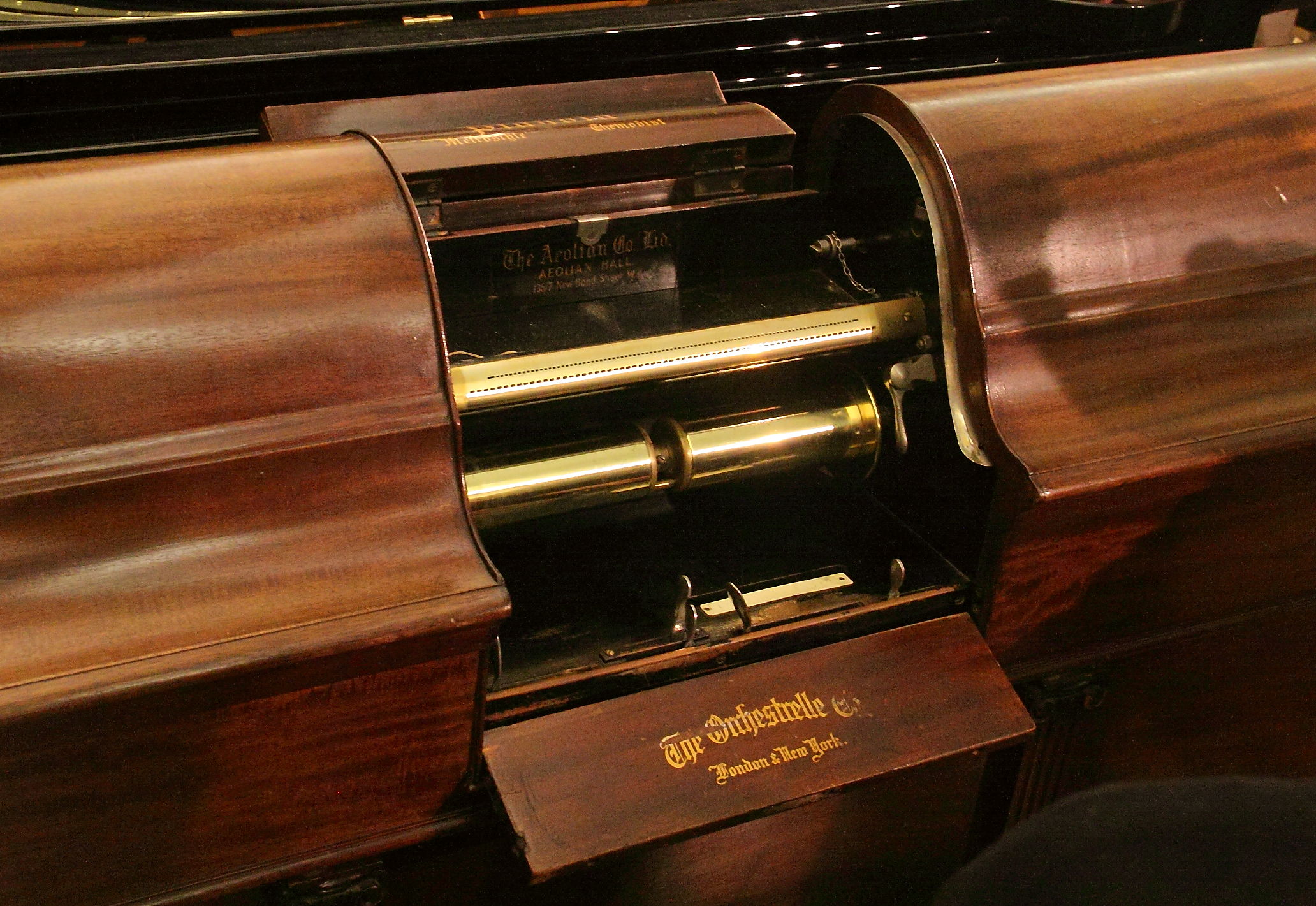
The pianola is not the same thing as a player piano, as Lawson informed the audience.  It is a device which fits over the keyboard of a traditional piano and depresses the keys based on the instructions of a paper roll inserted as one would in a player piano.  However the pianola allows the performer to vary dynamics and phrasing and actually perform the music.  And Lawson demonstrated this beautifully.

pianola

Pianola showing the place where the paper roll is inserted.

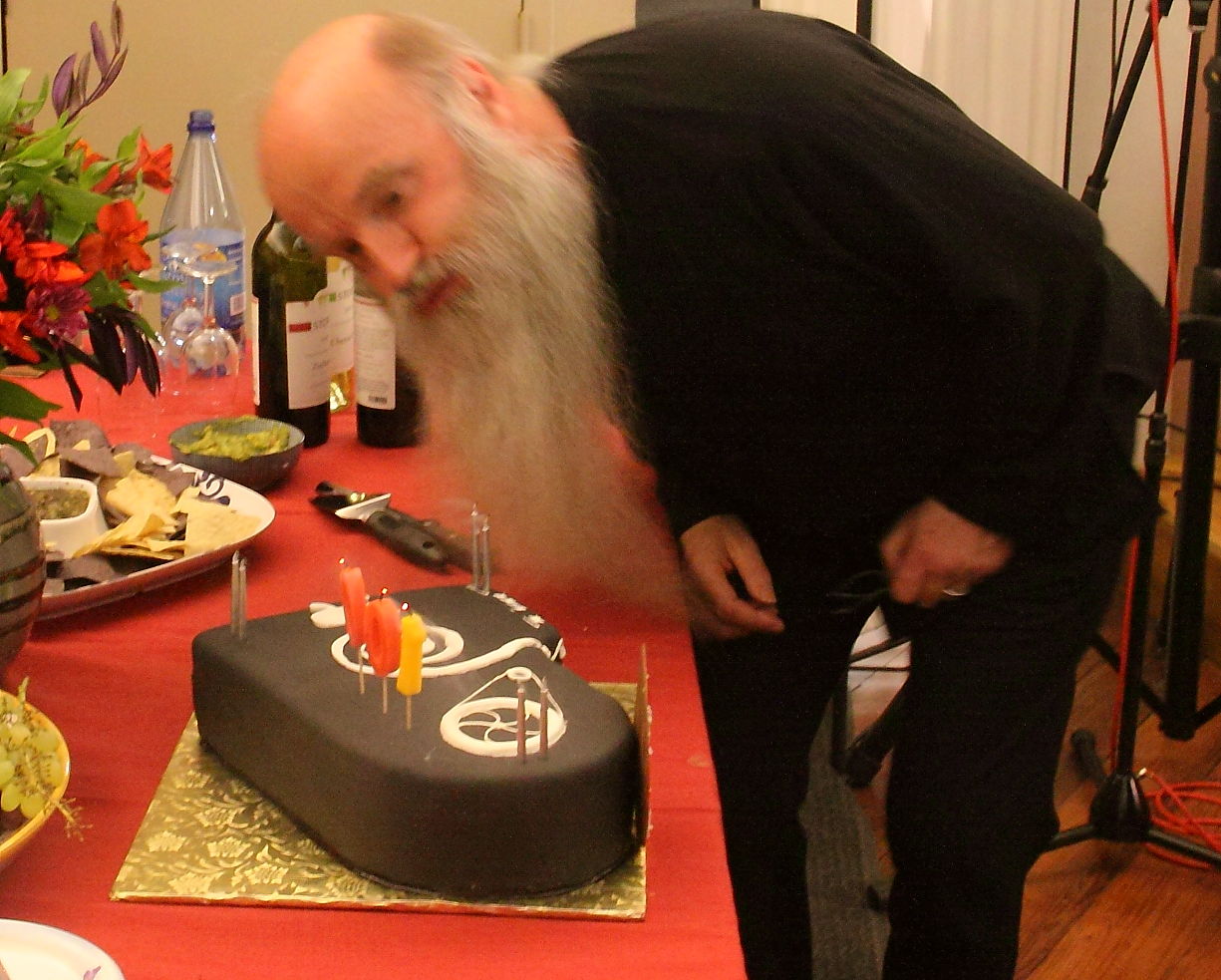
At the intermission birthday candles were lit and Lawson was accorded the honor of blowing them out in the late composer’s honor.  Nancarrow died in 1997 having lived to see a tremendous resurgence in interest in his music and an acknowledgement of his contribution to music.  His complex rhythm studies for player piano number just over 50.  And though he wrote some chamber and orchestral music as well, these are the pieces on which rest his fame as an innovator.

Rex Lawson blowing out the candles on Nancarrow's birthday cake.

Rex Lawson blowing out the candles on Nancarrow’s birthday cake.

Just prior to the intermission we were treated to the multi-talented artist an composer Trimpin‘s computer controlled pianola.  Attached to two pianos were devices for pressing the keys which were in turn controlled by a computer program.

Piano with Trimpin’s computer controlled pianola attached to the keyboard

Piano number two with Trimpin's computer controlled pianola attached to the keyboard

Piano number two with Trimpin’s computer controlled pianola attached to the keyboard

They played the massively complex Study No. 40b and did so very effectively.  The audience left their seats to stand around the two upright pianos which behind the seating area.  The sound cannot be described in words and the audience, some perhaps mystified, were very appreciative.  Trimpin later spoke of this work reconstructing one of Nancarrow’s abandoned project, a percussion orchestra controlled by a piano roll.  It was abandoned when Nancarrow realized that the technology could not perform the music accurately, something which is now possible with Trimpin’s research.  The results of that research, Trimpin: Nancarrow Percussion Orchestra / MATRIX 244 will be installed in the Pacific Film Archive and be available to the public from November 2nd to December 23rd.

Trimpin holding a prototype for Nancarrow's aborted percussion orchestra experiment's

Trimpin holding a prototype for Nancarrow’s aborted percussion orchestra experiment’s

After the candles were out the audience, led by Charles Amirkhanian, sang happy birthday which prompted Lawson to spontaneously run to one of the pianos to accompany the traditional song.  Charles Amirkhanian, composer, radio host and impresario produced the first complete recording of Nancarrow’s player piano studies (and the only recording made on Nancarrow’s player pianos in his Mexico City studio) in 1980 which brought the composer to a much wider audience and got him invited to the 1982 New Music America festival and later helped him get a Mac Arthur genius grant.  A chance find in a record store in Paris inspired Hungarian composer Gyorgy Ligeti to write his masterful piano etudes after hearing these recordings.

Charles Amirkhanian with Rex Lawson

Charles Amirkhanian holding the microphone while Rex Lawson sings along with one of his piano rolls.

Trimpin scanned all of Nancarrow’s piano rolls into a computer and made it possible for the music to be studied more widely as well as preserving it on a hard drive.  He went from the piano rolls which are essentially a digital medium the equivalent of punch cards for historians and those of us old enough to remember to digital storage on a magnetic drive.

As I noted at the beginning this was a most appropriate tribute occurring on Nancarrow’s actual birthday and featuring people like Amirkhanian, Lawson and Trimpin who were inspired by Nancarrow’s work and have done so much to bring it to light and to preserve it for posterity.

Following the intermission we were again treated to Rex Lawson who provided a perspective on the importance of player pianos and pianolas in early 20th Century culture.  He illustrated the function of the pianolist explaining as he said, “Why I need to be here at all…” by playing a Rachmaninoff polka first without any nuance executed by the pianolist and then with him demonstrating how the pianolist puts life into the piece, a world of difference.  He spoke of composers who actually wrote for the pianola.  It is different from writing for a pianist because the pianola is not limited to the size of one’s hand or the number of fingers one has.  It afforded composers a technology to write a more orchestral fabric.

He demonstrated with pieces by Sir Arnold Bax, an early 20th century British composer and by Stravisnksy (a marvelous arrangement of the scene from Petroushka when the puppet first comes to life).  He also spoke of now forgotten composers who had the career of being arrangers for the pianola.  While many homes had pianos and many could play the piano, the pianola allowed them to play larger and more difficult works beyond the skills of the average pianist and, frequently, beyond the skills of any human being.

The evening ended with another demonstration of Trimpin’s computer driven pianola this time playing one of Nancarrow’s early boogie woogie pieces.  And then there was time to speak with the artists and audience members who showed enthusiasm and interest.

Tonight’s event, we were told, was organized by Other Mind’s development director Cynthia Mei and she made a plea for funding this and next weekend’s events through Kickstarter (http://www.kickstarter.com/projects/otherminds/nancarrow-at-100-a-centennial-celebration?ref=card) where the rewards for participating in the funding range from mention in the program booklet to CDs, t-shirts and downloadable recordings of the performances.  This writer is a proud part of the kickstarter campaign and would like to encourage others as well.  We are honoring a true genius in American music and preserving his influence and legacy for future generations.  I think Mr. Nancarrow would have heartily approved.