Black Classical Part Three


20130214-170052.jpg

For my third installment I have chosen to highlight that series of recordings by conductor Paul Freeman of music by black composers which I mentioned in a previous blog.

In 1974 Columbia Records issued 9 LPs (originally it was to be 12) over the next few years in a series called, ‘Music by Black Composers’. The music was chosen largely by Paul Freeman who also wrote the liner notes and conducted the performances. He was assisted by musicologist Dominique-Rene de Lerma who contributed his knowledge of pre 20th century black music and also edited some of the pieces for performance.

This set of records was featured by my local radio station (WFMT in Chicago) at the time of its release and opened my listening mind to to this cornucopia of fascinating classical concert music by black composers. The series was so titled in part because it included music from many countries and also because it was released before the term ‘African American’ became Le mot juste (but that is another story).

The series was apparently recorded and released 1974-78 and re-released in 1986 as a set under the Columbia Special Products label. Historically it was an important set of releases much like the series curated by David Behrman called ‘Music of Our Time’ which featured some truly cutting edge music by composers writing in the sixties and seventies. To be sure the black composer series was not cutting edge modernism like that series but gains its cutting edge from collecting in one set music from the 18th to the mid-20th century by a set of composers who, other than having been trained in the discipline of music performance and composition, held in common only a skin color darker than ‘white’.

Billboard announced the plan to issue these records in 1973 saying that they were the fruit of a collaboration between the Irwin-Sweeney Miller Foundation of Columbus, Indiana and, with the encouragement of Dominique-Rene de Lerma, the school of music at Indiana University in Bloomington. Citing “campus politics” professor de Lerma reported that Indiana had lost interest so he phoned Paul Freeman (conductor with the Detroit Symphony at the time) and advised him to contact the ‘Afro-American Music Opportunities Association’ whose support then helped launch this series. The original plan was to release four albums per year for at least three years but a great beginning soon slowed and the 9th album (pictured above) was the final release in the series.

Coming twenty some years after the voting rights act of 1965 it retained the some cachet of the civil rights movement and likely was produced at that time in the hopes that this might help sell the albums to consumers. I don’t know who ultimately bought these albums or what their total sales were but I know that some visionary producers at WFMT piqued my interest and that I bought many of these records and listened with interest when they were scheduled to play (I religiously perused the monthly program guide).

The original releases went out of print in a few years. There was a CD set (currently out of print) compiled by the Columbia University (Chicago) Center for Research in Black Music funded by the Ford Foundation that released a selection of the Detroit Symphony performances (now a pricey collector’s item) from that set as well as a reissue of the complete set on vinyl records with the original cover art and program notes which remains, I am happy to report, available by mail from the College Music Society in Missoula, Montana www.music.org.

The contents are:
Columbia M-32781 (1973); volume 1
Saint-Georges: Symphony concertante, op. 13 (ed. by Barry S. Brook; Miriam Fried, Jaime Laredo, violins; London Symphony Orchestra)
—–: Symphony no. 1 (ed. by D. de Lerma; London Symphony Orchestra)
—–: Scena from Ernestine (ed. by D. de Lerma; Faye Robinson, soprano; London Symphony Orchestra)
—–: String quartet no. 1 (ed. by D. de Lerma; Julliard Quartet)

Columbia M-32782 (1973); volume 2
William Grant Still: Afro-American symphony.
—-: 2 arias from Highway 1, U.S.A. (London Symphony Orchestra; William Brown, tenor)
Samuel Coleridge-Taylor: Danse nègre.
—–: “Onaway, awake, beloved” from Hiawatha’s wedding feast (William Brown, tenor; London Symphony Orchestra)

Columbia M-32783 (1974); volume 3
Ulysses Kay: Markings (London Symphony Orchestra)
George Walker: Trombone concerto (Denis Wick, trombone; London Symphony Orchestra)

Columbia M-32784 (1974); volume 4
Roque Cordero: Violin concerto (Sanford Allen, violin; Detroit Symphony Orchestra)
—–: Eight miniatures (Detroit Symphony Orchestra)

Columbia M-33421 (1975); volume 5
José Maurício Nunes-Garcia: Requiem Mass, M. 185 (ed. by D. de Lerma; Doralene Davis, soprano; Betty Allen, mezzo-soprano; William Brown, tenor; Matti Tuloisela, bass-baritone; Helsinki Philharmonic Orchestra; Morgan State University Choir [Nathan Carter, director])

Columbia M-33432 (1975); volume 6
José White: Violin concerto (ed. by Paul Glass and Kermit Moore; Aaron Rosand, violin; London Symphony Orchestra)
David Baker: Cello sonata (Janós Starker, cello; Alain Planès, piano)

Columbia M-33433 (1975); volume 7
William Grant Still: Sahdji (London Symphony Orchestra; Morgan State University Choir [Nathan Carter, director])
Fela Sowande: African suite (3 excerpts; London Symphony Orchestra)
George Walker: Lyric for strings (London Symphony Orchestra)

Columbia M-33434 (1975); volume 8
Olly Wilson: Akwan (Richard Bunger, piano; Baltimore Symphony Orchestra; Richard Bunger, piano)
Thomas Jefferson Anderson: Squares (Baltimore Symphony Orchestra)
Talib Rasul Hakim: Visions of Ishwara (Baltimore Symphony Orchestra)

Columbia M-34556 (1978); volume 9
George Walker: Piano concerto (Natalie Hinderas, piano; Detroit Symphony Orchestra)
Hale Smith: Ritual and incantations (Detroit Symphony Orchestra)
Adolphus Hailstork: Celebration! (Detroit Symphony Orchestra)

Later Freeman began a series on Chicago-based Cedille records that released three further volumes of black composers’ music with his wonderful Chicago Sinfonietta as well as several CDs dedicated entirely to single black composers (more about those and more in another post).

Perhaps an innovative label such as Naxos might some day bring these Columbia recordings back into circulation in their entirety in the CD format. Meanwhile I am pretty happy with my LPs with their copious notes and full-sized beautiful graphics. If you haven’t heard this set I would encourage you to avail yourself of some of this beautiful music.

Black Classical Conductors (Black Classical Part Two)


James Anderson De Preist(1936-2013)

James Anderson De Preist
(1936-2013)

The recent passing of conductor James DePreist is a great loss to the world of classical music. I first encountered this man’s work when I bought a New World CD containing music by Milton Babbitt (Relata I), David Diamond (Symphony No. 5) and Vincent Persichetti (Night Dances). All performances are by the Julliard Orchestra under three different conductors of music by three different composers of about the same generation of east coast American Composers. De Priest conducts the Night Dances piece. He had studied under Persichetti at the Philadelphia Conservatory.

De Preist had a fondness and a feel for contemporary music. Among his fifty some recordings (no reliable discography is available online just yet) he recorded music by Paul Creston, George Walker, Gunther Schuller, Ellen Taaffe Zwilich, Easley Blackwood, Aulis Sallinen, Giya Kancheli, Alfred Schnittke, William Walton, Nicholas Flagello and Joseph Schwantner among other more familiar names as well.

He was the nephew of Marian Anderson and cared for her in his home in Portland, Oregon until her death in 1993. De Preist was the conductor of the Oregon Symphony and served as it’s music director from 1980 until 1993. He conducted nearly all of the world’s major orchestras and was awarded the National Medal of Arts in 2005.

His passing this February, Black History Month in the United States, got me thinking about the legacy of black classical conductors. There have been a few luminaries that also deserve attention and I will attempt a short survey a few of those whose art has touched my own life.

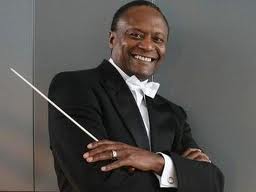
Paul Freeman

Paul Freeman

Paul Freeman (1936- ), now retired, was the founder and music director of the Chicago Sinfonietta, an alternative orchestra to the Chicago Symphony which played a distinctly different program from them introducing a great deal of new music by young composers along with an unusual selection of older music and some classical warhorses. His 9 LP survey recorded 1974 to 1979 and released by Columbia Records in 1986 of music by black composers is a landmark set of recordings surveying music by black composers from various countries with some emphasis on American Composers. He followed this in 2003 with 3 CDs of music by black composers on Chicago based Cedille records and has continued to give exposure to these unjustly neglected artists. Along with his promotion of black composers Freeman has recorded a great deal of 20th century music by other unjustly neglected masters such as Leo Sowerby, Meyer Kupferman, Bohuslav Martinu, Tibor Serly, Robert Lombardo, William Neil, Richard Felciano to name a few. He recorded a delightful complete set of Mozart Piano Concertos with frequent collaborator, pianist Derek Han (the set was incorporated into the Complete Works of Mozart released on the Brilliant Classics label).

Michael Morgan (1957- )

Michael Morgan (1957- )

Michael Morgan who I recall as having been the assistant conductor of the Chicago Symphony from 1986 to 1990 under both George Solti and Daniel Barenboim. I had the pleasure of hearing him conduct the Chicago Symphony’s fine training ensemble, The Civic Orchestra, on several occasions.

Currently he is the music director of the Oakland East Bay Symphony, a post he has held since 1990. In that time he has done much to strengthen the orchestras standing artistically and financially and he has forged alliances with the Oakland Youth Orchestra and the Oakland Symphony Chorus.

Unfortunately Morgan has made few recordings but his choice of repertoire and championing of new music continues to endear him to critics and to bay area audiences.

Thomas Wilkins (1956- )

Thomas Wilkins (1956- )

In 2011 Thomas Wilkins became the first black conductor appointed to the Boston Symphony (a city historically resistant to integration in the 1960s). He is the conductor of that city’s youth orchestra.

He was appointed music director of the Omaha Symphony in 2005 and has held appointments with the Richmond Symphony, the Detroit Symphony and the Florida Orchestra.

Henry Lewis (1932-1996)

Henry Lewis (1932-1996)

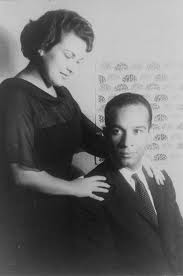
California born Henry Lewis was the first black musician to join a major symphony orchestra when, at the age of 16, he joined the double bass section of the Los Angeles Philharmonic. He became the first African-American to lead a major symphony orchestra when Zubin Mehta appointed him assistant conductor of that same Los Angeles Philharmonic in 1961, a post he held until 1965. He is credited with founding the Los Angeles Chamber Orchestra as well

Lewis is probably better known in the media for having been married to soprano Marilyn Horne from 1960-1979.

Carl Van Vechten's portrait of Marilyn Horne with her husband Henry Lewis in 1961

Carl Van Vechten’s 1961 portrait of Marilyn Horne with her husband Henry Lewis.

Horne credits Lewis with her early development as a singer.

Charles Dean Dixon (1915-1976)

Charles Dean Dixon
(1915-1976)

Dean Dixon, as he was known, was born in Harlem and studied at Julliard and Columbia University. He formed his own orchestra when racial bias prevented him from working in most settings and in 1941 gave a concert at the request of Eleanor Roosevelt who in 1939 famously arranged for Marian Anderson to sing on the steps of the Lincoln Memorial after she had been prevented by racial bias (and the Daughters of the American Revolution) from singing in any concert venue in Washington D.C.

While he did guest conduct the NBC Symphony, the New York Philharmonic, the Philadephia Orchestra and the Boston Symphony he left the United States in 1949 to further his career in overseas. He conducted the Israel Philharmonic Orchestra during 1950-51, was principal conductor of the Gothenberg Symphony from 1953-60 (by popular demand), the HR Sinfonieorchester in Frankfurt from 1961-74, the Sydney Symphony Orchestra from 1964-67.

Dixon returned to the United States and had various guest conducting engagements with major orchestras. And he conducted the Mexico City Orchestra during the 1968 Olympics. His legacy includes quite a few recordings made in the 1950s, some of standard repertoire, but some of American music like that of Randall Thompson, Leo Sowerby and fellow black American William Grant Still among many others. These were some of the first recordings I ever heard of much of that repertoire.

He, like those who followed him, did a great deal to promote the music of Americans and of the 20th Century in general. And his recordings are an important part of his legacy that remains largely untapped (though Naxos historical has reissued some on CD, bless their hearts). The racial bias he encountered is our American legacy. Dixon once defined three phases of his career by the way he was described. First he was the “black American conductor”. Then he was the “American conductor” and, finally he simply, “the conductor Dean Dixon.”

Impossible, you say?


einsteintrain

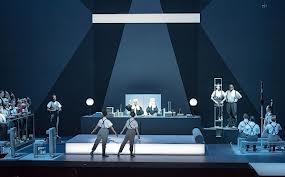
The first scene


I had the pleasure of seeing the recent production of the Philip Glass/Robert Wilson “opera” ‘Einstein on the Beach’ in Berkeley on October 28th.  I had seen the production at the Brooklyn Academy of Music 20 years ago and have loved the music since I first bought the recording issued on the short-lived Tomato record label (this is the performance now available on Sony).  It is clearly a work which compels me and has insinuated itself into my world view.

The production was beautiful.  The musicians as always played well under the precise and confident direction of Michael Riesman who has apparently conducted every performance of the opera (that alone is an astonishing feat).  The dancers were spectacular in their execution of Lucinda Childs’ unusual choreography.  And the solo violin played in this production by violinist Jennifer Koh breathed a new virtuosic life into the familiar solo part.

Dance with spaceship

The set design and lighting were about as good as it gets and the performers appeared to be well rehearsed and operated as well oiled parts of the unified whole of the machine that is Einstein on the Beach.  It was a production that was loving and well received by the audience (a genuinely appreciative standing ovation followed the performance) in this, the west coast premiere of this landmark piece from 1976.   It is certainly worth noting that it took 36 years for this to be produced in even this most liberal of musical places.

I have hesitated to write about this performance partly because I didn’t want to simply report my attendance and geeky satisfaction.  I wondered if everything has already been said ad nauseam about this piece and adding yet another adoring review would be pointless and dull.  But the performance (all 4.5 hours of it) left me with a renewed appreciation for the music and the visuals.  It reinforced my belief that this is a truly significant work of art and that it will continue to be revived.  However it is likely that this is the last revival we will see which has been supervised  by the original creators.  Philip Glass is 75 and Robert Wilson is 71.  Lucinda Childs is 72.  And there is at the time of this writing no heir apparent for the Philip Glass Ensemble.

The vaguely apocalyptic themes provide a sort of commentary for our times.  Like any great work of art it continues to take on meaning for subsequent generations.  It is both a response to the milieu in which it was created and a mirror in which is reflected the present time of its performance.  Don’t get me wrong.  This avant-garde masterpiece is hardly easy listening or easy viewing.  In addition to its length it is non-linear, devoid of plot and devoid of most of the conventions by which we normally judge and appreciate both theater and music.

But it has been embraced by many.  Mark Jacobs’ Spring/Summer 2012 Fashion Show featured models walking up and down the runway to the sound of the opening “1, 2, 3, 4…” of the solo chorus which opens the work.  A Pepsi commercial from 2008 titled ‘Einstein’s Choice’ also featured that same chorus.  And the incidental music to any number of nature programs are frequently infused with the now familiar arpeggios endemic to Philip Glass’ compositional style.

Spaceship scene

Combine these things with the fact that revivals of this opera play to nearly or completely sold out houses in New York, France, Berkeley, Mexico City, Amsterdam and Ann Arbor, Michigan.  Granted the revivals are infrequent, the last being 20 years ago, but the draw of this work apparently remains strong suggesting that it is now and will likely remain in the repertoire.

I came away from this production with a sense of exhilaration that I feel when I encounter a great performance of a masterpiece by Mozart, Beethoven or John Coltrane, a sense of connection to a greater meaning such as one finds in all great works of art be they music, theater, painting, literature, film, etc.  And I don’t think I am alone in having felt that.

When I first began listening to this piece in the aforementioned Tomato recording I was both fascinated and perplexed.  I felt compelled to listen again and again and was perplexed at what I was hearing.  But history tells us that few seem to fully appreciate great art at the time of its emergence, that such appreciation takes time.  With time and repeated listenings I began to find the work grow on me, become familiar.

Seeing the 1992 revival in Brooklyn only further reinforced my sense that this is a very significant work and it remains one of my favorite pieces of music.  It is one of the pieces of music that feels to me like a personal discovery, one which I seem to have appreciated to some degree from my first encounter with it.  And my understanding as well as my affection for this work has only increased with time.

What remains to be seen is whether this work can continue to be successful in subsequent productions done by people whose connection to the work is less direct and whether it can continue to speak to subsequent generations.  The majority of the crowd at Zellerbach hall for this performance appeared to be in the 40 to 50+ category which may be in part due to the cost of a ticket.  I hope that it is not lack of interest.

For years, until the new recording was released on Nonesuch Records in 1993, I listened to the 1979 release which, due to the length of the music, abbreviated some of the repetitions to allow the recording to fit on 4 vinyl discs.  It is this recording which I know best and is most deeply imprinted on my memory.

Of course the experience is quite different with the accompanying visuals.  I had learned to appreciate the music alone with just of few still photos to kindle my imagination as to how the full production would appear.  And, not surprisingly, my first encounter with the full production in 1992 exceeded my expectations and provided a new and richer perspective on the meaning of this opera.

When I say “meaning” I am referring only to the meaning which I experience.  I don’t lay any claim to any special knowledge here.  And I think that this and all great works of art sustain their worth through their ability to mean and be associated with a variety of things.  Einstein has different meanings and associations for each individual and perhaps no ultimate “meaning”.

Even the texts associated with the piece are intentionally non-linear, make few concrete references to culture as a whole.  There is no story here, there are only visual images, sonic images and a variety of spoken words which, while in English, have mostly vague meanings.  The issue here is the emotional impact.

Epilogue (Knee Play 5)

‘Einstein’ has clearly affected me emotionally and I am witness to the its effect on the audiences of which I was a part.  When I tell people anything about the meaning of the work I invariably refer to it as “post-apocalyptic” metaphor which ends quite simply with a poignant little love story, if you will, a bedtime story for our times.  After some 4 hours of having presented it’s audience with a plethora of images the opera ends with two lovers on a park bench who sit silently while the bus driver, his vehicle moving slowly from stage right to stage center, narrates the scene.  The lovers sit quietly until, we are told, one speaks up and asks, “Do you love me, John?”  This other’s answer speaks from the throes of youthful optimism and love at first affirming his love and then, when asked, “How much do you love me?”, he answers, “Count the stars in the sky.    Measure the waters of the oceans with a teaspoon.  Number the grains of sand on the seashore.”

This epilogue seems to suggest that, in the end, all that matters is how we experience each other, how well we succeed in communicating on a one to one level.  And perhaps that is also a metaphor for the work’s ability to communicate with subsequent generations.  While we try to communicate we succeed only sometimes.  Great art succeeds only sometimes.  The salient issue is having tried.  Despite the difficulties in communication, in love, in life, we try.  The opera ends in that 1979 recording with the chorus, two speaking voices, violin and organ all ending softly and definitively at the same time as the narration,  “Impossible, you say?”

Annie Lewandowski, Luciano Chessa, Theresa Wong in Berkeley


Lewandowski piano

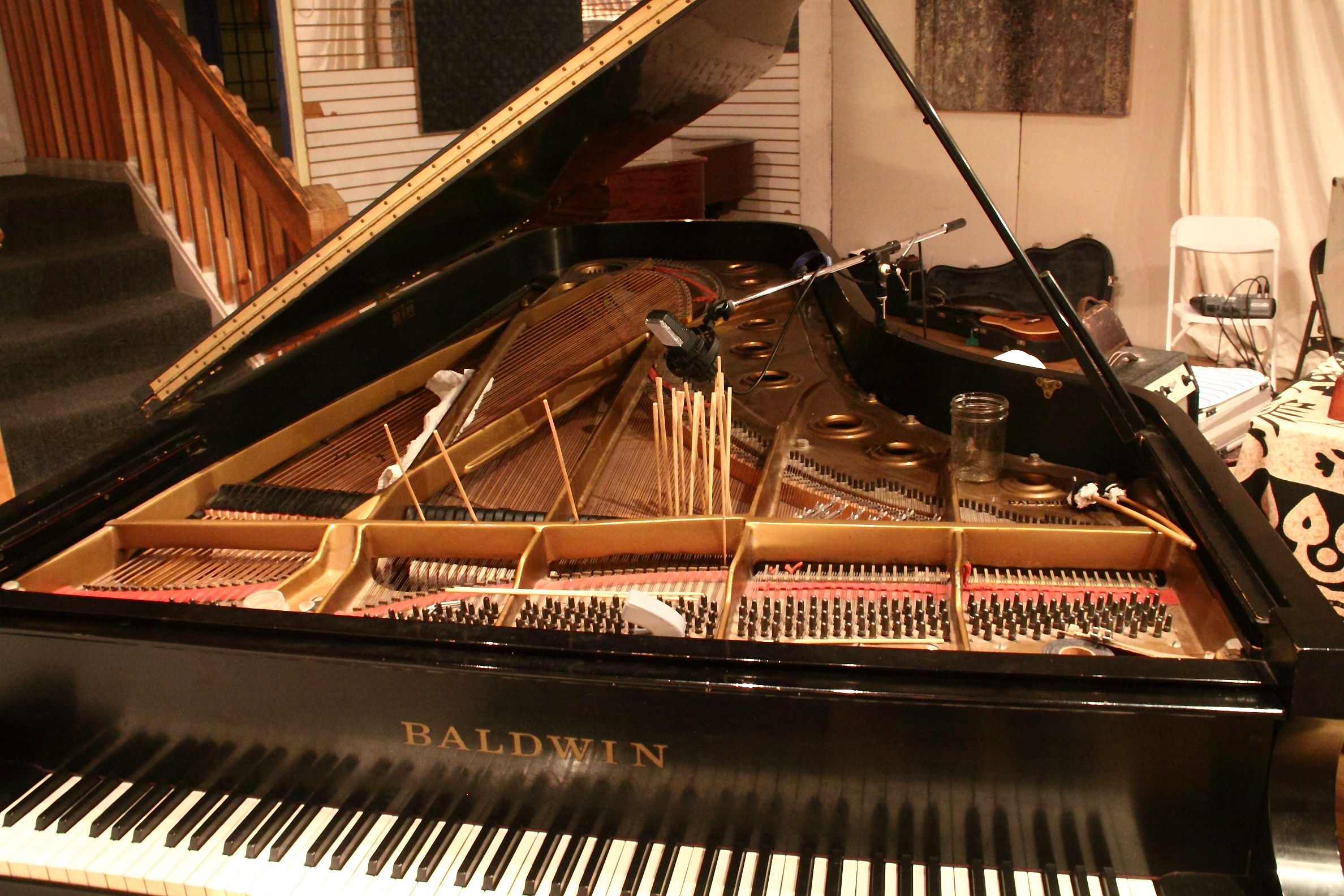
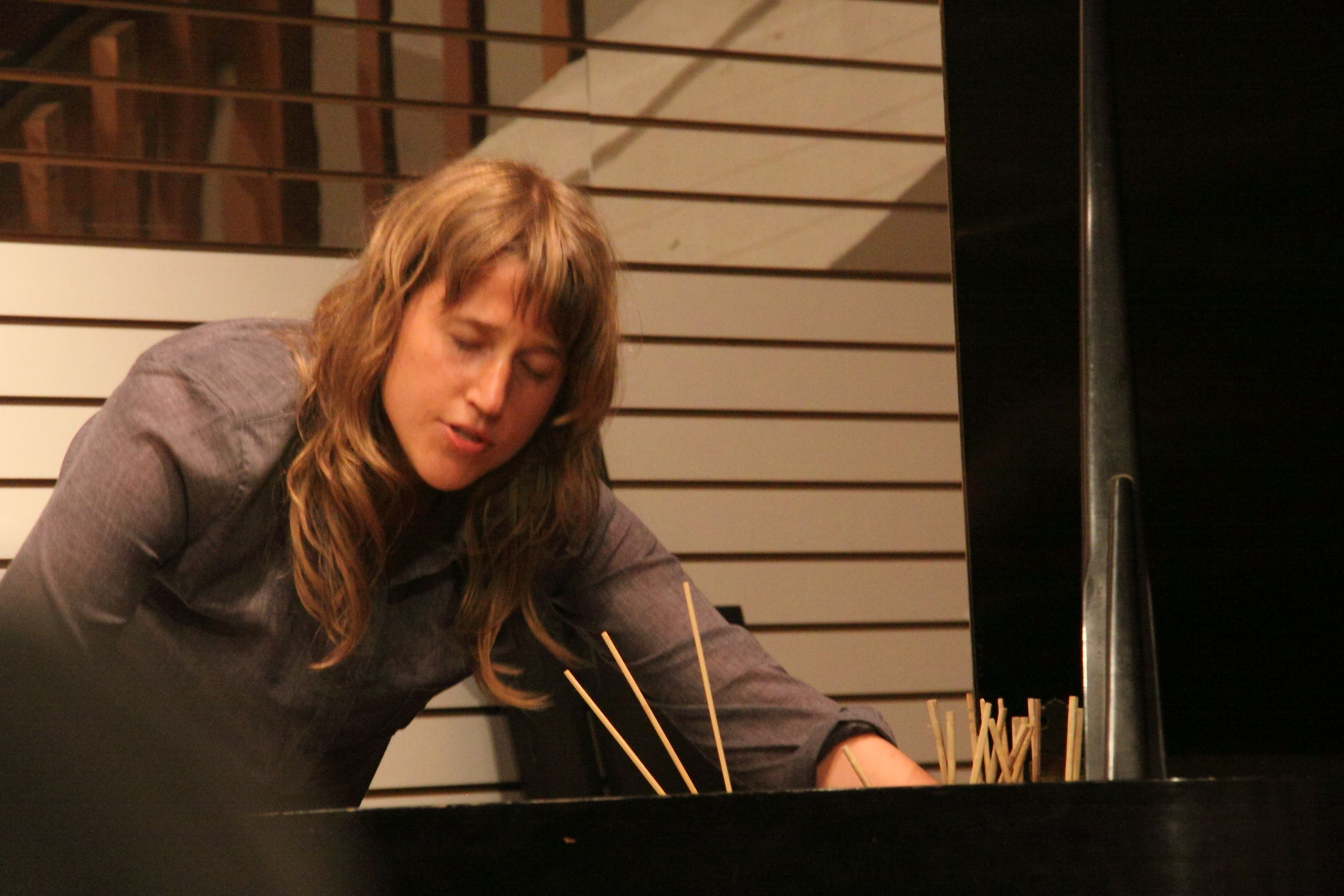
A view of the inside of the piano showing Lewandowski’s alterations.

It is easy to miss the nondescript storefront on University Avenue where this performance took place. And the promotion of this concert appeared to be mostly through Facebook and the Bay Area improvisers web site which resulted in a small but appreciative audience interested in hearing the work of Annie Lewandowski, now a music lecturer at Cornell. She is a graduate of Mills College. She has a varied resume ranging from classical piano to progressive rock bands and she presented tonight her work with extended piano techniques much like those of John Cage but with some distinctly personal twists extending Cage’s methods further. Ms. Lewandowski was hosted by Theresa Wong (also a Mills graduate), bay area composer, cellist and singer who organized the event and Luciano Chessa, San Francisco Conservatory professor, composer, musicologist, historian and performer and producer who played a couple of different roles in this evening.

performance of La Barbara's 'Hear What I Feel'

Luciano Chessa performing Joan La Barbara’s ‘Hear What I Feel’

The first performance was introduced by Ms. Wong who informed us that Luciano Chessa had been kept in isolation for the last hour while the preparations were done for his performance. The piece being performed was Joan LaBarbara’s ‘Hear What I Feel’ from 1974. It consists of a table upon which there are several plates each containing some object or substance. The performer, who is blindfolded, is seated at the table and the performance consists of the performers reactions to the substances and/or objects he examines with his hands alone. It is performance art that would be perfectly at home with other Dada and Fluxus-like scores.

Wong led Chessa carefully from the back of the performance space to the table containing six plates. After seating him she positioned the microphone carefully in front of him. Chessa spent several minutes with each object examining three predominantly with his left hand and three with his right. All the while during his tactile adventure he vocalized a variety of sounds evoking (presumably) his emotional response to each object or creating an audio analog for them.

As with all such scores the result leaves a wide range of possibilities to the performer. And this performance was suitably humorous and engaging. Following his examination of the last of the objects Chessa removed the blindfold and reacted to each of the objects (without vocalizing) as he examined them visually. There was an effective combination of (mockingly?) serious concentration and idiosyncratic responses that left the audience genially amused and entertained.

Lewandowski piano

Annie Lewandowski playing in the piano, on the keyboard and singing.

Wong cello

Theresa Wong playing her carefully altered and electronically enhanced cello and singing.

This was followed by a duet between Lewandowski and Wong. Both performers utilized various ways of altering the sounds of their instruments by adding objects to the strings or by exciting the strings with objects. Wong also made use of a foot pedal controlling some electronics. Lewandowski’s piano was miked and amplified somewhat.

The improvisation was started by Lewandowski with some percussive like sounds elicited at the keyboard. Wong responded sparely at first and the two seemed to trade ideas which became richer as the performance went on. Again the serious concentration was present as the performers carefully heard and responded to each others’ music making. While satisfying it was a sort of introduction or first taste of what was to come in the second half.

A brief intermission saw the performers mingling with audience members, many of whom were acquaintances and other musicians.

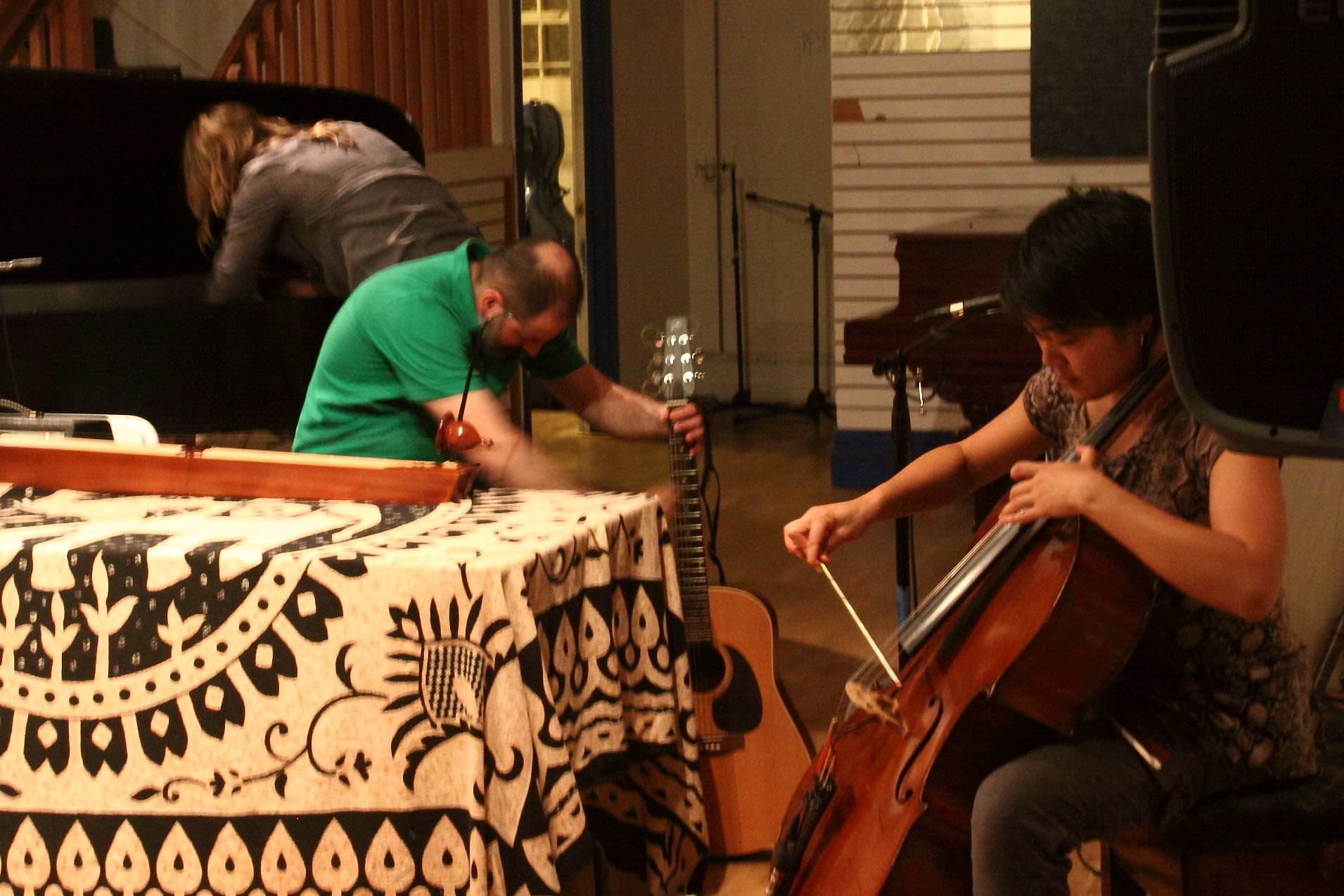
Annie Lewandoski, Luciano Chessa and Theresa Wong in a trio improvisation

Annie Lewandoski, Luciano Chessa and Theresa Wong in a trio improvisation

What concluded this unusual program was a trio for all three performers. Lewandowski with her prepared piano, Wong with her altered cello, Chessa with his signature Vietnamese Dan Bau and guitar. All three also sang. The performance started sparely as each introduced suggestions or themes for the improvisation and reacted to them.

Lewandowski gave a much fuller exposition of the possibilities of her instrument playing the keyboard, inside and all around the piano as well as singing. Wong also seemed to use a wider amount of sound possibilities in her playing. Chessa played the traditional Vietnamese folk instrument in all but traditional ways using devices to excite the strings and focusing on tuning and even some percussive possibilities. At one point he left the table where he was performing to pick up an acoustic guitar. After picking a few notes he walked to the back of the stage area and ascended a stair case leading to a sort of balcony that surrounded the performance space. It was at this point that he began softly singing what sounded like an Italian folk tune as he played the guitar in a most traditional manner. This gave a collage effect to the performance juxtaposing the most traditional kind of music making with the extended and experimental sounds.

Chessa remained on the balcony for a bit, then descended the staircase again and returned to the more unusual playing methods at first on the guitar and then back at the table on the Dan Bau. Following this Lewandowski began vocalizing a melody with sparse accompaniment that would have been perfectly at home in a scene from ‘Eraserhead’ at times. She was echoed by Wong’s extended vocal techniques at first and then Lewandowski and Wong began singing a more traditional sounding melody with beautiful harmonizations interpolating this singing at different points while still traversing their freely improvised instrumental playing supported by Chessa on the Dan Bau.

This made for a rather tranquil mood as they ended the second half of the concert. The audience was appreciative. And this writer was pleased to have found a gem of a concert experience by young, serious (but good-humored) and accomplished musicians in the eclectic world of the east bay.