Bob and Blue, A Musical Pilgrimage


Littlefield Hall (photo copyright by author)

…tell the old story for our modern times. Find the beginning.

-Homer, The Odyssey (Emily Wilson translation)

When I first got the email notice of this concert, I was, to say the least, intrigued. A two piano concert at Littlefield Concert Hall on the campus of Mills College featuring two composer/performers who figured prominently in that Temple of new music and in my personal listening life. Alas, I live some 350 miles from that location. But further intrigue came from the featured artists: Sarah Cahill and Joseph Kubera, two of the finest working new music pianists anywhere and both worked with the evening’s composers. This was just too compelling and I decided that I would regret missing this if I failed to go hear it.

So it was, I planned my little odyssey, leaving at about 9AM from Santa Barbara on a nice lightly trafficked trip, more a pilgrimage than an odyssey. A pilgrimage, frequently defined as a personal spiritual journey ostensibly in search of insight or enlightenment is how I’ve come to identify my listener’s adventure to the secular temple of Mills College featuring music of former Mills faculty Robert Ashley (1930-2014) and Robert Sheff (1945-2020), better known by his stage name, “Blue Gene Tyrrany”.
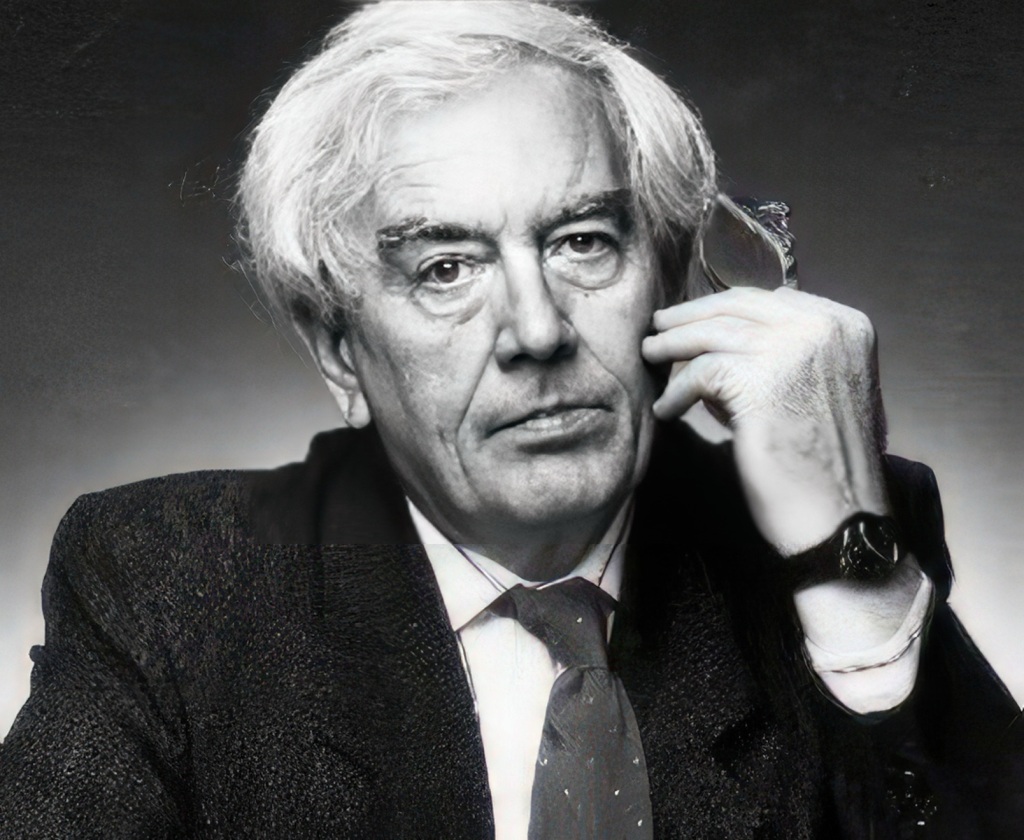
Robert Ashley (copyright unknown)
“Bob and Blue” (copyright by Other Minds)

The two featured composers had a strong connection to the Bay Area, mostly via their work at Mills College. This intelligent but modest production left little room to print program notes so the performers spoke of the music at various points during the concert and the excellent liner notes were made available by a QR code in the program book.

Sarah Cahill, pianist, radio host, producer, tireless advocate for new music (photo copyright by Other Minds)
Joseph Kubera, pianist, member of the SEM ensemble, Downtown Music, and countless collaborations promoting new music with many fine recordings to his name. (Photo copyright by Other Minds)

Our two performers are no strangers to each other or the composers on the program, having collaborated on numerous performances and recordings. The well rehearsed duo turned in riveting performances of this largely unknown repertoire which made a strong case that it be better known. Their playing and choice of repertoire compelled this listener’s attention such that I forgot to take all but a few performance shots. See those program notes for further biographical info on these two fine musical celebrants.
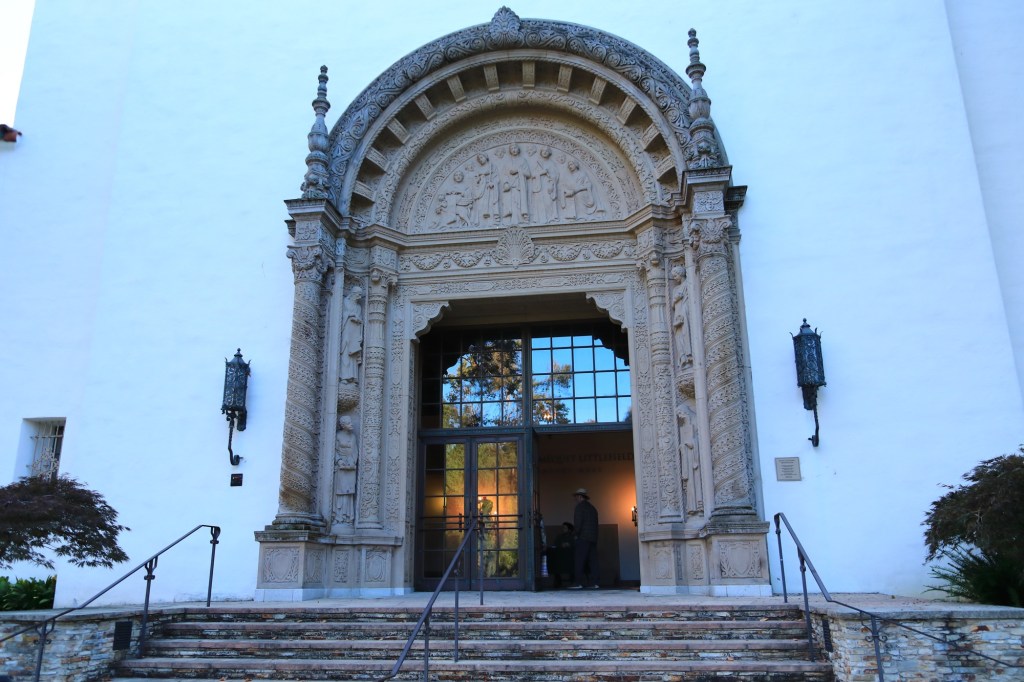
Entrance to Littlefield Concert Hall (copyright by author)

Mills College has long been a temple, a Mecca for new music in the Bay Area of California. Its roster of faculty and students comprises some of the finest post 1945 composers and performers. Darius Milhaud (1892-1974) and Luciano Berio (1925-2003) and students as diverse as Terry Riley (1935- ), Steve Reich (1936- ), and Dave Brubeck (1920-2012) to name but a few. Many artistic spirits musical and otherwise, exert their presence here. It’s a perfect destination for a pilgrimage.

A bust of frequent Mills visitor Lou Silver Harrison (1917-2003) in the lobby, a persistent benevolent spirit. (photo copright by author)

The concert was organized by Charles Amirkhanian and his Other Minds organization, another guiding light in the San Francisco/Oakland new music scene. Pianists Sarah Cahill and Joseph Kubera were to be the celebrants in the concert ritual paying homage to “Bob and Blue” as well as to the oracular Mills College.

Scene from the lobby (photo copyright by author)

Let me tell you about this concert hall. It is the work of legendary California architect Julia Morgan (1872-1957) who famously also worked on Hearst Castle. This is one of her several architectural gems on campus. Her spirit was also witness to this celebration by virtue of her fine architecture.
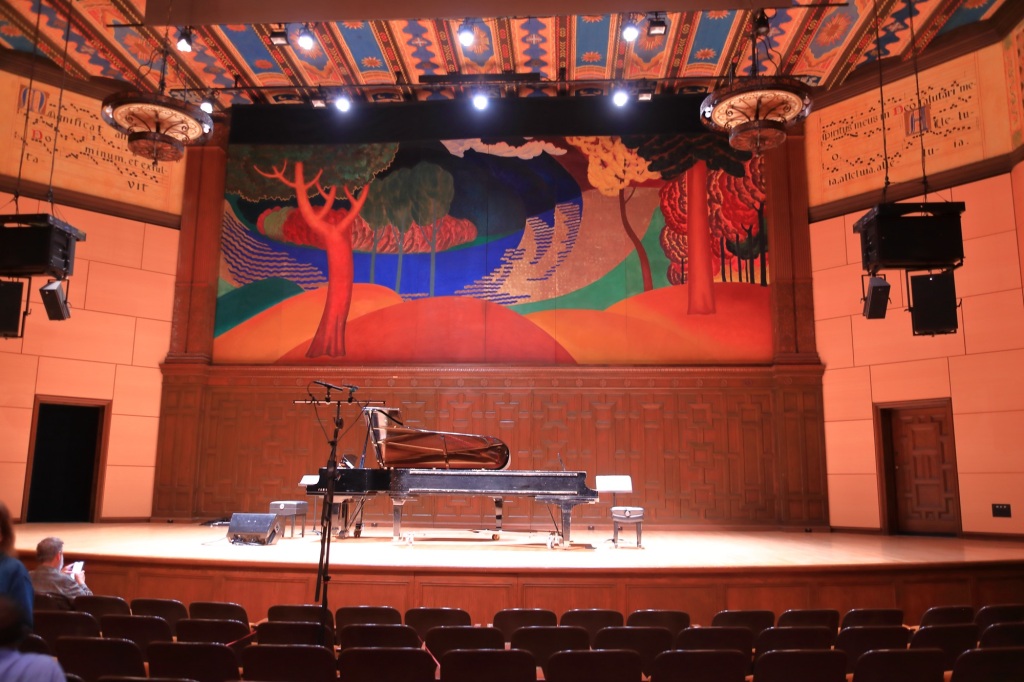
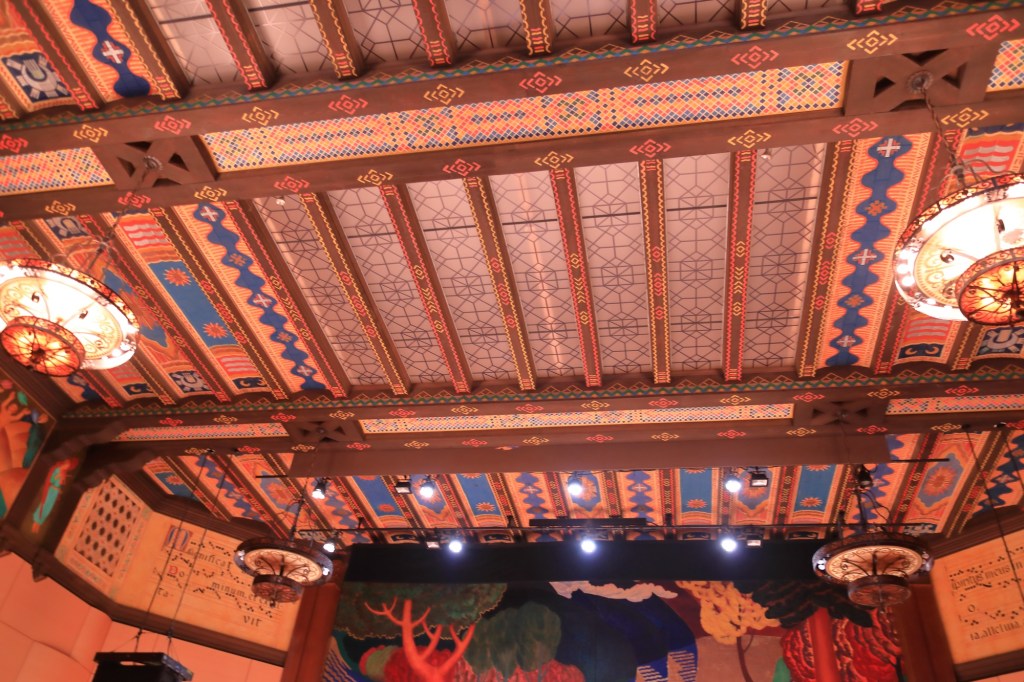
Stage at Littlefield Hall showing the ornate, colorful detailed designs (photo copyright by the author)
Look at that ceiling and those chandeliers (photo copyright by the author)

Two pianos, a new Steinway stage left and a slightly worn Baldwin stage right were placed such that the pianists seated at their respective keyboards could see each other. The Steinway with its lid open to reflect the sound to the audience and that well worn Baldwin with no lid at all (for reasons to be revealed later). The sonics of the hall and tuning of those pianos were excellent.
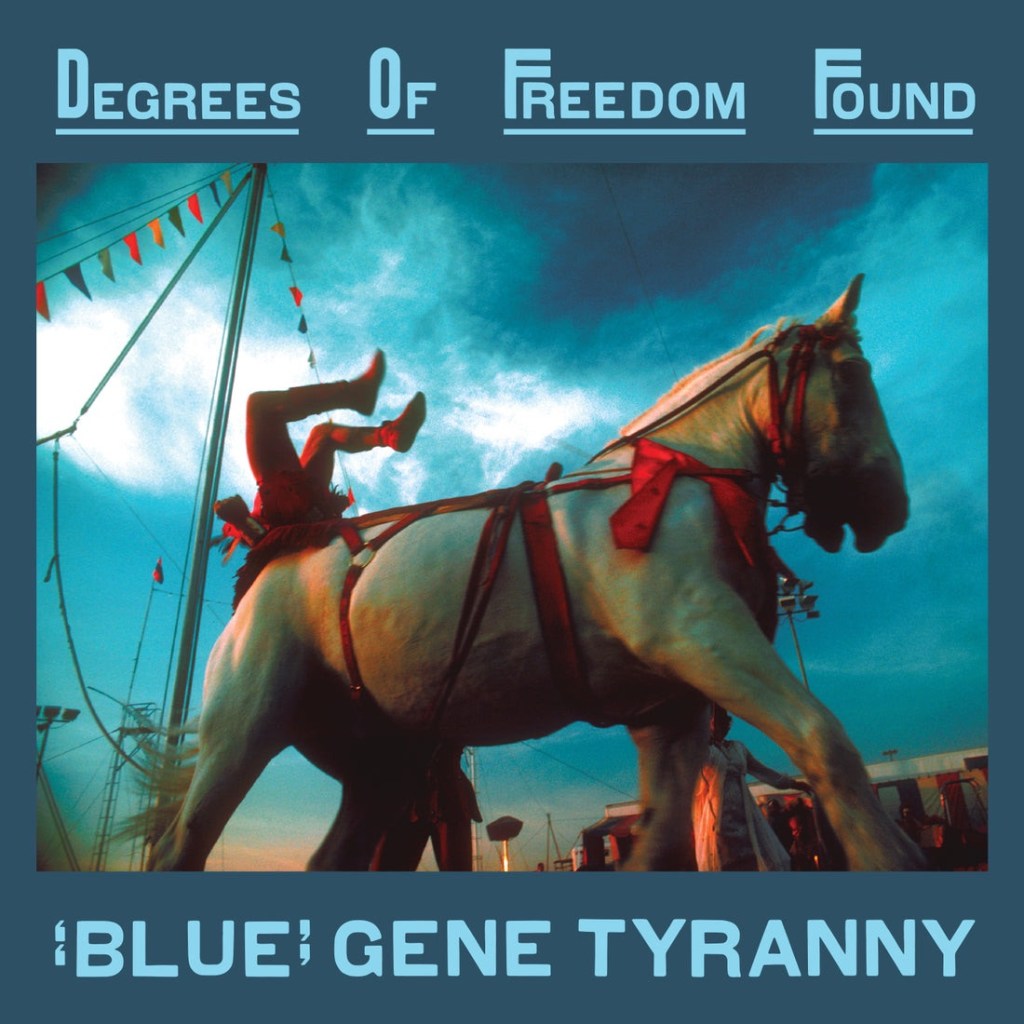
Unseen Worlds’ wonderful survey of Blue’s ensemble works.

The concert opened with Blue Gene Tyrrany’s peaen to old Route 66 in his “Decertified Highway of Dreams” (1999) for two pianos. It was clear from this first selection, that our performers were well rehearsed and in sync despite rhythmic complexities inherent in this quite beautiful work. It is cinematic and sweetly nostalgic, a fine example of “Blue”’s genius. The performance was riveting and worthy as the first performance ritual of the evening.

This was followed by a real rarity, a performance of Robert Ashley’s Piano Sonata (1959, 1979, 1985). In fact, it appears to have been the first complete performance of the two piano version of this impressive serially structured piece. Previous recordings are available, one with the composer performing the first movement at the ONCE Festival from 1966, the other by Blue Gene Tyrrany on his album, “Just for the Record”. This writer also found some useful analysis by musicologist Kyle Gann on his website. Gann worked with Ashley and later published a fine survey of Ashley’s music that is well worth your time. The result was a convincing, almost romantic sounding performance of this foundational work in Ashley’s oeuvre.

This was followed by a solo rendition by Joe Kubera of Tyrrany’s “The Drifter” (1994), which was written for Mr. Kubera. He spoke briefly about the structure of this work (which he also recorded on his recent “Horizons” album). This piece has a meandering quality created by the intricate evolving structure. Kubera’s performance was hypnotic and a fine tribute.

The second half began with Ms. Cahill solo at that stage left Steinway playing first Tyranny’s “Nocturne With and Without Memory” (1989), one of his better known works. Then she played his “Spirit” (1996/2002), a piece that is a sort of homage to the experimental composer/performer Henry Cowell (1897-1965). It was rather unusual in that it involved harmonics over which the pianist plays. The title is an homage to Cowell’s famous piano piece, “The Banshee”, a malevolent spirit in Irish mythology. Both were vintage Blue Gene pieces.

Two pianists, one piano.

Then Kubera returned, taking a seat at the blemished Baldwin with Cahill standing at that same piano, at a 90 degree angle to Kubera. Here, in these two obscure Ashley pieces, Viva’s Boy (1991), and “Details” (2b, 1962), Cahill played like a chef at a chef’s table, playing the strings inside the piano while Kubera manned the keyboard. These true rarities getting perhaps their first performance, were certainly a highlight of the concert.

It was Blue Gene Tyrrany’s spirit that was the final ritual celebration on this magical night with both pianists at their respective pianos to give a heartfelt reading of his, “A Letter From Home” (2002). This brought this learned, well rehearsed, beautifully collaborative evening’s ritual to a satisfying close.

The modest, self selected audience, applauded warmly and gave an extended, much deserved ovation and seemed as enthralled as this listener whose musico-spiritual pilgrimage found an ecstatic height. I drove home that same night, blessedly lifted, if only briefly, from the chaos of the world by this wonderful artistic ritual. They will now take this great program to New York.

Female Artists Matter: Sarah Cahill’s Survey of Piano Music by Neglected Women Composers


First Hand Records FHR 131

Strictly speaking all women composers are neglected. Despite significant efforts in recent years there remain significant disparities in the representation of women composers in the concert and recital halls. Realistically it will take years just to catch up on those composers whose music has languished in unfair obscurity. Now in this International Women’s Month we are seeing the release of a great deal of music by various artists attempting to correct this neglect each with their own lens. Here we have the first installment of three planned CDs by the Berkeley based pianist, Sarah Cahill. This volume, titled “In Nature” is to be followed by one called “At Play” in November, 2022 and “The Dance” in March, 2023.

Photo by Christine Alicino from Cahill’s web site

Cahill is as much curator as artist, a skill evident in her weekly radio program “Revolutions Per Minute” on Bay Area radio station KALW and any number of creative concerts and musical projects in the San Francisco area. She is an internationally acclaimed recitalist and soloist and her You Tube Channel is one I frequently visit just to see what she’s up to. It is where I first heard many of the women composers featured on the present CD and a place where one can get a sense of her unique choices of repertory that characterize her career. Her husband, acclaimed videographer and video artist John Sanborn does the camera work and I must say that these videos were a welcome respite during the COVID lockdown and an opportunity to experience her musicianship up close and personal (only a page turner at a recital gets a better seat).

The first release in this series contains music spanning some 250+ years. The first selection is by Anna Bon (1739/40-ca.1767) which puts her in the late baroque/early classical era. This is the 5th (of 6) in her Opus 2 sonatas for keyboard. This is the first recording on a piano of this entertaining work by this Venetian composer who died in her 20s. Listeners will discern echoes of Mozart (1756-1791) and Haydn (1732-1809) for whom she sang in the choir at Prince Esterhazy’s, Haydn’s celebrated patron and employer. But the sound of the mature J.S. Bach (1685-1750) certainly dominates this very accomplished sonata. This writer hears it almost as a not too distant relative of the Goldberg Variations.

Next we come to 1846 with the music of Fanny Mendelssohn-Hensel (1805-1847), sister of Felix Mendelssohn (1809-1847). Though Fanny composed some 450 pieces in her short life most remained unknown and some were falsely attributed to her more famous younger brother, Felix. In fact he published some of her work under his name (in his Opus 8 and 9 collections) as women rarely got published at the time and Felix recognized his older sister’s talent.

Cahill has chosen numbers one and three of Fanny’s Opus 8 “Four Lieder for Piano” (a form which her younger brother would later embrace in his “Songs Without Words”). These accomplished early romantic works will leave the listener wanting more of this woman’s music which remains still largely unrecorded. They are a testament to her inventiveness as a composer as well as her virtuosity as a pianist and one hopes for a reassessment of her work.

The next selection comes from a Venezuelan composer, soprano, pianist Teresa Carreño (1853-1917). Sometimes referred to as the “Valkyrie of the Piano”, she had a 54 year career championing the work of luminaries such as Edward MacDowell and Edvard Grieg. Her 1848 etude-meditation, “A Dream at Sea” is a romantic virtuosic work that sounds like a challenge to play but a joy for the listener. This deserves to be in the recitalist’s repertory.

The next unknown gem in this fine collection comes from the pen of Leokadiya Aleksandrovna Kashperova (1872-1940) who was one of Igor Stravinsky’s piano teachers. In a sad echo of present day events Kashperova’s works, though published, were suppressed from performance due to her Bolshevik in exile husband whose politics were, to say the least, unpopular. Cahill here plays her Murmur of the Wheat from the piano suite, “In the Midst of Nature” (1910). Cahill handles the finger busting, Lisztian virtuosity with seeming ease and makes a case both for the further exploration of this woman’s music and the inclusion of it in the performing repertoire. This recording is the commercial recording premiere of the work.

We move now from one of Stravinsky’s piano teachers to one of John Cage’s. American composer, pianist, educator Fannie Charles Dillon (1881-1947) studied composition with Rubin Goldmark (one of Aaron Copland’s teachers) and piano with the great virtuoso Leopold Godowsky.

Years before Olivier Messiaen took up the practice, Dillon, was known for the inclusion of birdsong in her works. One of her 8 Descriptive Pieces, “Birds at Dawn Op. 20 No. 2” (1917) was performed and recorded by early 20th century virtuoso Josef Hoffman. Cahill comments in her fine liner notes, “Dillon’s score is remarkable in its specific notation of bird songs: the Chickadee, Wren-tit, Thrush, Canyon Wren, Vireo, and Warbling Vireo…”. It is indeed a sonic painting of the birds at dawn.

The Czech composer, conductor, pianist Vítězslava Kaprálová (1915-1940) was the daughter of composer, pianist Václav Kaprál (1889-1947). She composed some 50 works in her short life and died at the age of 25 in Montpelier, France two days after France surrendered to the Nazis. Her four “April Preludes Op. 13” were written for the Moravian-American pianist Rudolf Firkušný and are her best known piano works. Cahill has chosen the first and third for this recording. The music is notable for its exploration of extended harmonic language and made this listener curious about her other compositions.

This next work is a classic Cahill achievement. As a pianist known for working with living composers as well as being a producer who knows good music when she hears it this is a bit of musical archeology that brings to life in this world premiere recording a work from 1949 by Hungarian pianist Agi Jambor (1909-1997). Jambor studied with the legendary Edwin Fischer and had a career as a pianist and teacher very tragically interrupted by the events of World War II. She came to the United States in 1947 where her husband passed away two years later. She taught at Bryn Mawr College and was granted Emeritus status in 1974.

Her three movement Piano Sonata “To the Victims of Auschwitz” was brought into a legible and performable score with the assistance of Dr. John DesMarteau who befriended Jambor late in her life and to whom the piece is dedicated. And it was in consultation with Dr. DesMarteau, Cahill writes, that she was assisted in the interpretation of this music. According to Cahill’s liner notes this work attempts to represent sonically some of Jambor’s war time memories. It is a substantial work, a lost and lonely artifact of history given a definitive performance and recording.

The amazing composer Eve Beglarian (1958- ), the only of these composers known to this reviewer prior to receiving this album, provides the next offering, “Fireside” (2001). It is in fact a Cahill commission for a project commemorating the centennial of another neglected female composer, Ruth Crawford (Seeger) (1901-1953). Beglarian takes a poem written by the 13 year old Ruth Crawford hopefully describing her fantasy of what she would be in future years and, utilizing some chords from one of Crawford’s piano pieces, constructs a powerful meditation on the subject at hand. As it turned out Crawford wound up giving up her composing career to work with musicologist Charles Seeger, not exactly tragic, but hardly what her 13 year old self had imagined. Beglarian writes that “Fireside is dedicated to women composers of the future, who will undoubtedly be making devils bargains of their own.”, a cynicism which is hard to deny.

This piece, in its world premiere commercial recording, is one of a genre unique to the 20th and 21st centuries, that of the speaking pianist. This puts in in a category shared by works like Frederic Rzewski’s classic “De Profundis” (1994) and Kyle Gann’s “War is Just a Racket” (2008), a Cahill commission for yet another of her fascinating themed projects and recorded on her CD, “A Sweeter Music” released in 2013.

The penultimate track on this journey is provided by Belfast born (now in London) Irish composer Deirdre Gribbin (1967- ). “Unseen” (2017), in its commercial recording premiere, is described by the composer as a sort of meditation on the innocent victims of violence she has seen in her now home city of London whose presence is frequently unseen by many and, in the composer’s words, “reflects my desire to embrace an awareness more fully of my immediate surroundings in all their beauty and cruel pain”.

Mary D. Watkins (1939- ) is an American pianist and composer, a graduate of Howard University who has penned three operas as we as music for orchestra, chamber ensembles, jazz ensembles, and solo piano. She is a fine pianist, an advocate for Black

At first glance I was struck by Shane Keaney’s dark, drab art work of this album’s cover. It echoes the photographic work of Declan Haun and his contemporaries who documented the harrowing events of the 1960s Civil Rights Movement. But after reading the harrowing stories behind this music I find it entirely apt. There is certainly beauty here but also pain and sadness. The monochrome portraits that make up the inside of this gatefold album charmingly includes Sarah Cahill’s face alongside portraits of the composers within, a reflection of the pianist’s solidarity with them. And the other photos in the booklet by Cahill’s daughter Miranda Sanborn add to the sense of connectedness that seems to characterize her projects. This is a wonderful start to a promising project.

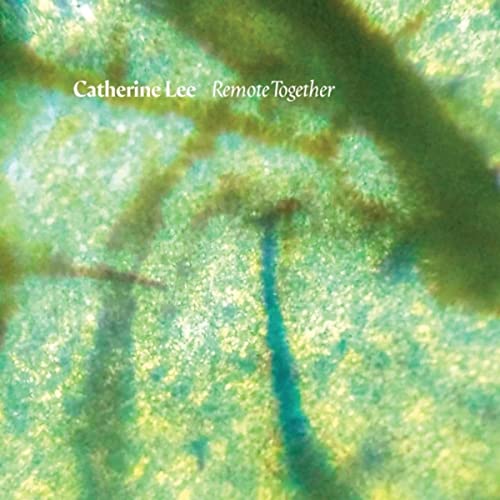
Catherine’s Oboe: Catherine Lee’s New Solo Album, “Remote Together”


Redshift Records

I make reference to “Gabriel’s Oboe” (from the Morricone score to The Mission) in a slightly ironic way to introduce an album in which the artist, Dr. Catherine Lee is on a Mission of a different sort from that of Gabriel in the film. Lee’s mission is the liberation and expansion of the role of her chosen instrument(s).

While many instruments fit comfortably into a solo role such as keyboard instruments, violins, and cellos this is not the case with the oboe and it’s double reed relatives the oboe d’amore and the english horn (Lee is a master of all of these). Indeed many instruments which have populated orchestras and chamber groups for ages have seldom if ever stood on their own. In a phenomenon which I term, “refugees from the orchestra” there have been many instances in which artists have taken their instruments out of the context of those ensembles and began to establish a performing tradition and commission a repertoire suitable for such a venture. In fact there are two west coast musicians who are renowned for their work in liberating their respective instruments from orchestras and into their own domains: Bertram Turetzky (professor emeritus at UC San Diego literally wrote the book on expanded techniques for double bass) and Stuart Dempster (trombonist extraordinaire who also “wrote the book” on the modern trombone). Dr. Lee is poised to make a similar mark on the musical world.

Lee’s previous album reviewed here, “Social Sounds” (2013) focused on music by Canadian composers. The present album (released May, 2021) parallels the tenor of these crazy pandemic times in both title and content. Recorded mostly in 2019 it arguably has some prescience the way good art tends to achieve. Here she includes composers whose milieu includes northern California and the Pacific Northwest in addition to Canada. The six compositions represented here touch on many mythological and actual beings from whom the artists derive their inspiration. Dr. Lee was apparently pleased with my review of her first solo disc graciously sent me a copy of this new effort.

Hurricane Ridge

Now for the last 18 months I have been on a travel contract living and working near Tacoma, Washington. My tenure in my “day job” has run pretty much concurrently with the rise of the pandemic and its attendant restrictions. As a result I had not explored this beautiful area of the world until recently. I decided to remedy this by taking a car trip to explore a bit of the Olympic Peninsula, the westernmost portion of the lower 48 states, and I took this CD along to provide a soundtrack for my trip. This journey of two days took me around and through parts of the Olympic National Park and through various tribal lands where native peoples have lived for thousands of years. Throughout the drive I let the disc play repeatedly and found it curiously satisfying as a soundtrack for the images I saw through my windshield (I did not bring music along on my hikes). Metaphorically Lee accompanied me on this journey.

Mount Baker, WA

This disc also appears to derive inspiration from several musical mythologies and persons which are also associated with the regions which span from the San Francisco Bay Area north into the Oregon, Washington, and Canada. John Cage, Pauline Oliveros (Lee holds a certification in Oliveros’ “Deep Listening” techniques), Harry Partch, Lou Harrison, Henry Cowell, spectralists (Wyschnedgradsky, Haba, Radulescu, etc.), Morton Feldman, Raymond Murray Schaeffer, Henry Brant and professor Lee who shares one of her own compositions much as she did on the first disc. There are six tracks containing six compositions which, though of different character, share a connection via the historical and mythological dimensions that comprise their roots. This is more about drones than rhythmic complexity and about images more than linear narratives.

The recording begins with the only actual solo composition, Jordan Nobles‘ “Nocturne” (2013). This is in fact a realization of a composition for a “spatialized” chamber group in which the instruments play “self paced melodies”. This track is a somber Cagean etude realized from this material for solo oboe. Spatial dynamics are the realm of both Raymond Murray Schaeffer as well as Henry Brant.

The second track is by the only composer on this recording with whom I have some familiarity, Dana Reason, a pianist and sound artist with roots in (the now mythological) Mills College and who is also certified in Oliveros’ “Deep Listening”. It is Pauline Oliveros whose spirit presides in this work. Her “Chanson de Fleurs: Eleanor of Aquitaine” (2017) is a sort of sonic narrative for oboe and soundscape evoking the mythology of the medieval French Queen. This is music that skirts the boundaries between didacticism and program music. It evokes images of the archetype of the eternal feminine. It is a lush and evocative work that brought images to this listener’s mind.

Taylor Brook‘s “Alluvium” (2017) is for oboe d’amore, a slightly lower pitched version of the modern oboe which was popular in the baroque era. It includes an electronic accompaniment and plays on the tuning problems common to these woodwind instruments. The recorded tape is the foil against which the soloist plays and deals with the tuning issues which in turn results in spectral harmonies which are rich and beautiful.

Julian Snow‘s “Red Eyes, Green Lion’s Teeth, Golden Heads” (2017) is also for oboe d’amore and recorded sounds. Here is a piece which ostensibly evokes the sprites and devas of “the flies and dandelions” of the composer’s back yard. Snow seems to channel the world music explorations of Henry Cowell and Lou Harrison in spirit.

Matt Carlson‘s “Chiasmus” (2018) for English Horn and Synthesizer attempts to metaphorically use the literary device of Chiasmus (a type of repetition for emphasis like “all for one and one for all”). This piece is, at 14:20, the longest piece on the disc. It consists of several short movements utilizing a minimalist dearth of materials to create variation structures. It is virtually a concerto whose virtuosic demands are interpretive rather than technical. It is a highly engaging piece that gave this listener joy in both passive and active listening. He seems to channel musical deities like Morton Feldman and Alan Hovhaness, a lovely experience.

The final conjuring on this disc is by Catherine Lee who presents “Silkys” (2020) a meditation for oboe and environmental sounds, a collaboration with sound artist Juniana Lanning. This is a meditation on the life of the domestic silk moth, again a soundscape rather than a narrative. Dr. Lee’s fascination with the natural world is also reflected in the cover art which is the artist’s own photomicrograph of the exoskeleton of a bombyx mori.

This is a subtle but widely embracing collection of music seems to be a logical next installment in Professor Lee’s mission to lead her tribe of double reeds to a new vision appropriate to the new century. Brava! Long live Catherine’s Oboe.

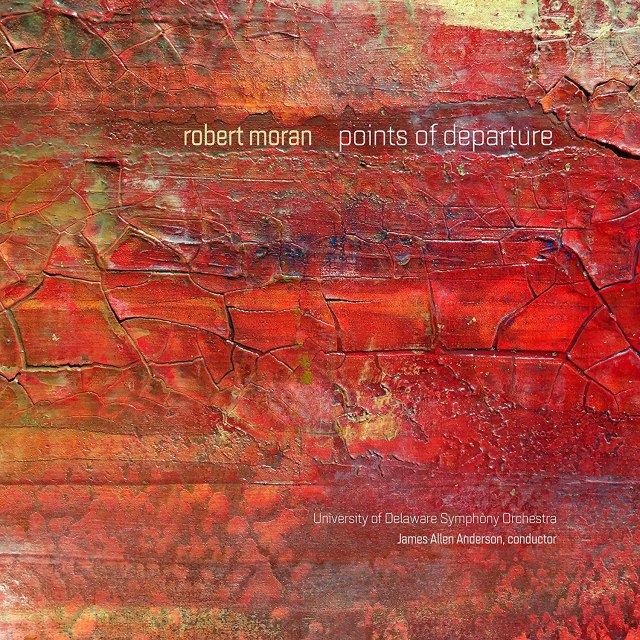
Robert Moran: Points of Departure


Neuma 123

This is another in this first volley of new releases from Neuma. Philip Blackburn did fine service by reissuing the out of print the wonderful Argo recordings of Moran’s works and released two new collections from this all too little heard American composers as well as the gorgeous Trintity Requiem (2011) on Innova Records. He now continues his advocacy of this composer in the release on Neuma of two new Moran recordings, The second, Buddha goes to Bayreuth (2015) will get its own review shortly.

The present disc consists of five works, only one of which (Points of Departure) has been recorded before. Composition dates range from 1973 to 2017. Moran’s work is widely eclectic reflecting his early study with Second Viennese composer Eric Apostel, his M.A. studies at (the now lamentably defunct) Mills College where he studied with Luciano Berio and Darius Milhaud. HIs work ranges from graphic scores to post minimalist and post modern/neo-romantic styles doubtless influence at least in part by the various places he has lived (Vienna, Milan, Berlin, Portland, San Francisco, and Philadelphia where he now makes his home).

All of the works on this album are of the very listenable and sometimes unabashedly beautiful category. But these compositions belie the processes that underlie their structures and methods. What is most fascinating is Moran’s ability to use quasi aleatoric procedures (as in Star Charts and Travel Plans I) and produce results so gentle on the ear. This is a beautiful disc.

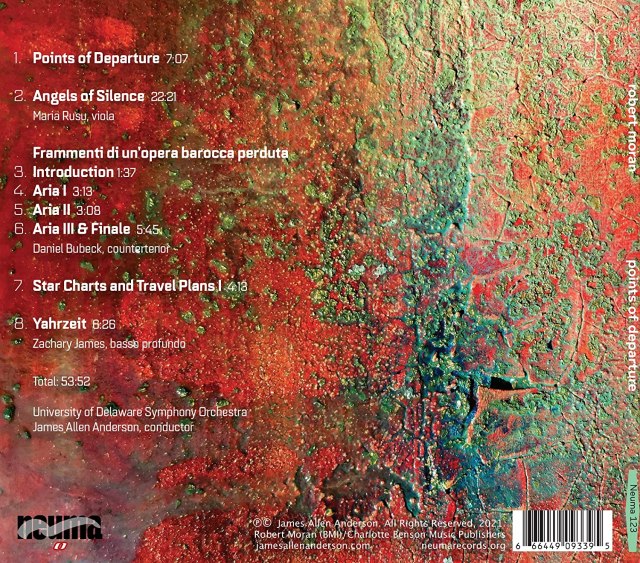
The all new recordings presented here begin with the titular Points of Departure (1993). It is a work for large orchestra which, according to Philip Gentry’s fine liner notes, is excerpted from a larger dance work. It is a rhythmic and exciting piece which demonstrates the composer’s mastery of the orchestra. One can easily imagine this accompanying choreography but it stands alone successfully as a concert piece.

The second track is Angels of Silence (1973) is seemingly anachronistic given it’s composition date when Moran’s output was arguably at it’s most experimental. Written during Moran’s time in San Francisco, it is one of a trilogy of works (between Messages from 1970 and Emblems of Passage from 1974). This trilogy followed on the heels of such grand experimental pieces as Thirty Nine Minutes for Thirty Nine Autos (1969) and Hallelujah (1971) for the city of Bethlehem, PA.

Here, despite the modernist use of chord charts for soloist and orchestra, we hear a very consonant piece which has an ethereal, gentle quality. To my ears it has much in common with the sound world of Stimmen Des Letzten Siegels (Voices of the Last Seal) (2001). The viola soloist, the Romanian-American Maria Rusu, handles her role beautifully with the university of Delaware Symphony Orchestra under the guidance of conductor James Allen Anderson. This writer’s fingers are crossed in the hopes of hearing the remaining two pieces of this trilogy in the near future.

Next up is the five movement Frammenti di un’ opera barocca perduta (2017). The title translates to something like “fragments of a lost baroque opera” and reflects Moran’s deep interest in early opera. The composer mentioned in an email exchange with this writer some years ago that he greatly enjoys listening to early baroque operas and this influence is in evidence here (in fact the texts he sets are texts from operas of this era). Scored for large orchestra with countertenor, a vocal artistry nearly extinct in the 20th and 21st centuries save for Philip Glass’ (with whom Moran collaborated in the fine fairy tale opera, The Juniper Tree) casting of the lead in his opera Akhnaten.

This gloriously lyrical suite can be sung by a soprano (and on first listen done before consulting program notes my guess was soprano) but it is sung as written by a truly fine vocal artist, Daniel Bubeck. The orchestral intro is followed by three arias (fast slow fast) followed by a brief orchestral epilogue. The piece is in some ways Moran’s Pulcinella, an homage to the past in the garb of the 21st century.

Star Charts and Travel Plans I (2016-17) is yet another example of the composer’s remarkable ability to use non-traditional notation to achieve his compositional goals. This rather meditative piece is very much in keeping with the overall sound of this fine release.

The disc ends with another vocal piece, Yahrzeit (2002-18), described by the composer as a “memory piece”. It has much in common emotionally with his wonderful Trinity Requiem (2011). Yahrzeit is a Jewish custom practiced on the annual celebration of the memory of the honored deceased. It is in memory of AIDS victim Michael Neal Sitzer whose life partner, poet James Skofield, wrote the beautiful text. Commissioned by friends of the couple, it was originally scored for male chorus and orchestra. It is presented here in a version for basso profundo, sung most movingly by Zachary James .

This is another major addition to the still too small discography of this great American composer. It is beautifully performed and recorded, a joy for fans of Moran’s work and a gift to listeners.

Fantastic New Music for Piano and Strings, The Jupiter Quartet with Bernadette Harvey


alchemy

There is no small irony for this reviewer in the title of this offering.  As soon as it was removed from its packaging I, much as Alice was implored by the comestibles in Wonderland, felt compelled by joyous expectation to consume it with eyes and ears.  And I was not disappointed.

Three composers are represented with one work each (two by Mr. Jalbert) in an album of recent compositions in modern but essentially tonal chamber music for highly skilled musicians. All But one (Secret Alchemy) are world premiere recordings commissioned by the Arizona Friends of Chamber Music and all contribute most handsomely to the piano and strings literature.

The highly skilled musicians are the extraordinary Australian Bernadette Harvey on piano with the Jupiter Quartet (Nelson Lee and Meg Freivogel, violins; Liz Freivogel, viola; and Daniel McDonough, cello).  They play extremely well together despite having to navigate all new and challenging material.  Harvey, in addition to traditional repertoire is a major advocate for living Australian composers.

jalbert

Pierre Jalbert

The album opens with Piano Quintet (2017) by Pierre Jalbert (1967-  ) which draws as much on the romantic tradition (can one hear the ensemble name “piano quintet” without thinking of Schubert, Brahms, and Schumann?) of that ensemble’s configuration as on his more modernist sense of rhythm and harmony.  It is cast in four movements titled, Mannheim Rocket, Kyrie, Scherzo, and Pulse.  This is a major work by a composer new to these ears and apparently very substantial.  This is highly engaging music with romantic leanings perhaps but there is nothing derivative here.  This composer is a voice that deserves an ear or two.

stucky

Steven Stucky

Next up is music by the late lamented Steven Stucky (1949-2016).  While I regret not having gotten to know a lot of his music during his lifetime I find myself enthralled at the power and lyricism of each work I hear (the man was prolific too so I have much listening to catch up on).  This one is no exception, Piano Quartet (2004-5) is in a single movement with multiple sections of varied character.  Anyone who has heard any of Stucky’s music will find this piece both exciting and accessible.

vine

Carl Vine

Carl Vine (1954- ) is a prolific Australian composer (the only non-American composer represented) whose work certainly deserves to be better known outside of his native country.  He does appear to get recognition and respect there and with Fantasia for Piano Quintet (2013) we can see why.  This one movement work is (like the Stucky piece) divided into sections played without pause.  This is another work of both power and virtuosity which holds the listener’s interest and, ultimately, provides a satisfying concert experience.

The program ends with another substantial work from Mr. Jalbert, a piano quintet in all but name.  Secret Alchemy (2012) allows us to hear some earlier chamber music writing by this composer.  Again each movement is given a title but this time they are more like expression markings and less poetic.  They are: Mystical, Agitated, Timeless, and With Great Energy.  Why that’s practically a program note!  And like the piece that opened this disc it indeed has great energy and will engage the listener.

This album exceeded my enthusiastic expectations and I will listen again, probably many times.  Well done.