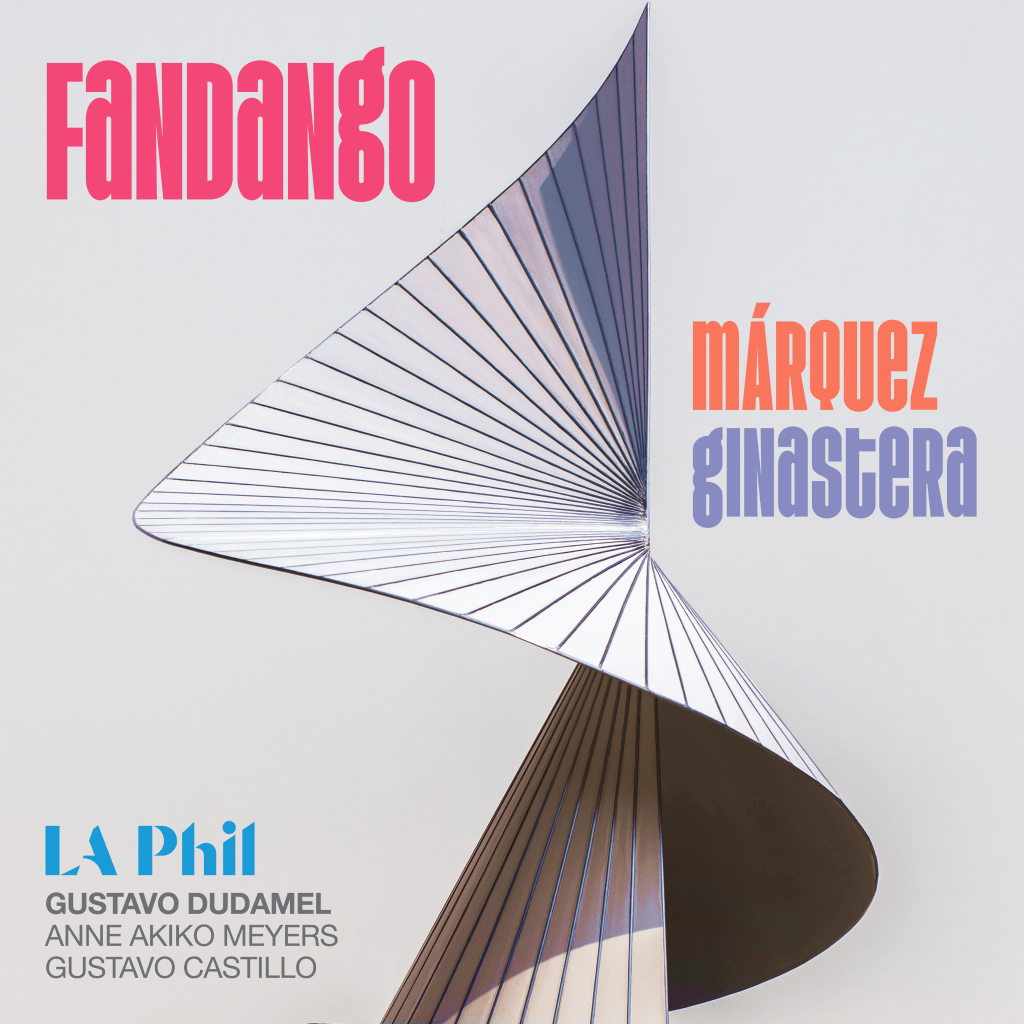
Fandango! Diversity Within Identities


Avie AV 2386

The primary importance of this new release is, of course, the presentation of these two major works but it also an exposition of the diversity (or do you prefer, “heterogeneity”?) that can become obscured by well intended terms like, “Latino” and “Hispanic”, or even conductor Gustavo Dudamel’s “Pan American”. All are well intended but racial, nationalist, and other categories are insufficient on their own in recognizing the rich diversity inherent in their cultures. Here we go, just in time for Latin History Month.

The concise liner notes tell us that even the album’s title, “Fandango” has multiple meanings depending on cultural contexts. The fact is that no single style or genre can be said to be representative of the marvelous diversity that exists within their intended scope which attempts to represent practically the whole of the western hemisphere as is the case with this release. So, while Fandango is certainly about the musical works presented, it also touches on the issue of diversity by the choice of two major works separated chronologically by some 80 years and representing composers from Argentina on the one hand, and Mexico on the other. Two different cultures that share a language in both words and , to some extent, music.

The centerpiece of this album is, of courses, the concerto that Maestra Akiko-Meyers commissioned from Mexican composer Arturo Márquez Navarro (1950- ). I’m sad to say that I am only now learning of this composer but delighted in his mastery of the orchestra and the grand romantic gestures of a past era along with an acute and personal appreciation of the folk idioms of his culture. At first I was skeptical of a “mariachi” inspired concerto because such attempts, even the most sincere, don’t always seem to work. Well, that is certainly not the case here. This is a strong contender for regular inclusion in the current canon of widely performed violin concertos. This one is a masterpiece which poses challenges to the soloist (which give her a chance to show her virtuosity) and surround it with rich, subtly, ultimately beautiful orchestral textures that support the soloist but which demand much of the orchestra and its conductor as well.
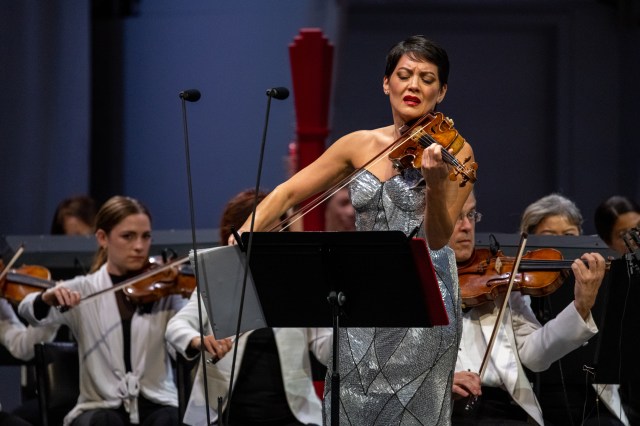
The concerto (written in 2020) is in the traditional three movements. The first, entitled “Folia Tropical” (tropical leaves) embraces the spirit of late romantic concerti like those of Bruch and Brahms. It is an extended movement that introduces and develops many moods and themes. It is a big symphonic movement worthy of a symphony and it gives the soloist much to do and upon which to demonstrate her musical and interpretive skills all the while with a very busy orchestra accompanying her.

The second movement, “Plegaria” (prayer) is a hugely substantive chaconne, the baroque contrapuntal variation form with a repeating bass line and thematic variations over the harmonic structures supported by those notes.. At least that is my listener’s understanding. But what is not necessary to “understand” technically is the emotional impact of this movement. This is an amazing use of the form. The soloist moves into different roles, sometimes very much upstage, sometimes an adjunct to the orchestra, sometimes not there at all. There is a slow, meditative beauty in this movement which is also characteristic of the romantic idiom in which this is written.

The third movement, “Fandanguito” (little Fandango) is a somewhat lighter and very energetic finale one might expect in a movement following the previous deeply emotional ones. And the composer does not disappoint. He writes a joyous, energetic finale which nonetheless stands up as substantially as its predecessors.
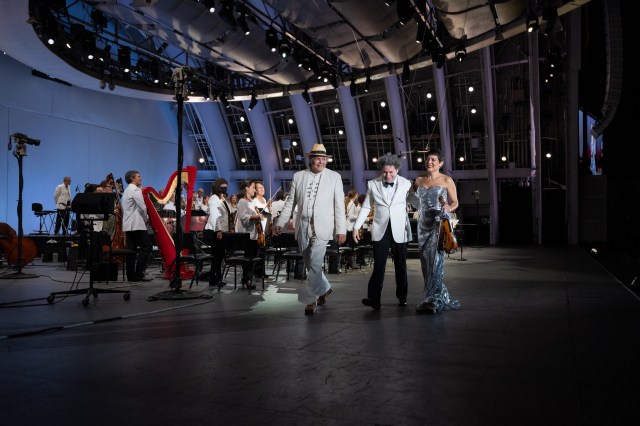
The composer Arturo Marquez with Maestro Dudamel and Anne Akiko-Meyers leaving the stage after a successful performance.

The joy, to this listener, is to hear a master composer in collaboration with a fine soloist both technically and interpretively. The composer has integrated his experiences and study of his own cultural folk musics and infuses the spirit of the music into his grand romantic idiom. That is, the concerto does not, for the most part use direct quotation from folk sources but uses structural elements in his composition. Maestra Akiko Meyers discharges her soloist duties with both startling facility and a deep understanding of the music and the composer’s intent.

Gustavo Dudamel is a joyfully rising star who brings his cultural proclivities and his own lens on western orchestral music. He is an exciting and incisive conductor. I don’t know the extent of Dudamel’s study of Latin folk musics but he really gets this work and brings out the composer’s subtleties in this gorgeous and exciting concerto.

The “B side” as they used to be called is no mere filler, it is the entirety of the Alberto Ginastera (1916-1983) ballet, “Estancia” Op. 8 (1941). Here, 15 separate movements are used in a five scene scenario. The work, usually heard in its four movement suite format and, even more frequently, just the spectacular finale, the Malambo.

In addition to its large orchestra, the ballet calls for a singer/speaker soloist who acts as both narrator and as soloist with orchestra. In this performance the challenge is admirably met by baritone GUSTAVO CASTILLO, another shining light cultivated by El Sistema. He performs well in both his baritone vocal duties and his narrator task in which he speaks Spanish in an elegant and, I’d say, almost Shakespearean grasp of the beauty of the language. The man understands drama as well as music.

This ballet is clearly a masterpiece. It reminds this listener of Prokofiev if he was born in Argentina. Nothing derivative here though. This is an intensely entertaining work, as substantial as Romeo and Juliet, similarly constructed in relatively brief musical segments designed to accompany a dance whose scenario is the story of the “gaucho” or cowboy that lived and worked hard lives, lives that were romanticized into a poem by Argentinian poet José Hernández (1834-1886). (click on the word “poem” for a link to an English translation of the poem).

All that to say that this is a truly enjoyable and important release. A valuable addition to the discography of Latin classical music.
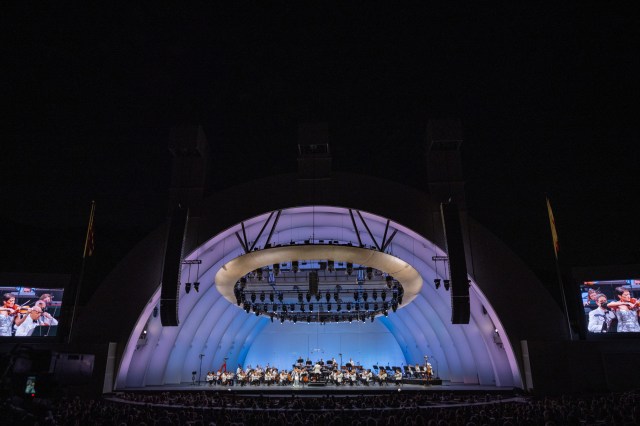
Dudamel and his LA Philharmonic at the Hollywood Bowl.

J. P. Jofre Double Concerto


jofredouble

This writer’s first encounter with a bandoneon was the electroacoustic “cybersonic bandoneon” of Gordon Mumma from about 1966.  In fact the instrument has its origins around the beginning of the 20th century.  It is a small accordion-like instrument which relies on the performer operating a bellows while pushing buttons on the instrument which force air past reeds which vibrate at their tuned pitch.  It is a folk instrument in Germany and Argentina where it became best known as the workhorse of the tango bands of the time where it continues to be popular.

It’s appearance in the avant garde with experimentalists such as Mumma did occur but the instrument became best known through the work of Astor Piazzolla (1921-1992) who incorporated tango in much the way Aaron Copland incorporated American folk songs into his classical works.  Despite his popularization of the instrument it remains largely just one of the instruments in local tango bands and the classical world appears to have largely withdrawn its interest since Piazzolla’s passing.

JPJofre

Juan Pablo Jofre (from his web site)

Well along comes native Argentinian Juan Pablo Jofre Romarion (1983- ) who appears to want to change that.  In addition to running his own tango band and promoting the music of his predecessor Piazzolla he now ventures into the classical realm with no less than a double concerto for bandoneon (of course) and violin.

Now this is not the avant garde stylings of the 1960s and 70s such as that typified by Gordon Mumma.  It is also not the sort of experimentation done by Piazzolla as he incorporated his native folk musics into the realm of the classical stage.  Instead we have a classically trained virtuoso bandoneon player forging his own style which is in fact quite listenable and seems to be treading a path of significance that may rival his teachers and mentors.  If you need a category for this disc try neo-romantic or just world music.

It is not difficult to imagine Jofre writing for the instrument of his own virtuosity but he also manages to write a substantial part for the other instrument in this double concerto, a violin.  He engages Belgian classical violinist Michael Guttman to share the stage in this large and substantial composition from 2016-17 and gives him a great deal to do.

Jofre has distinguished himself as one of the important interpreters of tango with his own band and, in particular, the works of Astor Piazzolla.  Now we get to hear the next phase of this emerging artist as he ventures into the world of the classical stage bringing his diminutive folk instrument to the fore.

In this tasty little recording we get to hear two highly skilled soloists and none other than the Orpheus Chamber Orchestra who do justice to Mr. Jofre’s first (and one hopes not the last) concerto for bandoneon and violin with chamber orchestra.  It is difficult to say if Jofre is going to be able to handle large musical forms (like symphonies, opera for example) but he is quite adept at writing for these three to five minute movements which constitute the concerto’s structure.

Jofre is at his best writing for the two solo instruments and some of it is ravishingly beautiful.  All of it is quite listenable and one must surmise that Jofre is a rising star with great talent and that he will continue to write music of this quality and passion.  It would be wonderful to hear more of the possibilities of combining the bandoneon with other classical instruments, maybe a concerto for accordion and bandoneon (of course the possibilities are boundless).  Clearly this is just the beginning for this emerging artist who seems poised to take on the mantle of Argentina’s other great tango composer, Astor Piazzolla both in his compositional and performance skills.

This substantial concerto (which chooses to split the outer movements into two parts) covers five of the six tracks on this disc.  The remaining three tracks are for bandoneon and violin.  These duos provide a glimpse of the powerful and intimate nature of Jofre’s compositional skills.  This is beautiful music and here’s hoping  that this disc will be the start of a mini renaissance of tango, Piazzola, etc.

It may be some time before the bandoneon is a common instrument in classical concert halls (or maybe it will never become common) but there is no doubt that Jofre’s instrument and his music deserve serious attention.  I would stay tuned if I were you.

Jason Vieaux and  Julien Labro, Chamber Music with Afro-Cuban Roots


Arica ACD-71309

This album seems to have been characterized as fusion/crossover perhaps for marketing purposes but it is in fact a fine compilation of too little heard works by Afro-Cuban/Latin American/South American composers of the mid to late 20th century.  Start with the rapidly rising star of guitarist Jason Vieaux whose earlier recording of the stunning Ginastera guitar sonata seems to place him in the position as a specialist in Latin American music.  Then add Julien Labro, a specialist in the bandoneón, an instrument best known for its ubiquity in tango music. Combine them with good audio engineering and an intelligent production and you have this album.

If there is a sense of “fusion” here it is due to the creative efforts of the composers involved.  In fact this is pretty much in the same tradition of Bartok, Kodaly, Copland, Thomson and others who mined folk and ethnic musics very successfully to infuse their “classical” compositions with new life.

Leo Brouwer (1939- ), Radamés Gnattali (1906-1988), and Astor Piazzolla (1921-1992) are all composers deserving of serious attention but are little known in North America and the reasons are clearly not musical talent.  All three composers are featured here in works arranged by Julien Labro who plays bandoneón, accordion and accordina on this recording.  He is joined by Jason Vieaux on guitar, and Jamey Haddad on percussion.

In addition we are treated to a composition by Pat Metheny and a curious arrangement of “Everybody Wants to Rule the World” by Roland Orzabal, Ian Stanley, and Chris Hughes to round out a diverse and engaging program.

One hopes that this will kindle further interest in these too little known composers but, until then, we have a marvelously entertaining recording that will likely please Latinists, guitar lovers, bandoneón lovers, and the like.

This is a fine and crisply recorded CD with some truly fine musicians.  Call it fusion if that helps you want to listen but please listen when you get a chance.  You won’t regret it.


Alberto Ginastera at 100


ginastera

Oberlin Conservatory OC 16-04

Let me start by saying that the only thing wrong with this album is that it is only one CD. Alberto Ginastera (1916-1983) is without doubt one of the finest composers of the twentieth century.  Stylistically he holds much in common with composers like his contemporaries Aaron Copland (with whom he studied), Carlos Chavez, Leonard Bernstein and others who incorporated the spirit if not always the literal music of his homeland’s folk culture into his music.  In additional to these nationalist works he wrote a substantial amount of traditional concert music which touched on the edges of modernistic trends.

He wrote three operas, two ballets. two piano concertos, two cello concertos, a harp concerto, three string quartets, a bevy of piano music and sundry other items.  It is simply not possible to contain a fair representation of his work on a single CD.  Despite that this disc is not a bad retrospective.  It is lovingly played and recorded and if it does not represent the whole of Ginastera’s oeuvre it is a nice sampling.

The disc begins with the wonderful Harp Concerto Op. 25 (1956, rev. 1968).  Though originally commissioned by Edna Phillips (principal harp of the Philadelphia Orchestra) she had retired before she could perform it and it was premiered in 1965 by the amazing Spanish harpist Nicanor Zabaleta.  This three movement work is certainly one of the composer’s finest works and is beautifully played by Yolanda Kondonassis with the Oberlin Orchestra under Raphael Jiménez.  This piece is one of the finest modern harp concertos and is representative of the composer’s international style with perhaps just a taste of modernism.

Next up is the single movement Pampeana Op. 16 (1947) with the great Gil Shaham on violin and his sister Orli Shaham on piano.  This is a sort of window on Ginastera’s earliest nationalist style full of melody and virtuosity.

The next work is the Sonata for Guitar Op. 47 (1976) played by Grammy winning virtuoso Jason Vieaux.  I had not heard this work and my first hearing was indeed a revelation.  This is a major work for guitar and a wonderful sonata in the classical form.  I gave these four tracks a few listens in an attempt to digest some of their beauty and complexity and I will doubtless give them many more listens.  This is a major piece that belongs in the repertory.

And, finally, we move to the earliest utterance here with the Danzas Argentinas Op. 2 (1937) in an exciting and dedicated performance from Orli Shaham.

The sound is wonderful and there are a geekily satisfying set of liner notes which include a useful analysis by James O’Leary, Frederick B. Selch Assistant Professor of Musicology, Oberlin Conservatory of Music.  All in all a beautiful production and a great introduction to Ginastera’s work but please, don’t stop here.  Make sure you get to hear his other work and perhaps the wonderful folks at Oberlin will consider a volume two?