Bob and Blue, A Musical Pilgrimage


Littlefield Hall (photo copyright by author)

…tell the old story for our modern times. Find the beginning.

-Homer, The Odyssey (Emily Wilson translation)

When I first got the email notice of this concert, I was, to say the least, intrigued. A two piano concert at Littlefield Concert Hall on the campus of Mills College featuring two composer/performers who figured prominently in that Temple of new music and in my personal listening life. Alas, I live some 350 miles from that location. But further intrigue came from the featured artists: Sarah Cahill and Joseph Kubera, two of the finest working new music pianists anywhere and both worked with the evening’s composers. This was just too compelling and I decided that I would regret missing this if I failed to go hear it.

So it was, I planned my little odyssey, leaving at about 9AM from Santa Barbara on a nice lightly trafficked trip, more a pilgrimage than an odyssey. A pilgrimage, frequently defined as a personal spiritual journey ostensibly in search of insight or enlightenment is how I’ve come to identify my listener’s adventure to the secular temple of Mills College featuring music of former Mills faculty Robert Ashley (1930-2014) and Robert Sheff (1945-2020), better known by his stage name, “Blue Gene Tyrrany”.
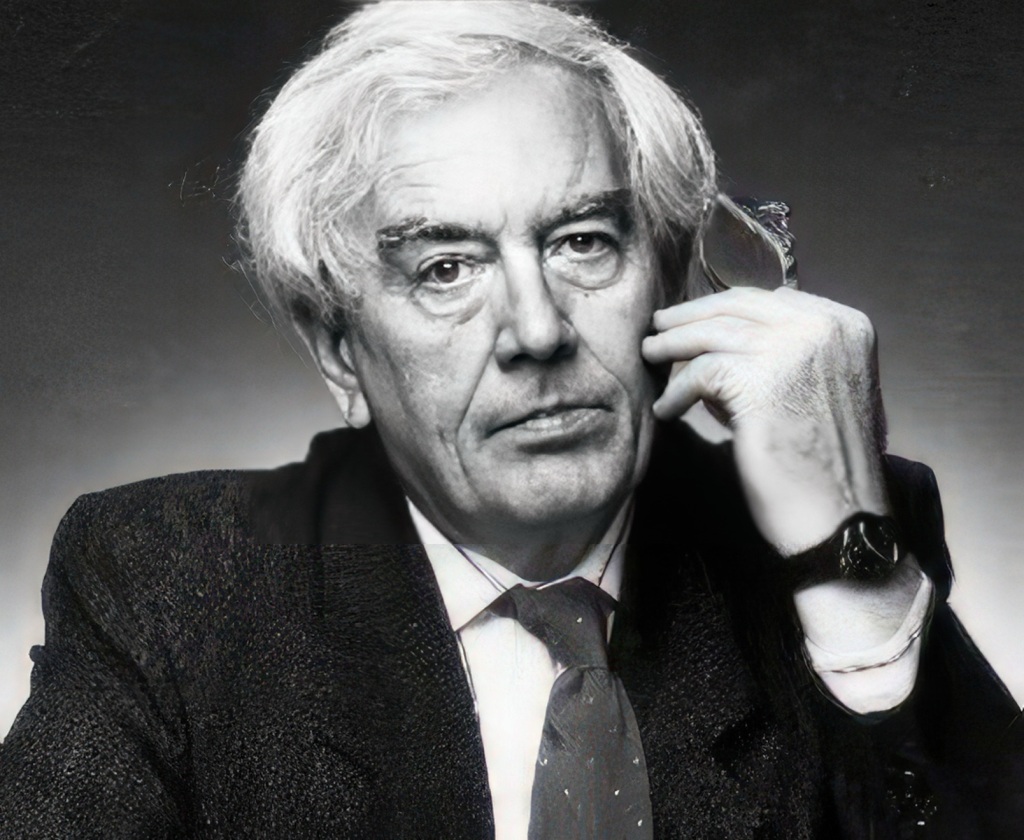
Robert Ashley (copyright unknown)
“Bob and Blue” (copyright by Other Minds)

The two featured composers had a strong connection to the Bay Area, mostly via their work at Mills College. This intelligent but modest production left little room to print program notes so the performers spoke of the music at various points during the concert and the excellent liner notes were made available by a QR code in the program book.

Sarah Cahill, pianist, radio host, producer, tireless advocate for new music (photo copyright by Other Minds)
Joseph Kubera, pianist, member of the SEM ensemble, Downtown Music, and countless collaborations promoting new music with many fine recordings to his name. (Photo copyright by Other Minds)

Our two performers are no strangers to each other or the composers on the program, having collaborated on numerous performances and recordings. The well rehearsed duo turned in riveting performances of this largely unknown repertoire which made a strong case that it be better known. Their playing and choice of repertoire compelled this listener’s attention such that I forgot to take all but a few performance shots. See those program notes for further biographical info on these two fine musical celebrants.
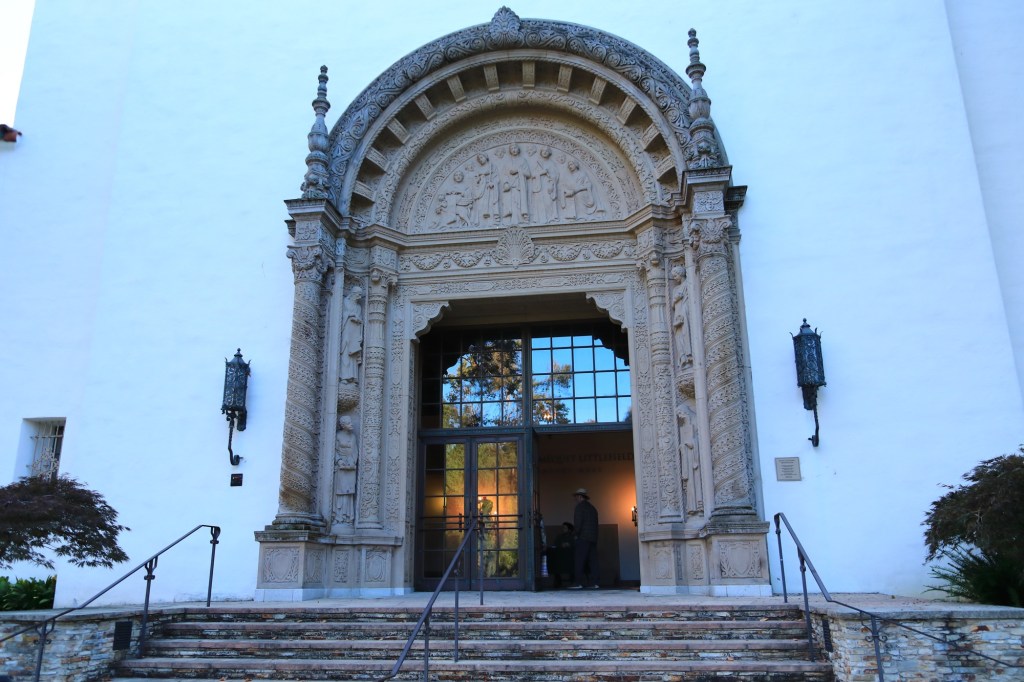
Entrance to Littlefield Concert Hall (copyright by author)

Mills College has long been a temple, a Mecca for new music in the Bay Area of California. Its roster of faculty and students comprises some of the finest post 1945 composers and performers. Darius Milhaud (1892-1974) and Luciano Berio (1925-2003) and students as diverse as Terry Riley (1935- ), Steve Reich (1936- ), and Dave Brubeck (1920-2012) to name but a few. Many artistic spirits musical and otherwise, exert their presence here. It’s a perfect destination for a pilgrimage.

A bust of frequent Mills visitor Lou Silver Harrison (1917-2003) in the lobby, a persistent benevolent spirit. (photo copright by author)

The concert was organized by Charles Amirkhanian and his Other Minds organization, another guiding light in the San Francisco/Oakland new music scene. Pianists Sarah Cahill and Joseph Kubera were to be the celebrants in the concert ritual paying homage to “Bob and Blue” as well as to the oracular Mills College.

Scene from the lobby (photo copyright by author)

Let me tell you about this concert hall. It is the work of legendary California architect Julia Morgan (1872-1957) who famously also worked on Hearst Castle. This is one of her several architectural gems on campus. Her spirit was also witness to this celebration by virtue of her fine architecture.
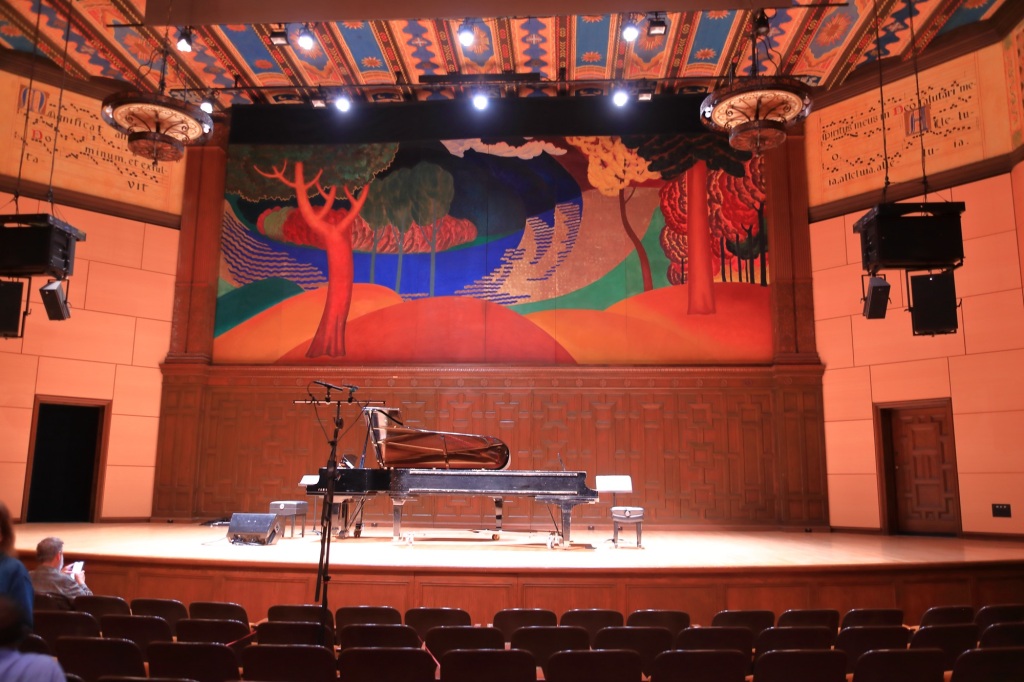
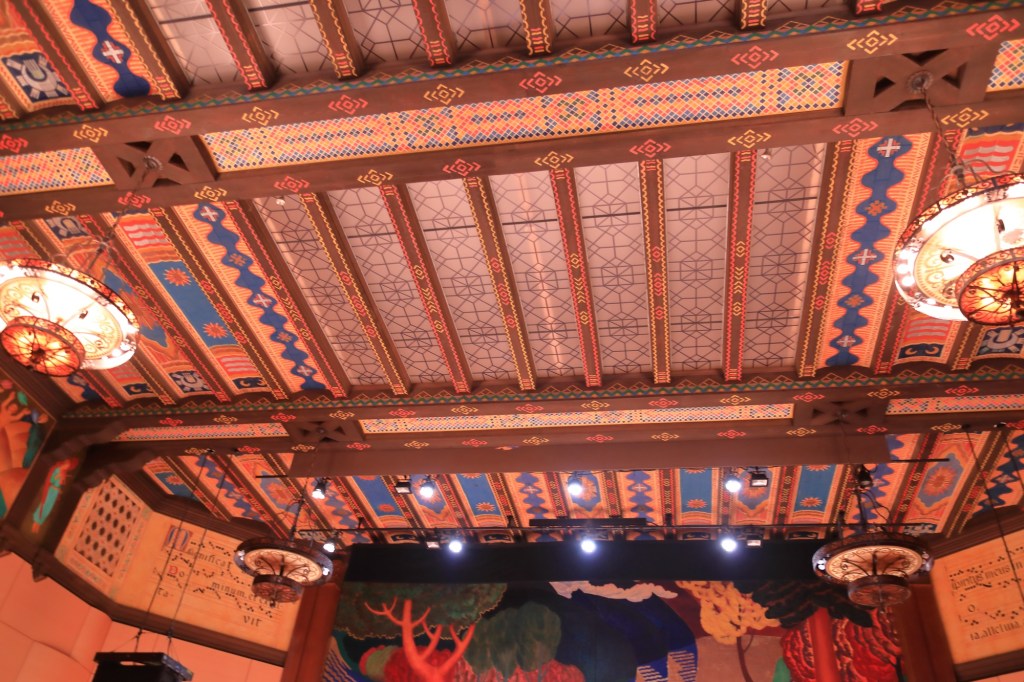
Stage at Littlefield Hall showing the ornate, colorful detailed designs (photo copyright by the author)
Look at that ceiling and those chandeliers (photo copyright by the author)

Two pianos, a new Steinway stage left and a slightly worn Baldwin stage right were placed such that the pianists seated at their respective keyboards could see each other. The Steinway with its lid open to reflect the sound to the audience and that well worn Baldwin with no lid at all (for reasons to be revealed later). The sonics of the hall and tuning of those pianos were excellent.
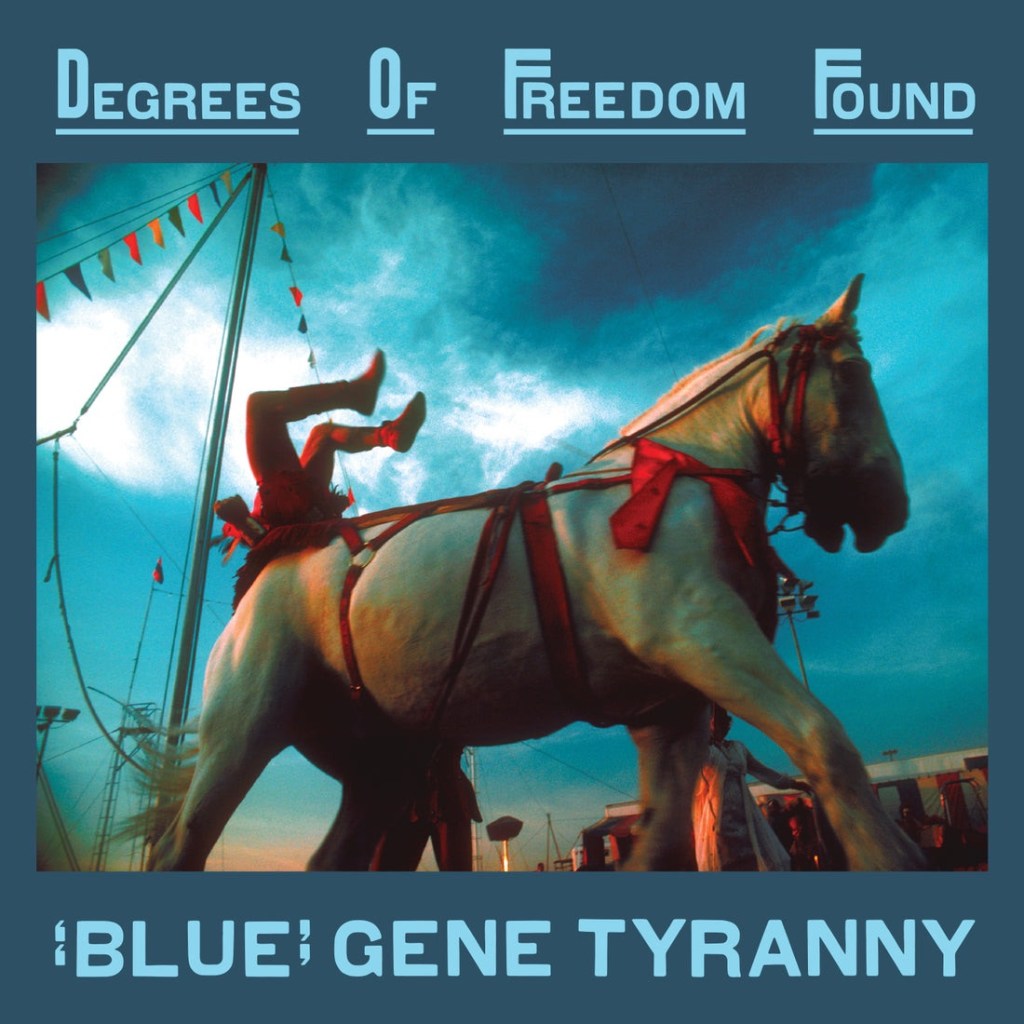
Unseen Worlds’ wonderful survey of Blue’s ensemble works.

The concert opened with Blue Gene Tyrrany’s peaen to old Route 66 in his “Decertified Highway of Dreams” (1999) for two pianos. It was clear from this first selection, that our performers were well rehearsed and in sync despite rhythmic complexities inherent in this quite beautiful work. It is cinematic and sweetly nostalgic, a fine example of “Blue”’s genius. The performance was riveting and worthy as the first performance ritual of the evening.

This was followed by a real rarity, a performance of Robert Ashley’s Piano Sonata (1959, 1979, 1985). In fact, it appears to have been the first complete performance of the two piano version of this impressive serially structured piece. Previous recordings are available, one with the composer performing the first movement at the ONCE Festival from 1966, the other by Blue Gene Tyrrany on his album, “Just for the Record”. This writer also found some useful analysis by musicologist Kyle Gann on his website. Gann worked with Ashley and later published a fine survey of Ashley’s music that is well worth your time. The result was a convincing, almost romantic sounding performance of this foundational work in Ashley’s oeuvre.

This was followed by a solo rendition by Joe Kubera of Tyrrany’s “The Drifter” (1994), which was written for Mr. Kubera. He spoke briefly about the structure of this work (which he also recorded on his recent “Horizons” album). This piece has a meandering quality created by the intricate evolving structure. Kubera’s performance was hypnotic and a fine tribute.

The second half began with Ms. Cahill solo at that stage left Steinway playing first Tyranny’s “Nocturne With and Without Memory” (1989), one of his better known works. Then she played his “Spirit” (1996/2002), a piece that is a sort of homage to the experimental composer/performer Henry Cowell (1897-1965). It was rather unusual in that it involved harmonics over which the pianist plays. The title is an homage to Cowell’s famous piano piece, “The Banshee”, a malevolent spirit in Irish mythology. Both were vintage Blue Gene pieces.

Two pianists, one piano.

Then Kubera returned, taking a seat at the blemished Baldwin with Cahill standing at that same piano, at a 90 degree angle to Kubera. Here, in these two obscure Ashley pieces, Viva’s Boy (1991), and “Details” (2b, 1962), Cahill played like a chef at a chef’s table, playing the strings inside the piano while Kubera manned the keyboard. These true rarities getting perhaps their first performance, were certainly a highlight of the concert.

It was Blue Gene Tyrrany’s spirit that was the final ritual celebration on this magical night with both pianists at their respective pianos to give a heartfelt reading of his, “A Letter From Home” (2002). This brought this learned, well rehearsed, beautifully collaborative evening’s ritual to a satisfying close.

The modest, self selected audience, applauded warmly and gave an extended, much deserved ovation and seemed as enthralled as this listener whose musico-spiritual pilgrimage found an ecstatic height. I drove home that same night, blessedly lifted, if only briefly, from the chaos of the world by this wonderful artistic ritual. They will now take this great program to New York.
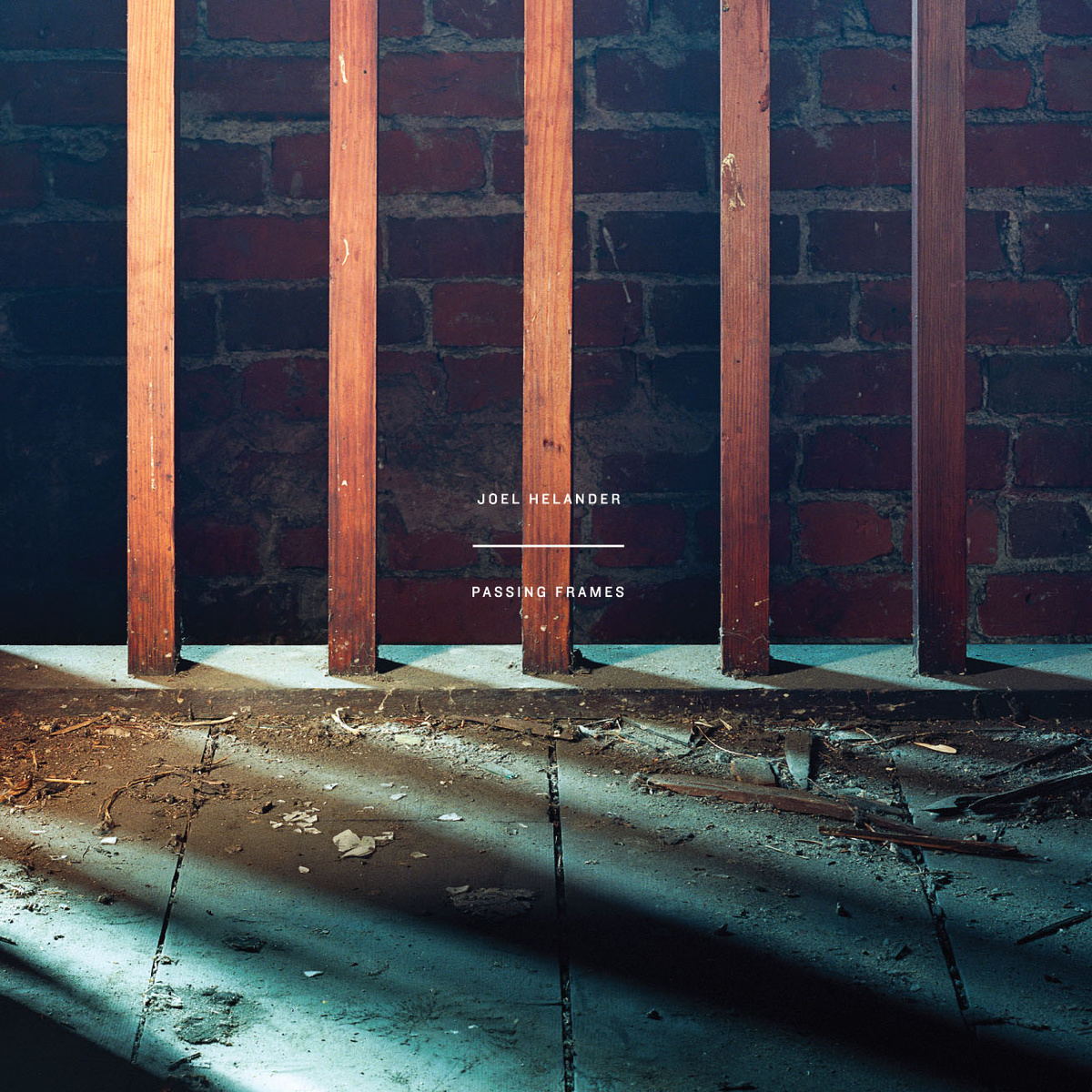
Passing Frames, a new CD by Joel Helander, Happy, Gentle Experiments


Let me first acknowledge that I am running behind on my reviews but one of the reasons I have been slow about this one is that I have had great difficulty trying to characterize this music in a meaningful way for readers of this blog.  And by that I don’t mean to imply that this music makes for a difficult listening experience, it doesn’t.

Passing Frames (2014)

Passing Frames (2014)

Passing Frames is the second CD by composer/pianist Joel Helander whose previous release, Flood (2012) is a solo piano effort.  These two CDs published on Bandcamp earned Mr. Helander mention in Forbes magazine in an article about the self-marketing that is available to musicians who are trying to establish themselves in the music business.

Joel Helander

Joel Helander

Helander is a student in theory and composition at Clark University where this very project is featured on their website.  I conducted a sort of interview with Mr. Helander via e-mail exchanges and learned that he has been playing piano for about 10 years including classical training and a more recent interest in jazz performance. He said that this project began as a sort of follow-up or perhaps a natural progression to his previous release.  His earlier album has much in common with this one in terms of atmosphere. Passing Frames is a set of ensemble pieces with the assistance of friends and classmates all drawn from the Worcester area.

His brother Karl Helander, a singer and song writer in his own right, who studied studio drumming at the University of Miami plays drums and percussion.  String and wind players were enlisted from the Worcester Chamber Music Society, fellow Clark students and other friends. He cites Mike Tierney (guitar, engineer, co-producer) as being essential to the creation of the overall sound of the album as well as being an effective instrumentalist in selected tracks.  All in all it sounds like this was a very close creative collaboration which was rewarding for all involved.

When I first received the CD in the mail I was immediately struck by the lovely cover art and overall design which led me to comment to Mr. Helander of the nostalgia for the larger cover art one used to get with vinyl LPs.  He commented that he had looked into this possibility but found it economically prohibitive.  The photo and overall design was by the same artist, Paul Puiia, who had designed his previous release. There are 11 tracks on this CD all with poetic titles that tell you little about the music itself but no doubt have some meaning for the composer and perhaps his collaborators.  That is not intended as a criticism, rather it is a reflection of music that is less concerned with form than expression.  Not program music but little poetic statements.  And given that Mr. Helander aspires to writing film music this sort of focus seems quite appropriate.

On my first few listens to this disc I was reminded in ways of Ludovico Einaudi, The Penguin Cafe Orchestra and perhaps some of the chamber music of Peter Schickele.  Mr. Helander said he was comfortable with those comparisons.  I did ask him to list some of the music he listens to and he provided me with a pretty eclectic list including:

-Debussy’s String Quartet
-Chopin’s Nocturnes
-Beethoven’s “Archduke”
-Satie’s “Gymnopedies”
-Bill Evans’ “Portrait in Jazz”
Randy Newman‘s “Sail Away”
-Rufus Wainwright’s “Want”
-Nina Simone’s “Little Girl Blue”
-Jon Brion’s “Eternal Sunshine of the Spotless Mind Soundtrack”
Van Dyke Parks‘ “Song Cycle”
-John Coltrane’s “Blue Train”
-The Bad Plus’ “Never Stop”
-Fleet Foxes’ “Helplessness Blues”
-Tom Waits’ “Orphans: Bawlers”
-Neil Young’s “After the Gold Rush”
Belle and Sebastien‘s “The Life Pursuit,”
-Chet Baker’s “Chet Baker Sings,”
Chilly Gonzales “Solo Piano I and II”
Brad Mehldau‘s “Highway Rider”
-Simon and Garfunkel’s “Bookends.”
This is an interesting and varied list.  I didn’t include this list to give prospective listeners and idea of what the music sounds like but I think it does reveal something about the aspirations and inspirations of the composer’s intent.
I had given some thought to trying to describe each of the tracks on the disc and give my analysis and impressions but finally decided to leave my readers with more general impressions.  Each of the tracks is a self-contained musical statement though three of the tracks are identified as being parts of a suite.  As I said, the poetic titles may have meaning for the composer and may invoke ideas in the listener as well but in the end I perceived the entire disc as a sort of unified whole in that the disc appears to be a musical statement which stands as a reflection of the composer’s ideas at the time of this release much as his first disc does.
Further listenings suggested a sort of sophisticated melancholy lounge music born both of the composer’s aesthetic and those of his collaborators (the production and recording certainly add to this effect).  There appears to be more of a classical influence with a jazz ambiance added.  This is an interesting disc which manages to be both gently experimental as well as eminently listenable.  It is a snapshot of this young man’s best efforts at composition and each can be listened to as a potential sound track to a yet to be made film sequence or simply as a pleasant musical statement on it’s own.
With the perspective of the first disc in mind one can see a progression and integration of nascent ideas evolving as the composer works to develop a more integrated and clear statement of his ideas.  He achieves exactly what he intended I think.  That being said I will be interested to see what he does next as I enjoy the work he has done so far.  If you are interested in new music this disc is worth a listen.  If you are just looking for something different to add to your listening selections you would not be disappointed either.

Tom Johnson and Samuel Vriezen, Great New Recording


A few of months ago received my copy of the newly minted CD by pianist/composer Samuel Vriezen.  This is one of those crowd-sourced projects on Indiegogo .  The disc consists of a new recording of a sort of minimalist classic and a new works by the pianist, Within Fourths/Within Fifths (2006) which is, essentially his artistic response to this piece.  The piece is dedicated to Johnson.

download

This is only the second recording of the Tom Johnson work committed to disc. That by itself is an achievement. The first was recorded by the composer and released on XI records in 1999.  That recording clocks in at about one hour.  By contrast Mr. Vriezen’s recording takes only about 30 minutes to play the piece.  Johnson, who is also known as the former music critic for the Village Voice is one of the few composers who actually embraces the term “minimalist”, in fact he was there witnessing the very birth of that style during his tenure at the Village Voice (1972-1982).

The Chord Catalog (1985) consists of, in order, all the possible chords in a single octave that are possible with two notes, three notes, four notes, etc. up to 13 notes with the doubling of the octave.  That’s a total of 8178 chords. This sounds like a potentially bland academic exercise like many minimalist or process music concepts.  No tempo is specified in the score.  It is an important piece which may not appeal to all audiences but will likely entertain anyone whose listening interests lie in the realm of minimalism, process music and conceptual art.

TheChordCatalogue-page-001

According to Kurt Gottschalk in his article for I Care If You Listen Johnson is a fan of Vriezen’s interpretation and, in fact, is one of the many contributors to the project.  Vriezen has been performing the piece for about 10 years now in public concerts and he posted a video of a performance of Chord Catalog with commentary by Tom Johnson and himself.  There are also scenes of Johnson with Vriezen as he performs a portion of Within Fourths/Within Fifths.

Vriezen’s piece by contrast lasts about 45 minutes and, though using similar methods, produces a different sound world.  He correctly describes the piece as lyrical and it is a wonderful piece on its own, more wonderful in context with its predecessor.  This disc is an artistic dialogue, a call and response between to kindred spirits of different generations.

Samuel Vriezen is a Dutch pianist, composer and writer born in 1973.  His web site lists his compositions and writings and there are downloadable mp3 files and scores.  There is also a Vriezen page on Ubuweb which contains mp3 files and pdf files of several of his pieces and includes useful program notes.  He also produced Johnson’s CD Symmetries (1980) featuring Vriezen and fellow pianist Dante Oei on Karnatic records.

This is the solo début recording by a composer and pianist with keen instincts and talents that leave this reviewer in excited anticipation of what he  will do next.  I am also proud to have sponsored this wonderful recording.

Enhanced by Zemanta

Cançonièr at the Berkeley Festival Fringe


Full moon presides over exsanguinous tales.

Last night, local early music ensemble Cançonièr performed in what was their last appearance until next year.  In the somewhat noisy parish hall of St. Mark’s Episcopal Church this four member ensemble played a slightly condensed version of a program they have been touring for the last year or so.  It was a program called ‘Black Dragon’ with music from the first half of the 15th century, the time of the reign of Count Vlad Dracula, the historical antecedent of the vampire character.

Cançonièr is a four member ensemble co-directed by Tim Rayborn and Annette Bauer.  The other two regulars are Shira Kammen and Phoebe Jevtovic.  All are amazing instrumentalists and scholars in their own right and all play in other ensembles and groupings.

Tim Rayborn is a medieval scholar , multi-instrumentalist, singer and performer.  Annette Bauer is a recorder virtuoso, multi-instrumentalist and singer.  Shira Kammen plays vielle (antecedent of the violin/viola), medieval harp and sings.  And Phoebe Jevtovic is a singer who also does double duty by playing a small bell set in some of the pieces.

Annette Bauer demonstrates her virtuosity on the recorder.

Tim Rayborn

Tim Rayborn providing context and performing.

The group goes beyond their scholarship (which is excellent) and puts their performances in context.  They provide translations of the words they sing (frequently in dead or antiquated languages) and they connect with their audience with a pleasant sense of humor as well as drama.

Shira Kammen playing the vielle.

They clearly enjoy playing together and seem very connected, deriving great pleasure from making music.  And they produce a beautiful sound with their intricately crafted replicas of the instruments of the time.

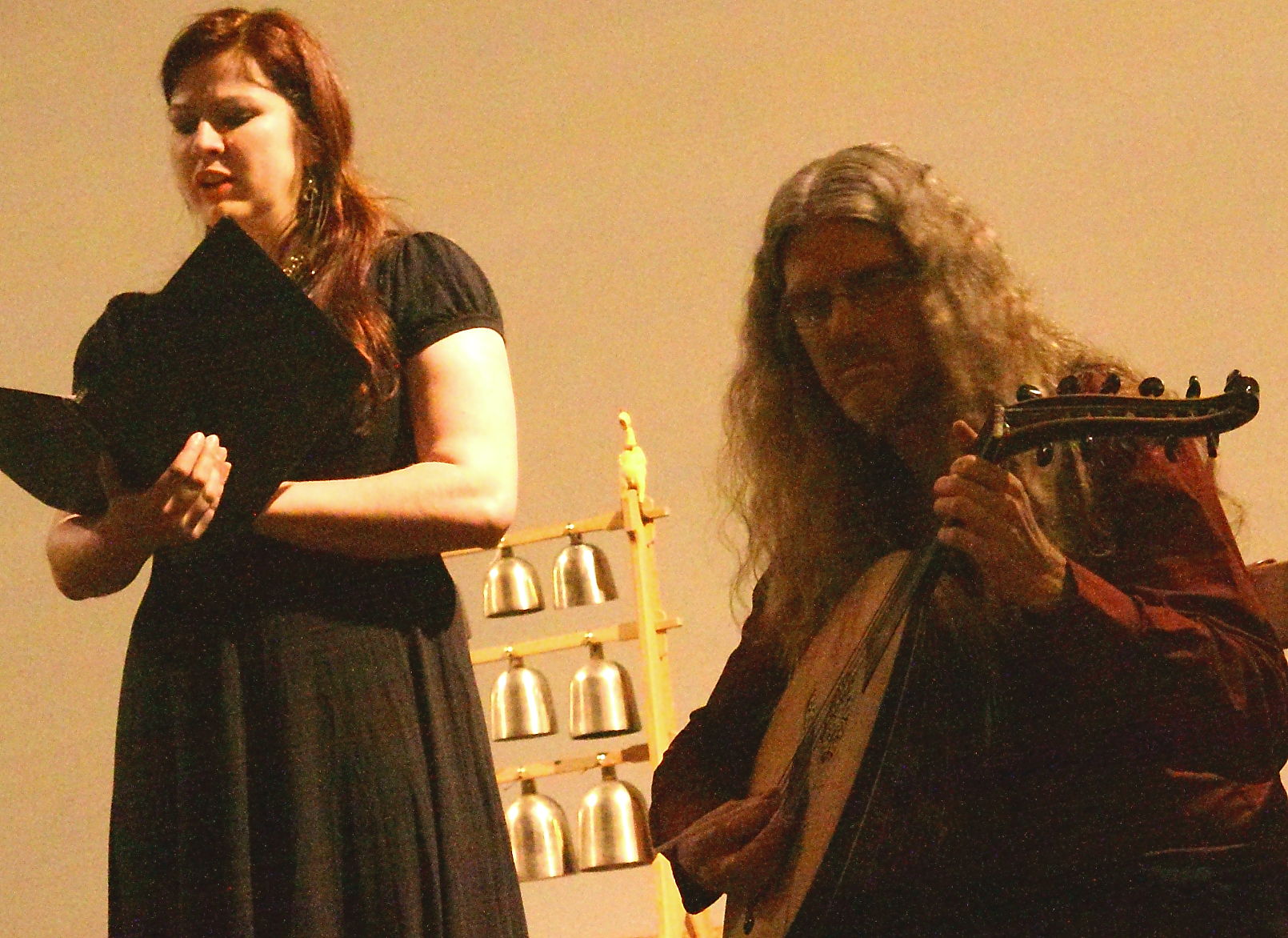
Phoebe Jevtovic sings accompanied by Tim Rayborn on the lute.

One complaint.  The location of this church at Bancroft and Ellsworth makes for a bit of urban distraction provided by sirens and traffic.  And there were apparently other activities going on in the church complex which could be occasionally heard.  But the musicians and audience handled the distractions in a good-natured manner consistent with the rest of their performances.

They began and ended their intermissionless program with a narrative drama with music partly sung, partly spoken or intoned but performed with characteristic flair by Tim Rayborn accompanied by himself on frame drum and the ensemble.  This was a jaunty upbeat sounding piece at the outset that gives way to the narrative talking/singing about the infamous subject of this performance here called Dracula of Wallachia.  The language here sounded like an old German dialect and after the brief but harrowing telling of the story in speech and song (the speech gratefully rendered in English) the jaunty music of the beginning returns to conclude the piece.  One can imagine this being performed in a tavern or inn by a troubadour or group of musicians for the guests.

Rayborn then spoke to the audience providing more context by explaining that tonight’s music is from the time of the Count’s reign but that it is not known if he indeed had musicians in his court.  And for those who do not know the story of ‘Vlad the impaler’, as he was known, this is pretty grisly stuff.  Reality programming from the dark ages if you will.

There followed two more composed songs, a folk song, a traditional Romanian dance,  a heart-rending Moldavian chant passionately sung by Jevtovic and a traditional Bulgarian dance.

I have not bothered to mention the composers’ names (which were listed in the printed program) because they are very little know and would likely clutter this little narrative.  My apologies to the composers and the scholars if I have offended in my omissions.

Left to right: Shira Kammen, Annette Bauer and Phoebe Jevtovic demonstrating their vocal collaboration.

But the next piece was by a composer familiar to anyone who has taken a course in western music history, Guillame Dufay (1397-1474).  The work of this composer, who provided a lot of sacred music for the church as well as secular pieces, was so successful that his work and his name have survived the ravages of history.  The ‘Lamentio Sanctae Matris Ecclesiae Constantinopolitanae’ required the vocal skills of all four in the group as well as instrumental accompaniment.  And they did so beautifully singing, we were told, in two different languages as the piece is originally written.

There followed an Italian dance, a Byzantine secular court piece called a “kratima” (spell check is practically useless here), a medieval Russian pilgrim  song and an Ottoman Turkish piece followed by a very spirited reprise of the first piece.

The ensemble clearly enjoys their music making.

All in all a very satisfying evening and a clearly appreciative audience sent this writer out into the Berkeley night not with nightmarish images but with the tunes of this joyful performance ringing in his head (medieval earworms?).  And I popped one of their CDs in my car stereo for the ride home.  I could easily hear this again.