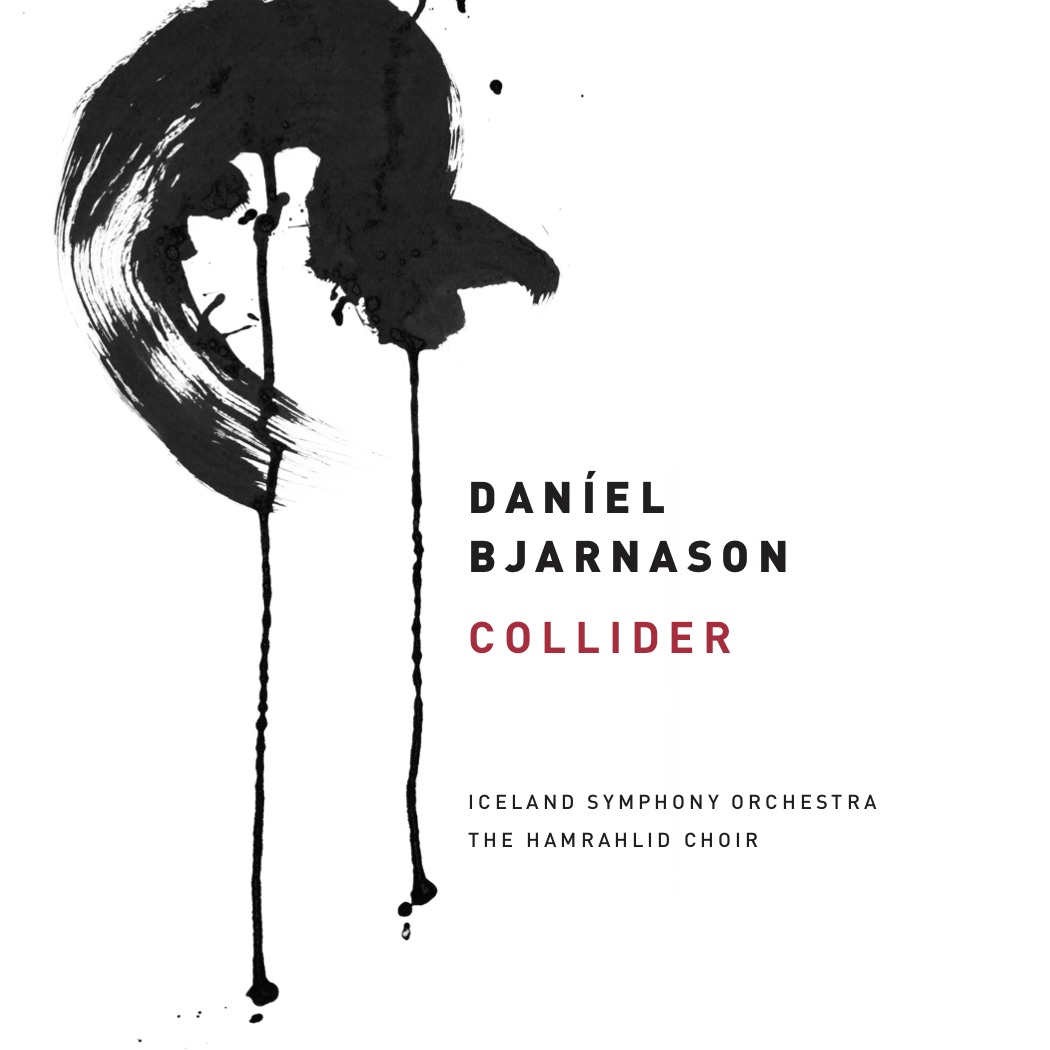
Two Sono Luminus Discs of New Music by Icelandic Composers (mostly)


DSL- 92267

There are, by my count, at least 8 discs on this fine audiophile label dedicated to music by composers from Iceland. That country’s musical prowess deserves to be better known as does their world class orchestra. I’m reviewing these back to back releases together because they are both Iceland Symphony recordings presenting new music by (mostly) Icelandic composers. And they have a secret connection.

This first disc is a nice mix of music by five different composers in works that really give the orchestra an opportunity to shine. Under the direction of composer/conductor Daniel Bjarnason we are availed of the sound of now, or at least Bjarnason’s “now”.

Track list

This disc, which seems to have a “outer space”theme in large part, opens with a large orchestral work from the most deservedly best known Icelandic classical composer, Anna Thorvaldsdottir. “Catamorphosis” is a 20+ minute work for full orchestra and then some. Her style initially reminded this listener of the sound mass of music like Ligeti and Penderecki. But her harmonic language is more lush and romantic. She has an astounding skill in writing for large orchestra, producing at times the modern equivalent of Impressionism. Her use of motives suggest she has digested ideas from minimalist/pattern composers. And at the end of the day (or the review), one realizes that she has developed her own voice.

The subtle colors of this work are well defined by the orchestra under Bjarnason’s truly expert guidance but also via the sonics that the Sono Luminus engineers are able to capture. This sounds like a difficult work to perform but Bjarnason manages to create a definitive performance and Sono Luminus’ sonics are, as always first rate.

Catamorphosis (2022) is typical of Thorvaldsdottir’s writing for large orchestra reflecting her skills as an orchestrator as well as her imagination, her ability to create a wide palette of subtle sound forms that suggest a sort of post impressionist style. The poetic and metaphorical titles tell little about the musical content (or structure for that matter). But her ability to create cohesive and compelling compositions such as this provide an experience that will likely evoke images for the listener, a sort of movie for the mind. So feel free to conjure your own images in this 7 part (played without pause) work and/or listen and watch a recent Elephilharmonie performance on YouTube here.

Missy Mazzoli’s comparatively brief “Symphony for Orbiting Spheres” (2014 rev 2016) taps into a vein of inspiration seemingly related to the cosmic images of Thorvaldsdottir. Mazzoli incorporates an electronic keyboard and harmonicas, among several less common instruments used in symphony orchestras, to create her own sonic cosmic fantasy. Please click the link on her name above to learn more about this rising star from her nicely designed website.

Daniel Bjarnason demonstrates his own formidable compositional chops with “From Space I Saw Earth” (2019). And this track also provides a link of sorts to the other album reviewed in this blog entry. This work, written on commission for the 100th anniversary of the LA Philarmonic, is a work that requires three conductors. The premiere was led by Zubin Mehta, Gustavo Dudamel, and Esa-Pekka Salonen, all of whom have significant connections to the orchestra (Mehta as conductor Emeritus, Dudamel as present chief conductor, and Salonen as conductor laureate). That was the premiere but this recording is conducted by Bjarnason along with Kornilios Michalaidis, and the then incoming chief conductor of the Iceland Symphony, Eva Ollikainen. Therein lies the “secret connection” to which I referred earlier.

María Huld Markan Sigfúsdóttir (1980- ) is a violinist and composer. Her orchestral work, “Clockworking” is a sort of post minimalist work with a gently driving Ostinato in the percussion. It reminds this reviewer variously of Birtwistle’s “Chronometer”, Ligeti’s “Poeme Symphonique”, to name a few but it is not derivative of these in any way. It is a very listenable and enjoyable orchestral work.

Bára Gísladóttir (1989- ) is a composer, vocalist, and double bass player based in Copenhagen. This, the briefest work on the album is at times the quietest and at others the loudest work here. I would add that it is also the most avant garde. Relying on a battery of percussion and what appears to be some extended instrumental techniques the composer creates a world that to this reviewer’s ears sound a bit like Gyorgy Ligeti’s work “Atmospheres” (1968). That’s not meant to say it’s derivative, just that it could conceivably be used for that famous psychedelic sequence from Stanley Kubrick’s masterful “2001, A Space Odyssey” where my own young ears first heard the Ligeti work.

DSL- 92268

As fabulous as that first disc is, this release, dedicated entirely to the work of Anna Thorvaldsdottir, is a worthy endeavor. In addition to that we are treated to the sublime and insightful artistry of the first female principal conductor of the Iceland Symphony, Eva Ollikainen who leads the Iceland Symphony on this disc.

Like the above release, the Iceland Symphony Orchestra demonstrates their world class artistry. This is not easy music to play but, under Ollikainen, as they have under her predecessor, they are able to articulate the intricately orchestrated sounds by this really astounding composer.

Just two works here. “Archora” (2022) and “Aion” (2018). Both are works of grand concept and could easily be called symphonies but the composer seems fond of metaphoric poetic titles. Regardless of the names given these works they demonstrate the composer’s grand sonic visions and her mastery of the orchestra, a mastery grasped very clearly by the Iceland Symphony’s new artistic director and conductor, Eva Ollikainen (1982- ). She holds the distinction of being the first woman to hold the post to which she was appointed in 2019.
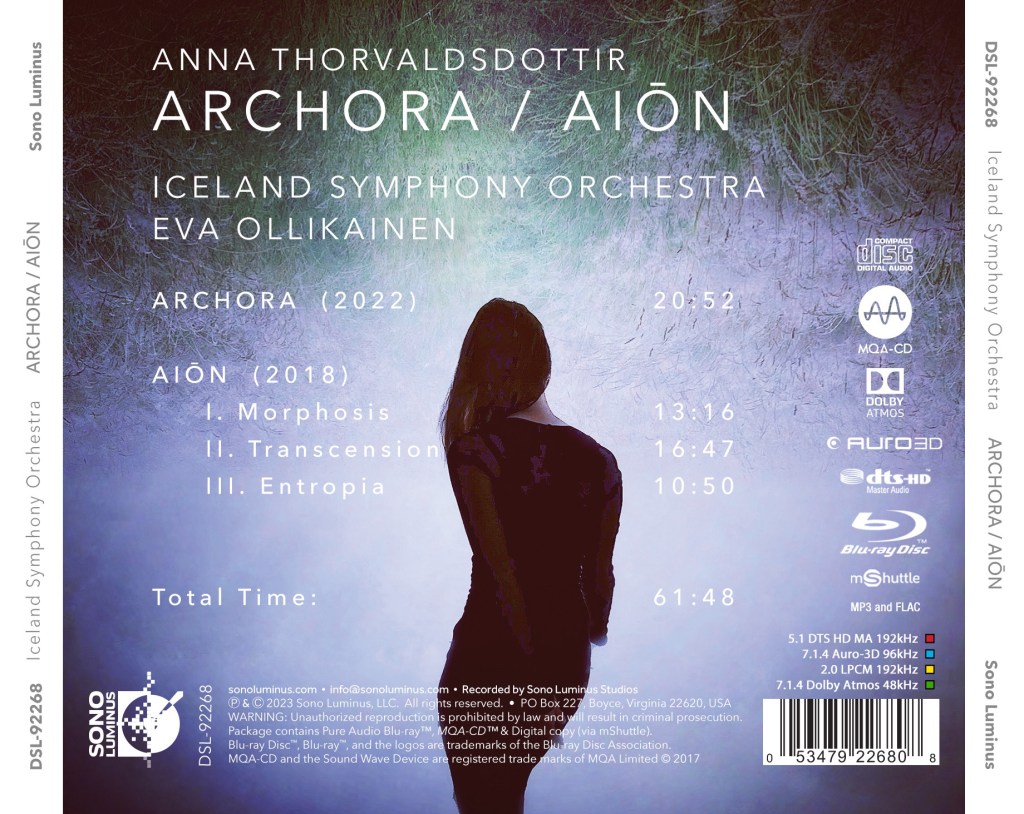
Track list

There are only two works presented but both are stunning examples of some of the finest new music being produced today. Yes, it’s great to see women having a greater presence (both as composers and conductors) but, truly, Thorvaldsdottir is “the bomb”, so to speak. Her creativity, her mastery of the orchestra are simply a revelatory as well as entertaining listening experience.
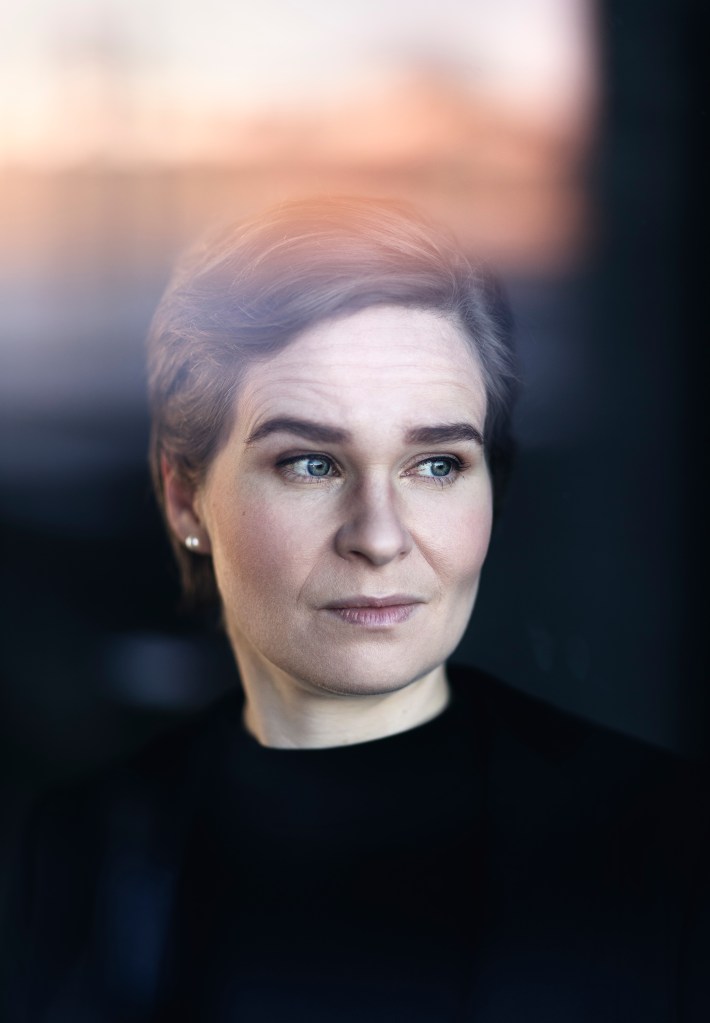
Eva Ollikainen

This release is also a landmark which showcases the formidable talent of the Icelandic Symphony’s new conductor. In addition to breaking gender barriers she is quite simply a rising star and one of the finest interpreters of new music today.

“Archora” (2022) is the most recent work here and it’s another of Thorvaldsdottir’s sprawling cinematic tone poems. No specific story here but the composer’s mastery of orchestral color will doubtless evoke images and feelings in the listener. Thorvaldsdottir is creating a sort of sonic (as opposed to literal) mythology. Her reference points seem to be largely in Greek and Roman mythology but also in Nordic and Northern European myths. Eva Ollikainen conducted the world premiere at the 2022 BBC Proms. You can hear that performance on YouTube here. But the Sono Luminus recording captures more of the subtle sound colors of this engaging work.

The composer’s three movement, “Aion” (2018) concludes this recording. Aion is a Greek God of time. The composer is concerned with various aspects of time in her work. This large three movement work is virtually a symphony with an augmented orchestra, extended instrumental techniques, and an optional choreographic accompaniment. (Tell me that’s not cinematic). There is an example of the optional choreography here.

This recording is also a fine introduction to conductor Eva Ollikainen who clearly has a grasp of this music. Various examples of her interpretive genius can be found on YouTube ranging from Beethoven to new contemporary masters.

These are two truly fine discs both musically and for sheer sonic detail. They’re available in streaming and hard copy CD as well as Blue Ray Audio. These are a fabulous listening experience. Enjoy!


The Loneliness of the Long Distance Blogger, a Reacquaintance


First let me say that the title of this blog and its contents is presented as both apology and explanation. It is an apology for the intervening 12 months during which this blog was on unplanned hiatus. Indeed the ongoing requests for reviews were certainly a factor in getting this venture up and running once again and I am grateful for the persistence of musicians and their representatives. It is also a brief explanation of some of the reasons this has happened. Nothing here should be construed as being a lament or request for assistance of any kind (except for encouraging more readers). This blog post is also intended as an announcement that there is much more to come.

2020 was a year which one which has been a long and strange time for most of us. I took on an extended contract in February, 2020 which required me to move to Tacoma where I pursue my “day job” of working as a registered nurse. My place of employment is a state psychiatric facility and my first few months were consumed with training and other pre-employment hurdles. While I enjoy my work I found the transition to a city far from home and the learning process of dealing with this facility and its clientele impacted me in ways I could not predict. Add to that the overwhelming onset of the Covid 19 pandemic began to eclipse and alter so many things.

Clyde

To ease my transition going approximately 1000 miles from home I brought my little 12 year old Maltese dog, Clyde along for the adventure. This wound up being a most pleasant learning experience about the meaning of “emotional support animal”. He continues to do his job.

As it was most practical, I chose to drive to my new assignment so I packed the car with clothing, a few books, a kindle, a computer, and a small flock of CDs for the drive time. Traveling long distances is a wonderful opportunity to listen to lengthy or multiple pieces of music. Of course this is best appreciated in the long freeway segments between towns that dominated my itinerary.

My listening program consisted of (in no particular order): Ives- Concord Sonata played by Rene Eckhardt, Alvin Curran- Crystal Psalms, the two disc Chicago Blues album by AACM, Charlie Haden- Not in Our Name, several private recordings of music by Primous Fountain, Daniel Bjarnason- Collider, several private recordings of music by David Toub, Peter Maxwell-Davies- Symphony No. 1, Wilfred Josephs- Requiem, and occasional forays to sample the local broadcast spectrum (ew). An eclectic program to be sure, one which benefits from solitude from other homo sapiens. My little companion took the passenger seat and easily accessed the little cup of water in the console, happy regardless of the music selections. It was a satisfying listening experience augmented by some truly eye candy vistas (I did bring my camera but…driving.)

It was jolting to see the post fire-ravaged sections of forest that dotted the landscape in this journey but it remains visually stunning if not in the most beautiful way. It was about 22 hours of leisurely drive time calculated to give me a couple of days to find my residence and figure out my daily driving route. My little companion and I ensconced ourselves in an Extended Stay America hotel arranged by my contract agent.

The planning I had done was pretty good actually. We arrived as I had planned where my companion immediately began his ambassadorial responsibilities by attempting to meet (and charm) all who crossed his path. All signs suggested a smooth transition.

However the unpredictable reared its presence in a variety of forms including licensure delays (not the fault of Washington State), subsequent training delays, a camera in need of repair, a failed hard drive, a rather challenging work environment (this state facility is long term and functions largely as a forensic facility dealing with illness too severe for the jail system), and the onset of the Covid lockdown as well as an actual Covid infection (which I survived with minor consequences and have since been vaccinated). All these did not occur at once but I’m just summarizing. Most of these events could neither be foreseen or prevented but they presented challenges.

One of the most curious effects on my psyche was an extended period of time when I lost my ability to focus on many things other than the job. I had brought a box of CDs for review fully expecting that I would be able to continue my blogging with my readers getting no clue as to the chaos of the writer’s mind. As a Rabbi once told me, “Man plans, God laughs”, a less than comforting chestnut of wisdom which applies as it doubtless will again. So why worry?

Mount Ranier as seen from my hotel window.

My lack of ability to focus manifested in an inability to read for leisure (one can partly blame the toxic writing habits that plague “orientation materials” for numbing my brain) but also in a seemingly selective ability to hold my attention on the musical genres that had been my soundtrack on the trip to get here. I found myself craving jazz and blues and in a serendipitous gesture of fate I was more than pleased to find that my local broadcast options included two NPR stations, one of which (KNKX), plays a masterfully curated selection of jazz and blues most of the day excepting news breaks. That music continues to soothe my soul but I’m happy to say my focus seems to have returned to its accustomed wider spectrum of genres.

From Cahill’s web page.

I lament the fact that I have missed the opportunity to write about the “Year of the Woman” in 2020 during the actual year but the impact of the sundry musical celebrations and creations will continue to resonate and the cause will continue to deserve attention. One of the few new music events which grabbed my resistant attention was the series that Bay Area pianist Sarah Cahill produced on YouTube. The series on women composers features short works (2-8 minutes) played in the artist’s Berkeley home. It is a virtual manifesto collecting a variety of too little known solo piano works by women (here’s hoping there’s an album in the offing). Of course the listener shouldn’t stop with the women composers. Cahill’s site offers of wealth of lesser known male composers interpreted with the same passion.

Linda Twine from Google Images.

I quite reasonably expected a sharp decline in readership given that my last blog post was published on March 7, 2020. There was initially at least a 50% fall off in readership but I was delighted to find that I ended the year with about 9300 hits, only about 4000 less than the previous year. A large part of that readership sought out my articles on black musicians and composers. Now, I focus on new music and just about any music which I think deserves an audience so the inclusion of black musicians is, of course, a given. So it seems particularly apt that I am returning to the blogosphere during black history month. This small portion of my output has driven more than its share of traffic to this site. The article on composer/director/producer Linda Twine was written in 2018 and has gotten well over 1500 views. I hope that means her star continues to rise. Other older articles, some written for Black History Month, also performed remarkably well. Indeed this can certainly be attributed in part to the Black Lives Matter movement and the continuing civil rights struggles in our purportedly “Post-Racial” era.

The blogger with composer Anthony Davis at a house concert in 2018

I was particularly pleased when composer Anthony Davis (whose work I have long admired) was awarded the 2021 Pulitzer Prize for his opera The Central Park Five. Like much of Davis’ work this opera is focused on civil rights issues such as, in this case, the miscarriage of justice against five black men falsely accused of a rape in Central Park. At least I got to say this during Black History Month.

I continue to reside in Tacoma where it is only a twenty minute drive to work. I have become accustomed to my daily duties and have found a surprisingly warm welcome for me and my skill set. I truly enjoy my day job.

We are still firmly in the time of Covid, in the time of serious social unrest, now transitioning with excessive drama to a new president as the world seemingly plunges toward fascism, hate, and economic disaster. But musicians have risen most heroically to the challenges of their art, performers trying to maintain a presence during a time in which live performances are severely restricted for public health reasons. But there are now fascinating concerts online, wonderful new music being released and I need to get back to talking about that.

Collider, The Marvelous Music of Daniel Bjarnason


This is the second album I’ve had the pleasure of reviewing by this wonderfully talented composer and conductor from Iceland. The other album which put his name forever into my watch list was Recurrence. Daniel Bjarnason conducted on that recording which features his work as well as that of fellow Icelandic composers.

The present release is also conducted by Bjarnason and features three amazing works by this young composer and conductor. The works include, “Blow Bright” (2013) for orchestra, “The Isle is Full of Noises” (2012) for chorus and orchestra, and the title work, “Collider” (2015).

Blow Bright and Collider are performed by the lucid Icelandic Symphony. They are joined by the Hamrahild Choir for the three movement, Isle Full of Noises. The recording is also listener friendly (with detail that sent this listener to find headphones to hear them).

It is a mark of genius that this composer already has a clearly defined sound all his own. Hearing these left this listener wanting to hear these pieces again and to hear more of this man’s work.

Blow Bright and Collider are significant contributions to the modern orchestral repertoire and Isle Full of Noises is an opportunity to hear Bjarnason’s vocal writing with orchestra. This listener, no surprise was charmed. His facility in melodic invention, judicious use of modern harmonies make for very listener friendly music that challenge gently but always entertain. Classical music is alive and well…at least in Iceland.

LA Percussion in High Definition


Having been a bit overwhelmed with a LOT of percussion recordings lately I placed this Los Angeles Percussion Quartet recording a bit further back in my review queue.  My apologies but I did it because I really wanted to give this recording my full attention and then to have something useful to say.

So I listened.  I put this on in my car when making a trip long enough to allow me to hear one of the two discs without interruption.  And I chose a relatively non-distracting drive in which I could actually pay attention to the music without incurring some danger on the road.

Of course the first thing that strikes the listener here is the lucidity of the recording.  Sono Luminus is showing off their signal processing prowess as well as their sensitivity with things like microphone placement and all the things that only great engineers know.

Let me make one thing very clear.  I am not a fan of sonic spectacle for its own sake.  I recall one incarnation of vinyl/analog fetish releases which a friend drooled over but whose content bored me to death.  Fortunately Sono Luminus seems to be steering clear of that sand trap.

This two disc set (well, three if you count the Blu-Ray Audio disc) collects music by largely little known composers (at least to these ears).  But fear not, this is not music that sounds like someone knocked over the stainless steel pot rack at Sur le Table.  Quite the opposite.  This is some intelligent music which compels the listener to stick with each piece and follow its development.  This is apparently the fourth album by LAPQ, the previous three also being Sono Luminus productions.

The first disc begins with the first of two Icelandic composers both of whom were represented on a previously reviewed discDaniel Bjarnason is a conductor and composer and his Qui Tollis, a work of wide dynamic range and a variety of moods from more assertive to more contemplative.  The second work is by the current darling of Icelandic classical music.  I am speaking, of course, of the very talented Anna Thorvaldsdottir.  Her work, Aura, is more consistently contemplative in nature and, like all her work, the listener is rewarded for paying close attention as she weaves magical impressionistic tapestries.

Memory Palace by Brooklyn based Christopher Cerrone piqued serious interest in this listener.  This man would seem to be a composer whose work deserves watching/listening.  This five movement suite for percussion indeed makes for compelling listening as he moves through a variety of moods and isn’t afraid of frank melodic invention during the journey.  This does not strike this reviewer as run of the mill percussion music (not that the preceding two works did either).  Rather this work suggests a distinctive compositional voice worthy of further attention.  Mr. Cerrone’s collection of awards including a Rome Prize and a runner up for a Pulitzer Prize suggests that he will be heard from again soon.

Fear-Release by Ellen Reid is a shorter though no less rewarding journey down yet another compositional path for percussion.  At just short of nine minutes this is a compact movement which relies on a fairly wide dynamic range and strategic use of silences and is a fitting close to the first disc.

The brief, rather poetic, liner notes draw a parallel between the multiplicity of languages found in the Los Angeles area and the multiplicity of musical languages found on this recording.  Indeed these are distinctive voices that extract a wide variety of sound from this percussion quartet.  This reviewer is somehow strongly reminded of Nexus, the Canadian percussion group which dominated the 1990s for a bit.  The similarity is in their enthusiasm and in their musical skills.  LAPQ is a distinct ensemble in its way and is a group that is not shy to be innovative.

I have to say, though, that I could have used a great deal more info and commentary on these compositions.  As one would benefit from multilingual dictionaries in Los Angeles the listener could gain much from learning more about the structure and intentions behind these fascinating compositions.  And, unless I have failed to find them (I looked closely) the liner notes carry lovely photos but fail to name the musicians whose sound was so lovingly preserved.  They are: Matt Cook, Justin DeHart, Nick Terry, and Justin Hills.

The concluding work coming in at almost 40 minutes is divided into tracks but is in fact one large movement.  It is probably the most contemplative work here though it has some pretty assertive moments.  I Hold the Lion’s Paw by Andrew McIntosh is a great show piece for demonstrating the range of these musicians.  Though continuous this piece delves through a variety of moods and uses apparently a wide variety of instruments as well.

Fans of percussion will love this disc as will fans of audio porn (there is something erotic about technology for the ears).  This is not easy listening and though seeking innovation makes no moves toward populism.  This is serious music making.


Recurrence: New Icelandic Orchestral Music


“Well I’ve never been to Iceland, but I really like the music.”  Please excuse the Hoyt Axton paraphrase but this music brings joy to this listener’s heart.

Wow!  Even as a writer with an avowed fondness for music from the Nordic regions I am pleased to say that I am just stunned at this recording.  This is all new music written in the last few years by Icelandic composers and performed by the Iceland Symphony which seems well prepared to handle these large works.

These seven tracks document five works by living composers and, I dare say, rising stars in the classical orchestral realm as well.  Only one of these composers is likely to ring a bell in all but a few listeners and that is Anna Thorvaldsdottir, probably the best known musician from Iceland since Björk.  And it is worth noting that three of the five works are by female composers.

There is a consistency in the large orchestral sounds from these composers that provide a unity for the listener and a challenge for the recording engineers.  In fact this is ideal to show off the sonic facility of the Sono Luminus label and the skills of producer Dan Merceruio and recording engineer Daniel Shores.  This is the sort of album that stereo salons use to show off the range of their amps and speakers.  It is indeed thrilling to hear and the better your sound system, the more exciting this will be.  Those blessed with Blue Ray Audio capability will doubtless get the best sound of all.  Both standard CD and Blue Ray Audio discs are included in this package.

In order of appearance the composers are: Thurídur Jónsdóttir (1967- ), Hlynur Vilmarsson, María Huld Markan Sigfúsdóttir (1980- ), Daniel Bjarnason (1979- ), and Anna Thorvaldsdottir (1977- ).  Bjarnason is also the very capable conductor of the Iceland Symphony in this recording.

The music, Flow and Fusion, bd, Aequora, Emergence (three movements), and Dreaming are not given composition dates but are presumably recent compositions by these young artists.  There are liner notes which are useful to the listener but the main point here seems to be the glorious sound.  One hears influence and/or homage to some of the great sonic experimenters of the late 1950s and 60s like Penderecki, Xenakis, Lutoslawski and probably some Icelandic composers whose works have yet to be heard outside of Iceland.

The album has the notation below the title of “ISO Project 1” so here’s hoping that there will be at least a second volume and that we be given the opportunity to hear more from the rich musical landscape of Iceland.  Bravo!  Brava!  Keep it coming.