…if it dies at all: Guy Klucevsek’s “Hope Dies Last”, New Compositions for Accordion(s) and Friends


Starkland

This is, by my count, the fifth Starkland release of Guy Klucevsek’s work. Klucevsek has happily been one of Starkland’s favorite artists. Though he officially retired from performing in 2018, he continues to compose, collaborate, and record.

“Hope Dies Last” consists of several new compositions from this (hardly retired) man. And if you don’t know his work, this is a fine place to start. Klucevsek is a unique composer/performer who has defined his brand as one of the finest accordion players in new and experimental music. Through years of composing, performing, and collaborating, Klucevsek has taken the accordion to places it never dreamed of going and still manages to do honor to the history and significance of his chosen instrument.

NB: This reviewer is biased, having had a long admiration for this artist. The “vernacular” idioms of the accordion had been very familiar to me from my childhood on with my exposure to rituals of some of my Eastern European ancestors (polka bands, Lawrence Welk, Myron Florence, etc). Because of Klucevsek I will never hear the accordion in the same way ever again.

Having, ostensibly, “retired” (at least from performing), we find his creative juices still flowing in these recent compositions. This album is largely representative of his more lyrical writing as heard in releases like, “Citrus, My Love” but Klucevsek is seldom far from parody (in an honorific sense) and both humor and pathos infuse this music in ways that sneak up on the listener. This recording stems in part from music written by Klucevsek and performed by many of his friends, but not always on accordion, on a concert in celebration of his 75th birthday.

We hear, on this album, compositional genius distilled from the composer’s broad knowledge and understanding of music in general, and of his ability to incorporate classical and vernacular idioms into his personal style. The valuable liner notes by the composer reveal how his work belies the complexity which underlies his very approachable style. There is a depth in these works that lies, tantalizingly, just below the surface.

One of the most rewarding aspects of this album is hearing all these fine collaborators play Klucevsek’s music. The dedication and enthusiasm of these performances are a fitting celebration of this unique artist who brings his 19th century folk instrument (and its milieu) very successfully into the 21st century. Participating artists include: Jenny Lin, pianos; Todd Reynolds, violins; Jeff Gauthier, violin; Margaret Parkins, cello and whistling; Will Holshouser, accordion; Alan Bern, accordion; Nathan Koci, accordion; Bachtopus Accordion Ensemble (Robert Duncan, Peter Flint, Mayumi Miyaoka, and Jeanne Velonis); Jerome Kitzke, heavy breather and toy piano schlepper; and, of course, Guy Klucevsek, accordion and piano. Starkland founder Tom Steenland’s steady producer’s hand is a guiding spirit here as well.

The last six tracks, “Industrious Angels” (2010) were written on commission by Laurie McCants for her dramatic presentation of the same name, a work inspired by the poems of Emily Dickinson. Collaborations such as this, with non-musician artists, are well represented in Klucevsek’s career. These are the oldest compositions here.

The first 13 tracks, with the exception of the 2022 transcription (of the 1988 original classic), “Flying Vegetables of the Apocalypse”, were all composed from 2015 to 2021. And they serve to characterize Klucevsek’s wide ranging musical interests whose further elucidation in the aforementioned liner notes provide valuable insights into his compositional processes. Really fascinating on that technical level as well as in the resulting sound of the compositions. This album just works well on so many levels.

In many ways, this release, with so much recently composed music, feels like an apotheosis, an artist’s very satisfying and nostalgic perspective looking back on a very successful career (I’m thinking like Wild Strawberries, maybe, but happier). It is a contemporary journey that will likely send listeners to hear more of this man’s work. And so they should.

More Klucevsek at Starkland
Starkland has previously released five other Klucevsek CDs:


Transylvanian Softwear with works by William Duckworth, Fred Frith, Klucevsek, and John Zorn.
Awarded a “Recording of Special Merit” by Stereo Review.


Free Range Accordion with works by Burt Bacharach, Lars Hollmer, Aaron Jay Kernis, Jerome Kitzke, Klucevsek, Stephen Montague, Somei Satoh, and Lois V Vierk. “A rebel with an accordion… Klucevsek combines poker-faced wit and imagination with command of his instrument, forcing you to re-think the accordion’s limitations” (Downbeat).


Polka From The Fringe A double-CD re-release presenting the most comprehensive edition of this major project conceived and shepherded by Klucevsek. Works by Mary Ellen Childs, Anthony Coleman, Dick Connette, William Duckworth, Carl Finch (of Brave Combo), Fred Frith, David Garland, Peter Garland, Phillip Johnston, Aaron Jay Kernis, John King, Mary Jane Leach, Bobby Previte, Elliott Sharp, Carl Stone, Lois V Vierk, William Obrecht, and more. “A long-overdue reissue” (John Schaefer, WNYC New Sounds). “A two-CD collection of new polkas he got from a wide range of classical new music, jazz and indie pop composers. It’s a riot, and an addictive one at that” (Los Angeles Times).


Teetering on the Verge of Normalcy with works exclusively by Klucevsek. With violinist Todd Reynolds, soprano Kamala Sankaram, and pianist Alan Bern. “This heartfelt album has an
especially elegiac quality” (Sarah Cahill).


Citrus, My Love offers two substantial works composed for dance, Citrus, My Love (1990) and Passage North (1990), separated by another piece Patience and Thyme (1991). A “strikingly
beautiful” CD (AllMusic Review) that is “generously imbued with melodic charm and grace” (The Wire).

“Dreams of a New Day”, a Landmark Recording Project from Cedille


Cedille CDR 90000 200

I have always made my admiration clear regarding Chicago based Cedille Records. They release quality recordings of unusual but intelligent choices of repertoire. This recording continues that formula but here achieves what is likely to be seen as a landmark anthology (or at least sampling) of Art Song by Black Composers. It speaks on many levels, as poetry, as music, as a collaboration between an incredible baritone, an amazing pianist, in a beautifully recorded and produced album. I was left throughout with the feeling that this is a loving collaboration. It is an integrated collaboration between many people who worked well together. It is a beautiful document and a timely one.

Baritone Will Liverman, the young rising star baritone who is slated to perform at The Met in the world premiere of Terence Blanchard’s “Fire Shut Up in My Bones” scheduled for fall of 2021 is clearly at the heart of this production. His intelligent choice of repertoire is both pleasing and revelatory. (the poetry of the song texts are published in one of two booklets that come with this CD). And Liverman’s voice is an admirable instrument that he wields with power and nuance. His commission of fellow rising musical star, composer Shawn Okpebholo whose “Two Black Churches” receives its world premiere recording. The pianist who manages to navigate significant demands with confidence and artistry, is Paul Sanchez, an excellent pianist, composer, and a fine collaborator.

The beautifully packaged CD (you gotta buy the CD) consists of 19 tracks representing 8 composers. The recording is billed as “Songs by Black Composers” but one can hardly miss the justly sad or angry tone of the texts and this was recorded July 22-24 of 2020 at the height of the COVID-19 pandemic and amidst social unrest over the epidemic of modern day lynchings. (2020 was also the year that Anthony Davis won the Pulitzer Prize for his protest opera, “The Central Park Five”) The moving rendition (“put together”, as Liverman quips in the liner notes) of Richard Farina’s 1964 song is played and sung by Liverman connecting this release with the tradition of protest music of another era. The struggle continues.

Before discussing the music I must supply a disclaimer of sorts. My working knowledge of art song in general is fairly limited and my knowledge of black art songs even more so. I know none of this music and have only in the last year or so came to know of the work of Shawn Okpebholo. I had read about the historical significance of Henry “Harry” Thacker Burleigh and Margaret Bonds but have heard little of their music.

In about 61 minutes listeners are given a survey, a sampling of art song by black composers ranging from Burleigh (who studied with Antonin Dvorak) to Okpebholo whose compositional talents continue to get much deserved recognition. It is a learned sampling of a huge repertory that deserves attention.

The opening song is I Dream a World (2017) by Damien Sneed (1979- ). This setting of the Langston Hughes (1901-1967) poem strikes a somber but cautiously optimistic note. It is followed by “Five Songs of Laurence Hope” (1915) by Henry “Harry” Thacker Burleigh (1866-1949). The name Laurence Hope is the pseudonym of Adela Florence Nicolson (1865-1904), a British poet who spent much of her life in British India where she developed an interest in the culture of the land. Fascination with the literature and culture of India was strongly in evidence in the early twentieth century. These five songs are reminiscent of Debussy and the impressionists and is but a small sampling of Burleigh’s art song output.

Harrison Leslie Adams’ (1932- ) setting of his own lyrics in “Amazing Grace” is yet another iteration of the abolitionist song. Margaret Allison Bonds (1913-1972) is represented by her “Three Dream Portraits” (1959), a song cycle on Langston Hughes poems. Bonds’ style put this listener in the mind of Copland’s Dickinson Songs though notably darker. This cycle is contemporary with the height of the Civil Rights Movement.

Next is “Riding to Town” (1943) by Thomas Kerr (1915-1988) who chose to reach back to the late nineteenth/early twentieth century poet Paul Laurence Dunbar (1872-1906) for his text. Dunbar was for the 19th century what Langston Hughes would be for the early to mid twentieth century.

“Two Black Churches” (2017) is the work commissioned by Liverman for this recording. It is a setting of two poems and one of the musical highlights here. The first, “Ballad of Birmingham” to a text by Dudley Randall (1914-2000) is a contemporary reaction to the 1963 bombing of the 16th Street Baptist Church in Birmingham which killed four little girls. The second song, “The Rain” to a text by the Poet laureate of Charleston, poet and musician Marcus Amaker (1976- ). It is about the Charleston Church shooting of 2015 at Emmanuel African Methodist Episcopal in which a lone gunman killed nine people. Okpebholo is modernist but accessible and these settings are among the most devastating and powerful statements on this recording.

“Mortal Storm” Op. 29 (1969) is a song cycle by one Robert Owens (1925-2017). It is a powerful cycle set to Langston Hughes poems. Owens left the United States in 1968-9 in response to the racial violence and moved to Europe where he had studied music under the GI Bill from 1946-1957. Owens died in Munich having never returned to the land of his birth. This work deserves to be better known and thanks is due to Liverman and his associates for bringing this sad masterpiece to contemporary listeners.

The album concludes with Mr. Liverman’s arrangement of “Birmingham Sunday”, a 1964 song by writer and composer Richard Farina (1937-1966). Liverman plays and sings on this final track which is an homage to a previous generation of song writers and protestors as well as a reminder that that generation’s work in Civil Rights is hardly complete. The song was notably used by Spike Lee in his elegiac film, “Four Little Girls” (1997).

The lucid and detailed program notes by Dr. Louise Toppin are a welcome addition to this production and help to provide a context. The design by Bark Design ties this little gem together. This one has Grammy and “collector’s item” written all over it.

Gene Pritsker and Some of His Collaborators, a Heady Mix


Gene_Pritsker

Gene Pritsker

We have here three very different CDs all of which feature composer/performer Gene Pritsker along with a variety of his colleagues and collaborators.  Each of these CDs is a unique production and reflects a marvelously creative group of composers and performers.

I first came to know of Pritsker’s work when he sent me a copy of his wonderful chamber opera, Manhattan in Charcoal and when I began to learn of the scope of his work through his numerous You Tube videos and his website I found myself rather overwhelmed and wholly intrigued.  In fact I can’t shake a comment which Leonard Bernstein once made about Igor Stravinsky to the effect that he was able to switch between different styles at different times with seeming ease and certainly skill (It was a comment made on a vinyl disc in which Bernstein spoke of Stravinsky in general on one cut and described the imagery of Petroushka on another.).  Pritsker’s Russian origins certainly play a part in reminding me of this association but it is the sheer extent and variety of his compositional visions and techniques that drive me to be reminded of this.  His virtuosity on the guitar also puts me in the mind of Frank Zappa at times too.  And he seems to be doing it pretty much all at once too, utilizing a wide palette of styles selectively with care and subtlety.  Pritsker switches between some very classical sounds to rock, jazz, rap, etc. as though the distinctions don’t exist or matter.  In the end they don’t matter really.  All is music I suppose and he seems be able to use them all pretty well and these discs are a nice sampling of some of this interesting musician’s various guises and interests.

mozart inf

ComCon0030

Fortunately I am not attempting a comprehensive cataloging of all that but rather reviewing a nice little selection of some current releases which Mr. Pritsker was kind enough to entrust to my critical ear.  First up here will be a Mozart tribute of sorts. Regular readers may recall another entertaining Mozart-based recording by John Clark (here). Indeed Mr. Clark makes an appearance here both as composer and performer.  This curious little disc consists of short, clever glosses on Mozart by Gene Pritsker, Patrick Grant, John Clark, Milica Paranosic, Dan Cooper and David Taylor.  Pritsker in particular seems to have a penchant for reworking music by other composers.  His Bach-based works also deserve attention as well.  But that is another matter.

There are 13 tracks and all have a somewhat improvisational character.  Of course variation forms are ubiquitous and varied throughout music history and these are, if not strictly speaking, “variations”, then something close which is why I have chosen the term glosses.  But all are entertaining and reflect a sort of new music take on Mozart who appears to have some meaning for each of the composers (Mozart is my desert island composer by the way).  I am sure that Mozart himself would have been amused and honored.  These are most certainly homage at the very least.

The CompCord Ensemble consists of Charles Coleman, voice; Chanda Rule, voice; Milica Paranosic, voice/gusle; Patrick Grant, voice/harpsichord; Lynn Bechtold, violin; Dan Barrett, cello; John Clark, horn; David Taylor, bass trombone; Gene Pritsker, guitar; Dan Cooper, bass; Javier Diaz, percussion/voice; Gernot Bernroider, drums; Franz Hackl, trumpet.

There are no liner notes here and perhaps that is for the best.  I have no doubt that there are a great deal of personal stories here as to how these pieces came about and what they mean to the respective musicians but they do stand on their own as entertainment and to my ear sound like they could even work as a film soundtrack (most likely a non-American film). This is entertaining material, perhaps a bit “inside” with its references but not difficult or obscure.   I will leave it to some future musical archaeologist to elucidate those details. The listener need only sit back and be entertained.

pritssker jarvis

ComCon0032


Now to the second disc.  This is quite different in character being a duo between a guitarist (Gene Pritsker) and a drummer (Peter Jarvis).  Such scant scoring tells one nothing about what is to come.  Each of the six tracks is by a different composer (Peter Jarvis, Gene Pritsker, David Saperstein, Joseph Pehrson, Jessica Wells and Daniel Palkowski).  As with the previous disc there are no liner notes so one is left with nothing but the sound.

This appears to be much more of an improvisational nature than the previous recording considered above.  The style here ranges from free jazz to rock and perhaps some contemporary musical styles as well.  Each track is a succinct statement and none of the tracks seem to go longer than necessary.  The musicianship is superb so if you are fond of the sound of guitars and drums played creatively and well you will enjoy this disc.  These musicians extract a great deal of varied sounds from their instruments.

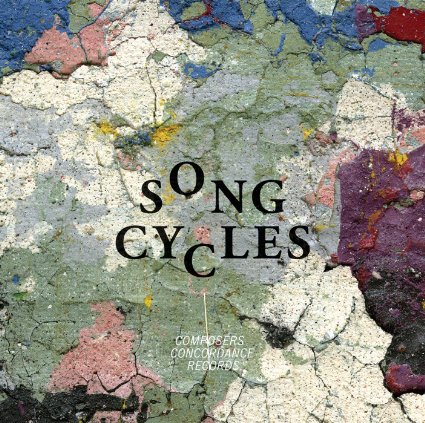
song cycles

ComCon0029


Finally we have this disc of song cycles.  Now the only song cycles I know at all well are those of Franz Schubert but that is, I think, an adequate place to begin to understand what is going on here (still flying without liner notes).

Eight composers and eight poets are featured in six song cycles. The first and last cycles (tracks 1-3 and 16-19) are the only ones which include instruments in addition to the voice and piano.  Only one song here (Inside on track 15) features poetry by the composer.  The rest, like Schubert utilized existing poetry.

Most of these composers are unknown to me which is both the joy and the bane of reviewing such discs.  All of these fall roughly into the classical art song tradition even with their occasional blues inflections (as in the Pritsker songs) or extended instrumental techniques.  David Gutay, Zach Seely, Patrick Hardish, Luis Andrei Cobo, Eleanor Cory are all new names to me and it Mr. Pritsker is to be commended for his efforts to promote others’ music.  The two composers here who are familiar are Mr. Pritsker and, another reason for commendation, Lester Trimble (1923-1986), a man embraced by Leonard Bernstein and cut from similar sonic cloth as both Bernstein and Copland.  This recording of Trimble’s Canterbury Tales is a welcome addition to the discography of mid to late twentieth century masters who deserve at least another listen.

The poets include: Tony Roberts, Jacob Miller, Dorrie Weiss, Jennifer Michael Hecht, Emily Dickinson, Richard Wilbur, Eleanor Cory and Geoffrey Chaucer.

Performers include Elizabeth Cherry, soprano; Thomas Carlo Bo, piano; Katie Cox, flute; Charles Coleman, voice; Derin Oge, piano; Patricia Songego, soprano; Taka Kigawa, piano; Lynn Norris, soprano; Amir Khorsrowpour, piano; Eleanor Taylor, soprano; Christopher Oldfather, piano; Circadia Ensemble consisting of: Melissa Fogarty, soprano; Kaoru Hinata, flute; Christopher Cullen, clarinet; Jenifer Griesbach, harpsichord (in the Trimble cycle).

The performances are uniformly excellent albeit a collection of separate recordings all mastered, as were the previous two discs by Sheldon Steiger.  If you love art song this is a treasure trove of current compositions but with a healthy respect for the past.