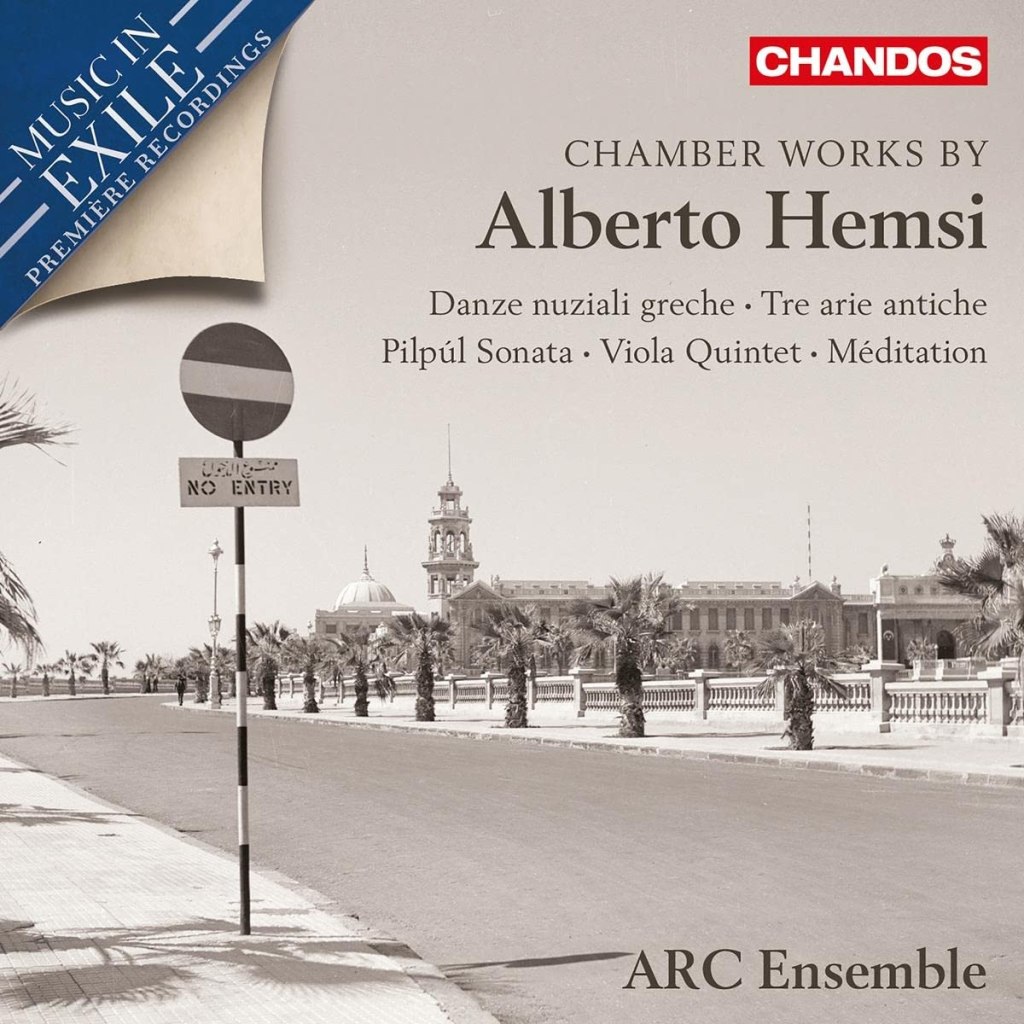
Alberto Hemsi, Out of Exile


Chandos CHAN 20243

“Music in Exile” is but one of many projects that are attempting to find, perform, and in many cases publish music neglected for many reasons, mostly political. Alberto Hemsi (1898-1975) is not a familiar name to this reviewer and will likely not be familiar to the average listener. But such are the hazards of resurrecting neglected music. This release in the 6th in the Music in Exile series and, like it’s predecessors, it is a loving adventure of discovery.

The ARC (artists of the royal conservatory) Ensemble here bring to a CD player near you an (apparently representative selection) of the extant works of this composer and ethnomusicologist. Hemsi spent 17 years collecting and publishing harmonizations of Sephardic Melodie’s he collected throughout the countries of the former Ottoman Empire.
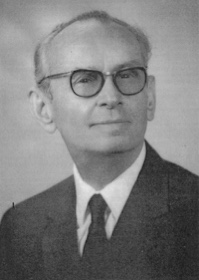
Alberto Hemsi (photo from University of Michigan website fair use)

The composer’s widow donated his manuscripts to the European Institute of Jewish Music in 2004 where The Hemsi Collection has become a significant part of one the largest collections of Judeo-Spanish music. Spain, in 1492, famously funded Christopher Columbus’ expedition of discovery and, infamously in that same year, officially exiled all of the Jews in Spain. Now some 500 years later the work of Hemsi is helping to preserve some of that culture.

Of course, like Bartok, Kodaly, Copland, and sundry like minded composers who incorporated similar song collecting ventures into the late romantic nationalist traditions in the late 19th and early to mid 20th century classical compositions. But this disc is actually more about Hemsi’s own compositions.

Track listing

The two works that comprise the first six tracks of this recording, the “Danzi Nuziali Greche” Op. 37 bis (1957) for cello and piano, and the “Tre Arie Antiche” Op. 30 (ca. 1945) for string quartet are fine examples of Hemsi’s direct incorporation of his collected folk musics into these charming chamber works.

But, for this listener, the pre 1945 works provide a compelling insight to this fine composer’s works that are not explicitly expositions of folk songs. Don’t get me wrong. All of these works are receiving world premiere recordings in this release, making them valuable additions to the history of music. But this listener was pleasantly drawn to Hemsi’s contributions to the western classical canon.

The three movement Violin and Piano Sonata Op. 27 (1942) is the longest work here and demonstrates the composer’s facility with larger compositional architectures. The same can be said of the “Quintet for Viola and String Quartet Op. 28 (ca. 1943). This very substantial music, composed in the shadow of the Second World War reveal a hopeful and talented composer producing music that would not see public performance in his lifetime.

The album concludes with the Meditation Op. 16 (ca. 1930). It Carrie’s the subtitle “in Armenian Style”. Hemsi’s folk song documentation also included Armenian Melodie’s, music of yet another culture of exile. It is doubtless influenced by some sense of the reality of the Armenian genocide which was vehemently denied until the 21st century.

We have yet another album of suppressed, oppressed, neglected music to add to an important and growing collection of music that arguably began with that of the Nazi declared “Entartete Musik” where music and composers were vilified viciously and directly. But this collection reminds listeners that the neglect and marginalization of art neither began or ended with “The Third Reich” and that there remains a great deal of research to be done and much joy to be derived from bringing such music to light as this disc does admirably.

Kudos to Chandos records and the fine Canadians of the ARC Ensemble for the joyful presentations of music that needs no longer languish in obscurity.

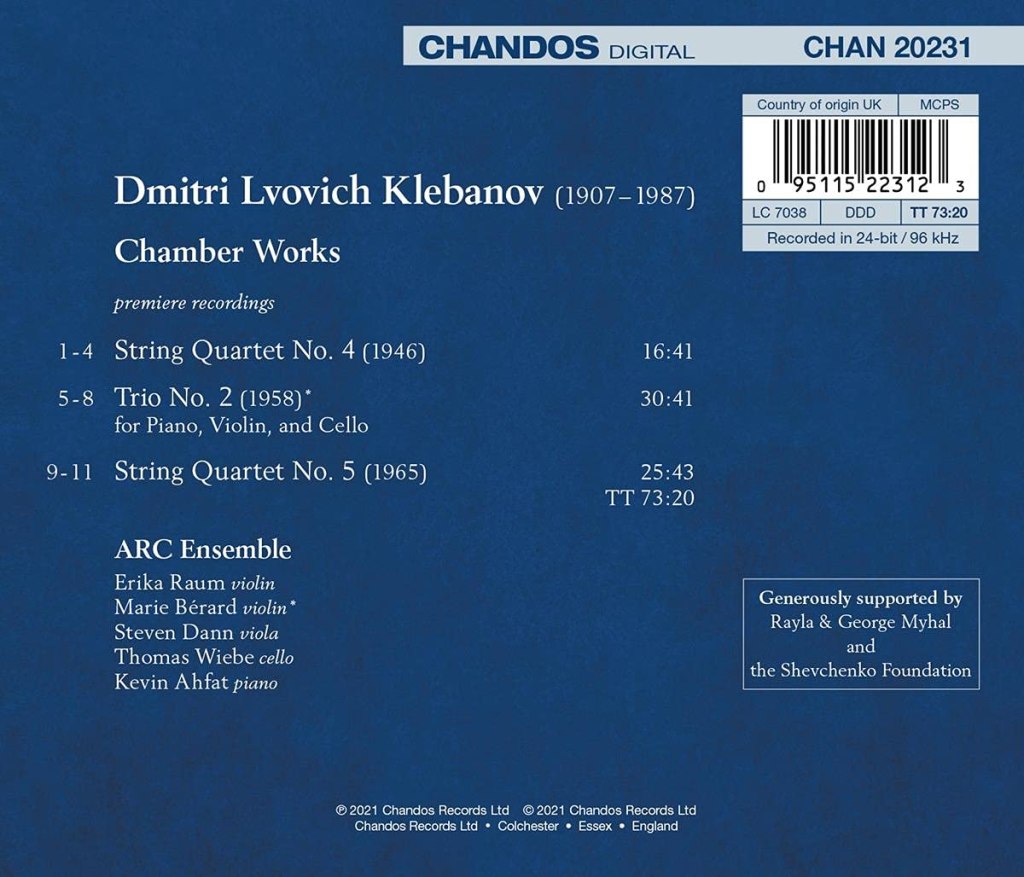
Dmitri Klebanov: Music from Exile


Chandos CHAN 20231

A wonderful trend was begun by London/Decca in the early 1990s with the release of their “Entartete Musik” series. It featured music by composers whose work had been suppressed by the dictates of the Nazi regime. It brought to light a great deal of wonderful music by mostly but not entirely Jewish composers many of whom died in concentration camps or were forced to live in exile. These recordings sparked a trend which continues today and this time the Chandos label hosts the efforts of the Toronto based ARC Ensemble whose scholarship and performance skills bring this, the fifth album in this important series. It is saddening to see the sheer volume of these oppressed works evidenced by the seemingly endless flow of new releases in this genre but there is some joy to be had in the fact that this music is slowly getting performances and recognition.

Previous releases featured premiere recordings by Jerzy Fitelberg, Szymon Laks, Walter Kaufmann, and Paul Ben-Haim. Haven’t heard these names? Well, maybe you’ve heard of Paul Ben-Haim, the Jewish/German composer who changed his name (Paul Frankenberger) when he emigrated to Palestine in 1933. The importance of projects like this one is to bring to light the art of composers lost to history and unknown in concert halls due to political oppression and/or outright murder.

This release features music by Jewish/Ukrainian composer Dmitri Klebanov (1907-1987), a composer whose work displeased the Stalinist regime. He wasn’t put in a concentration camp, he wasn’t killed, he wasn’t even sent into exile in the Gulag. Rather he was forced into a sort of intellectual exile in which he produced music which pleased the regime. But he had been cast as a sort of “whipping boy” by the regime and used as an example in the hopes of preventing others from straying to more liberal and outspoken paths such as those of Prokofiev and Shostakovich.Fortunately he outlived Stalin and was able to return to his own personal style of composition. It is this music which is presented here.

The three works from 1946, 1958, and 1965 respectively seem to have been chosen to reflect three fairly distinct eras in Klebanov’s artistic development. Whether these are ultimately representative of those chosen eras seems beside the point which is, I believe, to present a representative sampling of his work to give listeners a taste of his work and to help guide interesting performers and record companies to decide what to record next.

These works will serve to represent this neglected composer for now. There do exist some recordings of this music but these are mostly on small labels and very difficult to find. The hope for this recording and for a project like this is to provide good recordings with authoritative performances which may inspire musicians to explore the remainder of the composer’s work and, hopefully, bring these gems to audiences.

The disc begins with the nearly classical sounding fourth quartet from 1946. Cast in the classical four movements it’s difficult, in 2021, to imagine how this very accessible music could offend Soviet leaders but that is another issue entirely. All music ultimately exists within a variety of contexts but it is only possible to hear this music as it is today, listening with ears that did not exist at the time the music was written. Suffice it to say that this is eminently listenable music played with insight and dedication by the wonderful ARC Ensemble (Erika Raum, violin; Marie Berard, violin; Steven Dann, viola; Thomas Wiebe, cello; and Kevin Ahfat, piano).

The second selection is the Second Piano Trio of 1958. It is cast in three movements, some of which will remind listeners of Shostakovich whose fame and mastery loomed brightly at this time. But neither the rather conservative classical form of a piano trio nor the basically tonal idiom is likely to have charmed Kremlin leaders of the time. This is intelligent music that show the composer at the height of his powers and this, generally speaking, was not appreciated by the powers that be at the time of the work’s genesis.

The last work on the disc is the composer’s fifth string quartet from 1965. Like the two works that precede it in this recording this is music of both substance and charm. It is as listenable as the other two works and would doubtless entertain the average concert goer. It bears comparisons to Shostakovich, yes, but also to Haydn, Mozart, and Beethoven.

Completists, such as your reviewer here, will wonder at the music not included on this disc: the first three string quartets, the first piano trio, the other chamber music, nine symphonies, and various concerti along with five operas and two ballets. It is both fitting and sad that this overdue review be published at at this moment in history when, as I write, the Russian army advances into the Ukraine leaving death and destruction in their wake. There is doubtless much more music yet to be uncovered/discovered, rescued from oblivion but the sad fact is that the forces which suppressed this Ukrainian composer’s works continue to oppress artists today.