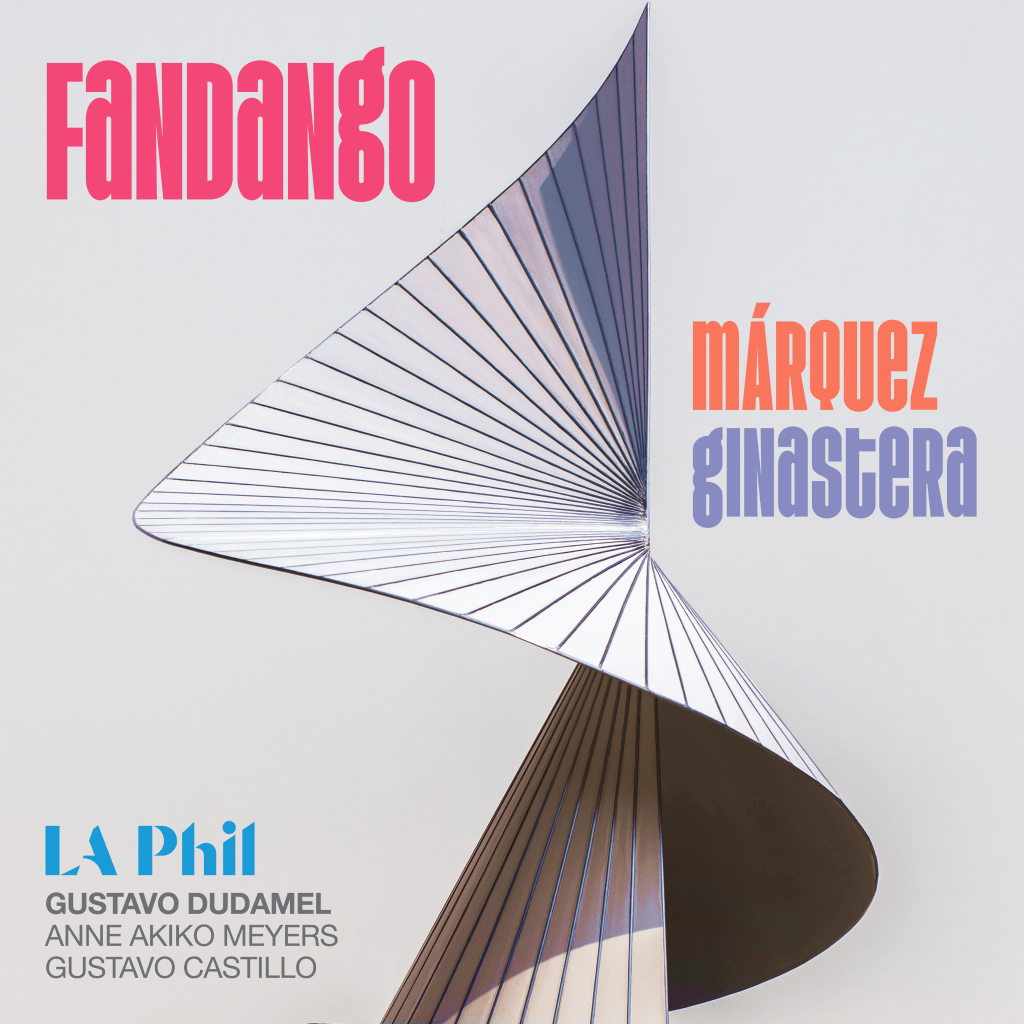
Fandango! Diversity Within Identities


Avie AV 2386

The primary importance of this new release is, of course, the presentation of these two major works but it also an exposition of the diversity (or do you prefer, “heterogeneity”?) that can become obscured by well intended terms like, “Latino” and “Hispanic”, or even conductor Gustavo Dudamel’s “Pan American”. All are well intended but racial, nationalist, and other categories are insufficient on their own in recognizing the rich diversity inherent in their cultures. Here we go, just in time for Latin History Month.

The concise liner notes tell us that even the album’s title, “Fandango” has multiple meanings depending on cultural contexts. The fact is that no single style or genre can be said to be representative of the marvelous diversity that exists within their intended scope which attempts to represent practically the whole of the western hemisphere as is the case with this release. So, while Fandango is certainly about the musical works presented, it also touches on the issue of diversity by the choice of two major works separated chronologically by some 80 years and representing composers from Argentina on the one hand, and Mexico on the other. Two different cultures that share a language in both words and , to some extent, music.

The centerpiece of this album is, of courses, the concerto that Maestra Akiko-Meyers commissioned from Mexican composer Arturo Márquez Navarro (1950- ). I’m sad to say that I am only now learning of this composer but delighted in his mastery of the orchestra and the grand romantic gestures of a past era along with an acute and personal appreciation of the folk idioms of his culture. At first I was skeptical of a “mariachi” inspired concerto because such attempts, even the most sincere, don’t always seem to work. Well, that is certainly not the case here. This is a strong contender for regular inclusion in the current canon of widely performed violin concertos. This one is a masterpiece which poses challenges to the soloist (which give her a chance to show her virtuosity) and surround it with rich, subtly, ultimately beautiful orchestral textures that support the soloist but which demand much of the orchestra and its conductor as well.
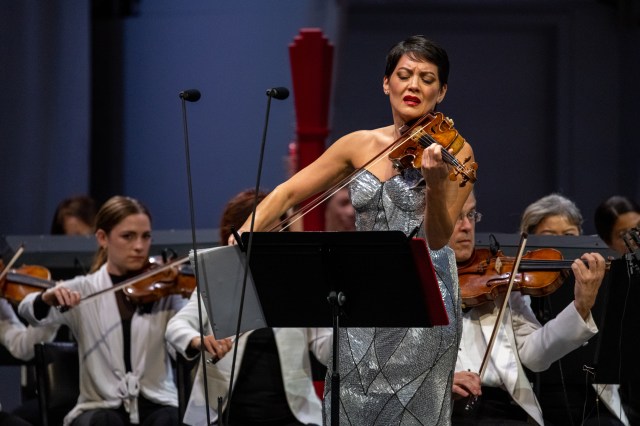
The concerto (written in 2020) is in the traditional three movements. The first, entitled “Folia Tropical” (tropical leaves) embraces the spirit of late romantic concerti like those of Bruch and Brahms. It is an extended movement that introduces and develops many moods and themes. It is a big symphonic movement worthy of a symphony and it gives the soloist much to do and upon which to demonstrate her musical and interpretive skills all the while with a very busy orchestra accompanying her.

The second movement, “Plegaria” (prayer) is a hugely substantive chaconne, the baroque contrapuntal variation form with a repeating bass line and thematic variations over the harmonic structures supported by those notes.. At least that is my listener’s understanding. But what is not necessary to “understand” technically is the emotional impact of this movement. This is an amazing use of the form. The soloist moves into different roles, sometimes very much upstage, sometimes an adjunct to the orchestra, sometimes not there at all. There is a slow, meditative beauty in this movement which is also characteristic of the romantic idiom in which this is written.

The third movement, “Fandanguito” (little Fandango) is a somewhat lighter and very energetic finale one might expect in a movement following the previous deeply emotional ones. And the composer does not disappoint. He writes a joyous, energetic finale which nonetheless stands up as substantially as its predecessors.
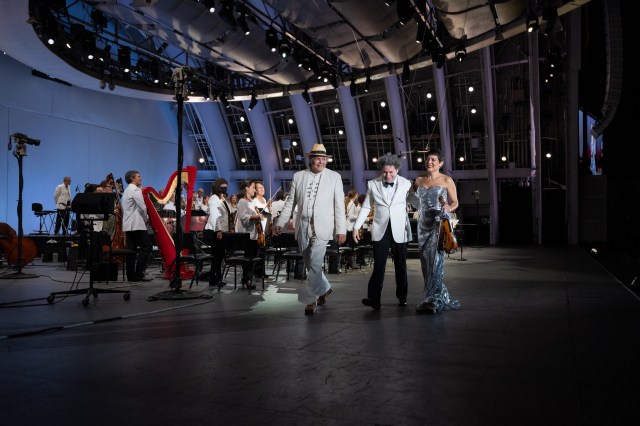
The composer Arturo Marquez with Maestro Dudamel and Anne Akiko-Meyers leaving the stage after a successful performance.

The joy, to this listener, is to hear a master composer in collaboration with a fine soloist both technically and interpretively. The composer has integrated his experiences and study of his own cultural folk musics and infuses the spirit of the music into his grand romantic idiom. That is, the concerto does not, for the most part use direct quotation from folk sources but uses structural elements in his composition. Maestra Akiko Meyers discharges her soloist duties with both startling facility and a deep understanding of the music and the composer’s intent.

Gustavo Dudamel is a joyfully rising star who brings his cultural proclivities and his own lens on western orchestral music. He is an exciting and incisive conductor. I don’t know the extent of Dudamel’s study of Latin folk musics but he really gets this work and brings out the composer’s subtleties in this gorgeous and exciting concerto.

The “B side” as they used to be called is no mere filler, it is the entirety of the Alberto Ginastera (1916-1983) ballet, “Estancia” Op. 8 (1941). Here, 15 separate movements are used in a five scene scenario. The work, usually heard in its four movement suite format and, even more frequently, just the spectacular finale, the Malambo.

In addition to its large orchestra, the ballet calls for a singer/speaker soloist who acts as both narrator and as soloist with orchestra. In this performance the challenge is admirably met by baritone GUSTAVO CASTILLO, another shining light cultivated by El Sistema. He performs well in both his baritone vocal duties and his narrator task in which he speaks Spanish in an elegant and, I’d say, almost Shakespearean grasp of the beauty of the language. The man understands drama as well as music.

This ballet is clearly a masterpiece. It reminds this listener of Prokofiev if he was born in Argentina. Nothing derivative here though. This is an intensely entertaining work, as substantial as Romeo and Juliet, similarly constructed in relatively brief musical segments designed to accompany a dance whose scenario is the story of the “gaucho” or cowboy that lived and worked hard lives, lives that were romanticized into a poem by Argentinian poet José Hernández (1834-1886). (click on the word “poem” for a link to an English translation of the poem).

All that to say that this is a truly enjoyable and important release. A valuable addition to the discography of Latin classical music.
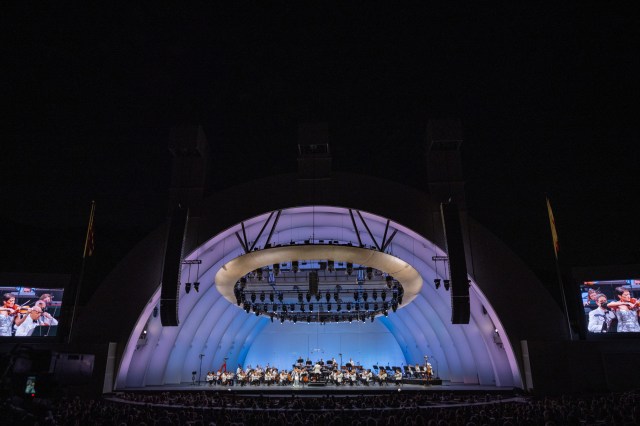
Dudamel and his LA Philharmonic at the Hollywood Bowl.

Two Sono Luminus Discs of New Music by Icelandic Composers (mostly)


DSL- 92267

There are, by my count, at least 8 discs on this fine audiophile label dedicated to music by composers from Iceland. That country’s musical prowess deserves to be better known as does their world class orchestra. I’m reviewing these back to back releases together because they are both Iceland Symphony recordings presenting new music by (mostly) Icelandic composers. And they have a secret connection.

This first disc is a nice mix of music by five different composers in works that really give the orchestra an opportunity to shine. Under the direction of composer/conductor Daniel Bjarnason we are availed of the sound of now, or at least Bjarnason’s “now”.

Track list

This disc, which seems to have a “outer space”theme in large part, opens with a large orchestral work from the most deservedly best known Icelandic classical composer, Anna Thorvaldsdottir. “Catamorphosis” is a 20+ minute work for full orchestra and then some. Her style initially reminded this listener of the sound mass of music like Ligeti and Penderecki. But her harmonic language is more lush and romantic. She has an astounding skill in writing for large orchestra, producing at times the modern equivalent of Impressionism. Her use of motives suggest she has digested ideas from minimalist/pattern composers. And at the end of the day (or the review), one realizes that she has developed her own voice.

The subtle colors of this work are well defined by the orchestra under Bjarnason’s truly expert guidance but also via the sonics that the Sono Luminus engineers are able to capture. This sounds like a difficult work to perform but Bjarnason manages to create a definitive performance and Sono Luminus’ sonics are, as always first rate.

Catamorphosis (2022) is typical of Thorvaldsdottir’s writing for large orchestra reflecting her skills as an orchestrator as well as her imagination, her ability to create a wide palette of subtle sound forms that suggest a sort of post impressionist style. The poetic and metaphorical titles tell little about the musical content (or structure for that matter). But her ability to create cohesive and compelling compositions such as this provide an experience that will likely evoke images for the listener, a sort of movie for the mind. So feel free to conjure your own images in this 7 part (played without pause) work and/or listen and watch a recent Elephilharmonie performance on YouTube here.

Missy Mazzoli’s comparatively brief “Symphony for Orbiting Spheres” (2014 rev 2016) taps into a vein of inspiration seemingly related to the cosmic images of Thorvaldsdottir. Mazzoli incorporates an electronic keyboard and harmonicas, among several less common instruments used in symphony orchestras, to create her own sonic cosmic fantasy. Please click the link on her name above to learn more about this rising star from her nicely designed website.

Daniel Bjarnason demonstrates his own formidable compositional chops with “From Space I Saw Earth” (2019). And this track also provides a link of sorts to the other album reviewed in this blog entry. This work, written on commission for the 100th anniversary of the LA Philarmonic, is a work that requires three conductors. The premiere was led by Zubin Mehta, Gustavo Dudamel, and Esa-Pekka Salonen, all of whom have significant connections to the orchestra (Mehta as conductor Emeritus, Dudamel as present chief conductor, and Salonen as conductor laureate). That was the premiere but this recording is conducted by Bjarnason along with Kornilios Michalaidis, and the then incoming chief conductor of the Iceland Symphony, Eva Ollikainen. Therein lies the “secret connection” to which I referred earlier.

María Huld Markan Sigfúsdóttir (1980- ) is a violinist and composer. Her orchestral work, “Clockworking” is a sort of post minimalist work with a gently driving Ostinato in the percussion. It reminds this reviewer variously of Birtwistle’s “Chronometer”, Ligeti’s “Poeme Symphonique”, to name a few but it is not derivative of these in any way. It is a very listenable and enjoyable orchestral work.

Bára Gísladóttir (1989- ) is a composer, vocalist, and double bass player based in Copenhagen. This, the briefest work on the album is at times the quietest and at others the loudest work here. I would add that it is also the most avant garde. Relying on a battery of percussion and what appears to be some extended instrumental techniques the composer creates a world that to this reviewer’s ears sound a bit like Gyorgy Ligeti’s work “Atmospheres” (1968). That’s not meant to say it’s derivative, just that it could conceivably be used for that famous psychedelic sequence from Stanley Kubrick’s masterful “2001, A Space Odyssey” where my own young ears first heard the Ligeti work.

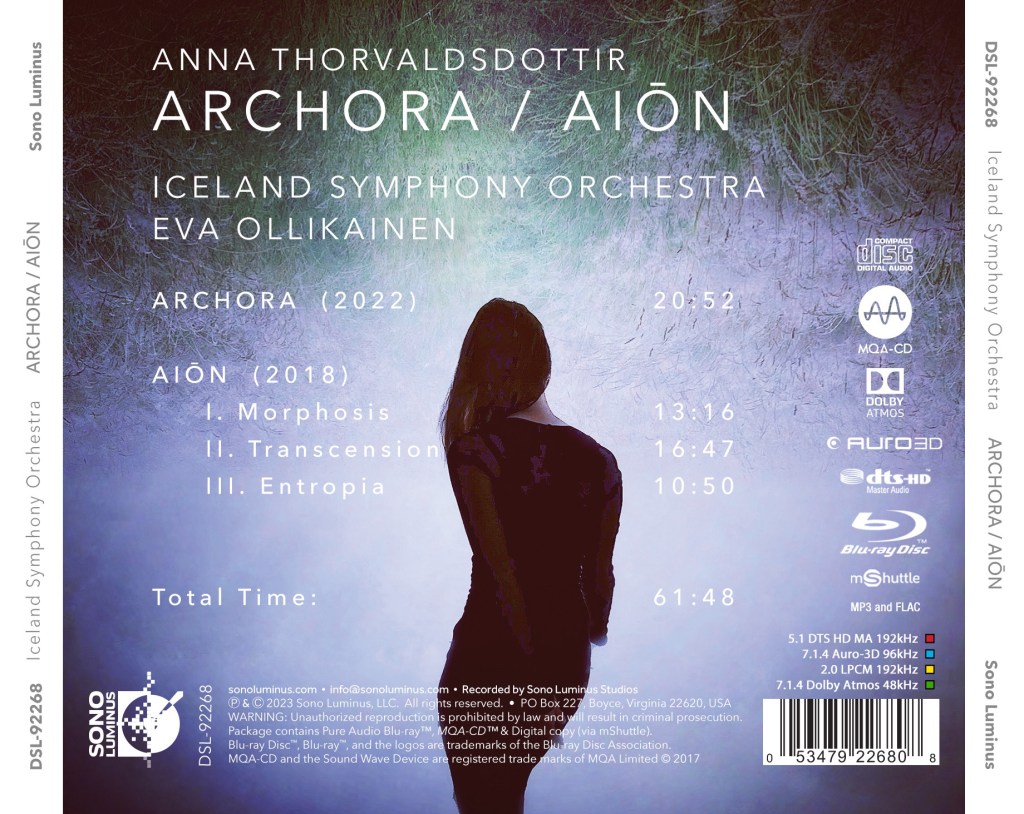
DSL- 92268

As fabulous as that first disc is, this release, dedicated entirely to the work of Anna Thorvaldsdottir, is a worthy endeavor. In addition to that we are treated to the sublime and insightful artistry of the first female principal conductor of the Iceland Symphony, Eva Ollikainen who leads the Iceland Symphony on this disc.

Like the above release, the Iceland Symphony Orchestra demonstrates their world class artistry. This is not easy music to play but, under Ollikainen, as they have under her predecessor, they are able to articulate the intricately orchestrated sounds by this really astounding composer.

Just two works here. “Archora” (2022) and “Aion” (2018). Both are works of grand concept and could easily be called symphonies but the composer seems fond of metaphoric poetic titles. Regardless of the names given these works they demonstrate the composer’s grand sonic visions and her mastery of the orchestra, a mastery grasped very clearly by the Iceland Symphony’s new artistic director and conductor, Eva Ollikainen (1982- ). She holds the distinction of being the first woman to hold the post to which she was appointed in 2019.

Track list

There are only two works presented but both are stunning examples of some of the finest new music being produced today. Yes, it’s great to see women having a greater presence (both as composers and conductors) but, truly, Thorvaldsdottir is “the bomb”, so to speak. Her creativity, her mastery of the orchestra are simply a revelatory as well as entertaining listening experience.

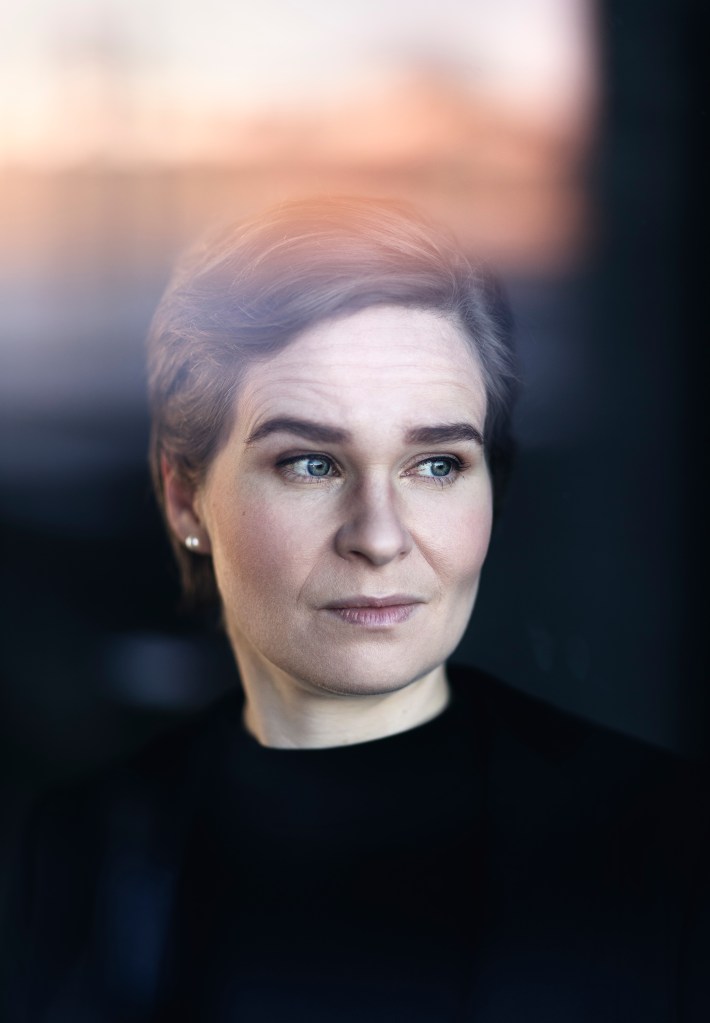
Eva Ollikainen

This release is also a landmark which showcases the formidable talent of the Icelandic Symphony’s new conductor. In addition to breaking gender barriers she is quite simply a rising star and one of the finest interpreters of new music today.

“Archora” (2022) is the most recent work here and it’s another of Thorvaldsdottir’s sprawling cinematic tone poems. No specific story here but the composer’s mastery of orchestral color will doubtless evoke images and feelings in the listener. Thorvaldsdottir is creating a sort of sonic (as opposed to literal) mythology. Her reference points seem to be largely in Greek and Roman mythology but also in Nordic and Northern European myths. Eva Ollikainen conducted the world premiere at the 2022 BBC Proms. You can hear that performance on YouTube here. But the Sono Luminus recording captures more of the subtle sound colors of this engaging work.

The composer’s three movement, “Aion” (2018) concludes this recording. Aion is a Greek God of time. The composer is concerned with various aspects of time in her work. This large three movement work is virtually a symphony with an augmented orchestra, extended instrumental techniques, and an optional choreographic accompaniment. (Tell me that’s not cinematic). There is an example of the optional choreography here.

This recording is also a fine introduction to conductor Eva Ollikainen who clearly has a grasp of this music. Various examples of her interpretive genius can be found on YouTube ranging from Beethoven to new contemporary masters.

These are two truly fine discs both musically and for sheer sonic detail. They’re available in streaming and hard copy CD as well as Blue Ray Audio. These are a fabulous listening experience. Enjoy!