The Thrall in the Hall: Randall Goosby and Zhu Wang Violin and Piano Duo at Hahn Hall


Violinist Randall Goosby

Though this was ostensibly Randall Goosby ’s show, the music making was a wonderfully integrated duo with pianist Zhu Wang, These two fine young musicians shared the virtuosic duties that the music in this concert demands. Both are clearly hard working and dedicated artists. Both have technical and interpretive prowess. And they clearly embody a mutual respect for each other.

Pianist Zhu Wang

The music on the program served to demonstrate the duo’s creative selection of music:

Coleridge-Taylor: Suite for Violin and Piano, op. 3 
Brahms: Violin Sonata No. 2 in A Major, op. 100 (“Thun”) 
Still: Suite for Violin and Piano
Price:Two Fantasies 
Strauss: Violin Sonata in E-flat Major, op. 18

Curiously, due to this reviewer’s lack of familiarity with the violin and piano repertoire and having written some recent reviews of black composers’ music, the only familiar pieces were two of the three pieces by black composers. Now, overall, this is a marvelously chosen set of pieces that reflect the eclecticism and technical skill of both of these musicians.

The classic Paul Freeman conducted set of music by black composers.

The Brahms was perhaps the most familiar to audiences but the other works were equally substantive and worthy of being heard. It is these rather visionary choices that characterizes this duo as fresh and innovative. In addition their obvious knowledge of the music along with their enthusiasm and affection for it conspired to make for a delightful evening and even nudged this reviewer to try to become more familiar with the violin and piano repertory in general.

Samuel Coleridge-Taylor (1875-1912) was a black British composer who has of late had a much needed revival of his music. He was named in honor of the celebrated British poet Samuel Taylor-Coleridge (1772-1834). During his rather brief lifetime, Samuel had been hailed as “the British Mahler but, after his death, his music lay largely fallow until revived by the late, great American black conductor, Paul Freeman (1935-2015). His revelatory series for Columbia records (now Sony) opened listeners’ ears to a fascinating selection of music by black composers internationally.

The Coleridge-Taylor opus 3 Suite for violin and piano (1893) is an early work cast in the high romantic late 19th century style of broad melodies and virtuosic demands. It served as the introduction to an intoxicating evening of (partly) seldom performed works alongside some fairly established works in the repertoire.

The Johannes Brahms (1833-1897) second violin sonata (of three) was written in 1879 and was named “Thun” after the Swiss city where he composed it. The three movements follow the classical fast, slow, fast structure common to this genre.

It is a product of high romanticism and it remains a staple of the repertoire. It, as with most of this composer’s music, is technically challenging for both instrumentalists. It was a fine vehicle to confirm the incredible technical skills of these young artists.

William Grant Still (1895-1978) was one of the finest composers of the early to mid twentieth century. Like Coleridge-Taylor and Florence Price (1887-1953), his music was lauded during his lifetime but was neglected until fairly recently in the aforementioned Black Composers set. These musical choices revealed another aspect of this delightful pair of musicians, that of being essentially musical archeologists uncovering forgotten gems much as Lord Carnarvan’s work availed the world to the marvelous Egyptian art of King Tut’s tomb.

Still’s Suite for Violin and Piano was inspired by three sculptures–Richmond Barthé’s African Dancer, Sargent Johnson’s Mother and Child, and Augusta Savage’s Gamin. Written in 1943, it synthesizes elements of blues, pop, and classical music to create musical description of this ethnically inflected visual art.

Richmond Barthé’s African Dancer
Sargent Claude Johnson’s Mother and Child (ca. 1932)
Augusta Savage’s Gamin

The three movements comprise essentially tone poems based on the visual artwork. It was after the second piece, depicting the Mother and Child sculpture that the spell cast by the duo’s that revealed the “Thrall” of this blog’s title.

Goosby embodies a calm and casual confidence and he let the audience know early on that it is OK to applaud after a single movement if you are so inclined. He has a warmth that put the audience at ease, embracing us in a most genial manner. There is, of course, nothing wrong with musicians who might seem more aloof but Goosby’s warmth was both generous and welcome. However, it became clear that this audience, after hearing that gorgeous second movement so beautifully played, paused in a seemingly hypnotic response to the impassioned performance that captured the beauty of the music. It felt as though we had become collectively and deeply engaged. That is the meaning of “thrall” and that was a beautiful experience that spoke of connections between composer, performers, and audience that represent the pinnacle of the art of chamber music performance. All three movements were wonderfully executed but that moment and the collective reaction was a truly moving experience.

Following a brief intermission we got to hear both of Florence Price’s two Fantasies for Violin and Piano (1933, 1940). Though I’ve become familiar with much of Price’s work (her three surviving symphonies and Goosby’s own reading of her two violin concerti have been released in the last couple of years) I had not heard these fantasies before.

Though written only seven years apart, the works embody distinctively different qualities. Both are certainly “capricious”, embodying a variety of moods, but the second is a bit longer and seemed to reflect the composer’s maturing style. Both works were enjoyable and seemed to please the audience.

This led us to the final work on the program, the Violin and Piano Sonata (1888) by Richard Strauss (1864-1949). Best known for his big orchestral tone poems and his grand operas, this was an early work which has found an audience due to its lyrical and friendly character.

It is cast in three movements, and it was at the end of the slow movement that we again saw/heard a sort of “agreed upon” silence in which the audience seemed to have shared a deep impact from that lovely movement played so passionately. No one applauded as a reverent silence came upon us.

The much busier third movement again presented the virtuosity and broad melodies of high romanticism. And there was applause and, much deserved standing ovations. It was a joy to have heard these talented and hard working musicians in an ecstatic night of chamber music.

Elegant Affable Virtuosity, Hanzhi Wang at the Music Academy of the West


wang1

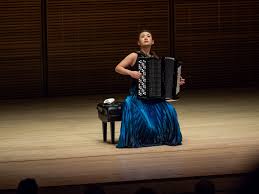
Hanzhi Wang with her Pigini concert accordion (publicity photo from the internet)

On the first day of February, on a sunny day in Santa Barbara, rising star Hanzhi Wang presented a solo recital in Hahn Hall at the matinee hour of 4PM.  Despite the beautiful weather a substantial crowd gathered for this event which was part of the always notable UCSB Arts and Lectures series.

This young performer only recently came to this writer’s musical radar a few months ago.  Subsequent research revealed her to be a marvelously accomplished musician.  She earned her Bachelor’s degree at the China Central Conservatory of Music in Beijing, and her Master’s degree at the Royal Danish Academy of Music in Copenhagen as a student of Geir Draugsvoll.  First Prize Winner of the 2017 Young Concert Artists International Auditions, Ms. Wang’s debut opened the Young Concert Artists Series in New York in The Peter Marino Concert at Zankel Hall at Carnegie Hall, and her Washington, DC debut opened the 40th Anniversary Young Concert Artists Series at the Kennedy Center.

Her interesting and rather eclectic program was artfully designed to showcase her strengths.  One of those strengths is certainly her ability to communicate with her audience both is her brief but lovely introductions to her performances using a microphone kept near her seat as well as in her radiant persona which communicates a humility and pleasant affability.  Of course the most important communication to be heard on this afternoon would be the musical.

She began with a couple of Bach pieces which, like most of his keyboard music, can be done equally well on harpsichord, piano, and now, accordion.  It is here that she showed her virtuosity and interpretive skills which reflected an obvious affection for the material.  Though scheduled to perform the famous Chaconne she chose instead to present these shorter, entertaining pieces.

wang3

Her Pigini concert accordion echoed the pleats in the skirt of her tasteful outfit well suited to a recitalist performing these essential works of the western musical canon.  She followed these with three keyboard sonatas by Domenico Scarlatti (1685-1757)(K. 9, 159, and 146).  This writer first encountered these little gems (the composer wrote over 500 of them) in the landmark recording Switched on Bach by Wendy Carlos in the 1970s and they are a delight on any concert program (though not programmed often enough).  She handled these challengingly virtuosic works with seeming ease expertly adding dynamics to define these works to create a wonderfully entertaining concert experience.

Wang followed these with three pieces by another late baroque master, French composer Jean-Philippe Rameau (1683-1764).  “L’ Egiptienne”, “La Livri”, and “Le Rappel des oiseau”.  Her obvious affection for these works have subsequently sent this listener to seek out more of Rameau’s works.  These works on the first half of the program were all characterized by her lovely playing, making a strong case for the role of this nineteenth century folk instrument’s role in the playing of classical music.

After a brief intermission Ms. Wang offered a twentieth century work by the late, great Russian composer, Alfred Schnittke (1934-1998).  Though not originally for the accordion the composer did utilize this instrument in some of his works.  Russian composers at least since Tchaikovsky have utilized the accordion to stunning effect.  And this performance was another demonstration of this young musician’s easy virtuosity and insight offering up these brief pieces inspired by Nikolai Gogol’s novel, “Dead Souls”.  The music is filled with both humor and passion with echoes of the dead souls (in Schnittke’s trademark “polytsylism”) of prior Russian composers.

The soloist’s clear understanding of the modern idiom was made very clear and one need only look to Wang’s website to see that her repertory ranges across 400 years of the western musical canon.  One wonders if there is anything she can’t play well.

Her last scheduled pieces came from the late nineteenth century by a composer which Wang humorously noted eschewed the accordion, Edvard Grieg (1843-1907).  The Norwegian nationalist’s famed Holberg Suite (originally for string orchestra) sounded pleasantly familiar on Wang’s instrument.

After an enthusiastic standing ovation Ms. Wang presented three more pieces, two by the late Argentinian Astor Piazzolla (1921-1992) and a piece by German composer and piano virtuoso, Moritz Moszkovsky (1854-1925).  These were like gifts to the audience which further demonstrated her facility with the tango inflected Piazzola and the playful, though difficult, pianism of Moszkowski.

This young woman is indeed a rising star who belongs on your radar.


Patricia Kopatchinskaja and Jay Campbell in Santa Barbara


img_0826

Shot of the stage of Hahn Hall at Santa Barbara’s historic Music Academy of the West (Photo by author)

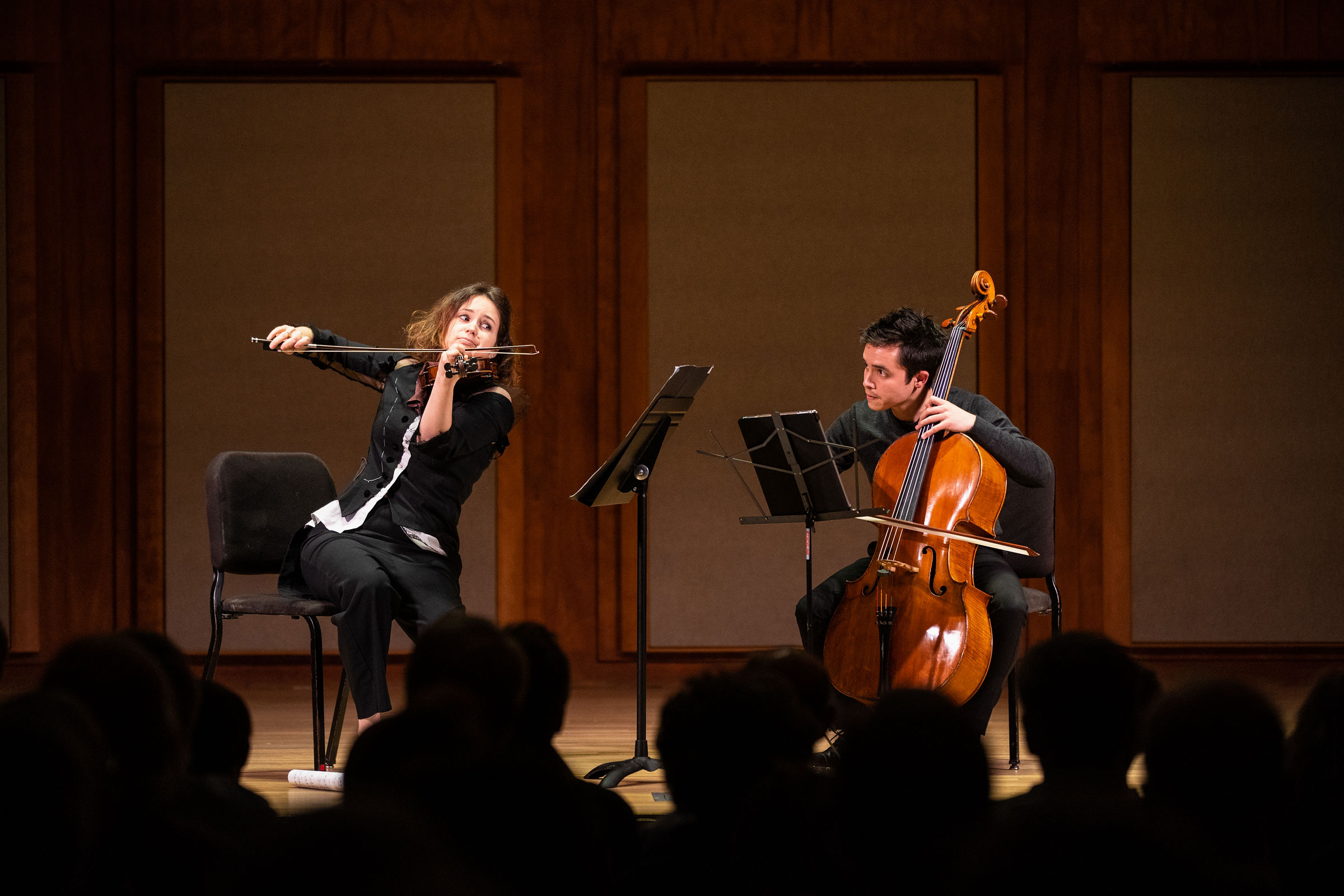
The beautiful and acoustically excellent Hahn Hall at the Music Academy of the West in Santa Barbara was the venue for a powerful chamber music concert on Saturday, January 25th.  The not too common combination of violin and cello played respectively by violinist extraordinaire Patricia Kopatchinskaja and the equally matched musicianship of cellist Jay Campbell delighted a near full house with a carefully chosen set of pieces from the 642 CE to the present.  Who knew that there was so much music for this combination of instruments and that it would be so marvelously engaging?

kopacampbellMA

Patricia Kopatchinskaja and Jay Campbell in Massachusetts (Photo from Patricia’s web site)

This concert was part of the UC Santa Barbara’s always excellent Arts and Lectures series.  Kopatchinskaja was clearly the big name on the marquee for this event but Campbell was clearly a match both in skill and enthusiasm for this night’s event.

A slight change in the program was announced at the beginning which, if this reviewer heard correctly placed a piece originally slated for the second half of the program in the number two slot on the first half.

The concert opened with an anonymous “Alleluia” from a collection of works only recently (the past 50 years or so) deciphered by scholars.  The slow melismatic voice lines transcribed here for these string instruments was played with the sort of approximate intonation common to so called “period performances” which attempt to provide as much as possible some sense of how the music may have sounded in its time.  It was a slow piece rich in harmonics and reverent in execution.

The next piece, a clearly modern piece from the look of the oversized score on the music stand, was (again if this reviewer heard this correctly) by Hungarian composer Márton Illés (1975- ).  It was the world premiere of “Én-kör III”, a piece that brought us nearly 1500 years forward and evoked the modernist sound world of Darmstadt and the sort of modernism that dominated the 1950s in Europe.  It was a challenging piece for both listeners and players involving special techniques of playing that doubtless made for a fascinating looking score.  On sheer virtuosity and powerful performance alone the piece was well received.  It is complex music that doubtless benefits from repeated hearings and this premiere suggests that that will be the case.  The interested listener would do well to explore the web site of this fascinating composer whose name and music was new to this writer’s ears.

Next up, music by another modernist composer, the German, Jörg Widmann (1973- ).  Two selections (numbers 21 and 24) from his 24 duos for violin and cello (2008) were also of the Darmstadt style modernism mentioned earlier.  The Valse Bavaroise (Bavarian Waltz) had echoes of the 19th century Viennese traditions while the Toccatina all’inglese which followed it was a finger busting virtuosic showpiece, another audience pleaser actually.

Then, as if to cleanse our aural pallets the duo played Orlando Gibbons’ (1583-1625) Fantasia a 2, No. 4 for two “viols”.  As in the opening piece these are transcriptions since the violin and cello as we know them today did not exist.  This little instrumental miniature was a charming and relaxing interlude.

The final piece on the first half of this concert was the too seldom heard Sonata for Violin and Cello (1920) by French composer Maurice Ravel (1875-1937).  This again set the mood to virtuosic modernism.  Even people in the audience familiar with Ravel’s better known works were astounded at the modern sound.  According to the program notes this work was written in the shadow of both the death of his esteemed fellow French luminary Claude Debussy (1862-1918) and the end of the First World War (also 1918).  Indeed there were angry dissonances to be heard but this four movement sonata remains an astounding work and this performance was a powerful and forceful reading conveying the respect that this masterpiece deserves.  It is filled with both jazz influences as well as gypsy music (no doubt dear to the Moldovan born Kopatchinskaja).  And were it not for the visual cues that only two instruments were actually playing one might guess that there were certainly more.  At this point we all needed an intermission just to breathe.

The second half of the concert consisted of (with one exception) music from the region of Kopatchinskaja’s birth.  The Romanian born Iannis Xenakis (1922-2001) produced a great deal of music in the high modernism and experimental traditions but the work which opened the second half of this concert was an early work “Dhipli Zyia” (1951) which sounded much like the work of (also Romanian born) Hungarian composer Bela Bartok (1881-1945) with whom Xenakis had familiarity and, apparently, affection.

The program continued without the punctuation of applause into the 14th century with a work by the French composer Guillaume de Machaut (ca.1300-1377), his Ballade 4.  This is apparently originally a vocal work and was played in transcription for tonight’s soloists.

Again without the transition signal of applause the duo launched into another work which, like the Xenakis, is atypical of his largely modernist oeuvre.  György Ligeti (1923-2006) is perhaps best know for his music’s (unapproved) inclusion in Stanley Kubrick’s 2001: A Space Odyssey (1968).  The work played on this night was “Hommage à Hilding Rosenberg” (1982).  Hilding Rosenberg (1892-1985) was among the earliest Swedish modernist composers and this work was written on the occasion of his 90th birthday.  The piece echoed Ligeti’s affection for the aforementioned Bela Bartok and folk tunes predominated this brief but lovely score.

The duo launched with little pause into a piece by Bartok’s contemporary Zoltán Kodály (1882-1967).  His “Duo for Violin and Cello” Op. 7 (1914) sounded almost like a model for the later Ravel piece heard at the conclusion of the first half of the concert.  This three movement work is unusual in this composer’s catalog in that it is more aggressively modern than much of his more folk inflected pieces (Bartok and Kodaly were early pioneers in ethnomusicology and they collected and recorded a great deal of folk music from the region of Hungary, Romania, etc.)  It was a fantastic finale which garnered the artists an enthusiastic standing ovation.  The smiling and obviously satisfied performers received the traditional bouquets of flowers and returned for a brief little piece (didn’t catch the name) which was a little token of thanks to the equally satisfied and smiling audience.