Not Just Another Black Composer Compilation: Kellen Gray Revives Neglected American Masterpieces


LINN CKD 731

For the humble listener, a musician’s technical and interpretive performance skills are one of the most compelling reasons to buy a concert ticket or a recording of said musician. But your humble reviewer has another, perhaps equally important reason for investing time and money in the work of a musician. And that skill is what I like to call “musical radar”. It is the (sometimes uncanny) ability of such gifted musicians to intelligently choose repertoire.

Conductor Kellen Gray demonstrates a keen sense of what music sounds good and also has the weight of substance. Following in the footsteps of incisive conductors like Leopold Stokowski (1882-1977), Dean Dixon (1915-1976), and Paul Freeman (1936-2015) Gray is clearly a champion for contemporary music and is now into the second volume of what this listener hopes will be many more releases of substantive music by black composers whose work has lain fallow for reasons unrelated to quality.

The first volume included early to mid twentieth century masterworks like William Levi Dawson’s 1934 “Negro Folksong Symphony”, William Grant Still’s First Symphony “Afro American” (1930), and George Walker’s “Lyric for Strings” (1946, orch 1990). These are certainly great and foundational works that deserve a place in concert programs but these works have had at least some exposure via recordings. Nonetheless they are fine foundation on which to build this series. Gray demonstrates a depth of understanding for these works and his skills as a conductor were displayed well here. But that was just the first volley in an exciting survey in progress.

In this second volume we see more deeply the acumen of this conductor’s musical radar. These are new commercial recordings of orchestral works by mid to late 20th century black composers, works of obvious substance that remain unjustly neglected. It is this “not the usual suspects” angle that finds this enterprising conductor demonstrating his personal perspective and respect for music history. And they are revelatory. Hearing these definitive performances will leave listeners wanting more as we get to hear some very exciting music that deserves at least a reckoning if not a place in the repertoire.

The four victims of the Birmingham Church bombing.

The disc begins with Margaret Bonds’ “Montgomery Variations” (1964), a classical set of variations, in this case on a gospel tune, “I want Jesus to walk with me”. But this work was “lost” and was only rediscovered in 2017. Its neglect was likely due both to the work being by a black woman, and the fact that it is a response to the 1963 Birmingham church bombing, a hate crime that killed four little girls. So, here it is, Bonds’ only surviving purely orchestral work getting a truly fine hearing. And what a great piece it is.

Margaret Bonds (1913-1972)

The work is structured in distinct sections with titles (Decision, Prayer Meeting, March, Dawn in Dixie, One Sunday in the South, Lament, Benediction). Each title is reflected in the musical mood of each section. It is an overt and powerful denunciation of a horrific hate crime. It is harrowing at times, somber and reverent at others, but Bonds’ composition is also effective in the metaphorical quality of the music itself. It is also very nearly a concerto for orchestra in its broad symphonic dimensions and clever orchestration most deftly handled in this recording.

The genre of “variations” is common throughout musical practice but only took on the guise of monolithic large orchestral works in the late 19th century. Well known examples include, Elgar’s “Enigma Variations”, Britten’s “Variations and Fugue on a theme of Henry Purcell”, Brahms’ “Haydn Variations”, etc. It’s hard to say if this work will find a place in the concert hall alongside those proven classics but Maestro Gray and the talented musicians of his Royal Scottish National Orchestra really make a strong case to do just that.

Ulysses Kay (1917-1995)

Next we are introduced to Ulysses Kay’s “Concerto for Orchestra” (1948). This work, first performed by the similarly incisive conductor, Leopold Stokowski has been sorely in need of a new recording and Maestro Gray serves up a taught and insightful performance that, like all the works on this release, stand as a challenge to performers, broadcasters, and listeners to not let this music fade into obscurity. The “Concerto for Orchestra” genre was first heard in a 1925 Hindemith work with that title and the work best known in the genre is without doubt Bartok’s 1943 “Concerto for Orchestra”. Where Kay’s work will stand in relation to other concerti for orchestra remains to be seen/heard (as with the Bonds work) but at least it now has a chance to be heard in all its glory.

It is one of Kay’s major works and it is of grand symphonic scale. This neoclassical work was written in 1948 and is cast in three movements. The work is eminently listenable but it puts challenges to the orchestra which this orchestra handles quite well.

Coleridge Taylor Perkinson (1932-2004)

The disc concludes with a rather brief work by a composer with whom even adventurous listeners (including myself) have limited familiarity. Coleridge Taylor-Perkinson. It is the only work here that comes from the 21st century. This 2001 Concert Overture subtitled, “Worship” reflects Perkinson’s exposure to black church music which he utilizes in this tone poem written for a sizable orchestra.

Gayle Murchison’s fine liner notes help guide the listener by providing context and by understandable descriptions of the compositional processes. This is an exciting release that builds nicely on the first volume and leaves this listener excitedly anticipating Kellen Gray’s next installment.
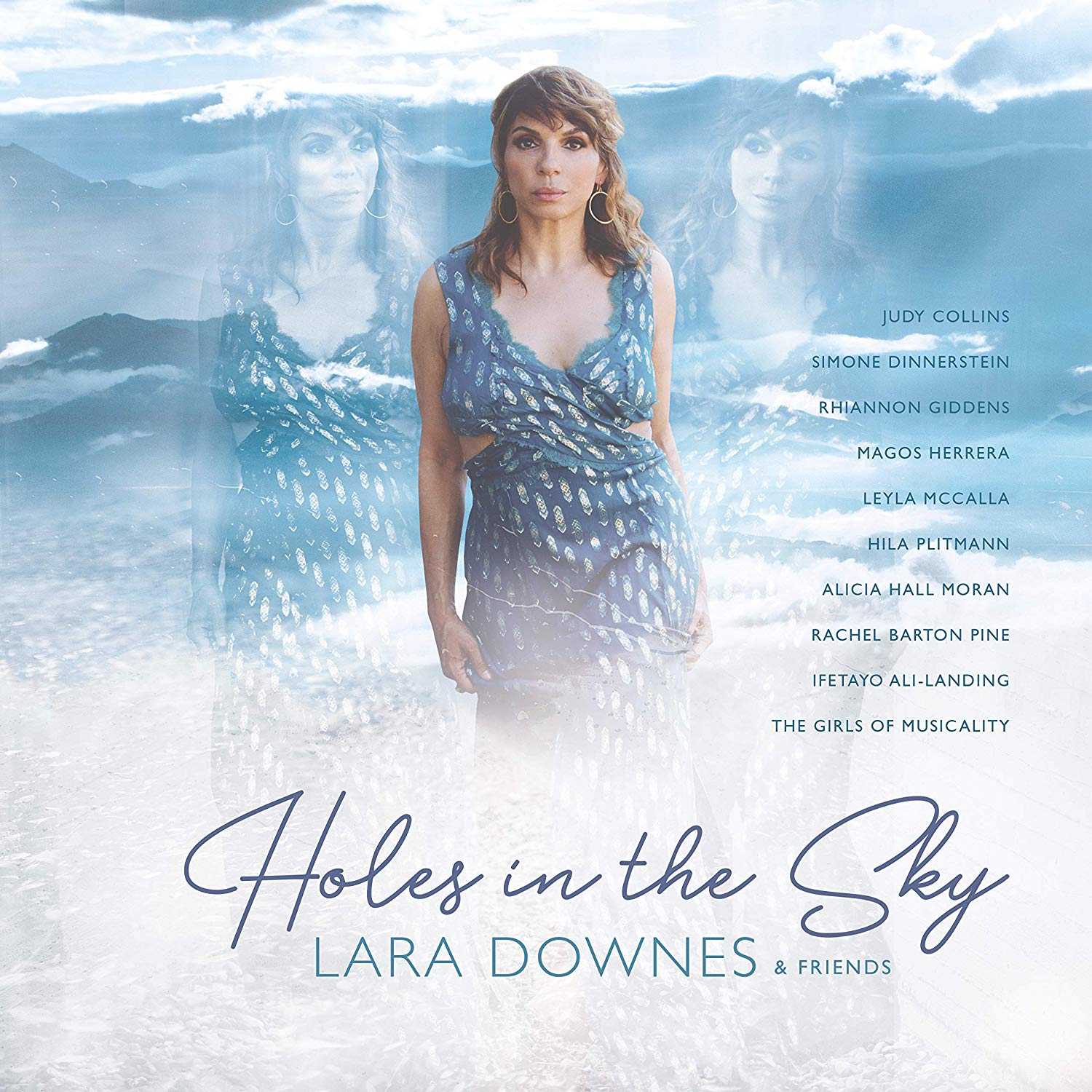
Holes in the Sky, Lara Downes Channels the Collective Artistry of the Feminine


downesholes

Sony/Portrait

Lara Downes has proven herself as a virtuoso pianist in solo, chamber, and with orchestra.  She has demonstrated facility with standard repertoire as well as an intelligent selection of contemporary composers.  In this sort of mid-career place she has begun releasing a more personal kind of album of which this is the third incarnation.  The “series’ to which I refer is the perception of this reviewer, not one defined as such by Ms. Downes but stick with me. Her previous releases have been organized on one level or another on themes just like most album of any stripe.  The difference is a more sociopolitical focus.

One look at the eclectic musical choices here and one sees Downes sharing her spotlight with kindred spirits (composers and performers both) while her themes take on more socially conscious ideas.  The first of these was America Again (2016) which is a beautiful collection of short piano pieces predominantly though not exclusively by black composers.  It is a very personal choice of repertoire reflecting her profound knowledge of the repertoire as well as the neglect of black composers.  The second was Lenny (2018), a tribute to Leonard Bernstein.  It includes a marvelously varied group of guest artists and, much as Lenny did, blurs the line between the “classical” and the “vernacular”.  It was a love song to a cherished artist (this writer included in the cherishing).

She does something similar here in this album whose title is taken, appropriately enough, from Georgia O’Keefe, “I want real things, live people to take hold of, to see, and talk to, music that makes holes in the sky, I want to love as hard as I can.”  In the essay that opens the program booklet Downes speaks briefly of her relationship with women in general and women as composers and as performers.

The album opens with a 1949 piece by Florence Price, a black American composer much of whose whose work has recently been rediscovered and recorded.  Her work was also featured on the America Again album.  This is a mid-century romantic piece for solo piano.

The second track, and the one that hooked this listener big time is this recording of Judy Collins early song, Albatross (1966) which appeared on her album Wildflowers which in turn provided some of the design elements of the album.  The liner notes to the present album also note this connection.

In place of detailed liner notes there is a fascinating conversation between two of the women involved with this album, Lara Downes and Judy Collins.  A lovely black and white portrait is included in the liner notes.  Their discussion centers primarily on the Albatross song but also touches on the nature of political activism in which Downes laments not being active in marches.  Collins tells her (and this writer agrees wholeheartedly) she belongs at the piano.  Indeed her activism, though of a gentler nature, gets ideas out most effectively utilizing her incredible talents as a pianist, historian, and fellow musician.

Rather than go through an analysis of each of these pieces I am simply going to provide a track list.  It appears that this album is designed to be heard and contemplated as a sonic document first and as a research project at a later time (one hopes for more detail at some point because these are interesting pieces).

1. Memory Mist (1949) by Florence Price

2. Albatross (1967) by Judy Collins

3. A Tale of Living Water (2010) by Clarice Assad

4. Dream Variation with Rhiannon Giddens (1959) by Margaret Bonds and Langston     Hughes

5. Ellis Island with Simone Dinnerstein (1981) by Meredith Monk

6. Don’t Explain with Leyla McCalla (1944) by Billie Holiday

7. Willow Weep for Me (1932) by Ann Ronel (arr. by Hyungin Choi)

8. Venus Projection (1990) by Paula Kimper

9. Morning on the Limpopo: Matlou Women (2005) by Paola Prestini

10. Farther from The Heart with Hila Pittman (2016) by Eve Beglarian and Jane Bowles

11. Favorite Color (1965) by Joni Mitchell (arr. by Nora Kroll-Rosenbaum)

12. Noises of Gratitude (2017) by Jennifer Higdon

13. Arroyo, Mi Niña with Mogos Herrera (2018) trad. arr. by Lara Downes

14. Music Pink and Blue (2018) by Elena Ruehr

15. Idyll (1946) by Hazel Scott

16. Blue Piece with Rachel Barton Pine (2010) by Libby Larsen

17. Bloom (2018) by Marika Takeuchi

18. Just for a Thrill with Alicia Hall Moran (1936) by Lil Hardin-Armstrong (arr. by               Hyungin Choi)

19. Agwani (Doves) (2009) by Mary Kouyoumdjian

20. What Lips My Lips Have Kissed (2014) by Georgia Stitt

21. Rainbow (n.d.) by Abbey Lincoln and Melba Liston (arr. by Laura Karpman)

22. All the Pretty Little Horses with Ifetayo Ali-Landing and The Girls of Musicality (Trad. arr. by Lara Downes and Laura Karpman)

In these 22 tracks all the music is by women composers and, most charmingly a selection of women performers who appear as sort of cameos on different tracks.  The music ranges from the mid-twentieth century to the present and embraces a variety of genres (classical, folk, blues, etc.).  The end result is a charming and very intimate document but also one which is somehow gently subversive as it presents the best in musical and performance quality as an acknowledgement of the accomplishments of women in general, (to paraphrase Ms. O’Keefe) making music as hard as they can.