A Reason to Listen: Roger Reynolds’ Latest, “For a Reason”,new recordings on Neuma Records


Neuma 128

Roger Reynolds (1934- ) turns 90 next year. This prolific American artist’s work is being collected and preserved by the Library of Congress. The present recording is the most recent release documenting Reynolds’ music, now numbering about 30 CDs and DVDs. And this is but a fraction of his musical works.

I first encountered Reynolds’ music when I heard a broadcast of the first commercial recording of his music. The disc, released in 1969 on Nonesuch records documented performances of Frederic Myrow’s “Songs from the Japanese” (1964) paired with Reynolds’ “Quick are the Mouths of the Earth” (1965), a work that actually uses the text of the title to derive the music. I recall that the sound of this music sent chills up my spine and sent me to a record store to purchase a copy. This first encounter was a visceral experience, one of many I would encounter as I heard his subsequent music, and that of his contemporaries.

Reynolds has been a prolific composer, writer, and reader. His father was an architect, Roger would go on initially to study engineering and then also encountered some of the new interest in experimental music at the ONCE Festival in Ann Arbor, Michigan in the early 60s. His studies in music and literature continued to be wide ranging and the fine liner notes by Thomas May in “For a Reason” are extremely useful in grasping the range of inspirations that inform Reynolds’ music. This is one of those gorgeous new music releases that will likely become one of those odd but much sought after collectibles. The booklet jdesign by Karen Reynolds, Stacie Birky Greene, and producer Philip Blackburn is by itself, worth the price of this release.

While listeners can certainly appreciate Reynolds’ work without those details, they add a dimension of understanding and provide contexts as well. In some ways, Reynolds is unclassifiable but this writer finds him to be the consummate experimentalist and modernist, two aspects that appear to have been in his work from the very beginning. His work is rarely easy listening but, even if you don’t get it on first hearing, his compositions tend to reveal weight and substance with repeated listenings.

That said, Reynolds’ music produces sounds that might be heard as romantic, expressionist, and even classical at times. Much of his work, as is the case with most of this 2 CD set, is electroacoustic. It is not heavily dissonant or overly complex to the listener’s ear but his music presents unique challenges to performers. And, as mentioned, this beautifully designed set includes a decent set of liner notes to help navigate this voyage.

Three of the four works here are “electroacoustic”, meaning that some form of electronics interacts with the performer. The one work that does not fit that category pretty much needs it’s own category. Pieces for speaking pianist are getting more common in the last 20 years or so but pieces for speaking percussionist are far less common. Frederic Rzewski’s “To the Earth” for speaking percussionist playing on clay flower pots comes to mind. Of course John Cage also wrote in this genre but Reynolds’ essay is the longest, most complex work this listener has encountered for solo percussionist with speaking duties.

The first track is “Dream Mirror” (2010), the first of Reynolds’ “Sharespace” series of compositions in which an instrumental performer interacts in the shared performance space with a computer musician in a duet. This first sharespace work is for guitar and computer musician. It features the fine Mexican guitarist, Pablo Gomez Cano. The fact that Cano is not a familiar name is likely that his work has focused on challenging new music such as this. Dream Mirror is a big work, at over 20 minutes in performance, but it has a chamber music quality consistent with the composer’s focus on the interaction of this duet in their shared performance space.

The second track introduces listeners to the fourth in the Sharespace series, this time, for violin. “Shifting/Drifting” (2015) was written for Irvine Arditti, one of the finest working musicians of our time supporting new music via his solo efforts and his work with his esteemed “Arditti Quartet”. Like the preceding track, this big duet takes some 20+ minutes in performance.

On to CD 2 for the third offering, “Here and There” (2018), both the longest work and the most recent. This one is for solo percussionist with a substantial speaking part designed to be spoken by the percussionist (in this case, Steven Schick, one of Reynolds’ fellow faculty at UCSD). Solo percussion works are relatively uncommon, though readers will want to familiarize themselves with volume one of Mr. Schick’s ongoing series of the solo percussion repertoire Hard Rain.

This will likely become a showpiece but, at the time of this writing only Schick and the ubiquitous William Winant come to mind as being both willing and able to perform this work right now. And it is apparently a beast of a challenge for the performer but remarkably engaging for the listener. The texts, from Samuel Beckett, are referenced in the liner notes. Not surprisingly, Schick delivers a stunning performance, setting a bar for successive performers and performances. The texts are non-narrative and have a more musical than didactic or dramatic function.

Last but not least is the earliest work on the album, “Sketchbook”(1985), originally written for Joan LaBarbara but never performed. Here, singer, Liz Pearse effectively took a page from Irvine Arditti (whose doctoral studies resulted in research that culminated in John Cage being able to finish his partially completed solo violin work, “Freeman Etudes”). Pearse, also pursuing doctoral studies came upon this work and collaborated with Reynolds in creating a performance. His texts here come from Milan Kundera. The work, while dramatic and challenging, is not a species of opera or monodrama but, like the preceding works, a piece that, like Reynolds, thrives on collaboration. In addition to requiring some pianistic skills, the singer collaborates with interactive computer electronics.

These four works, despite their differences, clearly fit Reynolds’ interest in literature, collaboration, and in various technical aspects described in the well documented liner notes. Those notes provide technical detail and insights beyond the scope of your humble reviewer’s skills but what I can tell you is that this release is a marvelously engaging experience revealing fascinating aspects of this composer’s work.

The experience of listening and reading and the visual experience of the graphics was an immersive one and a delightful use of my time. Heads up to all my fellow new music aficionados. This is truly spectacular.

Solo Artist Pamela Z releases “a secret code”


Neuma 143

Pamela Z first came to this writer’s attention when the fine Starkland label under the very insightful guidance of Tom Steenland released a cutting edge, surround sound 5.1 DVD release in 2000 which featured her along with other similarly interesting musicians in a forward looking recording.

Starkland ST-213

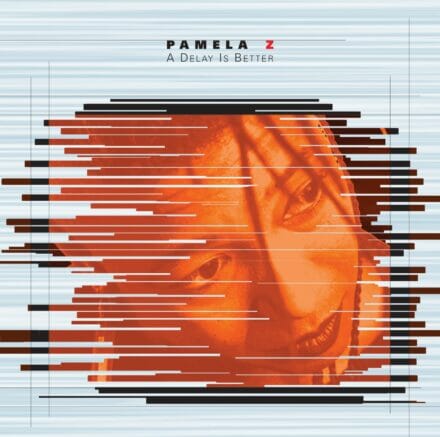
The first CD dedicated entirely to Ms. Z’s work was also a Starkland release (A Delay is Better, 2004) was quickly added to my music collection when I was still a Chicago resident. Since moving to California in 2005 I have had the pleasure of seeing Pamela’s work live on numerous occasions (something which I highly recommend). She is a fascinating performer to watch as well as hear. These releases are the only ones dedicated entirely to her work currently available to the general public though her crowd funded DVD, Baggage Allowance may be obtainable through her web site. Much of her presence on recorded media is as a collaborator so this new disc of largely new work is a truly welcome addition to her catalog and an opportunity to see a unique talent.

Pamela Z performing at Other Minds 23 in 2018

Her visual presence and gestures are an important part of her work but it is the hearing part with which we are concerned here. Philip Blackburn at Neuma records has chosen to release a new disc consisting of performances of more recent compositions. Z maintains a busy schedule of composing and performing world wide and her quirky creativity has not failed her. Let me say that I use the word “quirky” just to indicate that her work is unique, a technological expansion of the tired “one man band” cliché in which she uses a variety of compositional electronics (some made exclusively for her) to facilitate her uniquely recognizable style. It is difficult to describe her work in a way that can easily be understood without actually having heard her work. Suffice it to say that, generally speaking, she works with live recording and subsequent looping of those sounds. She is able to turn loops on and off as the piece progresses. Her texts come from a variety of sources, including found texts. And the presentation of these texts are sometimes sung and sometimes spoken.

She has had great success as a collaborator with spoken word narration, singing (she also has a beautifully trained soprano voice), and performing with other musicians. These collaborations are listed on her web site and are worth your time to explore.

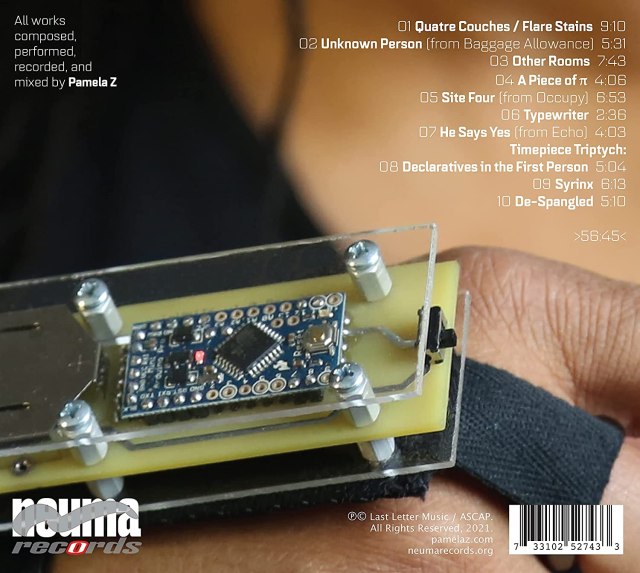
The photo of the back cover of this new album serves both to provide a listing of the tracks but also to display one of the wearable electronic devices mad for her which she uses (to pleasantly theatrical effect) in performance. From her web site: “She uses MAX MSP and Isadora software on a MacBook Pro along with custom MIDI controllers that allow her to manipulate sound and image with physical gestures.”

Z is a vocalist, an operatically trained singer and voice over artist who has pioneered the use of complex delay and looping systems to produce her work. She is apparently enamored of language (she has studied English, French, Italian, and Japanese). Her combination of spoken and sung passages combined with the looping/delay technology, and, increasingly, writing for other instrumentalists is the basic medium(s) with which she works.

In my mind she shares conceptual space with artists like Amy X Neuberg, Meredith Monk, and Diamanda Galas, at least that is the way I have them filed in my collection. In fact, each of these performers has their own distinct style and aesthetic, each a separate origin story. What they have in common in this listener’s mind is the fact that they are women, the fact that their voice is their primary instrument, and the fact that each uses that voice, sometimes with some augmentation, to achieve their compositional and performance goals. (I nurture a personal fantasy of some day hearing one or all of these women doing their cover of a piece like Rzewski’s “Coming Together” or some similar speaking pianist type work but that’s a topic for another blog).

The ten tracks on this release represent Ms. Z’s more recent work. Taken as a whole this album has an almost existential/apocalyptic character at times. There are 10 tracks ranging from about 4 to 10 minutes each and they span the years from 2003 to 2018 with one track from 1995. The overall feel of this is rather darker in tone than the Starkland disc but it also reflects her further artistic development and that alone is worth the purchase price. The album is recorded, edited, and mixed by the artist who also supplies the brief but clear and useful liner notes.

The first track, Quatre Couches/Flare Stains is a studio mix of two pieces (Quatre Couche from 2015 and Flare Stains from 2010), two works she has combined in her live performances. So this is mix is a 2021 artistic mashup reflecting what she has gleaned from her live performances and incorporating that learning into a new compositional experience.

Unknown Person (2010) is an excerpt from the aforementioned “Baggage Allowance” (2010) which uses found texts collected during the composition process as lyrics and is a work with many metaphorical dimensions that touch on existential ideas that touch us all.

Other Rooms (2018) is constructed around vocal samples of an interview with playwright Paul David Young.

A piece of π (2012) utilizes the first 200 digits which express the value of that mathematical constant. Z recounts further details of her process in the liner notes.

Site Four (2017) is a section of music which was composed for a dance work.

He Says Yes (2018) is an excerpt from music for a theater piece.

Typewriter (1995) is the outlier here. It is one of Z’s live performance staples which utilizes the beautifully designed MIDI controllers which she wears and which control the electronics as she moves her body through the performance space. Even without the visuals, one can get an idea of this seminal work and how it influenced her later developments.

The disc ends with a trilogy of works, The Timepiece Triptych, which consists of Declaratives in the First Person (2005), Syrinx (2003), and De-Spangled (2003). This trilogy is a virtual compendium of the techniques which Z has thus far developed. Using sampling, linguistics, spoken voice, singing voice, and her signature electronics this artist presents work which functions on many levels. It is entertaining, it is thought provoking, it is funny, it is sad, it is personal, it is self referential, it refers to us all. Denotation, connotation, musical/electronic alchemy, language (both spoken and sung) all come together to create art which is engaging and, watch out, sometimes subversive.

Though I earlier made reference to my filing preferences for this and (what I consider) similar artists there is, in the end no one quite like Pamela. She is the Alpha and the Omega, the A and, of course, the Z.

Robert Moran Brings the Buddha to Bayreuth


Neuma 136

As I write this I am seeing images of the 20th anniversary commemoration of the twin towers attack and can’t help being reminded of another of Robert Moran’s works designed for resonant spaces like cathedrals. His “Trinity Requiem” (2011), written for the 10th anniversary of this tragic event, was written for the space in which it was subsequently performed, Trinity Cathedral in New York. Its setting of Psalm 23 lingers in my head as I write. The present work was written for and performed within the Kollegienkirche in Salzburg, Austria.

These two very different works serve to demonstrate the range of Moran’s creative palette and his ability to use disparate techniques to achieve remarkably personal and effective results. In the Trinity Requiem we hear a composer using fairly conventional tonal harmonies but with the unusual orchestration of children’s chorus, organ, cellos, and harps. His compositional methods, his harmonies are friendly and familiar, sweet and poignant without being saccharine.

By contrast, in Buddha Goes to Bayreuth” (2011/14), the composer uses a chamber orchestra, chamber choir, and the distinctive sound of a countertenor. And the orchestral writing involves the use of chance operations of the Chinese classic text, I Ching. As he tells it in his liner notes, the composer had been introduced to the I Ching by his friend John Cage. What is most interesting is how Moran is able to use a Cagean technique to produce his desired result and come out sounding nothing at all like Cage. It is a mark of Moran’s skills that he is able to draw on a wide variety of compositional techniques and a thorough knowledge of the subtleties of orchestration to create a sound which achieves his compositional goals.

The second part of this work, as you can see from the track listing, is nearly twice the length of the first. The second part was composed in 2011 and the first part to fulfill the request for an evening length performance piece.

Stylistically this work has more in common with Moran’s earlier mystery play, “Game of the Antichrist” than it does with the Requiem, though both are designed to take advantage of the resonant spaces of the cathedrals in which they were performed. This work relies more on the randomized chords in which Moran utilizes aleatoric structures in a way that are uniquely his. He did something similar in one of the pieces on another album reviewed here, “Points of Departure“.

This Dada-like dramatic work is but one side of Moran’s stylistic output. His sonic toolbox ranges from aleatoric and graphic scores to unabashed romanticism, from Cagean chance operations to scary minimalism (as in the yet unreleased “Spin Again” from 1982) and post-romantic singable melodies as in “Towers of the Moon” and his collaboration with Philip Glass in “The Juniper Tree”. In the end he is one of America’s finest composers whose music deserves more hearings and rewards listeners for the effort.

Producer Philip Blackburn clearly has an affinity for Moran’s work and he deserves thanks for making much of the composer’s work available in fine recordings. The entire spectrum as described above is available on recordings right now on both the Innova and Neuma labels. Get them while you can.