Emanuele Arciuli, Defining a Genre: Walk in Beauty


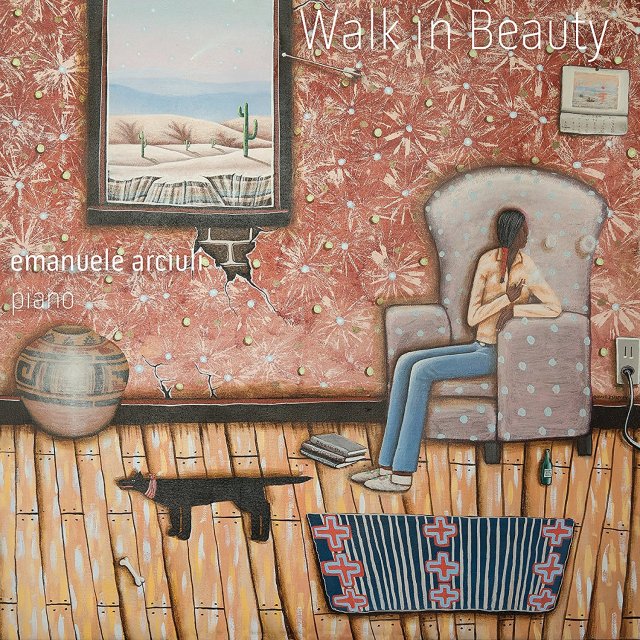
walk in beauty

Innova 255

This 2 CD set virtually defines a genre.  Following in the traditions of such notable compilations as Robert Helps’ “New Music for the Piano”, Alan Feinberg’s wonderful series of discs on Argo records among many others we see Arciuli displaying his grasp of music in the tradition of the gentle musical anthropology found in the music and scholarship of Peter Garland.  The album’s title comes from Garland’s lovely multiple movement Walk in Beauty (1992) released on New World records in the 1990s.  The present collection is both nostalgic and forward looking reminding us of great past efforts and introducing us to new work.  It is a look at a loosely defined style of mostly late 20th century American piano music through the lens of a non-American artist.

Garland’s interest in Native American myths and music inform his post minimalist ethic and the additional pieces chosen for this two disc set reflect similar artistic sensibilities.  Emanuele Arciuli is an Italian pianist whose interests range from the Second Viennese School to the unique compositions of Thelonius Monk.  He also has a strong interest in classical music from Native American traditions which puts him very much in sync with Garland’s work as well.  Here he has chosen music which he clearly understands and which appear to have deep meaning for him.

There are 28 tracks on 2 discs representing 13 composers.  Five of these composers are explicitly affiliated with their respective Native American traditions and the remaining eight composers take their inspiration at least in part from the rich music and/or mythology of those cultures.  The bottom line here is that these are carefully and lovingly chosen works which open a window on one fine musician’s perception of a certain Western/Native American/New American style which, at worst, holds up a mirror and, whether we like it or not, it tells us something about who we are and from whence we came.

Connor Chee‘s “Navajo Vocable No. 9” opens the album and sets the tone.  This is one of a series of piano pieces by this fascinating composer/pianist whose star is deservedly rising.  His work celebrates Navajo culture and is informed as well by his training in traditional western art music.

This is followed by Peter Garland‘s “Walk in Beauty”.  This piece is representative of Garland’s post-minimalist, impressionistic style.  It was previously recorded so wonderfully by Aki Takahashi on the eponymously titled New World Records album from the early 1990s.

Garland’s music is fairly well documented but deserves a wider audience. (Curiously he does not have a dedicated web site.)  His scholarship and promotion of new music also serve to place him very highly among this countries finest artists and scholars.  In addition to his compositional output he is known for his Soundings Press publications and his papers are now held by the University of Texas at Austin.

Kyle Gann is, similarly, a scholar and a prolific composer.  He has for many years demonstrated a keen interest in Native American myths in his diverse and creative output.  Gann is here represented by his “Earth Preserving Chant”.

Michael Daugherty is known for his incorporation of pop culture in his work and has been recognized with no fewer than three Grammy Awards.  His work is rooted in pop Americana and “Buffalo Dance” is his homage to Native Americana.  And if his homage seems a bit P.T. Barnum at times, that too is Americana.

John Luther Adams, a recent Pulitzer Prize winner for his orchestral work, Become Ocean, is a prolific composer who derives much of his inspiration from the mythology of Alaskan natives.  Adams spent many of his creative years in Alaska working with ecological projects as well as musical ones.  “Tukiliit” is representative of this work and pays homage to Native American/First Nation peoples.

Raven Chacon is an emerging composer who has produced a great deal of work though little appears to be available on recordings.  “Nilchi Shada’ji Nalaghali” (Winds that turn on the side from the Sun) is an electroacoustic work serves as a little sample of this artist’s work and its inclusion in this fine collection alone suggests that the remainder of his work deserves to be explored.

Martin Bresnick is an honored member of the American Institute of Arts and Letters and his work is fortunately well known.  The present piece, “Ishii’s Song” is a reference to an American Indian, the last of his tribe who lived out his life under the protection and scrutiny of anthropologist Alfred Kroeber at the University of California Berkeley.  His spirit still seems to linger in the Bay Area and this piece is a sort of homage to him.

This set contains two works by Louis W. Ballard (1931-2007) who was a Native American composer that composed classical concert music.  His work is steeped in Native American mythology and deserves to be better known.  Leave it to a non-American to point out this deficit.  Arciuli makes a strong case for listeners and for other musicians to embrace this neglected artist.  Disc Two track 2 contains the “Osage Variation” and Disc two tracks 13-16 contain his “Four American Indian Piano Preludes”.

Jennifer Higdon is a star already very much risen on the musical scene and she is here represented by a substantial piano piece called “Secret and Glass Gardens”.  Higdon, also a recipient of the Pulitzer Prize, is one of those composers who manages to be friendly and accessible as well as modern.  Arciuli seems to perceive similarities in her vision that make this work fit in convincingly in this collection.  Hers is seemingly a similar romanticism and nostalgia and Arciuli has convinced at least this listener of the kinship of this piece in the vision of this collection.

Arciuli introduces another composer unknown to this reviewer, Peter Gilbert.  This young composer with an impressive resume is the co-director of the composition program at the University of New Mexico.  The offering here is his set of four “Intermezzi” for piano.

The inclusion of Carl Ruggles‘ “Evocations-Four Chants for Piano” seem at first to be a strange choice but following the Gilbert Intermezzi one gets the impression that the Americana that is Ruggles is a part of the provenance of this collection.  Ruggles coarse and famously racist attitudes hardly fit with the generally romantic vision of this collection but Americana as perceived by a non-American need not edit the unsavory from the overall picture.  The music is what this is about and these are indeed masterful little essays and a part of the American grain.

Another new name is given a brief appearance in the “Testament of Atom” by Brent Michael Davids.   This young composer’s clever website lists a plethora of works whose titles resemble many of the pieces on these discs.  Again we must trust the artist that his inclusion of this work is representative of his vision of this version of Americana.

For his concluding track Arciuli does a wonderful thing by including the work of Talib Rasul Hakim (1940-1988), another too little known American composer.  Born Stephen Alexander Chambers, he changed his name in 1973 when he converted to Sufism, a spiritual sect of Islam.  The music, “Sound Gone”, is a fitting finale to this beautiful, challenging, and ultimately inclusive collection of Americana.  Bravo, Mr. Arciuli and thank you for the gift of showing us some of the best of how we Americans look to you.



Howard Hersh’s Chamber Music: Dancing at the Pink House


hersh pink

This latest release by Howard Hersh reveals more of his range as a composer.  His previous release focused on one large concerted work for piano and chamber orchestra as well as some virtuosic writing for piano and for harpsichord.  This disc (worth a listen if only for the return engagement of the pianism of Brenda Tom) focuses on some smaller chamber ensembles and a look at the composer’s more impressionistic moods.

This writer is left with the notion that each piece seems to be an intimate telling of a story.  Though the stories are not explicit, each piece has a distinct narrative character.  Mary Rowell handles the multi-track violin parts on Madam’s Tavern (2014).  The piece has an almost symphonic character evoking a variety of styles and meandering most pleasantly through a musical narrative whose details are not as important as the fact that the piece engages very successfully on a purely musical level.  It is written for solo violin with a chorus of some 15 tracks of violin accompanying.

Loop (2006) is a sort of cyclic quasi-minimalist work featuring Jonah Kim on cello, Brenda Tom (gently) on piano, and Patricia Niemi on vibraphone.  It is a dream-like, perhaps even impressionistic piece whose structure and compositional techniques serve the end goal of being a charming aural object.

I Love You Billy Danger (2012) was written for pianist Brenda Tom.  Here she demonstrates her virtuosity and her dramatic and dynamic range in a piece which, though related to Liszt according to the liner notes, seems to evoke the rather Lisztian master Frederic Rzewski as well.  Tom is at her fines with this challenging work and she conveys the narrative well.

Night (2013) seems related to the earlier Loop by virtue of being a percussion piece but also by its gentle evocation of a shimmering musical narrative punctuated with a clarinet part that alternately hides within the percussive sounds and comes wailing out  in jazzy/bluesy moments.  This writer was left with the notion of Gershwin haunting the score (but maybe that is because this review is being written in the Halloween season).  José González Granero is on clarinet, Patricia Niemi on marimba, and Nick Matthiessen on percussion.

Dancing at the Pink House (2006) is a musical narrative for clarinet and piano that Hersh has featured as a teaser on his website.  It was written for Patricia Shands, clarinet and is accompanied by James Winn on piano.  Shands is the owner of said Pink House and she seems to be having a lot of fun with this playful but substantial piece.  Both of these musicians appeared on Hersh’s 2007 CD release, Pony Concerto (Albany Records).

Dancing at the Pink House is a valuable addition to Hersh’s discography and reveals more of his range as a composer.  This is a highly entertaining recording and leaves the listener wanting more.

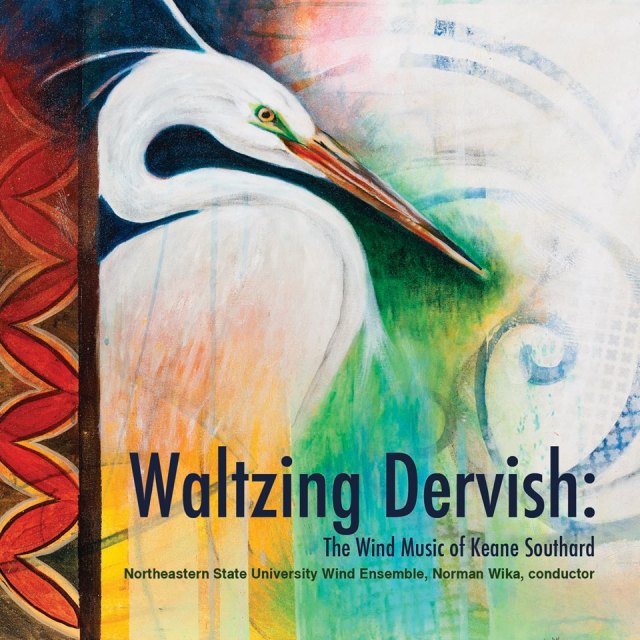
Visions of a Dreamer: Keane Southard’s Waltzing Dervish


dervish

Keane Southard (1987- ) is a composer and pianist whose work is influenced by a variety of styles including standard classical and pop and folk influences.  This major debut disc is a fine sampling of his work though it is important to realize that his work is for diverse ensembles of pretty much every description and the present sampling is of music for wind ensemble.

Just like every specialized grouping, be it string quartet, string orchestra, wind quintet, solo piano, full orchestra, etc., one encounters composers with varying degrees of facility in each configuration.  Southard seems very much at home with the wind ensemble/band and its possibilities.  A quick look through his extensive works list at his site suggests a hugely prolific musician with a wide variety of skill sets in a variety of musical configurations.  Wind ensemble is clearly one of his strengths and the Northeastern State University Wind Ensemble of Oklahoma under conductor Norman Wika are up to the challenges.  Southard playfully refers to this grouping as a “wind powered” ensemble using it as a metaphor for ecologically sustainable power systems.

There are nine tracks of which three are transcriptions of other composers’ work and the remaining six are by Southard.  His metaphors are as eclectic as his musical choices but fear not, his choices are friendly ones.  The first track, Waltzing Dervish sets the tone as an original and substantial composition of some ten minutes duration in which he takes on the waltz and its various meanings both public and personal to create an original band composition concerned as much with ecological metaphor as with a striving for multicultural diversity in an optimistic and thoughtful exploration of what can easily be a tired dance form.

The second piece is an arrangement of a piece by Francisco Mignone (1897-1986), one of the composers whose music he encountered during his 2013 Fulbright Fellowship in Brazil.  The piece is scored for optional choir (not used in this recording) and band, an arrangement Southard made with the intention of sharing this music as a highly viable selection for concert band.  It is indeed a joyous affair and one could easily imagine this being adopted as a staple in the rarefied realm of concert band music.

Do You Know How Many You Are? is the composer’s 2013 band arrangement of a 2010 choral piece which he describes as having basically come to him in a dream.

Claude Debussy’s Menuet (ca. 1890) was originally a piano piece which Southard envisioned in this orchestrated form during the course of his studies of orchestration.  That sort of inspiration is not uncommon for a composer but the result is not always as ideal as the composer imagined.  Fortunately this orchestration works quite well and again would proudly fit in a given band’s repertoire as an audience pleasing piece.

The next piece, originally an orchestral piece from 2013 is presented in the composer’s own arrangement for band.  No Interior Do Rio De Janeiro (2013/15) is another of the inspirations from the composer’s 2013 Fulbright Fellowship and was inspired by his work with “Orquestrando a Vida”, a Brazilian music project inspired by Venezuela’s famed “El Sistema”.  The band version was written on a commission from the present NSU Wind Ensemble.  Here is perhaps a departure from the dance theme of the first three tracks.  It seems to be a thesis or musical diary entry reflecting his personal take on the experience of working with this project though the spirit of the dance remains throughout.

Carousel (2008/2010) is the arrangement for band of the third movement of a mini-symphony (perhaps a scherzo?) for orchestra.  Curiously he describes his inspiration as coming from the sound of the calliope, a sort of steam driven organ common in circuses of the late 19th and early 20th centuries.

Cortège et Litanie (1922) by French composer and organist Marcel Dupré (1886-1971) is a bit of a departure.  Neither a dance nor derived from Brazilian sources this piece was originally written for organ.  The organ (like the calliope in the previous piece) is arguably a wind instrument and this transcription retains some of the ambiance of that grand instrument.  It is among Dupré’s better known pieces and seems a natural for band.

Uma Pasacalha Brasiliera (2015) is a commission from a the Arrowhead Union High School Wind Ensemble and conductor Jacob T. Polancich.  The composer describes various influences in the circuitous path the the completion of this work but it is basically a sort of homage to the baroque form of the pasacaglia (variations over a repeating bass line) as well as to some of the great folk song influenced composers such as Percy Grainger.  Brazilian influences dominate much of the composer’s work from this period and they combine with the aforementioned baroque and folk influences to form a wonderfully creative take on that form of baroque counterpoint.

Finally the big finale is presented in another transcription, this time of a concerto for piano and organ from 2008.  Of course the organ again lends it’s sound easily to a band transcription and we have this Concertino for Piano and Wind Band (2008 rev. 2015) which allows us to hear the considerable keyboard skills of the composer.  This is the most substantial work on the disc and provides a satisfying finale to this portrait of a prolific and optimistic young composer at the very successful beginnings of what this writer (optimistically) hopes will be a long and productive career.


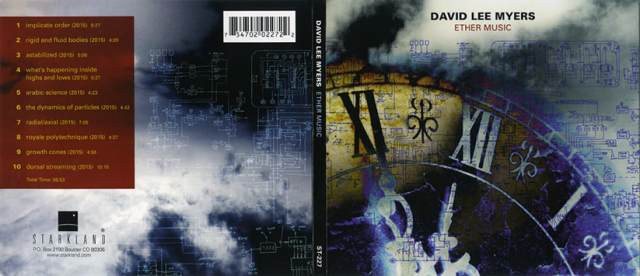
David Lee Myers’ Ether Music: A Nearly Lost Thread of Electronic Music


ethermusic-large_orig

Starkland 227

There is a certain nostalgia here both in the sound of this album and its provenance.  David Lee Myers (1949- ) is perhaps best known for his work under the rubric of Arcane Device from 1987-1993.  Under that name one finds 23 albums on the discogs web site.

Myers has collaborated with people like Asmus Tietchens (1947- ), a German electronic composer (with a hefty discography), Kim Cascone  (1955- ), an American electronic composer and producer, Marco Oppedisano (1971- ), an American guitarist and composer, Ellen Band, an American electronic composer, and Tod Dockstader (1932-2015), among others.  His output has been in the electronic music genre, i.e. no live components and he works in a style which he calls, “feedback music”.  Like Dockstader, Myers has worked outside of the academy and has relied upon home made electronics and techniques he has developed over the years to produce a rather unique musical style.

tod-dockstader-01

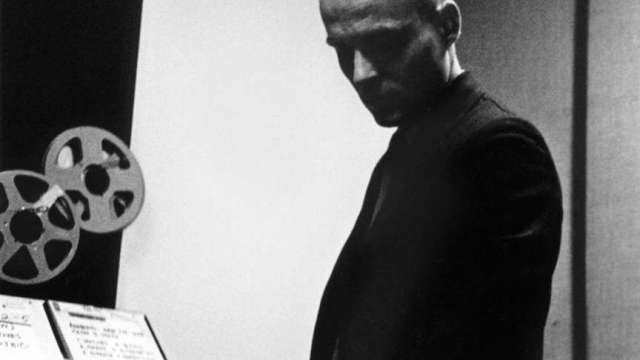
Tod Dockstader with tapes and score notes.

More so than the other mentioned collaborators Myers’ work with Dockstader is the “thread” to which the title of this review refers.  The release of the long out of print early work of Tod Dockstader was effectively the genesis of Starkland Records.  With the release of Quatermass (1992) and Apocalypse (1993) Dockstader was forced out of obscurity and motivated to begin composing and releasing recordings again.  Those Starkland releases were of some long out of print LPs from the early 1960s and Dockstader, who had been working in the music industry but no longer releasing his compositions was inspired to bring that aspect of his work again to the public.  Two of those efforts included the collaboration of David Lee Myers, Pond (2004) and Bijou (2005).  (After Dockstader’s death Starkland surprised the musical world by releasing heretofore unknown gems from the composer’s archive in From the Archives (2016).)

myers

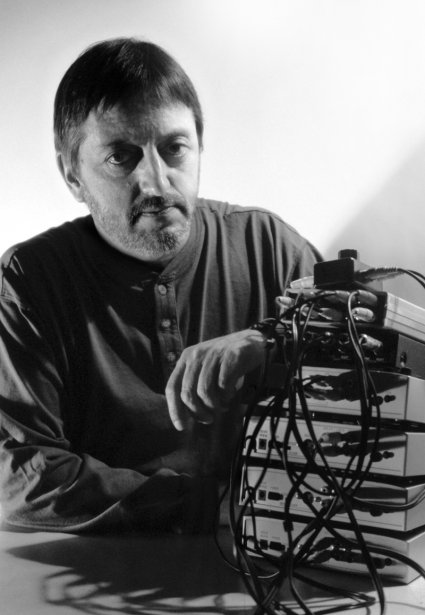
David Lee Myers with some of his electronics.

It is both beyond the scope of this review and beyond this reviewer’s expertise to comment meaningfully about the compositional processes by which Myers achieves his ends but, thankfully, the liner notes by Dan Visconti provide significant insight in this area.  One can assume that his innovations in electronics as well as the devices themselves will become a treasured part of the history of electronic music along with the recordings themselves.

There are ten tracks here all written in 2015, and all utilizing Myers’ “feedback music” techniques.  The CD booklet includes both some of Myers’ beautiful circuit sketches as well as photos of some of his self made electronic processing equipment.  (This actually seems to echo the similar production of the booklet from that “From the Archives” disc of Dockstader’s work.)  Also worth noting is that the mastering is done by Silas Brown whose expertise contributed so significantly to the success of that last Dockstader disc.

The listener is free to dwell on the technical notes and ponder how these sounds and processings come together to produce the final product or simply let the experience flow over you.  There are doubtless many riches to be found in the pursuit of the technical and the analytic.   But the most important thing is that you listen, just listen.  This reviewer’s first hearing of this disc was on a long, leisurely late night drive which allowed an uninterrupted experience of the entire disc.  It was only later that I chose to take in the liner notes and booklet.  And while these enhanced the experience the tracks are sufficiently substantive in themselves to carry the listener into Myers’ unique technological vision which is unlike any other save perhaps for that of the aforementioned thread to Dockstader.

Though related by this thread, Myers’ vision is truly like none other in the field of electronic classical music.  If anything this seems to be a nearly lost thread, one of the self-sufficient tinkerer and explorer who shares his discoveries with anyone who dares to listen.  So, listen, I dare you.  You won’t be disappointed.

Release date scheduled for November 10, 2017.