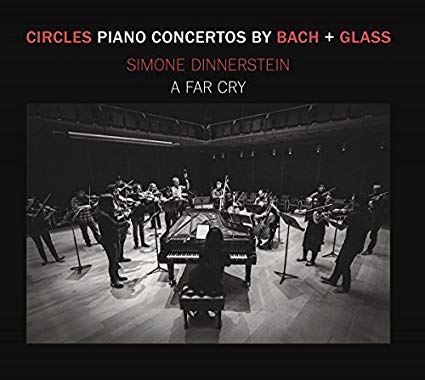
Simone Dinnerstein: Bach and Glass


dinnerglass

It has been interesting to watch the progression of Philip Glass’ career.  From his driving amplified ensemble music that so entranced this writer to as near groupie status as he will ever be to the more mainstream orchestral work of his work since at least the 90s the fascination remains at some level.

The familiar arpeggios are still to be found along with basically diatonic harmony with occasional polytonal sections.  What is interesting about Glass’ third piano concerto is a sort of chamber romanticism.  A Far Cry is a small chamber orchestra ideally suited to works like the Bach first piano concerto. Though technically originally written for harpsichord pianists have successfully broken the taboo on strict adherence to using the harpsichord and have developed techniques to optimize the sound of the piano (which has very different qualities from a harpsichord).

Simone Dinnerstein is an artist who I first met (albeit virtually) on Facebook.  Her reading of the Goldberg Variations from a few years ago seemed to signal her entrance into the mainstream of performers.  The choice of works on this disc are a sort of characterization of her interests.  She is an accomplished Bach performer with, obviously, an interest in new music.  So pairing her as soloist with A Far Cry whose interests appear to be in a similar range was perfect.

The performance of the Bach G minor piano concerto (No.7) is as delightful as it gets.  Dinnerstein and the ensemble seem work together very well.  These intense little chamber orchestras seem to be proliferating and one could speculate on the economic and political reasons for that but what is more interesting is the commitment and intensity that these small ensembles can bring to music.

The Glass concerto has the feel of a sort of miniature romanticism.  This writer heard it as echoes of Brahms but on a far more intimate scale.  It is difficult to say whether this new work (or for that matter, the other two piano concertos) will become a regular part of the repertory but it is clear that Glass continues to have his champions both in musicians and listeners.

There is nothing groundbreaking here and that is not what is apparently intended.  What we get in this recording is a couple of dedicated and thoroughly enjoyable performances by clearly dedicated musicians.  This is not an original instruments or musicological discoveries type of album.  It is simply good music making.

If you are a fan of Philip Glass and/or Simone Dinnerstein you will want this disc.  But don’t forget to pay attention the this little chamber group.  They are superb and energetic musicians and this reviewer expects to be hearing more from them in the near future.  Maybe we will get a new set of Bach and/or Mozart concertos.  Here’s hoping.

Quince Ensemble: Motherland


quince

New Focus FRC 203

I looked at the rather drab cover.  I had never heard of the Quince Ensemble nor any of the composers featured on this disc.  I looked again at the cover.  Clearly it was labeled with one of those parental advisory warnings which one rarely sees on a classical recording.

My usual practice is to do some research before spinning a given disc but I decided to just put this one in the CD player cold.  I had about an hour’s drive ahead and I decided to just let the disc speak for itself.  But my spidey sense suggested I might be in for a rather dull listen.

So much for my superhero powers.  From the moment the first track played I felt drawn in.  What I heard seemed to be a mixture of Peter Kotik (of Many, Many Women in particular), Meredith Monk, a touch of La Mystere de Voix Bulgare, the west coast group Kitka, and a few others).  That is to say that this disc grabbed my attention and had echoes of a few other contemporary vocal music styles.  What I heard was very compelling, creative, practiced, passionate.

This is mostly an a capella group though they made very effective use of harmonicas as drone material at one point.  Even after reaching my destination (achieved before the disc ended) I couldn’t bring myself to shut it off so I stayed parked and listening til I had heard the entire disc.  Yes, it was THAT compelling.

Complicating the reviewer’s task further is that the disc contains four compositions by four composers whose first appearance on this writer’s radar was from this very disc.  All four are world premiere recordings and all are by women composers.

The Quince Ensemble consists of Liz Pearse (soprano), Kayleigh Butcher (mezzo soprano), Amanda DeBoer Bartlett (soprano), and Carrie Henneman Shaw (soprano).  And this is the fourth album dedicated entirely to this ensemble’s work.  Two previous albums were appearances and collaborations.

The featured composers are (in order of their appearance on this release): Gilda Lyons (1975- ); Laura Steenberge; Cara Haxo (1991- ); and Jennifer Jolley (1981- ).  All appear to be Calfornia based and at the beginnings of what will doubtless be some interesting careers.  I will leave it to the interested reader to look into the details available at these various web sites but, after listening to the music, most listeners will want to know more.

The pieces range from Lyon’s Bone “Needles” coming in at just over 4 minutes to the next two multiple movement pieces and finally Jolley’s “Prisoner of Conscience” which is an homage to the politically active musical group, “Pussy Riot”.  This is the longest and most political piece on the album.

From the initial (and incorrect) assumption that this would be a dull disc to the end of this listening journey I came to see this disc in quite a different light.  The cover now seems friendly and appropriately representative of the album.

Rather than go into a bland or potentially inaccurate analysis of these pieces suffice it to say that this is effective and affecting music by a delightfully talented and energetic ensemble.  If you like vocal music, political music, music by women, or are just looking for something to lift you from your daily malaise give this one a try.  You will be both challenged and entertained.  No doubt this group would be fantastic in a live performance but for now we shall have to make do with this wonderful recording.