Jacob Greenberg Putting Debussy in Context


hanging

New Focus FCR 192

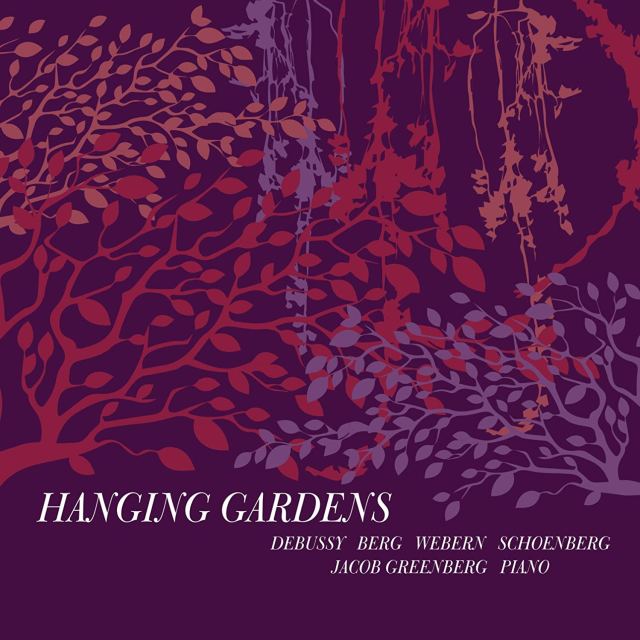
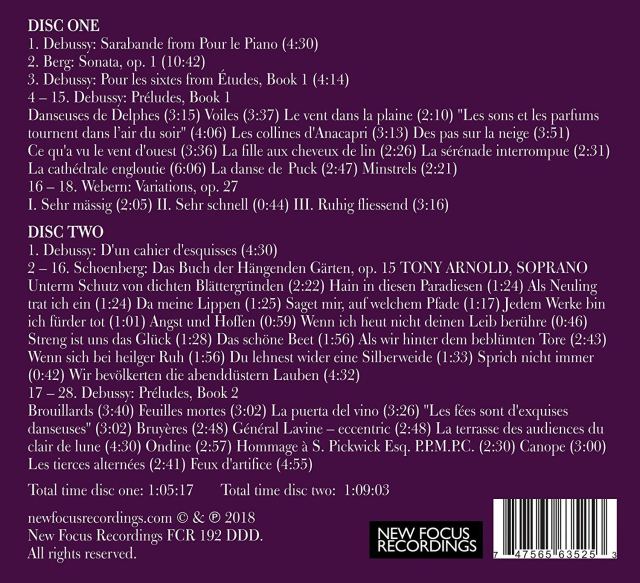
Well it’s been 100 years since Claude Debussy (1862-1918) left the earthly plane and anniversaries are good times for a re-evaluation.  Usually this just means issuing recordings of a given composers works, mostly the composer’s most popular.   Jacob Greenberg has chosen to record Debussy’s Preludes for Piano Books I and II (1909-1913).  But that alone seems a bit pedestrian so he adds in Alban Berg’s (1885-1935) Op. 1 Piano Sonata (1909), Anton Webern’s (1883-1945) masterful Variations for Piano (1936), and Arnold Schoenberg’s (1874-1951) “Book of the Hanging Gardens” Op. 15 (1908-9) as well as a few additional Debussy pieces.  Greenberg is a sort of refugee from the International Contemporary Ensemble.  For this recording he also conscripts the fine soprano (and fellow ICE refugee) Tony Arnold.  These two have already amassed quite a few recordings of repertory from this era.
greenberbdebussy813HMwi-pPL._SL1500_

This mix provides a context for the listener which shows where the Preludes fit historically and demonstrates some of the similarities in sound between these early 20th Century works.  We hear music written between 1908 and 1936 by four composers.  Hearing these works together gives the listener a sense of how some of the best “contemporary” compositions of this brief era sounded.  Indeed there are similarities here and one can see the emerging style which would become known as “expressionism”.  It is clearer how this emerged from Debussy and Ravel’s “impressionism” when you hear related works from the same era.

This reviewer had not been familiar with Schoenberg’s “Book of the Hanging Gardens”.  It is one of the less performed of his works.  These songs have a militantly atonal sound. Vocalist extraordinaire Tony Arnold puts real muscle into her reading of these songs.  The disc is worth acquiring for her performance alone.

In some ways this cycle appears to have been Schoenberg’s “Tristan und Isolde” meaning that he had stretched the limits of tonality and, unlike Wagner, he chose to develop a method which would ensure that there is no tonal center in his music.  He developed his method of 12 tone composition and rolled out his first example of this new method in 1925.

What is striking is that this Schoenberg song cycle dates from pretty much the same time as the Debussy Preludes and Alban Berg’s Piano Sonata.  One gets a sense of some of the tensions involved here.  Try to imagine being in the audience and hearing the wide stylistic differences between these two works and realizing that they are essentially from the same era.  Add in the much later Variations by Webern and one gets a sense of how far music could go, stylistically, based on Schoenberg’s methods.

Obviously the Debussy Preludes are the main focus here and these are acknowledged as classics of the repertoire.  They are most ably performed here but what struck this listener the most was the sound of those preludes in the context of the other pieces here which were part of that same 30 year span.  One can begin to hear perhaps some affinity between the Debussy and the later thornier harmonies and rhythms that typify the expressionistic style which would dominate much of the mid-twentieth century.

This is a fabulously entertaining recording and a sort of music history lesson as well.  Greenberg is a strong and assertive musician with an obvious feel for these pieces.  His choice of repertoire makes this a particularly good choice for the listener who is just beginning to explore this musical era and an eye-opening program for the seasoned listener.  Great set.

Telegraph Quartet Debut: Into the Light


TelegraphQuartet_IntoTheLight_AlbumCoverThis is the debut album for the Telegraph Quartet who are based in the San Francisco Bay Area.  They have chosen some curious works from the quartet repertoire to represent this nascent ensemble, Anton Webern’s Op. 5 Fünf Satze (1909, Benjamin Britten’s Three Divertimenti (1936), and Leon Kirchner’s String Quartet No. 1 (1949).

Webern is, of course well known, but relatively seldom played.  His pithy, brief, pieces belie a complexity which may delight musicologists but his music, for all of it’s craft, is never going to be a crowd pleaser like Haydn or Beethoven.  It appears that The Telegraph folks are putting together a carefully selected intro to their work.  They execute these little masterpieces with care and manage to squeeze the expression out so that the audience can begin to appreciate it.

The Benjamin Britten (1913-1976) Divertimenti were unfamiliar to this listener and, doubtless, will be a pleasant surprise to many.  Britten wrote three string quartets and a few other miscellaneous pieces for quartet.  It is a bit surprising that these little Britten gems have gone with so little notice before now.  These are three brief (though not as brief as the Webern) but engaging little compositions that clearly deserve at least an occasional performance.  The Telegraphs handle these with a powerful almost romantic interpretation.  It’s hard to say not ever having heard any other performance but these are engaging pieces.

Leaving the best for last we get to hear music by Leon Kirchner (1919-2009).  This Pulitzer Prize winning composer (he won for his Third String Quartet from 1967).  Kirchner wrote 4 quartets in total which vary widely in style.  They date from 1949, 1958, 1966, and 2006 (which remains unrecorded…hint, hint).  Kirchner wrote in pretty much all genres and even worked with electronics.  It is time for a new reckoning of his work.

The first quartet is the least heard of the lot and is of a sort of romantic quality.  It is a passionate composition that is influenced by a variety of styles but it precedes his 12 tone compositions.  This quartet seems to have an affinity for romantic gesture and singing melodies and listeners will doubtless want to hear this work multiple times.

Some may recall a Columbia album from the 1970s that recorded Kirchner Schoenbergian second quartet as a “B side” to an album which contained Kirchner’s drama, Lily, based on Saul Bellow’s “The Rain King”.  That disc was almost a Kirchner sampler displaying two major aspects of the composer’s output.

All the works here are bound to please a concert audience and this little collection of works dating a forty year period from 1909 to 1949 are excellent vehicles for this ensemble which sports a lush sound and a feeling for the proper shaping of melodies.

The Telegraph Quartet consists of Joseph Maile and Eric Chin (who apparently share the role of first violin with the other taking the second violin), Pei-Ling Lin, viola, and Jeremiah Shaw cello.  It’s difficult to say how this new quartet will fare but this album suggests that they are already on their way musically and, judging from their choice of repertoire, they are likely to unearth (and probably commission) unheard delights of the quartet repertoire.  Well done!

Josh Modney’s “Engage”, New Music for Violin Solo and Not Solo


modneyengage

New Focus FCR 211

This is an awesome undertaking.  I recall when pop musicians were cautioned that it may be unwise to release a so called “double album” for fear that their inspiration (or talent) may not be up to the task.  Well here comes Josh Modney violinist and Executive Director of the Wet Ink Ensemble , a member of the International Contemporary Ensemble (ICE), and a performer with the Mivos Quartet for eight years.  This 3 CD set is his solo violin debut album.  And what an album it is.  There is no lack of talent, skill, or imagination here.  This is essentially three faces of Josh Modney a sort of sonic CV.

The first disc features four tracks of music by contemporary composers for violin with soprano, piano, and/or electronics.  All four are fairly recent compositions:  Sam Pluta’s “Jem Altieri with a Ring Modulator Circuit (2011), Taylor Brook’s “Vocalise” (2009), Kate Soper’s “Cipher” (2011), and Anthony Braxton’s “Composition No. 22” (1998).All of these are challenging for the musicians and none are easy listening but all demonstrate aspects of Modney’s skills as a musician

The second disc features J. S. Bach’s “Ciacona” or “Chaconne” (1720) from the second violin partita.  But this is not just another performance of this towering masterwork of the solo violin repertoire.  Modney has chosen to perform it in just intonation.  Now how’s that for versatile?

The effect is subtle and may even be lost on some listeners but fanciers of Bach and alternate tunings will likely find this to be anywhere from mildly interesting to revelatory.  It is a fine performance and it is interesting to hear it in just intonation and amazing to know that this performer has this uncommon skill of playing accurately in an alternate tuning on the violin.

Filling out the second disc is a piece by pianist Eric Wubbels, “the children of fire come looking for fire” (2012).  This is a very different piece and I’m not sure why it was paired with the Bach except that it fit the available space.  Wubbels contribution is a sort of electroacoustic collage.

The third (and last) disc is of solo violin compositions by Josh Modney.  Again we move into contemporary and experimental compositions which reflect Modney’s skill with the instrument as well as his insights into it’s potentials.  Again there are no echoes of Bach here but rather more of the experimental/avant garde/free jazz style which dominates this album.  The solo violin repertoire is not huge so it is reasonable to assume that these little gems will find a place there.

This is a lovely production with striking cover art and excellent sound.  If you like cutting edge violin music you will have a wonderful time with these discs.  And if you’re looking for a wildly skilled and imaginative musician check this set out and get ready to be wowed.


A Far Cry: Visions and Variations


farcryvisions

Crier Records CR 1801

This is the latest release by an ensemble whose debut CD was released some nine years ago.  Most recently this ensemble released a fine recording featuring Simone Dinnerstein playing piano concertos by J. S. Bach and Philip Glass.  This recording is focused on the virtuosity of this small string orchestra by focusing on some unusual but highly listenable pieces from the early twentieth century to the present.

The lovely cover art (by Bill Flynn) conjures images that evoke Picasso’s drawings of Igor Stravinsky conducting.  The album evokes a feeling of an early twentieth century salon and makes the most of this rather small ensemble which counts 20 musicians on this release.  The issue here seems to be quality musicianship exploring unusual but very listenable music.

The disc begins with the too little heard Variations on a Theme by Frank Bridge (1937) by Benjamin Britten (1913-1976).  Bridge was one of Britten’s teachers and a fine composer as well.  This is the piece that first brought Britten international recognition but it is not frequently played or recorded as one might expect.   It is a very entertaining set of variations and one can only surmise that this ensemble will likely tackle some of Britten’s other early string orchestra pieces like the Simple Symphony (1934).

After that workout we are treated to another set of variations.  This time by one Ethan Wood, a violinist with the ensemble.  His contribution is a set of variations on the French song, “Ah vous dirais-je, Maman” (better known to some as “Twinkle, Twinkle Little Star”).  This little fantasy is billed as “a folk tale for 18 players based on characters created by W. A. Mozart”.

And, finally, we have a lively transcription of Sergei Prokofiev’s ” Vision Fugitives” Op. 22.  Originally for piano, this string orchestra version is a unique but interesting idea.  The ensemble handles this complex music well and this version provides a perspective on these little miniatures that will produce discussion among fanciers of the original piano versions.

All in all this is basically a pretty conservative program stylistically but the intelligent choices of repertoire and the wonderful execution make this a stand out release with incredible potential that will leave listeners waiting for their next release.