I have attended nearly every OM annual concert series since 2012. But pesky adult responsibilities intervened for the last few years. Having had to miss OM 25 due to my out of town work I resolved to make it to OM 26 now that I am back in California. However circumstances conspired such that I was only able to make one night of this essential new music festival.
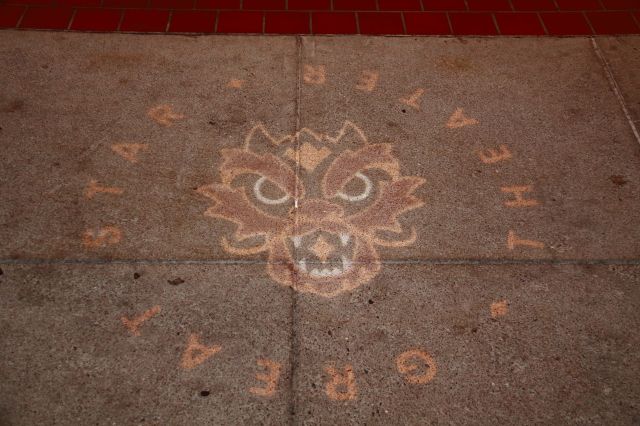
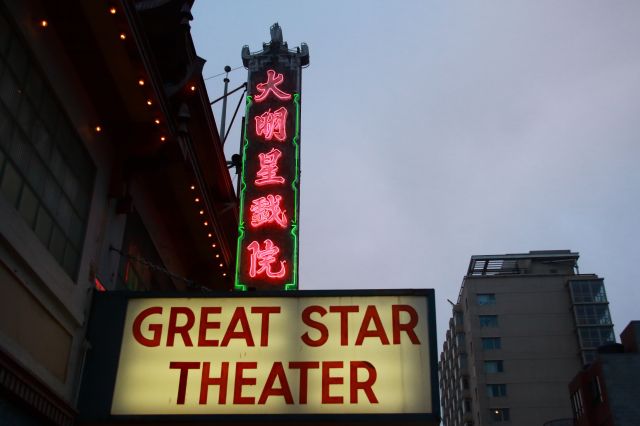
I do plan to listen to the archived audio and video streams which Other Minds now provides. but nothing can truly take the place of live performances. And, in addition to providing some wonderful sonic ear candy, there is the spectacle of the performances themselves. On top of that, these performances have showcased many wonderful performance spaces such as the The Jewish Community Center, The SF Jazz Center to name a few of them. OM 26 was held at the historic Great Star Theater in San Francisco’s Chinatown neighborhood, a venue known for presenting traditional Chinese Opera (in fact Chinese Opera continues to be on the bill for this charming little performance space).
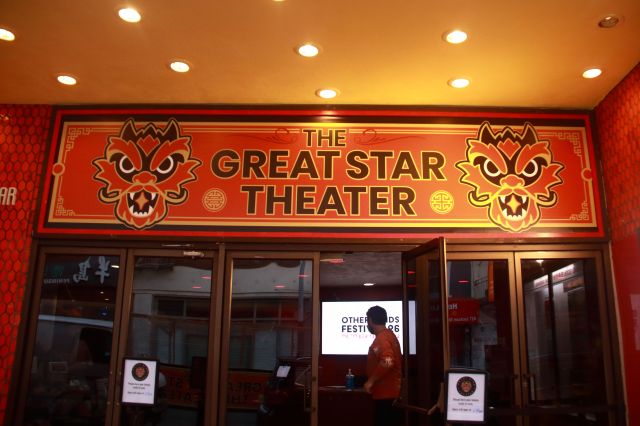
A heavy fog enveloped the northern end of the city as I approached the venue but the sun greeted me when I reached my destination. According to their website this theater is “Located in San Francisco’s renowned Chinatown, the historic Great Star Theater is a one-of-a-kind venue. Built in 1925, this traditional proscenium stage live theater was originally home to Cantonese Opera and Hong Kong kung-fu movies. Recently under new management and newly renovated and revitalized, it now features a variety of theatrical, musical, circus, and motion pictures for a new generation.”
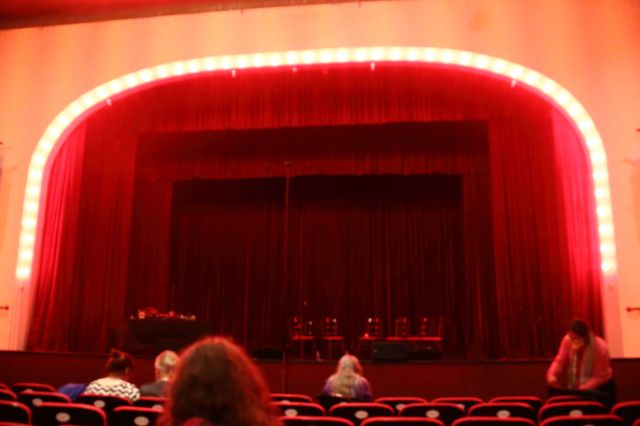
The 438 seat theater was more than adequate to accommodate the small but fervent crowd of Other Minds fans. There were seats to be had but the small audience was a highly appreciative one willing to open themselves to the adventure of new music curated by Charles Amirkhanian who has presided over the new music scene of the Bay Area ever since his tenure as classical music director of radio station KPFA which began in 1969. The Fresno native studied at Mills College, earning an MFA in 1980. While his tenure at KPFA ended in 1992, his involvement in new music productions continued. During that time he recorded interviews with nearly every area composer and musician as well as a panoply of international artists. His gentle, friendly manner along with his mellifluous resonant baritone voice (one that looms large in his sound poetry) has served him well in radio and in his large catalog of interviews. He founded Other Minds in 1992 with television producer (now president emeritus of Other Minds) Jim Newman.
What I Missed
In this 26th incarnation of this iconic series of new music concerts the following were presented on the first concert:
First Night
THERESA WONG
Fluency of Trees
MARI KIMURA
JanMaricana, D’Alembert Caprice, Motion Notions (Dai Fujikura), Rossby Waving
RAVEN CHACON & GUILLERMO GALINDO Improvised Set
Missing this fabulous first night was a painful experience. Theresa Wong is a fine musician/performer from the Bay Area. Her name, of course, occurs elsewhere in the pages of this blog, She is not to be missed as composer, as cellist, as performer.
Mari Kimura, no stranger to Other Minds fans, is one whose work I do not know. But it is by introduction of stunningly intelligent and skilled artists such as this one that the OM fan can safely put on their collective and individual radar, sure that their/our attention is not misspent.
Pulitzer Prize Winner Raven Chacon is one of those fine artists about whom Other Minds (aka Mr. Amirkhanian) can say “I told you so,” If you studied your emails you will find a link to an OM interview with maestro Chacon. He is a Native American (Navajo Nation) musician whose experiments caught the eye/ear of OM and resulted in an appearance and interview. How wonderful for him to return in his post Pulitzer appearance.
Guillermo Galindo is a respected Bay Area musician, sound designer, conceptual artist, and teacher. He is one you want to keep your ear/eye on. His unique instincts visually and sonically are a good bet in his performances. Paired with Chacon? How can you go wrong?
Third Night
DOMINIC MURCOTT
The Harmonic Canon
KUI DONG
Scattered Ladder
LARS PETTER HAGEN 10 Svendsen Romances, Seven Studies in Sadness, Diabelli Cadenza, Coda
And the grand finale, always the one you go to if you can’t make them all, the third night:
Dominic Murcott (who appears as percussionist/conductor on evening two) is one who, by a glimpse of his online CV, immediately was placed on high listening/reading priority in my links list. It will forever be a “one that got away” story for this absent fan. The bell and the backstory are alone worth the price of the ticket,
Lars Petter Hagen is a new name to this writer, a warning shot across my bow from OM. The Sternberg/Cahill duo here performing this composer’s work are also a guarantee of fine performance,
Kui Dong is another esteemed Bay Area artist whose work has long had a productive affiliation with OM. Any new work or recording of her work is a cause for attention. Her work for the Prism Percussion Duo was doubtless a substantive experience.
There is a link provided for each of the artists for the reader’s convenience. Please do click those links and explore further. I know I certainly will,
What I Did See and Hear
The concert began with the stylings of Hanna Hartman, a Berlin based Swedish composer who favors old and lower tech electronics. In this digital age with access to incredibly complex synthesizers and other sound technology, Hartman (at least here) worked with a Buchla 200 synthesizer and a selection of recorded and live sounds which were processed and created what sounded to my ears like a live performance of a tape composition. Quite a feat.
Standing at a table stage left covered with electronic and non-electronic devices she looked like the host of a cooking show live mixing sounds into a logical flow which were projected in stereo to the audience.
The performance had her draped in multicolored tubes which she used to blow into and create sounds in miked containers of water. She stood actuating materials on her table that might have come from an erector construction set and/or a “Mouse Trap” game (familiar to listeners of a certain age) and which resulted in a veritable barrage of sound which moved from one speaker to another but created an immersive and room dominating flow of sounds.
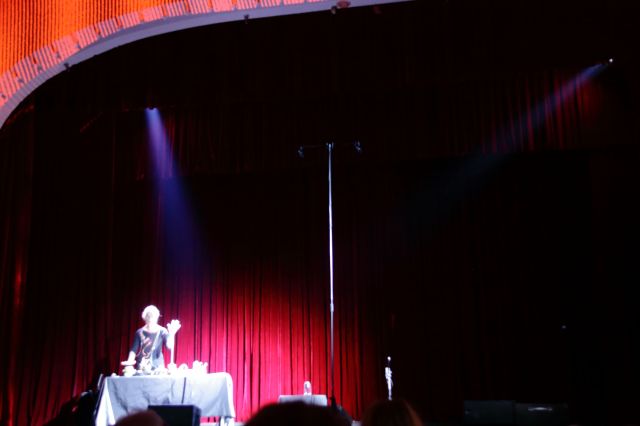
It might best be called a sound collage. It seemed to be guided by a program or sequence much as any musical composition. The sounds, sometimes apocalyptic, sometimes more drone like and serene, were engaging. And the curious image of her working with these various materials sometimes seemed indirectly connected to the sounds heard. It was as if the chef’s culinary efforts had taken on a sonic life of their own.
Though baffling at times the audience and this writer were very appreciative as the music revealed its internal logic. We had been introduced to yet another interesting artist by the Other Minds experience.
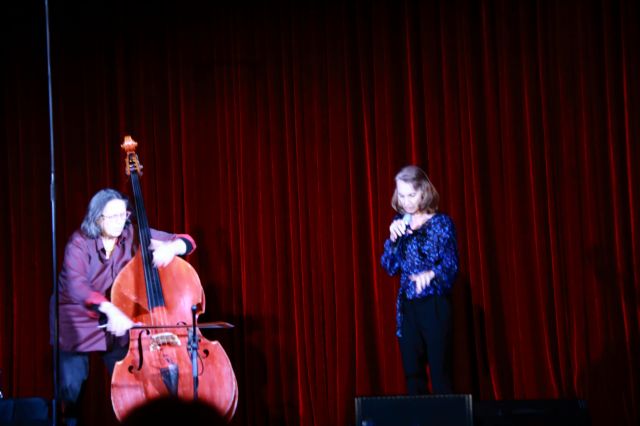
Then after just a bit of stage arranging Joëlle Léandre and Lauren Newton took the stage for a set of improvisations on double bass and voice. Going from the retro electronics and electroacoustic to good old live analog sound was a contrast.
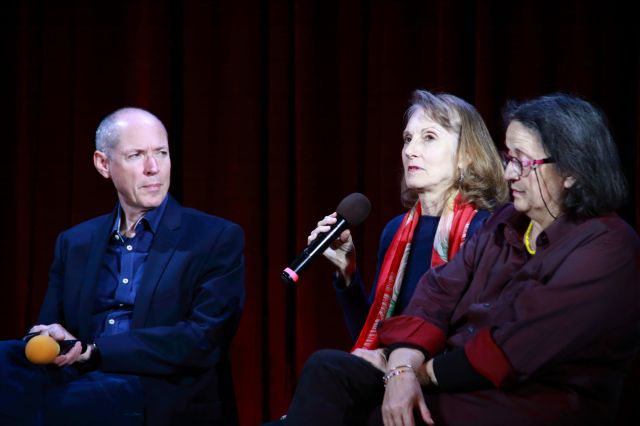
These two brought an intense energy to the stage in a sort of cosmic cabaret. Newton is a classically trained singer who now performs (at least on this night) a sort of glossolalia of non linguistic sounds in league with co-improviser Léandre.
Joëlle Léandre is a double bass player with skills sufficient to have had her included in the late conductor/composer Pierre Boulez’ “Ensemble Intercontemporaine”. Boulez was a very demanding and exacting man. Léandre was also influenced by hearing the work of the AACM (American Association of Creative Musicians), a Chicago based group which introduced African musical ideas into modern western performances.
Call it “free jazz”, “new classical”, or whatever you choose. These new sounds and performance styles launched the double bass player to another world and another career as an improvising musician.
Well, these two women brought a wild shared creative energy to the stage. In a set of (if I counted correctly) five separate improvisations they traded with Léandre beginning, then Newton beginning, and clearly demonstrated a comfortable relationship between themselves as performers. The set went from moments of angst to moments of gentle humor to virtually indescribable moments which all shared an intimate connection between the performers as well as the audience.
Léandre compelled a variety of sounds ranging from standard bowed string sounds to ethereal harmonics, percussive sounds, and even her own vocalizations. Newton’s instrument (her voice) seemed to channel a mysterious range of sounds from whispers to glossolalia, to almost words. She and Léandre seemed possessed by dance like movements and hand gestures resembling those of raga singers all of which were a part of a truly engaging performance.
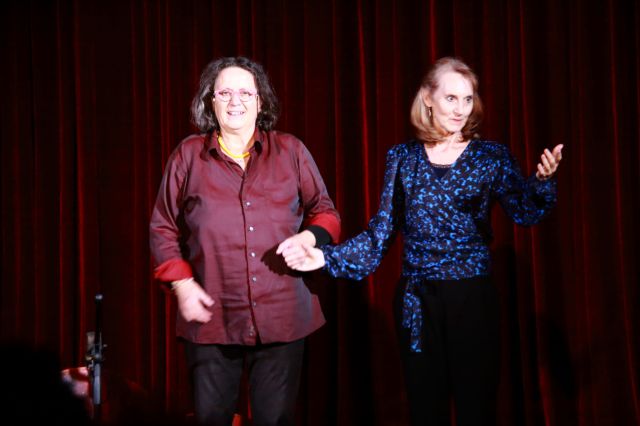
After that intense experience the audience was allowed a brief intermission to recover and be able to focus on the final performance of the evening. From the electric to the acoustic we moved, perhaps inevitably, to the electroacoustic.
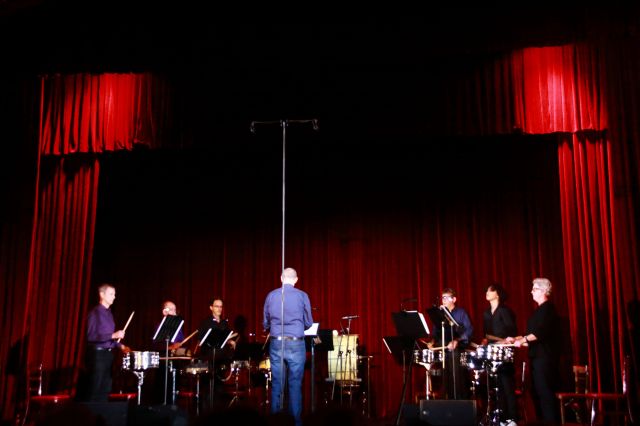
Yes, THAT Charles Amirkhanian, the voice of OM. In addition to his leadership work with the various aspects of OM, he is a much respected composer/sound artist, His astute advocacy of the up and coming voices presented via OM are an enduring legacy. Here is an exciting local premiere performance of a major opus.
Amirkhanian noted his earliest compositional inspirations to have been a result of his experience with being a drummer in the high school marching band. So that kind of gives you a clue as to this unusual orchestration.
Add to that his unique take on sound poetry, his skills with tape manipulation, sound samples, etc. and this multi movement work takes on an epic proportion. I reprint the liner notes below but my personal experience is as follows:
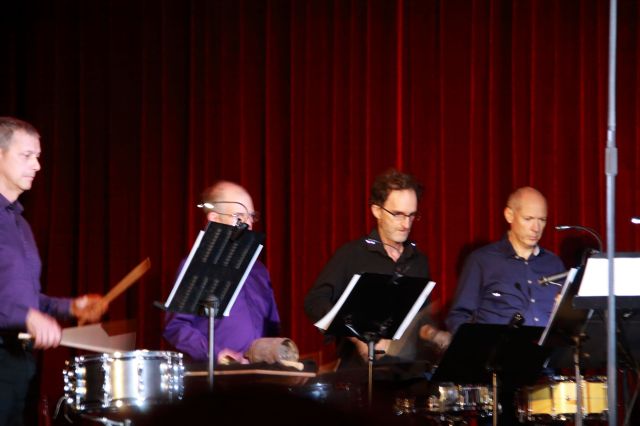
“Ratchet Attach It” (2021)by Charles Amirkhanian is a large multi movement work for eight percussionists and sound samples. It is a piece which succeeds on many levels. The composer’s background (and clearly cherished) experience as a percussionist is the most obvious driving force and framework but the inclusion of his sound art, use of language as both sound and syntax interpolated between and sometimes with the live musicians performance. The electronic interpolations are, whether intended or not, a sort of nod to Edgar Varese’ “Deserts”. Their function within the composition however, are quite different.
There is a characteristic humor which runs through much of Amirkhanian’s work. His gentle defiance of drum cadence structures and doubtless other performance conventions in this work become transformed via caricature, a sort of personal nod to fellow percussionists. They are punctuated with a variety of audio intrusions between and sometimes within movements. These intrusions are autobiographical and nostalgic as they refer or connote respectful homages of fellow artists as noted in the very useful program notes. These are not actually intrusions as much as connecting audio cadences as a sort of mortar for the deconstructing drum cadences that dominate the music’s structure. It takes on a character of ringing changes in bell ringing but that is deconstructed as well,
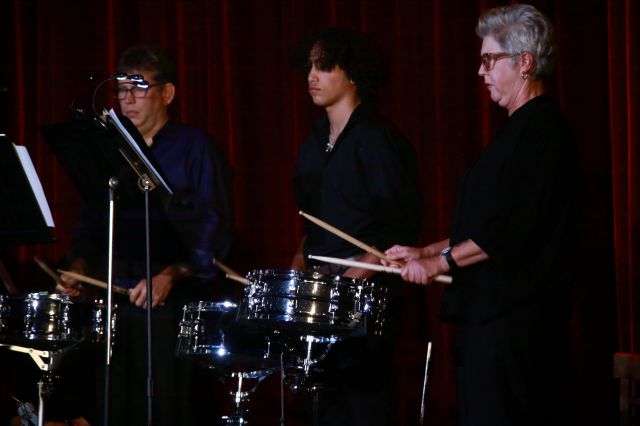
There are a panoply of examples of the concept of humor in music at work here but as I am not a musicologist I will restrict my examples to the most obvious. In what may also be gentle parody, the conductor, Mr, Murcott, traveled between podium and fellow drummer leading the orchestra as did Mozart and Beethoven, with their instrument close by. Other players did their share of marching around in a visual ballet as they carried various bells that they played before returning to their assigned snare stations. A large bass drum asserted itself from back center in the ensemble, This was a disciplined performance making a strong case for the music. Quite a spectacle and maybe an “audicle” (sound spectacle) as well.
Replete with multiple references to personal and historical events as well as quasi minimalist manipulations of drum cadences in a live action electroacoustic visual and sonic event. It is a remarkably seamless mix of electric and acoustic, a major achievement. Dead serious but with great joy and humor.
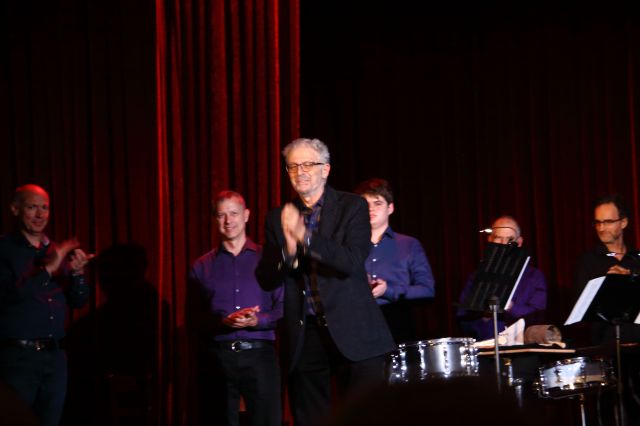
The composer’s notes here add much to the appreciation of this complex work:
I – The U.S. Army
Postal Unit at Blandford, Dorset, 1944
When it became apparent during World War
II that Hitler’s Germany would take a route through Blandford to attack England, the bar- racks from WWI were re-activated and popu- lated, in large measure, by U.S. Army personnel starting in 1943. The following year, my 29-year- old father Ben, the commander of a unit of men assigned to sort the mail sent from the U.S. to England and Continental Europe, arrived to be- gin work in Dorset. On the weekends, the com- mander had the privilege of driving some of his men around for sightseeing, from Stonehenge, to Piccadilly Square, to Edinburgh. Ben’s enthu- siasm for the people of England, the landscape and its history, is evident in his many letters home to my mother who was about to give birth to me in January 1945.
II – In Praise of the Venerable Piano Roll
The wonders of music made available to many non-performers in the early 20th Century by the invention of the player piano brought an unimag- inable thrill of excitement to so many. Before the days of high-fidelity sound recording, hearing the acoustic sounds of an actual piano, playing note-perfect renditions of classical and popular repertoire in one’s own home, was a profound-
ly mesmerizing experience. Snare drummers everywhere will welcome the chance to honor this signal achievement with a roll of their own. My thanks to Dominic Murcott for suggesting that the percussion repertoire lacked a single piece comprised solely of the sounds of drum rolls.
III – Ticklish Licorice
This movement comprises a quick-time perfor- mance of the novelty piece Flying Moments, by Leo Livens (1896-1990), accompanied by crystalline bell sounds from the percussionists. Livens, in his day, was a renowned British composer
of light music. Here the player piano is useful
in brightening up the music with a high-speed rendition of this playful music, performed in a studio recording by Rex Lawson with his usu-
al nuance and panaache on the Bösendorfer Imperial Grand at Dulwich College in 1994—John Whiting, sound engineer.
IV – Chatteratchet
The sound up close of a concert orchestral ratch- et can be hair-raising. Also, full of bird-chirping- like overtones. I learned this early on by accident while sitting in the enclosed cab of my Volkswa- gen bug and turning the handle of this ear-split- ting instrument. I decided to compose a solo for amplified ratchet, followed by duos, an octet, and other combinations over the years. The act of playing this mechanical instrument somehow relates, for me, to the mechanism of the player piano, with its constant rotating of the paper roll on which music has been encoded. The ratchet came to mind in relation to Spitalfields and the history there of tailoring. My only visit to the neighborhood came some years ago when I visited the offices of my friend Timothy Everest, bespoke tailor. In this quartet for four amplified ratchets, much of the work is devoted to the practice of turning the instrument’s handle con- tinuously, but at the slowest possible speed. The counterpoint between the instruments literally is out of the control of the players due to the nature of the spokes and their response to the turning crank, resulting in an interesting irregularity.
V – Hopper Popper
Numerous different ethnicities produced piano rolls of their own folk and popular music, includ- ing my people, the Armenians. Here is a roll of the love song “Haperpan” (a woman’s name), with its irregular phrase structure, augmented by our percussionists with wire brushes on the snare drum heads. The rhythmic irregularities in the cutting of the roll are especially interesting, if subtle.
VI – Exculpatorium
An excuplatorium (a word I coined) would be
a large, highly reverberant room where elder- ly snare drummers (and The Blue Man Group) must go to be absolved of their youthful sins of exhibitionism. As my first original compositions were relatively sedate marching band drum ca- dences, unlike some later more flamboyant and theatrical Fluxus-inspired pieces, I return to my pedestrian roots in this movement.
VII – To the Riled Wrecks
In 1896, the American composer Edward MacDowell (1860-1908) and his wife Marian purchased a lovely rural farm in Peterborough, New Hampshire. MacDowell immediately set about writing a series of short piano pieces he titled Woodland Sketches, Op. 51. One of these, “To a Wild Rose,” heard here, was a favorite of my piano teacher mother Eleanor’s. I’d often request it from her as music to go to sleep to when I was seven and just beginning myself
to study piano. Rex Lawson here performs an 88-note roll of the music on a pianola adjust- ed to a setting for rolls that contain only 65 notes across the width of the roll, with crushing results.
VIII – Dominictrix
This solo for snare drum was composed for my invaluable collaborator in the composition and world premiere of Ratchet Attach It, Dominic Murcott. I incorporate some of his favorite licks— thus, Dominic tricks.
IX – Bum of the Flightlebee
This backwards rendition of the Rimsky-Kor- sakov favorite The Flight of the Bumblebee is played by Rex Lawson by reversing the physical roll on the spindle. This piece is the only one I’ve
discovered that is both interesting and recogniz- able in any of the four possible performances of the paper roll—forward, backward, and each of those with treble to bass reversed.
X – Pedestrian
The most memorable drum cadence ever, in
my experience, was written for and played
at the funeral of the American President John Fitzgerald Kennedy on November 25, 1963. Its somber use of strictly regular rhythm capped by a dotted figure still haunts me, long after I heard it at the age of eighteen during the day-long event televised nationally from Washington, D.C. Using an additive process of extending the roll figure, and doubling it with the grating sounds of ratchets, resulted in this variation on a most memorable walking tune.
XI – Tyrannus Rex
Three piano rolls played by Rex Lawson com- prise the core of this concluding movement: The Tarantella from Rachmaninoff’s Suite No. 2 for Two Pianos in an arrangement made by the composer, Percy Grainger’s roll of his own Molly on the Shore, and a roll of the popular song from 1933, “Stormy Weather,” by Harold Arlen with lyrics by Ted Koehler, on an 88-note roll played while shifting back and forth between 65- and 88-note settings on the pianola. Percussion em- bellishments orchestrated by Dominic Murcott lend an added spatial dimension.
Performers included:
MEMBERS OF
THE OTHER MINDS ENSEMBLE
JEREMY STEINKOLER, DIRECTOR
DOMINIC MURCOTT, CONDUCTOR
ANDREW GRIFFIN
ANDREW LEWIS
CLAY MELISH
ROWAN NYKAMP
ERIKA OBA
BRIAN RICE
DAWN RICHARDSON
KEITH TERRY
They played their hearts out. And I’m sure glad I didn’t miss this epic night,




 New Music Buff