Der Vogelfanger mit eine Starling, Musical Ornithology from Lyanda Lynn Haupt


Book cover photo from Goodreads

Who knew? I mean I’ve read many books on this, my desert island composer. Alfred Einstein, Peter Gay, the Dover edition of the collected letters, etc. Perhaps I missed the mention of a starling somewhere in there. But, here we have it, an naturalist writer augmenting mountains of musicology with this delightful volume chronicling this ornithologist’s efforts to find and raise an actual contemporary starling after learning that Mozart had bought one to keep as a pet (curiously, one who charmed Mozart by singing the tune from his most recent piano concerto as a way of greeting the composer at the pet shop).

Lyanda Fern Lynn Haupt is a naturalist, avid birder, environmentalist, and writer based in Seattle, Washington. The book at hand in this belated review was published in 2017. I don’t recall how I came across this charming and engaging account of the author finding, raising, and keeping a starling as a household pet some time after learning that famed Viennese composer, Wolfgang Amadeus Mozart had had a pet starling. Most likely NPR, Amazon, or even Facebook are to blame.

This book is a curious mixture of ornithology, history, musicology, and autobiographical memoir. The author’s seemingly encyclopedic knowledge of things avian adds meaningfully to this unique and adventurous volume. She has hands on, intimate knowledge of rescuing and raising many bird species.

The book is a seriously engaging read even if you know little about birds or Mozart. It reads like an intellectual and very personal account by an astute and compassionate writer who draws you in to her infectious curiosity. I guess it’s safe to call this one a “page turner”.

Here is the book with its star (ling).

Apparently Mozart was enamored of song birds and birds in general. One he would echo in his later opera, “The Magic Flute”. It is this work, more specifically the “Vogelfänger” or “bird catcher” character from which I derived my (hopefully clickable) title.

Mozart acquired this bird in 1784 in a Viennese pet shop where the bird demonstrated his talent at vocal mimicry by singing the opening tune of the last movement of Mozart’s just recently finished Piano Concerto No. 17 K. 453 of 1784. It’s a minor mystery as to how the bird learned this but it has been suggested that Mozart may have taught it to the quick little learner. That’s a charming and satisfying explanation anyway.

In fact the author pens an imagined version of Mozart’s bringing the new pet into their home. As the author acknowledges, the story of this little pet is omitted by many of Mozart’s many biographers. But she manages to put together a charming and believable narrative which serves to satisfy fans of the composer while using this imagined narrative to also discuss the characteristics of this often maligned bird species.

She goes on to recount how starlings (which are not native to North America) were introduced by one Eugene Schieffelin, an Anglophile pharmacist from the Bronx who, as a result of his love of Shakespeare joined with the curiously named “American Acclimatization Society of New York” endeavoring to bring all the birds mentioned in Shakespeare to New York. And while many of the bird species perished, the starlings flourished in an invasive manner.

The author speculates that those 80 or so birds released in 1890 were likely the direct genetic antecedents of the very bird she captured and raised. This, she says, explains the lack of many genetic characteristics of the starling species (apparently 80 birds is an insufficient sample of the full genetic expression of the species). So we have, essentially a North American variant of that which resides in Stratford on Avon.

The writing moves its focus deftly from telling the stories of her experience with a starling she kidnapped and raised to interesting facts about starlings in general, to her reconstruction (absent a wealth of facts faded in over 200 years of history) of the experiences Mozart must have had. This includes a trip ti Vienna.

I’m going to stop my summation here and suggest that there is much more to the narratives within this volume. It is part science, part mystery, ornithology, history, autobiography, and an intellectual quest.

If you like music, like Mozart, like birds, like a good adventure story, here is a gorgeously written book that is a compelling, entertaining, and informative read.

Charles in Charge, Composer/Producer/Impresario Charles Amirkhanian at 80


Charles Amirkhanian (photo by Carol Law, all rights reserved)

An overflow crowd packed the lovely auditorium at Berkeley’s David Brower Center this past January 19th. Octogenarians (and younger folks as well) populated both stage and audience in a show of appreciation for a man whose work as music director of KPFA (1969- 1992) and subsequently as an arts promoter and curator of new music in California’s Bay Area continues to enhance the artistic reputation of the Bay Area.

A rare and exciting aspect of this evening were the rare opportunities to hear Charles’ music, including representative sound poetry classics and a recent major opus capped off by a world premiere of a new work.

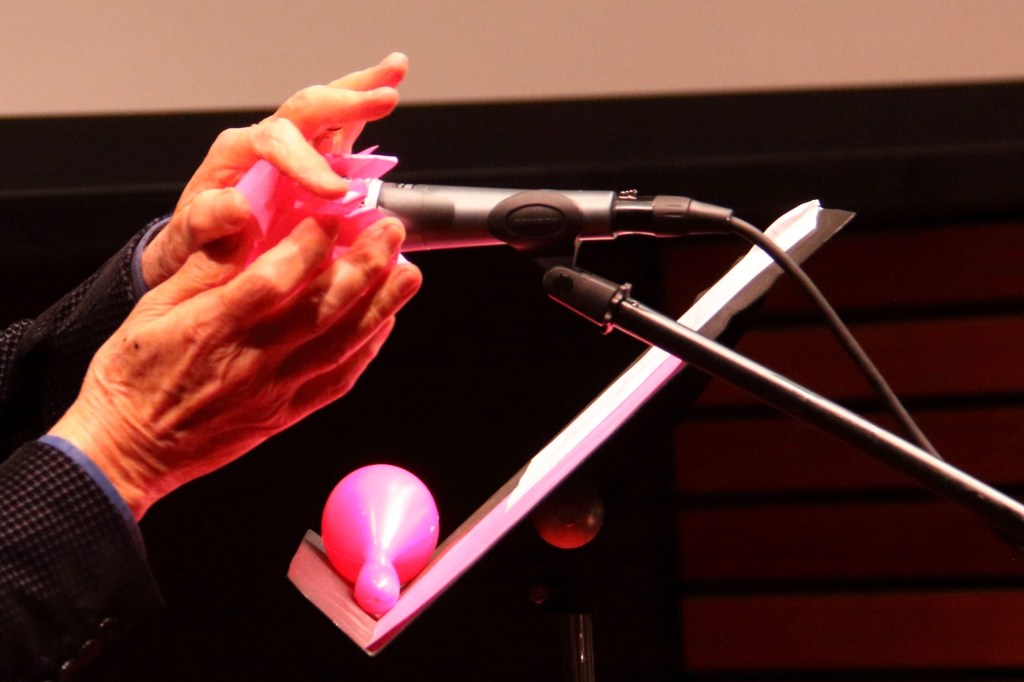
The hands of the artist. Photo by Allan J. Cronin

The genuine affection, appreciation, and respect was palpable as the honored guest demonstrated his skill at hosting when a couple of technical glitches slowed (but did not stop) the amiable birthday celebration. The audience waited calmly and quietly.

Both the guest of honor and the host (Liam Herb) used a well honed, self effacing humor used most skillfully to entertain the sympathetic audience while the technical difficulties were surmounted in real time.

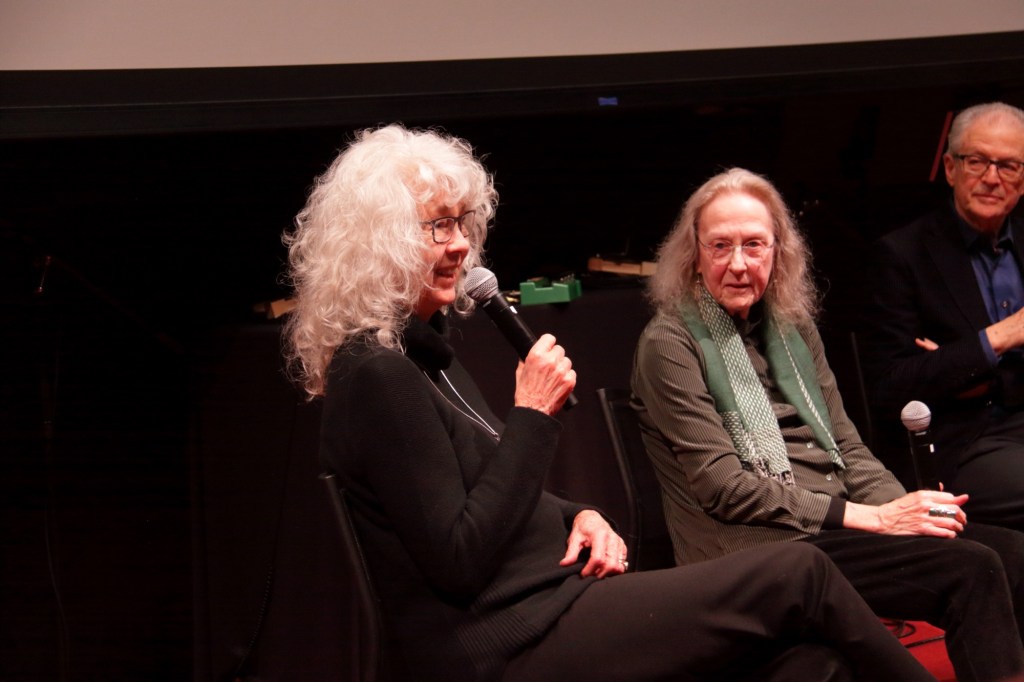
Panel discussion featuring (left to right) Susan Stone, Anthony Gnazzo, Paul Dresher, Charles Amirkhanian, Sarah Cahill, and Liam Herb (Photo by Allan J. Cronin, Creative Commons license)

Herb, a composer and performer, introduced himself in the midst of the technical resolutions, graciously announcing that, as producer, he accepts responsibility for the glitches. Charles maintained his familiar master of ceremonies crowd pleasing good humor as Herb worked goodnauturedly (if that’s a word) with the rest of the crew to resolve the issues and get on with the show.

The formal opening remarks were given by Other Minds’ associate director, Blaine Todd. And the evening began in force.

Blaine Todd (photo by Allan J. Cronin, Creative Commons license)

The program glided past the initial hiccup to present a film about our guest of honor. The bevy of fans and bona fide new music professionals sat with rapt attention as the film, featuring the familiar faces of several “Bang on a Can” artists.

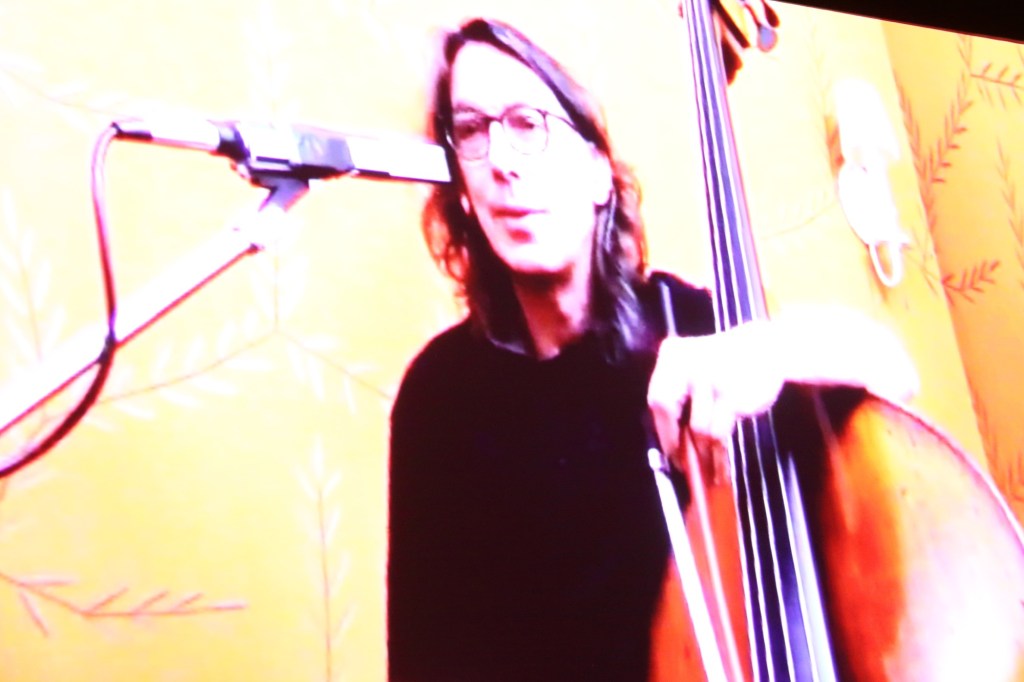
The late great Robert Black interviewed by Amirkhanian in the streaming premiere of Audible Autopsy. (Photo of film appearance by Allan J. Cronin)

Excerpts from the 2015 Other Minds 20 documentary featured Julia Wolfe, David Lang, and Peter Gordon (now, it seems elder statesmen (and women) in their own right.

Production manager Liam Herb then served as moderator for a conversation or live interview (with Amirkhanian) for the next segment. This was followed by some videos with music by the guest of honor:

Real Time/T.V. Time Video with Amirkhanian’s “Muchrooms”

The film, presented in its entirety was accompanied by “Muchrooms”, from the CD recording of that standalone work.

Next was Amirkhanian’s and Carol Law’s classic collaboration: History of Collage (1981). This is a major work and a great collaboration with his partner in life and arts. I’m pleased to add my own shot from the performance at the Other Minds 23 experience, my favorite OM festival(so far).

History of Collage (1981) photo by Allan J. Cronin taken at the Other Minds 23 wonderful live performance of this work (Photo by Allan J. Cronin is Creative Commons license 2015)

We also heard and saw Audience (1978) with photography by Law and music/poetry by Amirkhanian followed by Chairs with photography by James Petrillo and music/poetry by Amirkhanian (excerpts from Seat Belt, Seat Belt (1973).

There followed a panel discussion led by Carol Law with Betsy Davids discussing David’s’ work and her connections via her work as a book artist. These two embody the experimental visual arts that characterize the skills of these fellow artists both onstage and off tonight. In fact, interactive collaboration and both respect and friendship were everywhere to be seen in this warm and pleasantly nostalgic evening.

Carol Law speaking with Betsy Davids (Photo by Allan J. Cronin, Creative Commons license)

This was followed by a recording of a major opus, Ratchet Attach It (2021) recently played at one of the (still ongoing) Other Minds Festival. This work is a major opus by Mr. Amirkhanian, one I’m pleased to say I heard live at the Chinese Theater in San Francisco a few years ago. Scored for a huge percussion ensemble, with audio recordings, and a conductor who moves between the podium and a space among the performers playing with the ensemble. It is perhaps one of his most integrated and evolved compositions. Stunning to hear it live. Glad to hear the (always too short) excerpts.

In fact Mr. Amirkhanian, a fixture in the arts of the Bay Area, continues to influence musical taste and present new and interesting music as he has for well over 50 years. His work as Executive Director of Other Minds includes the fabulous OM Records as well as the annual Other Minds Festival and a continual flow of carefully curated concert events by luminaries (or soon to be luminaries) throughout the Bay Area and beyond. There is also the huge archive of thousands of hours of interviews and concerts that are available in streaming audio and video via the Other Minds website.

Many of the artists featured in the Other Minds concert series continue to work, innovate, and expand musical concepts. An Other Minds commission, Henry Brant’s Organ Concerto, Ice Field, earned him a Pulitzer Prize. Many have gone on to greater achievements in their respective careers. Of course not every composer started their musical careers at Other Minds concerts. Many mid or late career musicians have joyfully been represented over the years. Its one of those festivals that innovative musicians seek to participate.

Such achievements reflect on Amirkhanian’s leadership and curatorial acumen, but more importantly his relationships with his fellow artists. Charles has earned a reputation for his support and his collaborative nature. Arguably, everyone in the house (and the overflow in the lobby) all have a degree of connection to Charles and his guests. It is why we’re all here tonight.

Charles Amirkhanian and Joseph Bohigian performing with Liam Herb’s electronics (Photo by Allan J. Cronin, Creative Commons license)

Following a brief intermission we were treated to a world premiere of a new work by our guest of honor, Noose Ratchet (2025) for two percussionists and electronics. Amirkhanian performing and/or promoting his own music is a relatively rare event and this alone was certainly worth the trip.

The work is arguably a trio for two percussionists playing ratchets, a curious instrument whose sound, if not entirely ubiquitous, is familiar. And the two play interactively with the electronics (the third member of the trio). Extended techniques and other duties get assigned (when in doubt it’s responsibility of the percussion section, right)?

There followed a lively and friendly panel discussion amongst frequent and past collaborators Susan Stone, Anthony Gnazzo, Paul Dresher, Sarah Cahill, and Liam Herb. This truly felt like a gathering of friends.

Happy Birthday, Charles.

The Elegant Icelandic Pianist and the Woman with Blurry Hands: Òlafsson and Wang Duo Pianos in Santa Barbara


Vinkingur Òlafsson
Yuja Wang

Program 
Berio:Wasserklavier
Schubert: Fantasia in F minor for Four Hands
Cage:Experiences No. 1
Nancarrow (arr. Thomas Adès): Study No. 6
John Adams:Hallelujah Junction
Arvo Pärt:Hymn to a Great City
Rachmaninoff:Symphonic Dances

From the very beginning this concert defied convention in so many ways. The Granada Theater hosted a sold out crowd for these two distinctly different rock stars. The two pianos were arranged so that the artists were sitting next to each other, Wang was seated slightly upstage and stage right while Òlafsson was stage left and a bit downstage (the conventional staging for two piano concerts has the pianists facing each other and equally center stage). Also noted was Wang using the iPad score reader whilst Òlafsson had a page turner for the hard copy paper score.

On the surface these two artists have distinctly different personas. Both are possessed of a high level of technical skill along with interpretive abilities that communicate with their audiences. But the juxtaposition of these two pianists is a pairing that had this listener wonder if they could occupy the same space. Òlafsson the contemplative man in the dapper blue suit and the introspective facade contrasted just a bit with Wang’s more extroverted showmanship. And Wang’s fashionable but characteristically flashy outfit (which was even “flashier” after intermission).

The concert began with a brief and generally lesser known piece by the great Italian composer, Luciano Berio (1925-2003), his Wasserklavier (1965). This short, contemplative work functioned as an appetizer as the duo segued directly to Franz Schubert’s (1797-1828) gorgeous Fantasy in F minor (1828). This work originally written for one piano, four hands, was played here on two pianos. The work, written in the year of Schubert’s death is of symphonic dimension. The duo played rather uptempo but delivered a very convincing performance.

After acknowledging applause they gave us a sort of brief palate cleanser, John Cage’s (1918-1997) Experiences No. 1 (1945-8), a work for two pianos. The soft and sparse texture segued to Thomas Adès arrangement of Conlon Nancarrow’s Player Piano Study No. 6 (ca. 1962). This study, one of about 50 studies, sounds gentle and bluesy but belies the actual rhythmic complexities which characterize all the studies. This team handled the complexities most deftly.

This was followed by another work of symphonic dimension, that of John Adams’ (1960- ) Hallelujah Junction (1996). It was this writer’s first hearing of the work and it was a charming and engaging post minimalist work that challenged the virtuosity of the artists and gave ample evidence of how well they performed together. The rousing ovation then took us to intermission.

(Photo by David Bazemore, all rights reserved)

The second half included Wang in a more revealing outfit more characteristic of much of the publicity photos I’ve lately seen of her. But most important is the artist’s virtuosity and interpretive power. She is a force of nature. Òlafsson is just a gentler expression that managed to link most successfully with his upstage partner on this night.

They began with Arvo Pärt’s (1955- ) Hymn to a Great City (1984-2004). This ca. 3 minute work (the city of greatness is not named) was a soft meditative work, perhaps echoing the Berio work which opened the concert.

It led without pause into Rachmaninoff’s (1873-1943) Symphonic Dances (1940) I had only been familiar with the lovely version for large orchestra (apparently written concurrently with the orchestral version) so it took a bit to grasp the intricacies that suggest that this music was written for two skilled pianists. Òlafsson and Wang traded moments to shine in this truly symphonic work but it worked very successfully with these two artists in their respective driver’s seats.

A standing ovation brought the two back to the stage where they sat next to each other for a rendition of Schubert’s bouncy Marche Militaire. A second encore two dances, by Dvorák and Brahms, eased into a calmer Brahms’ familiar Waltz in A-flat Major capped off a truly fine concert, not a union of opposites but rather a collaboration of genius.