Bob and Blue, A Musical Pilgrimage


Littlefield Hall (photo copyright by author)

…tell the old story for our modern times. Find the beginning.

-Homer, The Odyssey (Emily Wilson translation)

When I first got the email notice of this concert, I was, to say the least, intrigued. A two piano concert at Littlefield Concert Hall on the campus of Mills College featuring two composer/performers who figured prominently in that Temple of new music and in my personal listening life. Alas, I live some 350 miles from that location. But further intrigue came from the featured artists: Sarah Cahill and Joseph Kubera, two of the finest working new music pianists anywhere and both worked with the evening’s composers. This was just too compelling and I decided that I would regret missing this if I failed to go hear it.

So it was, I planned my little odyssey, leaving at about 9AM from Santa Barbara on a nice lightly trafficked trip, more a pilgrimage than an odyssey. A pilgrimage, frequently defined as a personal spiritual journey ostensibly in search of insight or enlightenment is how I’ve come to identify my listener’s adventure to the secular temple of Mills College featuring music of former Mills faculty Robert Ashley (1930-2014) and Robert Sheff (1945-2020), better known by his stage name, “Blue Gene Tyrrany”.
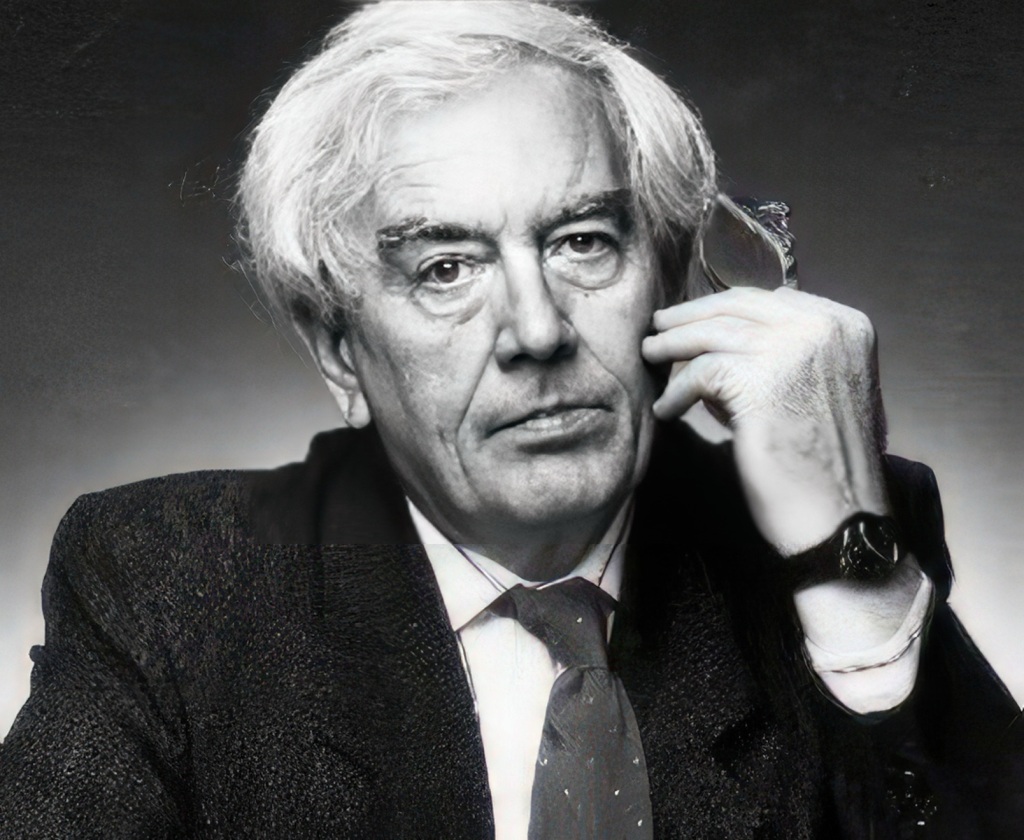
Robert Ashley (copyright unknown)
“Bob and Blue” (copyright by Other Minds)

The two featured composers had a strong connection to the Bay Area, mostly via their work at Mills College. This intelligent but modest production left little room to print program notes so the performers spoke of the music at various points during the concert and the excellent liner notes were made available by a QR code in the program book.

Sarah Cahill, pianist, radio host, producer, tireless advocate for new music (photo copyright by Other Minds)
Joseph Kubera, pianist, member of the SEM ensemble, Downtown Music, and countless collaborations promoting new music with many fine recordings to his name. (Photo copyright by Other Minds)

Our two performers are no strangers to each other or the composers on the program, having collaborated on numerous performances and recordings. The well rehearsed duo turned in riveting performances of this largely unknown repertoire which made a strong case that it be better known. Their playing and choice of repertoire compelled this listener’s attention such that I forgot to take all but a few performance shots. See those program notes for further biographical info on these two fine musical celebrants.
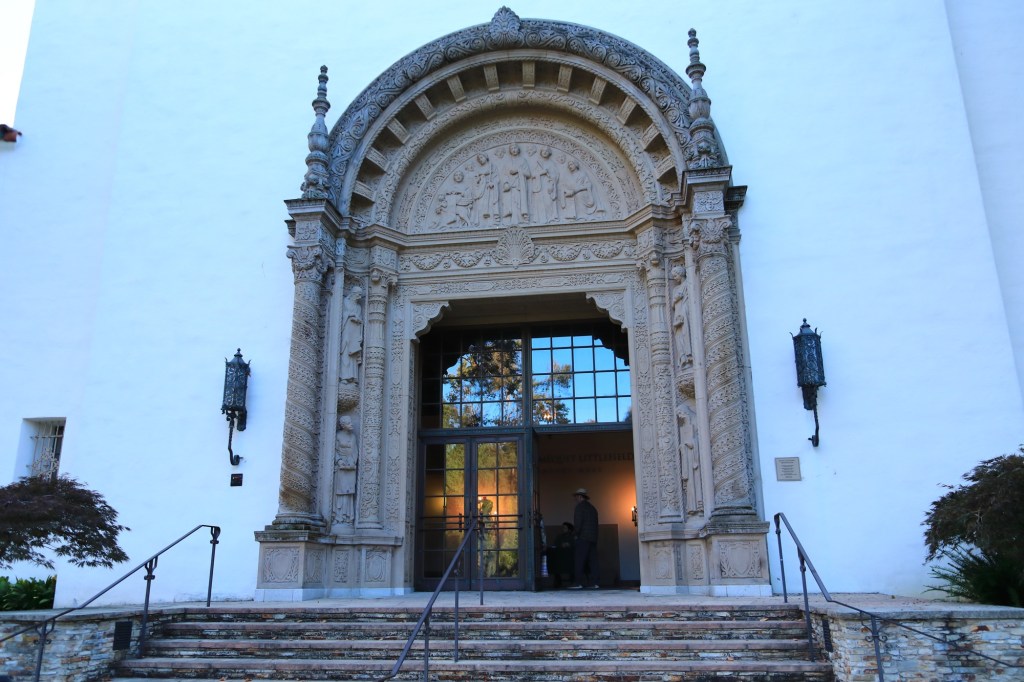
Entrance to Littlefield Concert Hall (copyright by author)

Mills College has long been a temple, a Mecca for new music in the Bay Area of California. Its roster of faculty and students comprises some of the finest post 1945 composers and performers. Darius Milhaud (1892-1974) and Luciano Berio (1925-2003) and students as diverse as Terry Riley (1935- ), Steve Reich (1936- ), and Dave Brubeck (1920-2012) to name but a few. Many artistic spirits musical and otherwise, exert their presence here. It’s a perfect destination for a pilgrimage.

A bust of frequent Mills visitor Lou Silver Harrison (1917-2003) in the lobby, a persistent benevolent spirit. (photo copright by author)

The concert was organized by Charles Amirkhanian and his Other Minds organization, another guiding light in the San Francisco/Oakland new music scene. Pianists Sarah Cahill and Joseph Kubera were to be the celebrants in the concert ritual paying homage to “Bob and Blue” as well as to the oracular Mills College.

Scene from the lobby (photo copyright by author)

Let me tell you about this concert hall. It is the work of legendary California architect Julia Morgan (1872-1957) who famously also worked on Hearst Castle. This is one of her several architectural gems on campus. Her spirit was also witness to this celebration by virtue of her fine architecture.
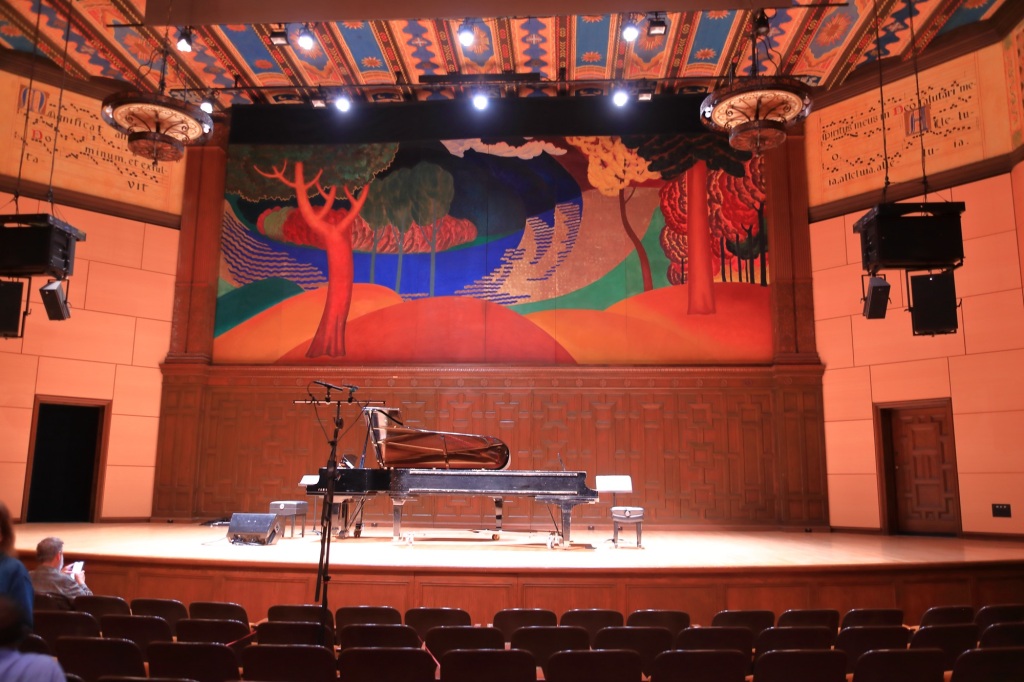
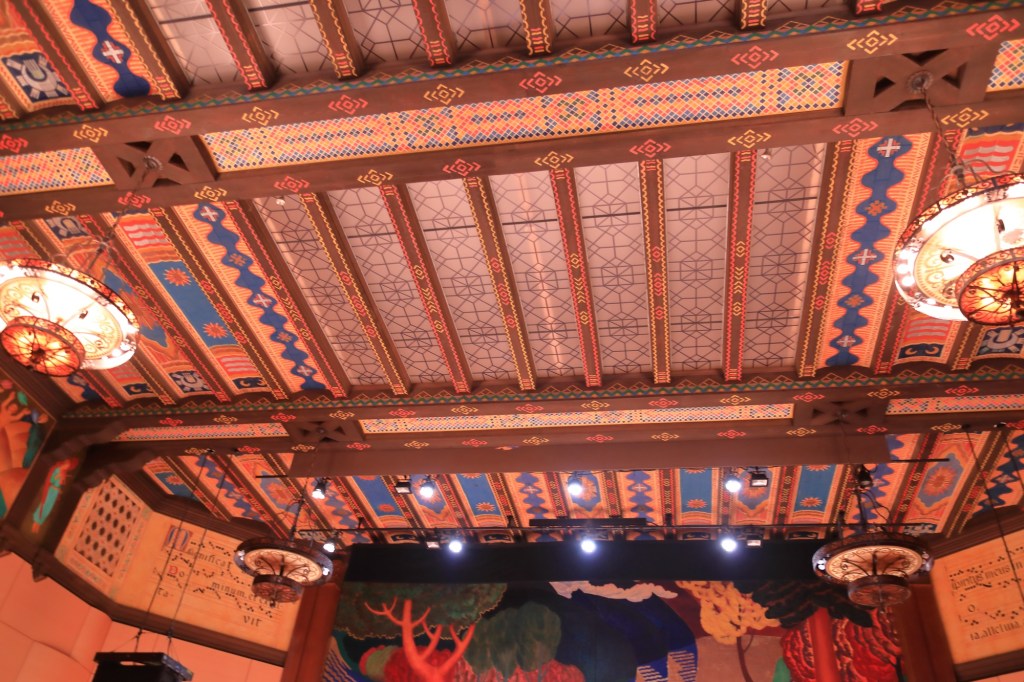
Stage at Littlefield Hall showing the ornate, colorful detailed designs (photo copyright by the author)
Look at that ceiling and those chandeliers (photo copyright by the author)

Two pianos, a new Steinway stage left and a slightly worn Baldwin stage right were placed such that the pianists seated at their respective keyboards could see each other. The Steinway with its lid open to reflect the sound to the audience and that well worn Baldwin with no lid at all (for reasons to be revealed later). The sonics of the hall and tuning of those pianos were excellent.
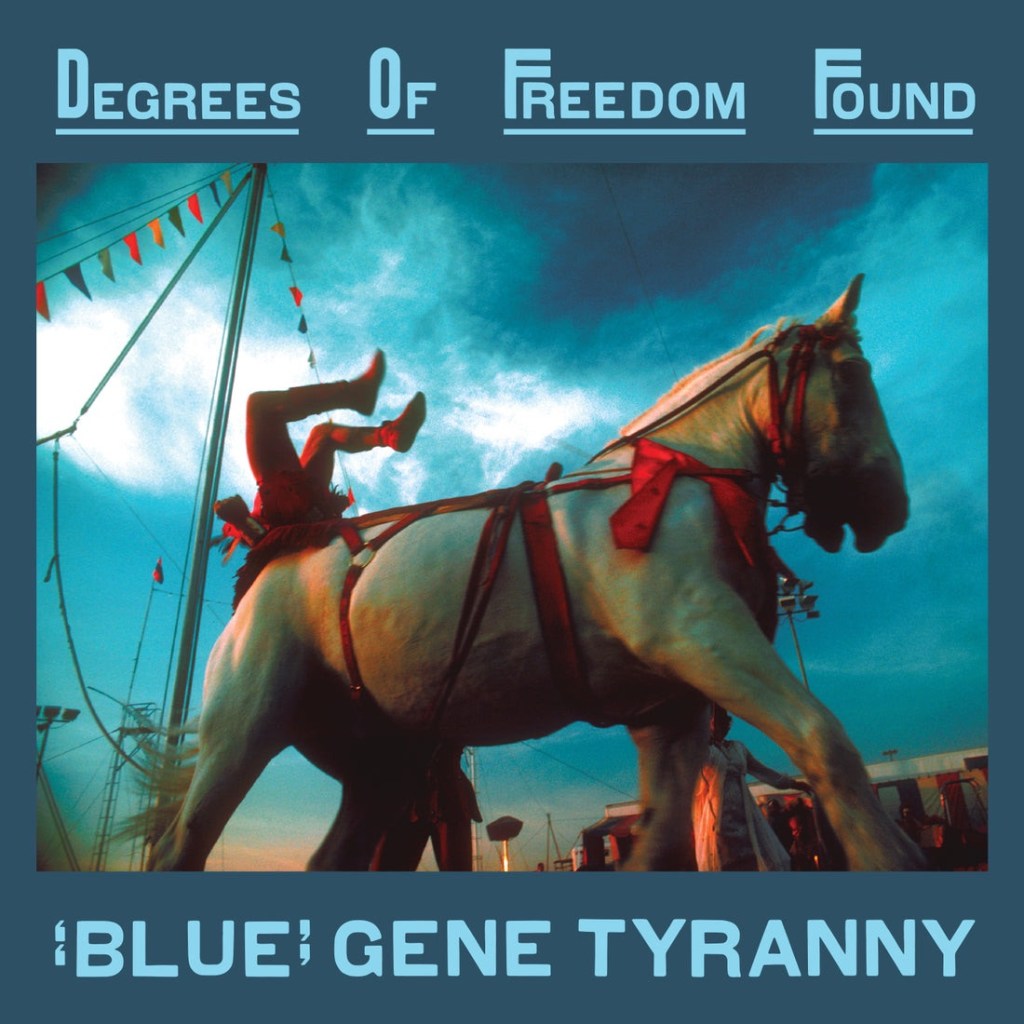
Unseen Worlds’ wonderful survey of Blue’s ensemble works.

The concert opened with Blue Gene Tyrrany’s peaen to old Route 66 in his “Decertified Highway of Dreams” (1999) for two pianos. It was clear from this first selection, that our performers were well rehearsed and in sync despite rhythmic complexities inherent in this quite beautiful work. It is cinematic and sweetly nostalgic, a fine example of “Blue”’s genius. The performance was riveting and worthy as the first performance ritual of the evening.

This was followed by a real rarity, a performance of Robert Ashley’s Piano Sonata (1959, 1979, 1985). In fact, it appears to have been the first complete performance of the two piano version of this impressive serially structured piece. Previous recordings are available, one with the composer performing the first movement at the ONCE Festival from 1966, the other by Blue Gene Tyrrany on his album, “Just for the Record”. This writer also found some useful analysis by musicologist Kyle Gann on his website. Gann worked with Ashley and later published a fine survey of Ashley’s music that is well worth your time. The result was a convincing, almost romantic sounding performance of this foundational work in Ashley’s oeuvre.

This was followed by a solo rendition by Joe Kubera of Tyrrany’s “The Drifter” (1994), which was written for Mr. Kubera. He spoke briefly about the structure of this work (which he also recorded on his recent “Horizons” album). This piece has a meandering quality created by the intricate evolving structure. Kubera’s performance was hypnotic and a fine tribute.

The second half began with Ms. Cahill solo at that stage left Steinway playing first Tyranny’s “Nocturne With and Without Memory” (1989), one of his better known works. Then she played his “Spirit” (1996/2002), a piece that is a sort of homage to the experimental composer/performer Henry Cowell (1897-1965). It was rather unusual in that it involved harmonics over which the pianist plays. The title is an homage to Cowell’s famous piano piece, “The Banshee”, a malevolent spirit in Irish mythology. Both were vintage Blue Gene pieces.

Two pianists, one piano.

Then Kubera returned, taking a seat at the blemished Baldwin with Cahill standing at that same piano, at a 90 degree angle to Kubera. Here, in these two obscure Ashley pieces, Viva’s Boy (1991), and “Details” (2b, 1962), Cahill played like a chef at a chef’s table, playing the strings inside the piano while Kubera manned the keyboard. These true rarities getting perhaps their first performance, were certainly a highlight of the concert.

It was Blue Gene Tyrrany’s spirit that was the final ritual celebration on this magical night with both pianists at their respective pianos to give a heartfelt reading of his, “A Letter From Home” (2002). This brought this learned, well rehearsed, beautifully collaborative evening’s ritual to a satisfying close.

The modest, self selected audience, applauded warmly and gave an extended, much deserved ovation and seemed as enthralled as this listener whose musico-spiritual pilgrimage found an ecstatic height. I drove home that same night, blessedly lifted, if only briefly, from the chaos of the world by this wonderful artistic ritual. They will now take this great program to New York.

Binaural Beats in the Tudor Rainforest


Neuma 158

On the back of the CD case, in the right upper hand corner, like a warning on the back of a medicine bottle, an entreaty:

“Binaural Recording: Please use headphones.”

Even those of you who think they know this masterpiece of experimental electronics by David Tudor (1926-1996) will find here a unique and important collaboration in this production initiated by Pauline Oliveros, then director of the Center for Music Experiment (CME) at UCSD. She invited a group called CIE (Composers Inside Electronics). And the resulting product of that collaboration documented here advances the understanding of this music and will henceforth be an influence on all future performances.

Unfortunately for this writer’s timing, the wealth of information gathered in the course of researching this review, the sheer volume of possibilities in performance and the wider scope of historical and technical elements embraced by this work required a deeper reading and contemplation on my part. In short, it has taken some time for this reviewer to get a grasp of how to express the significance of the deeply substantive work at hand. I simply didn’t know enough about the history of electronic music and the work of this seminal musician.

So now, after some serious study, this is my perspective on this landmark composition and, in particular, the deeper significance of this performance. In short, there will likely be many more performances of this work but this one will always be a standout. Not the ultimate version perhaps, but one of the most memorable.

David Tudor ca. 1950

David Tudor was a pianist who championed contemporary piano music and then began a career as a composer. But he was no ordinary composer. Taking inspiration from the composers whose work he championed, Tudor developed musical ideas with structures that contain indeterminate elements within a larger structure. Such is the case with Rainforest which was first developed in 1968 against a cultural backdrop of the height of the psychedelic sixties and the political “days of rage”, a time of artistic innovation like Allen Kaprow’s “happenings” which expanded the concepts of what constituted art, a time of wild experimentation. His work crossed paths with the San Francisco Tape Music Center (which later became the Mills College New Music Center). Tudor traversed some of the same territory as Donald Buchla, Pauline Oliveros, Maggie Payne, Morton Subotnick, Ramon Sender, as well as many others.

The first iteration of Tudor’s innovative and experimental “Rainforest” was in 1968. It is a testament to Tudor’s creativity to have created a structure that contains the indeterminate sonic events called for in the score (not a formal score but a set of performance instructions) in such a way that the piece evolves with each iteration, each performance. That, rather than the varying sonic content, is the heart of this major work of contemporary sonic art.

First, this is a binaural recording, meaning that it was recorded with a technology intended to deliver the sound directly to headphones of the listener hopefully producing an experience much as would have been experienced by sitting in the audience. Earlier versions of this technology involved, basically, microphones embedded in the ear canals of an anthropomorphic head which is placed in front of the performance as a listener would sit in their seat. However, the present recording recording involved another generation of this technology which is particularly well suited to this music. Here the microphones are worn in the ears of the recordist(s) as they meander through the space in which the piece is being performed. The result is the listener being able to (almost literally) get inside the head of the person wandering within the space and listening to the sounds created, sometimes at a distance, sometimes more closely.

Despite the entreaty that the listener wear headphones when listening to this recording (you really should try that at least once), one can play this recording as one would any other musical recording. It can also be appreciated by playing it on speakers in any space as a sort of sound installation. This piece challenges conventional concepts of music and its audience.

New Carriers of the Flame of the Leading Edges of New Music


English: Shiraz Art Festival: David Tudor (lef...

With Paul Hillier in Malmö fall 2005

Kronos Quartet with Paul Hillier in Malmö fall 2005 (Photo credit: Wikipedia)

Looking back at the history of music since 1945 one can clearly see the musicians who took on the newly developing repertoire with all its difficulties both in performance and in selling it to an audience.  These are the performers who introduced these new pieces to unsuspecting audiences and lovingly nurtured them to the place they now hold in the canon of musical masterpieces.


I’m speaking here of people like David Tudor, champion of the New York School (Cage, Feldman, Brown and Wolff) as well as a composer in his own right.  I’m speaking of ensembles like the Kronos Quartet and the Arditti Quartet, champions of innovators in music for string quartet.  I’m also speaking of conductors including Serge Koussevitzky, Leopold Stokowski, Leonard Bernstein and a host of others who daringly programmed new music and even sometimes endeared their audiences in so doing.

Arditti String Quartet

Cover of Arditti String Quartet

Date of photo not recorded.

Date of photo not recorded. (Photo credit: Wikipedia)

These are the people who brought that fascinating repertoire to my ears and those of many over the years  They are the people who also taught me why this music needs to be heard, whose enthusiasm communicated the depth in the scores they lovingly rehearsed and performed.


These musicians are part of a tradition, that of championing new music.  They widen and deepen the repertory by their selection, interpretation and performances of music that is new or not yet well-known.  They are the high priests and priestesses of the religion of sonic culture.  And as they fade into history they leave a vacuum which must be filled.


English: Portrait of Serge Koussevitzky (Russi...

 Portrait of Serge Koussevitzky from the Library of Congress’s George Grantham Bain Collection (Photo credit: Wikipedia)

My intention here is to identify some of the musicians I have discovered who seem to be taking up residence in that vacuum.  I am starting a series of articles in which I intend to share what I believe to be important cultural finds both in the musicianship and the emerging repertory.


As always I am open to any and all suggestions for inclusion here.  I would like to know who is going to introduce me to my next favorite musical discovery.


English: Leonard Bernstein

 Leonard Bernstein (Photo credit: Wikipedia)

My first article, currently in preparation, will be on the French pianist Nicolas Horvath.  His significant presence in social media makes him almost hard to miss and relatively easy to research.  Please stay tuned.


Enhanced by Zemanta

Music 109, Alvin Lucier’s personal view of the post 50s avant garde


20130604-083336.jpg

This little volume is an endearing record of an undergraduate course, a music appreciation course designed for students with an interest in the music of the avant-garde of the 1960s, 70s and 80s taught by a man who was an integral part of that era as a composer, performer and teacher. The class, which he taught at Wesleyan University was reportedly very popular continues to be offered today. And this book is required reading for fans of new and experimental music.

In just over 200 pages Professor Lucier takes the virtual class of readers through a very personal journey of the music, experiments and performances of some of the highlights of some of the major works and composers of this time period. And he manages to navigate all this wildly experimental music in a way that is understandable to a general audience (remember that this is an undergraduate course for non music majors).

What makes this book so special and unique is its personal nature (Lucier was a composer, performer, organizer and interpreter of much of the music) and the particular networks to which he connects. Few historians save for Kyle Gann pay significant attention to the techniques which arose from the orbit of Ann Arbor, Michigan and composers like Robert Ashley, Gordon Mumma and Lucier himself among many others. But this group is indeed an orbit and not a universe unto itself. David Tudor, for example, crossed paths with these composers as well as, more famously, with John Cage and the New York School.

This delightfully readable volume narrates Lucier’s vast experience with and love for a variety of experimental trends. Lucier writes of his own works and places them within the contexts of fellow innovators including the above mentioned artists as well as diverse voices such as Pauline Oliveros, Philip Glass, Steve Reich, LaMonte Young, Roger Reynolds, Gordon Mumma, Robert Ashley, Earle Brown, Morton Feldman, John Cage, Christian Wolff, David Tudor, Karlheinz Stockhausen and many others. This personal inside view makes for entertaining and compelling reading which provides a historical context as well as insights to the “method behind the madness” of a diverse and innovative time in music history.

Except for Kyle Gann’s fine volume on Robert Ashley this is the only book length treatment (known to this reviewer) of artists connected with the ONCE festival and the Sonic Arts Union. Lucier’s place in music history is connected across east coast academia as well as far less academically connected groups like these. This book connects some of those dots placing an important perspective on this era.

Earlier this year I had the pleasure of speaking with Paula Matthusen, a composer who now teaches at Wesleyan. In fact she has inherited this delightful and inexplicably popular course. She told me that not only does the course continue to be popular, many of the students come in with some level of experience of this music and a desire to know more. How cool is that?

Matthusen shares many of her teacher (Lucier’s) concepts in her own work but she is clearly the next generation in experimental music reminding us that art of the era documented is receding into the past yet we hardly know it. And how can we appreciate the latest work without some understanding of how we got there? Lucier’s book provides a great introduction and hopefully will encourage more attention to this important and fascinating time in American music history.