Annie Lewandowski, Luciano Chessa, Theresa Wong in Berkeley


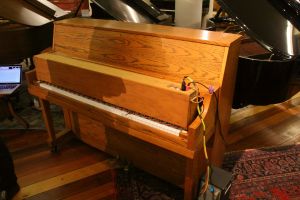
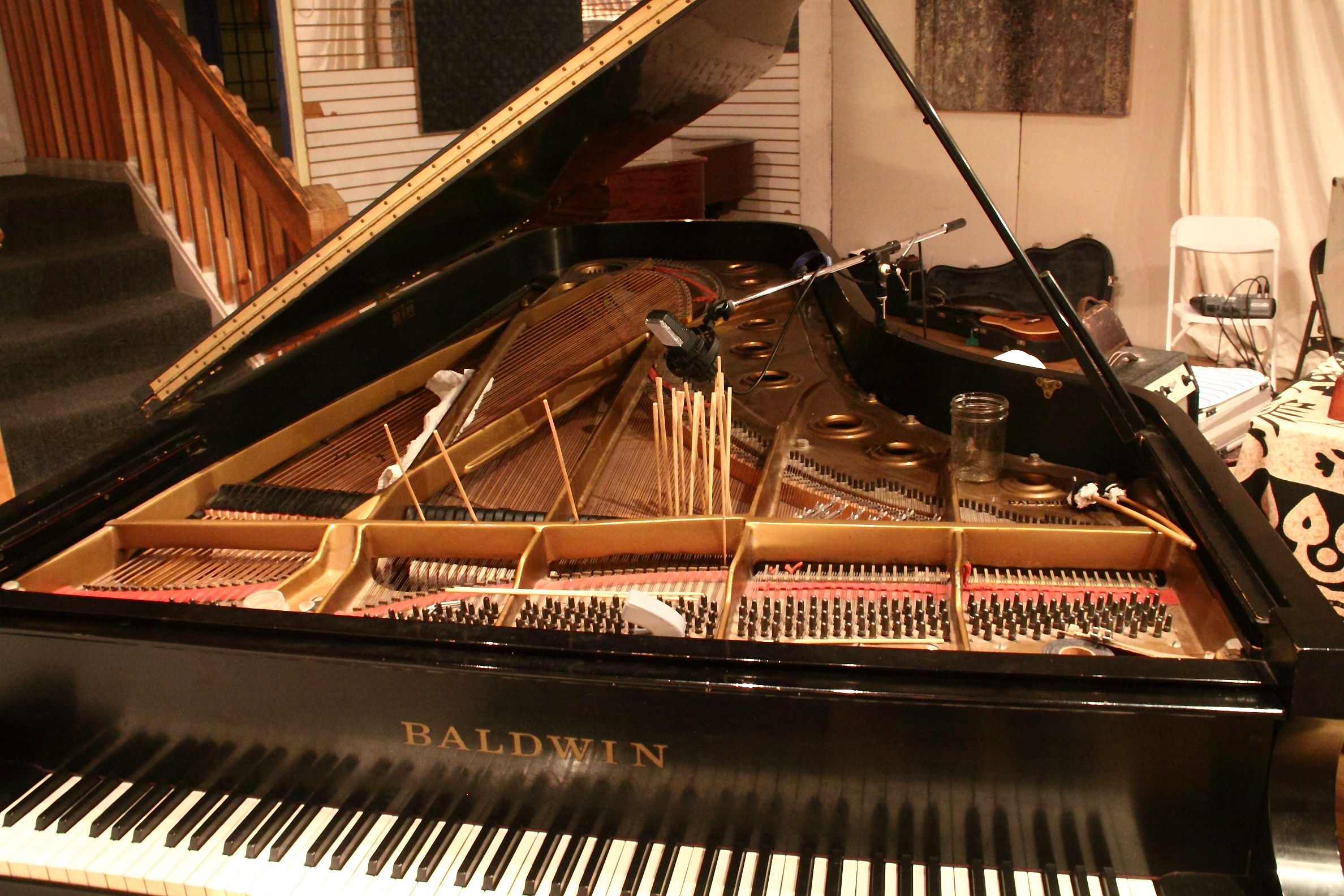
Lewandowski piano

A view of the inside of the piano showing Lewandowski’s alterations.

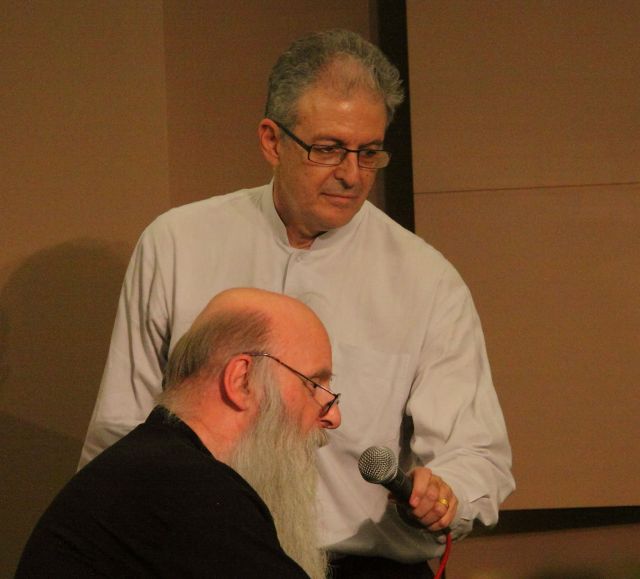
It is easy to miss the nondescript storefront on University Avenue where this performance took place. And the promotion of this concert appeared to be mostly through Facebook and the Bay Area improvisers web site which resulted in a small but appreciative audience interested in hearing the work of Annie Lewandowski, now a music lecturer at Cornell. She is a graduate of Mills College. She has a varied resume ranging from classical piano to progressive rock bands and she presented tonight her work with extended piano techniques much like those of John Cage but with some distinctly personal twists extending Cage’s methods further. Ms. Lewandowski was hosted by Theresa Wong (also a Mills graduate), bay area composer, cellist and singer who organized the event and Luciano Chessa, San Francisco Conservatory professor, composer, musicologist, historian and performer and producer who played a couple of different roles in this evening.

performance of La Barbara's 'Hear What I Feel'

Luciano Chessa performing Joan La Barbara’s ‘Hear What I Feel’

The first performance was introduced by Ms. Wong who informed us that Luciano Chessa had been kept in isolation for the last hour while the preparations were done for his performance. The piece being performed was Joan LaBarbara’s ‘Hear What I Feel’ from 1974. It consists of a table upon which there are several plates each containing some object or substance. The performer, who is blindfolded, is seated at the table and the performance consists of the performers reactions to the substances and/or objects he examines with his hands alone. It is performance art that would be perfectly at home with other Dada and Fluxus-like scores.

Wong led Chessa carefully from the back of the performance space to the table containing six plates. After seating him she positioned the microphone carefully in front of him. Chessa spent several minutes with each object examining three predominantly with his left hand and three with his right. All the while during his tactile adventure he vocalized a variety of sounds evoking (presumably) his emotional response to each object or creating an audio analog for them.

As with all such scores the result leaves a wide range of possibilities to the performer. And this performance was suitably humorous and engaging. Following his examination of the last of the objects Chessa removed the blindfold and reacted to each of the objects (without vocalizing) as he examined them visually. There was an effective combination of (mockingly?) serious concentration and idiosyncratic responses that left the audience genially amused and entertained.

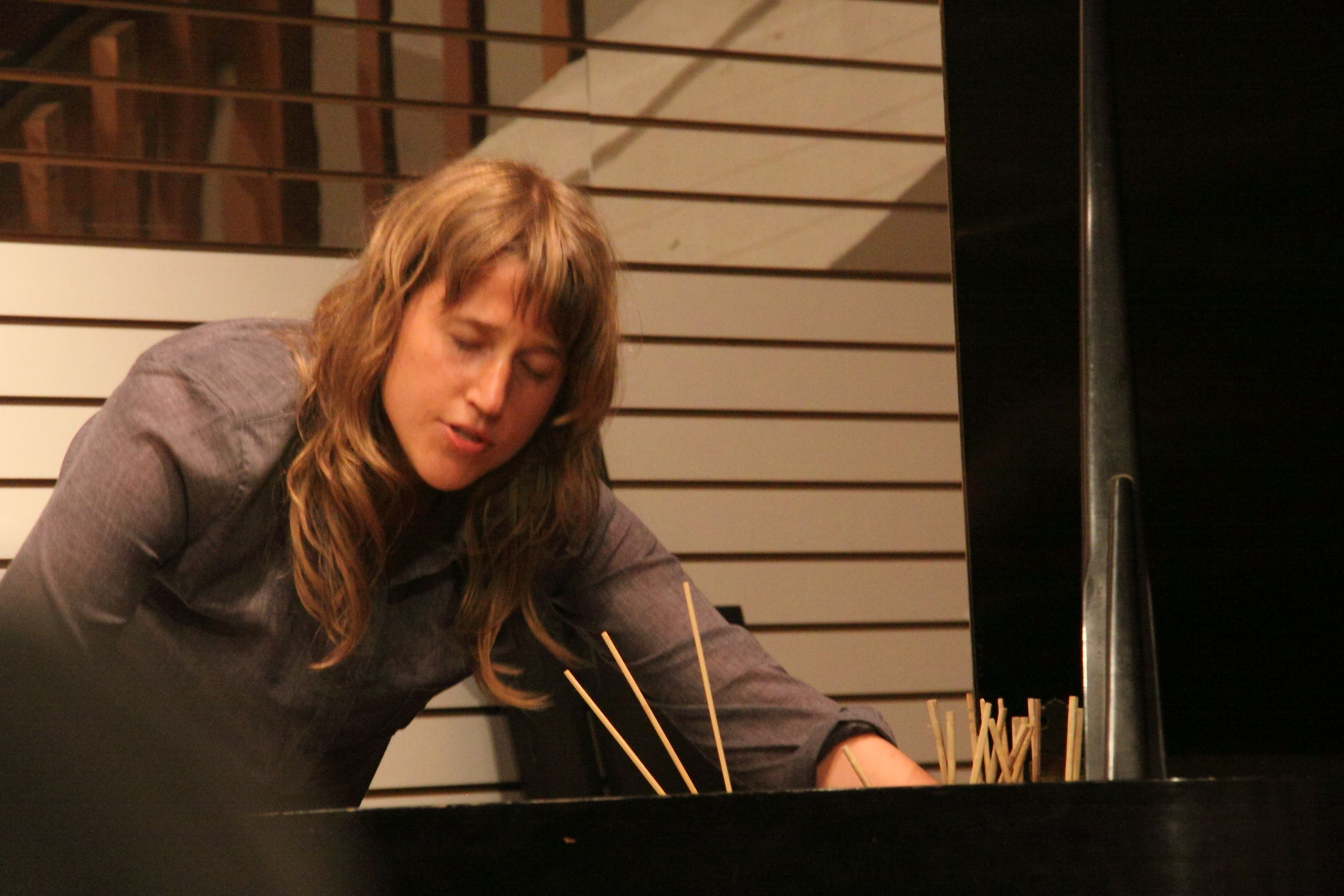
Lewandowski piano

Annie Lewandowski playing in the piano, on the keyboard and singing.

Wong cello

Theresa Wong playing her carefully altered and electronically enhanced cello and singing.

This was followed by a duet between Lewandowski and Wong. Both performers utilized various ways of altering the sounds of their instruments by adding objects to the strings or by exciting the strings with objects. Wong also made use of a foot pedal controlling some electronics. Lewandowski’s piano was miked and amplified somewhat.

The improvisation was started by Lewandowski with some percussive like sounds elicited at the keyboard. Wong responded sparely at first and the two seemed to trade ideas which became richer as the performance went on. Again the serious concentration was present as the performers carefully heard and responded to each others’ music making. While satisfying it was a sort of introduction or first taste of what was to come in the second half.

A brief intermission saw the performers mingling with audience members, many of whom were acquaintances and other musicians.

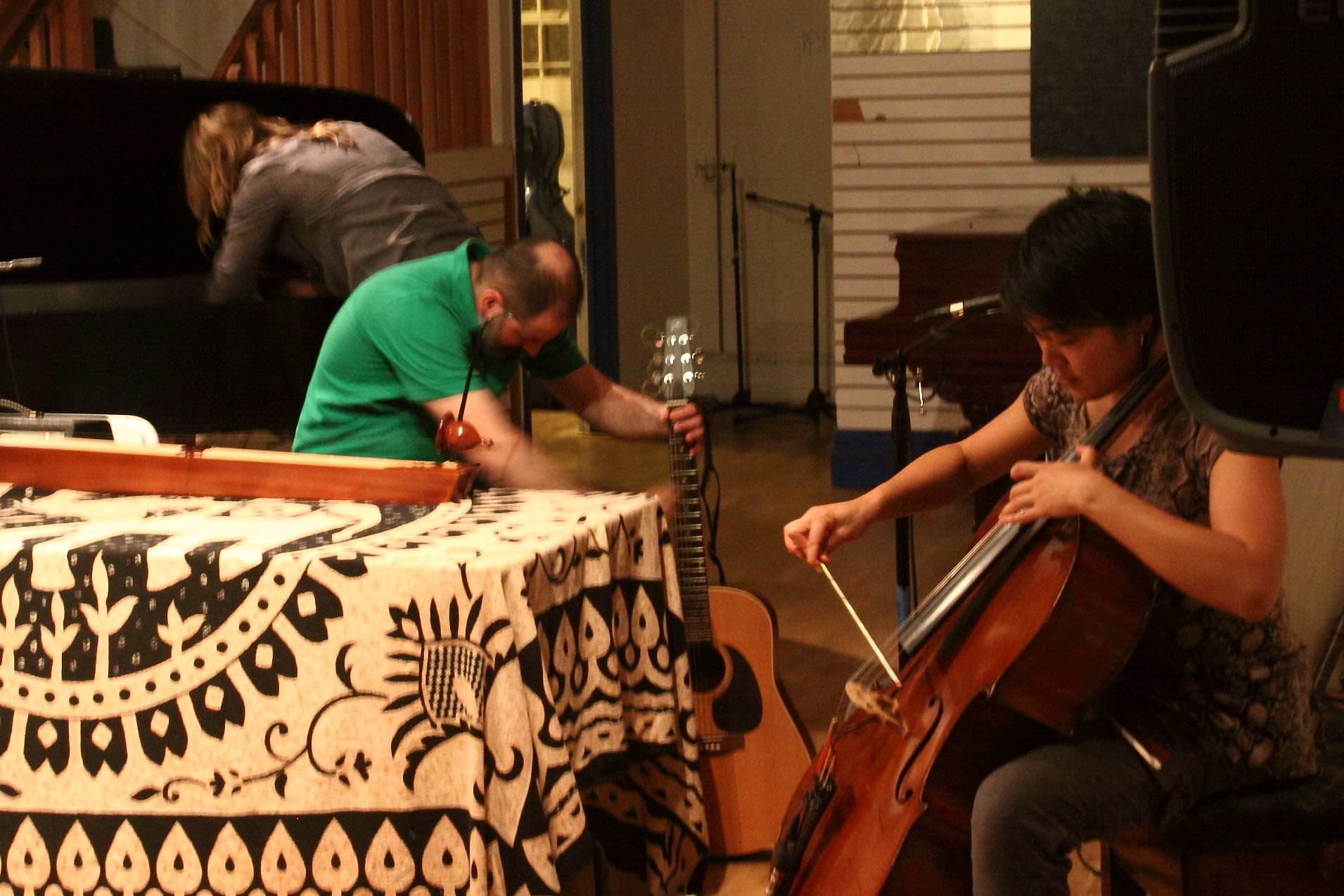
Annie Lewandoski, Luciano Chessa and Theresa Wong in a trio improvisation

Annie Lewandoski, Luciano Chessa and Theresa Wong in a trio improvisation

What concluded this unusual program was a trio for all three performers. Lewandowski with her prepared piano, Wong with her altered cello, Chessa with his signature Vietnamese Dan Bau and guitar. All three also sang. The performance started sparely as each introduced suggestions or themes for the improvisation and reacted to them.

Lewandowski gave a much fuller exposition of the possibilities of her instrument playing the keyboard, inside and all around the piano as well as singing. Wong also seemed to use a wider amount of sound possibilities in her playing. Chessa played the traditional Vietnamese folk instrument in all but traditional ways using devices to excite the strings and focusing on tuning and even some percussive possibilities. At one point he left the table where he was performing to pick up an acoustic guitar. After picking a few notes he walked to the back of the stage area and ascended a stair case leading to a sort of balcony that surrounded the performance space. It was at this point that he began softly singing what sounded like an Italian folk tune as he played the guitar in a most traditional manner. This gave a collage effect to the performance juxtaposing the most traditional kind of music making with the extended and experimental sounds.

Chessa remained on the balcony for a bit, then descended the staircase again and returned to the more unusual playing methods at first on the guitar and then back at the table on the Dan Bau. Following this Lewandowski began vocalizing a melody with sparse accompaniment that would have been perfectly at home in a scene from ‘Eraserhead’ at times. She was echoed by Wong’s extended vocal techniques at first and then Lewandowski and Wong began singing a more traditional sounding melody with beautiful harmonizations interpolating this singing at different points while still traversing their freely improvised instrumental playing supported by Chessa on the Dan Bau.

This made for a rather tranquil mood as they ended the second half of the concert. The audience was appreciative. And this writer was pleased to have found a gem of a concert experience by young, serious (but good-humored) and accomplished musicians in the eclectic world of the east bay.

Ilhan Mimaroglu, a Personal Appreciation


I remember first coming across the music of Ilhan Mimaroglu on a Turnabout LP of electronic music in the 1970s. The unusual sounding name stuck in my head. And as I continued exploring and collecting contemporary music I would occasionally run across his name.

In the 1980s I came across tantalizing descriptions of his work in various record catalogs like one which stated that the music included a recording of Che Guevara’s autopsy (To Kill a Sunrise). I remained intrigued.

It wasn’t until the 1990s that I resolved to get a more comprehensive take on his music and to obtain as much of his it as I could find. At that time I had to rely on e-bay where I was able to find a couple of CD compilations and a copy of the anti-war LP “Sing Me a Song of Songmy”, a collaboration of sorts between Mimaroglu and the Freddie Hubbard Quintet. A good representative selection of his work can currently be found on the Ubu web site as well as the Avant Garde Project. And according to the discogs web site (which lists about 58 albums in which he was involved) his LPs are selling for any where from about $10 to about $80.

Born in 1926 in Istanbul he earned a degree in law before coming to the United States. Mimaroglu studied with (among others) electronic music pioneer Vladimir Ussachevsky at the Columbia-Princeton Electronic Music Center, the prominent east coast workshop where Milton Babbitt created some of his masterpieces and where Edgar Varese, Luciano Berio, Mario Davidovsky, Charles Wourinen and other luminaries worked and studied.

Through his work at the venerable Atlantic Records, along with fellow émigrés Ahmet and Nesuhi Ertegun he produced jazz and blues albums, most notably with Charles Mingus. Here he was able to establish his own record label, Finnadar. He released his own music and that of other avant garde composers such as Luciano Berio, Anthony Braxton, Henry Cowell, Morton Feldman, Pierre Boulez, Frederic Rzewski and others. One of my favorites and a classic, in my humble opinion, is The Adoration of the Clash, a recording by pianist Doris Hays of music by Hays, Feldman and others. In short he strove to promote some difficult listening by avant garde composers of the day.

He had an interest in agitprop, art that expresses political views. (The term is a portmanteau of agitation and propaganda and was coined in the 1930s in communist philosophical circles.) Indeed much of Mimaroglu’s work has overtly political themes. In a 1975 interview with Charles Amirkhanian he expressed his distaste for folk music, particularly that of his native Turkey and that region of the world, because he says it supports oppressive regimes.

In addition to his work with Charles Mingus he is noted for having some of his music grace the soundtrack of Frederico Fellini’s ‘Satyricon’. But his music understandably reached a limited audience. His music can be harsh and is intentionally disturbing dealing with disturbing themes. But it is well crafted and has a distinctive sound. Fans of the avant garde should definitely seek out his work.

In the course of collecting his music I came to learn that Mimaroglu was also a writer along with being a composer, producer and teacher (Ingram Marshall is among his students). He died July 17th of 2012 in Manhattan. And, though anyone’s passing is a time for sorrow, it is a time for reflection and frequently resurrection by renewed interest. I hope that more of this important figure’s work will come to light in the months and years to come. RIP.

Cançonièr at the Berkeley Festival Fringe


Full moon presides over exsanguinous tales.

Last night, local early music ensemble Cançonièr performed in what was their last appearance until next year.  In the somewhat noisy parish hall of St. Mark’s Episcopal Church this four member ensemble played a slightly condensed version of a program they have been touring for the last year or so.  It was a program called ‘Black Dragon’ with music from the first half of the 15th century, the time of the reign of Count Vlad Dracula, the historical antecedent of the vampire character.

Cançonièr is a four member ensemble co-directed by Tim Rayborn and Annette Bauer.  The other two regulars are Shira Kammen and Phoebe Jevtovic.  All are amazing instrumentalists and scholars in their own right and all play in other ensembles and groupings.

Tim Rayborn is a medieval scholar , multi-instrumentalist, singer and performer.  Annette Bauer is a recorder virtuoso, multi-instrumentalist and singer.  Shira Kammen plays vielle (antecedent of the violin/viola), medieval harp and sings.  And Phoebe Jevtovic is a singer who also does double duty by playing a small bell set in some of the pieces.

Annette Bauer demonstrates her virtuosity on the recorder.

Tim Rayborn

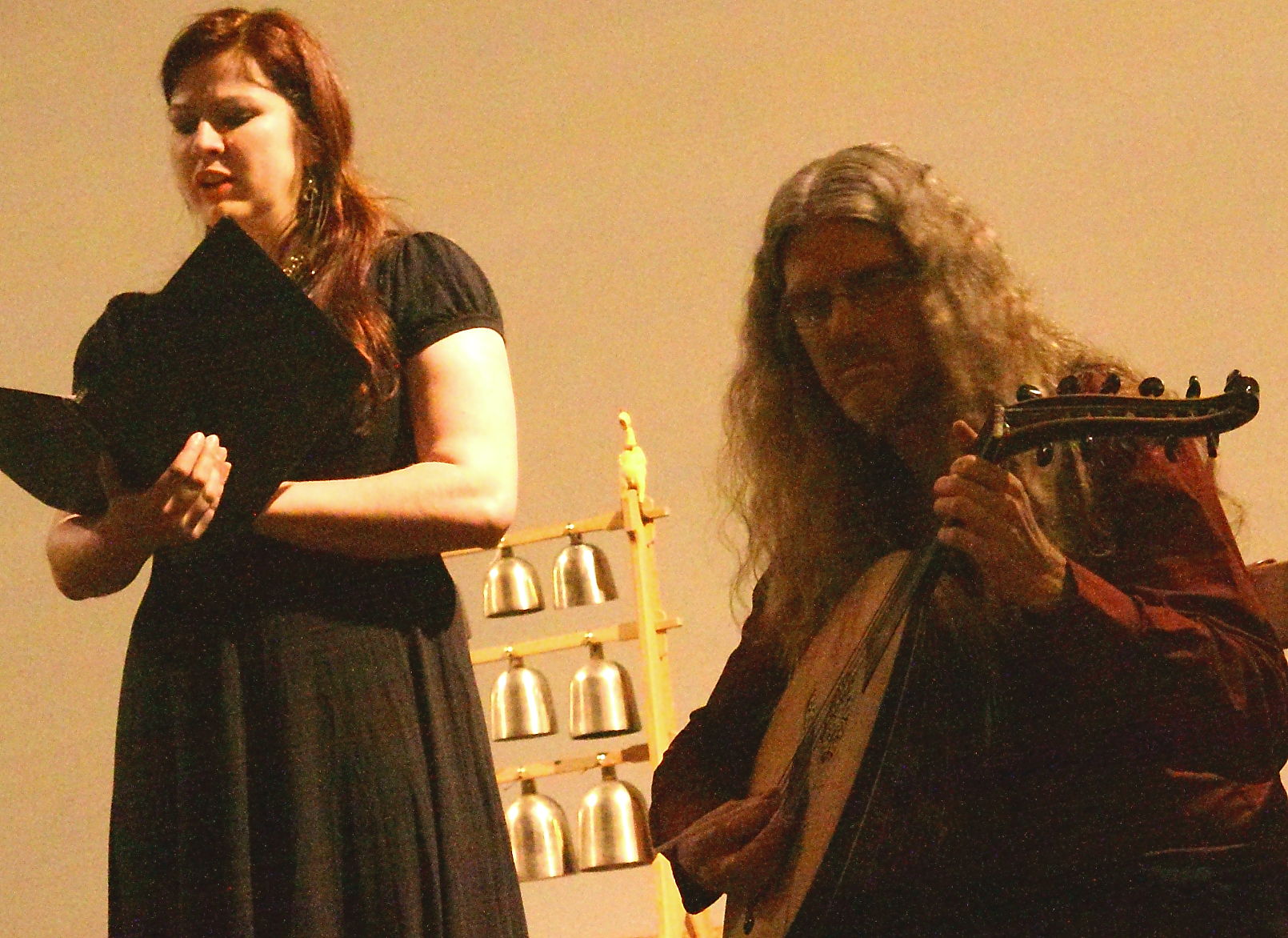
Tim Rayborn providing context and performing.

The group goes beyond their scholarship (which is excellent) and puts their performances in context.  They provide translations of the words they sing (frequently in dead or antiquated languages) and they connect with their audience with a pleasant sense of humor as well as drama.

Shira Kammen playing the vielle.

They clearly enjoy playing together and seem very connected, deriving great pleasure from making music.  And they produce a beautiful sound with their intricately crafted replicas of the instruments of the time.

Phoebe Jevtovic sings accompanied by Tim Rayborn on the lute.

One complaint.  The location of this church at Bancroft and Ellsworth makes for a bit of urban distraction provided by sirens and traffic.  And there were apparently other activities going on in the church complex which could be occasionally heard.  But the musicians and audience handled the distractions in a good-natured manner consistent with the rest of their performances.

They began and ended their intermissionless program with a narrative drama with music partly sung, partly spoken or intoned but performed with characteristic flair by Tim Rayborn accompanied by himself on frame drum and the ensemble.  This was a jaunty upbeat sounding piece at the outset that gives way to the narrative talking/singing about the infamous subject of this performance here called Dracula of Wallachia.  The language here sounded like an old German dialect and after the brief but harrowing telling of the story in speech and song (the speech gratefully rendered in English) the jaunty music of the beginning returns to conclude the piece.  One can imagine this being performed in a tavern or inn by a troubadour or group of musicians for the guests.

Rayborn then spoke to the audience providing more context by explaining that tonight’s music is from the time of the Count’s reign but that it is not known if he indeed had musicians in his court.  And for those who do not know the story of ‘Vlad the impaler’, as he was known, this is pretty grisly stuff.  Reality programming from the dark ages if you will.

There followed two more composed songs, a folk song, a traditional Romanian dance,  a heart-rending Moldavian chant passionately sung by Jevtovic and a traditional Bulgarian dance.

I have not bothered to mention the composers’ names (which were listed in the printed program) because they are very little know and would likely clutter this little narrative.  My apologies to the composers and the scholars if I have offended in my omissions.

Left to right: Shira Kammen, Annette Bauer and Phoebe Jevtovic demonstrating their vocal collaboration.

But the next piece was by a composer familiar to anyone who has taken a course in western music history, Guillame Dufay (1397-1474).  The work of this composer, who provided a lot of sacred music for the church as well as secular pieces, was so successful that his work and his name have survived the ravages of history.  The ‘Lamentio Sanctae Matris Ecclesiae Constantinopolitanae’ required the vocal skills of all four in the group as well as instrumental accompaniment.  And they did so beautifully singing, we were told, in two different languages as the piece is originally written.

There followed an Italian dance, a Byzantine secular court piece called a “kratima” (spell check is practically useless here), a medieval Russian pilgrim  song and an Ottoman Turkish piece followed by a very spirited reprise of the first piece.

The ensemble clearly enjoys their music making.

All in all a very satisfying evening and a clearly appreciative audience sent this writer out into the Berkeley night not with nightmarish images but with the tunes of this joyful performance ringing in his head (medieval earworms?).  And I popped one of their CDs in my car stereo for the ride home.  I could easily hear this again.