Blackness, Race and Music, What I Have Learned So Far


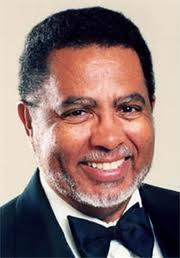
Two years ago, when I was just at the start of my blogging adventures, I decided it would be a good idea to do a few articles in honor of Black History Month. I am not black and I have no expertise in the area of black music but, in keeping with the personal perspective of this blog, I decided that my interest in these subjects is sufficient reason to express some opinions and ideas.  I chose Carl van Vechten’s portrait of William Grant Still, considered by many to the first major black composer to receive recognition in the 20th Century as my symbol for this article.  Much of his music remains unknown and little performed though there have been some significant recordings released in the last few years.

I called that first set of articles “Black Classical”. Curiously my brief article on black conductors has been one of my most read pieces (947  views as of the time I write these words).   So I continued to write on this subject in the following year. For my second set of articles I took the opportunity to look at the 50 year anniversary of the Civil Rights Act of 1964, by all measures a landmark piece of legislation. I asked a question, in part rhetorical because I had a basic idea of the answers I expected, but also to elicit opinions and to discuss issues of race and music.

I sent queries to a random set of composers and conductors and received a few very gracious replies. Comments ranged from carefully worded egalitarian musings on how black music and music by other racial minorities should be integrated and heard throughout the concert seasons to seemingly careful statements suggesting that this might not even be the right question or that it shouldn’t be asked. Not all comments were published but I am grateful to all who replied. And I have been able to continue this discussion in the various groups on Facebook.

I learned in a (yet to be published) interview with Anthony Davis some fascinating perspectives. Professor Davis did not address my question as I originally asked but he provided some valuable food for thought. It is worth noting that Davis is a composer whose politics are frequently very much in evidence in his music. In a discussion of the current state of music he commented regarding John Cage‘s apolitical stance by saying that, “John Cage’s silence is the silence of white privilege.” One could argue that taking an apolitical stance may have contributed to Cage’s ability to get grants and commissions.  Politically charged music generally does not fare as well.

In general I found more or less what I expected. The Civil Rights Act of 1964 has had little, if any, benefit for black musicians and composers. And given the ongoing killing of unarmed black men by police one must wonder if we have been going backwards as a society. But I don’t want to do a grand social critique here. That is a subject for another blog and is a bit outside of my scope at least for now.

I found some musicians who did not want to address racial and discriminatory issues. It seems the issue is too “hot” and that one could face consequences for even asking the question. And some did not feel sufficiently well-versed in Civil Rights history to make a truly informed assessment of this issues.  Perhaps it is a form of white privilege that allows me to ask such a question. We shall see if any reactions result in verbal attacks or (not likely I think) in a reduction in my readership.

What I have learned is that black classical musicians (who are not in short supply) occupy very few prominent positions in academia, in the public sphere of conductors and performers and in the representation in recorded performances of what is a rich but virtually untapped repertoire.  The inequality remains with perhaps some progress but not enough to pronounce the issues here as resolved to a truly significant degree.  But there is a vibrant community of black musicians who are working as did their predecessors to contribute to our collective culture and the discussions are both lively and stimulating.

In 2014 there was a performance by the Cincinnati Symphony of an Oratorio, “The Ordering of Moses” (1937) by R. Nathaniel Dett. The premiere performance of the piece (a beautiful and listener friendly piece of music) was broadcast live. But that broadcast was truncated, leaving out the finale when white listeners complained about music by a black composer getting so much airtime. Happily the entire piece was broadcast uninterrupted and made available in streaming format. However there is no commercial recording of this grand biblical choral work.

I was pleased to be able to review the fully staged performance in May, 2014 of Zenobia Powell Perry‘s opera Tawawa House (1984) in the unlikely venue of Modesto, California by Townsend Opera.  It was a heartfelt and beautiful production and was reviewed here.

Another interesting event in 2014 was the first appearance of three black counter tenors in a performance of a Purcell Opera in Los Angeles.  My blog on this subject can be found here.  I was pleased to make the acquaintance of Mr. Bill Doggett who has been very helpful in keeping me up on the latest developments with black musicians and composers and was the person who alerted me to this historic event.

Coming up in March at the Other Minds festival there will be performances by Errollyn Wallen and Don Byron.

I have been able to dialog with various black musicians on Facebook most notably through the groups Black Composers, The National Association of Negro Composers and Opera Noir.  Composer, performer and conductor Anthony R. Green is posting the name of a black composer every day for the month of February with examples of their work.

Some recent films have done much to tell the very unpretty history of black people in the United States including: 12 Years a Slave (2013), after Solomon Northrup‘s harrowing memoir,  Fruitvale Station (2013), a retelling of the execution style shooting of Oscar Grant at the hands of police in Oakland, California, Selma (2014), a dramatization of the 1965 march in support of voting rights (musical direction by Jason Moran).  And this trend, happily, seems to be on the rise providing artistic historical narratives to aid in the processing of the complex, shameful and painful histories depicted.  The lack of recognition by the motion picture industry supports my arguments for the poor representation and acknowledgement of black artists in general.

I have to mention that the wonderful set of recordings by Paul Freeman originally released on Columbia records remains available as a boxed set of 9 vinyl records with notes from the College Music Society now being offered at only $17.50 (that is not a typo either) via mail order.  I’m going to buy a couple of extra copies to give away as gifts.  It’s a really nice set.

Perhaps the most useful thing I learned is the egalitarian approach by conductor Michael Morgan who stated his desire that music by ethnic groups be integrated into programming on a regular basis rather than being highlighted in a given month.  (I am pleased to report that maestro Morgan will be receiving an award for his service to new music from the American Composers Forum.)  I am now using that approach with this blog in which I will continue to highlight the work of musicians and other artists whose work I find interesting and worth promoting.  So please stay tuned.


My 2014, a Summation and (sort of) “Best of…” List


The stage at Kanbar Hall stands ready to receive performers on opening night of OM 18

The stage at Kanbar Hall stands ready to receive performers on opening night of OM 18

As New Music Buff heads on into its fourth year in the online realm I find that I have a steadily increasing readership averaging 18 hits per day with an international reach of about 88 countries. I say readers, not followers because the stats provided have no way to track returning visitors but you know who you are.  And I thank WordPress for their entertaining summary published earlier here.


Last year I provided a list of my greatest hits (i.e. my most read articles in 2013) so here is a list of 2014’s top ten:

Black Classical Conductors (Black Classical Part Two)
This is a 2013 article which continues to be popular. I did an addendum called: Black Conductors, A Belated Addendum  and received a note from Tania Leon who remarked quite correctly that she is indeed a black American conductor.  Clearly I will need to expand this survey once again.

Maybe Music Remains Forever
This review of the excellent newly released Martin Bresnick CD went the equivalent of viral for my blog and I was pleased to have discovered the work of this wonderful American composer.

Primous Fountain World Tour Begins in Moldova
This relatively little known living black American composer was a child prodigy whose second symphony was commissioned by Quincy Jones had his sixth symphony premiered in Moldova in 2014.

Tawawa House in Modesto?
I was granted a comp ticket to see this really great performance of a little known 20th century opera by a black female American composer, Zenobia Powell Perry.  It was a great experience, a passionate, entertaining performance and put Modesto on the musical map for me.

Other Minds 18, Three Nights on the Leading Edge
Curiously this review was read more than the one about the 2014 Other Minds 19. More to come about the upcoming Other Minds 20.  For anyone who doesn’t know this is my favorite new music festival.

Far Famed Tim Rayborn Takes on the Vikings
This article about a 2013 performance by this very talented multi-instrumentalist, singer and scholar/historian continues to be popular. I’m hoping to catch another of his performances in 2015.

Black Composers Since the 1964 Civil Rights Act: Primous Fountain
I started in 2013 writing an occasional series of articles for Black History Month. I had no idea how popular this would become. The theme for the 2014 series is given in the title and you can rest assured that I will continue the series in 2015.

Tom Johnson and Samuel Vriezen, Great New Recording
A review of a crowd sourced recording project and one of my favorites of 2014.

Black Composers Since the 1964 Civil Rights Act
This is the introductory article for the 2014 series. Many thanks for the comments and support on this article and its successors.  I plan to give my summation of the various responses on this received both on and off the books.

Abraham Lincoln and the Avant Garde
This is one of an ongoing series of articles on political expression in music. It was after I friended Dorothy Martirano on Facebook and mentioned this piece that the article got a few new readers. Perhaps I should have mentioned the composer in my title.  Kudos to the late great Salvatore Martirano, gone too soon and too little known even now some twenty years after his passing.


SOME OF MY FAVORITES FROM 2014

Now regarding my personal favorite recordings of 2014 I have to insert a disclaimer to the effect that I make no claim whatsoever to this list being comprehensive or representing anything more than a few of my personal favorite recordings encountered in this past year. My apologies in advance to those I missed. I hope to catch up some day. So, in no particular order:

Mysterienspiel 2012

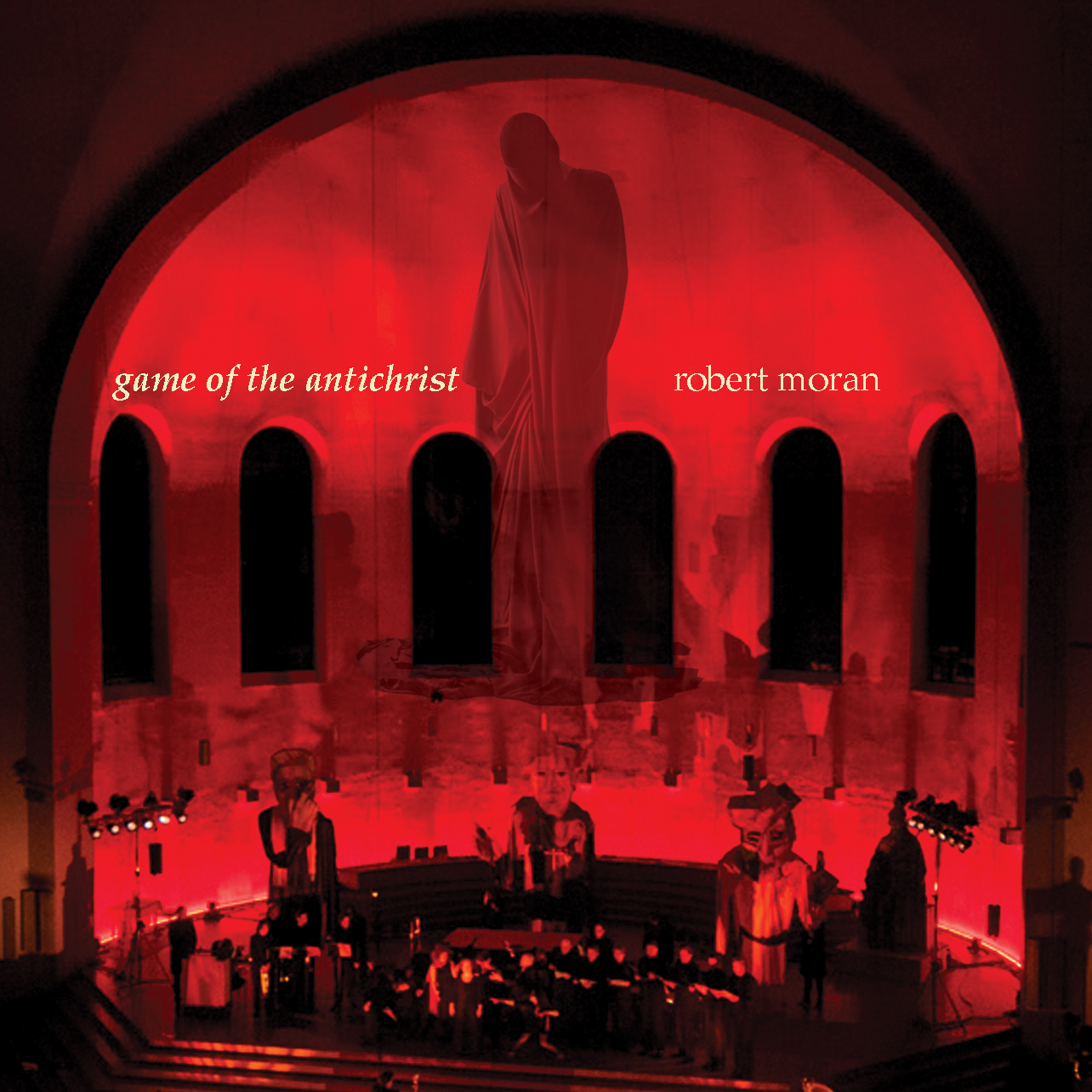
Game of the Antichrist by Robert Moran (Innova 251)
I promise a more comprehensive review soon but this is a great CD by a too little known American composer.  Mr. Moran recommended the disc to me after I wrote to him praising his wonderful “Trinity Requiem”.  I plan a more comprehensive article soon.  Meanwhile here is a link to a performance on Vimeo.

AZ spread

Alcatraz/Eberbach by Ingram Marshall and Jim Bengston  (Starkland S-2019)

This DVD is essentially the completion of a collaboration of photographer Jim Bengston and composer Ingram Marshall.  As such it is the most complete artistic statement superseding the audio only release (still worth having by the way) from some years ago.


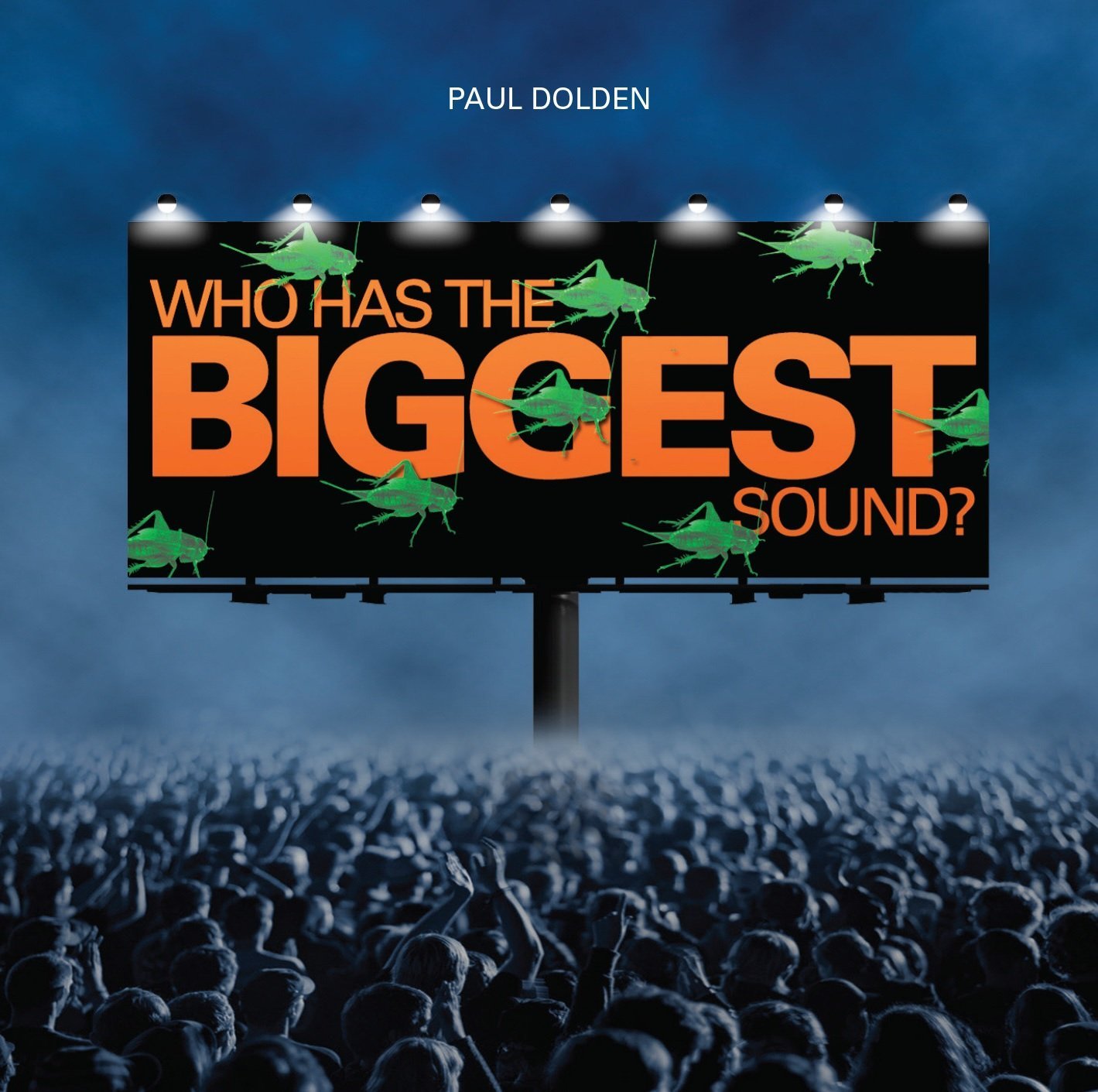
Who Has the Biggest Sound? by Paul Dolden. (Starkland ST-220)
A difficult to categorize recording that brings two major works by this (previously unknown to me) Canadian composer to the listening audience. I reviewed this disc here.  I am still working on absorbing its subtleties.

221CoverB

Prayers Remain Forever by Martin Bresnick (Starkland ST-221)
In addition to providing me with quite a few readers the opportunity to review this recording introduced me to the work of this too little known living American composer.  My review garnered quite an amazing amount of readers as well as an appreciative response from Mr. Bresnick himself.  And now I find myself buying his other recordings.  Really great music.


Album cover

Album cover

Notes from the Underground by Anthony Davis. (BMOP sound 1036)

I have been a fan on Anthony Davis and his music for some years now and I was pleased to be able to review this disc.   I  was later able to obtain an interview with Professor Davis which will be forthcoming later this year.

download

Tom Johnson/Samuel Vriezen Chord Catalog/Within Fourths, Within Fifths. (Edition Vandelweiser)

I eagerly reviewed this crowd sourced CD in which I was proud to be one of the contributors to its production.  It is only the second recording of Johnson’s landmark of minimalism and an opportunity to hear the work of the fine composer/performer Samuel Vriezen.

basketmonk

Basket Rondo/Jukebox in the Tavern of Love by Meredith Monk/Eric Salzman. (Labor LAB 7094)

This Labor Records release would have escaped my attention were it not for my having run across it while researching another new music article.  New music aficionados might remember Eric Salzman for earlier works such as “Civilization and It’s Discontents” and his involvement with Nonesuch records or one of his many other significant involvements in the new music scene over the last 40 years or so.  This disc is the première recording of Meredith Monk’s “Basket Rondo”, one of her best realized new works as well as the première of a great new sound/music drama by Salzman.  A more thorough review is in the works.

howardhersh2

Something by Howard Hersh ( Snow Leopard Music 888295062350)

Mr. Hersh kindly sent me this CD for review which will be forthcoming but it easily makes it to my favorites list for 2014.

webreaknonclass

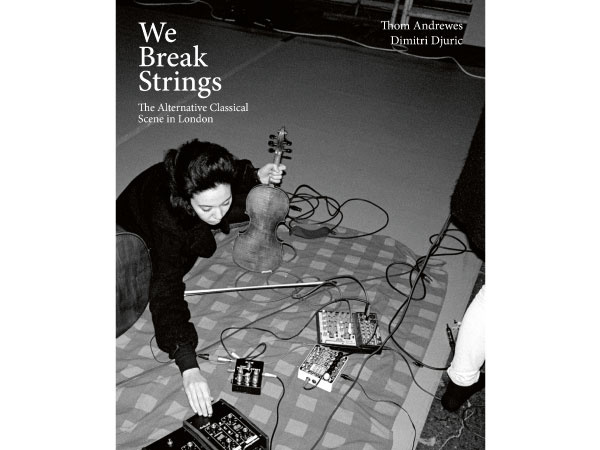
I also have to mention another crowd sourced project, “We Break Strings” by Thom Andrews and Dimitri Djuric, a book about the “alternative classical scene in London”.  The book which includes a CD sampler languishes in my “to be read” stack but my initial perusal left me with the impression of a beautifully conceived and executed volume which has much to offer the musically curious.  More about this book in a future blog.


Maybe Music Remains Forever, A New Martin Bresnick Disc


221CoverB

This latest release from Starkland adds significantly to the discography of the Yale based composer Martin Bresnick.   Born in 1946 in the Bronx, New York, he studied at  the University of Hartford (B.A., 1967), Stanford (M.A., 1968; DMA, 1972) where he studied with electronic music pioneer John Chowning and Györgi Ligeti.  He also studied with Gottfried von Einem in Vienna (1969-70).   He has taught at the San Francisco Conservatory of Music, Stanford University  and Yale where he is now a professor of composition.  Bresnick is a member of the American Academy of Arts and Letters and has been the recipient of numerous prizes and awards.  His wife is the wonderful new music pianist Lisa Moore whose work with Bang on a Can as well as her solo efforts have made many valuable additions to new music recordings.

Bresnick_Martin

Composer Martin Bresnick

I had heard of Bresnick but had not yet sampled his music so the opportunity to review this disc prompted me to follow-up on my long-planned intent to investigate the work of this American composer.  Not wanting to judge him just from this disc alone, I obtained  for comparison the CRI recording which contains his second and third string quartets and a couple of other chamber pieces for strings which range from 1973 to 1994 in their composition dates.  As I listened to both that disc and the one which is the subject of this review I found myself increasingly intrigued with this unique musical voice.

As it turns out the unsuspecting consumer may have already been exposed to this man’s work in one of several film scores including two of the Cadillac Desert  series, The Day After Trinity and an Academy Award nominated short from 1975, Arthur and Lillie.  The most recent film score listed on his site was for The Botany of Desire, after Michael Pollan’s best-selling book on human interactions with food.   I must confess that I don’t really recall the music from these films but I will be listening closely next time I screen them.

The CRI disc consists of Bresnick’s earlier works for strings.  It is an enjoyable if more an academic musical experience.  But the present disc, Prayers Remain Forever consists of more recent compositions ranging from the 2010 Going Home to the 2012 Ishi‘s Song.  These are much freer compositions concerned more with expression than form.  David Lang, who wrote the liner notes on the inside of the gatefold, describes them as being “deeper and more personal.”

A look at Bresnick’s starting places for these pieces gives a clue as to their nature.  The composer, writing in the booklet that comes with the disc, cites Kafka, Goya, Ishi (the last of the Yahi-Yani Indian tribe), mortality, religion and his own emotional response to having visited his ancestral home in Belarus.  All in all a somber, elegiac set of pieces that deal with deeply personal emotions and memories.

Tracks 1, 3, 5 and 6 were recorded at the Morse Recital Hall, Sprague Hall at Yale University by Eugene Kimball.  Tracks 2 and 4 were recorded at Firehouse 12 in New Haven, CT by Nick Lloyd who also mastered this disc.

The first piece on the disc, Going Home-Vysoke, My Jerusalem (2010) is scored for oboe, violin, viola and cello.  It was inspired by the composer’s experiences having visited the ancestral home of his family.  He speaks of remembering the stories he heard from his grandparents of the “alte heym” (Yiddish for old home) and the suffering they endured, the murder of his great grandparents, the destruction of the town.  Bresnick, who is himself a trained oboe player, weaves a beautiful, though painful, picture here.  This could conceivably be a film score to the images that are in the composer’s memories.  It is, for this writer the most poignant and personal of the pieces on this recording.  It is beautifully played by an ensemble who call themselves “Double Entendre” with Christa Robinson, oboe; Caleb Burhans, violin; John Pickford, viola and Brian Snow, cello.

Ishi (ca. 1860-1916)

Ishi (ca. 1860-1916)

The second track, Ishi’s Song, was inspired by an actual recording of Ishi, thought to have been the last of his tribe of Yahi-Yani Indians of Northern California.  Ishi lived out his life at the University of California at Berkeley under the care of anthropologist Alfred Kroeber and remains a beloved figure to many especially in the San Francisco  bay area .  Ishi recorded a song he that he had been taught and it is this song that forms the basis (or cantus firmus according to the composer) of this piece for singing pianist.  Lisa Moore is no stranger to the repertoire for speaking or singing pianist having recorded Frederic Rzewski’s masterful De Profundis (1992).  Her talents are put to good use here in this virtuosic set of variations on the haunting tune.

Kafka at the age of five

Kafka at the age of five (Photo credit: Wikipedia)

Josephine, the Singer (2011) is perhaps the most unusual piece here.  It is inspired by the Kafka story of the same name which is about a mouse that can sing.  This piece is a significant contribution to the solo violin repertoire.  It is an expressive piece in a single movement which is played with an easy sense of virtuosity and expression by violinist Sarita Kwok.

Strange Devotion (2010) is a lyrical piano piece sensitively played by Lisa Moore.  Bresnick’s inspiration, according to his notes in the accompanying booklet, state that he is here depicting a one scene from Goya’s horrific set of etchings, Disasters of War in which a donkey pulls a cart holding a coffin as people kneel by the roadside while it passes.  The “strange devotion” to which he refers is the devotion to religion.  The mood here is not one of cynicism it is more like a lament.

A Message from the Emperor (2010) is another piece based on Kafka.  This piece is scored for two speaking percussionists who play marimba, vibraphone and small tuned drums.  This little narrative follows in the same basic tradition as the speaking pianist piece.  The musicians speak sometimes separately, sometimes together coordinating their substantial duties on their instruments as well.  The story tells of an important message that, as is characteristic in Kafka’s absurdist world, can never actually be communicated.  It’s not clear if this (or, for that matter, the other tracks on this disc)  is intended as political protest music but the analogies are certainly there if the listener chooses to apply them..

yehuda_amichai2

Yehuda Amichai (1924-2000)

The last work here is inspired by “Gods Come and Go, Prayers Remain Forever”, a poem by famed Israeli poet Yehuda Amichai (1924-2000).  One  line of the poem, “Tombstones crumble” provides the inspiration for the appropriately somber cover art while  the music at hand, Prayers Remain Forever (2011) chooses perhaps a more optimistic line from the poem.  Again we have a deeply felt emotional expression here expertly interpreted by TwoSense  (Lisa Moore, piano and Ashley Bathgate, cello).


Gods Come and Go, Prayers Remain Forever

I saw in the street on a summer evening
I saw a woman writing words
On a paper spread on a locked wooden door,
She folded it and slipped it between the door and the doorpost
And went off.

I didn’t see her face or the face of the man
Who will read the writing and not the words.

On my desk lies a rock with the inscription “Amen,”
Piece of a tombstone, remnant of a Jewish graveyard
Ruined a thousand years ago in the city of my birth.

One word, “Amen” carved deep in the stone,
Hard and final, Amen to all that was and will not return,
Soft Amen: chanting like a prayer,
Amen, Amen, may it be His will.

Tombstones crumble, words come and go, words are forgotten,
The lips that uttered them turn to dust,
Tongues die like people, other tongues come to life,
Gods in the sky change, gods come and go,
Prayers remain forever.

(found on http://jpbaird.com/2013/11/)

Perhaps these non-literal musical expressions here can be said to be poetic and, like the prayers of Amichai’s poem may even last forever.  At least that seems to be the optimistic point Bresnick seems to make here.  This is a beautiful recording with talented and dedicated musicians that will continue to make it to my playlists.  And I am now compelled to seek out more by this wonderful composer.

Black Composers Since the 1964 Civil Rights Act


In this, the 50th anniversary year of the landmark 1964 Civil Rights act I have decided to do a survey of black composers who have come of age in the aftermath.  The push for equal rights in the way people are treated, given access to voting, education, business and financial opportunities was the spirit of that legislation.  Though many speak of a “post-racial” America it is clear from any fair analysis that we have a long way to go.

President Lyndon B. Johnson meets with Civil R...

President Lyndon B. Johnson meets with Civil Rights leaders Martin Luther King, Jr., Whitney Young, James Farmer (Photo credit: Wikipedia)

I am beginning a series of articles in honor of Black History Month and in honor of this legislation which attempts to address this inequality. Each article will feature a composer or composers whose work I personally find interesting and worth promoting and which was written or premiered in or after 1964.  I will not necessarily limit myself to Americans both because that would be unnecessarily constricting and inconsistent with the spirit of Black History Month and because non-American black composers suffer similar obscurity and may have even benefited from the 1964 legislation.

Civil Rights Act of 1964

Civil Rights Act of 1964 (Photo credit: Wikipedia)

Whether the legislation has improved the opportunities for black composers is, of course, open to debate but the quality of these artists stand alone on their own merits.  They may have had opportunities not available to their predecessors and this may be a positive result of this legislation.  But the fact that awareness of their work is limited and promoted in relatively obscure contexts such as this blog suggests that true equality in the area of recognition of artistic merit remains elusive (though the availability of recordings of the music of black composers has certainly increased) .  Curiously the United States has chosen the shortest month of the year to celebrate Black History whereas England, who abolished slavery before the U.S., celebrates it in October.  Yes, it’s only 3 days, but the irony is hard to miss.

The pioneering work of musicologist Dominique-Rene de Lerma has done a great service in promoting the work of black composers internationally.  He was involved in the production of the landmark series for Columbia Records along with the great (now retired) conductor Paul Freeman recording a variety of music from black composers world-wide. I had discussed this set in a blog last year and it is worth mentioning that the complete set of recordings has been reissued on 9 vinyl discs as a result of a Ford Foundation grant and remains available through the College Music Society in Missoula, Montana for $35.  This beautifully produced box set deserves an honored place in any record collection.

This pioneering set has inspired similar series by Albany Records and Cedille Records which have made recordings available of some very attractive music of black composers which deserves a wider audience.  It is largely these sets and the writing of Professor de Lerma which serve as the source for the series I am doing on this blog.

The internet site africalssical blog is also a very useful resource which is updated frequently and reports the work of black musicians working in the so-called classical world.  It is difficult and perhaps superfluous to try to separate jazz and classical so I will include composers without concern for specific genre categories except, perhaps, pop composers whose work is well-represented in the mainstream.

Pioneering black musicians like Natalie Hinderas, Martina Arroyo, Marian Anderson, Dean Dixon, William Grant Still and their like paved the way for their successors such as Kathleen Battle, Jessye Norman, Paul Freeman, George Walker and others whose stars became visible to the casual onlooker.  Of course there are fine black classical artists whose talents remain too little known.  How many people know Awadagin Pratt, Mark Doss, Michael Morgan and other active black musical artists?  It takes much more work for listeners to find and appreciate their talents.

It takes even more work to find black composers, especially if they are not also performers.  Most people, even most musicians, would have difficulty naming a single black classical composer.

I contacted several prominent black musicians to pose the question of how the Civil Rights Act of 1964 has impacted black classical composers.  To date I am pleased to say that I have received two gracious replies.  The first is from Michael Morgan who currently serves as conductor of the Oakland East Bay Symphony, the Sacramento Philharmonic and the Festival Opera in Walnut Creek.  He has numerous recordings to his credit as well.  Maestro Morgan replied as follows:

Michael Morgan (1957- )

Michael Morgan (1957- )

“I don’t believe the 64 Civil Rights Act has impacted black composers directly, however, the national conversation it inspired did cause performing arts groups (and their philanthropic supporters) to look for new ways to expand their audiences into communities not traditionally as well represented in concert halls. Orchestras are still making efforts (some more sincere than others) to connect with various minority communities. Unfortunately, rather than sprinkle such efforts throughout their seasons, some have opted for the annual Martin Luther King or Black History Month (or Cinco de Mayo, or Chinese New Year, etc. etc.) concert resulting in less sustained contact than might otherwise be possible. Such concerts have, however, been something of a boon for black composers, performers and conductors who find themselves at least included on orchestra programs on those annual occasions.

There may have been a more direct impact on the integration of some concert halls in particularly segregated cities, but the performing arts have historically been somewhat ahead of society in general in terms of promoting fully integrated events, at least in communities where there was significant acceptance of such integration.”

Morgan’s practical approach to programming is evident here and the point is well-taken that consistent programming of minority composers would result in a more sustained impact than simply having focused efforts during given months or weeks.  In fact this notion has convinced me that my blogs on the subject might be more effective if I were to spread them throughout the year, something which I will now incorporate.  My previous blog post on black classical conductors which included Maestro Morgan has been one of my most frequently viewed posts and I will expand on that subject in the months to come.

Adolphus Hailstork

Adolphus Hailstork

The second reply was from eminent composer Adolphus Hailstork who was the subject of my first blog post for black history month from last year.  He replied very thoughtfully as follows:

“Fifty Years After the 1964 Civil Rights Act

Having grown up in New York State and not experienced “legalized” segregation as practiced in the South, I had enjoyed as a youth, all the rights and privileges of American citizenship due me. There were no “colored” this and “white” that signs or classrooms, or lunch counters, etc. So the Civil Rights Act of 1964 did not have a direct effect on my life at that time.

(I much later came to appreciate the value of the changes in the south when I came to live there as a working adult.)

Actually, it was the assassination of Dr. King that opened doors to my beginning my doctorate degree that same year when I got out of the army (1968).

Also, that tragic event influenced the unfolding of my career, because it led to an interest in the music of African-American classical composers for the honoring of Dr. King’s birthday celebration in January and, by extension, the heightened interest in such music during the February Black History Month observance.

I believe the history of African-Americans is tragic, heroic, triumphant, and, of course, filled with awesomely dramatic stories. It is an honor to attempt in some small way to pay tribute through music to our story.”

Clearly Dr. Hailstork notes the difference between his experiences in the north where he was born and was able to see the profound contrast he experienced working in the south at Old Dominion University in Virginia particularly during the early civil rights struggles and their aftermath.  The emotional impact of the assassination of Dr. Martin Luther King in the same year he concluded his military service  is noted as a formative issue as well.

One can easily hear the deep emotional impact of which he speaks in works like his second symphony from 1999 which reflects his feelings after having visited the slave markets of West Africa and his American Guernica (1983) which is about the Birmingham 16th Baptist Church bombing which killed 4 little girls in 1963.  Other works such as his Epitaph for a Man Who Dreamed, In Memoriam Martin Luther King, Jr. (1979) also reflect the impact of these events on him personally and reflect what he describes as his feeling of honor in being able to pay tribute to these tragedies describing them aptly as “our story”.

I think it is important to begin to see the tragic and triumphant events of the civil rights era as our American story and not just as the story of black Americans.  Indeed these events are part of our collective history as human beings and as Americans.  These are stories that need telling and re-telling as a part of the healing process and the exorcising of the evil deeds of our collective past.

Enhanced by Zemanta

MLK, the Classical Playlist


President Lyndon B. Johnson meets with Martin ...

President Lyndon B. Johnson meets with Martin Luther King, Jr. (Photo credit: Wikipedia)

There is no doubt that rhythm and blues is the soundtrack of the Civil Rights Movement but in this, the 50th anniversary of the 1964 Civil Rights Act, I am issuing a programming challenge to the classical music world.  Hey there all you classical music stations, both internet based and broadcast.   Hey there Spotify and Pandora.  Have you explored the music written for and about the Civil Rights era?  Well, here’s your chance.

I begin my programming day with Joseph Schwantner’s “New Morning for the World” (“Daybreak of Freedom”), written in 1982.  Comparisons to Copland’s “Lincoln Portrait” are made due to the similarity in character and the use of a narrator.  The other work on this  Oregon Symphony CD under the late great James De Preist is  a work by an older composer Nicolas Flagello.  The cantata, “The Passion of Martin Luther King” from 1968, was composed in the shadow of the assassination of Dr. King and first performed in 1969.  Both works deserve more hearings for their musical accomplishments as well as for the subject of their dedications.

Description unavailable

Description unavailable (Photo credit: pennstatenews)

Moving on to the next segment I will move on to Adolphus Hailstork‘s 1978 “Epitaph for a Man Who Dreamed”  followed by William Grant 1930 Symphony No. 1 “Afro-American”.  Still is rightfully known as Dean of Afro-American composers.  A contemporary of Aaron Copland, his accomplishments established without a doubt the place in classical music for black composers.  Hailstork acknowledges his debt to the older master.  He is the next generation of black musicians contributing to the repertoire.  I will conclude this segment with Hailstork’s Symphony No. 2 which contains his impressions upon visiting the slave market areas of western Africa, places where began the shameful history of black slavery.

And on we go now to Luciano Berio’s 1968 “O King”, a chamber piece later incorporated into his masterwork, “Sinfonia” of the same year.  I program the version from Sinfonia, it’s my favorite rendering.  The vocal parts of this piece are solely comprised of the name “Martin Luther King”.  Also from 1968 there is Michael Colgrass’ “The Earth’s a Baked Apple” which is subtitled, “A Musical Celebration in Honor of Dr. Martin Luther King, Jr.” (psst, I have a bootleg of it).

We move on to afternoon programming featuring Anthony Davis’ opera, “X”, based on the life of Malcolm X.  This is  a work that deserves a new production.  Following this I will move on to Duke Ellington‘s 1943 “Black, Brown and Beige” Suite and then his “Three Black Kings” titled in French with rhyming wordplay as “Les Trois Roi Noir”.

Album cover

Album cover

The program would be incomplete without programming the wonderful Other Minds CD of Sarah Cahill’s album “A Sweeter Music” featuring a diverse collection of compositions written for her on commission by Terry Riley, Meredith Monk, Frederic Rzewski, Kyle Gann, Carl Stone, Phil Kline, Yoko Ono and The Residents.  The title is taken from Dr. King’s Nobel Prized lecture in which he refers to peace as “a sweeter music”.

Dizzy Gillespie

Cover of Dizzy Gillespie

I will end my fantasy program with Dizzy Gillespie’s “Brother K’ and Hale Smith’s “In Memoriam Dr. Martin Luther King, Jr.”  But fear not I leave you with a useful reference I have recently discovered.  “A Catalog of Music Written in Honor of Martin Luther King, Jr.” edited by Anthony McDonald.

Stay tuned for more on these subjects coming up during February for Black History Month.  Peace, Dr. King.

A mural painted on the side of the African Ame...

A mural painted on the side of the African American Museum depicts the Hough riots, the civil rights movement and a family looking towards a bright new future for the city and the community. (Photo credit: Wikipedia)


Enhanced by Zemanta

Alvin Curran at 75, Experimentalism with an Ethnic and Social Conscience


English: The American composer Alvin Curran pl...

English: The American composer Alvin Curran playing the shofar in his composition “Shofar 3,” for shofar and live electronics (2007). Photo taken at a concert of Curran’s music in Warner Concert Hall, Oberlin Conservatory of Music, Oberlin College, Oberlin, Ohio, United States. (Photo credit: Wikipedia

Alvin Curran (1938- ) is an American composer currently living and teaching in Rome whose career began as an expatriate artist working with the cutting edge improv electronics group Musica Elletronica Viva (MEV) in 1966. He turns 75 on December 13, 2013.

Curran was born in Providence, Rhode Island.  His father was a musician in a dance band and he learned to play piano and trombone early on.  He was exposed to big band music, jazz, traditional Jewish music and western classical music during his formative years.  Following his father’s example he also played in dance bands during boat crossings of the Atlantic.  He earned a B.A. in music from Brown University in 1960 where he studied composition with Ron Nelson.  He went on to complete his M.M. at Yale in 1963 were he studied with Elliott Carter and Mel Powell.

A 1964 Ford Foundation grant allowed him to go study in Darmstadt where he met the likes of Stravinsky, Xenakis, Berio, Yuji Takahashi, Andriessen, Remo Remotti, and above all Frederic Rzewski.  He joined with Rzewski,  Richard Teitelbaum and Allan Bryant, all fellow expatriate American musician/composers, with whom he formed the legendary ‘Musica Elettronica Viva‘ or MEV.  This was in early 1966 where their use of largely home made electronics in their improvisational ensemble live performances preceded the days of easily obtainable and operated electronic musical instruments. That wouldn’t begin to happen until about 1964 when Don Buchla, in collaboration with Ramon Sender, Morton Subotnick and the San Franciso Tape Music Center created the first modular instrument, the “music easel” later known as the ‘Buchla Box’ and Robert Moog on the east coast developed the “Moog” synthesizer.  Curran crossed paths with many of these people during his tenure teaching (1999-2006) at Mills College in Oakland where the San Francisco Tape Music Center had been integrated into the Mills Center for Contemporary Music.

Curran says that during all his years in Rome he met and interacted with many in the Italian avantgarde and new music circles like Franco Donatoni and Guiseppe Chiari.  He was mentored by the reclusive (think Thomas Pynchon) Giacinto Scelsi who held regular salons at his villa.  It was in these days that Curran developed his individual style further.  He lived and taught in Rome from 1966 to 1999 and was very active on the European scene.  After his teaching stint at Mills College Curran returned again to Rome.

Buchla 100 series modular synthesizer at NYU

Buchla 100 series modular synthesizer at NYU (Photo credit: Wikipedia)

In addition to electronics he uses acoustic instruments ranging from conventional instruments such as piano, strings, woodwinds, voices, etc. to the ancient shofar and environmental sounds including site-specific sound installations, multi-media works and film scores.  His works include the massive set of piano pieces ‘Inner Cities’ (1993-2010) which lasts about 6 hours in a complete performance, the early multi-media Songs and Views from the Magnetic Garden (1973), Maritime Rites (1984) written to be played by musicians in boats in various harbors incorporating, of course, the ambience of the given harbor’s acoustic properties.  Maritime Rites has been performed in its various incarnations in Central Park in New York as well as Philadelphia, Berlin and Sydney.

In a wonderful interview from 2003 with the ever vigilant composer/journalist Frank Oteri (published online at New Music Box) he was asked about the political and ethnic/religious content of his music.  Curran replied that he did not set out to express these things as aspects of himself, that the pieces  just happened due to an inspiration at the time.  He says that he is composing all the time and his influences are as wide ranging as his teachers and his milieu.  His style varies widely in part due to his many influences but also because a given style seems to work for the piece.  It sounds as though music is channeled through him.

Unfortunately, as with most expatriate composers, his music is generally less well known in his native country but there are quite a few recordings including some recent releases of some out of print recordings.  In addition there are quite a few videos on YouTube including pianist Kurt Jordan’s live performance of Inner Cities 1-13 from 2009 at Azusa Pacific University which is more than the previously complete recording by Daan Vandewalle who recorded 1-11 (as of 2010 there are 14 parts according  to Curran’s official web site).   As is frequently the case with much contemporary music YouTube provides a great resource, especially for the casual and/or cash-strapped listener.  It is a really good way to get familiar with this man’s diverse and fascinating music.

Not infrequently his music takes on sociopolitical issues as well as inspiration from the composer’s Jewish heritage.  His Schtetl Variations (1987), dedicated to Morton Feldman is an improvisatory meditation on these poor villages of eastern Europe and Russia (think of Fiddler on the Roof) which became the settings for the notorious anti-semitic pogroms. A later piano piece called 11 Schtetl Settings (1988) continues his exploration of this part of his ancestry.  Animal Behavior (1992) for sampler keyboard and optional percussion is a pretty transparent indictment of 1990s American politics.  And the list goes on.

His “Nineteen Eighty Five: Piece for Peace” (1985) involved three ensembles performing at 3 different radio stations in Venice, Amsterdam and Frankfurt (which was simulcast by all three countries) is a a sort of precursor to what is perhaps his most integrated and powerful political composition, his ‘Crystal Psalms’ of 1988.  Here the historical, sociopolitical, ethnic and even geographical are joined to the avant garde in a stunning sonic commemoration and condemnation of the fascism and genocide that characterized the horrors of the second world war.

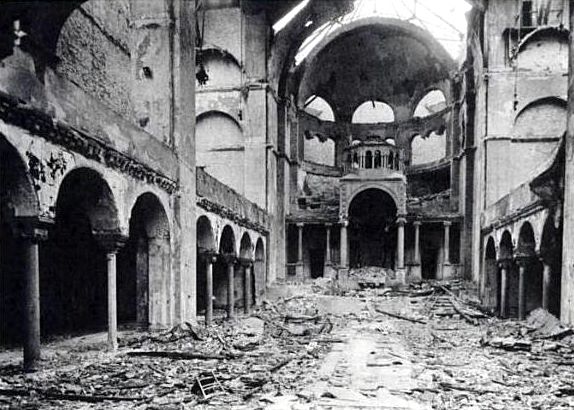
Interior of a Berlin Synagogue after Kristallnacht

Interior of a Berlin Synagogue after Kristallnacht

Seventy Five years ago this November (9th and 10th) Jewish shops and synagogues were vandalized and looted over those two nights throughout much of Nazi Germany and Austria in a most extreme incarnation of the “pogroms” that became known as “Kristallnacht” or the “Night of Broken Glass“.  It was one of the first major and overt expressions of Hitler’s genocidal plans then still being formulated. Unfortunately this event continues to be imitated by like-minded hateful individuals and groups worldwide. So the sociopolitical context of this musical work written for the 50th anniversary of that event sadly has an ongoing relevance for our contemporary world even 25 years after its creation.

At its most basic level this piece is a sort of concerto for six instrumental ensembles playing in radio stations in six different countries live mixed by the composer and broadcast throughout Northern Europe on October 20th of 1988. There is no text as such but the sounds of people praying and the apparently random Hebrew letters and German numbers are scattered throughout the piece along with environmental and found sounds on the tape Curran prepared which plays throughout the performance as a sort of political pedal point.

English: "Hebrew alphabet" in Hebrew...

English: “Hebrew alphabet” in Hebrew, modern serif typeface. (Photo credit: Wikipedia)

The liner notes of the recording describe the piece as “radio concert for six choruses; six sextets each including a quartet (violas, cellos, bass clarinets, bass flutes, trombones, tenor sax/tuba) plus accordion and percussion; tape.”  All were individually conducted with the conductors coordinated by a click track and mixed live by the composer. The recording on New World records is the document of that broadcast.

The effect is that of a collage connected by the electronic nervous system, the radio stations, which link the various performances.  The program is largely implicit here and listening to this piece evokes images that can vary from one listener to the next as any great piece of art provokes different experiences. The sound images here are not pretty and the work is very emotionally intense. Those images are guided by the tone of the music and fueled by the cryptic words and sounds mixed in with the live performances.  It is, in effect, his Mitzvah to the memories of the fallen.  You will not come away unmoved.

Kristallnacht occurred in November of 1938, a month before Curran was born but  the impact of that action continues to resound from that generation to this.  As a politically aware artist he was compelled to respond and he did so in a most emphatic, creative and powerful manner.  Perhaps it is the inherited duty of one generation to exorcise the demons and the atrocities of the previous ones.  Curran has certainly contributed most memorably to such an effort with this work.

Thank you, Mr. Curran, for your prolific and varied contributions to music and your efforts through your art to exorcise the demons of our collective past.  I wish you a happy 75th birthday and wishes for many more creative years to come.

Classical Protest Music: Hans Werner Henze “Essay on Pigs” (Versuch über Schweine)


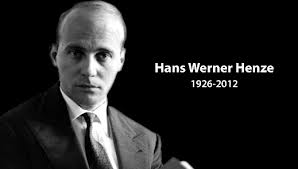
German composer Hans Werner Henze (1926-2012) left Germany in 1953 because of his dissatisfaction with German intolerance of both his leftist politics and his homosexuality. He settled in Italy where he lived with his partner and had a long, prolific career composing music for orchestra, chamber ensembles, theater, soloists and film. Much of his music was an expression of his politics.

The “Versuch über Schweine”or in English, “Essay on Pigs” of 1968 is scored for woodwinds, brass, strings, percussion, “beat organ” and electric guitar with vocal soloist. It was created at one of the composers most overtly political periods which included the Sixth Symphony (1969), El Cimarrón (1969-70) and Das Floss Der Medusa (1968). Indeed there was much political conflict in the world at this time.   The musicians have a challenging instrumental score to interpret but this is no ordinary vocal part as it calls for the extended vocal techniques of the singer for whom it was written. Henze was reportedly very impressed with having heard the Rolling Stones and this encounter appears to have influenced his musical sound as well.

As near as I can determine the work was performed only once on February 14, 1969 with Roy Hart and the English Chamber Orchestra conducted by the composer and subsequently recorded with those forces. The vocalist in the Deutsche Gramophone recording is Roy Hart as well and he appears to be an early practitioner of what we now call ‘extended vocal techniques’. He precedes the likes of Cathy Berberian, Diamanda Galas, Julius Eastman, Joan La Barbara and Meredith Monk. Monk’s students like Robert Een, Andrea Goodman and Anthony De Mare (among others) also carry on the tradition but I know of no one who has attempted this piece since Hart.

English: Photo of Gaston Salvatore

English: Photo of Gaston Salvatore (Photo credit: Wikipedia)

Essay on Pigs is a setting of poetry by Chilean poet Gaston Salvatore (1941-  ) who collaborated with Henze on several works. The music reflects the angry and sometimes hysterical tone of the poetry making this anything but easy listening.

I recall a musicologist, Dr. Richard Norton, who had corresponded with Henze, playing this piece in its entirety (some 20+ minutes) during one of his classes (at the University of Illinois Chicago in the mid-seventies). I always felt that was a sort of revolutionary act to do that. From what I recall I think I was probably the only person in the class who was already familiar with the work. The reaction of confusion or stunned silence from my fellow students was what one would expect from anyone who had not heard the piece before.

I have been unable to find any critical reviews or reports of audience reactions to performances but this is a piece that has the potential to clear a room or provoke anger.  It must have been quite a show. The piece certainly deserves a revival and I think it is a very significant piece of political music whose expressionism reflects well the issues of the times.  The problem is finding a vocalist to navigate this highly unique and unusual piece..  Any takers?

Enhanced by Zemanta

Peace through “A Sweeter Music”


President Lyndon B. Johnson signs the 1964 Civ...

President Lyndon B. Johnson signs the 1964 Civil Rights Act as Martin Luther King, Jr., and others, look on. (Photo credit: Wikipedia)

Album cover

Album cover

It is fitting that this CD, this music has been released in the 50th anniversary year of the March on Washington and just prior to the 50th anniversary of the Civil Rights Act of 1964.  The series of 18 pieces in this major commissioning project by the wonderful bay area pianist, producer and new music advocate Sarah Cahill called “A Sweeter Music”, its title taken from a phrase in Martin Luther King, Jr.’s 1964 Nobel Prize lecture.  Though only 8 composers are represented on this recording this is a fine document of some truly wonderful and heartfelt music.  And Cahill’s introductory note indicates that there are plans to record the other ten pieces as well.

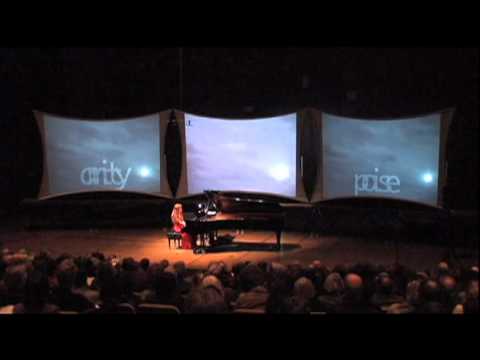
The project was planned to include video projections by Cahill’s husband, the skillful video artist John Sanborn.  The first formal performance took place on the Berkeley campus and the video projections across three screens added a dramatic perspective on the various pieces.  I was present at the first performance in Berkeley and later at a small multi-purpose hall in Point Reyes in the north bay.  At the smaller venue the projections were limited to a single screen but the images still added to the impact.  At the time of this writing Sanborn has posted some of these videos on You Tube ( http://www.youtube.com/user/sanborn707?feature=watch).

Still from one of Sanborn's videos.

Still from one of Sanborn’s videos.

Each of the recitals contained a selection of the pieces commissioned.  Sarah Cahill kindly provided the complete list which includes: Be Kind to One Another by Terry Riley, Peace Dances by Frederic Rzewski, There is a Field by Jerome Kitzke, Dar al-Harb by Preben Antonsen, The Olive Branch Speaks by Mamoru Fujieda, The Long Winter by Phil Kiline, Two, Entwined by Paul Dresher, War is Just a Racket by Kyle Gann, B’midbar by Larry Polansky, drum no fife by The Residents, Devotion to Peace by Michael Byron, Sonamu by Carl Stone, After the Wars by Peter Garland, A New Indigo Peace by Pauline Oliveros, Movement (Deep in My Heart) by Ingram Marshall, Study War No More by Bernice Johnson Reagon, toning by Yoko Ono and excerpts from Steppe Music by Meredith Monk.
The pieces represented on this recording are a diverse set including those by Frederic Rzewski, Terry Riley, Meredith Monk, Yoko Ono, The Residents, Phil Kline, Kyle Gann, and Carl Stone.  Missing from this disc, and planned for a future release, are the pieces by Jerome Kitzke, Larry Polansky, Pauline Oliveros, Preben Antonsen,  Sanborn’s images definitely enhanced the experience of the music and this writer hopes that some day this music might be released in a DVD format with those images but the pieces here stand easily on their own merits.

The disc opens with Terry Riley’s ‘Be Kind to One Another (rag)’ (2008-10).  Riley takes his title from a statement made by Alice Walker which followed the 9/11 attack on the World Trade Center.  Rather than express an anti-war stance Riley harkens to the days of his youth when he played barrel house piano music while he studied composition.  This is a jaunty and entertaining but substantial piece which expresses the wish for kindness.  It is a challenging work to play but not to hear.

‘Steppe Music’ (1997) is apparently a reworking of a 30 minute piano piece (the piece at hand lasts about 8 minutes) commissioned by Sarah Cahill for another masterful pianist, Nurit Tilles.  Meredith Monk is of course best known for her extended vocal techniques and dance/theater pieces.  Little of her piano music has been recorded and one hopes that there will be more to come.  This is a less literal contribution which, the composer says, is about “color, texture, resonance, and gesture…”.  Like her performance pieces this is music about images which evoke emotion and it is unlike any of Monk’s recorded piano music.

The seven ‘Peace Dances’ (2007/8) were written by a composer/pianist well-known for his political statements in music as well as for his virtuosic music.  Frederic Rzewski is probably best known for his massive set of variations on the protest song ‘El Pueblo Unido Jamas Sera Vencido‘ (The People United Will Never Be Defeated) commissioned in 1976 for Ursula Oppens.  His catalog contains a great deal of music with explicit and implicit political references.  Rzewski’s music sounds deceptively simple but is in fact very challenging to play.  These are part of a much larger set of compositions called “Nanosonatas”.  The dances here contain a variety of musical and political references that will entertain and frustrate musicologists for years to come but present the listener with some welcome additions to the repertoire.  Cahill plays them effortlessly and repeated listenings reveal more of the rich textures.  Rzewski’s inspiration, like that which inspired this series, is rooted in the same struggles as represented by Martin Luther King, Pete Seeger, gospel music and contemporary folk music.  The last of these dances was a birthday present for the 100th birthday of Elliott Carter.

Kyle Gann’s ‘War Is Just a Racket’ (2008) is written for speaking pianist.  He takes Christian Wolff’s ‘Accompaniments’, which was written for Frederic Rzewski in 1972 requiring the pianist to sing and speak as well as play.  It reminds this writer of Rzewski’s own ‘De Profundis’ of 1992 for speaking pianist using a text by Oscar Wilde.  Gann takes as his text a very interesting text by one General Smedley Butler who gave this speech in 1933.  Like Rzewski, Gann is no stranger to politics in his music.  This addition to the “speaking pianist” repertoire is spoken with feeling by Cahill as she pounds out the angry chords and melodies.  This is perhaps the most literal of the pieces on the disc and probably the least friendly to a conservative audience.

Sonamu (2010) was written by Carl Stone for piano and electronics.  It’s not the electronics your grandmother listened to either.  Stone uses a computer to perform “spectral convolution”, a process, the composer explains, which isolates various aspects of the sounds to “…shape and enclose the pitch and harmonies of separate voices…”.   The intention stated by Stone is to evoke ghosts and memories of the aftermath of war.  This most complex and abstract piece reminds me of the ghost electronics compositions by Morton Subotnick.  This piece requires repeated listenings and would no doubt be enhanced by Sanborn’s images.

Composer Phil Kline describes a process of using various musical fragments edited together to evoke images of living in a land under siege.  Kline was an eyewitness to the World Trade Center disaster and his personal experiences contained metaphorically in ‘The Long Winter’ (2009) have a memorial-like quality.  In the liner notes he describes his fantasy images leading to the realization that he (and we) do live in a land (or perhaps a world?) under siege.  The piece is in two sections ‘Crash’ and ‘Embers’.

Yoko Ono’s ‘Toning’ (2008) purports to be an effort to heal both performer and audience through sound.  As with much of her work this piece has an anti-art quality like the work she produced for the Fluxus performances.  This is perhaps the technically simplest of the pieces on this recording.  I think that reactions will vary to this music much the way that they vary to Ono’s oeuvre.  Those familiar with her work will see the threads that connect and others may simply dismiss her work entirely.

The enigmatic San Francisco based group “The Residents” aspire to anonymity as individuals in the hope that their audiences will focus on their art.  This is clearly one of their performance art pieces and is fairly explicit in its anti-war stance.  It consists of recorded voices and sounds in addition to the live piano performance and demonstrates the eclectic range involved in these commissions.

This CD was recorded at the recital hall at the University of California at Santa Cruz by Tom Lazarus.  It was released as another of the fine recordings of contemporary music on the Other Minds label with Charles Amirkhanian of ‘Other Minds’ as executive producer.  It is a major addition to the recordings of this political classical genre and a significant contribution to the solo piano repertoire as well as a snapshot of an eclectic range of contemporary music of the moment.  Highly recommended.

Abraham Lincoln and the Avant Garde


Abraham Lincoln’s speeches and writings are well liked and frequently quoted in many contexts. Perhaps their most famous use in music is that of Copland’s ‘Lincoln Portrait’ for narrator and orchestra. And without doubt his most famous words are those of the ‘Gettysburg Address’ first read on Thursday November 19th, 1863 at the dedication of the Soldier’s National Cemetery in Gettysburg, Pennsylvania. That’s 150 years ago.

20130409-215729.jpg

Those words were brought to the service of the avant garde in 1967 when Salvatore Martirano employed them in his overtly political ‘L’s GA’ for “gassed masked politico”, “helium bomb”, three 16mm movie projectors and two channel tape recorder. The piece was updated to a version for three video tapes played simultaneously on three monitors sometime in the 1980s.

<code><br />
20130409-210826.jpg

Salvatore Martirano (1925-1999) was a major pioneer in electronic music. He graduated from Oberlin College in 1951 where he studied composition with Herbert Ellwell. In 1952 he completed a masters degree at the Eastman-Rochester School having studied with Bernard Rogers. He studied with Luigi Dallapicola in Italy from 1952 to 1954 on a Fulbright Fellowship.

While his early work is influenced by the twelve tone traditions which also characterize Dallapicola’s music nothing in his various teachers’ work could possibly prepare one for the music he would produce in his mature works. His long association with the University of Illinois afforded him access to technology and developers with cutting edge ideas that he absorbed and mastered. Until a fair assessment is made of the work and achievements of the computer labs there it is difficult to say if they exceeded that of the Columbia Princeton lab (with the brilliant Milton Babbitt at the punchcards).

The piece at hand in this essay defies verbal description and is not easy listening. It utilizes the text of the Gettysburg Address read by a man in a gas mask breathing helium (which raises the pitch of his voice in a cartoon-like way), 3 sixteen millimeter film projectors and electronic score on tape. The original recording lasts some 25 minutes. I recall that the version for three videotapes on simultaneously running monitors lasted about the same time. But the experience is one of a complex wall of sound and images that is unrelenting until it actually ends. It was embraced as a sort of “cri de coeur” in sympathy with the escalating anti-war protests of the time.

Unfortunately the posts on you tube do not contain the video footage which definitely enhances the experience of this true multimedia masterpiece. And it is a prime example of classical political protest music. It is and should be disturbing.

But even in retrospect I doubt that the passing of time can be seen to have diminished the importance of this composition both as music and of sociopolitical protest (that never seems to become irrelevant actually). This work certainly deserves to be heard and experienced much more widely and studied along with Martirano’s other mature works and the body of work which has come out of the hybridization of music and technology of that era.

Hiroshima After the Fact


English: Photo of Polish composer, Krzysztof P...

English: Photo of Polish composer, Krzysztof Penderecki (Photo credit: Wikipedia)

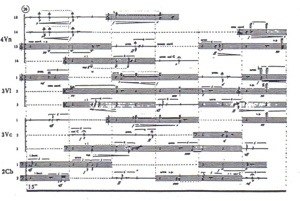
Krzysztof Penderecki’s ‘Threnody to the Victims of Hiroshima’ was an experiment in extended techniques for string instruments and the use of tone clusters written in unconventional musical notation using specialized symbols for the extended techniques and marking time in seconds rather than a tempo and metric divisions. It is scored for 52 solo strings which play sounds, not melodies for the indicated durations in the score.

20130409-165958.jpg
It was written in 1959 and was originally titled, ‘8’ 37″‘ perhaps a reference to John Cage’s ‘4’ 33″‘ of 1952. The composer had just won prizes for three works (Strophen, Psalms of David and Emanations) at the Warsaw Autumn Festival earlier that year. The Threnody effectively launched his career as a composer.

20130409-165841.jpg

Penderecki states that he simply changed his mind about the title and decided to dedicate it as “Threnody for the Victims of Hiroshima”, a title which was certainly topical in the Cold War paranoia of the times about nuclear holocaust. It is under that title that the piece has received numerous performances and recordings. It was used briefly in the film, ‘The Lives of Men’.

Penderecki’s music has been used in films such as ‘The Exorcist’ (which first introduced me to this composer), ‘The Shining’ and ‘Shutter Island’ among others. But the sound world or sonic signature of his work has been very influential.

He has not been largely political in his musical output but the ‘Lacrimosa’ (1980 later incorporated into the ‘Polish Requiem’, 1980-2005) was commissioned in commemoration of the Solidarity struggles which signaled the end of communist rule in Poland. His composition, ‘Dies Irae’ (1967) has been subtitled the ‘Auschwitz Oratorio’ and is dedicated to the victims of the infamous Nazi death camp.

Political Classical Music in the Twentieth and Twenty First Centuries


My earliest listening adventures in new music, the ones that shaped my present interests, included the early Odyssey vinyl which contained Steve Reich’s tape piece of 1966, “Come Out”, Frederic Rzewski’s 1974 recording which contained Attica (1972) and Coming Together (1972) and the RCA budget disc of new music which contained Penderecki’s harrowing Threnody for the Victims of Hiroshima (1960). In addition to satisfying my fascination with new sounds they were also pointedly political in their messages.

In late 2008 or very early in 2009 I read of a recital to be held at Mills College premiering some of the pieces in a set of piano pieces commissioned by Sarah Cahill called, “A Sweeter Music”, a title taken from a speech by Martin Luther King. I was already familiar with Cahill’s fine pianism and her support of new music. Pieces had been commissioned from Meredith Monk, Frederic Rzewski, Terry Riley, Yoko Ono, Bernice Johnson Reagon, Pauline Oliveros, Peter Garland, Kyle Gann, Paul Dresher, Carl Stone, Ingram Marshall, Jerome Kitzke, Phil Kline, Mamoru Fujieda, Larry Polansky, Michael Byron, The Residents, and Preben Antonsen. I think this was a significant set of commissions and I am happy to read on Cahill’s website that a recording will be forthcoming from Other Minds records.

The recital was a very informal affair in a small concert room at Mills. Many of the pieces were in stages of rehearsal and none of them had the later added multi-screen video projections which were created by Cahill’s husband, the fine videographer and filmmaker, John Sanborn. The audience was small and only a few pieces were actually played but Cahill discussed the project plans and afforded the opportunity for the audience to examine the actual scores.

Needless to say I enjoyed the evening. I spoke with Ms. Cahill and asked if she knew of any books on the subject of political classical music. She concentrated seriously for a moment, searching her knowledge of the literature and replied, “No, I don’t know of any, you should write one.”

That idea has continued to intrigue me so I have decided to begin a series of blog posts on what I do know about contemporary classical music written with the intention of stating a political or social issue. It didn’t take much thought or research to know that this would be a big topic.

At some point I will need to construct a sort of taxonomy of the types of political music to more widely define the area. Fo)r now, though, I decided to limit my research to music written after 1950 by non-pop composers (much has been written about folk/pop political music) which was written with the intention of stating and/or influencing a political or social issue.

I found a great article by Kyle Gann (he always seems to know about music I like, including his own) which appeared in 2003. It is a fine starting point for these efforts.

I will begin by trying to construct a list of such music and, in addition to the pieces listed above, I would suggest  Rzewski’s magnum opus The People United Will Never Be Defeated (1975), Salvatore Martirano’s L’s GA (1968), Karel Husa’s Music for Prague 1968, Luigi Nono’s Intolleranza (1960), Hans Werner Henze’s Essay on Pigs (1968), George Crumb’s Black Angels (1970).

I am open to suggestions in the construction of this list and welcome comments as I attempt this project.

RIP Hans Werner Henze


I just learned last night that the great German composer Hans Werner Henze died on Saturday October 27th at the age of 86.  I have been fascinated by this man and his music since the mid 1970s.  While generally classified as a sort of neo-romantic these days I recall the man and the music of controversy.

Henze was, for me, one of the great political composers and stands with the likes of Luigi Nono, Hans Eisler.  His compositions like ‘Essay on Pigs’, ‘The Raft of the Frigate Medusa’, ‘El Cimmaron’, and the 6th Symphony stand out as some of the finest political commentary achieved in classical music.  The premiere of The Raft of the Frigate Medusa had to be cancelled due to political protests which broke out in the concert hall and among the musicians themselves.

Though he may be better known for his wonderful operas and film scores (which I like as well) I will always remember when DGG suddenly dropped Henze from their catalog in the 1970s due to how politically hot he was.  I recall his interview in Stereo Review, I believe, where he discussed his homosexuality and denigrated his German homeland for their discriminatory practices.  Henze had moved to Italy where he spent many productive years.

Much of his music has, for me, a sort of “in your face” quality that reminds me of the expressionism of Schoenberg and the sound world of Varese.  Pieces like the Essay on Pigs will still not fail to offend, repel and fascinate listeners because of it’s dissonant style and unusual extended vocal techniques as well as the political content of the text.  One of my favorite Henze pieces will always be the noisy and very dissonant 6th Symphony which he composed during a stay in Cuba.  And while his style mellowed somewhat after that his compositional approaches were frequently pushing the envelope using tape, spoken voices and dissonances that worked well in the context of his work.

The sweeping grandiose orchestral works include ballets, 10 symphonies, various concerti.  His operas are rather frequently performed.  And his chamber music, including 5 string quartets, deserve more attention.  It is clear as to why he is considered a sort of neo-romantic and I don’t think that that is at odds with his political convictions.  Henze seems to me to have been an idealist, supporting progressive and radical political ideas as a part of his grand and all embracing  style.  Harsh sounds did not need to be excluded from his sonic pallete.  He seems to have embraced a wide variety of techniques and sustained a long and productive career.  Perhaps he was the ideal post-modern romantic.

RIP, Hans.  We go on listening.  Thank you for the sounds.

henze