Homage by Heresies, Maya Beiser’s Insightful Homage to the Urtext of Minimalism, Terry Riley’s “In C”


Islandia Music

It is the duty of performers to infuse their performance with their nuances of interpretive skills until they (and, hopefully, composer and audience) are satisfied that they are doing justice to the music. When the music at hand challenges established norms and expectations that task becomes quite large. One need only look at the plethora of performances of Terry Riley’s seminal “In C” to realize that the nature and structure of this piece invites, by design as it were, experimentation with instrumentation and experimentation with the music itself which consists of 51 short notated cells.

This is the whole score

The original release in 1968 has been followed by at least 40 recordings reflecting choices made related to tempo, instrumentation, etc. In an earlier review of the “In C” version by Brooklyn Raga Massive, I addressed the inherently heretical nature of this music in light of the etymology of the term “heresy” (derived from “hairesis”, the Greek word for decision or choice). And this music demands intelligent choices.

This 1964 composition has been definitively analyzed in Robert Carl’s fine volume, “Terry Riley’s in C” so interested readers should seek out this book for definitive analytical detail. My main point here is that the musics elicits the making of choices much more so than the traditional western classical notated score. And the present release says nearly as much about the performer/producer, as it does about the composer. It is Maya Beiser’s expertise on her instrument, certainly. It is her experience performing at the center of the new music performance scene to have a definitive grasp of the pluralities that are the nature of new music. And, finally, it is her daring to make choices that threaten to make her not merely a performer but virtually a co-composer. All that with managing to flatter the composer and engage adventurous listeners. She did something similar in her Philip Glass album. She even did it with her recording of the Bach cello suites. Now that’s heresy at its best.

There can never be a definitive recording of this work. That is a huge part of this music’s charms as well as its importance as a challenge to the very nature of western classical music. The music itself is heretical.

Not all listeners may appreciate this significantly new, innovative, and very personal performance but the composer shared an appreciative blurb on the album’s back cover and the reviews this writer has seen have been unanimously positive.

Beiser’s use of harmonics and, indeed, quite a few of her instrument’s extended capabilities (pizzicati, harmonics, etc) all conspire to her revisioning of this music. On top of that she even uses her own voice and employs two percussionists to round out her orchestration of the work.

The percussion accentuates the ritual nature of the music. The harmonics and multiphonics place this version in the spectral realm of new music and even suggested to this listener the Phil Spector “wall of sound”, another hallmark of some ritual musics.

It is an album that invites repeated hearings to grasp the subtleties and insights of this interpretation. Beiser here, even at her most transgressive, is not seeking to supplant other interpretations, rather she simply shows the power of this landmark work to inspire another generation of talented performers (and enlightened listeners, for that matter) to experience the enduring cultural significance of this masterpiece. Brava, Maya! And sincere thanks, Terry.

It’s a “Gotta Have” recording.
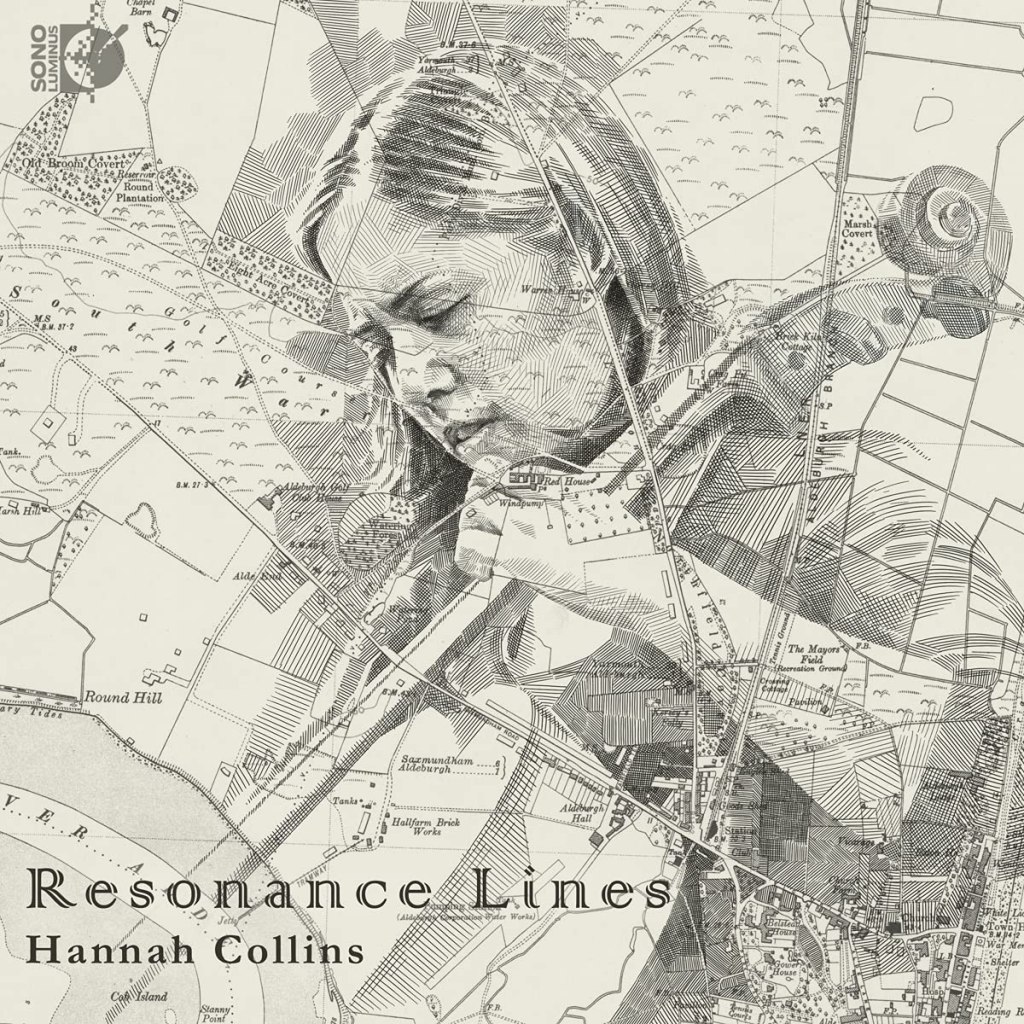
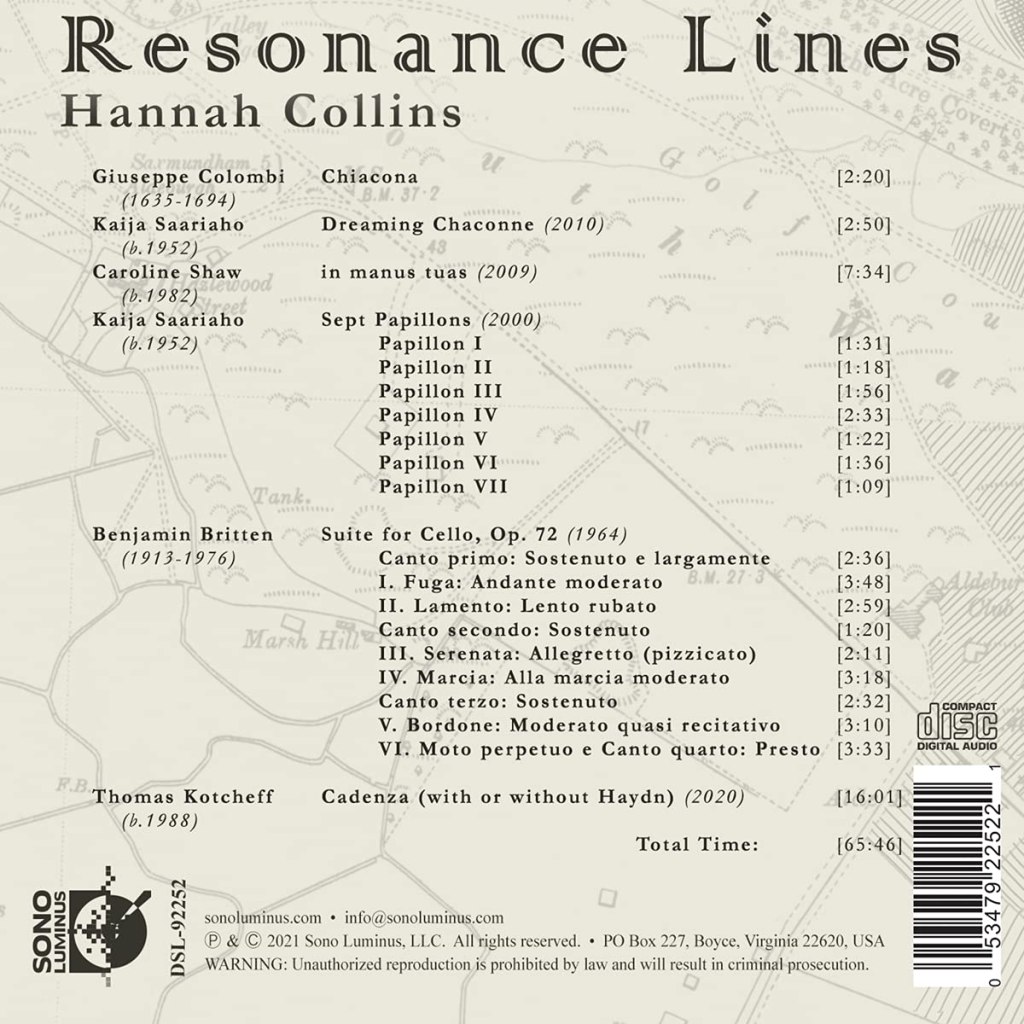
Rising Star Cellist Hannah Collins Defines Her Vision for Her Instrument in “Resonance Lines”


Sono Luminus DSL-92252

Having chosen a debut album featuring solo cello without electronics or accompaniment the Sono Luminus label virtually guarantees that every one of the subtleties of the performer’s skills will be heard in all their glory. And so we have an auspicious solo debut album by a skilled and talented artist with a unique and intelligent vision in her choice of repertoire for her instrument. Hannah Collins has a beautifully designed web page describing her background so I will focus only on the music on this release.

Even a brief glance makes it obvious that Collins’ radar captures a wide range of music which encompasses five centuries of compositional efforts by both a consciously curated selection of composers that reflect both racial and gender diversity and who themselves represent a substantive variety of styles and visions. She begins with a rather obscure baroque composer (I had never heard of him), Giuseppe Colombi (1635-1694). His Chiacona (1670) is apparently the first identified composition for solo cello (the famous solo cello suites by J.S. Bach wouldn’t come along until 1717-1723).

This arguably foundational work of the solo cello genre is then followed by the very fine Finnish composer Kaija Saariaho (1952- ) whose Dreaming Chaconne (2010) is in fact a variation on the Colombi piece.

The third track, “In manus tuas” (Into your hands) by the equally fine American composer, Carolyn Shaw (1982- ) was written for Ms. Collins, and is an aural peek inside the mind of the composer as she recalls a performance of a motet by 16th century English composer Thomas Tallis (1505-1585). Shaw evokes a sonic memory moment of hearing a performance of “In manus tuas Domine” in Christ Church in New Haven, Connecticut which made a strong impression on her. It is a work that appears to be destined to become a modern classic. It creates spectral harmonics that engulf the listener inside Shaw’s memory of the event. The composition’s title also function metaphorically as she offers her music into the hands of the artist and the minds of the listeners. It is a challenge both technically and interpretively and Collins rises to those challenges with seeming ease.

The next seven tracks are given to another Saariaho composition, “Sept Papillons” (2000). This earlier work from her extensive catalog is also given to extended instrumental techniques as she evokes the seven butterflies of the title. This set of pieces was written for the fine Finnish cellist, Anssi Karttunen. It was at the 2008 Creative Dialogue Workshop in Santa Fe, New Mexico (run by Karttunen) that Collins encountered this music and the extended techniques required for its performance. Saariaho’s sound world is like that of an incarnation of Debussy and his impressionist aesthetic. There is apparently no visual program here but the music recalls, in this listener’s mind, Saariaho’s earlier “Nymphea” (1987) for string quartet and electronics which was inspired by Monet’s famed “Water Lilies” of 1906.

This fine disc includes the first (of three) suites for solo cello by Benjamin Britten. All three of these (1964, 1967, 1971) had all been composed for the Russian virtuoso Mstislav Rostropovich. Like the the Saariaho and Shaw pieces these suites are inspired by earlier works, in this case the Bach suites of the early 18th century. Collins plays the first (Opus 72) of these and her performance makes this listener hope that she will later record the other two.

While modeled on earlier music, the Britten work utilizes techniques that would likely be unfamiliar to cellists before the 20th century. It is homage both to Bach and to Maestro Rostropovich. And Collins’ playing furthers this homage to both of these past masters.

The final track is a work by one Thomas Kotcheff (1988- ). Like the first track, this young composer is unfamiliar to this writer. His work, “Cadenza (with or without Haydn)” of 2020” carries on the theme of homage. In a nod to the late great Frederic Rzewski (1938-2021) whose “Cadenza with or without Beethoven” (2003) is an extended cadenza which can be played on its own or as part of the Beethoven 4th piano concerto.

Kotcheff’s work is a cadenza for Haydn’s C major cello concerto. Like the Rzewski, it can be performed with the concerto or as a solo work on its own. Also like the Rzewski, the more modern aspects of this “cadenza” might confuse audiences anticipating more conventional music that fits with the context of the concerto for which it was written and the music stands very strongly on its own.

Like a lot of solo artists are doing these days, Collins’ debut solo album is like her personal manifesto of music for her chosen instrument. It is a fine foundation anticipating what will likely be an enlightening as well as entertaining career.

Georg Friederich Hass’ Trois Hommages (for two pianos tuned a quarter tone apart) played by Mabel Kwan


New Focus FCR214

I know this review is “late out the gate” but this disc really needs to be heard. When I did finally listen to this disc in its entirety while on a long drive I was positively mesmerized. This odd mixture of 1/4 tone tunings along with post minimalist repeating patterns takes on the character of drone as well as its own take on minimalism and even spectralism to some degree. These three homages are gestures of respect to three composers whose work obviously has great meaning for Georg Friederich Haas (1953- ). The composers selected for these homages are György Ligeti (1923-2006), Josef Matthias Hauer (1883-1959), and Steve Reich (1936- )

It echoes a similar work by Ligeti, Three Pieces for Two Pianos – Monument – Selbstportrait mit Reich und Riley (und Chopin ist auch dabei) – Bewegung (1976) but with conventional tunings. Haas has had a long interest in microtonal music by composers like Ivan Wyschnegradsky, Alois Hába, as well as the music of Pierre Boulez and Luigi Nono.

It is easy to see why he chose Ligeti for the first homage (written in 1984). Haas’ work owes much to Ligeti’s influence including dissonant harmonies and micropolyphony. This first homage is the longest, clocking in at about 30 minutes. And Steve Reich has met with admiration and homages from many fellow composers but I must admit to having been stumped at the inclusion of Hauer’s work. This one I had to look up. Hauer was a Austrian composer whose substantial oeuvre is not really well known in the United States but deserves at least a second look. Hauer created his own 12 tone system apparently in parallel with Arnold Schoenberg but achieved little recognition despite a large catalog of works. That appears to be the reason why he was chosen. Hauer’s homage is placed second in this performance and Reich’s is last. Both the Hauer and Reich homages were written in 1982. And though this piece requires 2 pianos it also requires only the two hands of a talented pianist.

Mabel Kwan‘s recording is the world premiere of this work which is among Haas’ earliest published works (having heard it a couple of times it is difficult to imagine why it waited so long for a recording). Kwan, a founding member of the Chicago based Dal Niente (whose name literally means, “from nothing” but is used in music to indicate basically a long diminuendo, a fade) is no stranger to new and experimental music.. Her musical credentials are extensive and this world premiere recording is a major feather in her musical cap and a demonstration of her formidable interpretive and performing skills. Brava! Ms. Kwan.