Oh Say Can You “C”? Terry Riley’s “In C” Turns 60 Years Old


Terry Riley with a t-shirt displaying the entire score of “In C” (photo from Facebook, copyright unknown)

November 4th, 2024 marks the 60th anniversary of the premiere of Terry Riley’s seminal masterpiece, “In C”. After having completed a variety of respectable compositional efforts, Terry Riley (1935- ) was jolted by the Muse to write this defining work that charted a path very different from that of the western classical mold of the composer’s formal education. It premiered in the very unconventional venue of a house in San Francisco, not in an auditorium designed for concerts. And it’s one of those pieces that now marks the transition from almost purely experimental writing to a style later dubbed “minimalism” (though many composers whose music is subsumed under this title eschew it in varying degrees). And whether you call it minimalism, trance music, drone, etc., the style would come to dominate a huge portion of concert works and recordings.

The score consists of 53 short musical phrases with no specified instrumentation and with no conductor’s score, just parts with a seemingly simple set of instructions. One page is what one might expect of a sketch of a larger work to be, not a complete score but, that’s it, One page with the instruction for the musician to repeat each cell or phrase ad libitum and then move on to the next. It was ostensibly the suggestion of composer/performer Steve Reich to have a pianist play eighth note repetitions of the top two highest octaves on the keyboard. In addition to this “click track” like strategy, the playing of those high “C”s also serves to anchor the tonality much as continuo does in that quasi improvisational baroque practice.

There is simply no finer account and analysis of this music than that of Robert Carl’s “In C”. Robert Carl (1954- ) is a teacher, composer, performer, and musicologist. I do not presume to have as extensive an analysis as he does but I’m interested here in providing a celebratory perspective from where I sit (and have been seated).

This music (as does all art) stands in a context with concurrent and recent events surrounding its conception and performance. Temporally it stands along with other notable compositions from 1964: Witold Lutoslawski- String Quartet, John Coltrane (admittedly one of Riley’s influences)- the albums, “Bessie’s Blues” and “Lonnie’s Lament”, Igor Stravinsky- Elegy for JFK and Variations in Memoriam Aldous Huxley (both men died on November 23rd, 1963), Roger Sessions- Symphony No. 5 and his opera, “Montezuma”, Milton Babbitt- Philomel, Karlheinz Stockhausen- Mixtur, Ben Johnston- Sonata for Microtonal Piano, Luciano Berio- Folksongs (written and premiered at Mills College, the later home of the Tape Music Center where Berio was teaching then), Olivier Messiaen- Et Expecto Ressurectionem Mortuorum, Iannis Xenakis- Eonta, and La Monte Young- (the first iteration of his masterpiece), The Well Tuned Piano.

My little list here is just a sampling of the western classical and jazz works that graced the natal year of “In C”. Admittedly, it is a cornucopia of some more experimental, some less so music that lie in this historical orbit. But, among the works in this list, it is the work of John Coltrane and La Monte Young that shares musical DNA with Riley’s aesthetic in this music. The other works contemporary mentioned represent a sort of “Garden of Forking Paths“ to a panoply of styles very different from the work at hand.

At a time when the style of American pop music had just recently met The Beatles, this work was a sort of coalescence of experiments done by La Monte Young, Steve Reich, and others. “In C” seems to have come out fully formed in its way. It was seemingly influenced by pop, jazz, and blues (whose use of repetition is endemic). 60 years later it is performed frequently and there exists at least 40 or so recordings of the work.

When I began writing this article I realized that Robert Carl’s book on this work fully covers the history and provides a definitive analysis to which I cannot contribute anything additionally useful. I then considered eliciting commentary from musicians and listeners about this music but found little interest because that has been well covered by several previous anniversary essays. So I decided to share a discography and photos of some the recordings I could find that have given me further insights into this touchstone work.

This discography is not comprehensive but my intent here is to celebrate this anniversary with the cover artwork that adorns the ever increasing documenting of this landmark of western art music. I will present what I believe is a representative selection of some 40+ versions.

Your humble author was 8 at the time of this work’s premiere. And my first hearing of ‘In C’ was in 1976 when my local radio station, the great WFMT in Chicago, aired a program curated by Raymond Wilding-White, a composer and professor of music at De Paul University. His task was to present representative works of American music, one for each day of the nation’s bicentennial year. ‘in C’ was one of them.

Since then I have heard many interpretations of this work. The original performance was at 321 Divisadero Street in San Francisco, California on November 4th, 1964. The original performers were: Terry Riley, Steve Reich, Jon Gibson, Pauline Oliveros, Stuart Dempster, Morton Subotnick, Warner Jepson, Tony Martin, William Maginnis, and Ramon Sender (who celebrated his 90th birthday this past week). This venue was the second and last home of the San Francisco Tape Music Center before it relocated and was renamed The Mills College Center for Contemporary Music in 1966 in Oakland.

Here, with brief commentaries, are my favorites. There are at least 38 versions according to the Wikipedia article. Here are my personal favorites in chronological order of release date:

The original Columbia Records release (1968)

If you only have one recording this is probably the one you want. Recorded in 1968, this brought the work effectively to a wide audience via international distribution. The instrumentation (some overdubbed) includes: saxophone, oboe, bassoon, trumpet, clarinet, flute, viola, trombone, vibraphone, marimbaphone.

Riley with the Chinese Film Orchestra (1989)

This important recording was made in China around the time of the Tiananmen Square uprising and the tapes were in effect smuggled out of the country in the aftermath of that incident. It stands as a fascinating document of eastern musicians encountering and interpreting this masterpiece.

The 25th anniversary release on New Albion (1990)

Don’t you just love anniversaries? By the time of this release (1989), this work had been disseminated into wide geographic regions and cultures. This version includes many of the musicians who premiered the work and this “traditional” reading is a loving homage to Riley’s work.

The Bang on a Can release (1998)

The Bang on a Can All Stars are among the finest ambassadors of new music. They have earned the right to put their stamp on any new work they choose and subsequently bring it anew to another generation of listeners.

Prog Rock does homage to Terry Riley (2001)

If you want to hear the wide range of musicians who have chosen to pay homage to this work this is a fine place to start.

The Africa Express release (2015)

Another fine example of the way this work can sound from a Central African perspective. This performance from Mali is absolutely electrifying.

Another fine culturally tinged version (2017)

This album is a personal favorite from the Brooklyn based collective featuring instruments from Hindustani traditions and others alongside western instruments. You can read my enthusiastic review here.

There are probably at least 50 recordings of this work. Some are private, maybe even bootleg versions. Clearly this work continues to become more and more essential and influential piece of music. It is not unlike a musical version of the Iconic monolith from the movie 2001: A Space Odyssey. The anomalous structure was of alien origin and was purported to accelerate the evolution of species who encounter it.

Riley’s work is most .definitely of terrestrial origin (well, San Francisco anyway) but, clearly this work continues to intrigue musicians worldwide and has arguably influenced the development of music itself.

Evolution supercharged by an alien presence.

Two Sono Luminus Discs of New Music by Icelandic Composers (mostly)


DSL- 92267

There are, by my count, at least 8 discs on this fine audiophile label dedicated to music by composers from Iceland. That country’s musical prowess deserves to be better known as does their world class orchestra. I’m reviewing these back to back releases together because they are both Iceland Symphony recordings presenting new music by (mostly) Icelandic composers. And they have a secret connection.

This first disc is a nice mix of music by five different composers in works that really give the orchestra an opportunity to shine. Under the direction of composer/conductor Daniel Bjarnason we are availed of the sound of now, or at least Bjarnason’s “now”.

Track list

This disc, which seems to have a “outer space”theme in large part, opens with a large orchestral work from the most deservedly best known Icelandic classical composer, Anna Thorvaldsdottir. “Catamorphosis” is a 20+ minute work for full orchestra and then some. Her style initially reminded this listener of the sound mass of music like Ligeti and Penderecki. But her harmonic language is more lush and romantic. She has an astounding skill in writing for large orchestra, producing at times the modern equivalent of Impressionism. Her use of motives suggest she has digested ideas from minimalist/pattern composers. And at the end of the day (or the review), one realizes that she has developed her own voice.

The subtle colors of this work are well defined by the orchestra under Bjarnason’s truly expert guidance but also via the sonics that the Sono Luminus engineers are able to capture. This sounds like a difficult work to perform but Bjarnason manages to create a definitive performance and Sono Luminus’ sonics are, as always first rate.

Catamorphosis (2022) is typical of Thorvaldsdottir’s writing for large orchestra reflecting her skills as an orchestrator as well as her imagination, her ability to create a wide palette of subtle sound forms that suggest a sort of post impressionist style. The poetic and metaphorical titles tell little about the musical content (or structure for that matter). But her ability to create cohesive and compelling compositions such as this provide an experience that will likely evoke images for the listener, a sort of movie for the mind. So feel free to conjure your own images in this 7 part (played without pause) work and/or listen and watch a recent Elephilharmonie performance on YouTube here.

Missy Mazzoli’s comparatively brief “Symphony for Orbiting Spheres” (2014 rev 2016) taps into a vein of inspiration seemingly related to the cosmic images of Thorvaldsdottir. Mazzoli incorporates an electronic keyboard and harmonicas, among several less common instruments used in symphony orchestras, to create her own sonic cosmic fantasy. Please click the link on her name above to learn more about this rising star from her nicely designed website.

Daniel Bjarnason demonstrates his own formidable compositional chops with “From Space I Saw Earth” (2019). And this track also provides a link of sorts to the other album reviewed in this blog entry. This work, written on commission for the 100th anniversary of the LA Philarmonic, is a work that requires three conductors. The premiere was led by Zubin Mehta, Gustavo Dudamel, and Esa-Pekka Salonen, all of whom have significant connections to the orchestra (Mehta as conductor Emeritus, Dudamel as present chief conductor, and Salonen as conductor laureate). That was the premiere but this recording is conducted by Bjarnason along with Kornilios Michalaidis, and the then incoming chief conductor of the Iceland Symphony, Eva Ollikainen. Therein lies the “secret connection” to which I referred earlier.

María Huld Markan Sigfúsdóttir (1980- ) is a violinist and composer. Her orchestral work, “Clockworking” is a sort of post minimalist work with a gently driving Ostinato in the percussion. It reminds this reviewer variously of Birtwistle’s “Chronometer”, Ligeti’s “Poeme Symphonique”, to name a few but it is not derivative of these in any way. It is a very listenable and enjoyable orchestral work.

Bára Gísladóttir (1989- ) is a composer, vocalist, and double bass player based in Copenhagen. This, the briefest work on the album is at times the quietest and at others the loudest work here. I would add that it is also the most avant garde. Relying on a battery of percussion and what appears to be some extended instrumental techniques the composer creates a world that to this reviewer’s ears sound a bit like Gyorgy Ligeti’s work “Atmospheres” (1968). That’s not meant to say it’s derivative, just that it could conceivably be used for that famous psychedelic sequence from Stanley Kubrick’s masterful “2001, A Space Odyssey” where my own young ears first heard the Ligeti work.

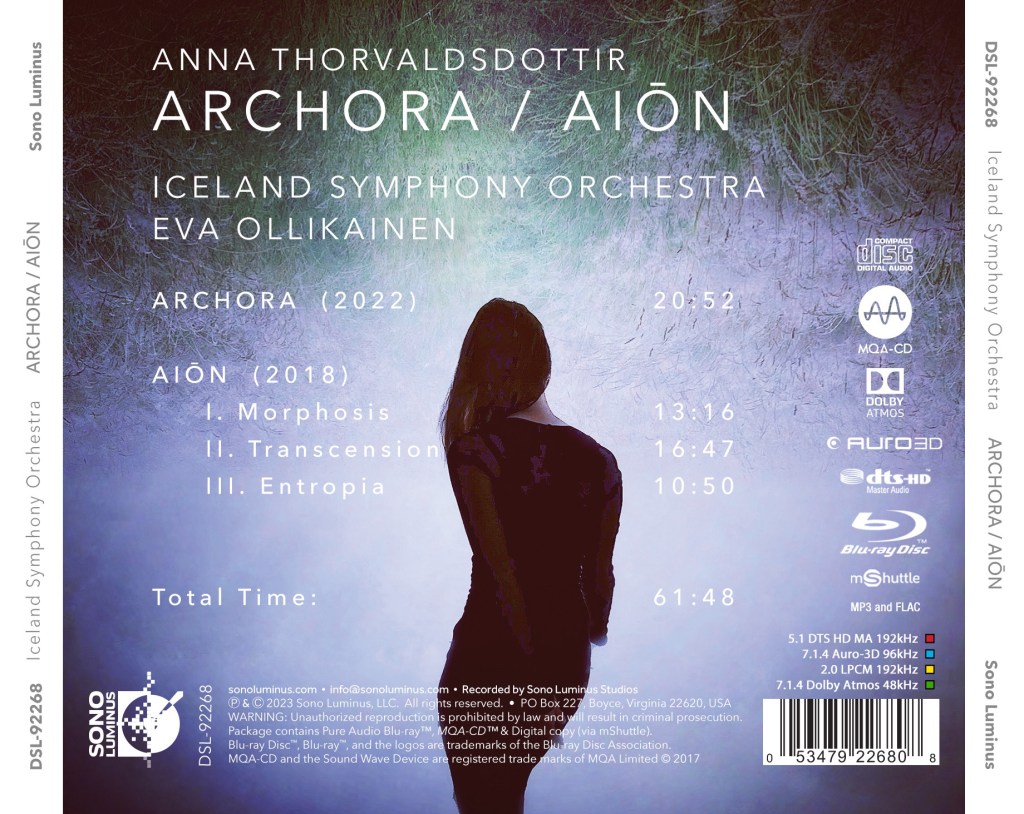
DSL- 92268

As fabulous as that first disc is, this release, dedicated entirely to the work of Anna Thorvaldsdottir, is a worthy endeavor. In addition to that we are treated to the sublime and insightful artistry of the first female principal conductor of the Iceland Symphony, Eva Ollikainen who leads the Iceland Symphony on this disc.

Like the above release, the Iceland Symphony Orchestra demonstrates their world class artistry. This is not easy music to play but, under Ollikainen, as they have under her predecessor, they are able to articulate the intricately orchestrated sounds by this really astounding composer.

Just two works here. “Archora” (2022) and “Aion” (2018). Both are works of grand concept and could easily be called symphonies but the composer seems fond of metaphoric poetic titles. Regardless of the names given these works they demonstrate the composer’s grand sonic visions and her mastery of the orchestra, a mastery grasped very clearly by the Iceland Symphony’s new artistic director and conductor, Eva Ollikainen (1982- ). She holds the distinction of being the first woman to hold the post to which she was appointed in 2019.

Track list

There are only two works presented but both are stunning examples of some of the finest new music being produced today. Yes, it’s great to see women having a greater presence (both as composers and conductors) but, truly, Thorvaldsdottir is “the bomb”, so to speak. Her creativity, her mastery of the orchestra are simply a revelatory as well as entertaining listening experience.

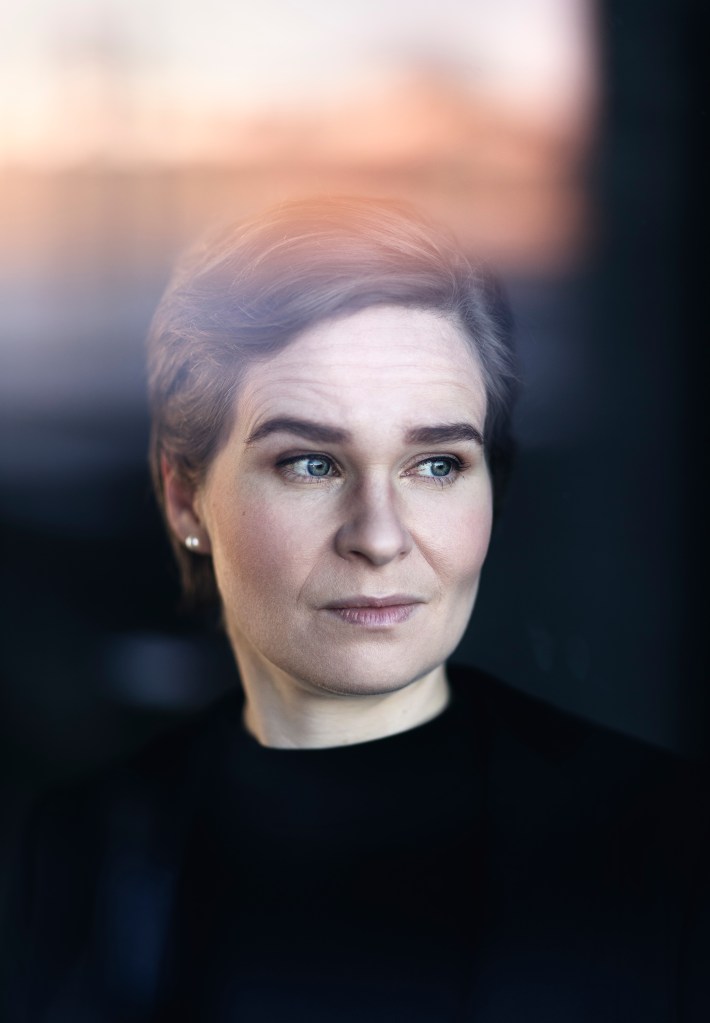
Eva Ollikainen

This release is also a landmark which showcases the formidable talent of the Icelandic Symphony’s new conductor. In addition to breaking gender barriers she is quite simply a rising star and one of the finest interpreters of new music today.

“Archora” (2022) is the most recent work here and it’s another of Thorvaldsdottir’s sprawling cinematic tone poems. No specific story here but the composer’s mastery of orchestral color will doubtless evoke images and feelings in the listener. Thorvaldsdottir is creating a sort of sonic (as opposed to literal) mythology. Her reference points seem to be largely in Greek and Roman mythology but also in Nordic and Northern European myths. Eva Ollikainen conducted the world premiere at the 2022 BBC Proms. You can hear that performance on YouTube here. But the Sono Luminus recording captures more of the subtle sound colors of this engaging work.

The composer’s three movement, “Aion” (2018) concludes this recording. Aion is a Greek God of time. The composer is concerned with various aspects of time in her work. This large three movement work is virtually a symphony with an augmented orchestra, extended instrumental techniques, and an optional choreographic accompaniment. (Tell me that’s not cinematic). There is an example of the optional choreography here.

This recording is also a fine introduction to conductor Eva Ollikainen who clearly has a grasp of this music. Various examples of her interpretive genius can be found on YouTube ranging from Beethoven to new contemporary masters.

These are two truly fine discs both musically and for sheer sonic detail. They’re available in streaming and hard copy CD as well as Blue Ray Audio. These are a fabulous listening experience. Enjoy!

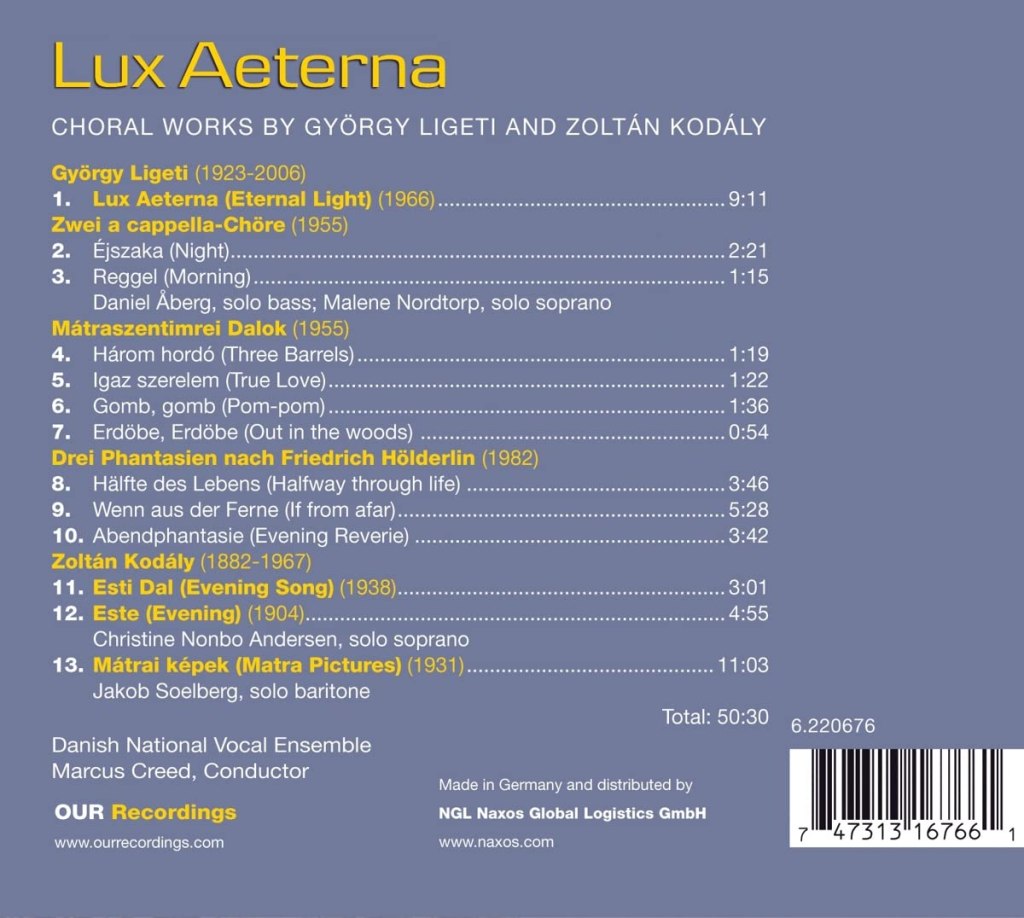
Lux Aeterna, 20th Century Choral Music of Ligeti and Kodaly According to Marcus Creed


OUR Recordings 6.220676

I thought I knew this music. After falling in love with György Ligeti’s (1923-2006) work having heard it so aptly used in Stanley Kubrick’s, “2001: A Space Odyssey” I eagerly purchased both of the complete works surveys on Sony and Telefunken but these fresh, insightful performances by the Danish National Vocal Ensemble under conductor Marcus Creed have made me fall in love again. And, while I have some familiarity with Zoltán Kodály’s (1882-1967) music (he is underappreciated) I did not know his unaccompanied choral works. So this encounter was an absolute revelation.

This release succeeds on several levels. First, it is one of the always reliably fine productions from Lars Hannibal’s OUR Recordings. So, from the physical design to and the the choices of repertoire and performers as well as the sound of the recording, this is a thoroughly enjoyable experience for the listener.

But what brings this release from competent to outstanding is the interpretive skillset of conductor Marcus Creed and the disciplined Danish National Vocal Ensemble. These are fresh, insightful readings that shed new light on these masterful composers and their work. Looking at Creed’s extensive discography it is clear that he commands a wide range of repertoire with a penchant for the twentieth century and beyond. His reading of Ernst Krenek’s massive 12 tone contrapuntal a capella masterpiece from 1941-2, “Lamentatio Jeremiae Prophetae” Op. 93 remains perhaps this challenging work’s finest interpretation in the 1995 Harmonia Mundi recording and a personal favorite of this reviewer. So it should come as no surprise that he is able to breathe new life into these works.

The opening work is probably the most familiar here. Ligeti’s “Lux Aeterna” (1966) was first thrust into the spotlight via its (unpermitted at the time) inclusion is the Kubrick film. This is mid-career Ligeti and one of the most effective uses of his “micropolyphony” and cluster chord harmonies. It is first heard in the Clavius Moonbase scene fairly early in the film. It accompanies the otherwise silent animation of a sort of space shuttle bus as it glides along the lunar surface. Along with the Kyrie of Ligeti’s 1965 Requiem and his orchestral “Atmospheres” (1961) work beautifully in telling the story in this film with its well known paucity of dialogue.

This opening track grabbed my attention immediately. The text, which appears in the traditional Catholic Mass and Requiem Mass is a communion hymn with the following words:

May light eternal shine upon them, O Lord,
with Thy Saints for evermore:
for Thou art gracious.
Eternal rest give to them, O Lord,
and let perpetual light shine upon them:
With Thy Saints for evermore,
for Thou art gracious.

But the experience of this music is positively otherworldly. Its wall of sound ambiance belies a rather complex construction which has become a landmark in the development of compositional practice. And it is vitally that this music, now nearly synonymous with the film, be heard as originally intended. It exists in both worlds now and this reading helps reaffirm it as the masterpiece it is.

The next six tracks are by Ligeti but this is the Ligeti still composing under the powerful spell of Bela Bartok. All date from 1955 but are a quantum leap back from the sound world of the first track. The two brief a capella choruses (the second includes solos for bass and soprano voices) are settings of words by Hungarian poet Sándor Weöres (1913-1989). These settings are ostensibly influenced by the composer’s early encounter with modern music in Vienna (Ligeti ultimately relocated from the artistically and socially oppressive Hungary to Austria). The second of these choruses had to wait until 1968 for a performance which provides some notion of how oppressive the Hungarian regime had been.

Those brief choruses are followed by four folksong settings which take the listener back into the sound world of Bartok and Kodaly with their respective folksong transcriptions. These are very enjoyable travels into Ligeti’s excellent but markedly more conservative beginnings.

Next is another Ligeti work but one from his later years demonstrating that he never stopped evolving as a composer. The “Three Fantasies after Friederich Holderlin” (1982) are themselves a quantum leap stylistically from the 1966 Lux Aeterna. These are also more complex settings and, suffice it to say, they are a powerful experience. What was micropolyphony in the earlier work is replaced by a more traditional style of polyphonic writing but one that could not exist were it not for those earlier efforts.

And then we come further back again to early and mid-career Kodaly in three a capella works, “Evening Song” (1938), “Evening” (1904), and “Matra Pictures” (1931). I say at the beginning of this review that I believe Kodaly’s music to be underappreciated. Indeed but I find myself with no excuse given the easy availability of so much music on You Tube and other online sources. And this is why the inclusion of this fascinating selection of the composer’s significant cache of a capella choral music is so very welcome.

Like, I suppose, many listeners I mostly know Kodaly’s work via his Peacock Variations and excerpts from his opera, “Hary Janos”. Of course I had also been aware of Kodaly’s pedagogy and his methods for learning music (and I was aware even before I saw it in “Close Encounters).

But my encounter with these fine choral works revealed to me the depth of the composer’s skills. This is marvelously written music by a composer intimately familiar with this medium and it has already sent me to exploring more of this composer’s work in all genres. It is not difficult to see Kodaly’s work as a logical predecessor to that of Ligeti. he same skill and invention the same ability to convincingly set text to music. This is a terrific release, highly recommended to lovers of choral music in general and, of course, of these two composers.