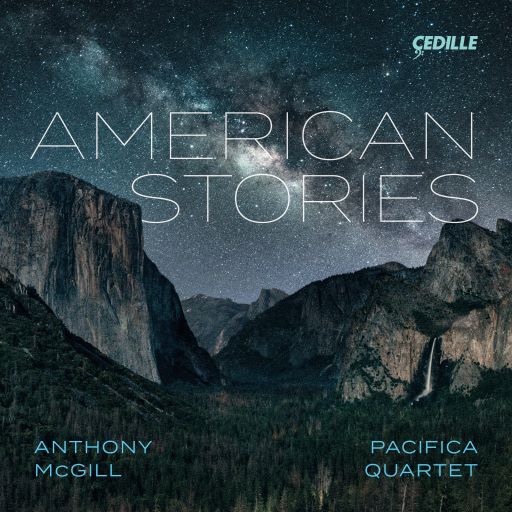
Anthony McGill’s star rises rapidly higher with the release of this new album. His previous Cedille release was music for woodwind soloists and orchestra and featured Anthony’s brother, flautist Demarre McGill as well. And this one is a real gem that introduces listeners to four composers whose work defines to significant degree the current state of American music. From the very well known work of Richard Danielpour to three less familiar names listeners will want to know better, this is one fine chamber music recording.
I was first introduced to the clarinet and string quartet genre via the 1957 RCA recording of Mozart’s A major Clarinet Quartet played by Benny Goodman with the Boston String Quartet (paired with Mozart’s Clarinet Concerto and this disc was my first hearing of both works). I later heard the Brahms Clarinet Quintet (McGill recorded both of these on a 2014 Cedille release) and other essays in this genre but the Mozart and Brahms are forever my reference point as I imagine they are for most listeners.

All of these works are essentially clarinet quintets though only one bears that specific title. All but one work are recorded premieres but all are fulfilling listening experiences beautifully performed by Mr. McGill and the fabulous Pacifica Quartet . This album is almost as much an homage to the clarinet quintet genre as it is to the people and historical events that provided inspiration for the music. This is music with messages for all who want to hear them.


All four works here are inspired by “American Stories”, as Maestro McGill says in his introductory notes, “Through music we connect with our stories.” The music here is about pain, struggle, memorial, and hope. It is more elegy than lamentation and, ultimately more music than history. But, as music, it succeeds very well and one hopes that these works will help preserve the histories described. This is beautiful and lyrical music with immediate appeal and substance that demands repeated hearings.
Richard Danielpour’s “Four Angels” (2020) is in one movement divided into four sections, each lamenting the death of four little girls (Addie May Collins, Carol Denise McNair, Cynthia Wesley, Carole Rosamond Robertson) who were killed in the bombing of the 16th Street Baptist Church in 1963 by Ku Klux Klan members. Danielpour says in his notes, “This music also stands as a small testament to the choice for a better path, one consisting of the compassion and understanding that we must have for one another.”, a statement that could be applied to all the works herein.

James Lee III is represented by his four movement “Clarinet Quintet”(2019) here in its premiere recording. This rising star states in his liner notes that this quintet is inspired by his reading of the experiences of Native Americans. It is also, via quotation in the first movement, homage to Black American composers who preceded him. The scherzo movement is named “Awashoha”, a Choctaw word meaning, “play here”. The metaphors he attaches to his classical forms are gentle impressionistic clues to his compositional processes. It is a deeply felt work and listeners are advised to explore his well organized website.

Ben Shirley’s “High Sierra Sonata” (2019) is in three movements and, according to the composer, is somewhat autobiographical, inspired by his fall into addiction and subsequent recovery. He specifically references his experience as a volunteer for an athletic event in the Eastern Sierra Mountains in eastern California where the unpredictable changes in weather provided him with a metaphor for life’s unpredictable nature, both in his life and others.

The recording concludes with “Shotgun Houses” (2000) by Valerie Coleman. This work, the only one on this release that is not a premiere recording, is an homage to fellow Louisville resident Muhammad Ali and references the architectural style known as “shotgun houses” known to both Ali and Coleman when they resided there. She states that the opening movement is a general homage to southern black culture, the second an homage to Ali’s mother, and the third a celebration of Ali’s triumph in the 1960 Olympics which essentially launched his fame.

 New Music Buff