Starstruckedness, a Fan Boy Essay and a Peek “Behind the Curtain” of a Blogger


I am an amateur, a dabbler, a passionate hobbyist when it comes to music. But music is an essential part of who I’ve become since the beginnings of my fascination with what might be termed “new classical” music back around the age of 10 or so (more on that in a later essay).

I am a listener above all and my shy, introspective personality initially led to a lot of alone time. I’m not saying, “loneliness”. Quite the contrary, I enjoyed it a great deal. After school I spent many a blissful evening amongst my books, records and tapes. And my radio, tuned to one (of three at the time) classical radio stations in my native Chicago.

WEFM, WNIB, and WFMT were my gateway into the world of classical music old and new. For whatever reason I didn’t like pop/top 40 music (though I’ve since widened my range of listening), a fact which severely narrowed my circle of peers and led me to develop my own world as I struggled the ardent but necessary developmental task of defining my identity (still struggling with that).

Fortunately these radio stations had a lot of genuinely talented program hosts and producers. These people were my teachers and my friends. Their adulation of classical music validated me and inspired me to emulate them to some extent which in turn led me to do a lot of reading. I felt cool (i.e. validated). So my appreciation of the significance of rock, blues, etc would have to wait until my college days but I tolerated pop stuff when socializing with my peers at the time, none of whom liked classical music.

As my interests developed, classical music became a solidly a treasured aspect of my personality. It remains a passion that gives me great joy (while it drains my budget). As basically a non-musician, a “fan” I began to attend more concerts, buy more recordings, and engage in fanboy/fangirl discussions and debates, even autograph collecting, my peer group expanded as I met people in college classes who shared my esoteric, non-pop interests.

At this point I want to tell you that I’ve come to suspect that, at their best, fans are essentially secular worshippers, deriving something like religious ecstasy as they seek to spend more time, in closer proximity to their chosen deities. That’s what the best performances of music are (other arts too, but that’s another essay), and, ecstatic experiences are addictive.

All this to say that the phenomena of being starstruck, I believe, is one of encountering musical artists in a deeply felt manner that impairs one’s ability to experience our favorite stars as mere humans. That, hopefully, comes later. But the experience of actually meeting your stars is much akin to children encountering their stars at Disneyland or Santa at the local shopping mall where, one can see the stunned look and disbelieving stare as they drink in the experience.

Sometimes the experience of humanness in one’s “gods” is off putting, at least at first. But getting to know a favorite artist as a human being allows one to get a perspective, to see them more as they are and not just as their latest work or even their body of work. Learning about the person, including their foibles and even failures is valuable. Whether you experience this via personal contact or via autobiographical and biographical writings it is an important perspective which enhances the listener’s appreciation.

The blogging is my way of acknowledging the joy that my favorite artists give me. It’s also a way of sharing a personal perspective for similarly inclined listeners who may share some of what I feel.

Time to fire up my CD player. Another worship service is at hand.

Comments welcome.

Ramón Sender Barayón, Always Going Toward the Light


Raysender

Ramón Sender Barayón at Arion Press in San Francisco (Photo Creative Commons 2011 by Allan J. Cronin)


This crowd sourced video opens with a sort of exposition of the various identities of its subject Ramón Sender Barayón (also known as Ramon Sender, Ramon Sender Morningstar, Ray Sender, and Ramon Sender Barayón).  His father was the renowned Spanish novelist Ramón J. Sender whose work was unappreciated (to say the least) by the Franco regime resulting in his spending the last part of his life as an expatriate in the United States of America.  His mother Amparo Barayón fared far less well.  Her short life and her death at the hands of the Franco regime are memorialized in her son’s book, “A Death in Zamora“, an experience which has understandably informed his life.  As a writer, in order to distinguish himself from his father, he adopted his mother’s maiden name appended to his given name.  Happily this and some of his other works are making it to the kindle format.

img_0745

The film unfortunately does not appear to be available in any commercial outlets at the time of this writing but one hopes that Amazon or some internet distributor will make it more widely available.  One small critique is the use of sometimes English narration and sometimes Spanish narration with attendant translation subtitles in the opposite languages is a bit difficult to get used to but hardly an insurmountable issue.

Sender’s personal website continues to be a source of useful information.  Links can be found here to many of his writings and other work as well as some discussion of his musical compositions.

deathzamora

In addition to being a writer he is an acknowledged pioneer in the area of experimental music.  He, along with Morton Subotnick, Pauline Oliveros, Joseph Byrd, William Maginnis, Tony Martin, Joseph Byrd, and Terry Riley (among others) founded the San Francisco Tape Music Center in 1962.  This later became the Mills College Center for Contemporary Music and remains in operation as of the date of this review.  Barayon’s ” novelized history of this time in his life titled, “Naked Close Up” finally found itself in a Kindle release after having circulated in PDF format for years on the internet.  (This history is also further documented in David Bernstein’s excellent, “The San Francisco Tape Music Center: 1960s Counterculture and the Avant-Garde“)

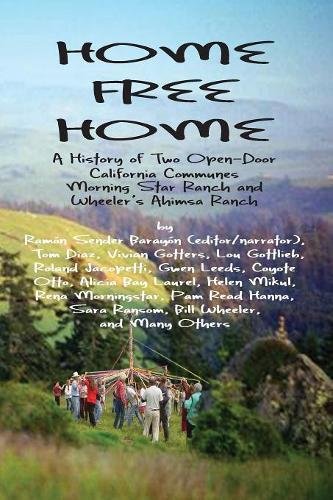
His curiosity and wide ranging interests saw him participating in alternative commune living situations (beginning in 1966) in northern California exploring spirituality and challenging established social norms through the exploration of viable alternatives.  He writes most eloquently about this in his recently published “Home Free Home“, a large edited tome on the Morningstar Ranch and Wheeler’s Ahimsa Ranch which includes material by several other former residents.  The book is as much compilation as it is historical writing and memoir.  It is a fascinating read and is filled with historically significant recollections and commentary by many of those one time residents of these (now sadly defunct) communities.

homefree

This DVD is one of those increasingly popular crowd sourced productions (here is the Indiegogo link) which has allowed independent publication of countless books and CDs and countless other projects which stimulate little interest among traditional venues despite the significance of their content.  The content here is of a profoundly important nature to fans of new music as well as fans of alternative living experiments and 60s counterculture and philosophy.  It is contemporary history and biography.

Ramón is man possessed of both wisdom and humor as well as deep thought.  This film is the first documentary to cover the diverse interest and involvement of this affable cultural polymath.  It begins with an interview of Mr. Sender in the living room of his home in San Francisco.  From there it traverses more or less chronologically among the dizzyingly diverse events which comprise his life thus far.

From his birth in Spain in 1934 to his present role as a sort of spiritual/intellectual guru running a lecture series called, “Odd Mondays” in San Francisco’s Noe Valley neighborhood which he and Judith Levy have managed for some 17 years with a variety of carefully chosen speakers.  The film covers a variety of topics and while it leaves out details at times it is a cogent and balanced biographical documentary.

His early involvement in the establishment of the influential San Francisco Tape Music Center finds him connected with fellow luminaries such as Pauline Oliveros, Terry Riley, Morton Subotnick, William Maginnis, Steve Reich, Joseph Byrd, Tony Martin, and Donald Buchla.  This institution, now relocated as the Center for Contemporary Music at Mills College, saw the creation of a great deal of musical technology and significant musical compositions (Terry Riley’s groundbreaking “In C” was first performed there in 1964).

Sender was one of the organizers of the Trips Festival in 1966 along with Stewart Brand (later of Whole Earth Catalog fame), Bill Graham, Ken Kesey with his Merry Pranksters. Following this he left San Francisco for Sonoma County in northern California.

He states at one point that he has not wanted to be identified with a single career (as his father was) so, following his experimental music work, he became among the first to experiment with communal living in the Morningstar Ranch and later in the Wheeler Ranch in Sonoma County, California.  These are now well documented in his book, “Home Free Home” mentioned earlier.

Happily the film does a nice job of acknowledging the role that his wife Judith Levy has played in his life since their marriage in 1982.  In particular her support in Sender’s research into his mother’s death at the hands of Franco’s thugs in Spain is both sweet and heartbreaking.  The two appear to be constant companions in a mutually supportive relationship he sought for many years.  They are frequently seen together.

A segment of his work which gets less attention here are his fiction and spiritual writings including Zero Weather, Being of the Sun (co-authored with Alicia Bay Laurel), Zero Summer, and Planetary Sojourn.  He has a collection of unpublished manuscripts and is reportedly now working on his autobiography.  Something which will doubtless be worth the wait.

senderchapelchimes

Sender with unidentified man walking out of the Pauline Oliveros Memorial Concert at Oakland’s Chapel of the Chimes in December, 2016 (Photo Creative Commons 2016 by Allan J. Cronin)