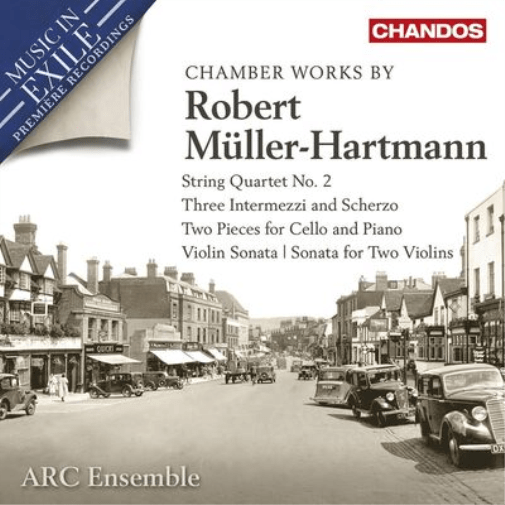
Almost Lost to History: The ARC Ensemble Plays Chamber Music of Robert Müller-Hartmann


There is most certainly an arbitrary factor in the determination of fame and of historical significance. Choose any figure at any historical moment and you can find other lesser known or forgotten figures who stood near, worked with, or were recognized in their time but whose presence has faded from history. Of course there are less arbitrary factors such as socioeconomic and political factors but, the ARC Ensemble’s mission is to fill some of the gaps (or gaping holes) in the historical record in their amazing “Music in Exile” series.

This most recent volume focuses on one Robert Müller-Hartmann (1884-1950). Even his brief Wikipedia page is apparently only available in German. This German-Jewish composer took refuge in England in 1933 where he became well known to artists of the day there like pianist Artur Schnabel and composer Ralph Vaughn Williams.

The process of exile is not a kind one. The list of refugee composers, from Europe alone, is a lengthy one with a few names that have been sustained to some degree in the historical record (like Arnold Schoenberg, Erich Korngold, Bertholdt Goldschmidt, Roberto Gerhard, and Ernst Toch) but, with the exception of Schoenberg, these artists are hardly household names. Even though many works by this parenthetical group have been recorded, they remain, in this writer’s opinion, far less known than they deserve.

ARC to the rescue. This latest installment is by a musician whose name and history were not known to this writer until now. After fleeing the terrors of fascist regimes, this talented composer/performer/teacher became integrated to musical life in England and even assisted Ralph Vaughn Williams in his compositional efforts. But Robert Müller-Hartmann’s music, though performed and respected at one time, has fallen into obscurity. These recordings, as this series does so well, provide a window into his creative music. And this release is a valuable historical document which justly recognizes an important voice and character whose work need not be absent any more.

Five works (or groups of works) are featured here:

1. String Quartet No. 2

2. Three Intermezzi and a Scherzo for piano

3. Two pieces for cello and piano

4. Sonata for Violin and Piano

5. Sonata for two Violins

It is difficult to say if any of these works will ultimately find a place in the common performing repertoire but at least we as listeners and other musicians have a chance to hear this music and decide. These unabashedly romantic works are both substantial and a challenge for the musicians that bring this art to life. So listen, decide, like or don’t like, but be grateful that it can be heard.

Those who want to learn more can download performance notes from when these pieces were presented in concert here.

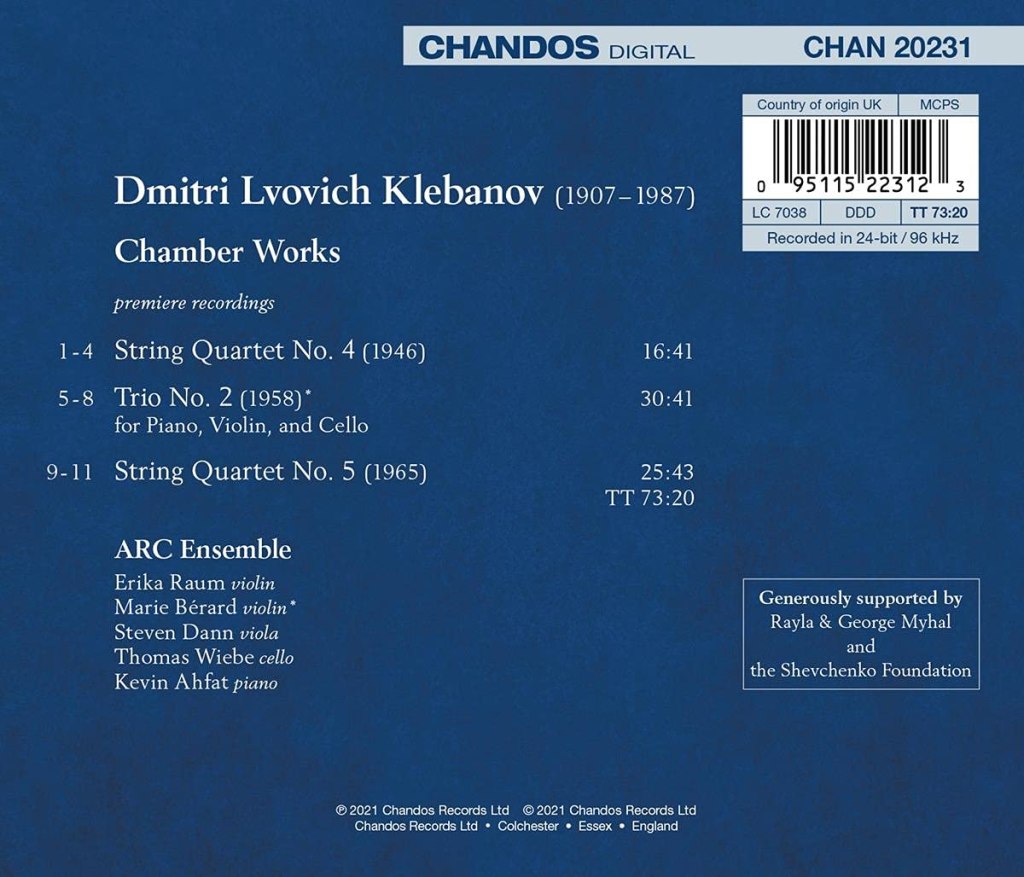
Dmitri Klebanov: Music from Exile


Chandos CHAN 20231

A wonderful trend was begun by London/Decca in the early 1990s with the release of their “Entartete Musik” series. It featured music by composers whose work had been suppressed by the dictates of the Nazi regime. It brought to light a great deal of wonderful music by mostly but not entirely Jewish composers many of whom died in concentration camps or were forced to live in exile. These recordings sparked a trend which continues today and this time the Chandos label hosts the efforts of the Toronto based ARC Ensemble whose scholarship and performance skills bring this, the fifth album in this important series. It is saddening to see the sheer volume of these oppressed works evidenced by the seemingly endless flow of new releases in this genre but there is some joy to be had in the fact that this music is slowly getting performances and recognition.

Previous releases featured premiere recordings by Jerzy Fitelberg, Szymon Laks, Walter Kaufmann, and Paul Ben-Haim. Haven’t heard these names? Well, maybe you’ve heard of Paul Ben-Haim, the Jewish/German composer who changed his name (Paul Frankenberger) when he emigrated to Palestine in 1933. The importance of projects like this one is to bring to light the art of composers lost to history and unknown in concert halls due to political oppression and/or outright murder.

This release features music by Jewish/Ukrainian composer Dmitri Klebanov (1907-1987), a composer whose work displeased the Stalinist regime. He wasn’t put in a concentration camp, he wasn’t killed, he wasn’t even sent into exile in the Gulag. Rather he was forced into a sort of intellectual exile in which he produced music which pleased the regime. But he had been cast as a sort of “whipping boy” by the regime and used as an example in the hopes of preventing others from straying to more liberal and outspoken paths such as those of Prokofiev and Shostakovich.Fortunately he outlived Stalin and was able to return to his own personal style of composition. It is this music which is presented here.

The three works from 1946, 1958, and 1965 respectively seem to have been chosen to reflect three fairly distinct eras in Klebanov’s artistic development. Whether these are ultimately representative of those chosen eras seems beside the point which is, I believe, to present a representative sampling of his work to give listeners a taste of his work and to help guide interesting performers and record companies to decide what to record next.

These works will serve to represent this neglected composer for now. There do exist some recordings of this music but these are mostly on small labels and very difficult to find. The hope for this recording and for a project like this is to provide good recordings with authoritative performances which may inspire musicians to explore the remainder of the composer’s work and, hopefully, bring these gems to audiences.

The disc begins with the nearly classical sounding fourth quartet from 1946. Cast in the classical four movements it’s difficult, in 2021, to imagine how this very accessible music could offend Soviet leaders but that is another issue entirely. All music ultimately exists within a variety of contexts but it is only possible to hear this music as it is today, listening with ears that did not exist at the time the music was written. Suffice it to say that this is eminently listenable music played with insight and dedication by the wonderful ARC Ensemble (Erika Raum, violin; Marie Berard, violin; Steven Dann, viola; Thomas Wiebe, cello; and Kevin Ahfat, piano).

The second selection is the Second Piano Trio of 1958. It is cast in three movements, some of which will remind listeners of Shostakovich whose fame and mastery loomed brightly at this time. But neither the rather conservative classical form of a piano trio nor the basically tonal idiom is likely to have charmed Kremlin leaders of the time. This is intelligent music that show the composer at the height of his powers and this, generally speaking, was not appreciated by the powers that be at the time of the work’s genesis.

The last work on the disc is the composer’s fifth string quartet from 1965. Like the two works that precede it in this recording this is music of both substance and charm. It is as listenable as the other two works and would doubtless entertain the average concert goer. It bears comparisons to Shostakovich, yes, but also to Haydn, Mozart, and Beethoven.

Completists, such as your reviewer here, will wonder at the music not included on this disc: the first three string quartets, the first piano trio, the other chamber music, nine symphonies, and various concerti along with five operas and two ballets. It is both fitting and sad that this overdue review be published at at this moment in history when, as I write, the Russian army advances into the Ukraine leaving death and destruction in their wake. There is doubtless much more music yet to be uncovered/discovered, rescued from oblivion but the sad fact is that the forces which suppressed this Ukrainian composer’s works continue to oppress artists today.