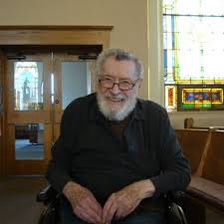
New Music Buff’s Best of 2023


Attack of the Music Memes

After agonizing about writing a “best of” blog and publishing it before January 1, I decided to take a pause and enjoy the holidays. So here I look back on my 2023 in the rear view mirror but with memories still pretty fresh.

Regular readers of this blog likely already know of my oft shared opinion of the superfluous nature of “best of” lists and of my acquiescence in producing such on an annual basis. I certainly don’t think of this as a meaningless exercise and I think the process has grown on me. It is a chance to achieve a perspective which would be missed by simply plowing on ahead with the usual flow of reviews and articles. But drawing down that 12 month perspective is an opportunity to evaluate those months, to see where we’ve been and to hopefully get a smidgen of insight into where I/we are likely headed.

My Facebook friends will recognize the representative meme at the head of this article which is one of the more cloying aspects of “AI”, whatever that is. So indulge me for a moment to look at this seemingly new intrusion into the reality we thought we knew. So, what is “AI” and what will it do to us? Ultimately I’m not the one to answer that question but I’d like to throw some ideas to add to the speculation.

First, the choices a composer makes, like the choices of a painter, a writer, etc. are the stuff of the mystery of creation itself. Why “A major”, or why that tuning, or scale, or rhythm, or orchestration, etc? So along comes the notion of removing, or at least distancing, the artist from their creative product. That notion started not with famed proponent John Cage but rather with Johannes Chrysostymous Wolfgang Amadeus Mozart in his K. 516f musical dice game. Voila! Algorithmic composition (actually fairly common practice in the classical era). An early manifestation of “AI”? Perhaps.

Lejaren Hiller (1924-1994) was the first composer to employ electronic data processing in a musical work in his Fourth String Quartet subtitled “Iliac Suite” in 1957. There followed similar experiments with various iterations of electronic creations at music centers worldwide including The University of Illinois at Champaign, Columbia-Princeton, Stanford, The University of California Berkeley and San Diego, The San Francisco Tape Music Center (later subsumed into the Mills College Center for Contemporary Music, IRCAM in Paris, Israel Electronic Music Studio, and counterparts in the Nordic countries, Germany, Belgium, etc. Proto “AI”?

While historically interesting I raise this issue to say that, as far as I can tell, “AI” has not made this writer’s greatest hits list but it is interesting and maybe even useful. With that, my concern for the subject officially goes to the back burner for a later time.

2023 has been a year of great personal changes for the writer of this blog. A job change, a geographical relocation, and many things unrelated to this blog characterized a busy year for New Music Buff. So here in a sort of holiday tradition I present my “Best of 2023” from my little listener’s corner of the world. For the sake of simplicity I present a more or less chronological exposition of my sonic adventures. (N.B. Not one portion of this article made use of “AI”).

I begin with not with my 20 most read posts, a practice that characterized previous iterations of this annual exercise. Instead I am providing my top 20 favorite releases that were reviewed in 2023. Please note a couple of caveats. First, I receive a lot of review requests, more than I can even listen to, much less give a reasonably intelligent review. Albums that I’ve not reviewed should not be assumed to be bad or insignificant and my reviews are personal observations. I really only review albums that interest me anyway. Second, this article is only one reviewer’s opinion and not intended to be definitive or to supersede anyone else’s opinions. Third, this is not the end of my attention to music that was released in 2023. Some releases require more time to give a fair listen and a respectful review. There are more to come in 2024.

First a few stats: 2023 saw the publication of some 45 blog posts on New Music Buff, earning me 9693 views for the year. I rarely get comments on my posts (though I welcome and invite comments both positive and negative). Not bad, I think, for the overall less appreciated musical styles that fuel my desire to write about.

Now, in chronological order (of publication) are my personal favorites as a listener:

Neuma 158

Binaural Beats in the Tudor Rainforest started my new year with a bang. Reviewing this disc required me to take a closer look at the astounding work of David Tudor and his unique contributions to new music. This important release is a recording of a work which, by its own concept cannot receive a “definitive” performance. But this recording comes mighty close, involving “binaural” recording utilizing a mobile set of binaural microphones which are worn by the recordist. In addition this recording involved a collaboration with Pauline Oliveros and a group called, “Composers Inside Electronics”. The recording was done during Oliveros’ tenure at UCSD. Rainforest IV is so called because it is the fourth iteration of the instructions that form the original concepts of Tudor’s composition, “Rainforest”. It is an immersive sonic experience heard on headphones but actually not bad even heard on stereo speakers. A rich and wonderful release.

Starkland S-236

From a 1960s electroacoustic to a budding 21st Century composer Kotoka Suzuki released on the reliably interesting and even visionary Starkland label. Next Gen Electroacoustic: Kotoka Suzuki will introduce the listener to this rising star who doubtless will produce more of her compelling compositions.

Sony 194399434826

Igor Levit is a fine concert pianist whose albums are effectively redefining the way we, as listeners, perceive the western classical oeuvre. Igor Levit: Defining Tristan does for the various musical pieces inspired by the Tristan legend what Levit did for the concept of the great keyboard variations in which he selected Beethoven’s “Diabelli Variations” and Frederic Rzewski’s “El Pueblo Unido Variations” to join his recording of the Bach “Goldberg Variations” in a 3 disc package placing these three large sets of variations as emblematic of the genre in three different centuries (18th, 19th, and 20th). Levit, by his recorded output, is providing a valuable perspective which may influence repertory choices for years to come.

Levit’s traversal of the Tristan legend here ranges from the second recording of Hans Werner Henze’s too seldom heard “Tristan Preludes” back to works by Wagner (of course) and Liszt. He even slips in his wonderful solo piano transcription of the Adagio of Mahler’s unfinished 10th Symphony into the mix. This is a very compelling Tristan anthology by a deservedly still rising star.

Cantaloupe

This Cantaloupe release by Bang on a Can composer and master clarinetist Evan Ziporyn is both masterful and great fun. Evan Ziporyn: Bang on a Pop consists of transcriptions of “pop” songs for multiple clarinets all played by Ziporyn via his very effective multi-track recordings. The album is very personal and pretty much cliche free with these engaging and insightful transcriptions. It is an homage to the songwriters as well as a showcase for Ziporyn both as composer and as performer.
Microfest MF 23

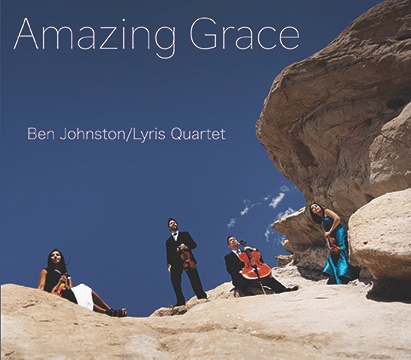
The Young Person’s Guide to Ben Johnston is an ideal way to introduce listeners to the wonderful world of the late Ben Johnston’s music. Johnston, a student and colleague of Harry Partch shows his compositional skills utilizing non-traditional western tunings in these representative works. Johnston here does for some quasi pop tunes what Evan Ziporyn did with his clarinetist perspective for the tunes on Pop Matters. But Johnston’s pretty, accessible work belies fascinating complexities that don’t actually sound complex to the listener. This disc contains Johnston’s last completed work, “Ashokan Farewell” (which Johnston took to be a public domain folk tune but is in fact a piece written by Jay Ungar). It is paired with the 4th String Quartet (a set of ingenious variations on “Amazing Grace”) from 1982 and the 9th String Quartet of 1997. Profound, lovely to listen to, and a great homage.

DVD OM 4001

This DVD is a major addition to the discography of Charles Amirkhanian’s sound poetry as fine sampling of one aspect of Carol Law’s (Amirkhanian’s life partner) complementary visual art. These collaborations are also important contributions to the visual and performative aspect of these collaborative works. Amirkhanian has been a fine curator and promoter of the work of others but he has rather seldom stepped into the spotlight himself. This quirky genre got some fabulous exposure at the 7 day Other Minds 23 festival in 2018 in which Amirkhanian’s work was presented in the (surprisingly varied) context of sound poetry of the amazing international collection of artists who were hosted at those events. This DVD should be in the collection of anyone interested in new music sound poetry and performance art. It is both entertaining and mind bending featuring a juxtaposition of images and sound reviewed in greater detail in the post “Dyadic Dreams”. But words cannot do justice to these works. You really have to see them.

Cedille CDR 90000 210

Readers of this blog know my fondness for the Chicago based label Cedille and their promotion of Chicago based musicians. This disc stands out in this group’s embrace of non-traditional composers alongside more traditional works. The inclusion of works by DJ composer Jlin and the academy based genre defying duo Flutronics alongside composers like Danny Elfman and Philip Glass demonstrate the wide ranging repertoire of Third Coast Percussion. Much more information can be found in Perspectives: Spectacular World Premiere Recordings from Third Coast Percussion on my blog. This one reimagines the percussion ensemble.

Neuma 176

This disc is a good example of why listeners and collectors should pay attention to the Neuma record label. Philip Blackburn, who had been the very successful curator of Innova records, took over the defunct Neuma label which was founded with the intention of promoting largely electroacoustic music though not exclusively.

Agnese Toniutti‘s New Music Vision is actually a review of two discs by this rising star, a dedicated new music pianist that needs to be on your radar. The other Neuma disc contains Toniutti’s traversal of John Cage’s reluctant masterpiece, “Sonatas and Interludes for prepared piano”.

The disc pictured here is Toniutti’s vision beyond the Cage work. This one focuses on mostly living composers Lucia Dlugoszewski, Tan Dun, Philip Corner, and Toniutti’s herself. Basically, if Toniutti plays it, you should probably at least give a listen.

2023 saw the completion of Bay Area pianist Sarah Cahill’s epic survey of piano music by female composers. Cahill is another (predominantly) new music focused pianist about whom I would also assert that, if she plays it, you should probably give at least one listen.

The End of the Beginning: Sarah Cahill’s “The Future is Female” Trilogy Completed will tell you all you need to know about this trilogy which encompasses about 300 years of music history and sheds light on some fascinating and substantial music written by women. Most of the works on this trilogy of albums are, in fact, world premieres but, fear not, even the pieces which are not premieres are likely not in your collection. This is a brilliant selection of music that effectively throws down the gauntlet to challenge other artists to explore this repertory. This trilogy is a true landmark and a joy to the ears.

This third volume in the wonderful Catalyst Quartet’s survey of another unjustly neglected group of composers focuses on the music of three black Americans of the twentieth century. Catalyzing Blackness, Volume Three: The Catalyst Quartet plays 20th Century music by Black Americans was nominated (but didn’t win) for a Grammy Award and, happily, I’m told that more volumes are in preparation. Again, this music is a pleasant revelation that does for black composers what Sarah Cahill has done for women composers (N.B. The first volume by the Catalyst Quartet focused on the black female composer Florence Price). And here’s hoping that Coleridge Taylor Perkinson, George Walker and William Grant Still will become household names in the concert hall.

Microfest MF 21

Son of Partch, Carrying on a Tradition is a really wonderful disc which, though I reviewed it in exceedingly positive terms, provoked a strongly negative reaction from the artist. The reaction apparently also provoked enough interest to have made this review one of my most read of 2023.

But, aside from the unfortunate negative reaction, I still maintain that this is a fine release worthy of attention from anyone who likes new music, microtonality, and the music of Harry Partch. Cris Forster is a composer, theoretician, and instrument builder clearly descended from the Partch tradition. His work deserves attention and this disc is a very satisfying experience.

Islandia IMR 011

Steven Schick is a master percussionist and conductor. This release is the first volume of his personal choices of solo percussion repertoire. Solo Percussion Manifesto Volume I: Steven Schick’s “A Hard Rain” is a manifesto of sorts and does for solo percussion music what Sarah Cahill has done for women composers and the Catalyst Quartet is doing for black composers. There are not many recordings of solo percussion music and Maestro Schick essentially presents his favorite works in definitive performances on a label produced by Bang on a Can cellist Maya Beiser. The second volume is in my review queue and, if this first volume is any indication, it will be a landmark survey.

Cedille

Rising Star Seth Parker Woods’ “Difficult Grace” is a Classic in the Making. Here’s another Grammy nominee that did not win but, this second album by this fine American new music cellist is a winner in my book (er, blog). This is actually the audio of what was developed as a staged performance but the music speaks for itself. Keep an eye/ear out for this rising star who, even now, is storming the new music cello scene in invigorating ways.

Neuma 128

A Reason to Listen: Roger Reynolds’ Latest, “For a Reason”,new recordings on Neuma Records. Here we see Neuma following its original electroacoustic mission with this remarkable set in celebration of Roger Reynolds’s 90th year. This is a lavish 2 CD box set with a beautiful booklet and lucid liner notes. It is a worthy production which showcases recent works by this prolific and important American composer.

Readers of this blog likely are aware of my interest in music that is suppressed and/or neglected so this disc grabbed my attention immediately. Israel does a great job of funding the arts and this can be seen in the proliferation of truly fine performers nurtured by that funding. Less well known are the composers who have flourished in the art healthy politics of this country. Some 50 years of history are represented here. This is but a sampling, albeit finely curated, of several generations of composers displaying a plurality of styles with substantial results. This entertaining disc will whet the appetites of intelligent and curious listeners and, hopefully, bring about more recognition of the world class composers who deserve an audience.

So, finally, went my 2023.

Opus 961, Violist Noémie Chemali’s Auspicious Debut: New Music Activism From Emerging Lebanese Composers


There are many ways to debut on the world stage and there are many ways to represent political activism. Violist Noémie Chemali has chosen, as her important first impression in her recorded debut, a selection of music from young composers whose heritage includes political oppression. The albums profits are promised to MSF, also known as Doctors Without Borders. These works are not directly political, rather they are a carefully curated selection of new works produced by composers who, in varying degrees, have experiences of dealing with or having friends and family whose lives are negatively impacted by political conflicts and oppression. This is gorgeous music by emerging talents.

The good news is that these wonderfully creative artists persevere in creating great art and it is the celebration of that creative drive that lies at the heart of this fine release. While the pieces here variously reference tunings, rhythms, and melodies representative of their individual ethnic heritages, they are not confrontational. Rather the music here stands as evidence of the beauty of artistic invention which stands defiantly in contrast to the cruelty of oppression and warfare. That gentle activism casts a kinder and gentler image of people more commonly represented in the media as terrorists (actually a numerical minority) in a culture with ancient roots and a powerful artistic soul (the better descriptor of the actual majority).

Links to the composers’ web sites can be accessed by clicking the names of said composers.

The album’s contents are as follows:

Wajdi Abou Diab (1991- )

1. “The Moraba’ Dance” (2020)

This, the composer’s Opus 13C, is based on an Arabic rhythm called “Al Mouraba”. It is for solo viola and is cast in the unusual meter of 13/4, using an Arabic scale. The music imitates traditional music which ostensibly enticed horses to dance in times past.

Sami Seif (1998- )

2. “La’ib an-nard / The Dice Player” (2019)

This musical impression of a poem of the same name by Mahmoud Darwish. It is, in the composer’s description, a meditation on the random elements that affect our lives. It is scored for viola, cello, and double bass.

Layale Chaker (1990- )

3. Cadenza from “The Brown Texts”; movement one (2017-2020)

4. Cadenza from “The Brown Texts”;movement two

The term “cadenza” derives from the word “cadence” and it generally refers to the improvisations (by the soloist) in a concerto. The notion of a solo cadenza does not appear, as far as this listener’s encounters, until the mid to late twentieth century. Penderecki’s Cadenza for Viola is the only example that immediately comes to mind. Though that work is sometimes performed separate from the viola concerto from which it derives, its origin is in the classical/romantic tradition of a virtuoso work that displays the skills of the soloist. As with the previous work, this one is a musical rendition of originally poetic ideas, those of the late Nadia Tueni. And, unlike any other cadenza I’ve known, it is cast in two separate movements. The piece is a fine showcase for Ms. Chemali’s technical and interpretive skills.

Noemie Chemali:

5. “Kadishat” (2021)

Delightfully, Ms. Chemali has chosen to include one of her own compositions. She describes this as a set of variations on the ancient Aramaic Trisagion “Qadishat aloho”, a tune which has been firmly ensconced in the composer/performer’s consciousness from having heard it since her childhood. One could characterize it as one of the greatest hits of the Eastern Orthodox Church and one of its most deeply felt pieces. Chemali casts this work for violin, viola, and cello. This writer is reminded of another fine example of the incorporation of sacred hymns into the classical music tradition, that of Carolyn Shaw’s fine “In Manus Tuas” which mines that composer’s memory of hearing a sacred chant. Both works reflect the composer’s internal process of hearing and attempt to convey that spiritual experience to the listener.

Mary Kouyoumdjian (1983- ):

6. “The Revolt of the Stars” (2018/2020)

This piece, another musical expression of a literary work, namely, the Armenian fable that provides the title for this work which is cast for cello, voice, and electronics. It is presented here in a transcription for viola by the soloist. The fable deals with the strength in numbers that rise up against those in positions of power. It is a delightful work with dark implications.

Saad Haddad (1992- ):

7. “Dohree” (movements 1&2)

8. “Dohree” (movement 3)

This work, scored for viola, harp, and flute is cleverly written in three movements which, in turn, each give a solo to each of the musicians who are, in turn, accompanied by the others in the group. “Dohree” is an Arabic word which translates as “my turn”.

Six pieces over eight tracks with chamber groups ranging from solo viola to viola with electronics (in the Kouyoumdjian work) and small chamber groupings in the others. All in all a fine and engaging selection of music that bear witness to the beauty and creativity of people living with oppression. This music reflects the human experience that can get erased by merely identifying ethnicity.

In addition to Ms. Chemali this recording includes the following musicians: Shaleah Feinstein, violin; Raffi Boden, violoncello; Kebra-Seyoun Charles, double bass; Lauren Scanio, flute; Deanna Cirielli, harp. They really do honor to the spirit of this music and this album is beautifully recorded as well.

Kouyoumdjian was the only composer known to this reviewer prior to hearing this album but she is apparently in very good company here and listeners would do well to make note of these rising stars. We will doubtless hear from them again. Here’s hoping.

Noemi Chemali (from the Orchestra of St. Luke’s web page)

This is the artist’s biography as it appears on her website (linked above):

French-Lebanese-American violist Noémie Chemali received her Bachelor’s degree from McGill  University’s Schulich School of Music, her Artist Diploma from the Robert McDuffie Center for Strings at Mercer University, and her Master’s Degree from The Juilliard School. Her principal teachers include Becca Albers, Hsin-Yun Huang, and Carol Rodland.

During her time at Juilliard, she made her Carnegie Weill Hall solo debut in the UN Chamber Music Society’s Arabic Language Day concert and collaborated with dancers of the New York City Ballet. During her time at the McDuffie Center for Strings, she performed alongside faculty members of the Cavani and Ehnes String Quartets. In 2019, she also performed in “A Night of Georgia Music,” a tour the American South with violinist Robert McDuffie,  guitarist Mike Mills of the band R.E.M., and pianist Chuck Leavell of the Allman Brothers Band/Rolling Stones. Some performance highlights from McGill include playing a concert with clarinetist David Krakauer in a program of Klezmer music, being selected to perform a chamber work by John Rea in a concert presented by the Société de musique contemporaine du Québec (SMCQ) alongside Schulich faculty and students, and participating in the 2018 Musical Chairs Chamber Music Festival, where she collaborated with students from the Mozarteum (Austria) and the Yong Siew Toh Conservatory of Music (Singapore).

Noemie has spent her summers at music festivals such as The Music Academy of the West, Sarasota Music Festival,  Orford Musique, The Lunenburg Academy of Music Performance (LAMP), Scotia Festival of Music, Manhattan in the Mountains, and Green Mountain music festivals. While Ms. Chemali was a fellow at the Music Academy of the West, she played under the baton of esteemed conductors Larry Rachleff, Stéphane Denève, Gustavo Dudamel, and James Conlon. While at Sarasota Music Festival, she served as principal violist of the festival orchestra under the baton of Jeffrey Kahane and performed in a faculty concert as a member of a quintet with bassoonist Frank Morelli. She has, throughout the years, participated in various masterclasses with artists such as Joseph Silverstein, Ida Kavafian, Cynthia Phelps, Karen Dreyfus, Richard O’Neill, James Dunham, Jutta Puchhammer and the Pacifica String Quartet.

Passionate about diversifying musical audiences, she co-founded the Hildegard Project, which aims to bring music written by women composers to women’s shelters in the greater Montreal area and was invited to speak about her work at the Classical Evolution/Revolution Conference in Santa Barbara, CA. Most recently, she founded Music@Daybreak, an interdisciplinary performance and research project which features performances at homeless shelters in collaboration with the Sociology department at Mercer University.

Noémie is the recipient of a Juilliard Career Grant, George J. Jakob Global Enrichment Grant, Gluck Community Engagement Fellowship, Juilliard Entrepreneurship Grant, Barenboim-Said Foundation (USA) Grant, and a Lower Manhattan Cultural Council Creative Engagement Grant. In January 2024, she will be releasing Opus 961, her debut album of music written by contemporary Lebanese composers.

Her website includes some YouTube videos reflecting the artist’s fascinating choices of repertory. Along with fervent activism, she demonstrates a pretty unique take on what she chooses to play. Her biography evidences an eclectic group of collaborators and influences that will likely characterize her career.

This is quite an impressive first impression from an artist who greets us at the beginnings of what this reviewer believes will be a long and interesting career representing a new generation of musicians with a unique and (hopefully more effective) approach to the ills of our age. Great art inspires, if not action, at least hope. And we desperately need hope. Thanks for that Ms. Chemali.

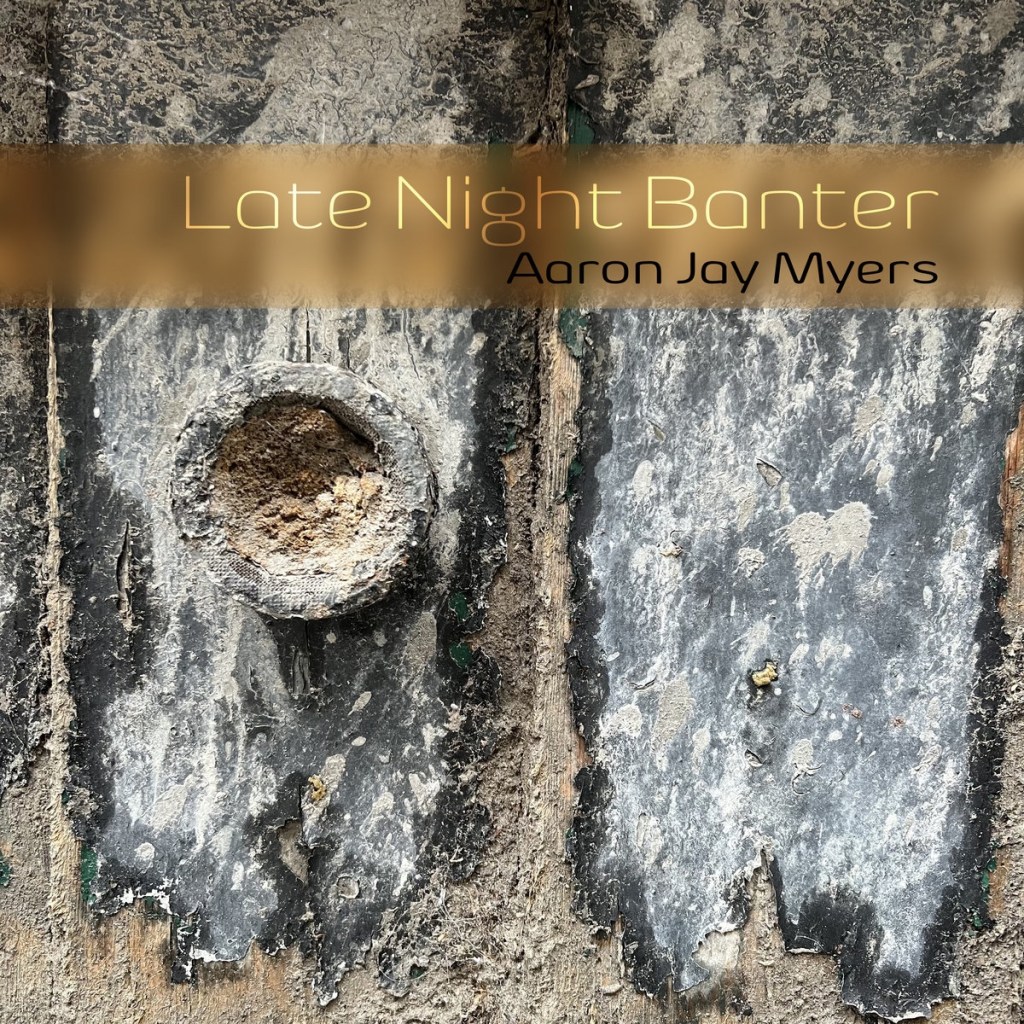
Aaron Jay Myers, Superbly Integrated Eclecticism in “Late Night Banter”


Neuma 175

Aaron Jay Myers’ third album grabbed my attention immediately and didn’t let go til the album ended. Working un-self consciously in a stunning plurality of styles (this guy clearly paid attention to his 20th century music history classes) he has produced some mighty substantial works. His ability to integrate a wide variety of techniques and styles into his artistic persona is simply astounding. His references to other composers’ works, rather than sounding derivative, evoke nostalgic homage, at least in this listeners ears. Indeed there seem to be more references per square inch than in a Thomas Pynchon novel. And the fact that he shares this writer’s passion for Star Trek, Deep Space Nine only endeared him more to me (more on that later).

His very listenable music seemingly embraces the whole of the twentieth century stylistically and his very judicious use of extended techniques for pretty much all instruments including voice demonstrate a firm understanding of where those techniques best serve his artistic vision. Fortunately he has managed to find performers who both meet his technical demands and have a real grasp of his musical vision. This Neuma release is truly something special.

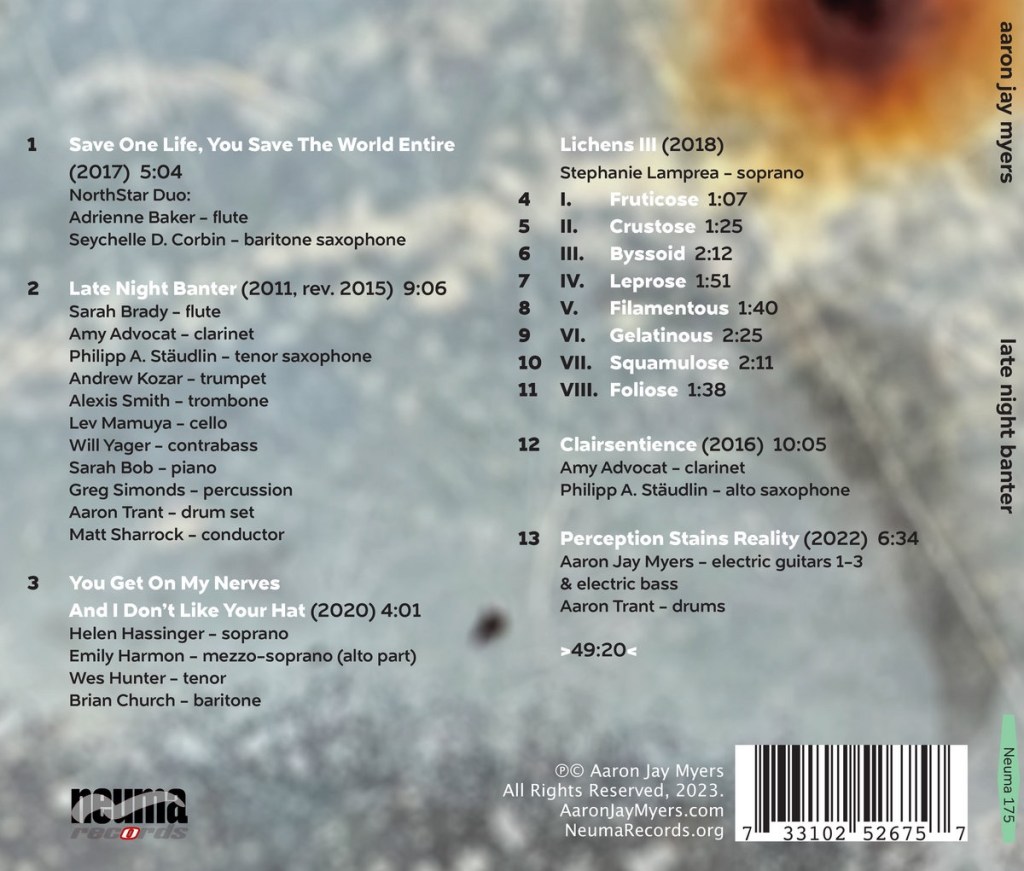
There are six works divided among the thirteen tracks. These chamber works were written between 2011 and 2021. None require more than ten minutes or so of your time and left this listener satisfied with the music and optimistic for the future of classical music in general.

“Save One Life, You Save the World Entire” (2017) for the unusual combination of flute and baritone saxophone opens this album with a surprisingly engaging work. It sounds like a challenge for the musicians who handle those challenges seamlessly and engage the listener in this rather brief essay.

When I listen to “Late Night Banter” (2011 rev. 2015) now, I do so in bare feet (it knocks my socks off). This piece for ten musicians with a conductor is a finely crafted piece that grabbed this listener’s attention by that craftsmanship but also by what seem to be a plethora of sonic references to 20th century music. The style of Stravinsky, an homage to Luciano Berio, etc. These brief references evoked emotional responses which led me to recall similar emotions I had attached to the apparent (at least to me) object of said reference. Even minimalist references occur matter of factly. Such efforts can sound derivative or at least imitative but not so in this piece. Rather it had the quality of a tour of the twentieth century in respectful jogs of memory. But even if you don’t get the references, this is a substantial and entertaining work. The evanescence of those references had me questioning whether they were actually there or just my mental figment. (I guess I’ll just have to listen again). Either way I was thrillingly engaged.

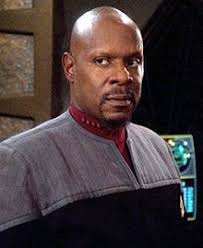
Avery Brooks as Captain Benjamin Sisko, commander of Deep Space Nine

“You Get On My Nerves, And I Don’t Like Your Hat” (2020) is the Deep Space Nine reference mentioned at the beginning of this review. If you haven’t seen this series I highly recommend it. And so, apparently, does Aaron Michael Myers. This work for vocal quartet (SATB) takes its title from a witty utterance by Captain Sisko (my fave Star Trek Captain). Of course you don’t have to know Star Trek lore to appreciate this work, but it helps. It is a challenging work for four unaccompanied soloists which reflects the composer’s sense of humor as well as his connection to pop culture.

Aaron Jay Myers

“Lichens III” (2018) is scored for soprano voice but the singer also does the work of a percussionist. In addition to the vocal challenges the singer is asked to perform on “body percussion”, the various sounds one can make by percussing (pounding) on one’s body. It is more commonly an idiom of folk and blues but soloist Stephanie Lamprea handles both the singing and the percussing as though it is her everyday practice accomplished with ease.

Clairsentience (2016) is another wind instrument duo, this time for clarinet and alto saxophone, a similarly unusual choice of instruments. This one is about twice the duration of that first piece and every bit as engaging as well as challenging.

The last track is a marvel of multitasking. Other than Aaron Trant (who does a fine job) on drums, all of the parts (three electric guitars, and bass) are handled by the composer. “Perception Stains Reality” (2002) is a tour de force consistent with the other works on this disc. Here he shows his rock/pop sensibilities, clearly as essential a part of his artistic endeavors as his “classical” training.

Myers is one to put on your hot list. He is certainly on mine. If you can hear a performance of his work, whether live or recorded, you would do well to check it out.

The Young Person’s Guide to Ben Johnston


Microfest MF 23

I’m guessing that my title has its origins in the Benjamin Britten piece, “The Young Person’s Guide to the Orchestra”. That phrasing has been used by the likes of Phill Niblock and King Crimson to title retrospective compilation discs. While the disc under consideration here is not, strictly speaking, a retrospective it is a fine representation of the chamber music of the late great Ben Johnston (1926-2019).

Johnston, a former associate of Harry Partch (Johnston played in Partch’s ensemble) was a composer in his own right. His ten string quartets are a landmark of the genre. Two of those quartets are featured here played by the Lyris Quartet (Nos. 4 and 9) along with what is apparently his last composition, “Ashokan Farewell” (1999) scored for an octet in which the Lyris is augmented with flute, clarinet, bassoon, and double bass.

Like so many composers before him, Johnston was fond of incorporating folk tunes into his compositions. The composer’s fourth quartet (included here) from 1973, which incorporates “Amazing Grace”, is likely his best known work. Despite its incredible complexity (nicely summarized in Kyle Gann’s lucid liner notes) this set of variations keeps that familiar tune near the surface and effectively make for music that is friendly to the audience, easy on the ears. It’s single movement clocks in at just under 12 minutes, the piece ends long before listeners have time to worry about that complexity.

Not all of the quartets incorporate familiar tunes but they explore various aspects of just intonation tunings. The ninth quartet (1987) is about twice the length of the fourth and is set in the familiar four movements that characterize the majority of the classical string quartet literature. The use of the classical format along with Johnston’s masterful writing also make this slightly odd sounding work just familiar enough that few listeners will find unpleasant. In fact the work is a joy to experience though very difficult to play.

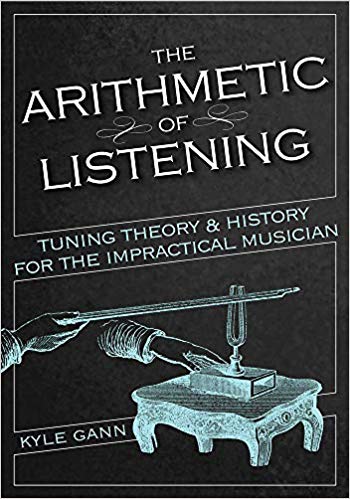
Listeners may want to seek out Mr. Gann’s very readable work on microtonal tuning systems, “The Arithmetic of Listening” available. Your humble reviewer is working through this text and finding it useful in understanding microtonality.

The final work (both the last on the disc and the last in the composer’s ouevre) is a delightful set of variations on a tune called “Ashokan Farewell”, a pretty folk like melody that pervades the Ken Burns Civil War documentary. I say “folk like” because the time was written by Jay Ungar and Molly Mason. Johnston mistakenly believed it to be a folk song in the public domain and, seeing its possibilities for his compositional aspirations, simply used it. Like the fourth quartet it is a set of variations in a single movement of similar length. This is the world premiere recording.

Musicians include Alyssa Park, violin; Shalini Vijayan, violin; Luke Maurer, viola; Timothy Loo, cello; Sara Andon, flute; James Sullivan, clarinet; Scott Worthington, double bass.

In researching this review I discovered that the tune actually has lyrics (also under copyright) and they are presented below:

The sun is sinking low in the sky above Ashokan
The pines and the willows know soon we will part
There’s a whisper in the wind of promises unspoken
And a love that will always remain in my heart

My thoughts will return to the sound of your laughter
The magic of moving as one
And a time we’ll remember long ever after
The moonlight and music and dancing are done

Will we climb the hills once more?
Will we walk the woods together?
Will I feel you holding me close once again?
Will every song we’ve sung stay with us forever?
Will you dance in my dreams or my arms until then?

Under the moon the mountains lie sleeping
Over the lake the stars shine
They wonder if you and I will be keeping
The magic and music, or leave them behind.

Ben Johnston

Those lyrics make for a fond farewell to a true musical genius who gave us both magic and music. Grab this lovely disc and honor his memory.

The Bewitched in Berlin, Kenneth Gaburo does Harry Partch for your head (phones)


Neuma 126

As far as I can tell this is only the second recording of Harry Partch’s 1958 dance theater masterpiece. The recording that most folks know is likely the CRI release which used that awful simulated stereo (which is rather unpleasant heard on headphones). That recording (thankfully remastered in the original mono for New World Records) is of the 1958 premiere of this inventive and groundbreaking work originally released on the composer’s Gate 5 label.

Neumann KU100 microphone used to record binaural sound (Photo from Wikipedia)

This release of the 1980 (six years after the composer’s death) Berlin performance is here released for the first time on Neuma records under Philip Blackburn’s new tenure. Neuma’s tagline, “Food for the Mind’s Ear” is curiously reflected in the recording method used here. Binaural recording was pioneered in the late 1960s using two microphones facing away from each other inside a dummy head with anatomically accurate human inner and outer ears. The idea was to produce recordings which, when heard on headphones, simulated the experience of being present in the audience. Of course one can listen on conventional speakers but it is truly worth one’s time and money to get a good set of headphones to appreciate this amazing performance.

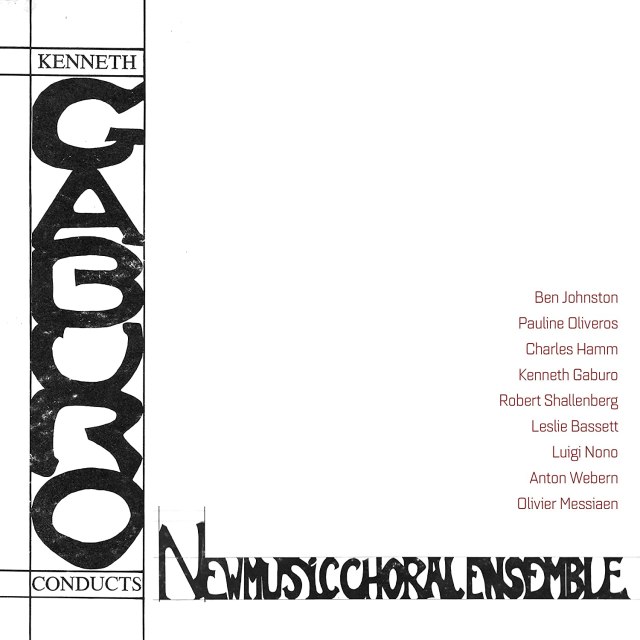
This is the second Neuma release which embraces Kenneth Gaburo’s legacy. The above recording (reviewed in an earlier blog post) is of a 1967 choral concert curated and conducted by Kenneth Gaburo at the University of Illinois at Champaign where, nearly ten years before that event, the premiere of Partch’s Bewitched was first imposed on a audience. It is Gaburo’s skills as a musical theater director that come into play in the 1980 Berlin production which features the Harry Partch Ensemble conducted by Danlee Mitchell, a long time Partch collaborator and performer.

The recording has a refreshingly superior sound to the 1958 mono premiere but the crucial significance of this release is of Kenneth Gaburo’s holistic theatrical vision which draws upon world music theater conventions such as Japanese Noh, Hindu Mahabharata performances, Gamelan accompanied Balinese Shadow Puppet theater, and the “happenings” of Allan Kaprow as well as ancient Greek theater. Gaburo rehearsed the musicians and dancers to channel Partch’s grand vision in this, the first of his three major dance/theater works (the others being Revelations in the Courthouse Park, 1960; and Delusion of the Fury, 1965-66). It is a masterpiece of American music.

back cover

The Harry Partch Ensemble in this recording consisted of Isabella Tercero (The Witch), Peter Hamlin (Adapted Koto), Phil Keeney (Spoils of War), Cris Forster (Marimba Eroica), Randy Hoffman (Cloud Chamber Bowls), Francis Thumm (Chromelodeon I), John Szanto (New Boo I), Dan Maureen (Bass Clarinet), Donna Caruso (Piccolo and Flute), Robert Paredes (Clarinet), David Dunn (Adapted Viola), Robin Gillette and Anna Mitchell (Kithara II), Ron Caruso (Diamond Marimba), Gary Irvine (Bass Marimba), David Savage and Paul William Simons (Harmonic Canon II), Ron Engel (Surrogate Kithara). Lou Blankenburg (choreographer/associate director) and Kenneth Gaburo (director). The Partch instruments are as much characters in this piece as the musicians and dancers.

The original recording done by RIAS (Radio In the American Sector) was restored and mastered by David Dunn. The booklet includes commentary from clarinetist Bob Paredes as well as Partch’s original scenario taken from the published score.

The Bewitched is a visionary politically progressive music/dance theatrical satire that parallels the work of Julian Beck and Judith Malina’s Living Theater and presages theatrical and musical trends that would later characterize the 1960s and beyond. This recording is a very significant historical document and a great sounding CD, an essential recording for fanciers of Partch’s work, and a performance that sets a standard for the future.

If you don’t already have a good pair of headphones get one and buy this CD. You won’t regret it.

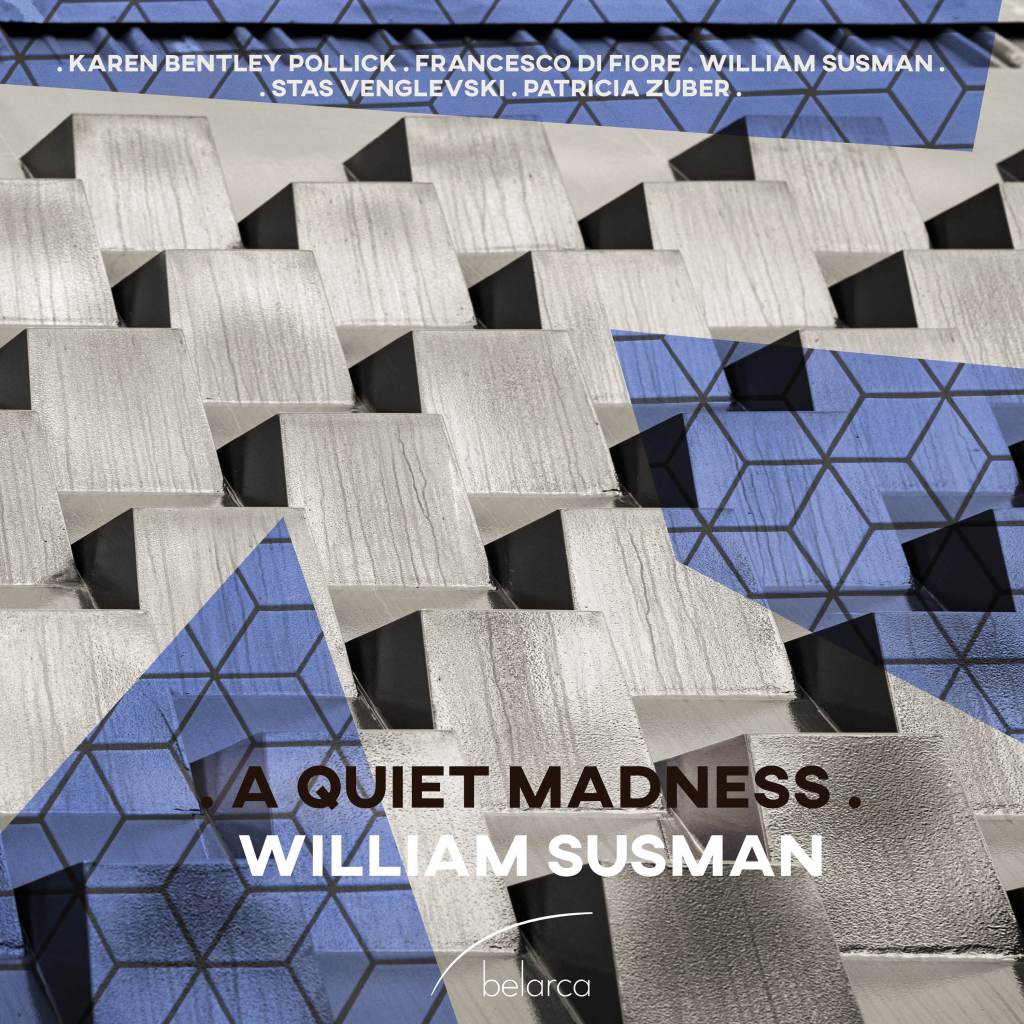
William Susman: A Quiet Madness


belarca 008

This 2020 release of chamber and solo pieces by William Susman (1960- ) is the third reviewed by this writer. The music here is from the last six years but these pieces rather unmistakably have Susman’s compositional fingerprints on them. There are six works in total and the solo piano pieces from Susman’s Quiet Rhythms series provide a sort of punctuation on tracks 2, 4, and 6. The Quiet Rhythms (2010, 2012, 2013) series appear to function sort of like working papers, little essays many of which are later used in other compositional projects. Three of those pieces similarly punctuate an album by pianist Erika Tazawa (Belarca 005) of piano pieces by Francesco Di Fiore, Douwe Eisenga, Marc Mellits, Matteo Sommacal and William Susman.

Francesco Di Fiore handles the piano on tracks 2, 4, and 6 playing Quiet Rhythms Nos. 1, 5, and 7 (all from 2010). These are just three tantalizing works from nearly 100 pieces in 4 books. Though these works seem to be a working out of ideas they interesting and engaging rather than simply didactic.

Susman, himself an accomplished pianist, plays the piano with Karen Bentley Pollick on violin in Aria (2013). This is the longest work on the disc and it is tantamount to a concerto or grand sonata which keep both performers very busy. It is above all a joyously lyrical piece likely to please listeners. The liner notes state that this piece uses material from an opera in progress. And a grand teaser it is.

Seven Scenes for Four Flutes (2011) is one of those delightful works which will doubtlessly be performed by a soloist against prerecorded tracks. Patricia Zuber, no stranger to Susman’s work, handles all four flute parts with seeming ease. The piece’s seven movements traverse a variety of moods in the poetically titled movements. This is a pretty densely written piece whose charms belie its complexity. Music using multiples of the same instrument (whether live or multi-tracked) inevitably invoke Steve Reich’s counterpoint pieces but there is in fact a large and growing list of such pieces which produce their own unique results consistent with their respective composers and this one is a most welcome addition to this genre.

The penultimate work is one for accordion, an instrument which has risen from folk music roots to a sometime part of an orchestra and, increasingly, as a solo instrument for classical repertoire both new and old. The soloist here, Stas Venglevski, rises to the challenge of Zydeco Madness (2006), a piece which takes the listener though various sections which challenge the artist and entertain the audience.

Despite the title this album is neither quiet nor mad (well maybe a little obsessive). But it is a welcome selection of music by a consistently interesting composer that leaves this listener wanting more.

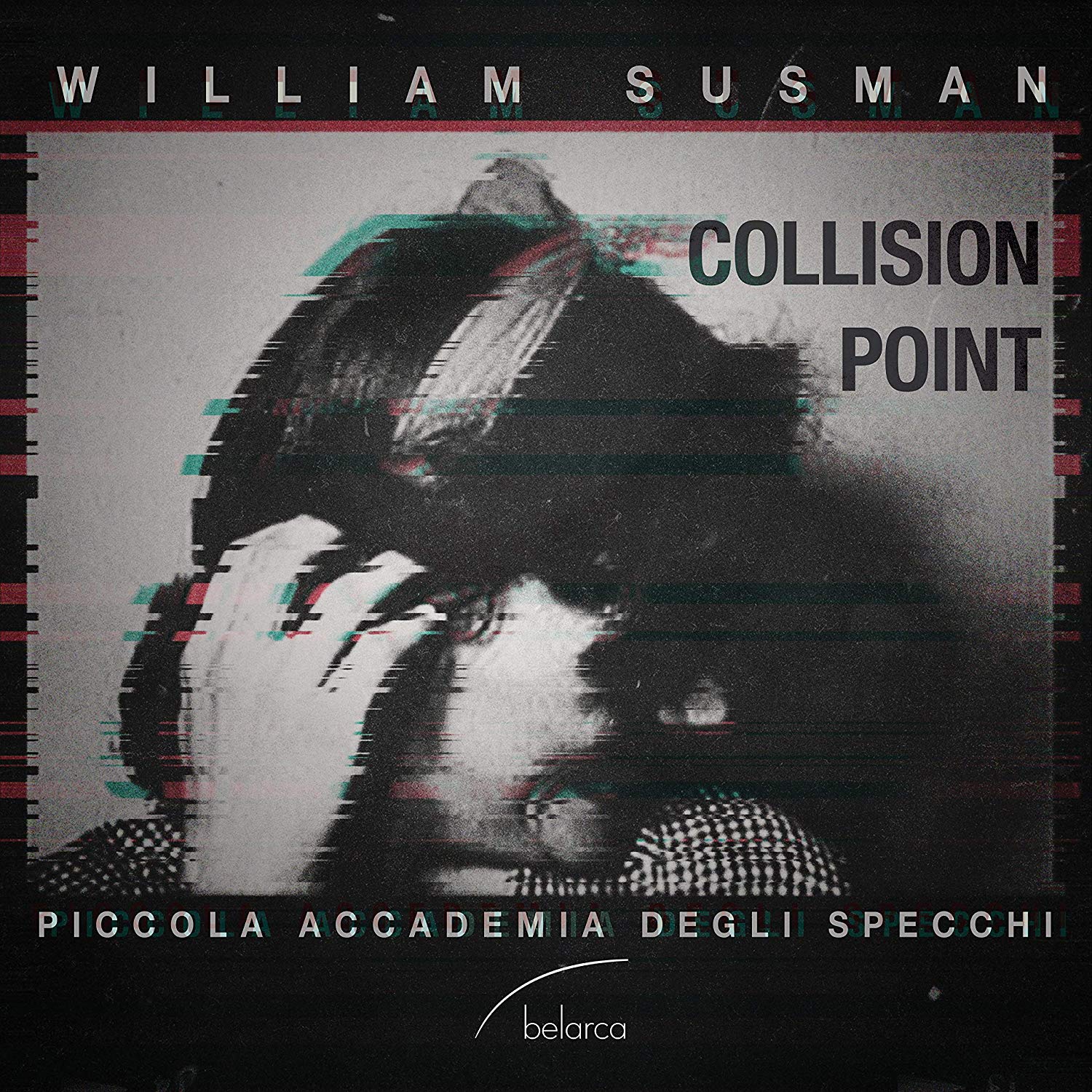
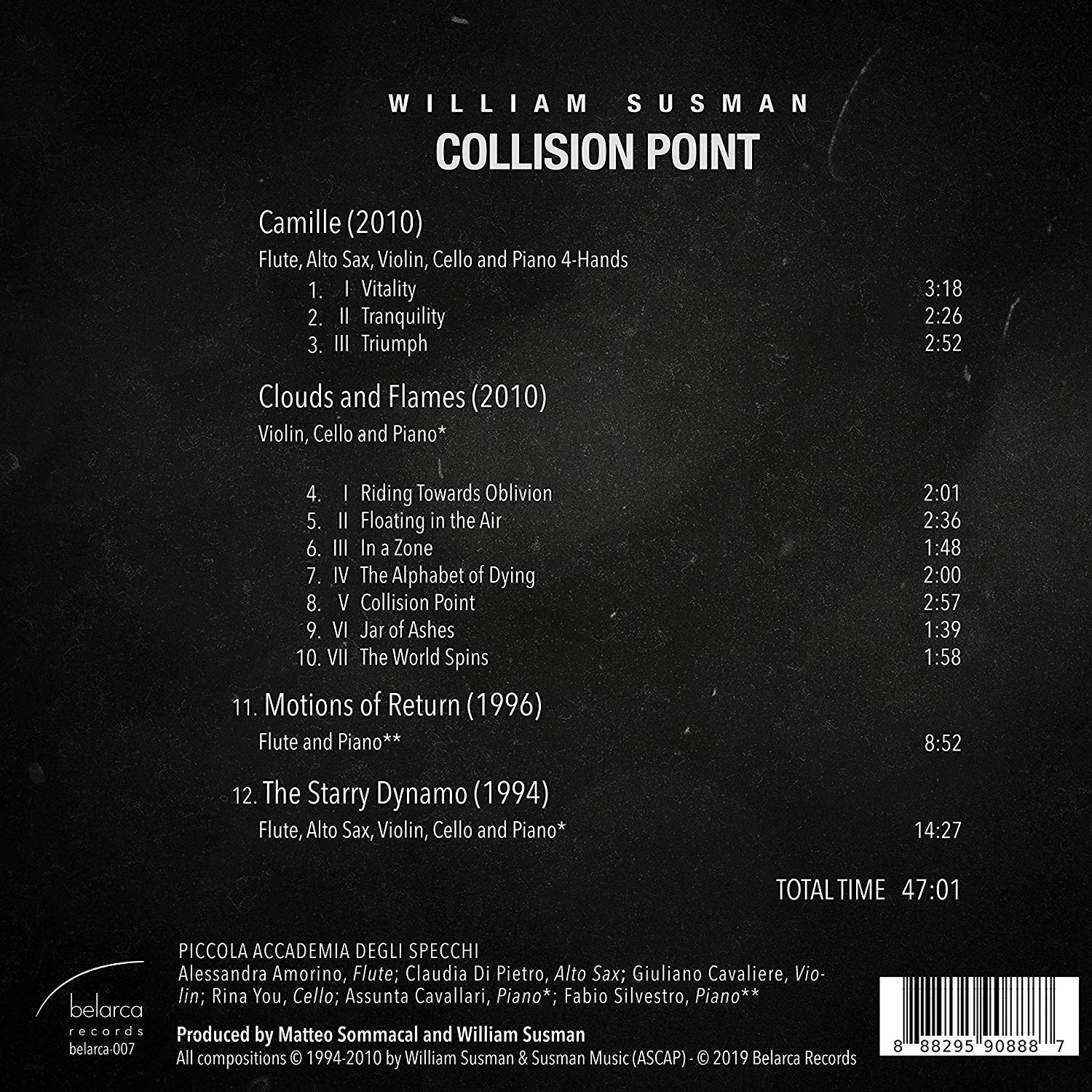
William Susman’s Collision Point


susmancollision

belarca 007

I first encountered this man’s music in a concert by the San Jose Chamber Orchestra (reviewed here).  I subsequently reviewed his album Scatter My Ashes .  Now fresh off the presses is the present disc which is a collaboration between Mr. Susman and Piccola Accademia Degli Specchi, a chamber ensemble specializing in new music.  It is a delightful and engaging journey to a region stylistically inhabited by the likes of Mikel Rouse whose post-minimalist chamber works on the Made to Measure label were a revelation to this listener in the early 90s.  What always perplexed me was why I had been unable to find more writing like this.  Well, here it is in all its glory.  These are standard concert length works (15-20 min range) which engage and sustain the listener easily leaving anything obviously experimental behind while also touching an artistic depth that satisfies.  Is there an untapped genre of well written post-minimalist chamber music?  If so, this disc belongs there.

collisionsusman

The disc contains four works, two from the 90s and two from 2010.  The first, Camille (2010) is the three movement work that opened the lovely Scatter My Ashes album from 2014.  Like the second work on this disc (the seven movement Clouds and Flames for violin, cello, and piano also from 2010) it utilizes a very personal take on post-minimalist ideas creating music of a quasi romantic nature with echoes of Brahms as well as Lou Harrison.  By which I mean to say simply that they seem to be a mature integration of what the artist has learned in school and since then as well.

So now to immaturity, so to say.  In the last two works listeners get a glimpse of music from an earlier stage of the composer’s development.  None of that description should be read as leaning to the pejorative in any way.  These works are like studies toward the later stylistic realms of the first two works from nearly twenty years later They can, for the sake of genre, also be subsumed generally into the post minimal.  Motions of Return (1996) for flute and piano along with The Starry Dynamo (1994) for flute, alto sax, violin, cello, and piano are both single movement works. This listener is left to conclude that this artist’s maturity continues to deserve our attention.

As this is a collaborative effort it is only fair to discuss the collaborators Piccolo Academia degli Specchi :
“Piccola Accademia degli Specchi (Little Academy of Mirrors) is a chamber ensemble, based and founded in Roma (Italy) in late 2000, specializing in the performance of contemporary classical music. Its original and characteristic instrumentation (piano 4 hands, cello, violin, alto/soprano saxophone, flute/piccolo), similar but different to the common Pierrot ensemble set up, and the outstanding musicianship of its members provide its unique sound and groove.

Current members are Fabio Silvestro (piano), Assunta Cavallari (piano), Rina You (cello), Giuliano Cavaliere (violin), Claudia Di Pietro (alto/soprano sax), Alessandra Amorino (flute/piccolo). ” (reproduced from the ensemble’s website accessed on 28 Dec 2019)

This album is the result of a ten year collaboration between the composer and the ensemble.  Cited influences include Allen Ginsberg, Colum McCann, and Francis Bacon.  I will leave it to literary scholars to opine as to the influences here but I can say this is some great music and great music making.  Bravo maestri!!

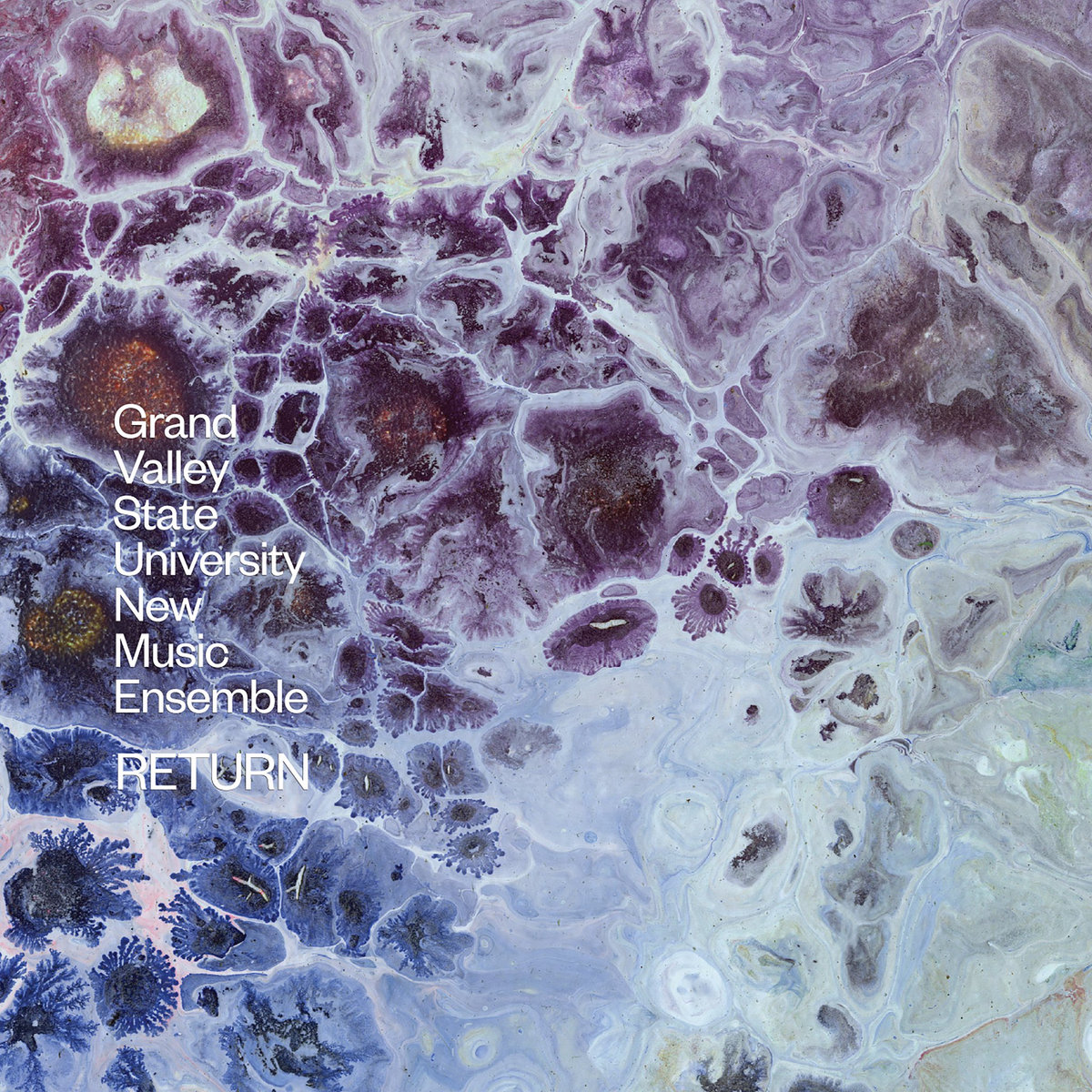
GVSU’s “Return”, an Intoxicating Adventure in Sound


gvsureturn

                                                                        Innova 983

OK, I’ve listened to this lovely CD numerous times and greatly enjoyed it each time. So why has it languished as a draft and why have I failed to publish this?

Procrastination aside there are several things I can identify as things that make this reviewer pause. First (and perhaps least significant) is unfamiliarity. The disc features three composers completely unknown to me: Daniel Rhode, Adam Cuthbert, and Matt Finch all of whom are listed as doing the additional duty of acting as mixing engineers (they are all students of the ensemble director as well).

GVSU  hails from the state of Michigan and it’s new music ensemble (consisting of Hannah Donnelly on piccolo, flute, alto flute, bass flute; Ryan Schmidt, clarinet, bass clarinet, contrabass clarinet; Darwin McMurray, soprano, alto, tenor, and baritone saxophones; Makenzie Mattes, percussion; Reese Rehkopf, piano; Jenna Michael, violin; Kirk McBrayer, cello; Niko Schroeder, sound engineer; and Bill Ryan, director and producer) is also new on this writer’s radar. Add the participation of the extraordinary violinist Todd Reynolds (on one track) and one’s attention is further piqued. Reynolds is an artist who chooses his repertoire and collaborations judiciously so his presence certainly functions as an endorsement.  But “unknown” is the heart of my interests both as listener and reviewer so that can’t be the reason though the lack of liner notes is a bugaboo (though hardly a fatal one).

On the positive side this is an Innova release and that fact alone lends credibility. Anything that Minnesota based label (the official label of the American Composers Forum) is worth your attention. Label director Philip Blackburn has a finely tuned radar which has led to many revelatory releases over the years.  Truly anything released on this label is worthy of your attention if you are a new music fan.

So we have hear a 15 track CD of 15 new works whose sounds seems to travel between ambient and postminimal. The pieces merge nicely with each other in a production which assures a fine listening experience. One can put this on either as background or for more intensive listening. It works either way. The playing is dedicated and insightful and the recording is top notch.

The pieces range in length from 1:32 to 7:32 and all seem to be just the right length communicating substance but never dallying too long. They’re bite sized, so to speak but they each have their charms as well as their complexities.  All are premiere recordings and all are commissioned by the ensemble.

Check it out. Click on the links provided in this review. And simply enjoy.


Concertante Music for Flute and Clarinet


71BwJt9fYpL._SL1200_

This release is a fine example of a record label fulfilling its mission by highlighting local talent while also making very intelligent selections of repertoire.  Cedille is one of those labels whose every release is worthy of your attention.  Here is a good example of why that is so. We have here four works for the rather uncommon combination of flute and clarinet with orchestra.  Concerti for multiple instruments probably began with Bach’s Brandenburg Concerti but this combination of flute and clarinet limits the repertoire choices considerably.  Nonetheless the folks at Cedille have gathered two 21st century pieces, one from the high romanticism of the late 19th century and a seldom heard gem from the late 18th century, all for these two instruments accompanied by orchestra.

Just for local interest let’s also add an opportunity for a local youth orchestra to show their considerable talents.  The Chicago Youth Symphony under conductor Allan Tinkham demonstrates the remarkably polished and mature sound of this local gem (Cedille is a Chicago label).  And Cedille, in its support of black musicians brings this marvelous pair of brothers with their expertise as soloists.  All in all a classic Cedille style release, intelligent choice of repertoire, promotion of young artists, promotion of artists of color, and quality recordings.

The disc opens with the world premiere recording of the eponymous single movement work, “Winged Creatures” (2018) by one Michael Abels (1962- ).  It is essentially a 12 minute concertante for the soloists with orchestra.  Abels is best known for having scored the brilliant horror genre film “Get Out” from 2017 (if you haven’t seen it, do make a note to yourself).

Winged Creatures is a well written mini concerto which, despite its recent vintage, tends toward a sort of neo-romantic sound.  The composer gives ample opportunity for the soloists to show their mettle and for the orchestra to demonstrate its facility with the music.  It is a delightful showpiece which seems to have a cinematic feel to it.

Next up, and this is typical of the acumen of the folks at Cedille, is a full blown, heretofore unknown (practically) Sinfonia Concertante from a lesser known contemporary of Wolfgang Amadeus Mozart.  Franz Danzi 1763-1826).  This double concerto for flute, clarinet, and orchestra was published in 1813 and sounds like Mozart and/or early Beethoven.  It is a highly entertaining piece, one which listeners will delight in hearing again.  Who knows this piece could become a sensation in the concert hall once again.  It’s about 22 minutes in length.

The third piece is an early work by French composer, pianist, organist, Charles Camille Saint-Saens (1836-1921).  Tarantella Op. 6 (1857) was written in when the composer was only 22 years old.  This is hardly one of his best works but it is a curiosity worthy of being heard and, like most of this composer’s work, it is eminently listenable.

Finally, we have another large scale concerto (and the second world premiere on the disc), “Concert Duo” (2012) by Joel Puckett (1977- ).  In gestures classical, jazzy, contemporary, but as listenable as anything on this release, Puckett’s work in three movements has tantalizing titles for each of the movements suggesting a wealth of non-musical references.

The ample liner notes provide the listener with a guide to the joys to be heard  on this collection and the recording, as usual with this label is lucid.  You can’t go wrong with this one.

Mathew Rosenblum: Klezmer, Witches, and the Avant-Garde


Conjuring the spirits of the 1950s/ 60s avant-garde and a few musical references composer Mathew Rosenblum (1954- ) enlists the klezmer spirit of none other than David Krakauer and master conductor Gil Rose with his wonderful Boston Modern Orchestra Project to bring life to this klezmer clarinet concerto.

The concerto, titled, “Lament/Witches Sabbath” (2017) is a tour de force for the soloist and certainly a challenge for the large orchestra.  Using elements of klezmer style along with musical references such as Berlioz in suggesting the evil sabbath revels the composer creates an unusual but fascinating canvas.  Nothing evil here, just some truly exciting musicianship. In addition we hear various noisy avant-garde effects and even voice overs reminiscent of Robert Ashley.  Ultimately it is also a species of classical which has a sociopolitical view and this is both memory and homage to the composer’s past, lamenting the suffering and pondering the evil that fueled it.

Krakauer’s facility with his instrument is simply astonishing.  He has the klezmer thing down but he also brings with him a great virtuosity as a classical clarinetist and a working knowledge of free jazz.  It’s not clear how much creativity this soloist was allowed within the constraints of the piece but the bottom line is that it works very well.  Gil Rose’ expertise in handling all this potential chaos is impressive as always and he delivers ultimately a very enjoyable performance despite those noisy avant-garde moments.  Indeed it is Rose’ ability to select repertoire with which he can grasp and from which he can conjure a compelling performance.  It is Rosenblum’s family biography taking him from the pogroms of the Ukraine to the United States.

The second track (of 4) is a solo for percussion.  Again the avant-garde remains interesting and both performance and recording communicate well with the listener.  Northern Flicker (2013) is no filler, it is an interesting, if rather brief, work.  Lisa Pegher is the busy soloist.

Falling (2013) is a complex work involving pre-recorded audio as well as a chamber group in a song cycle based on the James Dickey poem of the same name.  It is a retelling of an incident in which an airline stewardess who died when she was sucked out of a defective emergency exit in the plane and fell to her death.  The cycle recounts an imagined look into her psyche as she fell to her death.  It is an affecting, if unusual, presentation but Rosenblum’s judicious use of modern elements  while still using recognizable melodies and more traditional techniques make for a listenable, if harrowing, experience.

Here the Pittsburgh New Music Ensemble consisting of Lindsey Goodman, flute; Eric Jacobs, clarinet; Nathalie Shaw, violin; Norbert Lewandowski, cello; Ian Rosenbaum, percussion; and Oscar Micaelsson, piano/keyboard join with soprano Lindsey Kesselman with conductor Kevin Noe to produce this rewarding work.

Finally we get another large work, this time for multi-tracked string quartet with percussion titled Last Round (2015) which is also biographical in that the composer is attempting to evoke a time in the 1980s when he frequented an establishment with fellow composers.  The composer, in his entertaining and informative liner notes recounts his time with fellow composer Lee Hyla and friends and seeks to evoke elements of the downtown scene of that era.  This is a rather large work with its own complexities but one which speaks easily to an audience, even one not experienced in the time and place the composer attempts to evoke.

This is a marvelous recording of a music by a composer unfamiliar to this writer (until now) whose work deserves your attention.

Harold Meltzer New Chamber Music


meltzervar

Open G Records

I was delighted to receive this disc directly from the composer.  I had not been familiar with Harold Meltzer‘s (1966- ) work so this would be my introduction.  The disc contains two works, a Piano Quartet (2016) and a song cycle, Variations on a Summer Day (2012-2016).  Both are functional titles which tell the listener little about what to expect in terms of style.  I was even more delighted when he kindly sent me some PDF scores of these pieces.

The Piano Quartet might be described as post minimal I suppose but the salient characteristic of this piece is that it is exciting and quite listenable.  It is also quite a workout for the musicians.  In fact this piece seems to embody a variety of styles which give it a friendly romantic gloss at times.  This is a fine addition to the Piano Quartet repertoire.

The musicians that do such justice to this composition are: Boston Chamber Music Society: Harumi Rhodes, violin, Dimitri Murrath, viola, Ramen Ramakrishnan, violoncello, and Max Levinson, piano.  All are kept quite busy and seems to be enjoying themselves.  I can’t imagine this not playing well to the average chamber music audience.

The song cycle, “Variations on a Summer Day” sets poetry by Wallace Stevens and Meltzer’s compositional style seems to be a good fit for Stevens’ poetic style.  This work is stylistically very similar to the Piano Quartet with hints of minimalism within a larger somewhat romantic style.  It is scored for chamber orchestra with soprano solo.  Actually the orchestra is Ensemble Sequitur, a group founded in part by the composer and clearly dedicated to the performance of new music.  The members of this group include: Abigail Fischer, soprano, Jayce Ogren, conductor, Tara O’Connor and Barry Crawford, flutes, Alan Kay and Vicente Alexim, clarinets, Margaret Kampmeier, piano, Miranda Cuckson and Andrea Schultz, violins, Daniel Panner, viola, Greg Hesselink, violoncello.

The poem is by the sometimes obtuse American poet Wallace Stevens.  Maybe “obtuse” is the wrong word but Stevens is not the easiest read.  What is interesting is how well this composer’s style fits this poetic utterance.  This is a lovely song cycle that puts this writer in the mind of Copland’s Dickinson Songs and Barber’s Hermit Songs and perhaps his Knoxville Summer of 1915.  There is an air of romantic nostalgia in this tonal and passionate setting.

Stevens’ poetry has been inspiring American composers for some years.  Works like Roger Reynolds’ “The Emperor of Ice CreamThe Emperor of Ice Cream“(1961-2) demonstrate an effective avant garde setting of another of his works.  It is fascinating to hear how different composers utilize the poet’s work.  The present cycle is a beautiful setting which presents a challenge to the musicians which is met quite successfully here.


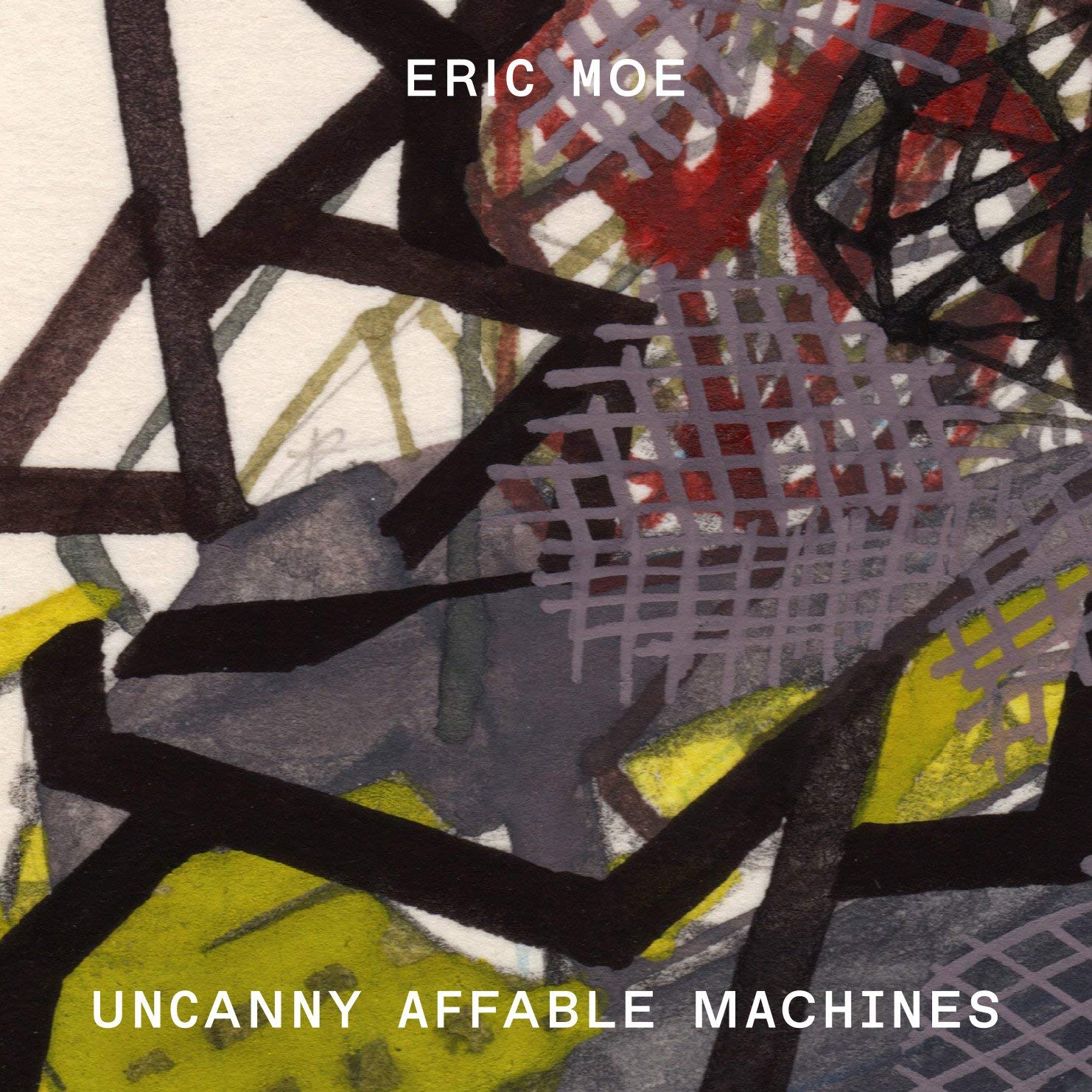
Eric Moe, Uncanny and Affable (and very interesting)


moeuncanny

New Focus FCR 212

Here I sit with an album by a composer with whom I have no familiarity.  Fortunately Eric Moe has a delightfully tenacious public relations department (at least with this particular record label) whose prompts did finally get me listening.  OMG, it says “electroacoustic”.   That could be really bad or obtuse.  Well, I did promise to review it so here goes.

Eric Moe (1954- ) is a composer with a very well organized web page.  A quick glance at that web page informs that this is the 12th or so disc from a man who boasts what looks like a list of over 100 compositions.  Moe is also a performer and participates on this disc.  This graduate of Princeton (A.B., Music) and Berkeley (M.A. and Ph.D., music) teaches at the University of Pittsburgh and is also an active performer of both his and others’ music.

moekeyb

This discs contains 6 composition for solo instrument (mostly with) electronics.  Now that combination has given this writer pause because the genre given the name “electroacoustic” can be a mixed bag.  Sometimes these works can be ponderous or obtuse with meanings obvious to the composer and, hopefully, the performer.

However your reviewer’s neurotic fears were apparently unfounded as the tracks played some truly wonderful compositions.  Each track features a different instrument.  The instruments, in order, include a drum set played by Paul Vaillancourt, a viola played by Ellen Meyer, a solo 19tet keyboard played by Eric Moe, an unbelievably virtuosic pipa played by Yihan Chen, solo piano played by Eric Moe, and flute played by Lindsey Goodman.

Suffice it to say that all the soloists here come with a high level of virtuosity as well as the ability to interact meaningfully with the electronics.  Far from being a nightmare of impenetrable experimental music this is rather a very entertaining set of pieces which tend to avoid the worst cliches of this genre.

Rather than attempting to describe each of these pieces (a task which would likely be more painful to read than write) it is best to simply provide assurances that the combination of this talented composer combined with the more than capable soloists provides a stimulating and interesting listening experience.  These are wonderful performers with great material.

The listener will want to hear each track more than once to get a good idea of what the composer is doing but, fear not, this album is much more adventure than ordeal.  It shows a composer at the height of his powers producing art which stimulates the senses and provides an emotional experience.  While there is clearly intellect behind the creation and performance of these works they tend to speak rather directly to the listener providing a stimulating entertainment that leaves the listener with a shred of hope that classical, even modern classical is far from dead.

Kudos to professor Moe and his collaborators and a nod of thanks to the tenacious publicity folks who would not let this release go quietly into the good night.  You shouldn’t either.

Steven Kemper’s Mythical Spaces


mythical

Ravello Records RR 7980

It is this writer’s opinion that the category “electro-acoustic” carries such a wide range of connotations that it is of limited use to a listener.  This album is so characterized and here simply means that both electronics and acoustic instruments are used.  Even the concept of electronic music is difficult since such a designation. Playlists on Spotify and iTunes usually points the listener to a form of pop/dance music if you search for electronic.  Further complicating things (and I think this is at least in part the point here) the electronics here include fixed media (electronics which does what it is programmed to do and does not interact with the performers or simply plays alone) and robotic electronics as well as electronics which interacts with the performer.  You will have to check the composer’s web page for more information on what exactly the “robotic” media are.

This is cutting edge in the sense that it is experimenting with new media in combination with more traditional media (and simple electronics is now “traditional media” having been superseded by the new fangled).  The actual sound of this music seems to inhabit a rather spare sound world akin perhaps to that of late Morton Feldman but with more brevity. These pieces last from 1.5-10 minutes on average and demand some concentration on the part of the listener.  Think maybe a cross between Feldman, Webern and say Subotnick.

Now one could conceivably play this music at a low volume in the manner of so-called “ambient” music. There are not many dynamic changes here to take you away from that sort of reverie.  But that does not really seem to be the composer’s intention. These are concentrated little essays, each seeming to explore the parameters of its context, fixed media, live instruments, robotic media, and combinations of these.

Steven Kemper is a new name to this writer.  His education and wide interests are available on his web site.  While he has an impressive bibliography with cutting edge research interests in music and sound this appears to be his first CD.

There are 15 tracks which comprise 5 works.  Mythical Spaces (2010) is for percussion with fixed media in 5 separate movements.  Breath (2015) is for fixed media alone in one movement.  Lament (2015) is also in one movement and is scored for flute with interactive media.

The longest single movement comprises In Illo Tempore (2012 rev 2017) is scored for saxophone, bassoon, AMI (automated monochord instrument), and CARI (cylindrical aerophone robotic instrument).  It clocks in at 7:48.

Last but not least is The Seven Stars (2012) for amplified prepared piano in 7 movements.

Live performers include Mark Truesdell, percussion; Wayla Chambo, flute; David Wegenlaupt, saxophone, Dana Jessen, bassoon, and Aurie Hsu, prepared piano.

This is music which requires some serious concentration from the listener.  Hearing/seeing this live might provide some additional aspects due to these strange electronic/robotic instruments but the point here seems to be one of an inner voyage which, if you focus you listening energy, transports you into this composer’s imaginary spaces.  Whether you will enjoy this or not is difficult to say but it is certainly worth the effort.


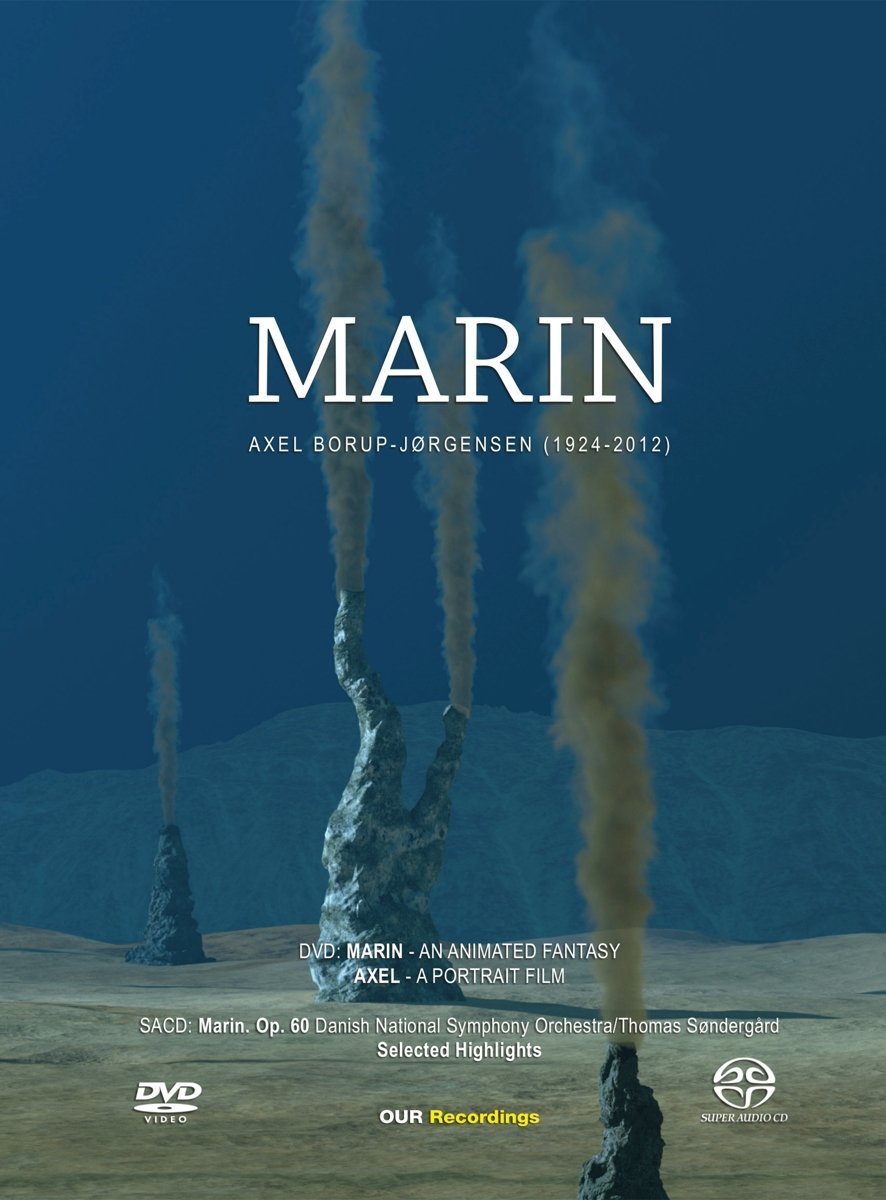
Marin: An Unknown Danish Master Gets His Due Marvellously


marin

I have made no secret of my passion for the music which has been coming out of the Scandinavian portion of our planet.  My knowledge of these musical traditions is mostly limited to the twentieth century up to the present but what a horn of plenty there is to be had.  There are so many composers that it is forgivable if one of them fails to get worldwide attention and acclaim during their lifetime.  Or is it?

Well if sins of omission that have been committed all can now be forgiven and the memory of Axel Borup-Jørgenson (1924-2012) is likely guaranteed to remain solidly in the history of music of the twentieth century.  The Danes take their music very seriously it seems (check out the You Tube Channel for the Danish National Symphony Orchestra if you don’t believe me) and producer Lars Hannibal and his crew have labored tirelessly to bring this formerly obscure master most deservingly to light in this DVD/CD combo pack featuring some of his finest works.

This truly major release contains a DVD with a gorgeous animated feature synced to the late composer’s swan song big orchestral piece, Marin op. 60 (1963-70) a really beautifully produced documentary (“Axel”) on the composer featuring some of his fellow composers including, Finn Savery, Pelle Gudmunsen-Holmgreen, Bent Sørensen, Sunleif Rasmussen, Per Nørgard, Gert Mortensen, Ib Nørholm, Michala Petri, and producer Lars Hannibal along with family and other musicians and producers.

The animated feature looks like one of the finer entries one might find on Vimeo.  The animation was done by Lùckow Film and works well with the music.  The biographical feature does a spectacular job of placing the composer in context with his Nordic contemporaries and with contemporary music in general.  The people interviewed give about as definitive a description of the man’s work as can be done in a film biography and the intervening or connecting scenes bespeak a high level concept of cinematography that makes this film both compelling and a delight for the eyes as well as the mind.  The concept of the composer’s use of silence as a compositional tool seems to be reflected in these transitional scenes.

The CD consists of seven carefully selected pieces on seven tracks.  The disc opens with the big orchestra piece which was heard behind the animation on the DVD, Marin Op. 60 (1963-70) followed by Music for Percussion and Viola Op. 18 (1955-56), For Cembalo and Orgel Op. 133 (1989), Nachtstuck Op. 181 (1987) (played here by the composer’s daughter, Elisabeth Selin), Winter Pieces Op. 30b (1959) for piano, Pergolato Op. 182 (2011) for treble recorder, and Coast of Sirens Op. 100 (1980-85) for flute, clarinet, violin, cello, guitar, piano, percussion, and multivoice tape.  This is truly a balanced portrait with examples of orchestral, solo instrument, keyboard, chamber and electroacoustic works from 1959-2011, a more than fair sampling of the composer’s output both by genre and by time.

The music seems to move between post-romantic tonality and expressionistic experiments such as one hears in the music of Gyorgy Ligeti.  The music is evocative and very listenable especially if one avails one’s self of the introductory film.  It certainly seemed to tune this reviewer’s ears properly.  It is helped as well by some very fine recordings that capture the subtlety of the composer’s work.

Lars Hannibal is clearly the guiding hand in this project but his genius (he is a fine guitarist as well as a producer) is his ability to engage all these fine musicians, artists, producers, and family in what is one of the most loving portraits this writer has ever seen.  Now that is the way to blast someone out of obscurity forever.

And this is but one entry in a larger project to record the composer’s complete output.  Two previous releases were reviewed on this blog and, presumably there are more to come.  But in the meantime there is much to savor here and one hopes that this will introduce this music into the general repertoire.  I’m sure Axel would be pleased to be placed as he is now among the masters of Danish composers.


Huang Ruo: Red Rain, a New Generation From the East Makes Itself Known


redrain

This recording grabbed my attention in wonderful ways from the very beginning and didn’t cease to amaze me until it ended.  Huang Ruo (1976- ) is one of the most striking new voices this reviewer has heard in some time.  This Chinese born American composer draws on his ancestral culture, modern culture and synthesizes it with contemporary compositional techniques in new and interesting ways.  He provokes the same sort of excitement in this reviewer that first contact with the music of Bright Sheng and Ge Gan Ru did when they first came into earshot some years ago.

huangruo

Huang Ruo (1976- )

(Perhaps it is due to the rising star nature of this artist but there seems to be relatively little reliable info on him.  His website is apparently not yet complete and even his Theodore Presser page fails to even give dates for his scores.  I’m hoping these glitches get resolved soon because I think this is a composer who deserves serious attention.)

The very first track, Four Fragments (2006?) in the version for cello solo (apparently there is a version for violin solo but it is not clear which came first) is a powerful and virtuosic piece loaded with various pizzicati, glissandi and other effects that perhaps only a score could really tell you with certainty.  What is interesting is the really organic nature of these effects, that is to say that they serve the composition and aren’t simply “golly gee what a virtuoso” type fireworks. The amazing Canadian Korean cellist Soo Bae handles this work beautifully and seemingly with relative ease.  This is the second longest (by about ten seconds) of the pieces on this disc and the music, the performance snagged me immediately.  What a powerful piece!

After that I was prepared for perhaps a let down, something more “ordinary”.  But, no, the next track, the title track, Red Rain (200?) for piano played by the wonderful Emanuele Arciuli is another distinctive statement which seems to mine the riches of the composer’s native culture and place it anew in a contemporary and relevant modern context.  At 10:50 it is a substantial piano work.  Like the cello piece it seems to use some unconventional idioms for the instrument and by that I mean it sounds nothing like Mozart, Beethoven, Debussy or even Boulez or Stockhausen.  It seems infused with an eastern musical flavor no doubt gained from techniques native to non-western traditions.

In another assault to any expectations I might have had the three movements of Shifting Shades have the pianist using a whistle such as your gym coach likely used with the pea inside to create a tremolo.  Here the pianist whistles (and plays some sort of flute, maybe a recorder or shakuhachi? at one point; he also apparently plays directly on the piano strings at times) whilst playing the rapid tremolos and the drones that seem to characterize Huang’s keyboard writing. Stephen Buck is the hard working pianist here.

Buck comes back again for the Tree Without Wind for piano (this time played a bit more conventionally).  This is the longest piece on the disc at 13:57 and rewards the listener’s attention.  It seems to probe mythological depths and was suggested by a Chan Buddhist narrative by Hui Neng.  Tremolos, clusters, drones and melodic fragments take on a symphonic grandeur at times.  There is a wide range of dynamics and tempi as the pianist recounts in sounds the meaning of movement and silence.

Three Pieces for Piano gives names to the short movements.  Prelude: Diffluent, Postlude: Left… and, Interlude: Points and Lines all contain the same techniques as the other piano pieces here (though without any additional instruments this time).  These sound like they might be earlier works and perhaps studies investigating different techniques though they seem fully fleshed out and complete in themselves.  The three movements are varied and the last one is apparently the composer’s only dalliance with twelve tone techniques and is by far the most conventional sounding work here though Huang’s distinctive fingerprint is present.  Once again we hear Stephen Buck navigating the score.

In the last track we get to hear the composer himself at the piano with Arash Amini (a member of the American Modern Ensemble) on cello in Wind Blows…  Like the previous tracks and as indicated in the fine notes by Stephen Buck this piece utilizes specialized effects to produce a unique sonic image.  The piano part is referred to as a “drone” and it is indeed static at least in relation to the part for cello. Unlike the preceding pieces there seems to be less concern about evoking images and more concern for just the sound itself which is described aptly as “meditative”.   In fact it is powerfully lyrical, even “Brahmsian” if I can be forgiven for that comparison.

The brief biography in the overall fascinating liner notes describe the composer as having been influenced by a wide variety of musical styles ranging from traditional Chinese folk musics to Chinese Opera, various western classical traditions including modernists such as Lutoslawski and various “pop” traditions as well.  He studied at the Shanghai Conservatory and he appears to have achieved a fascinating synthesis in what seems to be his mature style.  He is a composer, conductor and vocalist.  His music is unique and beautiful as a Taoist painting but grounded in traditions that embrace perhaps the entire world as filtered through his creative mind. Bravo Innova for bringing this music to light in this fine and interesting CD.

Definitely keep and eye and ear out for this guy.  He has many things to say and interesting ways to say them.

Rhys Chatham’s Pythagorean Dream


pythdream

Foom FM007CD

Rhys Chatham is responsible for one of my most read posts, the fabulous Secret Rose performance reviewed here and here.  An album released around the same time is reviewed here.  These reviews reflect the music most people think of when they hear Chatham’s name: alternate tunings, large groups of multiple guitars, sometimes groups of brass and woodwinds (Chatham plays trumpet and flutes as well) in a sort of wall of sound.

For this release Chatham has chosen to go solo, sort of.  In Pythagorean Dream he uses digital delay in a real time performance allowing him to achieve a similar sound world while maintaining control over the performance in the manner of a solo performer.

Regardless of the instrumentation Chatham has always been interesting and that has not changed in this release.  He uses Pythagorean tuning (hence the title) in this work which is split over three tracks for a total of about 55 minutes of impressionistic musings in the key of Pythagoras, so to speak.

The first track has some trumpet sounds softly at the beginning but focuses on the electric guitar building his choirs of instrumental sounds using his effects pedal.  This is the familiar Chatham multiple guitar sound.  The second track presents his musings with flute, alto flute and bass flute with a guitar cadenza.  Here he reminds this listener at times of the work of LaMonte Young with sustained tones and then plays some jazz like riffs over these before the final cadenza with the guitar.  The third track, according to the liner notes, is the whole of the brass intro to the piece and is presented as a “bonus track” and is entitled Whitechapel Brass Variations. This track, unlike the previous two, is a live (as opposed to studio) performance and is a good opportunity to hear Chatham’s skill with trumpet.  It is a fearless performance.  He manages to pursue his experiments without sounding experimental.

The overall effect of this piece, with drones, hints of free jazz and memories of minimalism is mesmerizing and appears to be the next logical step in his development as a composer and performer.  A few years ago Tony Conrad released an album inspired by the same tuning system and called that album, “Slapping Pythagoras”.  Chatham, by contrast, seems more concerned with soothing him.

The brief but informative liner notes are by the composer and the recording is lucid with Chatham doing the engineering and the mastering.  This album is a must for all Rhys Chatham fans and a nice intro to his current work for those who have not heard this important composer’s work..