Catalyzing Blackness, Volume Three: The Catalyst Quartet plays 20th Century music by Black Americans


This is the third volume in the Catalyst Quartet’s wonderful and insightful survey of neglected works by black composers. The first focused on music by the black English composer Samuel Taylor Coleridge (1875-1912), the second on music of late nineteenth to mid-twentieth century American composer Florence Price (1887-1953). The present disc focuses on the works of three men whose musical careers were entirely in the twentieth century: William Grant Still (1895-1978), George Walker (1922-2018), and Coleridge-Taylor Perkinson (1932-2004).

William Grant Still is roughly contemporary with Aaron Copland (1900-1990). Copland has often been called the “Dean of American Composers” and Still has been called the “Dean of Afro-American Composers”. Such honorifics, while well intended, do nothing to describe the true depth and significance of either of these composers.

Similarly their best known works, Copland’s “Appalachian Spring” (1944), and Still’s “Afro-American Symphony” (1930) are fine pieces of music but cannot represent the whole of their respective authors’ outputs. Both produced quite a bit of music and went through stylistic changes as their artistic sensibilities evolved. Copland’s oeuvre is pretty well documented, allowing listeners to grasp its entirety while Still’s work has not enjoyed the same distinction. That is changing, slowly, and that is reason to celebrate.
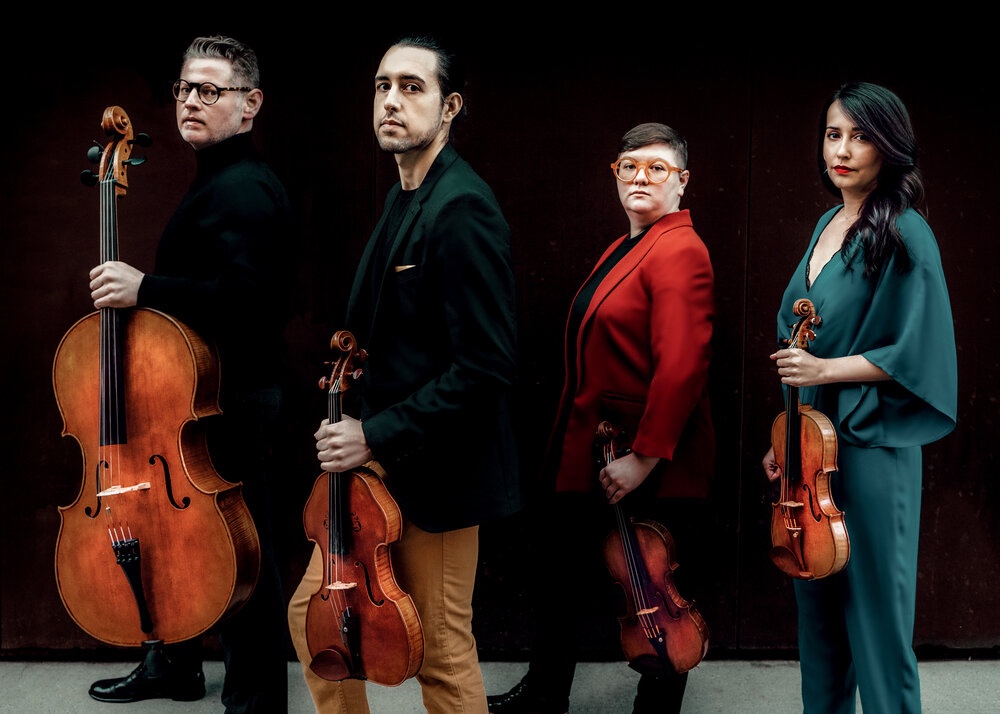
The Catalyst Quartet (Karla Donehew Perez, violin; Abi Fayette, violin; Paul Laraia, viola; and Karlos Rodriguez, cello) from their website

Still is represented here by his “Lyric Quartette” (published in 1960 but likely written 1939-1945). These three movements for string quartet are intended to represent a plantation, the mountains of Peru, and a pioneer settlement, respectively. This appears to be the first commercial recording of the work, a set of vignettes (Still never wrote a string quartet as such) seemingly published as an afterthought after looking back over his files. That’s not to denigrate the music. It is finely crafted and reflects a composer closer to the folk eclecticism of his contemporaries William L. Dawson (1899-1980) whose use of folk idioms resembles that of Aaron Copland (1900-1990) and Virgil Thomson (1896-1989), two white contemporaries (rather than his later more post romantic style). These composers’ use of folk idioms and the comforting tonal harmonies, very much in vogue when the music was first written, sound rather old fashioned in their year of the Lyric Quartette’s publication. Nonetheless, it is a vital work in understanding Still and his development as a composer. This would make for a great encore or second selection following a Haydn or Mozart Quartet.

George Walker was a sought after concert pianist and he forever holds the distinction of being the first Black American to be awarded the Pulitzer Prize in music (for his 1996 “Lilacs” for voice and orchestra). I learned from one of my personal favorite Chicago broadcasters that he, Bruce Duffie (WNIB host 1975-2001) played Walker’s “Lyric for Strings” (1946, orch. 1990) as the final sign off music at the closing of the beloved independent station (reportedly very satisfying to that terminal audience). The link provided is to a transcript of his subsequent conversation he had with Walker in 2001, worth your time to read.

So what does all this have to do with this release? Well, that, “Lyric for strings” is actually Walker’s orchestration for string orchestra of the second movement, “molto adagio“ of his three movement String Quartet No.1 (1946) “Lyric”. Samuel Barber garnered a great audience with his “Adagio for Strings” from the molto adagio of his String Quartet (1935-36).

The outer movements (1 and 3) of Walker’s quartet (carefully conceived and thoughtfully developed at length) frame the beautiful adagio with a passionate elaborately developed allegro and a high energy, virtuosic finale (much as in the Barber work). The quartet’s title, derived from the slow movement which was originally titled “lament” is dedicated to Walker’s grandmother, a former slave. A very different perspective of America, for sure, but a truly spectacular example of string quartet writing.

I wrote my review in chronological order to clarify my narrative but the actual track order is:

String Quartet No. 1 “Calvary” Coleridge-Taylor Perkinson (1932-2004)

  1. Allegro
  2. Adagio
  3. Allegro vivace
    Lyric Quartet William Grant Still (1895-1978)
  4. The Sentimental One
  5. The Quiet One
  6. The Jovial One
    String Quartet No. 1 “Lyric” George Walker (1922-2018)
  7. Allegro
  8. Molto adagio
  9. Allegro con fuoco

So String Quartet No. 1 “Calvary” (1956) by Coleridge-Taylor Perkinson is leaving the most recent for last. This work, shares with the other two it’s having been written fairly early in the composer’s career (he was about 24 when he wrote this piece, Still was in his 40s and Walker about 24 when they wrote their respective quartets). So Catalyst adheres to these important but early utterances from these three important artists. And for clarity the name permutations we encounter here comprise: Samuel Taylor Coleridge (1772-1834) is the English poet, Samuel Coleridge-Taylor (1875-1912) is the black English composer honorifically named after that poet, and Coleridge Taylor Perkinson (1932-2004) the black American composer honorifically named in honor of said English composer.

This is another outstanding but neglected American composer who happens to be black. This fine string quartet is defined by its serious tone and elaborate development in a passionate romantic tonal idiom. Of course the composer shares his prominent jazz (Perkins was nothing if not eclectic) influences in rhythms and harmonic structure. Based loosely on the hymn, “Calvary” from which it takes its name, it was actually premiered in Carnegie Hall as part of a memorial for composer and baritone Harry T. Burleigh (1866-1949). The opening allegro is a searching and unsettling matter followed by a calming slow movement characterized by an incessant pizzicato repeating figure. The finale, a touch more hopeful sounds almost improvisatory at times much in the manner of some jazz forms. Truly another outstanding example of good string quartet writing. This is powerful music!

These recordings are both beautifully done and, arguably, definitive in their interpretation of these delightful and essential additions to the quartet literature. The Catalyst does a fine and honorable job in their ongoing mission to reclaim forgotten gems such as these for present and future listeners. Thank you for that. Please keep working on this body of work lest it be lost to history.

“Dreams of a New Day”, a Landmark Recording Project from Cedille


Cedille CDR 90000 200

I have always made my admiration clear regarding Chicago based Cedille Records. They release quality recordings of unusual but intelligent choices of repertoire. This recording continues that formula but here achieves what is likely to be seen as a landmark anthology (or at least sampling) of Art Song by Black Composers. It speaks on many levels, as poetry, as music, as a collaboration between an incredible baritone, an amazing pianist, in a beautifully recorded and produced album. I was left throughout with the feeling that this is a loving collaboration. It is an integrated collaboration between many people who worked well together. It is a beautiful document and a timely one.

Baritone Will Liverman, the young rising star baritone who is slated to perform at The Met in the world premiere of Terence Blanchard’s “Fire Shut Up in My Bones” scheduled for fall of 2021 is clearly at the heart of this production. His intelligent choice of repertoire is both pleasing and revelatory. (the poetry of the song texts are published in one of two booklets that come with this CD). And Liverman’s voice is an admirable instrument that he wields with power and nuance. His commission of fellow rising musical star, composer Shawn Okpebholo whose “Two Black Churches” receives its world premiere recording. The pianist who manages to navigate significant demands with confidence and artistry, is Paul Sanchez, an excellent pianist, composer, and a fine collaborator.

The beautifully packaged CD (you gotta buy the CD) consists of 19 tracks representing 8 composers. The recording is billed as “Songs by Black Composers” but one can hardly miss the justly sad or angry tone of the texts and this was recorded July 22-24 of 2020 at the height of the COVID-19 pandemic and amidst social unrest over the epidemic of modern day lynchings. (2020 was also the year that Anthony Davis won the Pulitzer Prize for his protest opera, “The Central Park Five”) The moving rendition (“put together”, as Liverman quips in the liner notes) of Richard Farina’s 1964 song is played and sung by Liverman connecting this release with the tradition of protest music of another era. The struggle continues.

Before discussing the music I must supply a disclaimer of sorts. My working knowledge of art song in general is fairly limited and my knowledge of black art songs even more so. I know none of this music and have only in the last year or so came to know of the work of Shawn Okpebholo. I had read about the historical significance of Henry “Harry” Thacker Burleigh and Margaret Bonds but have heard little of their music.

In about 61 minutes listeners are given a survey, a sampling of art song by black composers ranging from Burleigh (who studied with Antonin Dvorak) to Okpebholo whose compositional talents continue to get much deserved recognition. It is a learned sampling of a huge repertory that deserves attention.

The opening song is I Dream a World (2017) by Damien Sneed (1979- ). This setting of the Langston Hughes (1901-1967) poem strikes a somber but cautiously optimistic note. It is followed by “Five Songs of Laurence Hope” (1915) by Henry “Harry” Thacker Burleigh (1866-1949). The name Laurence Hope is the pseudonym of Adela Florence Nicolson (1865-1904), a British poet who spent much of her life in British India where she developed an interest in the culture of the land. Fascination with the literature and culture of India was strongly in evidence in the early twentieth century. These five songs are reminiscent of Debussy and the impressionists and is but a small sampling of Burleigh’s art song output.

Harrison Leslie Adams’ (1932- ) setting of his own lyrics in “Amazing Grace” is yet another iteration of the abolitionist song. Margaret Allison Bonds (1913-1972) is represented by her “Three Dream Portraits” (1959), a song cycle on Langston Hughes poems. Bonds’ style put this listener in the mind of Copland’s Dickinson Songs though notably darker. This cycle is contemporary with the height of the Civil Rights Movement.

Next is “Riding to Town” (1943) by Thomas Kerr (1915-1988) who chose to reach back to the late nineteenth/early twentieth century poet Paul Laurence Dunbar (1872-1906) for his text. Dunbar was for the 19th century what Langston Hughes would be for the early to mid twentieth century.

“Two Black Churches” (2017) is the work commissioned by Liverman for this recording. It is a setting of two poems and one of the musical highlights here. The first, “Ballad of Birmingham” to a text by Dudley Randall (1914-2000) is a contemporary reaction to the 1963 bombing of the 16th Street Baptist Church in Birmingham which killed four little girls. The second song, “The Rain” to a text by the Poet laureate of Charleston, poet and musician Marcus Amaker (1976- ). It is about the Charleston Church shooting of 2015 at Emmanuel African Methodist Episcopal in which a lone gunman killed nine people. Okpebholo is modernist but accessible and these settings are among the most devastating and powerful statements on this recording.

“Mortal Storm” Op. 29 (1969) is a song cycle by one Robert Owens (1925-2017). It is a powerful cycle set to Langston Hughes poems. Owens left the United States in 1968-9 in response to the racial violence and moved to Europe where he had studied music under the GI Bill from 1946-1957. Owens died in Munich having never returned to the land of his birth. This work deserves to be better known and thanks is due to Liverman and his associates for bringing this sad masterpiece to contemporary listeners.

The album concludes with Mr. Liverman’s arrangement of “Birmingham Sunday”, a 1964 song by writer and composer Richard Farina (1937-1966). Liverman plays and sings on this final track which is an homage to a previous generation of song writers and protestors as well as a reminder that that generation’s work in Civil Rights is hardly complete. The song was notably used by Spike Lee in his elegiac film, “Four Little Girls” (1997).

The lucid and detailed program notes by Dr. Louise Toppin are a welcome addition to this production and help to provide a context. The design by Bark Design ties this little gem together. This one has Grammy and “collector’s item” written all over it.