Bob and Blue, A Musical Pilgrimage


Littlefield Hall (photo copyright by author)

…tell the old story for our modern times. Find the beginning.

-Homer, The Odyssey (Emily Wilson translation)

When I first got the email notice of this concert, I was, to say the least, intrigued. A two piano concert at Littlefield Concert Hall on the campus of Mills College featuring two composer/performers who figured prominently in that Temple of new music and in my personal listening life. Alas, I live some 350 miles from that location. But further intrigue came from the featured artists: Sarah Cahill and Joseph Kubera, two of the finest working new music pianists anywhere and both worked with the evening’s composers. This was just too compelling and I decided that I would regret missing this if I failed to go hear it.

So it was, I planned my little odyssey, leaving at about 9AM from Santa Barbara on a nice lightly trafficked trip, more a pilgrimage than an odyssey. A pilgrimage, frequently defined as a personal spiritual journey ostensibly in search of insight or enlightenment is how I’ve come to identify my listener’s adventure to the secular temple of Mills College featuring music of former Mills faculty Robert Ashley (1930-2014) and Robert Sheff (1945-2020), better known by his stage name, “Blue Gene Tyrrany”.
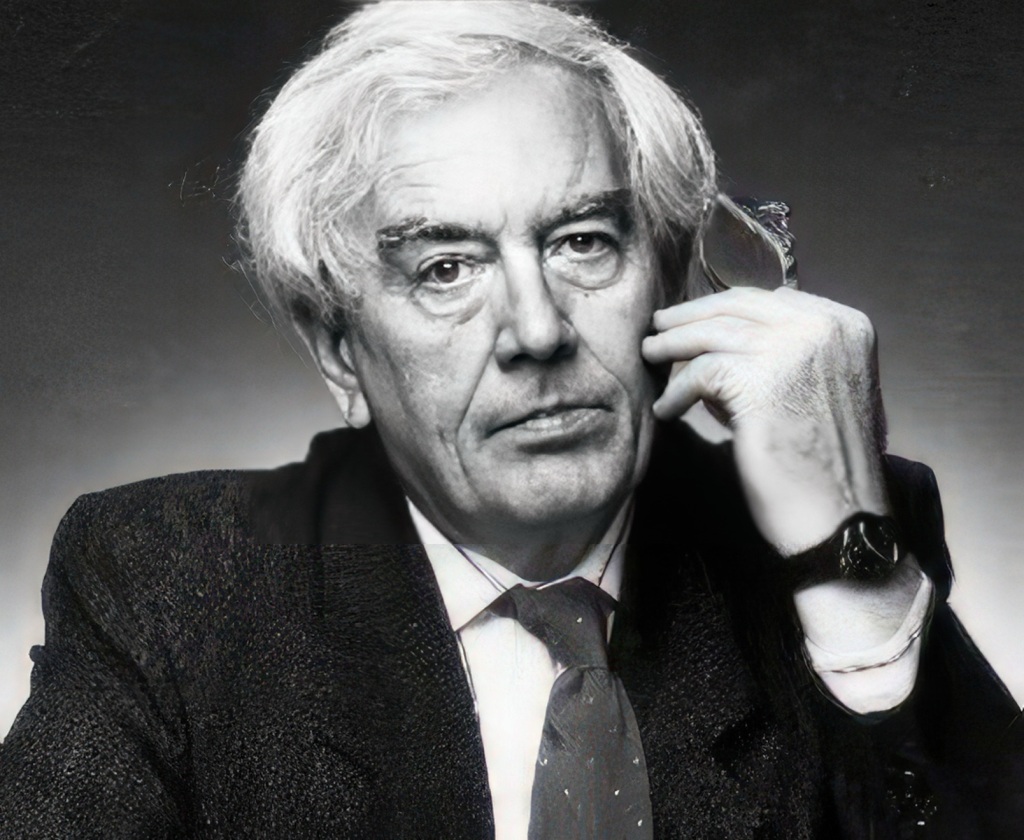
Robert Ashley (copyright unknown)
“Bob and Blue” (copyright by Other Minds)

The two featured composers had a strong connection to the Bay Area, mostly via their work at Mills College. This intelligent but modest production left little room to print program notes so the performers spoke of the music at various points during the concert and the excellent liner notes were made available by a QR code in the program book.

Sarah Cahill, pianist, radio host, producer, tireless advocate for new music (photo copyright by Other Minds)
Joseph Kubera, pianist, member of the SEM ensemble, Downtown Music, and countless collaborations promoting new music with many fine recordings to his name. (Photo copyright by Other Minds)

Our two performers are no strangers to each other or the composers on the program, having collaborated on numerous performances and recordings. The well rehearsed duo turned in riveting performances of this largely unknown repertoire which made a strong case that it be better known. Their playing and choice of repertoire compelled this listener’s attention such that I forgot to take all but a few performance shots. See those program notes for further biographical info on these two fine musical celebrants.
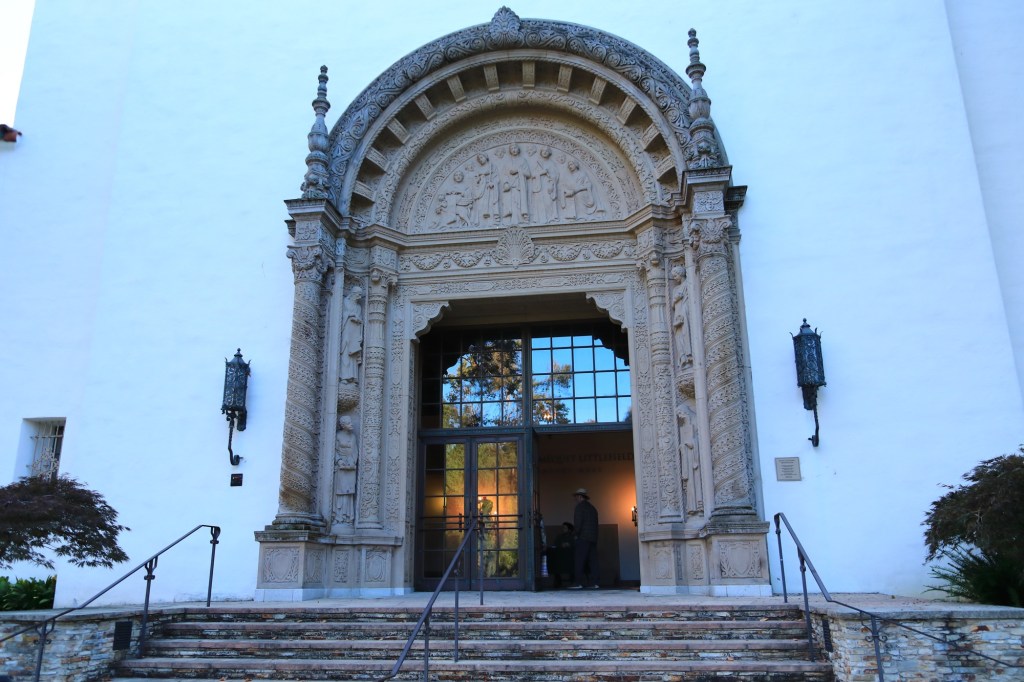
Entrance to Littlefield Concert Hall (copyright by author)

Mills College has long been a temple, a Mecca for new music in the Bay Area of California. Its roster of faculty and students comprises some of the finest post 1945 composers and performers. Darius Milhaud (1892-1974) and Luciano Berio (1925-2003) and students as diverse as Terry Riley (1935- ), Steve Reich (1936- ), and Dave Brubeck (1920-2012) to name but a few. Many artistic spirits musical and otherwise, exert their presence here. It’s a perfect destination for a pilgrimage.

A bust of frequent Mills visitor Lou Silver Harrison (1917-2003) in the lobby, a persistent benevolent spirit. (photo copright by author)

The concert was organized by Charles Amirkhanian and his Other Minds organization, another guiding light in the San Francisco/Oakland new music scene. Pianists Sarah Cahill and Joseph Kubera were to be the celebrants in the concert ritual paying homage to “Bob and Blue” as well as to the oracular Mills College.

Scene from the lobby (photo copyright by author)

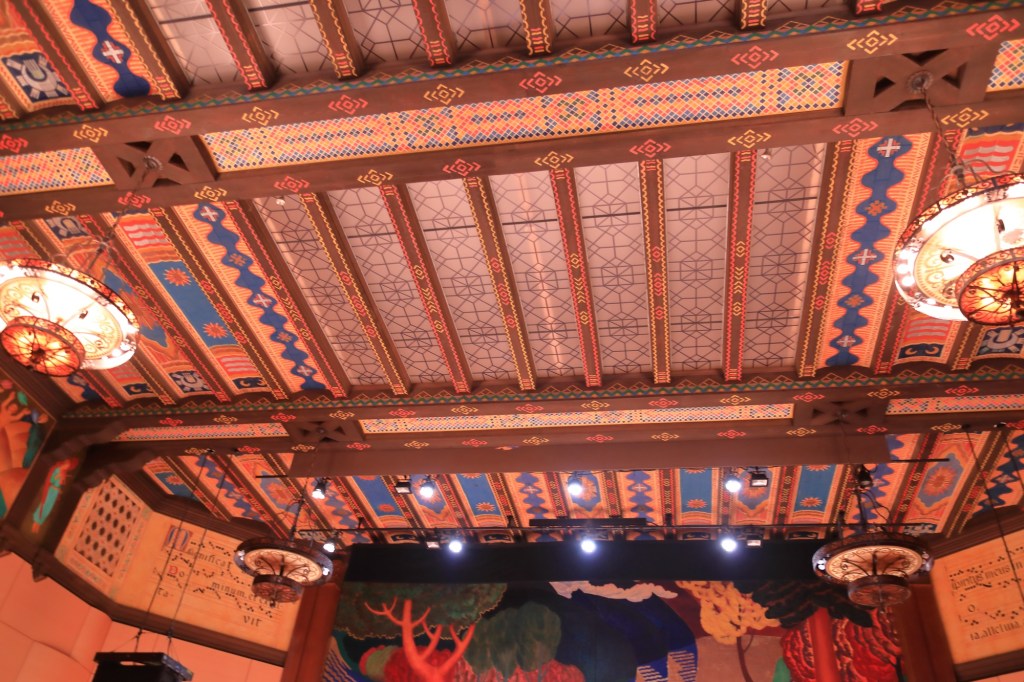
Let me tell you about this concert hall. It is the work of legendary California architect Julia Morgan (1872-1957) who famously also worked on Hearst Castle. This is one of her several architectural gems on campus. Her spirit was also witness to this celebration by virtue of her fine architecture.
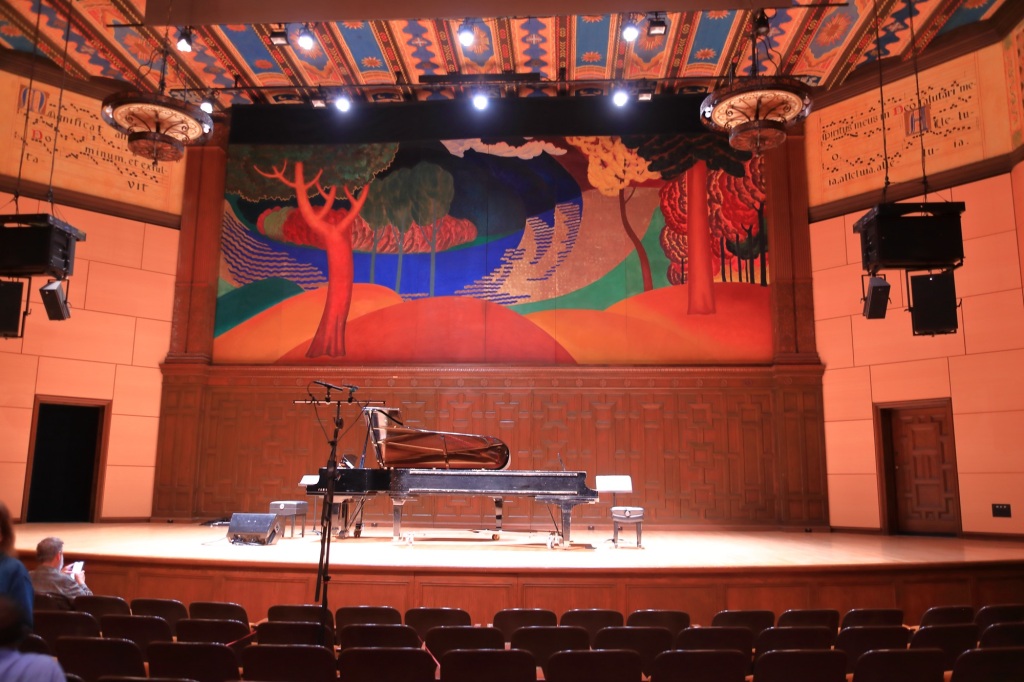
Stage at Littlefield Hall showing the ornate, colorful detailed designs (photo copyright by the author)
Look at that ceiling and those chandeliers (photo copyright by the author)

Two pianos, a new Steinway stage left and a slightly worn Baldwin stage right were placed such that the pianists seated at their respective keyboards could see each other. The Steinway with its lid open to reflect the sound to the audience and that well worn Baldwin with no lid at all (for reasons to be revealed later). The sonics of the hall and tuning of those pianos were excellent.
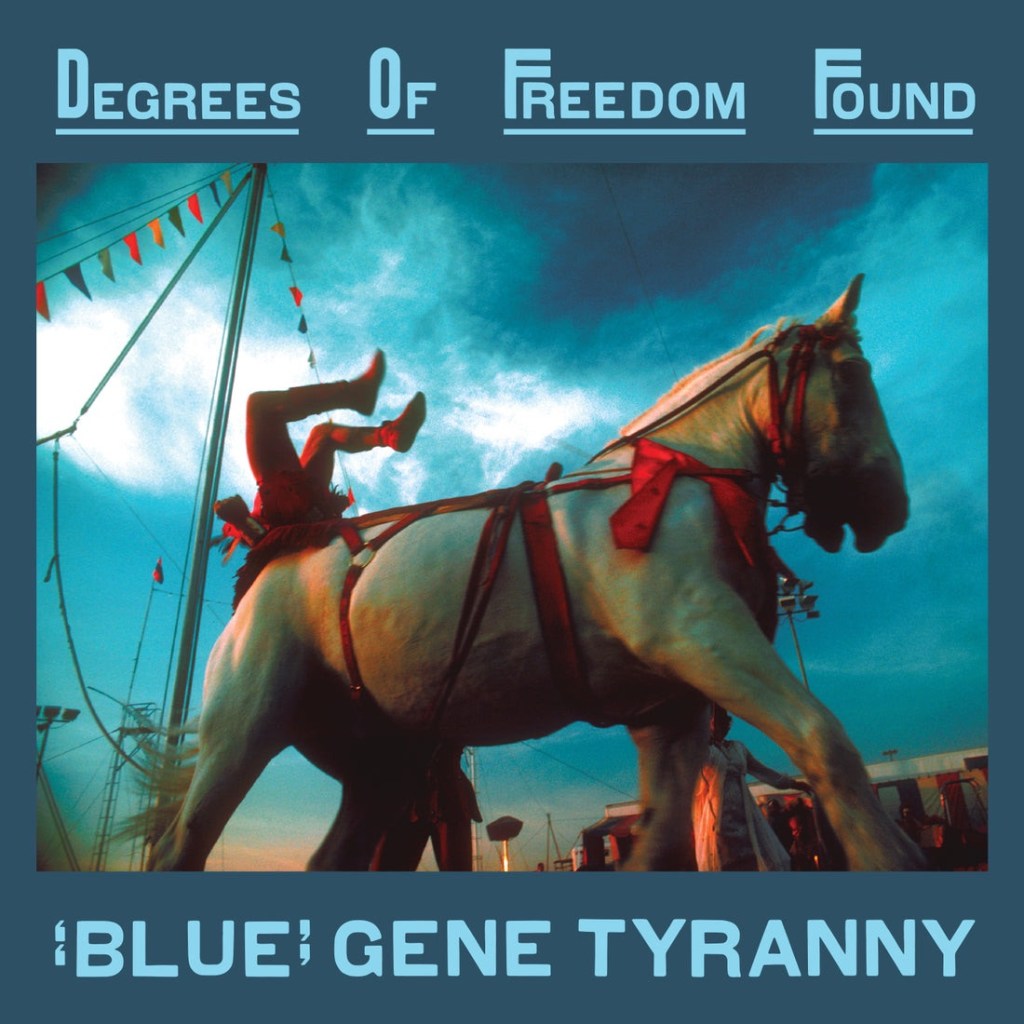
Unseen Worlds’ wonderful survey of Blue’s ensemble works.

The concert opened with Blue Gene Tyrrany’s peaen to old Route 66 in his “Decertified Highway of Dreams” (1999) for two pianos. It was clear from this first selection, that our performers were well rehearsed and in sync despite rhythmic complexities inherent in this quite beautiful work. It is cinematic and sweetly nostalgic, a fine example of “Blue”’s genius. The performance was riveting and worthy as the first performance ritual of the evening.

This was followed by a real rarity, a performance of Robert Ashley’s Piano Sonata (1959, 1979, 1985). In fact, it appears to have been the first complete performance of the two piano version of this impressive serially structured piece. Previous recordings are available, one with the composer performing the first movement at the ONCE Festival from 1966, the other by Blue Gene Tyrrany on his album, “Just for the Record”. This writer also found some useful analysis by musicologist Kyle Gann on his website. Gann worked with Ashley and later published a fine survey of Ashley’s music that is well worth your time. The result was a convincing, almost romantic sounding performance of this foundational work in Ashley’s oeuvre.

This was followed by a solo rendition by Joe Kubera of Tyrrany’s “The Drifter” (1994), which was written for Mr. Kubera. He spoke briefly about the structure of this work (which he also recorded on his recent “Horizons” album). This piece has a meandering quality created by the intricate evolving structure. Kubera’s performance was hypnotic and a fine tribute.

The second half began with Ms. Cahill solo at that stage left Steinway playing first Tyranny’s “Nocturne With and Without Memory” (1989), one of his better known works. Then she played his “Spirit” (1996/2002), a piece that is a sort of homage to the experimental composer/performer Henry Cowell (1897-1965). It was rather unusual in that it involved harmonics over which the pianist plays. The title is an homage to Cowell’s famous piano piece, “The Banshee”, a malevolent spirit in Irish mythology. Both were vintage Blue Gene pieces.

Two pianists, one piano.

Then Kubera returned, taking a seat at the blemished Baldwin with Cahill standing at that same piano, at a 90 degree angle to Kubera. Here, in these two obscure Ashley pieces, Viva’s Boy (1991), and “Details” (2b, 1962), Cahill played like a chef at a chef’s table, playing the strings inside the piano while Kubera manned the keyboard. These true rarities getting perhaps their first performance, were certainly a highlight of the concert.

It was Blue Gene Tyrrany’s spirit that was the final ritual celebration on this magical night with both pianists at their respective pianos to give a heartfelt reading of his, “A Letter From Home” (2002). This brought this learned, well rehearsed, beautifully collaborative evening’s ritual to a satisfying close.

The modest, self selected audience, applauded warmly and gave an extended, much deserved ovation and seemed as enthralled as this listener whose musico-spiritual pilgrimage found an ecstatic height. I drove home that same night, blessedly lifted, if only briefly, from the chaos of the world by this wonderful artistic ritual. They will now take this great program to New York.

RIP Jon Gibson (1940-2020): Relative Calm


Receiving this album for review the fact is I actually shed a tear when, upon opening my mail, I found the cover of this album cause my emotions to jump to regions of nostalgic memories deeply treasured.

Another fact is that, due to COVID 19, the virtual stoppage of all live concerts, and shifts in my scheduling priorities I had stopped following the career of Mr. Gibson (1940-2020) for the last few years and I wasn’t even aware that this disc had been released. I had heard that he had died in October, 2020. Gibson is a musician I first encountered, as most people had, via his omnipresence at concerts of the Philip Glass Ensemble where he was a founding member. Gibson’s performances of the saxophone solo in Glass’ “Facades”, which I first heard in 1980, are forever etched in my memory. And I caught pretty much every concert they did in or near Chicago from 1980 to perhaps 2000. So that little personal history gives you some idea as to why seeing this album was a “gut punch” of emotion to me.

Albums

I lifted this discography of Gibson’s releases from discogs.com and it does not include his work the Philip Glass Ensemble in which he was a member since 1968. It is probably not definitive but it provides some perspective on Gibson’s range of repertoire and his musical affiliations.

  • Visitations 4 versions Chatham Square Productions 1973
  • Two Solo Pieces 5 versions Chatham Square Productions1977
  • In Good Company 4 versions Point Music1992
  • S..E.M. Ensemble – Petr Kotik / Jon Gibson / David Behrman / Ben Neill – Virtuosity With Purpose. (CD, Album)Ear-Rational Records ECD 10341992
  • Criss X Cross ‎(CD, Album). Tzadik TZ 80202006
  • Phill Niblock / Jon Gibson – Darmstadt Essential Repertoire 12/4/2009 ‎(5xFile, MP3, 256)ISSUE Project Roomnone 2009
  • The Dance ‎(CD, Album) Orange Mountain Music 70072013
  • Relative Calm ‎(CD, Album)New World Records 80783-22016
  • Jon Gibson’s Visitations Otoroku2017
  • Violet Fire – An Opera About Nikola Tesla ‎(2xCD, Album) Orange Mountain Music70182019
  • Songs & Melodies, 1973-1977 ‎(2xLP, Album) Superior ViaductSV1732020
  • David Behrman with Jon Gibson & Werner Durand -Viewfinder / Hide & Seek ‎(LP, Album, Ltd)Black Truffle BT08220211

Gibson’s brand of minimalism resembles Glass’ at times but Gibson’s eclecticism, his mix of styles bear the fingerprints of a style which will be easily recognized by listeners familiar with some of his previous albums.

This is an album’s worth of music written for a performance piece with choreography by the wonderful Lucinda Childs (who choreographed Philip Glass’ “Einstein on the Beach” and commissioned Gibson in 1981 for this piece). Relative Calm (1981) is in four sections (or movements) each with its own character.

Tracklist


1. Relative Calm (Rise) (1981)
Composed By, Wind, Keyboards, Autoharp, Sounds [Field Recording] – Jon Gibson
Keyboards – Joseph Kubera
Percussion – David Van Tieghem


2. Q-Music (Race) (1981)
Composed By, Keyboards – Jon Gibson
Keyboards – Joseph Kubera

3. Extensions RC (Reach) (1981)
Sopranino Saxophone, Composed By – Jon Gibson

4. Return (Return) (1981)
Keyboards – Joseph Kubera
Percussion – David Van Tieghem
Saxophone, Composed By – Jon Gibson

Gibson’s fondness for jazz is evident here but the dominant style is the composer’s brand of minimalism. Relative Calm was commissioned and choreographed by Lucinda Childs with decor by Robert Wilson, it received its world premiere by the Lucinda Childs Dance Company at Théatre National de Strasbourg in
Strasbourg, France on November 26, 1981. It’s wonderful and it is a blessing to have this recording available.

This was released in 2016 on New World Records and is now available for streaming on Bandcamp. The excellent liner notes are by Kyle Gann and Dean Suzuki tell you pretty much all you need to know and the album sounds great. Thanks, Mr. Gibson, RIP.

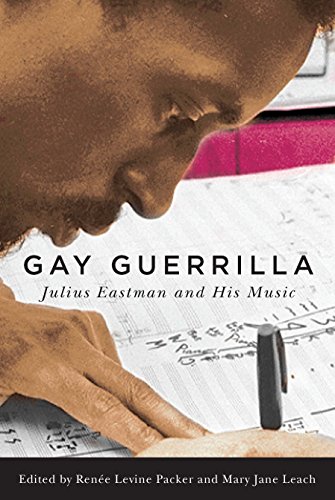
Crazy Nigger, Gay Guerrilla, Precious Artist: Julius Eastman Examined


eastman

This essential collection celebrates the life and work of a composer and performer whose unique presence was nearly eroded to nothing but for the work of composer (and co-editor of this volume) Mary Jane Leach who spearheaded an effort to rescue as many scores and recordings as possible after Eastman’s death in 1990 at the age of 49.  The first evidence of this modern archaeological effort came with the release of Unjust Malaise (2005), three CDs which featured some of the recordings that were gathered in that early effort.  In addition it should be noted that Leach continues to maintain a resource page with the most up to date information on Eastman scholarship efforts.

Now, along with Renée Levine Packer (whose wonderful history of the Buffalo New Music Days, “This Life of Sounds” (2010) is not to be missed) we have a lovingly edited collection of essays which comprise a sort of biography as well as an appreciation of this very important American composer.

One look at the acknowledgements reveals the wide scope of individuals with whom Eastman came into contact and whose contributions became so essential to this volume.  The wonderful introductory essay is so very appropriately written by George E. Lewis whose figure itself continues to loom knowledgeably over late twentieth and early twenty first century music.  He takes a characteristically unflinching look at the cultural, historical and socioeconomic factors that contextualize Eastman’s work as well as his untimely demise.  Eastman’s frequent use of politically incorrect titles that challenge a smooth vocal delivery in the most seasoned of broadcasters is here made to seem quite understandable (if not comfortably palatable) within the complex forces that defined Eastman’s milieu.  Lewis embraces Eastman’s talents and makes the prospect of further study of his work tantalizing.  He provides a truly authoritative context which can serve all future work in this area.

There are nine chapters, a chronology and a select bibliography along with photographs and score examples.  The essays that comprise each chapter focus from the macro-view of Packer’s biographical sketch and Leach’s timeline to micro-analyses of some of Eastman’s works and some additional personal perspectives.  One of the most endearing qualities of this volume is the fact that many of the contributors knew and/or worked with Eastman at one time or another.  It is clear that all the contributors were deeply affected by their encounters with Eastman himself and/or with his music and all are rather uniquely suited to be in this volume.

One suspects that Packer’s biographical sketch which opens this volume will henceforth serve as a basic model for all future biographical research.  Whether one finds agreements or not the material is presented in as complete and organized a fashion as can be imagined.  It paints the picture of a prodigy who, for whatever reason, fell into disarray.  Whether there was drug use or symptoms of mental illness will be the debate which will, of course, never be satisfactorily resolved.  What shines through though are tantalizing moments and a plethora of relationships, however brief sometimes, that contribute to all we will ever really know of the enigma of the life of this precious artist.

Some of what follows has the quality of memoir and some leans more toward academic analysis.  All of these essays, timelines, bibliographies, etc. tie this book together as the first most comprehensive effort at trying to understand the man, his music, his milieu, his unusual personality.

These accounts will always be crucial in any future analysis of the enigmatic talent of Julius Eastman.  Though many will attempt to affix labels to his personality variously attributing his quirks to mental or physical illness no one will ever know him the way the people in this book did, as a precious artist whose work was rescued (as much as it could be) from obscurity by his family (both biological and artistic).  He was and is loved in perhaps the only way that he would allow, through his work and his deeds.

This book is a fascinating read which serves to put the artist back into his proper place as the genius he was.  Much remains to be written, performed, analyzed and recorded but this book will always serve as the reference point for what is to come.