The Thrall in the Hall: Randall Goosby and Zhu Wang Violin and Piano Duo at Hahn Hall


Violinist Randall Goosby

Though this was ostensibly Randall Goosby ’s show, the music making was a wonderfully integrated duo with pianist Zhu Wang, These two fine young musicians shared the virtuosic duties that the music in this concert demands. Both are clearly hard working and dedicated artists. Both have technical and interpretive prowess. And they clearly embody a mutual respect for each other.

Pianist Zhu Wang

The music on the program served to demonstrate the duo’s creative selection of music:

Coleridge-Taylor: Suite for Violin and Piano, op. 3 
Brahms: Violin Sonata No. 2 in A Major, op. 100 (“Thun”) 
Still: Suite for Violin and Piano
Price:Two Fantasies 
Strauss: Violin Sonata in E-flat Major, op. 18

Curiously, due to this reviewer’s lack of familiarity with the violin and piano repertoire and having written some recent reviews of black composers’ music, the only familiar pieces were two of the three pieces by black composers. Now, overall, this is a marvelously chosen set of pieces that reflect the eclecticism and technical skill of both of these musicians.

The classic Paul Freeman conducted set of music by black composers.

The Brahms was perhaps the most familiar to audiences but the other works were equally substantive and worthy of being heard. It is these rather visionary choices that characterizes this duo as fresh and innovative. In addition their obvious knowledge of the music along with their enthusiasm and affection for it conspired to make for a delightful evening and even nudged this reviewer to try to become more familiar with the violin and piano repertory in general.

Samuel Coleridge-Taylor (1875-1912) was a black British composer who has of late had a much needed revival of his music. He was named in honor of the celebrated British poet Samuel Taylor-Coleridge (1772-1834). During his rather brief lifetime, Samuel had been hailed as “the British Mahler but, after his death, his music lay largely fallow until revived by the late, great American black conductor, Paul Freeman (1935-2015). His revelatory series for Columbia records (now Sony) opened listeners’ ears to a fascinating selection of music by black composers internationally.

The Coleridge-Taylor opus 3 Suite for violin and piano (1893) is an early work cast in the high romantic late 19th century style of broad melodies and virtuosic demands. It served as the introduction to an intoxicating evening of (partly) seldom performed works alongside some fairly established works in the repertoire.

The Johannes Brahms (1833-1897) second violin sonata (of three) was written in 1879 and was named “Thun” after the Swiss city where he composed it. The three movements follow the classical fast, slow, fast structure common to this genre.

It is a product of high romanticism and it remains a staple of the repertoire. It, as with most of this composer’s music, is technically challenging for both instrumentalists. It was a fine vehicle to confirm the incredible technical skills of these young artists.

William Grant Still (1895-1978) was one of the finest composers of the early to mid twentieth century. Like Coleridge-Taylor and Florence Price (1887-1953), his music was lauded during his lifetime but was neglected until fairly recently in the aforementioned Black Composers set. These musical choices revealed another aspect of this delightful pair of musicians, that of being essentially musical archeologists uncovering forgotten gems much as Lord Carnarvan’s work availed the world to the marvelous Egyptian art of King Tut’s tomb.

Still’s Suite for Violin and Piano was inspired by three sculptures–Richmond Barthé’s African Dancer, Sargent Johnson’s Mother and Child, and Augusta Savage’s Gamin. Written in 1943, it synthesizes elements of blues, pop, and classical music to create musical description of this ethnically inflected visual art.

Richmond Barthé’s African Dancer
Sargent Claude Johnson’s Mother and Child (ca. 1932)
Augusta Savage’s Gamin

The three movements comprise essentially tone poems based on the visual artwork. It was after the second piece, depicting the Mother and Child sculpture that the spell cast by the duo’s that revealed the “Thrall” of this blog’s title.

Goosby embodies a calm and casual confidence and he let the audience know early on that it is OK to applaud after a single movement if you are so inclined. He has a warmth that put the audience at ease, embracing us in a most genial manner. There is, of course, nothing wrong with musicians who might seem more aloof but Goosby’s warmth was both generous and welcome. However, it became clear that this audience, after hearing that gorgeous second movement so beautifully played, paused in a seemingly hypnotic response to the impassioned performance that captured the beauty of the music. It felt as though we had become collectively and deeply engaged. That is the meaning of “thrall” and that was a beautiful experience that spoke of connections between composer, performers, and audience that represent the pinnacle of the art of chamber music performance. All three movements were wonderfully executed but that moment and the collective reaction was a truly moving experience.

Following a brief intermission we got to hear both of Florence Price’s two Fantasies for Violin and Piano (1933, 1940). Though I’ve become familiar with much of Price’s work (her three surviving symphonies and Goosby’s own reading of her two violin concerti have been released in the last couple of years) I had not heard these fantasies before.

Though written only seven years apart, the works embody distinctively different qualities. Both are certainly “capricious”, embodying a variety of moods, but the second is a bit longer and seemed to reflect the composer’s maturing style. Both works were enjoyable and seemed to please the audience.

This led us to the final work on the program, the Violin and Piano Sonata (1888) by Richard Strauss (1864-1949). Best known for his big orchestral tone poems and his grand operas, this was an early work which has found an audience due to its lyrical and friendly character.

It is cast in three movements, and it was at the end of the slow movement that we again saw/heard a sort of “agreed upon” silence in which the audience seemed to have shared a deep impact from that lovely movement played so passionately. No one applauded as a reverent silence came upon us.

The much busier third movement again presented the virtuosity and broad melodies of high romanticism. And there was applause and, much deserved standing ovations. It was a joy to have heard these talented and hard working musicians in an ecstatic night of chamber music.
Other Minds 24, Concert Three, Reviving the Music of a Forgotten Master


wysschnegradsky4p

Photo: Ebbe Yovino-Smith

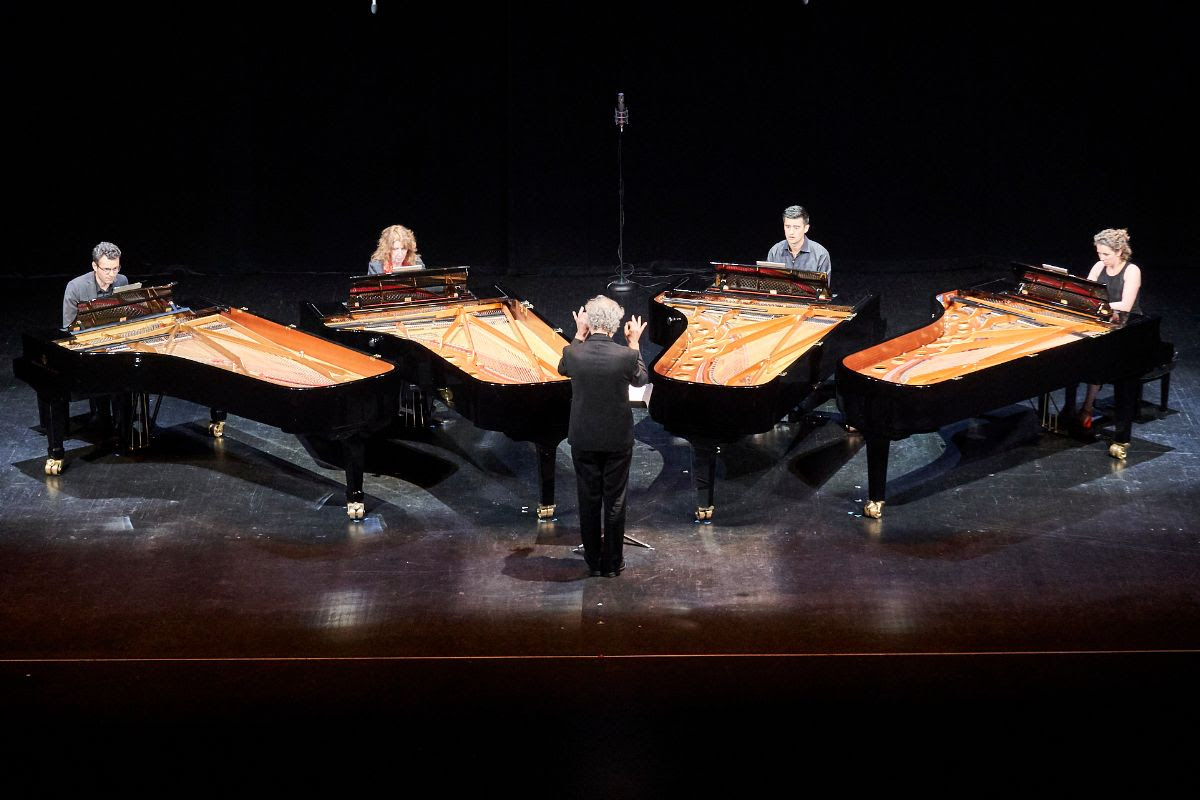
The staging was simple and practical but nonetheless imposing for this third and last OM 24 concert series.  Imagine four Steinway concert grand pianos arranged in a semicircle with a conductor and a music stand at the apex.  The heavy black curtain at the back served to emphasize the instruments and the musicians in a visually standard concert presentation.

jimcallahan

But, and this is significant, pianos 2 and 4 (looking stage left to stage right) had been tuned down 1/4 step.  I had the pleasure of speaking with Jim Callahan of Piedmont Pianos (who provided the instruments for this event).  When I inquired about this he replied quickly and authoritatively, “From stage left to right, pianos 1 and 3 are A 440 (concert pitch) and the others are tuned down 1/4 step.  When there are two pianos the one stage left is concert pitch and the one on the right tuned down.”

If you have any familiarity with the piano keyboard you know that there are black keys and white keys which correspond to the twelve divisions of the octave (from middle C to C) common to most western music.  A quarter tone is half way from the note you hear when you hit a white key and the note you hear if you hit the adjacent black key.  Ivan Wyschnegradsky was not the first person to seek more divisions to create the sound he sought.  1/4 tones are common in some middle eastern cultures but not seen in western music much before the twentieth century.

Ivan Wyschnegradsky (1893-1979) was a Russian born composer who spent much of his creative years in Paris.  It was there that tonight’s producer, Charles Amirkhanian and his wife Carol Law met him and learned of his work.  This concert along with the first OM 24 concert heard in March by the Arditti String Quartet (reviewed here) constitute a lovely revival of this unjustly forgotten composer as well as a personal connection to this “missing link” in music history.

CharlesatOM24

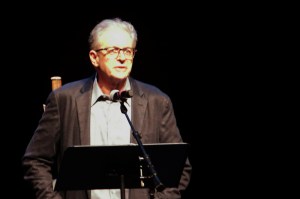
Charles Amirkhanian addressing the small but enthusiastic audience.

While some of this composer’s work uses the conventional western music scales (examples were present in this concert) his extensive work with other tunings necessarily limited performances of his music.  That, along with his rhythmic complexities, limited the amount of performances he would be able to receive.  One hopes that these concerts will spur further interest in his work.

The program booklet, prepared under the direction of Other Minds production director Mark Abramson, contains a wealth of information, knowledge and photographs.  You can download a PDF file of the program here.  It is a gorgeous production loaded with information for further exploration.

One might have expected 1/4 tones to create a very dissonant harmony but the surprise tonight was that the harmonies sounded like an extension of the work of Debussy and the impressionist composers.  Rather than harsh sounds, much of this music comes across like an impressionist painting might sound if it were music.  Tuning is a whole subject unto itself and a good resource can be found in the web pages by another Other Minds alumnus, Kyle Gann.  His extensive information on the subject can be found here.

The concert opened with Cosmos Op. 28 (1939-40, rev. 1945) for 4 pianos.  It is unusual to see a conductor at a multiple piano concert but the logistics of performance required a conductor to guide them through the complexities of rhythm and even the complex use of sustain pedals.  The pianists Sarah Gibson, Thomas Kotcheff, Vicki Ray, and Steven Vanhauwaert were ably led by conductor Donald Crockett.  This was a US premiere.

Overall the music has echoes of Stravinsky, Messiaen, Debussy, and Schoenberg (from his pre 12 tone days).  This large work, according to the program notes, does not have a specific program, rather it is a grand exploration of densities and registers. It does have a cinematic quality that suggests a program.

OM 240005

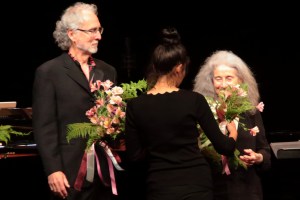
Martine Joste receives a bouquet as Donald Crockett looks on.

Next on the program was Étude sur le carré Op. 40 (1934, rev. 1960-70) for solo piano (another US premiere).  The French title translates as “Study on the Musical Magic Square”.  It is a reference to the structure of the piece which involves repetitions of melodic sequences analogous to the magic square with words or numbers.  What is important is the musicality of course and Martine Joste played it with passion and intensity providing the audience with a performance that sounds absolutely definitive.  Her amazing technique at the keyboard and her focus on this music truly brought life to this technically difficult piece.

Joste is a master pianist and president of the Association Ivan Wyschnegradsky and has been active in the performance of contemporary music along with the better known classical canon of works.  She would appear in the second half of the program.

If you are exploring the limits of composition with a new technique it makes sense to write some music that will demonstrate that technique.  Much as Bach wrote his Well Tempered Clavier to showcase the (now standard) well tempered tuning.  So Wyschnegradsky composed his 24 Preludes Op. 22a (1934 rev. 1960-70) to demonstrate his ideas.

OM 240002

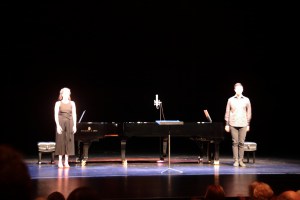
Shot of the two piano stage set up.  Remember the concert pitch instrument is stage left.

It was from this collection that we next heard Preludes Nos. 1, 3, 4, 5, 9, 10, 15, 16, 19, 20, 23, and 24 played by the performing duo Hocket.  As if they are not busy enough as solo pianists (and composers in their own right) Sarah Gibson and Thomas Kotcheff perform as a duo.  The link to their work in that area can provide more information,

OM 240001

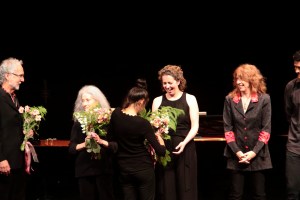
Sarah Gibson (l) and Thomas Kotcheff (r) performing as the Hocket Duo

They managed to navigate the complexities of these pieces nimbly, as though they had been playing them all their lives.  It certainly sparked this listener’s curiosity about the remaining preludes which we did not hear on this night.

Again the 1/4 tones sounded strange to western ears at times but never really harsh.

Following intermission the usual OM raffle of various prizes were drawn.  As if the fates intervened the colorful Ivan Wyschnegradsky clock went to master microtonalist John Schneider, another OM alumnus.  This clock is available in the Other Minds Store along with a cache of really interesting CDs, clothing, etc.

The four pianists, Gibson, Kotcheff, Ray, and Vanhauwaert again teamed up for a performance of Étude sur les mouvements rotatoires, Op. 45 (1961, rev. 1963).  This time they performed without a conductor.  Here the magic square becomes a magic octagon, at least metaphorically.  This is another example of using extramusical principles applied to organize music differently.  And again, as in the previous pieces, the harmonies were friendly and actually quite beautiful.

Mme. Joste returned to the stage for a solo performance (and the third US premiere) of Three Pieces for Piano, Op. 38:  Prelude (1957), Elévation (1964), and Solitude (1959).  Again we were treated to virtuosity and a seemingly definitive performance.  The title puts one in the mind of Schoenberg and his voice, along with that of Messiaen, Debussy, et al were present.  What was striking was her energetic and fluid performance which made the notes on the page (Joste performed from traditional paper scores, not the iPads used by the others) come alive in a delightful way.

OM 240006

The stage had to be reconfigured for the final piece, another 4 piano work which took perhaps a minute or two.  Mr. Crockett again led these young and enthusiastic performers in Ainsi parlait Zarathustra, an early work which was originally written for a quarter tone piano played by six hands(such things do exist), a quarter tone harmonium (4 hands), a quarter tone clarinet, string ensemble, and percussion.  This score has been lost but we heard the 4 piano transcription tonight.  It is a sprawling work with four defined sections much like a symphony.  The movements are titled Tempo Giusto, Scherzando, Lento, and Allegro con fuoco.

This piece takes its title from the same Nietszsche novel that inspired Richard Strauss’ tone poem “Also Sprach Zarathustra” or, in English, “Thus Spake Zarathustra”.  Only Wyschnegradsky’s Zarathustra seems more pained and less the romantic hero of Strauss’ 1896 orchestral work.

Wyschnegradsky’s piece is virtually a symphony and, though one can scarcely imagine how the now lost orchestration might have sounded, there was still a grand romantic sweep to it.  With a scherzo worthy of Bruckner the piece was a coherent whole with the last movement recapitulating, if not literally, the spirit of the fire dance that ended the first movement.  This was also a premiere and surely another definitive performance of a true masterpiece.

On this night we witnessed nothing short of a resurrection of the art of a very important 20th century composer.  The audience, like the performers were enthusiastic in their response.