Dane Rousay’s Blip


cover

Dane Rousay is a San Antonio based percussionist and this is the first of several planned releases.  This is a solo effort largely with drum kit and perhaps a couple of enhancements or additional percussive hardware.  There are 8 rather brief tracks on this album, all of an experimental nature and all very well recorded.

One small disclaimer:  I generally don’t review download only releases but Mr. Rousay was persistent and kind in his requests for a review.  Another aspect is that there appears to be an increase in this purely digital release format and to ignore that in favor of a demand for a physical product would likely be missing an opportunity to hear some good work.

Despite the brevity there is much for the ear.  The percussion seems to be closely miked and that is apparently the point here.  Each track is like a mini-etude or experiment which will presumably be used as material for other work.  Whether this is jazz, free jazz, new music, classical, etc. is actually beside the point.  The point appears to be the sound itself.

There are no liner notes and little in the way of explanation to be found even on the composer’s web site.  (That’s not necessarily a negative thing either.)  It is not clear if this music is improvised or composed or if there is any predetermined structure and there appears to be no intended connection between each of the tracks.  Most of the work is mallets or sticks of some sort hitting the targeted percussive surface though he does make use of extended techniques such as rubbing the mallets across the surface creating rich harmonics in the manner of the spectralists.

After multiple listens this reviewer is left with the impression of having visited the artist’s studio for a rather personal tour of some of his working ideas.  If you are a percussionist or a fan of percussion music this album will doubtless interest you.  It is not easy listening but it does appear to be a very personal exploration of this artist’s techniques and ideas.

I am looking forward to more from this interesting and seemingly uncompromising artist.
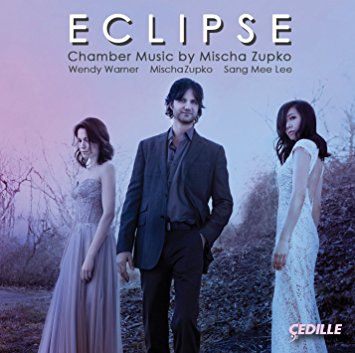
 

Eclipse of the Son: Mischa Zupko


zupko

Mischa Zupko (1971- ) is a composer, a pianist, and a professor of music at Chicago’s De Paul University.  He is the son of avant garde composer Ramon Zupko (1932- ).  Mischa’s work featured on this Cedille release suggests that the proverbial apple has fallen quite a distance from the family musical tree.  That is neither bad nor good but it is striking.

The elder Zupko’s work, despite its significance, is too little known.  A few recordings exist on the old CRI recordings label and this writer recalls being impressed by them. According to the Chicago Reader article he really didn’t want his son to go into the music business but apparently what is in the blood is in the blood.  A curious note too is that one can find articles on both these composers on Wikipedia but not the English/American one, rather curiously both are to be found on the Dutch Wikipedia site.

The present disc is apparently the first dedicated entirely to this emerging composer’s work (now numbering some 50 pieces).  It is a disc of chamber music and from the first the listener is immediately aware that the younger Zupko is possessed of a sort of retro romantic bent.  Think of the great virtuoso composer/pianists of the 19th century like Franz Liszt and Anton Rubinstein.  He does gratefully acknowledge his father as inspiration but clearly follows a different path.

This music is about passion and virtuosity.  The composer defines this clearly in his liner notes.  The performers Mischa Zupko on piano, Wendy Warner on cello, and Sang Mee Lee on violin demonstrate both passion and virtuosity on this lucid recording.  They play very well together and they all have ample opportunities to show off their respective skills.

There are seven works on ten tracks dating from 2005 to 2015.  The first five tracks consist of “Rising” (violin and piano, 2009), “Fallen” (cello and piano, 2010), “From Twilight” (solo violin, 2015), “Eclipse” (violin and cello, 2014), and, “Nebula” (solo cello, 2015).

There then follows the four movement”Shades of Grey” (2005) for violin and piano.  This is the earliest work on the disc but stylistically it is consistent with the rest of the disc. Zupko certainly develops as a composer but his style seems pretty firmly established.

The last track seems to be the big feature here.  “Love Obsession” (cello, piano, 6 pre-recorded cello tracks; 2013) is perhaps the most adventurous and grand of the works on this recording.  As with the other works on the disc the composer cites various literary influences and inspirations consistent with the apparently romantic ethic which seems to drive his creativity.  And as with the other tracks we hear a tonal romantic idiom filled with passion.

My title for this review is not intended to suggest that the younger Zupko has surpassed his father in any way except perhaps in that his work has, whether by accident, timing, design, or whatever, gotten more attention.  This is not a case of Johann Strauss Jr. and Sr. in jealous competition, this is simply another generation responding to it’s muse and that is worth celebrating.


New Orchestral Music from Rain Worthington


Rain Worthington herself kindly sent this CD to me for review.  There seems to be very little biographical information online about this very interesting composer.  Her current  credentials available on her website are impressive but there is little to be found on her training and influences. (Time to talk to the webmaster I suppose)  This appears to be the first disc dedicated solely to her music and it is an great one.

There are seven tracks representing seven orchestral pieces dating from 2001 to 2012. Like the album title, all are given poetic titles which make no reference to musical structure.  No doubt there are stories behind each of these but there is no information  in the liner notes as to the inspirations or intended meanings of this music.

This reviewer is fond of detailed liner notes but their absence is hardly a hindrance to the appreciation of these little tone poems for various sized orchestras.  There is a remarkable consistency of style here suggesting that this composer has a clearly established voice.  Clearly Worthington is a master of orchestration as she wields complex orchestral pallets where dissonance as well as orchestration contribute to the color in a basically tonal framework.

The music here is about motive and gesture rather than melody per se.  Perhaps that is a “minimalist” method but the impression to this listener suggests influences as diverse as Claude Debussy, Jacob Druckman, Daniel Asia, Toru Takemitsu, and Anton Bruckner. This is beautiful though not “pretty” music with complex emotional content that leans in somber, wistful, sometimes haunting, and even nostalgic directions much as an impressionist painting.

The lovely cover photograph, a time exposure of a night scene with a blurring of stars over a lake, works as a metaphor for the album’s content.

Three orchestras (none of them American) under three different conductors are employed in this very satisfying release.  Multiple listenings will definitely contribute new layers of understanding for the listener.  This listener found that initial impressions of seemingly simple, pretty romantic/impressionistic leanings give way to things deeper and perhaps even disturbing.

One of the conductors, Robert Ian Winstin (1959-2010) was an American composer and conductor (whose compositional efforts deserve some serious review) is at the helm of the Czech Philharmonic Orchestra on two tracks.  Petr Vronsky leads the Moravian Philharmonic Orchestra on four tracks and Ovidiu Marinescu leads the Russian Philharmonic on one track.  It is amazing how well these orchestras handle the challenges here.  These are some excellent musicians.

Kudos to producer Bob Lord for his bold choice in releasing this disc.  Hopefully we will soon be seeing more of this composer’s work in the near future.  My thanks to Ms. Worthington for sending this my way.


Duo Stephanie and Saar: Bach Art of Fugue


duo bach

New Focus Recordings FCR 181

One of Bach’s last works (It is dated 1748) was thought for many years to have been a sort of academic thesis which was not meant for performance.  Even though it has received performances it is problematic in many ways for performers and listeners. it has spawned many different approaches to this score which specifies no instrumentation, no ordering to the separate movements, and leaves it’s last fugue tantalizingly incomplete.

There have been many orchestrations for ensembles ranging from various chamber groupings to full orchestra.  It has been done on harpsichord, organ and piano, organ, string quartet, brass ensemble, saxophone quartet to name a few.  In fact all of these approaches would seem perfectly appropriate and authentic within the context of baroque performance practice.  Undoubtedly we can expect more of this pluralistic approach to come to terms with Bach’s final utterance.

Sometimes the most salient characteristic of a recording of this work is about a new orchestration or some new scholarship, including yet another effort to complete the fugue which Bach left incomplete in the manuscript.  In this two disc recording the motivation seems to be simple clarity.  Duo Stephanie and Saar (pianists Stephanie Ho and Saar Ahuvia) perform the pieces on piano 4 hands, two pianos and solo piano as befits their artistic vision.  They order the pieces by playing the first 12 fugues (or contrapuncti, as Bach refers to them) followed by alternately performing the four canons in between the remaining fugues and ending with the Canon in Augmentation to create a sense of an arch of unity with increasing complexity followed by the comparatively simple postlude of the final canon.  As with many of the recordings Stephanie and Saar choose to leave the last fugue incomplete as Bach left it which is slightly jarring, leaving the sensation of having missed a step in the descent of a staircase but the final canon then does serve to bring the listener down gently.

Not until the minimalist movement would we see such a long focus on a single key (D minor), a potential deal breaker for a lesser composer.  However the lucidity of these performances and recordings allows the listener to focus on the beautiful intricacy of counterpoint that represents one of the pinnacles of western musical art.  Actually I have found that this recording works as well with focused listening as it does as background music where its energy sneaks in to your consciousness in a different but no less exhilarating way.  This is doubtless due to the quality of interpretation.

Nothing flashy here, no overblown musicological perspectives, just strong playing by artists who clearly know and love this music.  The Art of Fugue is not the easiest of Bach’s works to appreciate.  Indeed it took this listener many years and multiple different recordings to finally grasp the depth of the work.  And while it may not have been intended for performance per se this recording does a good job of finding the unity in these contrapuntal etudes which are effectively a summing up of the techniques of the high baroque era.  Stephanie and Saar take us on a wonderful journey, one you will want to take many times.

Michala Petri Goes Brazilian


OUR Recordings 6.220618

Since her debut in 1969 at the tender age of 11 Danish born recorder virtuoso Michala Petri has been one of the finest masters of the recorder.  This ancient instrument, a forerunner of the flute, has existed since the Middle Ages and has amassed a huge repertoire and Petri seems to have demonstrated mastery over all of it and has been an advocate and promoter of new music for her instrument as well.  She has inspired composers to write new works for her and she continues to entertain audiences and has assembled an ever growing discography of startling range and diversity.  Nearly single handed she has managed to honor past repertoire and firmly ensconce this instrument in the 21st century.

In this release, produced by Lars Hannibal (himself a fine guitarist and frequent Petri collaborator) Petri takes on the music of Brazil and, despite the fact that recorders have seldom found their way into the music of this geographic region, she delivers a convincing and hugely entertaining program on this disc.  Along with Marilyn Mazur on percussion and Daniel Murray on guitar the listener is given an entertaining cross section of Brazilian music ranging from the more classically oriented work of Heitor Villa-Lobos (1887-1959) and Ernesto Nazareth (1863-1934) to the smooth jazz/pop sounds of Antonio Carlos Jobim (1925-1994) and Egberto Gismonti (1947- ).  In between are included works by the album’s guitarist Daniel Murray (1981- ) and a few names unfamiliar to this reviewer including Paulo Porto Alegre (1953- ), Paulo Bellinati (1950- ), Hermeto Pascoal (1936- ), and Antonio Ribero (1971- ).

There is a remarkable unity in this Danish production which stems from a meeting between producer Lars Hannibal and Daniel Murray in Vienna in 2014.  Hannibal’s ear found a kindred spirit whose musicality is a good match for that of Petri.  And like a good chef he added the delicate and necessary spice of the tastefully understated (but extraordinary) percussionist Marilyn Mazur to create a unique trio that sounds as though they’ve played together for years.  Here’s hoping that they’ve secretly recorded enough material for a second album.

All the tracks appear to be transcriptions though the transcriber is not named (I’m guessing they’re collaborative).  What’s nice is that there is nothing artificial or uncomfortable about these arrangements.  The overall impression left is that of a skilled ensemble and listeners encountering the original forms of these works might well assume those to be the transcriptions.  So convincing are these performances.

One last thing.  The sound.  This super audio CD release was engineered by Mikkel Nymand and Preben Iwan and the sound is fabulous.  I don’t have a machine that can read the super audio tracks on this hybrid disc but what I can hear is a lucid recording which embraces the subtleties of this unique ensemble.  Enjoy!