Dmitri Klebanov: Music from Exile


Chandos CHAN 20231

A wonderful trend was begun by London/Decca in the early 1990s with the release of their “Entartete Musik” series. It featured music by composers whose work had been suppressed by the dictates of the Nazi regime. It brought to light a great deal of wonderful music by mostly but not entirely Jewish composers many of whom died in concentration camps or were forced to live in exile. These recordings sparked a trend which continues today and this time the Chandos label hosts the efforts of the Toronto based ARC Ensemble whose scholarship and performance skills bring this, the fifth album in this important series. It is saddening to see the sheer volume of these oppressed works evidenced by the seemingly endless flow of new releases in this genre but there is some joy to be had in the fact that this music is slowly getting performances and recognition.

Previous releases featured premiere recordings by Jerzy Fitelberg, Szymon Laks, Walter Kaufmann, and Paul Ben-Haim. Haven’t heard these names? Well, maybe you’ve heard of Paul Ben-Haim, the Jewish/German composer who changed his name (Paul Frankenberger) when he emigrated to Palestine in 1933. The importance of projects like this one is to bring to light the art of composers lost to history and unknown in concert halls due to political oppression and/or outright murder.

This release features music by Jewish/Ukrainian composer Dmitri Klebanov (1907-1987), a composer whose work displeased the Stalinist regime. He wasn’t put in a concentration camp, he wasn’t killed, he wasn’t even sent into exile in the Gulag. Rather he was forced into a sort of intellectual exile in which he produced music which pleased the regime. But he had been cast as a sort of “whipping boy” by the regime and used as an example in the hopes of preventing others from straying to more liberal and outspoken paths such as those of Prokofiev and Shostakovich.Fortunately he outlived Stalin and was able to return to his own personal style of composition. It is this music which is presented here.

The three works from 1946, 1958, and 1965 respectively seem to have been chosen to reflect three fairly distinct eras in Klebanov’s artistic development. Whether these are ultimately representative of those chosen eras seems beside the point which is, I believe, to present a representative sampling of his work to give listeners a taste of his work and to help guide interesting performers and record companies to decide what to record next.
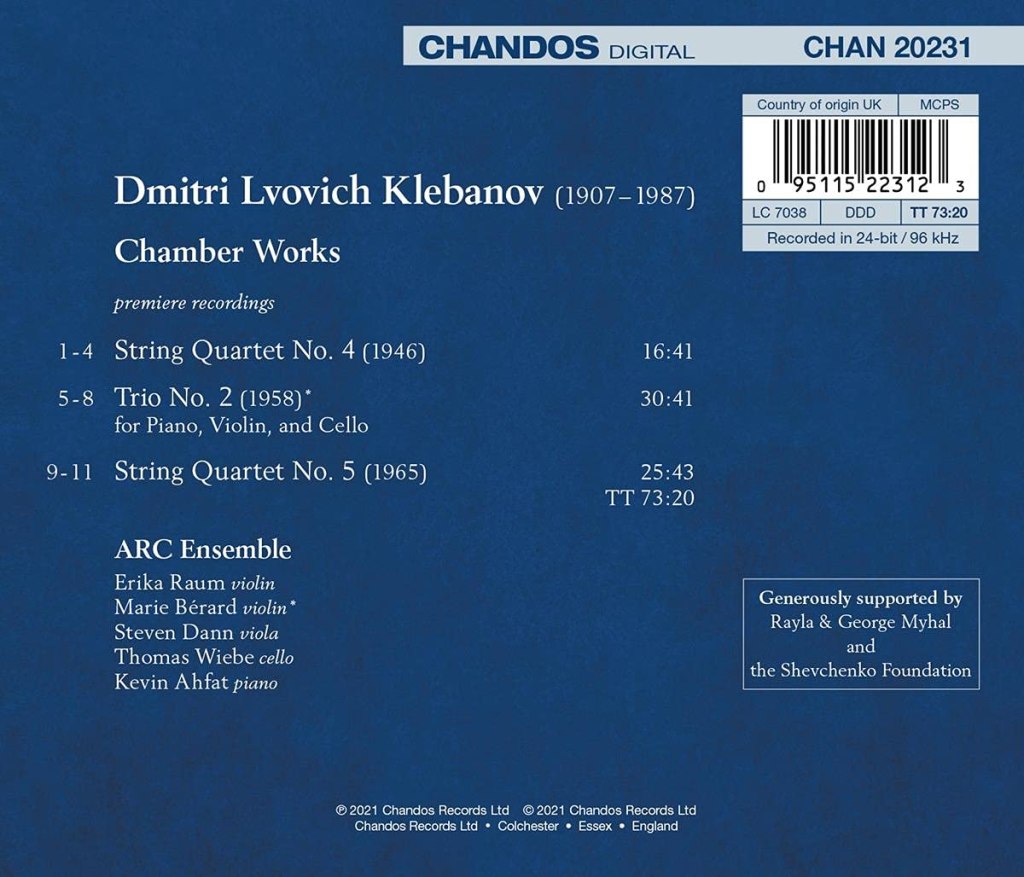
These works will serve to represent this neglected composer for now. There do exist some recordings of this music but these are mostly on small labels and very difficult to find. The hope for this recording and for a project like this is to provide good recordings with authoritative performances which may inspire musicians to explore the remainder of the composer’s work and, hopefully, bring these gems to audiences.

The disc begins with the nearly classical sounding fourth quartet from 1946. Cast in the classical four movements it’s difficult, in 2021, to imagine how this very accessible music could offend Soviet leaders but that is another issue entirely. All music ultimately exists within a variety of contexts but it is only possible to hear this music as it is today, listening with ears that did not exist at the time the music was written. Suffice it to say that this is eminently listenable music played with insight and dedication by the wonderful ARC Ensemble (Erika Raum, violin; Marie Berard, violin; Steven Dann, viola; Thomas Wiebe, cello; and Kevin Ahfat, piano).

The second selection is the Second Piano Trio of 1958. It is cast in three movements, some of which will remind listeners of Shostakovich whose fame and mastery loomed brightly at this time. But neither the rather conservative classical form of a piano trio nor the basically tonal idiom is likely to have charmed Kremlin leaders of the time. This is intelligent music that show the composer at the height of his powers and this, generally speaking, was not appreciated by the powers that be at the time of the work’s genesis.

The last work on the disc is the composer’s fifth string quartet from 1965. Like the two works that precede it in this recording this is music of both substance and charm. It is as listenable as the other two works and would doubtless entertain the average concert goer. It bears comparisons to Shostakovich, yes, but also to Haydn, Mozart, and Beethoven.

Completists, such as your reviewer here, will wonder at the music not included on this disc: the first three string quartets, the first piano trio, the other chamber music, nine symphonies, and various concerti along with five operas and two ballets. It is both fitting and sad that this overdue review be published at at this moment in history when, as I write, the Russian army advances into the Ukraine leaving death and destruction in their wake. There is doubtless much more music yet to be uncovered/discovered, rescued from oblivion but the sad fact is that the forces which suppressed this Ukrainian composer’s works continue to oppress artists today.
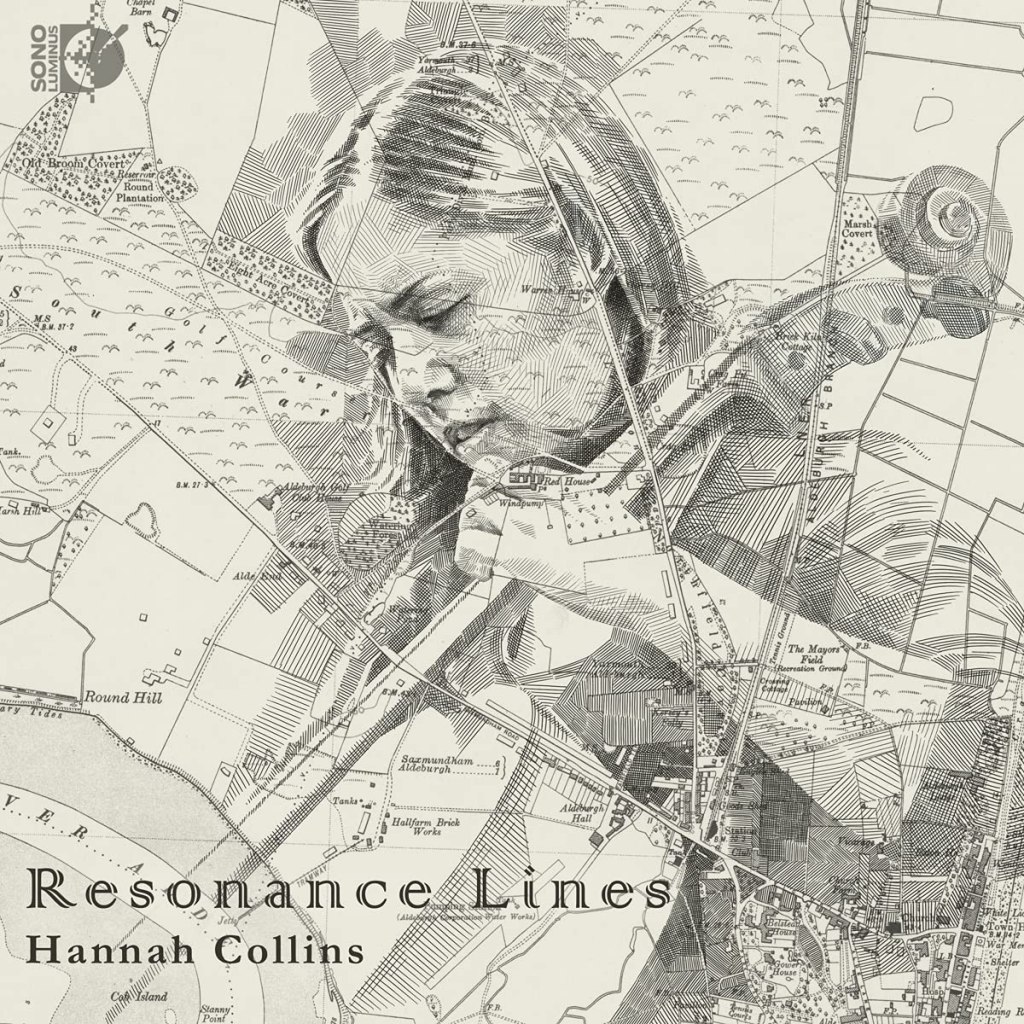
Rising Star Cellist Hannah Collins Defines Her Vision for Her Instrument in “Resonance Lines”


Sono Luminus DSL-92252

Having chosen a debut album featuring solo cello without electronics or accompaniment the Sono Luminus label virtually guarantees that every one of the subtleties of the performer’s skills will be heard in all their glory. And so we have an auspicious solo debut album by a skilled and talented artist with a unique and intelligent vision in her choice of repertoire for her instrument. Hannah Collins has a beautifully designed web page describing her background so I will focus only on the music on this release.

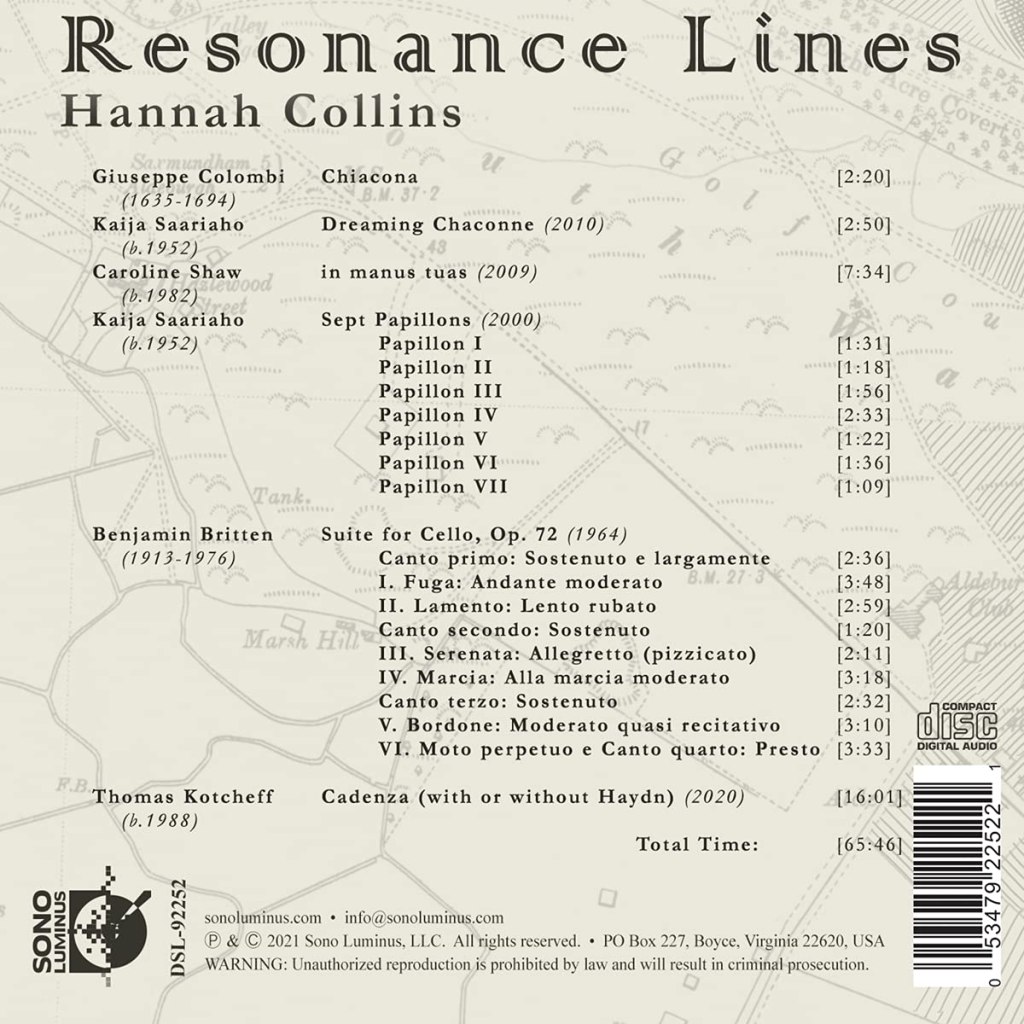
Even a brief glance makes it obvious that Collins’ radar captures a wide range of music which encompasses five centuries of compositional efforts by both a consciously curated selection of composers that reflect both racial and gender diversity and who themselves represent a substantive variety of styles and visions. She begins with a rather obscure baroque composer (I had never heard of him), Giuseppe Colombi (1635-1694). His Chiacona (1670) is apparently the first identified composition for solo cello (the famous solo cello suites by J.S. Bach wouldn’t come along until 1717-1723).

This arguably foundational work of the solo cello genre is then followed by the very fine Finnish composer Kaija Saariaho (1952- ) whose Dreaming Chaconne (2010) is in fact a variation on the Colombi piece.

The third track, “In manus tuas” (Into your hands) by the equally fine American composer, Carolyn Shaw (1982- ) was written for Ms. Collins, and is an aural peek inside the mind of the composer as she recalls a performance of a motet by 16th century English composer Thomas Tallis (1505-1585). Shaw evokes a sonic memory moment of hearing a performance of “In manus tuas Domine” in Christ Church in New Haven, Connecticut which made a strong impression on her. It is a work that appears to be destined to become a modern classic. It creates spectral harmonics that engulf the listener inside Shaw’s memory of the event. The composition’s title also function metaphorically as she offers her music into the hands of the artist and the minds of the listeners. It is a challenge both technically and interpretively and Collins rises to those challenges with seeming ease.

The next seven tracks are given to another Saariaho composition, “Sept Papillons” (2000). This earlier work from her extensive catalog is also given to extended instrumental techniques as she evokes the seven butterflies of the title. This set of pieces was written for the fine Finnish cellist, Anssi Karttunen. It was at the 2008 Creative Dialogue Workshop in Santa Fe, New Mexico (run by Karttunen) that Collins encountered this music and the extended techniques required for its performance. Saariaho’s sound world is like that of an incarnation of Debussy and his impressionist aesthetic. There is apparently no visual program here but the music recalls, in this listener’s mind, Saariaho’s earlier “Nymphea” (1987) for string quartet and electronics which was inspired by Monet’s famed “Water Lilies” of 1906.

This fine disc includes the first (of three) suites for solo cello by Benjamin Britten. All three of these (1964, 1967, 1971) had all been composed for the Russian virtuoso Mstislav Rostropovich. Like the the Saariaho and Shaw pieces these suites are inspired by earlier works, in this case the Bach suites of the early 18th century. Collins plays the first (Opus 72) of these and her performance makes this listener hope that she will later record the other two.

While modeled on earlier music, the Britten work utilizes techniques that would likely be unfamiliar to cellists before the 20th century. It is homage both to Bach and to Maestro Rostropovich. And Collins’ playing furthers this homage to both of these past masters.

The final track is a work by one Thomas Kotcheff (1988- ). Like the first track, this young composer is unfamiliar to this writer. His work, “Cadenza (with or without Haydn)” of 2020” carries on the theme of homage. In a nod to the late great Frederic Rzewski (1938-2021) whose “Cadenza with or without Beethoven” (2003) is an extended cadenza which can be played on its own or as part of the Beethoven 4th piano concerto.

Kotcheff’s work is a cadenza for Haydn’s C major cello concerto. Like the Rzewski, it can be performed with the concerto or as a solo work on its own. Also like the Rzewski, the more modern aspects of this “cadenza” might confuse audiences anticipating more conventional music that fits with the context of the concerto for which it was written and the music stands very strongly on its own.

Like a lot of solo artists are doing these days, Collins’ debut solo album is like her personal manifesto of music for her chosen instrument. It is a fine foundation anticipating what will likely be an enlightening as well as entertaining career.

John Bullard, Expanding a Classical Repertory for a Vernacular Instrument: 24 Preludes for Banjo


Volume One on Bullard Music

I can recall with delight the first time I heard a banjo in a classical piece. It was the 1936 score to the Pare Lorentz film, “The Plow That Broke the Plains” by Virgil Thomson. In one of the movements of the suite extracted from the film score Thomson writes a set of variations on an American folk song, a practice he shared with his contemporary, Aaron Copland. The sound of the banjo was both jarring and charming and marked, for this listener, the first time hearing this vernacular instrument in a classical context. Then there was John McEuen, then of the “Nitty Gritty Dirt Band” including his transcription of the (familiar to young pianists) Sonatina by Muzio Clementi on one of their folk/rock/country albums.

So the release of these 24 Preludes for Banjo by Adam Larrabee, expertly played by John Bullard seems a natural next step. Bullard has previously released an album of Bach played on the banjo and seems intent on expanding the classical repertoire for his instrument. Here, rather than having transcriptions of music originally written for other instruments, we have music written directly for the banjo. Larrabee, an accomplished banjo player echoes Bach’s Well Tempered Clavier in this set of 12 preludes (with 12 more yet to be recorded to complete the set of 24).

Composer Adam Larrabee strikes a pretty amazing balance writing brief pieces in each of 12 keys, alternating major and minor keys for contrast and incorporating, as Bach did, baroque dance forms. He connects to the twentieth and twenty first century by using some post baroque dance forms such as waltz, barcarolle, and mazurka. He even manages to further blur the lines of genre by penning an homage to rocker Rick Ocasek.

Rather than being intimidated or overwhelmed writing music which will inevitably invite comparisons with Bach, Chopin, Shostakovich, etc. Larrabee never overplays his hand and sticks to short, simple forms devoid of unnecessary complexity. These are pretty much etudes on how to write for banjo and they provide a tasteful, entertaining set of examples that can serve as a great starting point for future compositions and future composers interesting in writing for this unusual folk instrument. I can’t wait for volume two.

The banjo, best known in both black and white vernacular or folk music, traces its origins to west Africa and come to this country as a biproduct of the transatlantic slave trade which began in 1619. Similar instruments can be found in other countries whose participation in the slave trade brought people who subsequently constructed these instruments for their personal use.

Now the utility of Bullard’s instrument is being consciously expanded and welcomed more fully into a place in a genre to which it had not originally been intended. It works.

BMOP: Music of American Composer Gail Kubik


BMOP/sound 1085

Gail Thompson Kubik (1914-1984) was born in Oklahoma, educated at the Eastman School of Music, Chicago’s American Conservatory (where he studied with Leo Sowerby), and Harvard (where he studied with Walter Piston). He is also among the long list of composers who studied with Nadia Boulanger.

Gail Kubik

Kubik joined NBC radio in 1940 and was music director for the Office of War Information where he composed and conducted music for their Motion Picture Bureau. He taught at Monmouth College, Columbia Teacher’s College (now Columbia University), and Scripps College.

To this writer’s ears his style is similar to that of Aaron Copland (14 years his senior) and contemporaries who included jazz influences in a mid-century post romantic tonal fabric. The pieces recorded here are roughly contemporary with Stravinsky’s neoclassical era and similar gestures can be heard in them. Carl Stalling’s music is also a likely influence.

Doubtless Kubik’s film work for the war department helped contribute to his success in a basically populist style which served him well. And also like Copland, he wrote for the concert hall producing 3 Symphonies, Violin Concertos for Jascha Heifetz and Ruggiero Ricci along with other orchestral works, chamber music, and two operas.

The present recording is focused on his post war concert music. Four works are presented here, from his Dr. Seuss collaboration of 1950 for narrator, orchestra, and percussion, “Gerald Mc Boing Boing” (possibly the only example from this era in which the music preceded the cartoon film), his two Divertimenti for diverse chamber groups (1958 and 1959), to his best known work, the Symphony Concertante for Piano, Trumpet, and Viola which won him the Pulitzer Prize for Music in 1952. (Without doing any research I would venture to say that this is a unique combination of solo instruments). Soloists Vivian Choi (piano), Terry Everson (trumpet), and Jing Peng (viola) handle the challenging solo parts with confidence and skill. This new realization alone is a reason to purchase this disc.

Like Copland and other film composers Kubik repurposed some of his film music as a source for his concert music. Without getting too much into the musicological analysis, the composer himself has related that the Symphony Concertante was repurposing of the music he wrote for the low budget noir film, “C-Man” (1949) which starred Dean Jagger and John Carradine, among others.

The two divertimenti for diverse chamber ensembles are like baroque suites consisting of brief pithy movements. They are analogous to works like Copland’s too seldom heard Music for the Theater (1925) with jazzy rhythms and harmonies throughout. Their unusual groupings of instruments likely limit the occasions on which they might be performed live so these recordings are very welcome.

The “Gerald Mc Boing Boing” cartoon took on a life of its own following its concert presentation, spawning a series of shorts furthering the myth of the title character. And during the research for this review I was fascinated to learn that the famed film sound designer, Walter Murch, once revealed that he was sometimes known by the nickname of that character due to an analogous childhood affectation. In addition, many actors voiced the narrator in the the many recordings that have been made of the purely audio recording as heard here. The demands of the narration are similar to those of the soloists in the concertante work. Narrator Frank Kelley delivers a performance that makes this very much his own, using it as a springboard to which he applies his skills as a voice actor. He really seems to enjoy himself here.

Much of Kubik’s music has been recorded before but not for some time, so this release by masterful curator and conductor Gil Rose and his incredibly talented ensemble, the Boston Modern Orchestra Project is a very welcome revival of this very talented and technically skilled composer. The four works on this recording may be a reasonable sampling of some of Kubik’s best work but it would be hard to say that it is a complete portrait without hearing some of the composer’s other large concert works. Mr. Rose and his musicians have shown a tendency to release more than one disc of one of these nearly forgotten composers so listeners charmed by these may anticipate more such gems in, the future, that is, if other ensembles don’t beat them to the punch. Either way this is a very welcome installment in BMOP’s ongoing survey of music that simply deserves to be heard because it’s good.

A Belated Fan Letter: Homage to George Crumb


Dear Mr. Crumb,

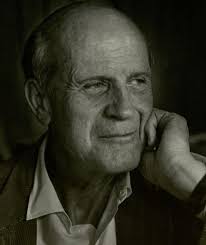
When I learned that you had shuffled off your mortal coil putting an end to a unique and lengthy creative career I was given pause, not because you were the best or my favorite composer (though much of your music is forever a part of my internal soundtrack), but rather because of the timing of when your work entered my life. We never met, I never corresponded with you, and I am not a professional musician/musicologist. I am simply a consumer, audience member who was 14 years old when he first purchased the (thankfully budget priced) recording of Ancient Voices of Children.

The 1971 premiere recording

At a tender time in my life working on the adolescent task of forming an identity I was not enamored of rock and roll, the music of most of my peers. I was a devoted fan of classical music and it was the intelligent programming of Chicago’s WFMT which, as my daily companion, taught me much about classical music old and new. It would be at least four or five years, when I was in college, that I would find others who shared my interests so my incessant listening with liner notes in hand was a solitary experience. But rather than being what one might imagine as a sad and lonely pursuit, I found it thrilling and somehow validating. It felt like a personal discovery and those bold avant-garde sounds combined with the chilling poetry of Lorca resonated deeply with my nascent personality. It was the first modern music to engage me at a time when I had yet to develop an understanding of Schoenberg, yet to encounter Mahler, or have much appreciation for music written before 1900.

Makrokosmos I with score excerpt on cover

It is difficult all these years later to fully recall the thrill of finding this 1974 release in the record bins at Chicago’s iconic Rose Records, a place that became intimately a part of my sense of self with wooden bins in rows that sprawled to a vanishing point. Three floors of browsing ecstasy for my solitary but increasingly confident self. Finding another recording by that composer who touched me so deeply, and one with a portion of the beautiful calligraphy which I learned characterized your work was overwhelmingly compelling. Of course I had to buy it immediately.

Much as I did with that first disc, I listened intensely and repeatedly, again with liner notes close at hand, and that bolstered with what I had learned since studying that first disc. It is a nod to Bartok’s Mikrokosmos, a presumptuous thing to do but the substance of this music is arguably comparable. In addition each of the 12 pieces was named for one of the Zodiac signs, and, a nod to Edward Elgar (who appended initials of friends to each of the “Enigma” variations). I took delight in reading that these pieces were similarly dedicated by appending initials of various people, and that The Phantom Gondolier of Scorpio was the work’s composer and that of Spring-Fire Aries was the performer, David R. Burge. I recall a certain delight when my junior scholar self decoded Crucifixus Capricorn as being fellow composer Ross Lee Finney. I realize now that I don’t know the other references but again I was hooked on the whole concept.

Voice of the Whale on the premiere recording on Columbia Records, 1974

When I heard Vox Balanae (Voice of the Whale) broadcast on WFMT I had already encountered Alan Hovhaness’ use of actual recordings of whale sounds in his orchestral work, “And God Created Great Whales” (1970) and I was stunned at the use of extended instrumental techniques to successfully evoke whale sounds and seagull sounds. It was also my first introduction to your sense of theater, lighting the stage with a blue light, and having the performers wear masks (in addition to asking the musicians to do some unusual things with their instruments and also to use their voices). I’ve since wondered how many musicians rebelled, or at least grumbled, under the weight of those stage directions and then, as now, I am grateful for musicians who aren’t afraid to break boundaries.

Now, this release was on the full priced Columbia label which was out of my budgetary reach. But along comes Rose records with their always delightful “cutout bins” where I would later find this gem at a budget friendly price. It was also a time when a major label took calculated risks releasing truly innovative, experimental music. Indeed Columbia would later introduce me to Terry Riley, Steve Reich, Luciano Berio, Harry Partch, and Conlon Nancarrow and, my gateway drug, Wendy Carlos with Switched on Bach.

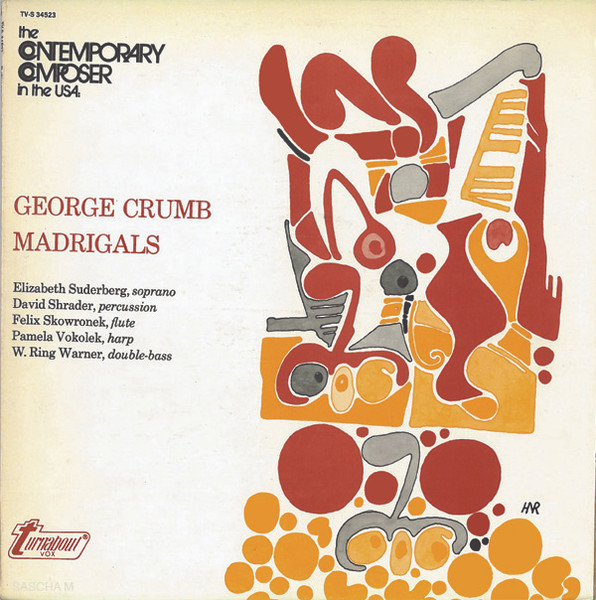
Lorca Madrigals 1965-69

I was hitting my stride and using what I had been learning from liner notes and the intelligent broadcast chatter of my beloved WFMT hosts. No surprise then that, when I found this budget album with the names of both George Crumb and Frederico Garcia Lorca, I knew that I was in my milieu. And this album would occupy me nearly as obsessively as the previous ones.

Makrokosmos III

The sheer beauty and distinctive design of the Nonesuch new music releases were my metaphorical dog whistle, so Makrokosmos III practically jumped into my arms at one of my Rose Records junkets. (I was and still am a bit of a completist, that is, if I buy a piece numbered “2”, I would have to find the one marked “1”, and so on). So I was somewhat upset that I had somehow missed Makrokosmos II or, heavens forbid, that no one had bothered to record it. But I easily put that obsession to the side as I became entranced by this new installment of the celestially inspired Makrokosmos series in this larger ensemble work (NB. I did not dabble in any drugs until well into my college days probably 4-5 years distant so I’m reasonably sure that the profundities I experienced were related to the power of the music, though doubtless with some adolescent hormonal effects). For whatever reason this album engulfed me most blissfully.

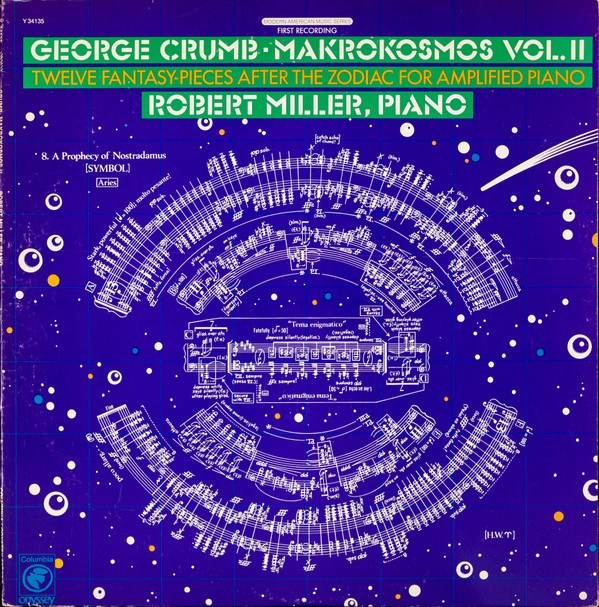
Robert Miller’s premiere recording of Makrokosmos II

Deus ex machina, I visited Rose records, prowling for more music that resonated with me when I found Robert Miller’s reading of the second Makrokosmos (on Columbia’s budget label, Odyssey) which, with the first Makrokosmos, comprised 24 pieces. I would some years later learn that the Zodiac pieces were in fact an analogy (or homage) to J. S. Bach whose two volumes of preludes and fugues, “The Well Tempered Clavier”, represented all 24 keys of the Western well-tempered scale and are a sort of urtext or manifesto, and which remain towering masterpieces. Now I’m not trying to suggest that Crumb’s work is of similarly immortal status. In fact the comparison is almost of an “apples/oranges” sort. But on the level of innovation in composition that Crumb’s work represents here does suggest strongly to this listener that the this set may do for extended techniques what Bach did for harmony and keyboard playing. (Crumb’s Five Pieces for Piano of 1962, which I did not hear til many years later and it is clear are sort of the “etudes” or “experiments”, if you will that later expanded into larger forms). They are clearly a truly innovative rethinking of what piano music and piano playing can be. They are also a logical successor to John Cage and Marcel Duchamp’s “prepared piano” innovations of a decade or so earlier.

In the decades of the 80s and 90s, I and my concert goin’ pals would make pilgrimages to live performances of Philip Glass, Terry Riley, Steve Reich, AACM, Keith Jarrett, the Arditti Quartet. Chicago Symphony, Civic Orchestra, Contemporary Chamber Players, and, of course, the Kronos Quartet (who I learned were formed shortly after founder and first violin, David Harrington heard Mr. Crumb’s 1970 political/musical masterpiece), “Black Angels”. It was the Kronos, whose beautifully staged and definitively played reading I can still recall (not eidetically complete but I do recall the stage lit from above, one light over each of four music stands with their instruments hung on cables over those desks (which they took down to play after they entered the stage).

After the house lights dimmed, there was a pause which served almost as punctuation, an indicator of a silence which helped get the audience into the mystical space which is deeply embedded in the music by structure, by analogy, by sheer sound, and by the theater. The musicians played standing at their desks (cellist Joan Jenrenaud was afforded a chair, thankfully). References to apocalyptic themes, alchemical symbolism, numerology, extended instrumental techniques, subtexts, epigrams, and striking optics all joined to create a performance that continues to evoke emotional memories. This music, written in protest of the Viet Nam War, also found its way into the score of the hit horror film, “The Exorcist”. Oh, yes, the “Night of the Electric Insects” played by the Electric String Quartet” added no small amount of uneasiness to the film and the music reinforces those emotions curiously well even on its own. The (now ubiquitous) use of amplification gives an “in your face” aspect to the performance of this music. It illuminates what would be barely perceptible extended technique effects and seems to push the music right up to your face and into your ears. Not your typical chamber music experience.

To be fair, while I have continued to follow your music, Mr. Crumb, I have not done so with the same passion as in those early days but I treasure listening to the Pulitzer Prize winning Echoes of Time and the River, Star Child, the early Solo Cello Sonata, and I’m incredibly pleased that David Starobin’s Bridge Records had been collaborating on a complete works edition (still in progress). But my sort of “first love” encounter with your music has been a significant part of making me who I now am and has given me great pleasures to sustain me since those early encounters. I want to thank you for your service to the arts and to let you know that your work has touched me deeply and is forever a part of me, it lives on. Rest in peace, a fan.