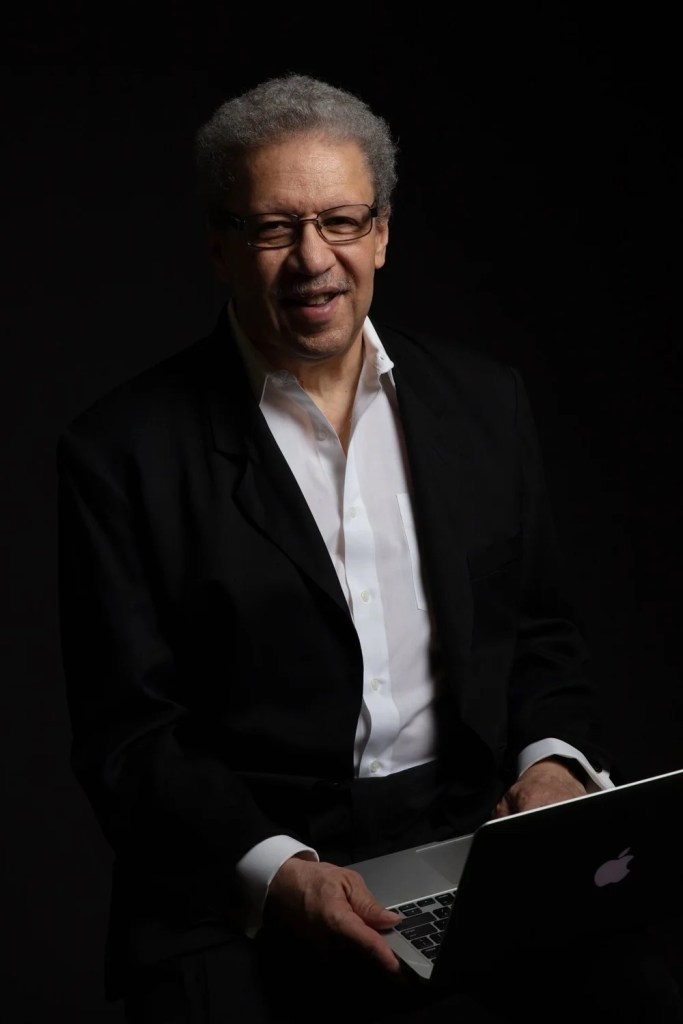
Anthony Davis has never hesitated to share express his feelings and politics in his music. His operas “X: The Life and Times of Malcolm X” (1986) and “Amistad” (1997) are two recent shining examples.
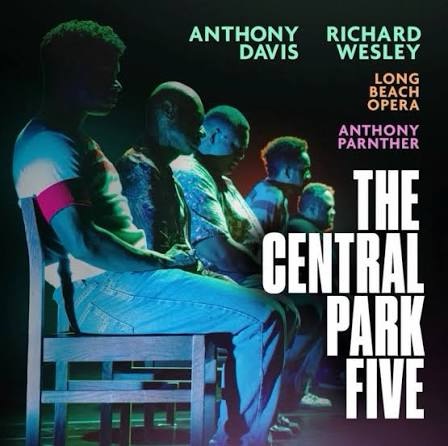
This most recent of his operas is also one that partakes of more recent political events than the previously mentioned works. It is, by my count, his 8th opera. And though all of Davis’ operas can be said to have some political content, “X”, “Amistad”, and now “The Central Park Five (2019), are most specifically focused on the transatlantic slave trade (ca. 1500- 1870) and subsequent black political history..
The story captured in the libretto by Richard Wesley made newspaper headlines and even motivated the pre presidential Donald Trump to take out full page ad in several media publications advocating their guilt and advocating for the death penalty.
While I have had the pleasure of multiple hearings of this powerful and substantial work I have chosen to include the composer’s excellent essay which describes not only the story but also the some of the intricacies and references embedded in the music itself.
Notes on The Central Park Five
By Anthony Davis
1989. A group of predominantly Black and Hispanic teenagers enter Central Park in New York City. They turnover garbage cans, throw rocks, harass people on bicycles. A young woman is sexually assaulted in the Park and six teenagers are detained and questioned about the assault. Five of the teenagers, Kevin Richardson, Raymond Santana, Korey Wise, Yusef Salaam and Antron McCray become the center of a criminal case that would polarize New York City. The Exonerated Five were falsely accused and convicted of the crime with no physical evidence. Condemned publicly by the press, the Exonerated Five were victims in a culture war waged against Black and Hispanic communities. A politically ambitious real estate mogul condemns the teenagers with a full page add, proclaiming “Bring Back the Death Penalty. Bring Back Our Police!” The persecution of the Central Park Five marks the beginning of Donald Trump’s political career, built on racial animus and the exploitation of the deep rooted racial divide in America.
Why? What accounts for what Johnny Cochran would later famously call, “The rush to judgement.” How could the court trust the coerced “confessions” of the five teenagers? How did we come to this moment that assumed guilt, blindly seeking revenge? What caused the deeply rooted anxiety of White Americans when confronted with Black-Hispanic culture and people?
1989. Spike Lee’s movie Do the Right Thing premieres, Quincy Jones’ album “Back on the Block” debuts, Black and Hispanic teenagers sing the Tone Loc song “Wild Thing” as they descend on the Park. The song becomes a label in the press as they describe the actions in the Park as “Wilding in the Park.” Did the persecution of the Five represent the White anxiety about Hip Hop entering mainstream American culture? Was the response to the Five a reflection of Tony in the Pizza restaurant smashing Radio Raheem’s boombox? The persecution of the Central Park Five, emblematic of other similar incidents of false accusations of Black and Hispanic men across the country, demonstrates the devastating consequence of the culture war, as incarceration has become the new slavery.
As a composer, I have always been drawn to stories that intersect the political and cultural worlds. My operas, X: The Life and Times of Malcolm X, Amistad, Wakonda’s Dream, Tania and Pancho Rabbit and the Coyote, all explore political moments and movements that are reflected in the dynamic of music. In X, it is the evolution of creative music from the forties to the sixties, a revolutionary movement in music as well as in politics. In Amistad, it is the false balance of the Missouri Compromise and the untenable grounding of America’s birth in both the ideals of Democracy and the original sin of Slavery. In American music one must always understand the irony that slavery created our culture from the advent of the minstrel show to the “Birth of the Cool.” Music can capture the tensions and fissures in our cultural and political life and the hope of something better. Music can allow us to feel the powerful forces at play in our lives, forces that are at once destructive but yet in our cathartic engagement allow us to envision a kind of freedom.
The Prologue of The Central Park Five begins with the “Exonerated Five” today as they reflect on the past. The opening cross-fade with the Kurzweil texture signify a fissure, a break, the dark spectre of trauma. Each of the Five recalls the trauma of the past. Librettist Richard Wesley ends the Prologue with poignant simplicity, “They tell us in school how big the world is, but that’s their world. They crushed mine.”
Act One introduces a recurring theme and harmony that suggests the past world of Harlem. The lyric, “Harlem, a Black and Tan Fantasy,” of course, suggests Ellington’s Harlem. In fact, before the Masque’s aria, the descending minor 3rd in the baritone saxophone suggests Ellington’s famous Tone Parallel to Harlem from 1949. Ellington describes the descending 3rds that appear throughout the work as signifying and enunciating “Harlem.” The theme is introduced by the Baritone Saxophone and starts as a dirge with variations. The harmony in f minor recalls one of Charles Mingus’ most famous harmonic progressions loosely based on the standard, “You Don’t Know What Love Is,” a ballad made famous by Billie Holiday. The melody is then played by the trombone with a counter-melody inspired by the great Eric Dolphy, played by the Baritone Saxophone and the Bass Clarinet. The theme moves into swing with an iteration by the trumpet. This introduces the Masque’s aria, “Harlem, a Black and Tan Fantasy.” The Masque is a malevolent force in the opera. He is the skeptical reporter, who distrusts Black people. He’s the policeman who arrests and interrogates the five suspects. He is the judge who condemns them.
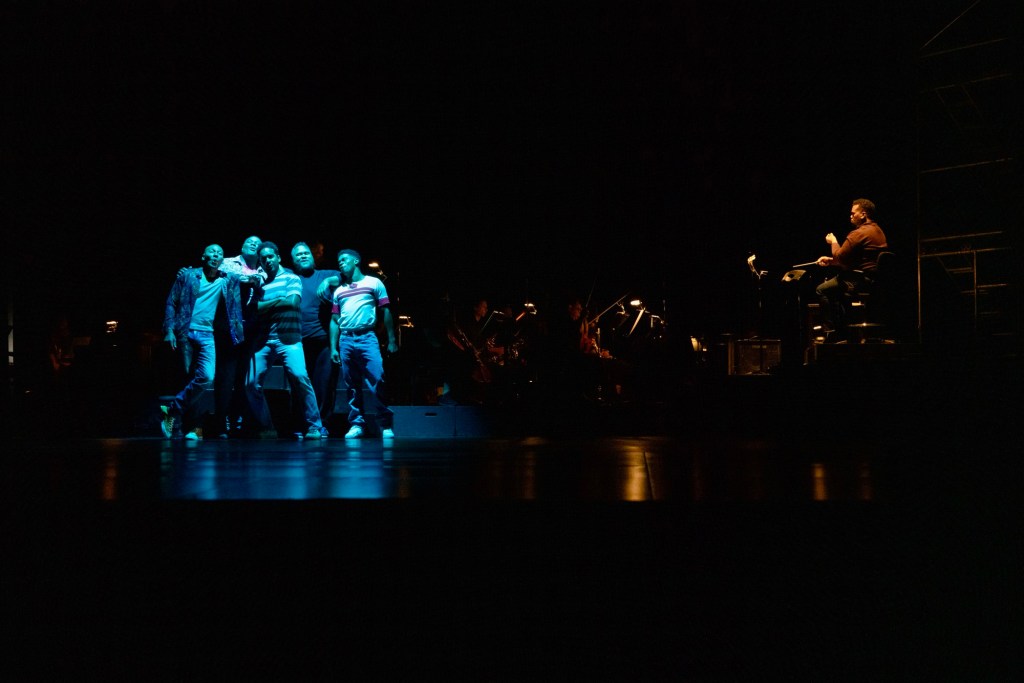
In Act One the five singers become their younger selves, before they arrive in Central Park. They are exuberant and recklessly free as they talk about their lives and aspirations. The music begins in a gamelan inspired texture with a 9 beat pattern in the vibraphone and right hand of the piano and a 10 beat pattern in the left hand of the piano. This creates a repeating grid of 90 beats. As in my first opera, X, often I try to marry underlying rhythmic structures with dramatic intent. Every 90 beats something new can happen in the music and in the drama. The orchestra slowly reveals the inner harmonic working of the drone against the free flowing lines of the Five boys. The Masque disturbs and interrupts the Five’s music signaled by a series of cascading major thirds that play against the harmony of the drone establishing a 4 against 3 rhythmic tension, as the music evolves “off the grid.” This leads to a new tempo before the Masque proclaims “They (Black people) are lost!” The opera explores rhythmic tension that is reinforced by the harmony. The Five defiantly sing “This is my world!” and later the anthem “The World is Ours!” The stable harmony of the anthem is eventually disturbed by the building polyrhythms as the Five become more excited culminating in the antiphonal rhythmic interplay between “This is no life. This ain’t living. This ain’t no life!” and “Time to bust out, time to break out, time break out, time to act out” This leads the Five into the Park. In the music, I tried to capture the exhilaration and exuberance of the Five and their illusion of freedom. As they enter the Park, the Five sing, “We are the freaks! We are the freaks who own the night!” The music in the Park is influenced by everything from Parliament Funkadelic to fusion Miles Davis and Jaco Pastorius with Weather Report. The music captures the exuberance and recklessness of the Park that quickly becomes out of control fueled by groove and funk.
Music allows us to see different worlds and to shift perspective. As Kevin and Antron are initially detained we hear the echoes of the Blues and again the stop-time from Black and Tan Fantasy as the Masque declares falsely that “That is the end of that.” The anthem music, when it returns as the Assistant District Attorney and the Masque discuss the assault, becomes a distant, shattered memory. The interrogation scenes feature rhythmically driven music as if an ex-machina force is coercing the Five’s confessions. The words of the Masque and the Assistant D.A. are like weapons. The vocal writing is more angular with shifting harmonic centers emphasizing speech rhythms and repetition as the Masque and A.D.A, try to force the Five to implicate each other. This is in contrast with more reflective moments that are lyrical and harmonically grounded. The Five’s collective sense of apprehension and fear is expressed in passages drawn from the vocal ensemble tradition of close harmony from doo-wop, Motown and the street as if through a filter of Gil Evans’ arrangements in “My Ship” or Blues for Pablo. The hybridity of the music tells the story.
A friend once asked me, “How do you write for Donald Trump?” I replied, “First, he is a tenor. Second, he repeats himself in his violent sound bytes. Third, he never completes a sentence.” I tried to capture his use of short, repeating phrases that could be amplified by the chorus. “Wilding, Rampaging, Wilding, Rampaging Wolfpack!” What is Trump’s appeal? Like moths to flame, Trump says things that people may think and be afraid to express. In MAGA world Trump’s racism is somehow authentic and Trump has helped unleash the pathological racism that is both systemic and psychological. I entertained these scary thoughts as I composed the opera.
Finally, the opera is an uplifting story of a community rising up against injustice, of the Five finally finding exoneration and vindication as the anthem returns with “The World is Ours!” But we know the cost, as Korey says, “They stole from me!” And we know this is a continuing story. The forces that implicated the Five are still with us.
Thank you to the librettist Richard Wesley who illuminated their story with humanity and emotion from Sheronne Salaam’s “They are trying to blame my son” to Korey’s “They stole from me.” None of this would happen without the love and support of my muse, Cynthia Aaronson-Davisuch passionate command. I must recognize the extraordinary work of Earl Howard who created the electro-acoustic world that shadows the opera. I need to call attention to the critical work of Andreas Mitisek who directed the first production in Long Beach and helped realize the dramatic possibilities of the opera. I am indebted to all the musicians and singers who brought this opera to life in Long Beach, Portland and Detroit and, of course, Long Beach Opera, particularly Jenny Rivera and Michelle Magaldi, who believed in the work and help produce this recording. I would also like to thank UCSD for its continued support of my work. None of this would happen without the love and support of my muse, Cynthia Aaronson-Davis.
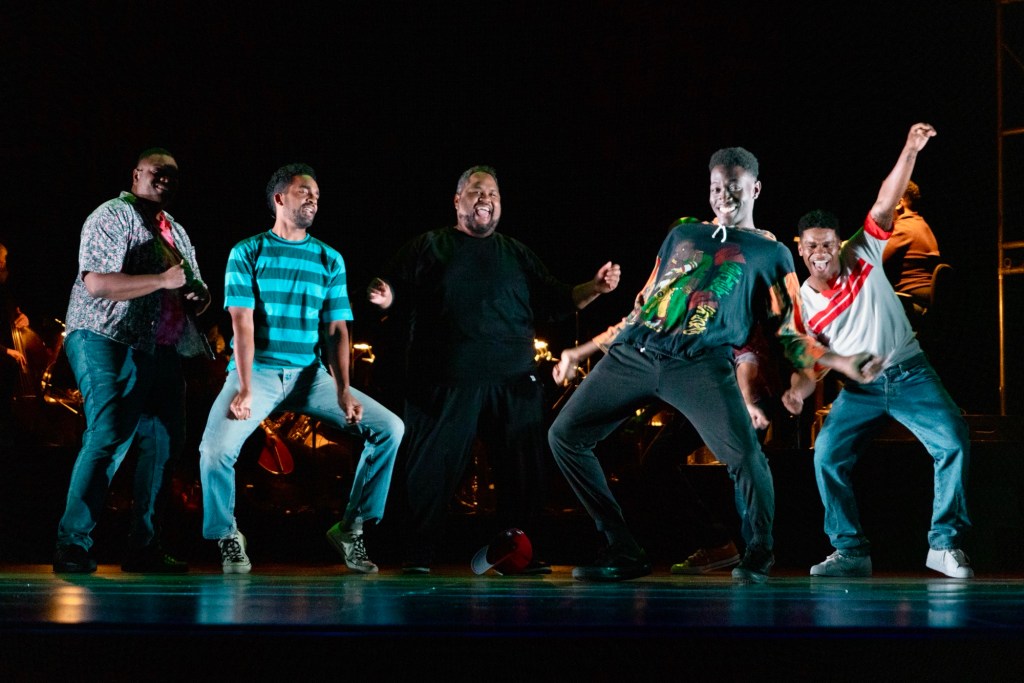
The opera has received many performances since its premiere by The Long Beach Opera, who commissioned the work. It has since been performed in Detroit, New York, and is scheduled for another performance in Long Beach.
The music incorporates bebop and other jazz styles into a listener friendly melodic and harmonic constructions that set the beautiful libretto’s words effectively.
Davis himself identifies as a politically expressive composer. Even in his non-stage works like his meditation on the first of the so called Miranda Rights (You have the right to remain silent) cast in the classical form of a concerto for clarinet (2007). Arguably, Davis’ work cannot be separated from the experience of Black American culture. Davis, raised in the cultural lineage of transgressional innovators such as George Lewis and his many colleagues of the AACM (American Association of Creative Musicians), a group that still works to include the cultures and rituals of many African countries into the practice of so called western art music). Davis has been a defining figure in contemporary music since at least the 1970s. And now he is recognized as an exemplar of “American” music by virtue of the recognition of the Pulitzer Prize.
As a work of classical protest music, it functions (in Jeremy Eichler’s term) as “times echo”, a use of great art to frame a noxious historical event in a sort of time capsule that preserves memories and feelings of the story that lives again in performance. As such, The Central Park Five stands proudly alongside Hans Werner Henze’s “Essay on Pigs” (1968), Benjamin Britten’s “War Requiem” (1961), and composers as diverse as Dmitri Shostakovich, Luigi Nono, Arnold Schoenberg, Steve Reich, Wynton Marsalis, and Louis Andriessen (to name but a few).
But, as is the case with any artistic work of protest, the actual impact remains to be seen. The horrors of racism remain a defining part of western culture, of American culture now cast forever in this deeply felt drama. This is definitely not, in Toni Morrison’s phrase, “…music to entertain the master and soothe his blunted soul.” And in a time of the active attempts to suppress and deny this unsavory history, art can preserve memories both good and bad.. There is a noble beauty in that.

