Other Minds 21, the Dawn of a New Chapter and the Raising of the Dead


BHM160008

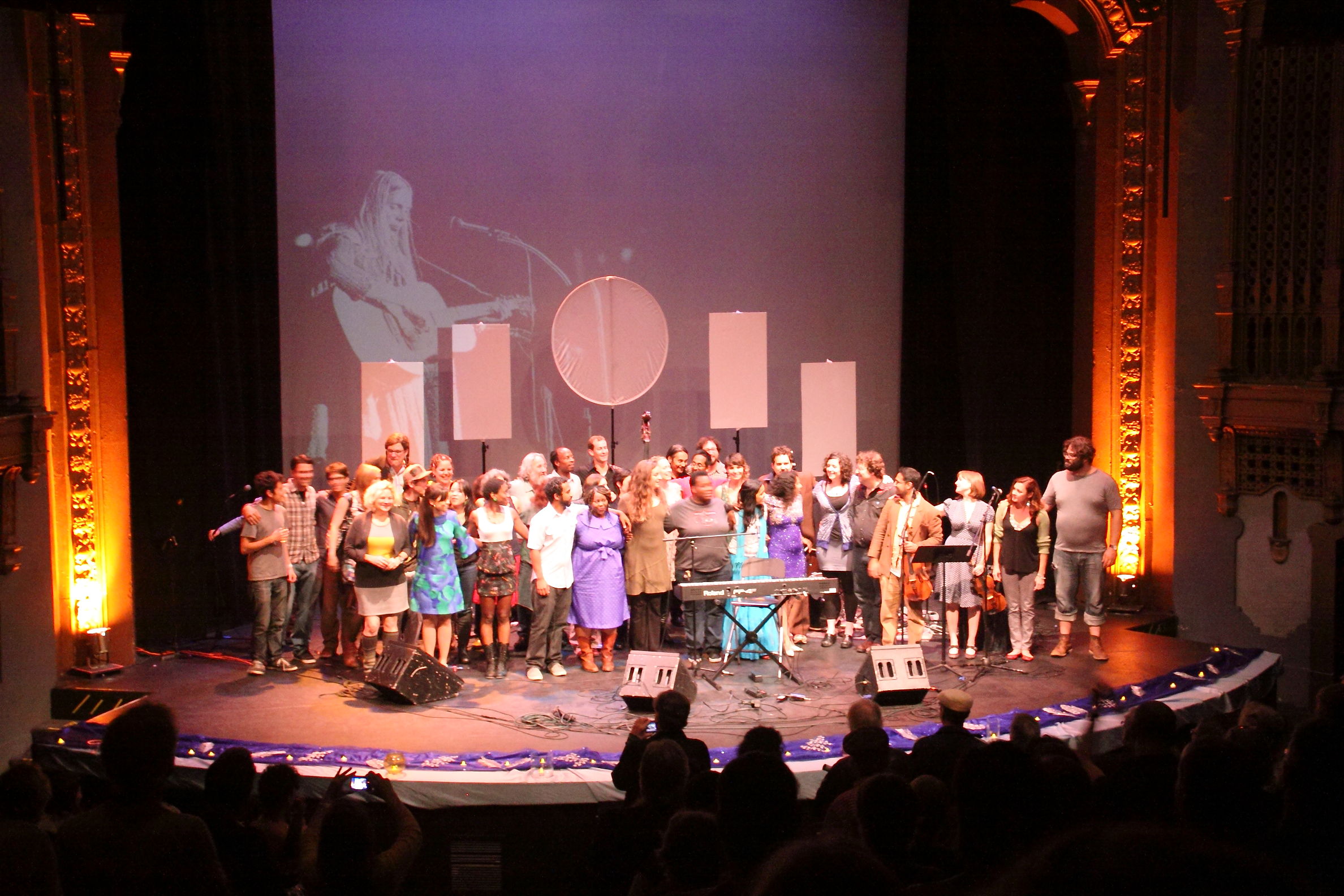
Charles Amirkhanian with the composers of OM 21

Much needed rain pummeled the city by the bay on all three days of OM 21 dampening, perhaps, some attendance but not the enthusiasm of the audience or the performers.  In most ways this concert was a continuation of the celebration begun last year commemorating 20 years of this festival.  Returning this year were Gavin Bryars (OM7) and Meredith Monk (OM1).

Until last year no composer had appeared more than once at this series.  For those unfamiliar with OM it is worth noting that the process has been for the 8-10 selected composers spend a week at the Djerassi Arts Center in Woodside, California sharing and discussing their work before coming to San Francisco for performances of their work.

As it turns out this year’s concert series will be the last to follow that format.  Apparently OM has become the victim of gentrification and has had to move out of its Valencia Street offices and will now opt for various concerts throughout the year as they have done but without the big three-day annual festival and the residency at Djerassi.

The archives of OM are now going to be housed at the University of California Santa Cruz where they will reside along with the Grateful Dead archives.  I do believe that Mr. Amirkhanian lived near Phil Lesh of the Grateful Dead when he lived in San Francisco some years ago so it seems fitting that these two archives will peacefully coexist in that space (also coming to UCSC will be OM 21 composer Larry Polansky though not in an archive).

This is certainly a change but this is a festival which has endured various changes in time and venue led throughout by the steady hand of the Bill Graham of contemporary music concerts, Charles Amirkhanian (both men have had a huge impact on music in the bay area as well as elsewhere and it is worth noting that the Contemporary Jewish Museum will have a tribute to Graham this year).

Actually Other Minds traces its provenance to the Telluride, Colorado Composer to Composer festival (also led by Amirkhanian) and later morphed into OM with the leadership of president (now emeritus) Jim Newman back in the early 1990s.  There is a short excellent film describing OM’s history on Vimeo here.

It is the end of a chapter but, as Amirkhanian explained, there are many exciting concerts coming up which will keep Other Minds in the earshot of the astute contemporary music aficionados on the west coast.  Next year, for example, will include several very exciting concerts celebrating the 100th birthday anniversary of beloved bay area composer Lou Harrison.

My apologies for the delay in posting which was due to both the richness of the experience and the exigencies of my day job and other responsibilities.  I hope that readers will find this post to have been worth the wait.

BHM160009

Nordic Voices

Starting our rainy day were the extremely talented singers known as Nordic Voices.  Lasse Thoresen‘s Solbøn ( Sun Prayer) (2012) and Himmelske Fader (Heavenly Father) (2012) both required keen listening and required the use of extended vocal techniques such as multiphonics.  The singing appeared effortless and even fun for the ensemble but that speaks more to their expertise and preparedness than any ease in terms of the score.

It is always difficult to judge a composer’s work by only a small selection from their output  but Thoresen’s virtuosity and subtle use of vocal effects suggests a highly developed artist and it would seem worth one’s time to explore more of this gentleman’s oeuvre.

BHM160010

Lasse Thoresen takes the stage to acknowledge the applause.

Next was an unusual, humorous/dramatic work by Cecile Ore called Dead Pope on Trial (2015/16) with a libretto by Bibbi Moslet.   This Other Minds commission was given its world premiere at this concert.  The work is based on the story of a medieval pope who was taken from his grave no fewer than six times for various perceived offenses.  It is a mix of irony and humor in a sort of madrigal context.  The work was in English and had the nature of a conversation between the singers.  No doubt a challenging piece, it was sung very well and the composer seemed as pleased with the performance as much as the audience.

BHM160011

Cecile Ore smiling as she acknowledges the applause for the wonderful premiere performance of her new work, Dead Pope on Trial.

As if in a demonstration of sheer stamina in addition to virtuosity Nordic Voices took the stage again, this time for some Madrigals (2002/2016) by returning artist Gavin Bryars.  Bryars is no stranger to Other Minds or to madrigals and such older musical forms from the renaissance and before.  He has extensively explored vocal writing and medieval harmonies in many previous works.  Though categorized as being a “minimalist”, Bryars actually has produced a huge range of music in all forms including opera, chamber and orchestral music.

His madrigals have been written for the Hilliard Ensemble and each book is distinguished by the madrigals having been written on a specific day of the week.  The first book on Mondays, etc.  They are settings of Petrach’s sonnets and are sung in the original Italian of his day.  On this night we were treated to four madrigals from Book Two and the premiere of a madrigal from Book Four.  That madrigal was dedicated to Benjamin Amirkhanian, the father of Charles Amirkhanian who celebrates his 101st birthday this summer.

I had the opportunity to meet and speak briefly with the affable Mr. Bryars.  His generous spirit pervaded our conversation and he spoke very highly of both his visits to Other Minds.  If you don’t know this man’s music you are doing yourself a great disservice.

BHM160016

A very pleased Gavin Bryars deflects the applause and adulation to the amazing Nordic Voices for their astounding performance of five of his madrigals.

The singers of Nordic Voices sustained a high level of virtuosity as well as sheer stamina as they sang for nearly two hours in the opening pieces of this concert series.  No time was lost setting the stage for the performance of the next piece, another premiere, Algebra of Need (2016) for electronic sampling and string quartet by Bang on a Can member Phil Kline.

BHM160045

FLUX Quartet playing at SF Jazz, 2016

The Flux Quartet was featured in the next two (and last) works on this long program.  Algebra of Need is Kline’s meditation on the words and the cadences of the iconic writing and voice of the late William S. Burroughs (gone 19 years as of this writing).  The familiar voice seemed to go in and out of clearly audible, at times mixed more closely with the string writing in this intense homage.
BHM160014

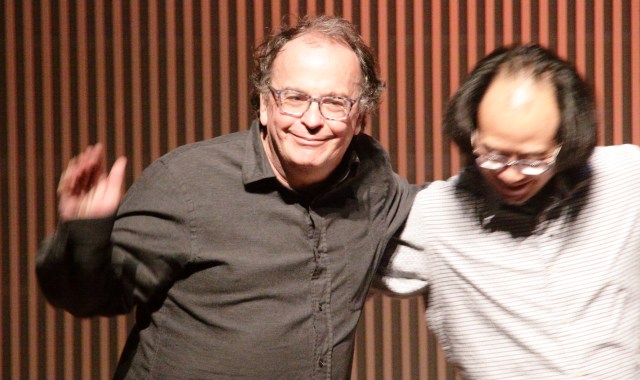
A satisfied looking Phil Kline leans in to embrace the first violin of the Flux Quartet after their premiere of his Algebra of Need.

The Bang on a Can collective was also represented tonight by Michael Gordon.  The Sad Park (2008) for string quartet and electronics put a most decidedly disturbing conclusion on the evening.  This piece, which samples the voices of children (one of them Gordon’s) as they spoke of their experience of the 9/11 Twin Towers attacks.

The effect was, as no doubt intended, harrowing leaving a pretty strange and unsettling feeling as we walked away from the concert into the still rainy night.

BHM160017

Michael Gordon embraces the FLUX Quartet’s first violin after a stunning performance of The Sad Park.

The rain continued on Saturday but the crowd was noticeably larger for the second night which opened with the usual panel discussion.

BHM160030

left to right: Meredith Monk, John Oswald, Nicole Lizee, Eliot Simpson, Larry Polansky, Oliver Lake and Charles Amirkhanian in a panel discussion prior to the concert

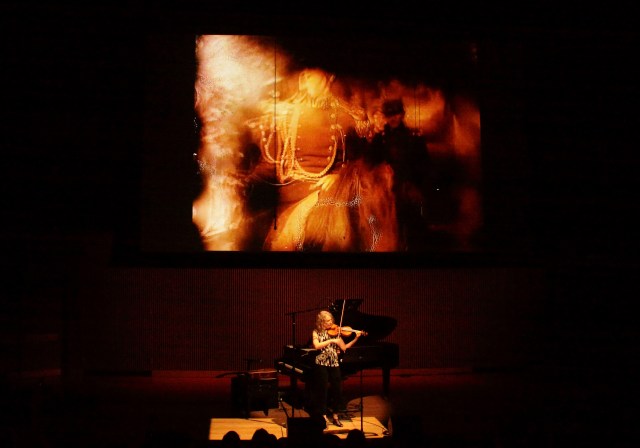
This evening began with a performance by the wonderful bay area violinist Kate Stenberg of a piece which was a sort of antidote to the somber, The Sad Park from the previous night.  Again the composer was Michael Gordon and the piece was Light is Calling (2004), a collaboration with filmmaker Bill Morrison.  Though hardly a happy piece Light is Calling is perhaps elegiac and the composer seems to achieve some of his stated intent to find some healing in the wake of a disaster to which he was all too close.
BHM160031

Kate Stenberg plays violin beneath the projection of a Bill Morrison film in Michael Gordon’s, Light is Calling
BHM160032

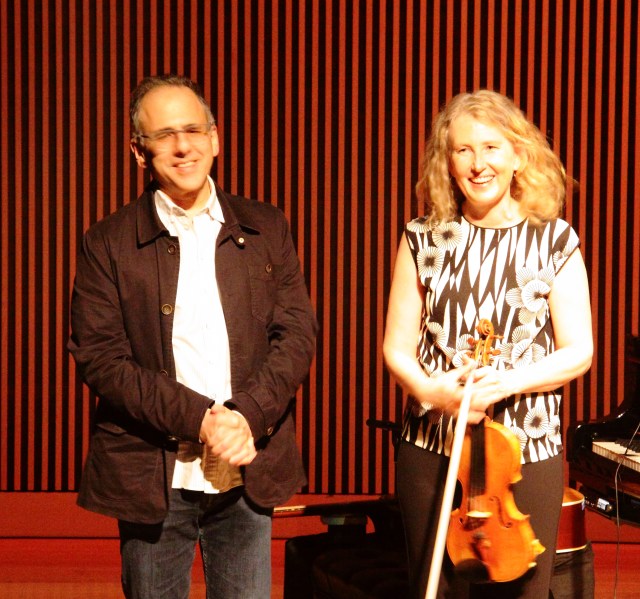
Michael Gordon and Kate Stenberg accepting the applause of an appreciative audience.

Next up was John Oswald, a Canadian composer whose career took off in infamy when his Plunderphonic CD, released to radio stations in the early 1980s, became the subject of legal battles over the meaning of copyright law in light of digital sampling.  Fortunately Oswald won the right to publish his work and his Plundrphonics concepts now underlie much of his compositional process.  Until this night I had not heard any but his Plunderphonic CDs so the introduction to his live music was a revelation.
BHM160033

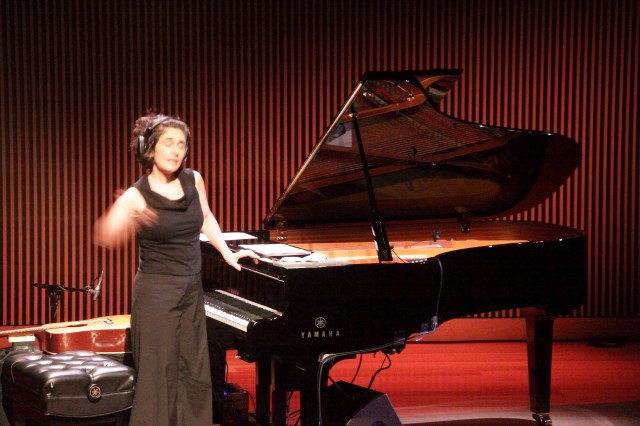
Pianist and (at least here) multi-instrumentalist Eve Egoyan performing with a Yamaha Disklavier and other instruments.

The first piece she did was called Homonymy (1998/2015) was originally written for chamber orchestra and was then transcribed for Egoyan and her prepared disklavier et al.  It is a piece based on linguistic elements and with a visual component as well.

BHM160034

Eve Egoyan performing Homonymy with overhead projections.

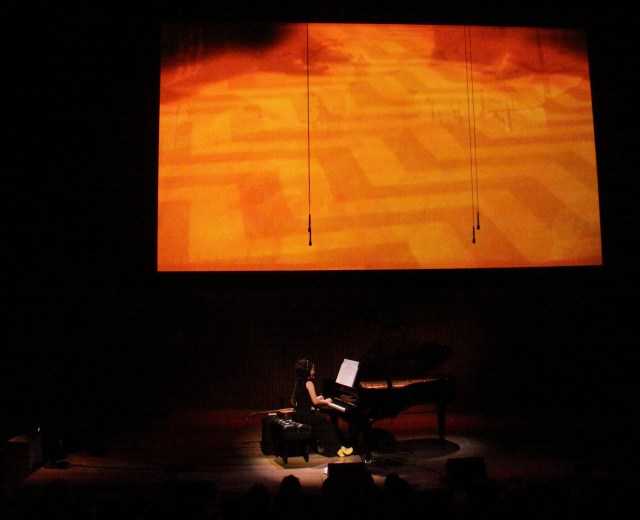
Nicole Lizee’s David Lynch Etudes (2015) was the next piece  and also made use of the projection screen.  The subtitle of the piece indicates it is for “disklavier and glitch”.  Well life imitated art as some sort of glitch prevented the projection from functioning at first but this was rather quickly resolved and we were treated to excerpts of scenes from several David Lynch films with the piano playing some of the rhythms of the dialog in an exchange that puts this writer in the mind of music like Scott Johnson’s “John Somebody” and Steve Reich’s incorporation of speech rhythms in works like, “The Cave”.

Nicole Lizee is a Canadian composer and was the youngest composer on this year’s program.
BHM160035

Eve Egoyan playing Nicole Lizee’s David Lynch Etudes with projected scenes/glitches from Lynch’s films.

The work is one of a series of pieces inspired by films and was executed with apparent ease by pianist Eve Egoyan who played the disklavier (both the keyboard and directly on the strings), a guitar and perhaps other gadgets .  The piece kept her quite busy and the associations I described above sound nothing like this work actually.  These etudes were a unique, typically Other Minds sort of experience, one that expands the definition of musical composition.

BHM160036

Nicole Lizee (l) with Eve Egoyan absorbing the audience’s appreciation of the David Lynch Etudes.

Two more John Oswald compositions graced the program next.  Palimpia (2016) is a six movement piece for disklavier with pianist playing as well.  Oswald says it is actually his first composition for piano.

BHM160046

John Oswald embracing pianist Egoyan and enjoying the audience applause for his work.

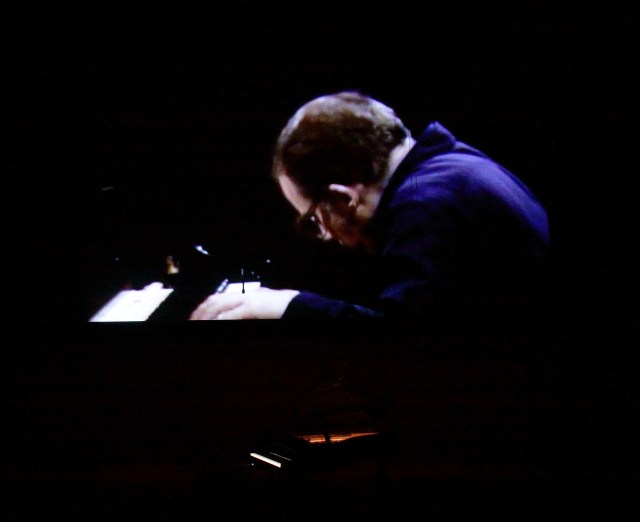
Well I did say there were two more Oswald pieces but this last one was a masterful plunder by this truly unusual composer.  Here Oswald conjured the playing as well as the image of the late great Glenn Gould who was seen actually playing Invaria (1999) with the disklavier performing along with the film of Gould performing this music.  It was, for this writer, a spellbinding experience.  He has raised the dead in the name of music.  Wow!  It was an amazing and heartfelt homage to a fellow great Canadian musician.
BHM160038

Glenn Gould playing John Oswald

Larry Polansky (1954- ) is well known as a teacher and as a composer but one is hard pressed to find much in the conventional discography of his work.  The few discs out of his amazing electronic music (and one disc of piano variations) represent only a small fraction of his output and represent only one genre of music which he has mastered.  However the astute listener needs to be advised to look online to look, listen and hear some of the bounty of his creative output.  Check out the following sites: Frog Peak Music (Polansky’s publishing site which includes music and scores by a great many interesting composer in addition to himself and Dartmouth Page (which contains link to various recordings, writings, computer software, etc.

BHM160039

Giacomo Fiore (left) and Larry Polansky playing Polansky’s ii-v-i (1997)

As an amateur musician who has enough trouble simply tuning a guitar it made my knees weak to watch these musicians effortlessly retune as they played.   Polansky’s experimentation with alternate tunings is an essential part of many of his compositions.

BHM160040

Fiore and Polansky changing their tunings mid-phrase in a stunning demonstration of virtuosity with pitch changes.

The program then moved from the electric to the acoustic realm with Polansky’s folk song arrangements.  Eliot Simpson, the pedagogical progeny of the great David Tanenbaum (who played these concerts last year at OM 20), played the just intonation National Steel Guitar and sang.

Let me say just two things here.  First, these are not arrangements like Copland’s Old American Songs and second, I will never hear these folk songs quite the same way again.  Polansky’s interest in folk music and Hebrew cantillation along with alternate tunings produces what the ears hear as perhaps a different focus.  In these pieces he did not stray too far from the original (as he does in his Cantillation Studies) but one is left with distinctly different ways of hearing and thinking about this music and the listener is left richer for that.  It is a journey worth taking and Simpson played with both passion and command.

Eliot Simpson playing a selection of Larry Plansky's Songs and Toods

Eliot Simpson playing a selection of Larry Plansky’s Songs and Toods

Polansky returned to the stage for a performance of his 34 Chords (Christian Wolff in Hanover and Royalton) (1995). Again we were treated to the virtuosic use of alternate tunings performed live (and again with live re-tunings) by the composer.

Oliver Lake delivering a blistering free jazz improvisation.

Oliver Lake delivering a blistering free jazz improvisation.

Continuing with the solo performer theme we were privileged to hear the virtuosic jams of Oliver Lake (1942- ) whose long career is legendary in the jazz world.  The “mostly improvised” (according to the composer) Stick was played on two different saxophones in what appeared to be as intense an experience for the performer as it was for the audience.

Oliver Lake takes a final bow at the end of the second concert of OM 21

Oliver Lake takes a final bow at the end of the second concert of OM 21

The emotional workout was received warmly by the audience.

Charles Amirkhanian introduces Meredith Monk on the final day of OM 21

Charles Amirkhanian introduces Meredith Monk on the final day of OM 21

There was no panel discussion on the third day of OM 21.  This matinée was dedicated entirely to the work of Meredith Monk (1942) who, fittingly was one of the featured artists in the first Other Minds gathering in 1993.  Now a recipient of the National Medal of the Arts this beloved artist returns to OM 21.  Though the rain continued the house appeared to be full.
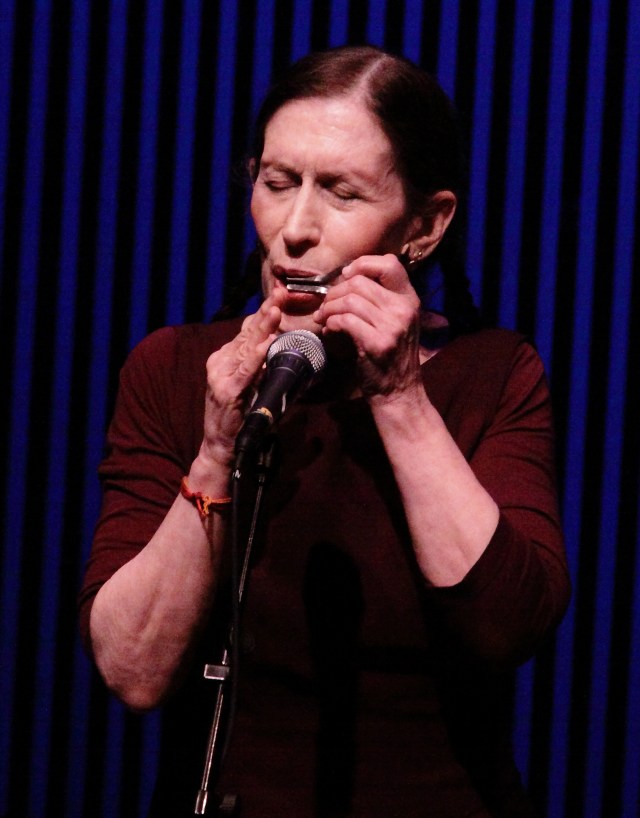
Meredith Monk playing a Jaw Harp in one of her early solo songs.

Meredith Monk playing a Jaw Harp and singing in one of her early solo songs.

Monk played a selection of material from various periods in her career in a mostly chronological survey which she called The Soul’s Messenger.  She began with selections from her solo songs and proceeded to her voice and piano music, then to her work with multiple voices and instruments.
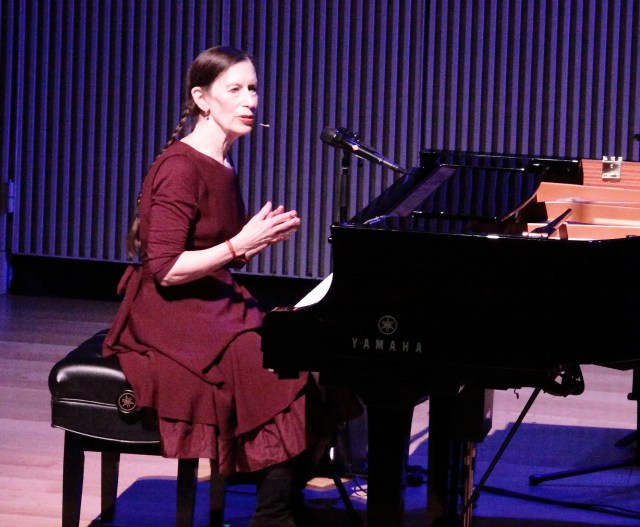
Meredith Monk performing her signature Gotham Lullaby

Meredith Monk performing her signature Gotham Lullaby

Most of the audience seemed to have a comfortable familiarity with the individual works she offered on this night which effectively gave a picture of her career.  Monk was in good voice and appeared to enjoy her performance.
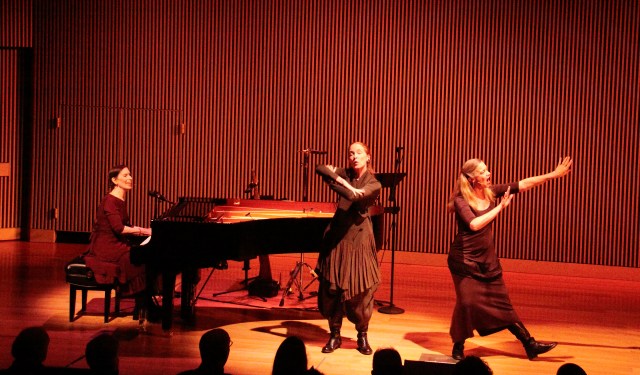
Long time collaborator Katie Geissinger and Allson Sniffin joined in the next selection

Long time collaborator Katie Geissinger and Allson Sniffin joined in the next selection

The stage was set to allow for the dance/movement that is an essential part of Monk’s works.  She originally trained as a dancer.
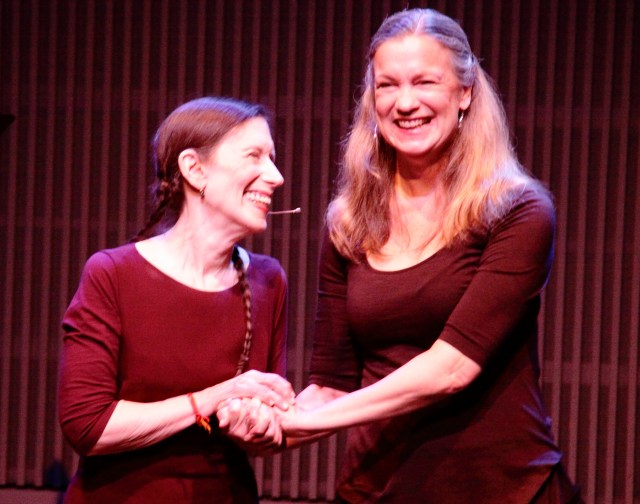
Monk and long time collaborator Katie Geissinger reacting to the appreciative audience

Monk and long time collaborator Katie Geissinger reacting to the appreciative audience

In addition to the grand piano the stage was set with two electronic keyboards, an essential sound in many of Monk’s works.
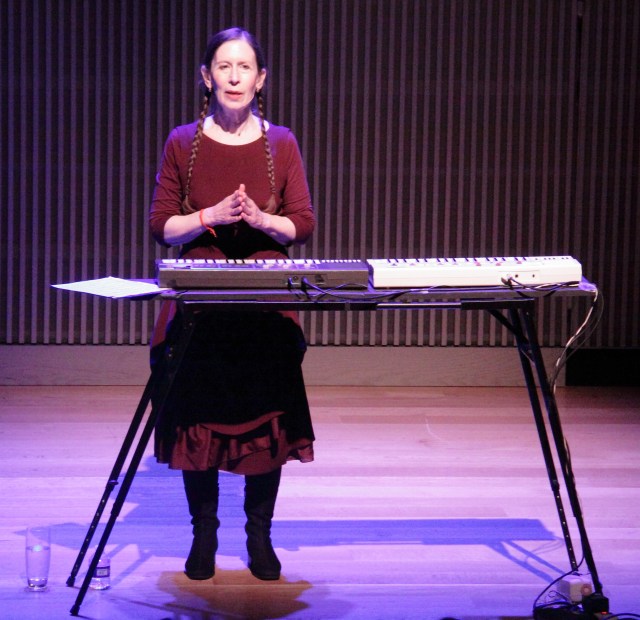
Monk at one of the electronic keyboards

Monk at one of the electronic keyboards

Woodwind player Bodhan Hilash joined the ensemble for the last set of pieces.
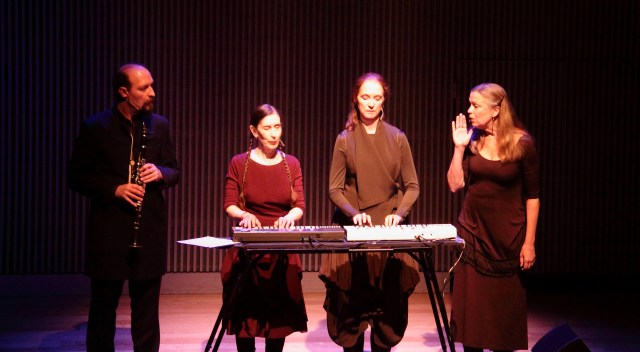
From left: Bodhan Hilash, Meredith Monk, Allison Sniffin and Katie Geissinger

From left: Bodhan Hilash, Meredith Monk, Allison Sniffin and Katie Geissinger

The audience gave a standing ovation at the end resulting in 3 curtain calls.
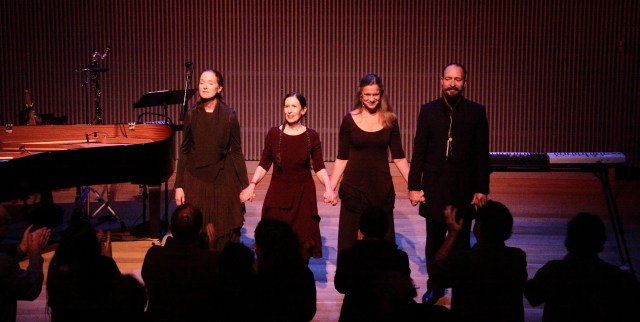
Left to right Allison Sniffin, Meredith Monk, Katie Geissinger and Bodhan Hilash receiving a standing ovation.

Left to right Allison Sniffin, Meredith Monk, Katie Geissinger and Bodhan Hilash receiving a standing ovation.

And the properly prepared artist came back for an encore of her song Details.
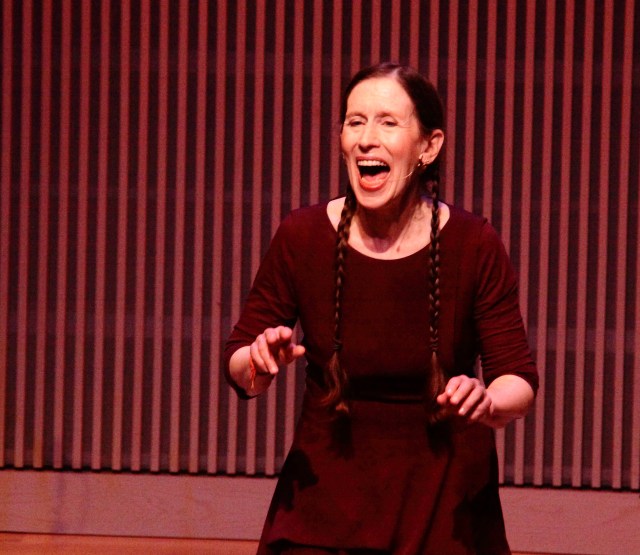
Meredith Monk performing an encore at the final concert of OM 21

Meredith Monk performing an encore at the final concert of OM 21


It was a fitting finale to a great OM 21, fitting to have this artist who appeared on the first iteration of Other Minds returning now crowned with a National Medal of the Arts and clearly beloved by the audience.  Her music like her lovely smile fade to the edge of memory like that of the Cheshire Cat on a truly triumphant finale.

And, despite some format changes, who knows what treasures continue to lie in store?  I will be watching/listening and so, apparently will many others.  Keep an eye on www.otherminds.org .  I know I will.


Spirituals Re-Imagined


411Wkh4lXuL._SS280
I managed to squeeze a delightful brunch meeting with my busy friend and colleague Bill Doggett on New Years Day.  It was there at a favorite Oakland cafe that we discussed many topics and Bill gave me a copy of this beautiful CD by a young black composer whose work is entirely new to me.

Okpebholo

Shawn Opkebholo (1981- )

Shawn Okpebholo (1981-  ) was born in Lexington, Kentucky.  He earned his B.A. in music at Asbury College and his M.M. and D.M.A. degrees at the  Unniversity of Cincinatti.  Doctor. Okpebholo is currently on faculty at Wheaton College  in Illinois.

The present disc is Opkebholo’s first CD dedicated entirely to his own compositions and is the composer’s “reimagining” of spirituals.  Drawing on the folk tradition of spirituals, worksongs, etc. as well as classical art song traditions he fashions his personal take on these much loved melodies.

I do feel compelled to mention the beauty of the photography and album design.  Greg Halvorsen Schreck took the pictures and Jeremy Botts did the overall design.  Powerful stuff.

In a slight deviation from the classic voice and piano arrangements the composer chose to score this little cycle for baritone, mezzo-soprano, viola and flue along with piano.  For this writer this was an interesting and suitably entertaining choice.

jnai

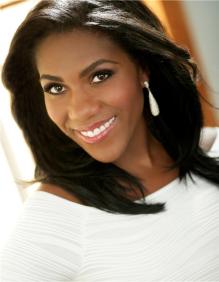
J’nai Bridges

Willnewheadshot

Will Liverman

The singers Will Liverman, baritone and J’nai Bridges, mezzo-soprano are marvelous and sensuous voices and discharge their duties most beautifully.  The pianist Paul Tuntland Sànchez is also a composer and very accomplished soloist.

Sanchez_Photo

Paul Tuntland Sanchez


The violist is Dorthy White Opkebholo and is the composer’s wife.  She is an accomplished musician in her own right.

The flute is played by Caen Thomason-Redus.

This is a beautiful recording of these loving arrangements of spirituals which can occupy that place in the literature populated by the likes of Aaron Copland’s Old American Songs.  A must for art song and folk song fans and a great opportunity to hear some fine musicians at the beginnings of what is hoped to be long and successful careers.

The Varieties of E#, a new Elliott Sharp Release on Starkland


Elliott Sharp

Elliott Sharp

I think the first time I heard of Elliott Sharp was when a friend played a vinyl copy of 1988s Larynx. I later got hooked on the delightfully noisy string quartets of 1987s Hammer, Anvil, Stirrup. With 89 albums to his credit (according to discogs.com) Sharp writes and plays music in a range of styles and for a range of ensembles.

Only two years older than John Zorn their musical paths are similar in that they both learned multiple instruments as children. While they are both incredibly creative, intelligent and productive artists, Sharp initially took a more traditionally academic path while Zorn is largely self taught (an amazing feat in itself).

Sharp studied music, anthropology, improvisation and electronic music with teachers like Benjamin Boretz, Roswell Rudd, Morton Feldman and Lejaren Hiller. His music frequently uses Fibonacci numbers, fractals, chaos theory and genetic metaphors. His collaborators have included blues guitarist Hubert Sumlin, Qawalli singer Nusret Fateh Ali Khan (and many others) and practically a who’s who of the Downtown New York scene.

He produced the Nonesuch album of Ornette Coleman covers by John Zorn (Spy vs. Spy, 1988) which is definitely worth a listen. It is one of a series of such recordings of covers of various artists which have also included Ennio Morricone among others.

The present recording comprises works written between 2004-2008 and, like the previous release of music by Martin Bresnick (reviewed previously in this blog here), comprises a sort of snapshot of the composer’s recent work. Like the Bresnick disc this recording samples Sharp’s writing for a variety of ensembles and is an effective portrait of his mature style.

As a long-standing performer in the New York downtown scene Sharp experimented with a variety of compositional and  instrumental techniques consistent with his scientific interests.  Now such experimentation by itself is of little interest except on a theoretical level but what we hear in the works in this recording is a composer who has integrated these techniques into a sound that is pretty uniquely identifiable as Elliott Sharp much as J.S. Bach’s techniques are easily recognizable in identifying that composer.

The first work (and the one that lends its title to the album) is The Boreal (2008).  It is the most recent of the compositions and is another chapter in Sharp’s reinvention of string quartet writing.  Written for the noted JACK quartet, it involves the use of different types of non-traditional bows fashioned by the composer and creates sounds full of harmonics. It is probably unlike any string quartet music you have ever heard and it expands the notion of what that traditional classical ensemble can do.  The recording, though recorded live at the Ostrava Festival, is remarkably free of ambient noise which allows the listener to hear the subtleties of the rather wide dynamic range to be heard without the interference.  The work resides in more or less the same sound world as his other quartets and its four movements seem to follow logically creating a conceptual whole as with any of the more conventional quartets in the repertory.

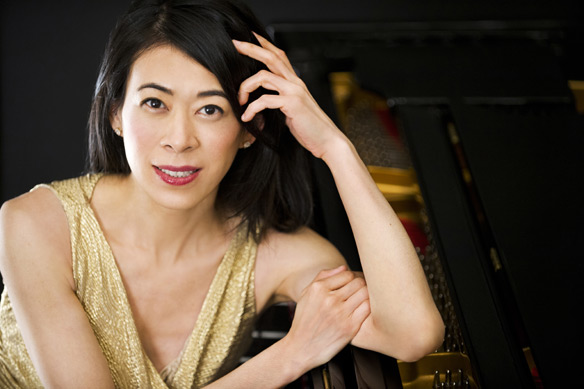
Jenny Lin

Jenny Lin

The second work, Oligosono (2004) is for solo piano.  As the liner notes tell us it is Sharp’s application of extended instrumental techniques which he developed on his guitars to the piano (a pretty interesting accomplishment).  It is written for and played by the wonderful Jenny Lin who navigates the inside of the piano as well as the keyboard in some rhythmically complex and virtuosic playing.  She executes the three movements with seeming ease.

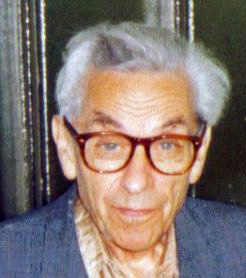
Paul Erdös "Erdos head budapest fall 1992" by Topsy Kretts - Own work. Licensed under CC BY 3.0 via Commons - https://commons.wikimedia.org/wiki/File:Erdos_head_budapest_fall_1992.jpg#/media/File:Erdos_head_budapest_fall_1992.jpg

Paul Erdös

Now we come to the composer’s work for larger ensembles.  Proof of Erdös (2006) is named for the mathematician Paul Erdös (1913-1996) perhaps most famous for the Erdös Number which is an indicator of the degree of separation a given person has with another (Erdös’ number would be a zero and his direct collaborators would be a one.  I’m guessing my Erdös Number with regard to Mr. Sharp would probably be at best a three for having reviewed this album).

Proof of Erdös is a four movement work written for Orchestra Carbon (one of Sharp’s various ensembles) and it is ably conducted by the American composer/conductor David Bloom.  It is a studio recording.  The work shares some of the sound world of the last piece on the album but the ensemble is more of a chamber group than the full orchestra but produces a similarly large and complex sonic image.

On Corlear’s Hook (2007) is a work for full orchestra and, for this reviewer, it is a great opportunity to hear Sharp’s ability to write for large orchestra.  It’s title is taken from a the lower east side neighborhood in Manhattan where Sharp resided with his family.  As the composer says in the notes there is no attempt to be programmatic or pictorial that the music is, “a reflection of the spectra of my existence (there) from one frequency band to another”.

The performance by the fine Janacek Philharmonic is conducted by the German conductor Peter Rundel (1958- ). Rundel, whose credits include a Grand Prix du Disque for his recording of the works of Jean Barraque (1928-1973), delivers a convincing performance of this tour de force.  The four movements, reflecting Sharp’s “spectra” coalesce to a unity which suggests that this piece could easily be called “symphony” if one wanted to use that apparently dated term.  The audience seems attentive or at least respectfully quiet which makes for a pretty definitive recording.

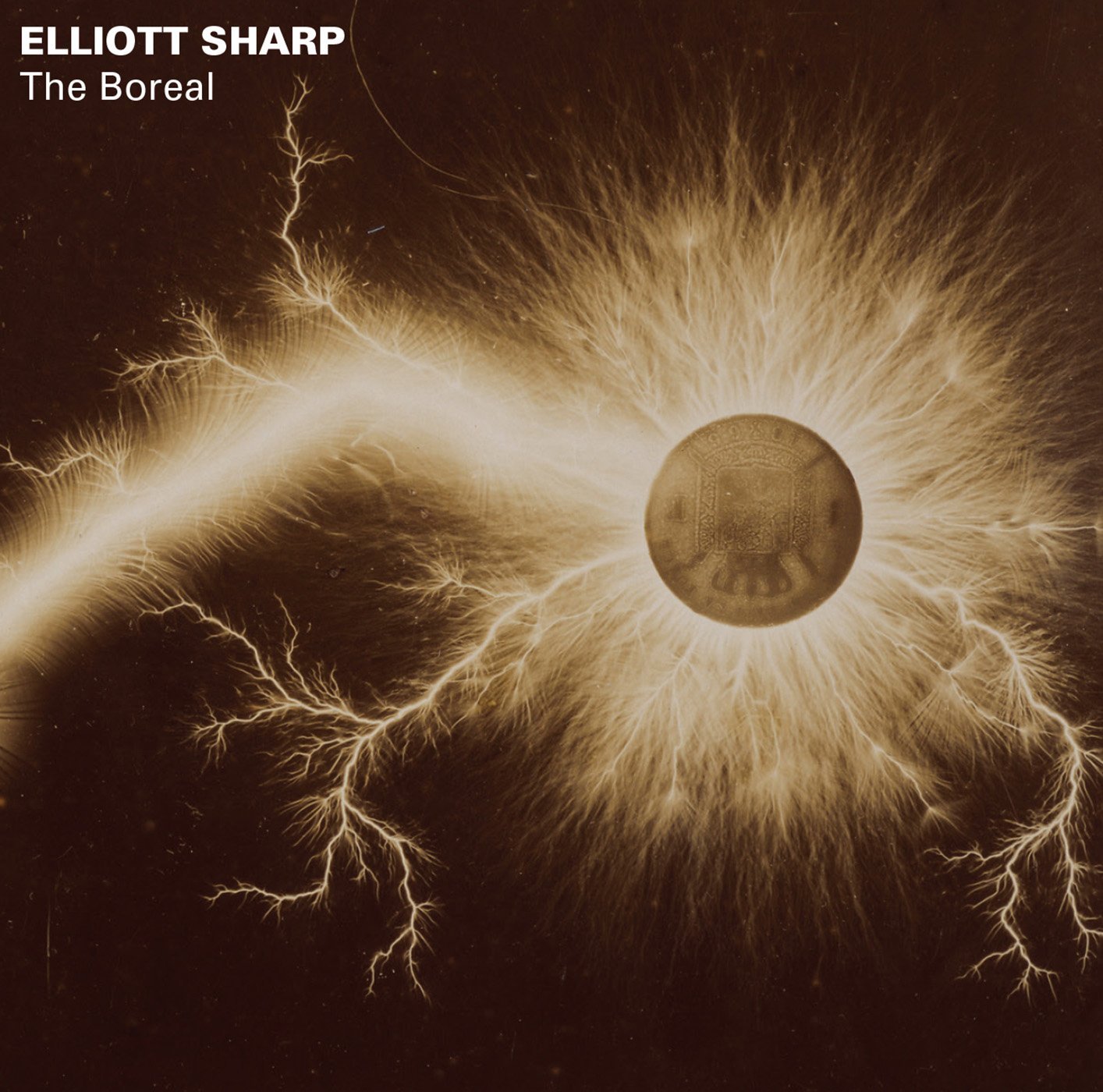
A great debt is acknowledged here to the fine work of the Ostrava Days festival under the guidance of Petr Kotik (1942- ) for curating this amazing annual new music event.  There are very useful liner notes by legendary boundary defying cellist (and sometime Sharp collaborator) Frances-Marie Uitti.   Sharp himself provides notes in the accompanying booklet. As usual with Starkland the recording is of very high quality and Tom Steenland’s gift for graphic design (using an 1888 photo of electrical “effluvia” from the surface of a coin) is well suited to represent the contents of the recording.

The Boreal Starkland ST-222

The Boreal
Starkland ST-222

Like many of Starkland’s releases this album challenges the listener but meeting that challenge and giving this a serious listen is ultimately very rewarding.  This is a fine example of a composer whose work deserves to be better known and this is a good sampling of some of his most refined work.  Hopefully this release will help to position Sharp as a composer with roots in the downtown improv scene who has taken his experimentation successfully into the larger world of the contemporary classical scene.


Classical Jazz, John Clark and His Odd Couple Quintet + 1


The Odd Couple Quintet

The Odd Couple Quintet

The French Horn and the Bassoon are two instruments seldom associated with jazz and improvisation.  Enter John Clark and Michael Rabinowitz who, along with their fellow musicians put together this playful and entertaining album.  Clark, born in 1966, studied at the University of Rochester, Eastman School of Music and the New England Conservatory.  He studied under George Russell and Ran Blake.  Currently he is on faculty at the Manhattan School of Music.

Composers Concordance 0022

Composers Concordance 0022

clark2Beginning playfully and appropriately with their arrangement of Neal Hefti’s theme from the movie The Odd Couple. From there the group traverses through various classical music pieces always with their unique jazz inflections.

This disc contains 8 tracks and is consistently pleasant, inventive and entertaining.  Clark, whose discography lists 18 albums on Wikipedia, has worked as a session musician and has recorded with people like B.B. King, Leroy Jenkins, Linda Ronstadt, Ornette Coleman and many others.

Building on work by folks like Jacques Loussier, Clark’s group basically traverses classical pieces with a jazz tinge.  All compositions, with the exception of the Odd Couple Theme are listed as being by John Clark but alert listeners (or those who read the lucid liner notes) will identify the original sources on which these compositions are based.

In addition to the two named principals they are supported by Freddie Bryant on guitar, Mark Egan on bass, Able Fogle on drums and Pete Levin on keyboards.

The last track is perhaps the most complex of the set and ties the album together with a fitting conclusion.  All in all this album is a lot of fun for fans of both classical and jazz.

End of an Era and a Summation: In the Mood for Food Dinner/Concert Series


Philip Gelb performing at the June 21, 2015 Garden of Memory Concert at Oakland's Chapel of the Chimes.

Philip Gelb performing at the June 21, 2015 Garden of Memory Concert at Oakland’s Chapel of the Chimes.

For a variety of reasons I have not been able to spend any time with this blog for the last month or two but recent events tell me that I must find the time to get back online and publish.  My apologies to all who are awaiting reviews and such.  They will now be forthcoming.

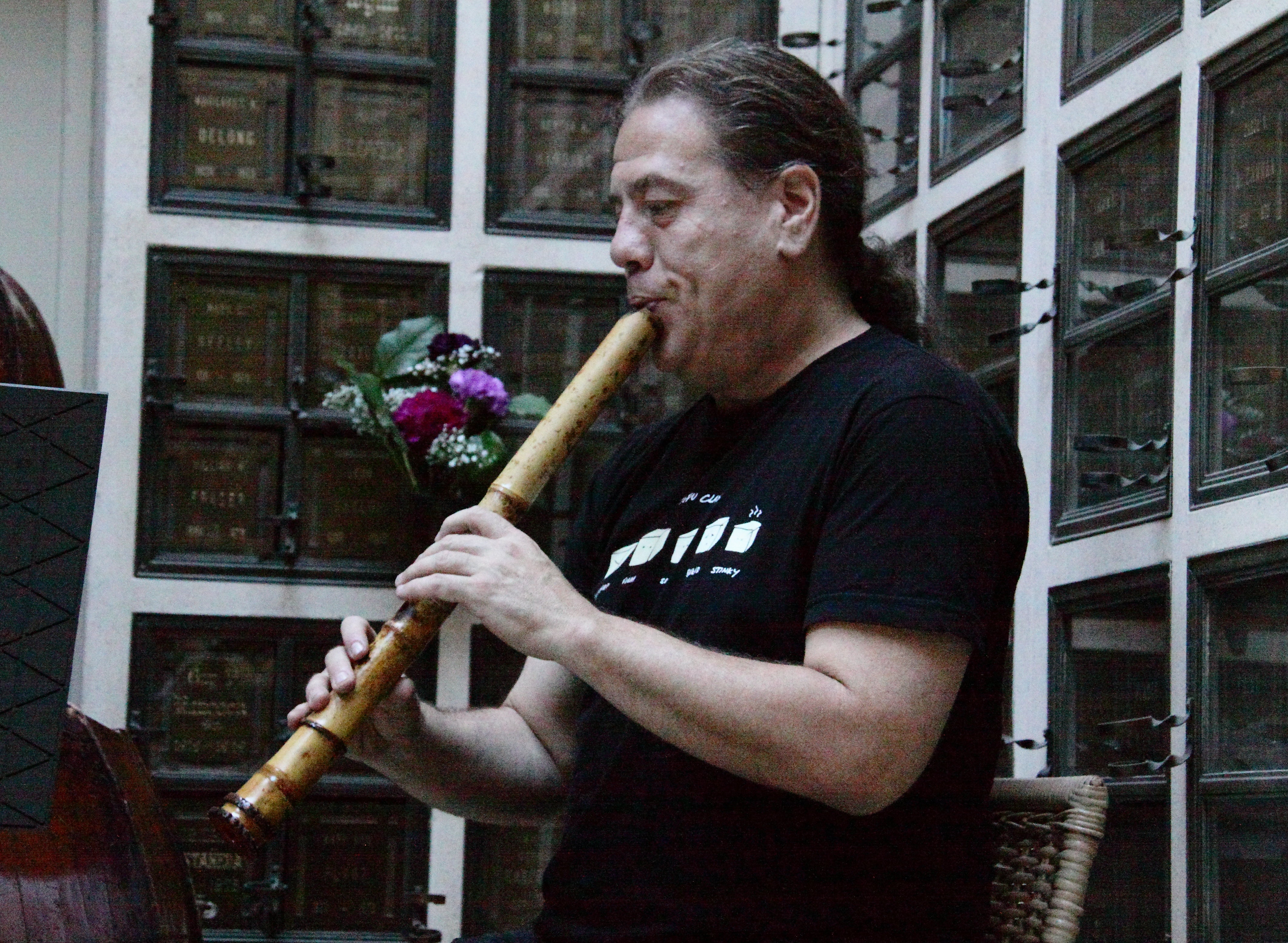
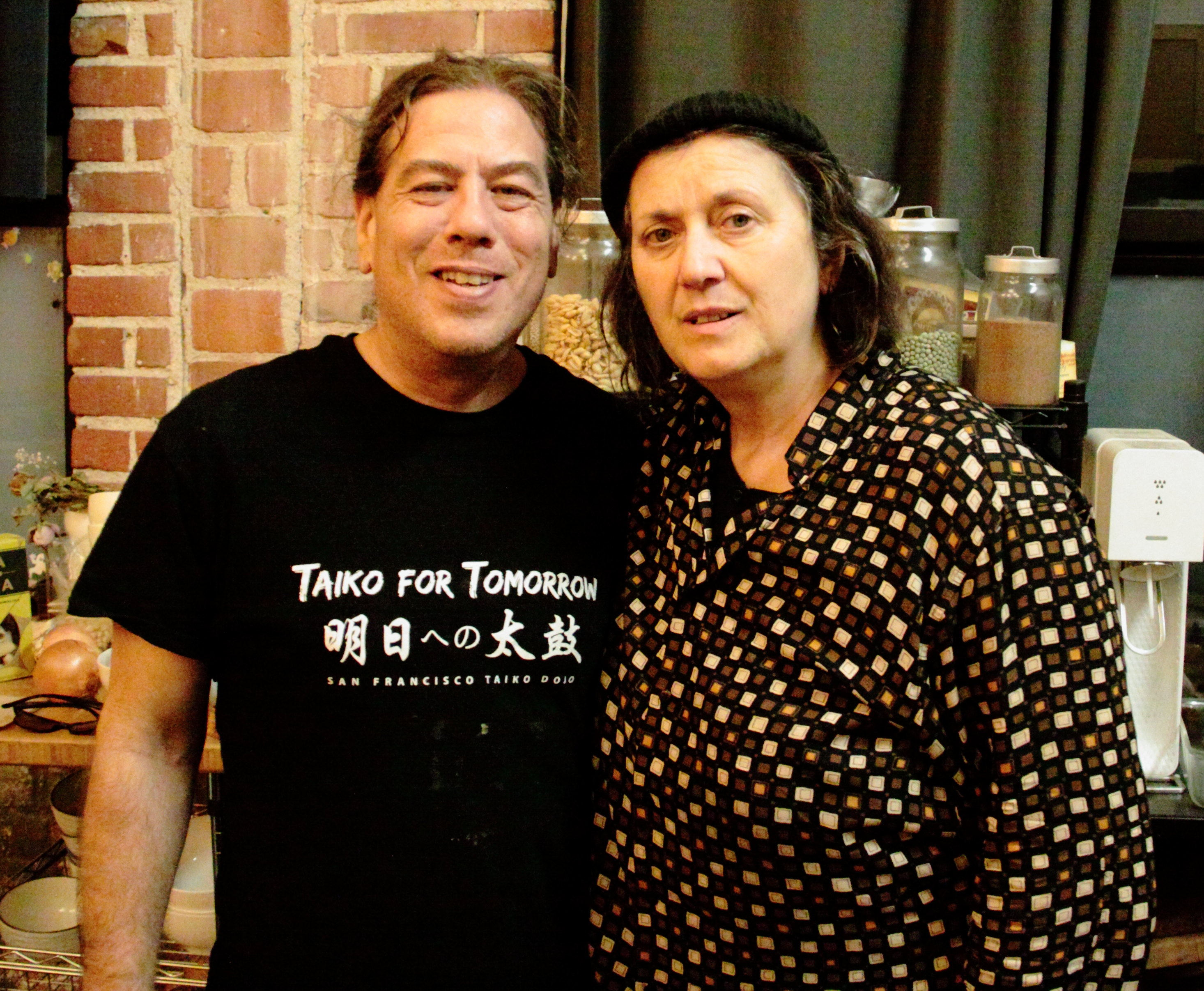
This past Saturday night June 27, 2015 is among the last of this East Bay series which has been with us for the last 10 years.  Philip Gelb, vegan chef extraordinaire, shakuhachi player and teacher has announced that he will be relocating to New York in the next few months.

I personally discovered this series shortly after I moved to the bay area.  In a nondescript West Oakland neighborhood in a modest loft live/work space I found a vegan dinner which also featured a performance by Bay Area composer/performer Pamela Z.  One concert/dinner and I was hooked.   The opportunity to meet and hear many wonderful musicians and enjoy the amazing culinary magic was just too much to resist.  I have been a regular attendee at many of these concerts and they all are valued memories.

Philip Gelb with Joelle Leandre at one of his dinner/concerts.

Philip Gelb with Joelle Leandre at one of his dinner/concerts.

Phil, who studied music, ethnomusicology and shakuhachi has been a familiar performer in the Bay Area.  In addition to performing and teaching the Japanese bamboo flute, Phil has run a vegan catering business and began this series some ten years ago modeled on a creative music series founded in part by the late Sam Rivers.  As a musician Phil has gotten to know many talented and creative musicians who performed on his series.  Phil is a friendly, unpretentious man with great talents which he successfully combined here.

phil1011

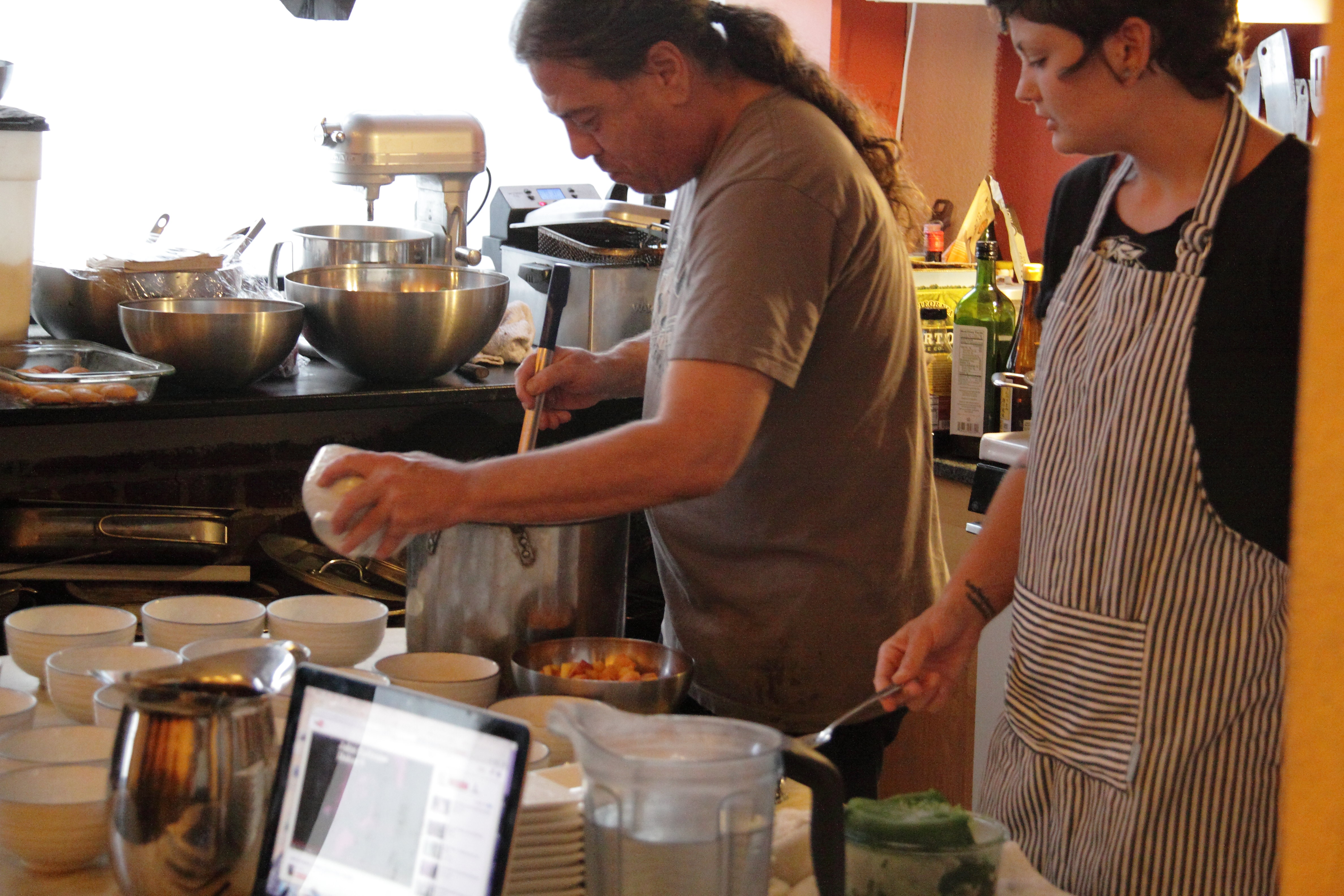
Phil and sous chef Cori preparing the evening’s feast.

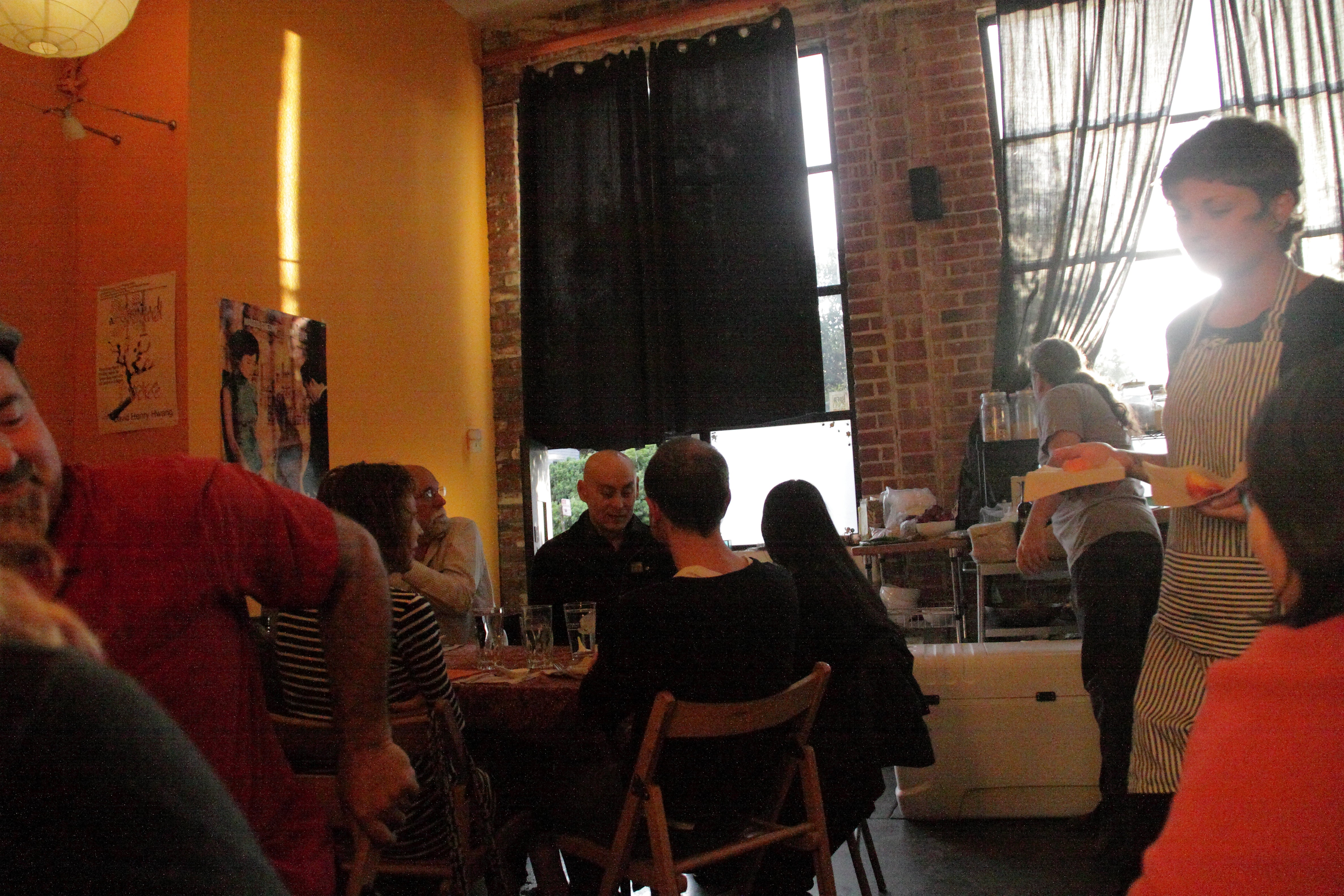
The 20 seats were sold out for the annual Masumoto Peach dinner.  At the peak of the harvest each year Phil has put together multiple course dinners featuring locally grown organic peaches from the now four generation Masumoto family orchard near Fresno .  In fact a recent film (information on the Masumoto page linked above) has been made about them called, “Changing Seasons” and one of the filmmakers was in attendance.  There was a short discussion with Q and A at one point.

Happy diners anticipating the next course.

Happy diners anticipating the next course.

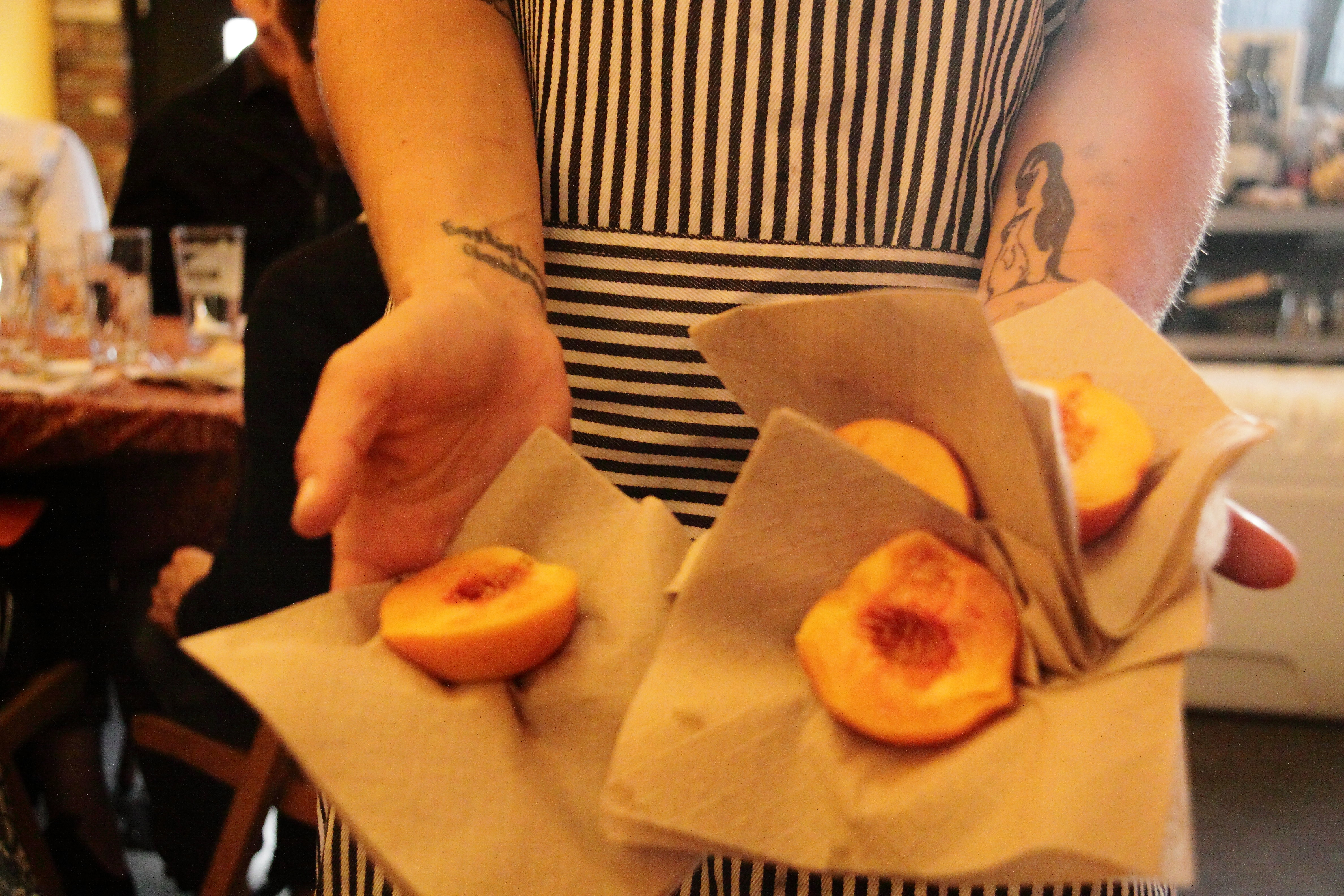
No music this night but wonderful food and friendly conversations filled the evening.  The meal began with, of course, a taste of the actual peaches.

sous chef Cori serving the peach halves that began the dinner.

sous chef Cori serving the peach halves that began the dinner.

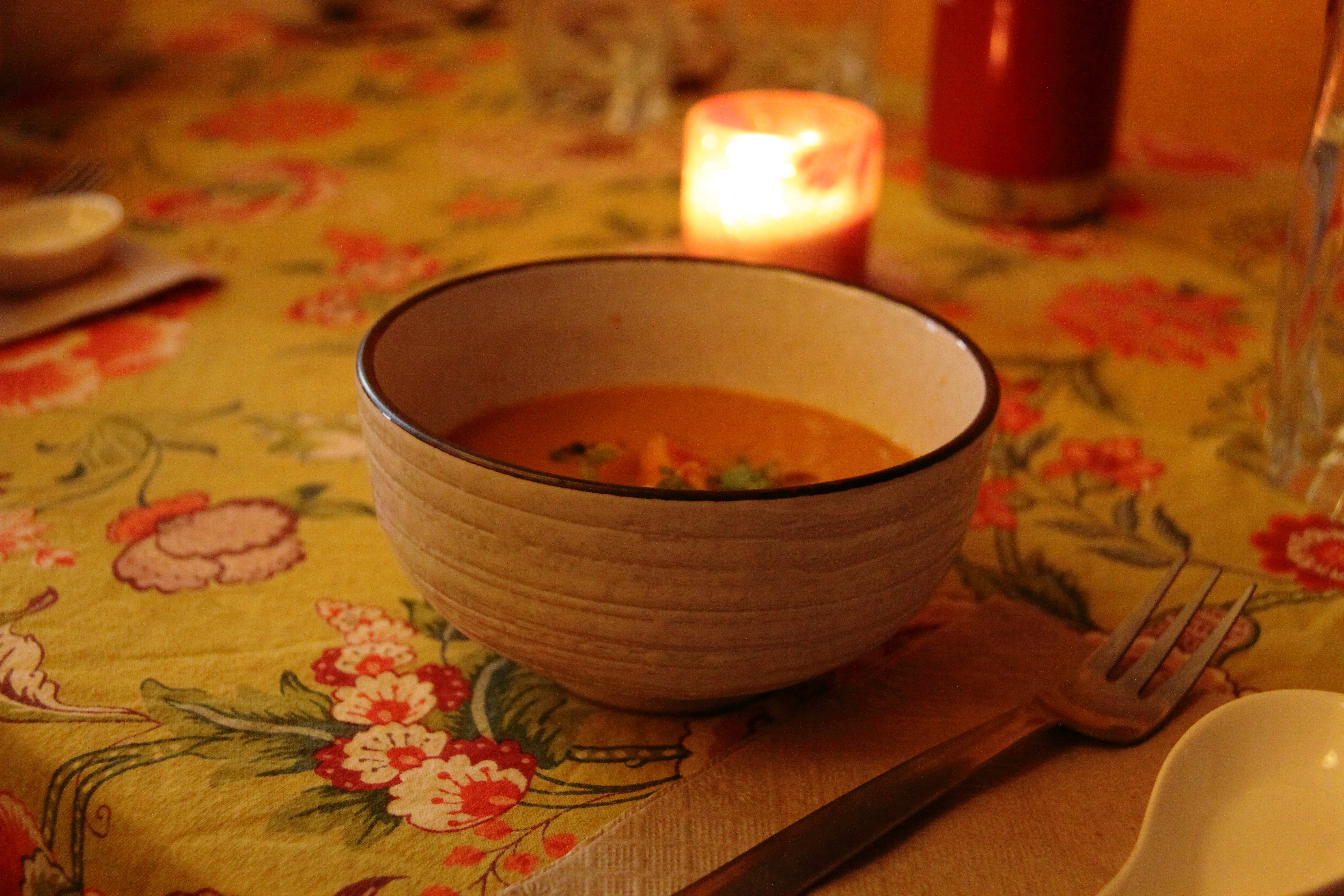
The next course, a peach tomato gazpacho.

phil1014

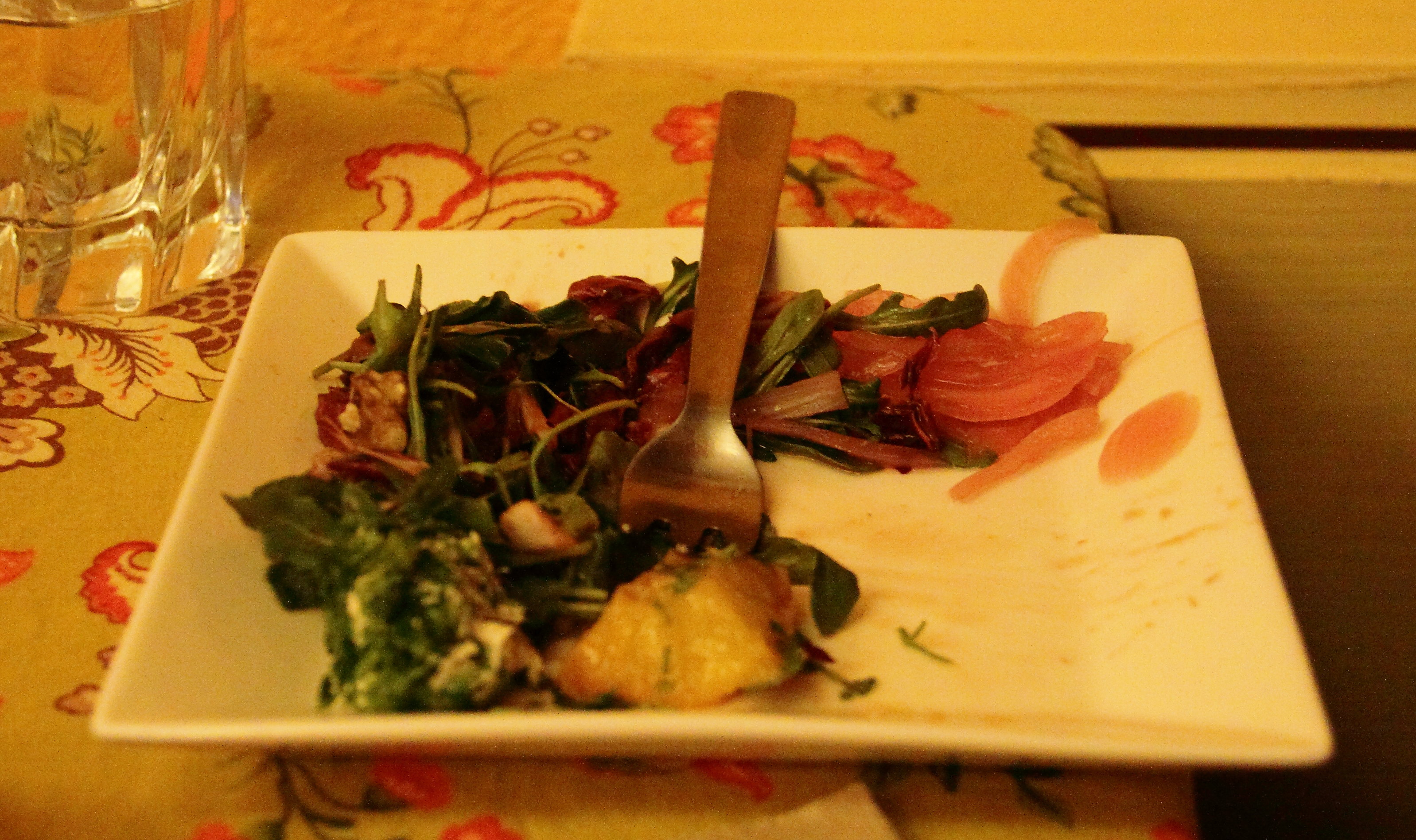
Followed by a grilled peach salad with cashew cheese balls, arugula radicchio,, pickled red onions, and a cherry balsamic dressing.

phil1016

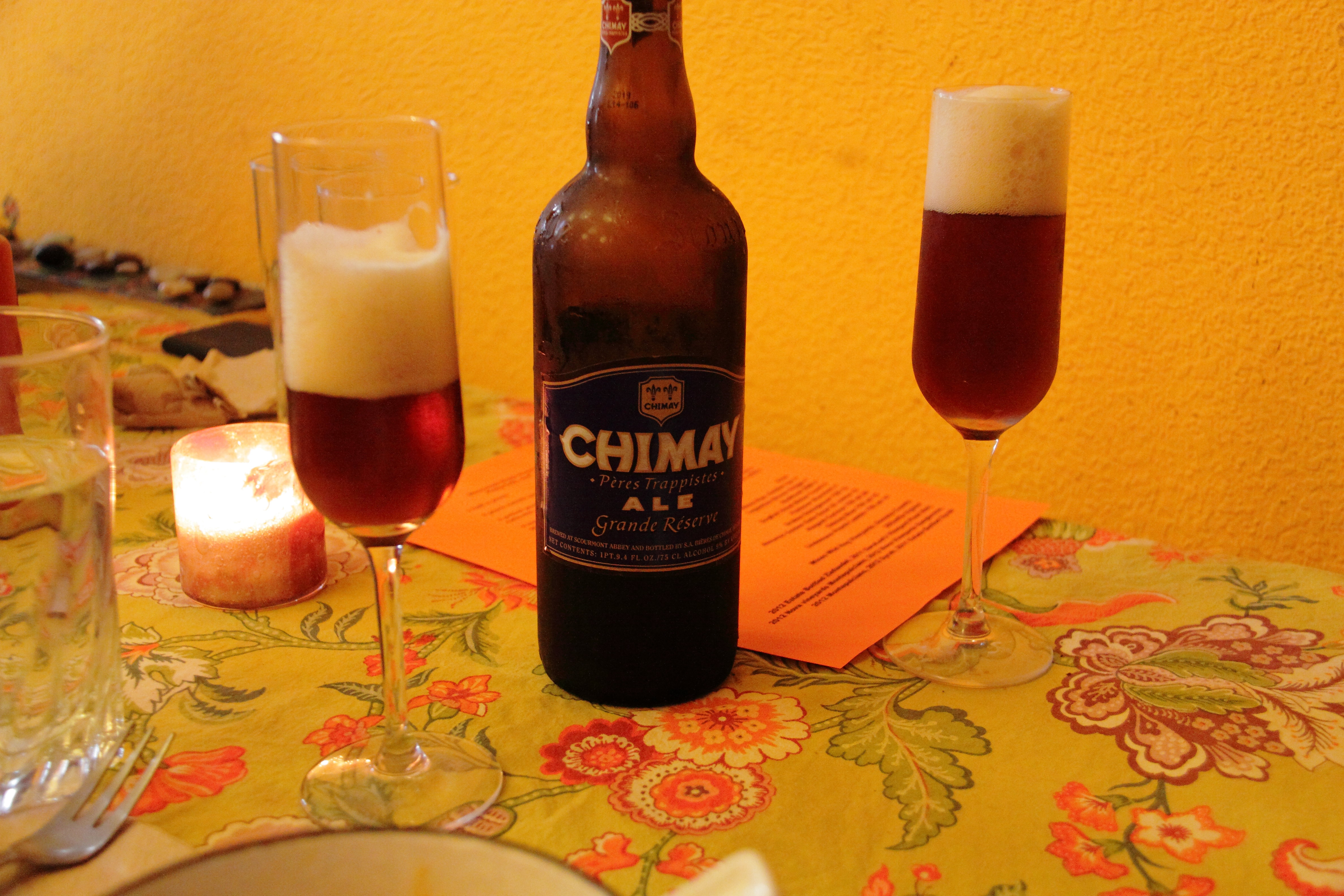
Oh, yes, a nice Chimay to quench the thirst.

phil1015

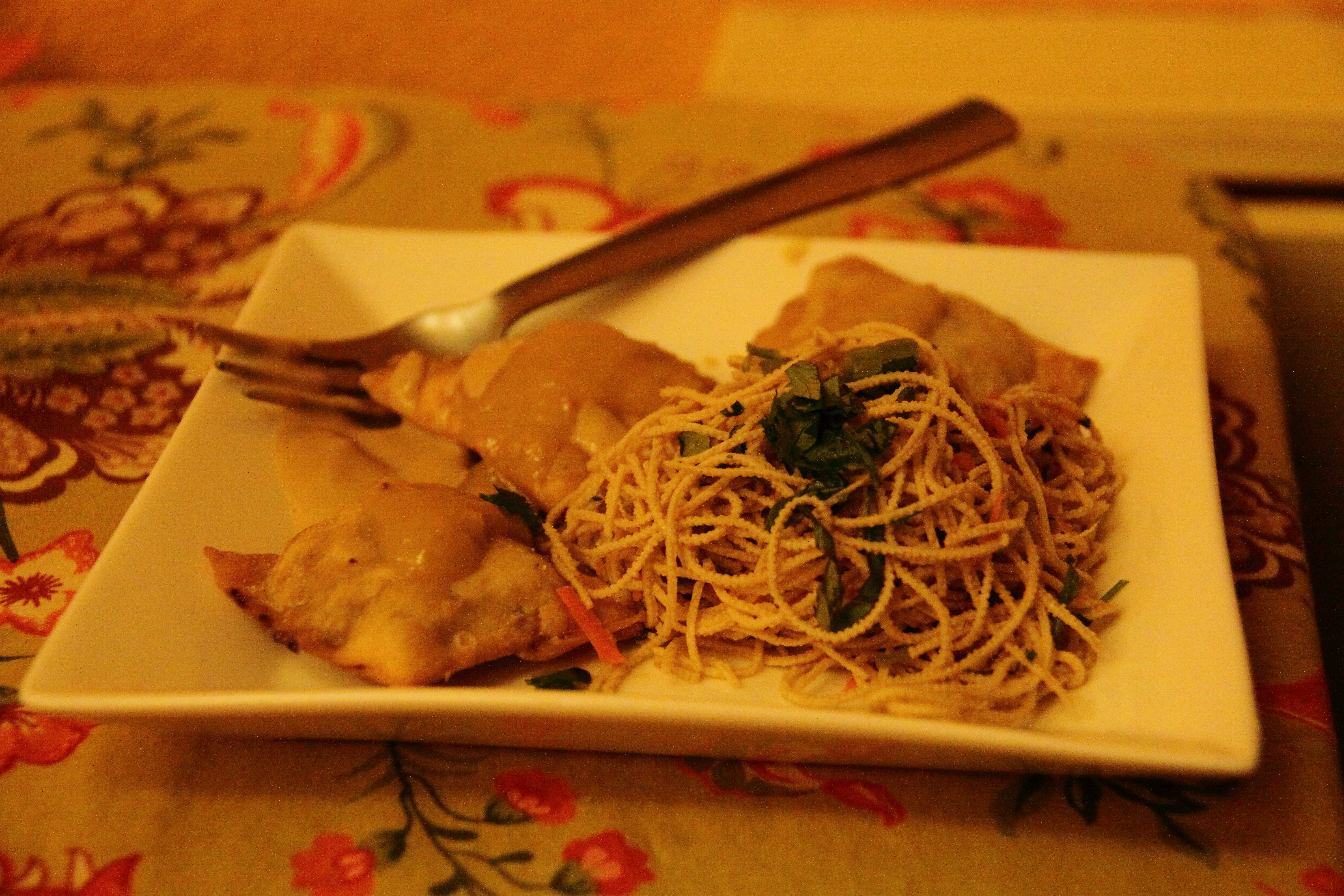
And then tempeh char siu wontons (from the local Rhizocali Tempeh), flat tofu noodles, a really great hot peach mustard and peach sweet and sour sauce.

phil1018

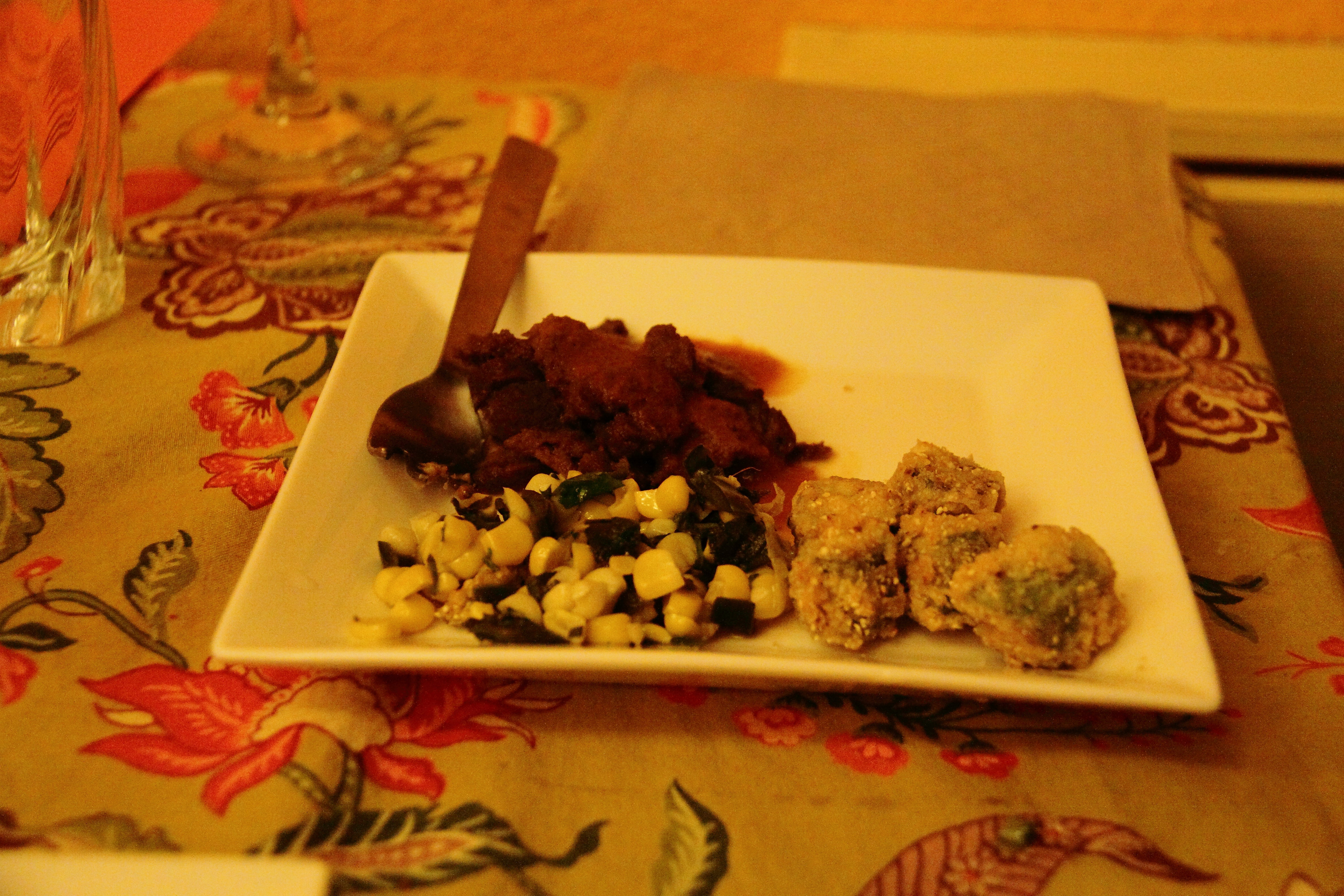
The main course: peach grilled seitan, peach barbecue sauce, roasted corn and peppers, and some crunchy fried okra.

phil1020

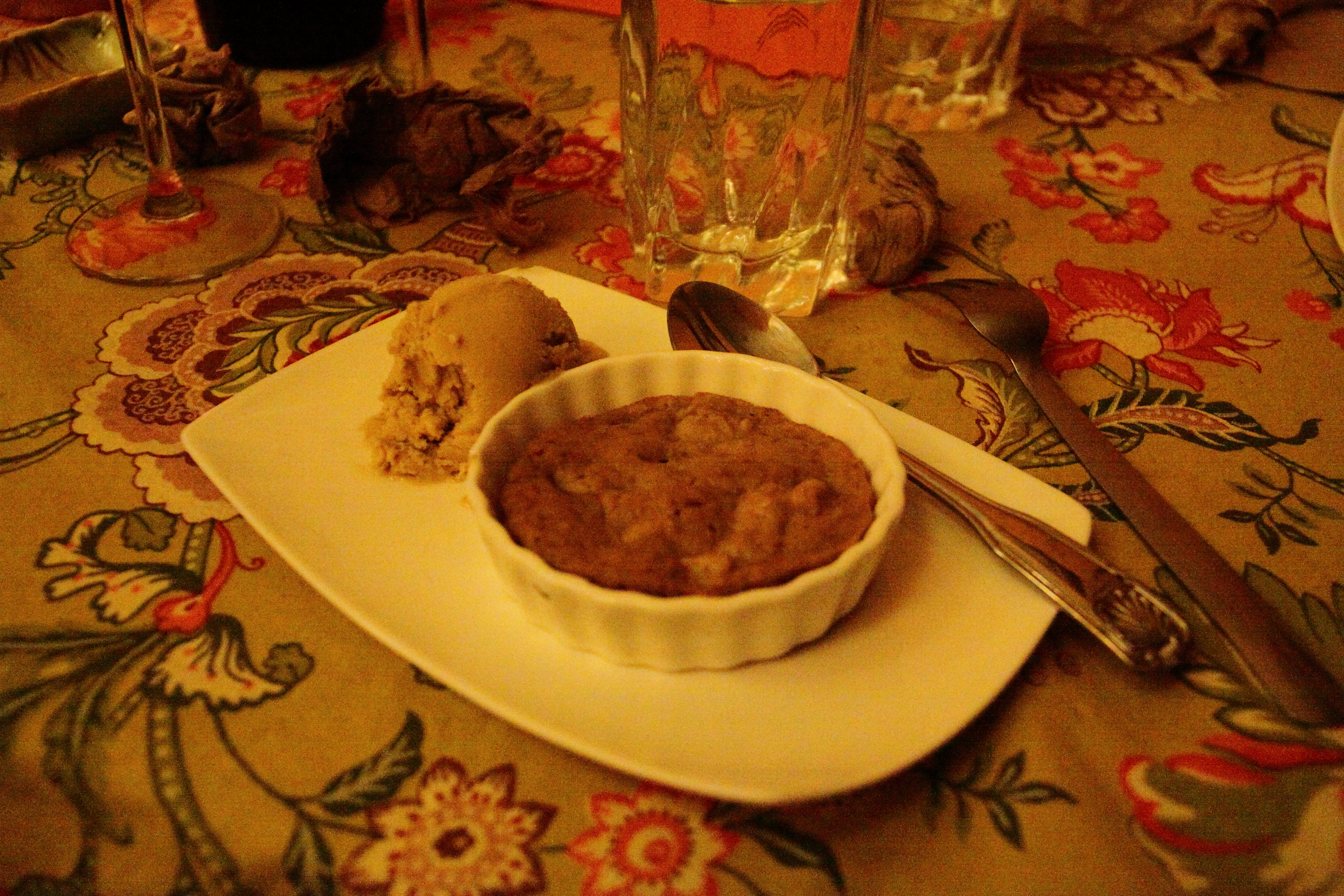
And, for dessert, peach rosewater cake with peach walnut sorbet.  As is his custom Phil went around offering more of that sorbet which most folks, present writer  included, availed themselves.

phil1021

This was a thoroughly enjoyable evening.

But, as I said, this tradition is coming to an end.  Not to fear, however.  Phil is in the process of writing a cookbook sharing the secrets of his culinary mastery and the book will also document some of the many musicians whose talents graced many an evening here.

La Donna Smith and India Cooke playing an improvised duet.

La Donna Smith and India Cooke playing an improvised duet.

Bassists Mark Dresser and Barre Phillips play together for the first time at In the Mood for Food.

Bassists Mark Dresser and Barre Phillips play together for the first time at In the Mood for Food.

The amazing Stuart Dempster at Phil's loft a few years ago.

The amazing Stuart Dempster at Phil’s loft a few years ago.

Gyan Riley, Terry Riley and Loren Rush attending the dinner/concert which featured Stuart Dempster.

Gyan Riley, Terry Riley and Loren Rush attending the dinner/concert which featured Stuart Dempster.

Pauline Oliveros and her partner Ione performing at a recent dinner.

Pauline Oliveros and her partner Ione performing at a recent dinner.

So this little sampling of photos provides some idea of the scope and significance of this series.  Happily it is being documented in a book for which an Indiegogo campaign is presently in process.  You can donate and receive any or many of a variety of perks ranging from a copy of the book for $40 and perks including an invitation to celebratory dinners planned in both New York and Oakland.  My copy and my dinner invite are reserved.

There are 34 days left in the campaign at the time of this writing and the project is now at 106% of its funding goal.  This is a piece of Bay Area music and culinary history that will please music enthusiasts and those who appreciate creative vegan cuisine.

Here is a list of musicians taken from the campaign site to give you an idea of the scope of the series:

Tim Berne – alto saxophone (Brooklyn)

Shay Black – voice, guitar (Berkeley via Ireland)

Cornelius Boots shakuhachi/bass clarinet

Monique Buzzarte – trombone, electronics (NYC)

Chris Caswell (2) – harp (Berkeley)

Stuart Dempster – trombone (Seattle)

Robert Dick (flute) NYC

Mark Dresser (2) – bass (Los Angeles)

Mark Dresser/Jen Shyu duet – bass, voice/dance

Sinan Erdemsel – oud (Istanbul)

Sinan Erdemsel/ Sami Shumay duet – oud, violin

Gianni Gebbia – saxophones (Palermo, Italy)

Vinny Golia- winds (Los Angeles)

Lori Goldston – cello (Seattle)

Frank Gratkowski (2) – clarinets, alto sax (Berlin)

Daniel Hoffman/Jeanette Lewicki duet violin, voice/accordion (Berkeley, Tel Aviv)

Shoko Hikage – koto (Japan-San Francisco)

Yang Jing – pipa (Beijing)

Kaoru Kakizakai (4) – shakuhachi (Tokyo)

Marco Lienhard shakuhachi (Zurich-NYC)

Mari Kimura – violin, electronics (Tokyo-NYC)

Yoshio Kurahashi (5) – shakuhachi (Kyoto)

Joelle Leandre – contrabass (Paris)

Oliver Lake – alto sax (NYC)

Riley Lee (2) shakuhachi (Australia)

Jie Ma – pipa (China, LA)

Thollem Mcdonas Jon Raskin duet piano/sax (wanderer/Berkeley)

Roscoe Mitchell – alto, soprano saxophones (Oakland)

David Murray – tenor sax (Paris)

Michael Manring (5) – electric bass (Oakland)

Hafez Modirzadeh – winds (San Jose)

John Kaizan Neptune – shakuhachi (Japan)

Rich O’Donnell – percussion (St. Louis)

Pauline Oliveros (2) – accordion (NY)

Tim Perkis/John Bischoff duet computers (Berkeley)

Barre Phillips solo and duet with Mark Dresser – contrabass (France)

Alcvin Ramos shakuhachi (Vancouver)

Tim Rayborn/Annette duet oud, strings, recorders (Berkeley/Germany)

Jon Raskin/Liz Albee duet sax/trumpet (Berkeley/Berlin)

Jane Rigler – flute (Colorado)

Gyan Riley (5) – guitar (NYC)

Terry Riley (2) – voice, harmonium (universe)

Diana Rowan (2) – harp (Berkeley/Ireland)

Bon Singer/Shira Kammen duet (voice, violin) (Berkeley)

LaDonna Smith/India Cooke duet (2) violin, viola (Birmingham, AL, Oakland)

Lily Storm/Diana Rowan – voice, harp (Oakland/Ireland)

Lily Storm/Dan Cantrell (2) – voice/accordion (Oakland)

Howard Wiley – tenor Saxophone solo and duet with Faye Carol voice

Theresa Wong/ Ellen Fullman duet

Amy X (3) – voice, electronics (Oakland)

Pamela Z – voice, electronics (San Francisco)

Philip Gelb’s Gourmet Vegan with Joelle Leandre in the East Bay


The door is open to the underground restaurant.

The door is open to the underground restaurant.

On Sunday February 15th I had the pleasure of attending one of my favorite underground restaurant/performance venues in West Oakland.  In a nondescript neighborhood of light industry, warehouses and loft spaces Philip Gelb has been running “In the Mood for Food” (a take of the title of one of his favorite films, “In the Mood for Love”) his occasional dinner/concert series since 2005.

Philip Gelb with Joelle Leandre

Philip Gelb with Joelle Leandre

Philip is an amazing vegan chef as well as a shakuhachi player/teacher whose cuisine is known to a fortunate group of people which includes this writer.  Combining incredibly creative dishes sometimes at the behest of a given artist (Amy X Neuberg requested a “purple” theme and got it when she appeared ) with his wide network of artist friends, many of whom he has performed with.  Phil has been doing these occasional events with a maximum audience of about 20 people (including the featured performer) at a rate of at least once every month or two.

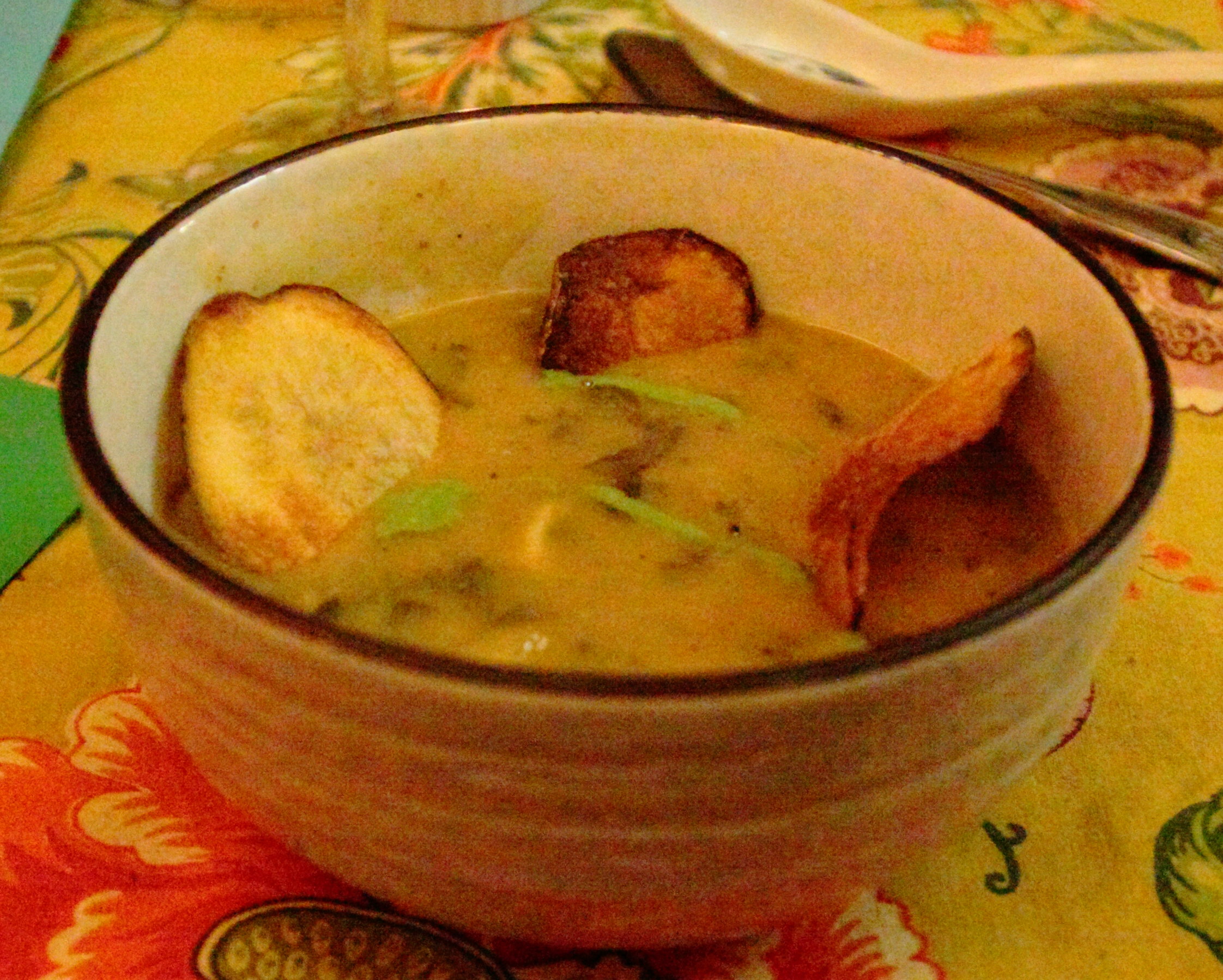
Potato Sorrel Soup

Potato Sorrel Soup

First let me say that I am not a vegan but if vegan fare always tasted this good I could easily make the transition (OK, I would have a hard time giving up pizza) to vegan fare.  Phil’s fresh locally shopped ingredients are transformed by his gustatory alchemy into a variety of delectable dishes in a wide range of cuisines.  His network in gourmet vegan food practitioners is rivaled only by his musical network.  Japanese is one of his specialties but I have personally partaken of various middle eastern and Caribbean cuisines with equal satisfaction.

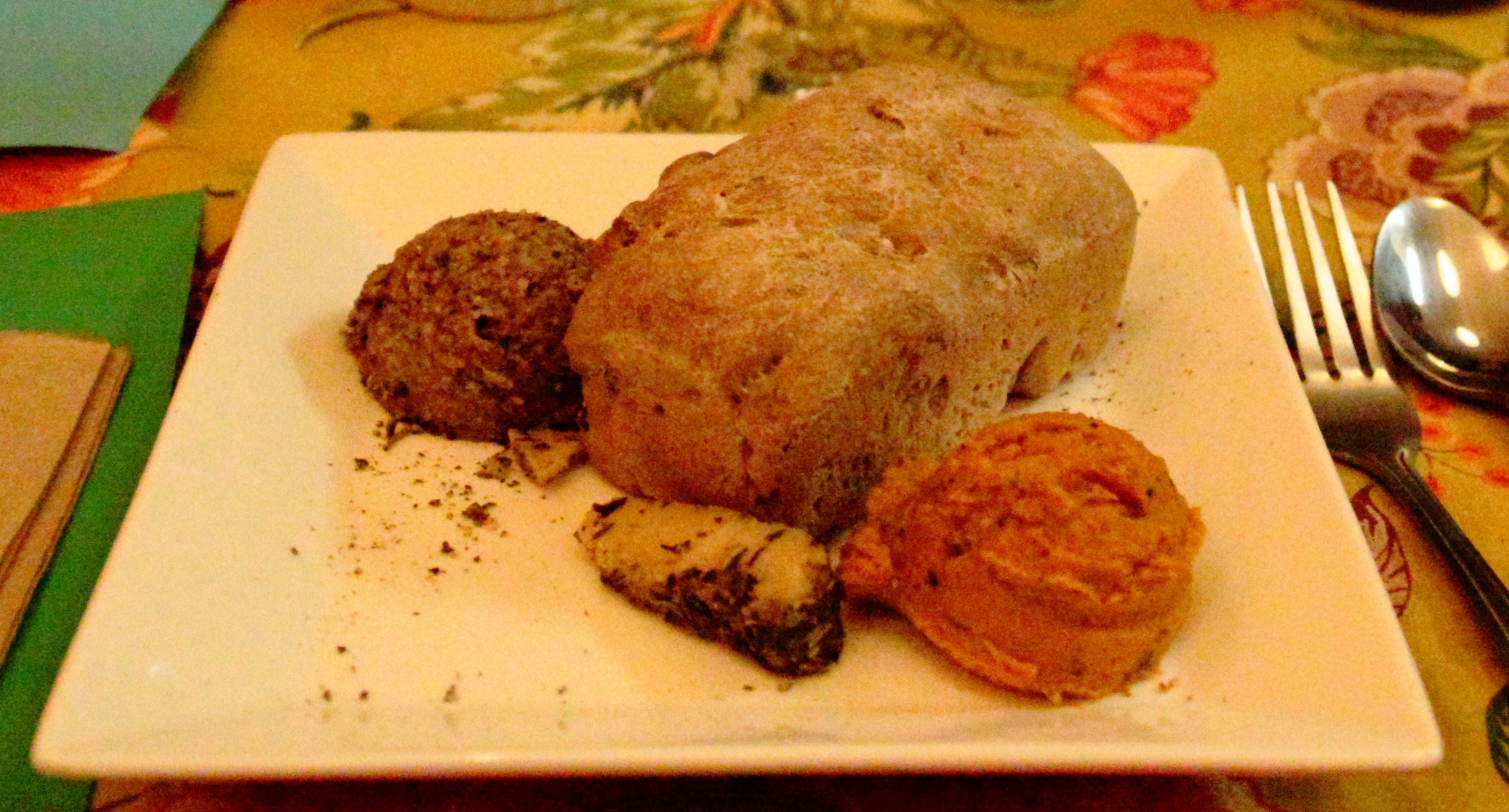
Mushroom Pate, Carrot Walnut Pate and Rosemary Bread, didn't get a picture of the fresh salad greens.

Mushroom Pate, Carrot Walnut Pate and Rosemary Bread, didn’t get a picture of the fresh salad greens.

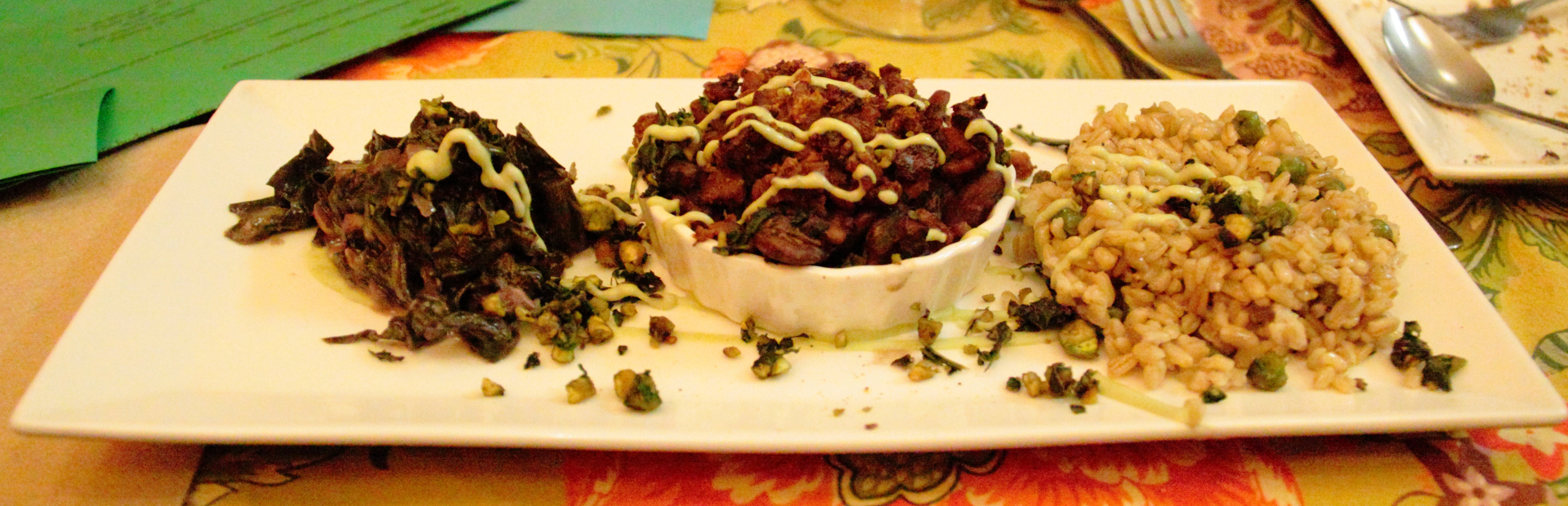
This night’s selection featured a creamy Potato Sorrel Soup followed by a salad plate consisting of rich Mushroom Pate, Carrot Walnut Pate, a freshly baked Homemade Rosemary Bread with Salad Greens and a tart Citrus Dressing. The main course consisted of Cassoulet, Oat Pilaf and Herbed Collards, all very tasty and very filling.

The main course of Cassoulet, Oat Pilaf and Herbed Collards.  It tastes even better than it looks in Phil's characteristically beautiful presentations, trust me.

The main course of Cassoulet, Oat Pilaf and Herbed Collards. It tastes even better than it looks in Phil’s characteristically beautiful presentations, trust me.

A feast such as this could not easily be upstaged but, in the little break before the dessert course, we were treated to a wonderful performance by Joëlle Léandre, the French Double Bass virtuoso, singer and composer whose work traverses a wide range of musical genre from John Cage to free jazz and categories that defy easy classification.  She has amassed a discography of over 100 albums to date and has performed with artists including Pierre Boulez, John Cage, Giacinto Scelsi, Derek Bailey, Barre Phillips (who appeared at this series a couple of years ago), Anthony Braxton, George Lewis, India Cooke (also one of Phil’s previous guest artists), Evan Parker, Irene Schweizer, Steve Lacy, Maggie Nicols, Fred Frith, Carlos Zingaro, John Zorn, Susie Ibarra, J.D. Parran, Kevin Norton, Sylvie Courvoisier and Pauline Oliveros (another recently appearing artist at this series).  Oh, and she has also performed and recorded with Mr. Gelb.

Leandre is a friendly and engaging person both in her playing and in conversation and we all had opportunities to speak with her and experience her charming personality as she related various observations and anecdotes.  These dinner/concerts are a uniquely intimate experience which you cannot get in the average concert setting.

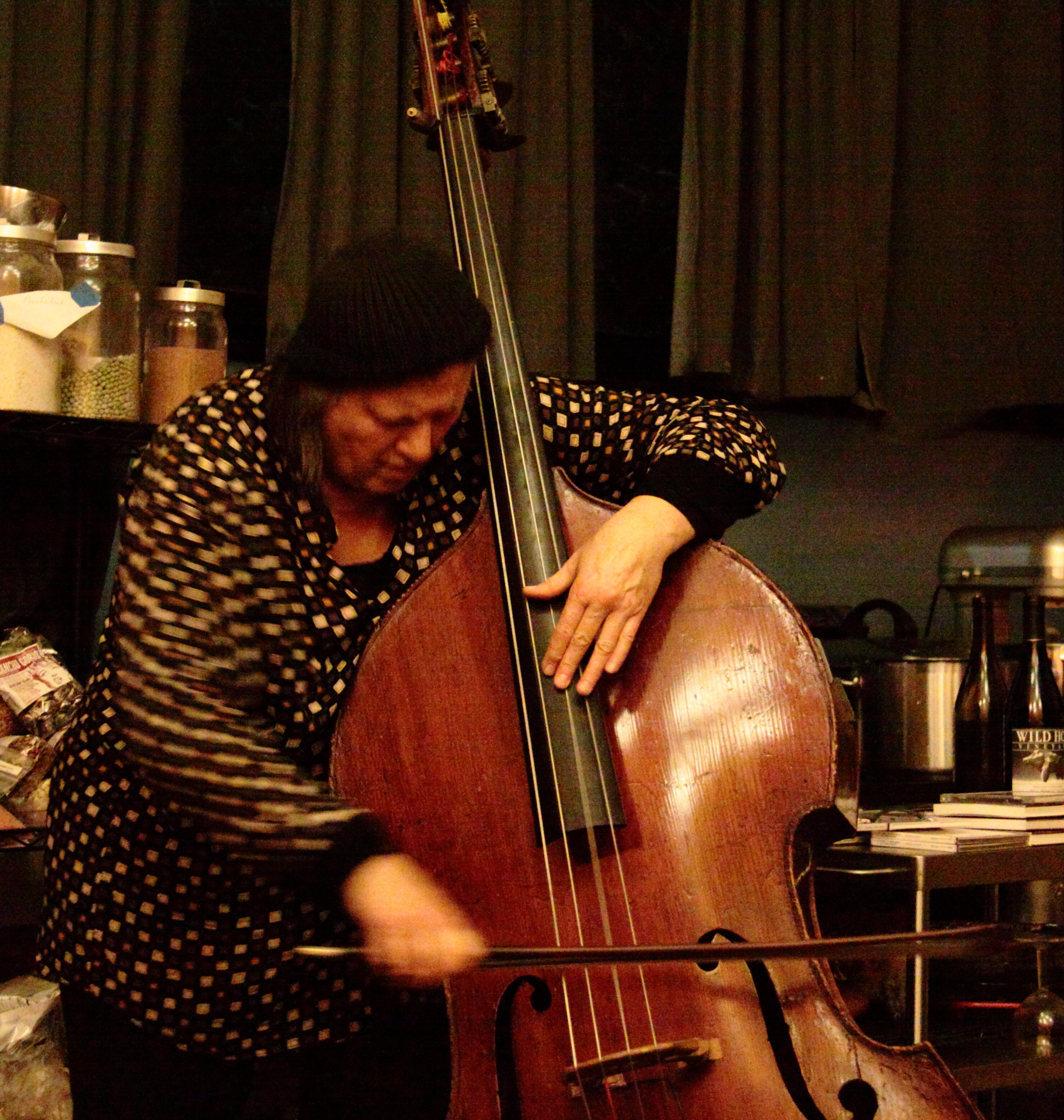
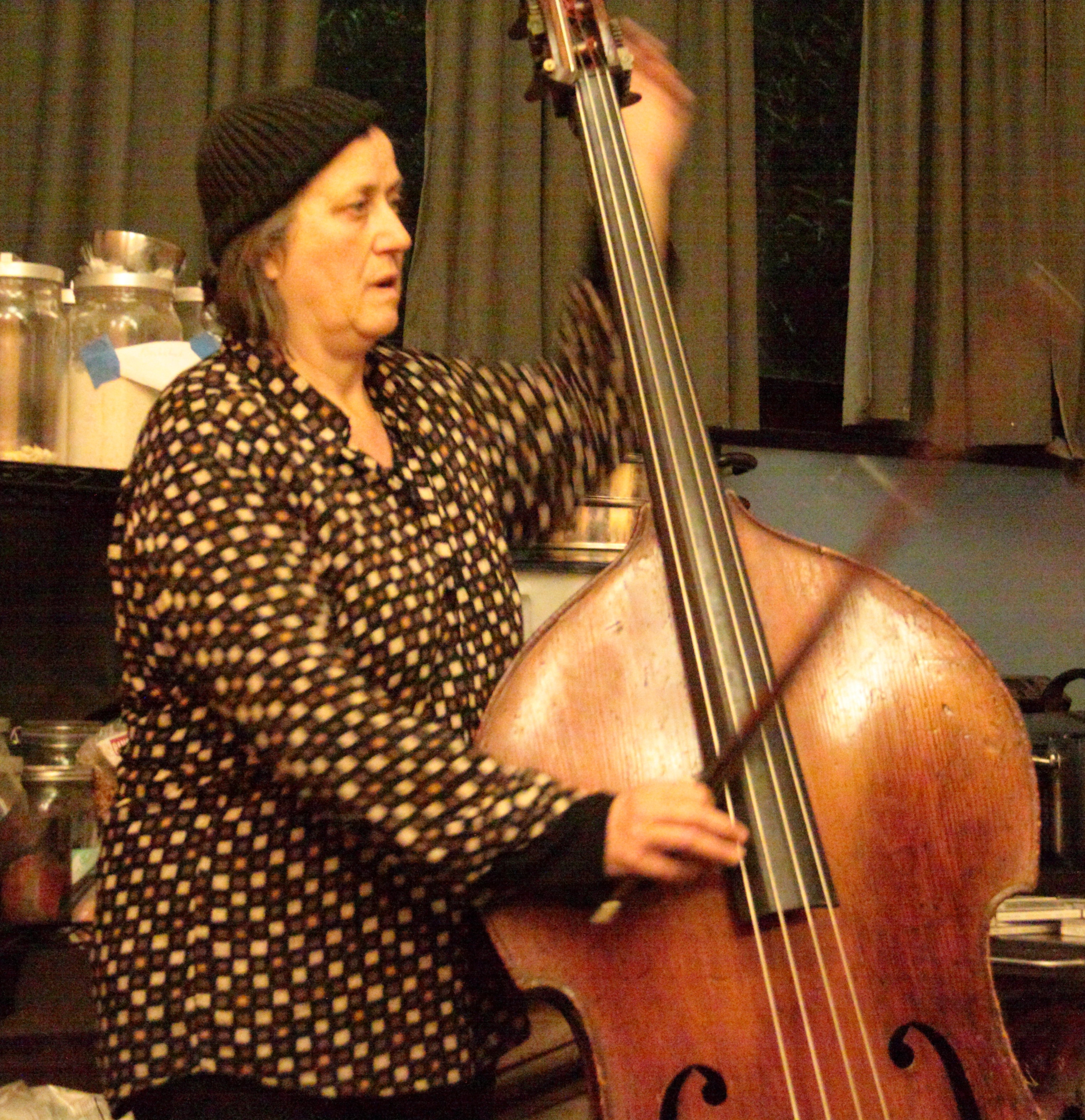
Leandre embraced and nearly danced with her instrument.

Leandre embraced and nearly danced with her instrument.

Ms. Léandre treated us with three separate improvisations in which she demonstrated her facility with a wide range of double bass techniques including various bowing techniques, pizzicati, percussive techniques and wordless vocals that mixed seamlessly with her very intense and passionate performances.  Unfortunately it is nearly impossible to really describe with any accuracy the music we experienced this night.  But suffice it to say that it was played in a manner that communicated very effectively with the very appreciative audience.  I asked her if she always plays with such passion and she rather matter of factly simply said, “yes”.

Her command of a wide variety of playing techniques blended together with her voice in an almost orchestral sound  tapestry driven by Joelle's passionate playing.

Her command of a wide variety of playing techniques blended together with her voice in an almost orchestral sound tapestry driven by Joelle’s passionate playing.

I was so taken with the performances that I failed to get a photo of the delicious dessert course which consisted of a Waffle Sundae comprised of a very fresh chocolate-buckwheat waffle covered with chocolate pistachio ice cream, maple walnuts and chocolate port sauce.  An amazing vegan sweet treat enjoyed by all.
The clearly happy audience lingered to talk with each other, with Phil and sous chef Cori as well as with Ms. Leandre who had a great selection of recent CDs and a couple of books available for purchase which she graciously signed.  Overall this was an extremely satisfying evening, certainly for this blogger and clearly for the other guests but also for our wonderful performer who left to get some sleep before her scheduled performances tomorrow at the Berkeley Arts Festival.
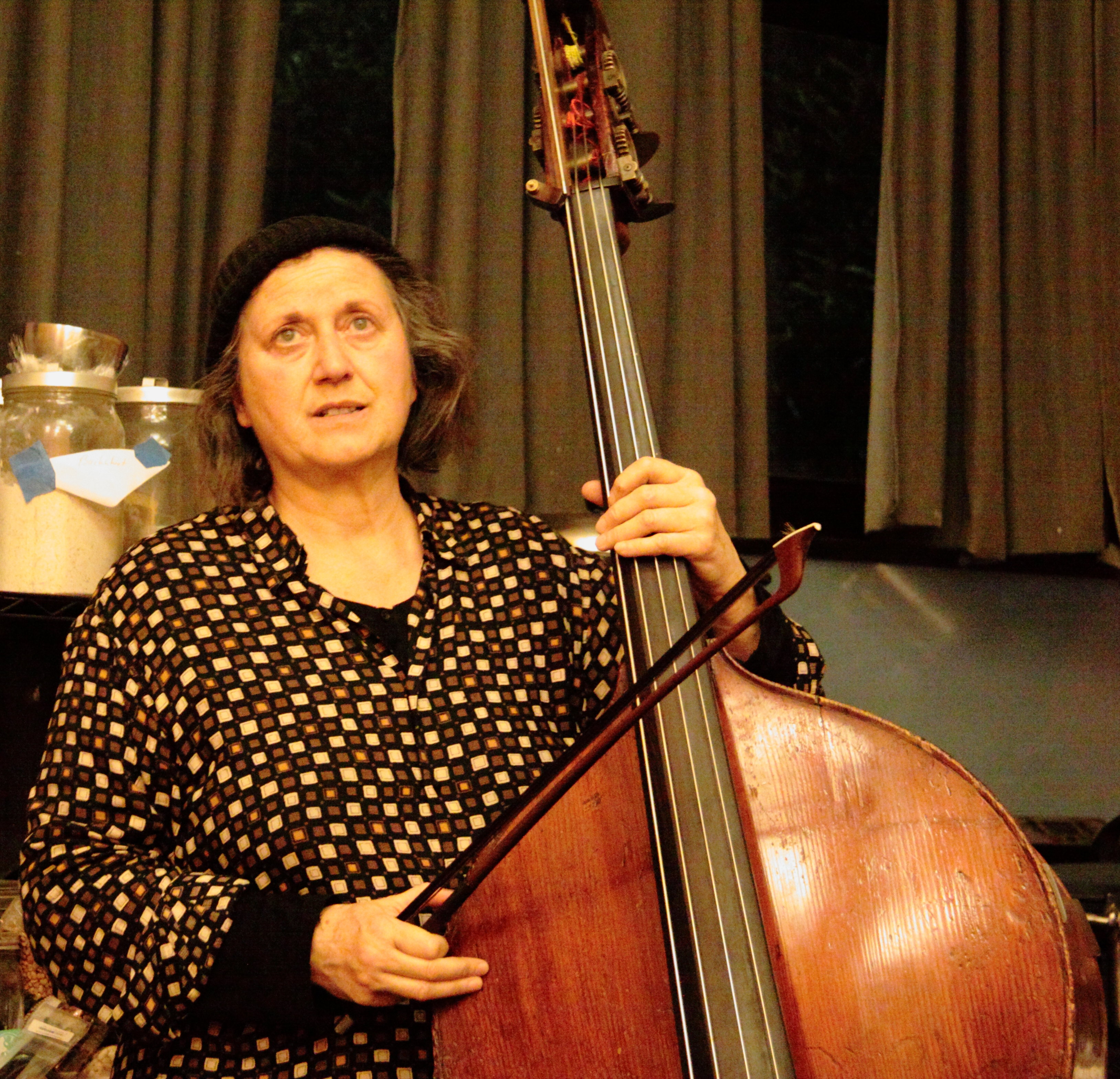
The performer pauses looking wistfully as the muse descends upon her.

The performer pauses looking wistfully as the muse descends upon her.


Undercover Performance Practices in the Bay Area


The practice of “covers” in pop music is part of the long tradition in music of making arrangements, variations, homages, etc. in response to a given composition.  To be sure the majority of these efforts are, though well-meaning, mediocre or worse.  But on the whole they can be quite fascinating and even revelatory.  Ravel’s masterful orchestration of Mussorgsky’s ‘Pictures at an Exhibition’ is so well done that few people are even aware that the original is a piano solo work.  The orchestration so enhances the original as to immortalize it and upstage the original version.  Similarly The Byrds’ cover of Bob Dylan’s ‘Mr. Tambourine Man’ has become the most recognized version of that song.

‘Undercover Presents’ is a concert organization which has been producing a very unusual set of concerts.  Taking an album by a given artist and recruiting a different band/musician to cover each of the songs and then presenting  both a studio recording and a live concert of the results.  So far they have done  Velvet Underground and Nico, Pixies’ Doolittle, Nick Drake’s Pink Moon, Black Sabbath’s Paranoid and, most recently, Joni Mitchell’s Blue.  The musicians are all from the San Francisco Bay Area and that comprises a huge trove of talented and innovative artists.  Their albums are available on bandcamp.com

I saw the production of Blue this past September and I will be there again this coming Monday having recruited some additional friends, “You gotta come see this!”

1Killbossa

The first band, ‘Killbossa’ is inspired by the Brazilian art/music/political movement of the late 1960s known as ‘tropicalismo’ and is a combination of a variety of different musical styles including bossa nova, psychedelic rock, avant-garde and Brazilian popular music.  They covered the first song on the album, ‘All I Want’.

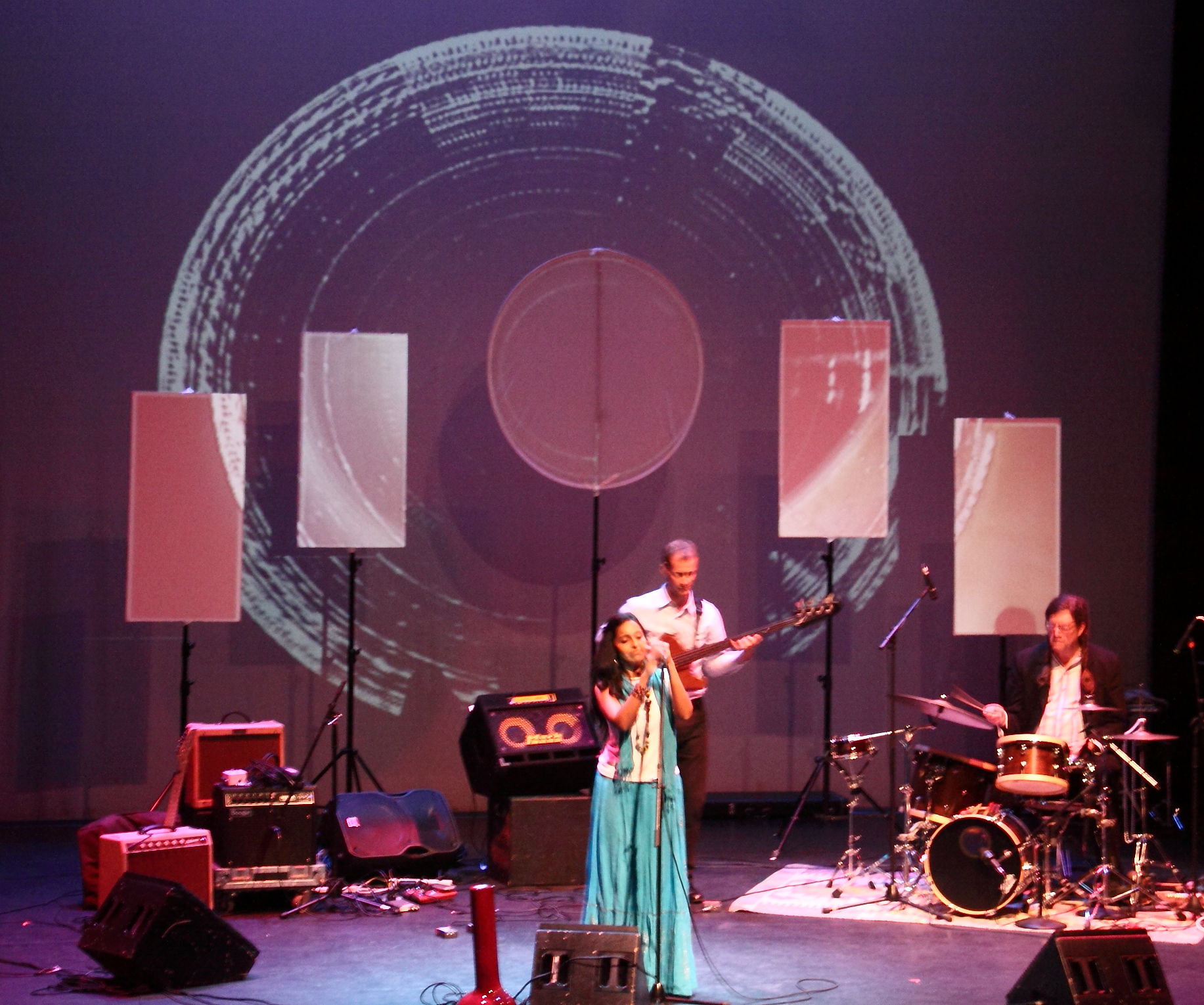
Next up Bharathi Palivela, a singer with traditional Hindustani vocal training teamed up with San Francisco bassist and teacher Daniel Fabricant covering ‘My Old Man’.

Georgia native, now San Francisco based bluegrass singer with her banjo and band put their spin on ‘Little Green’.

‘Carey’ was given a reading by clarinetist, vocalist Beth Custer with her strongly jazz inflected ensemble.

Kitka is an all female a capella group specializing in eastern european style folk singing.   Their a capella cover of ‘Blue’ was alone worth the price of admission.

Amy X Neuberg is an Oakland based singer, performer and tech wizard.  With her voice and electronics she created a unique version of ‘California’.

7mafia

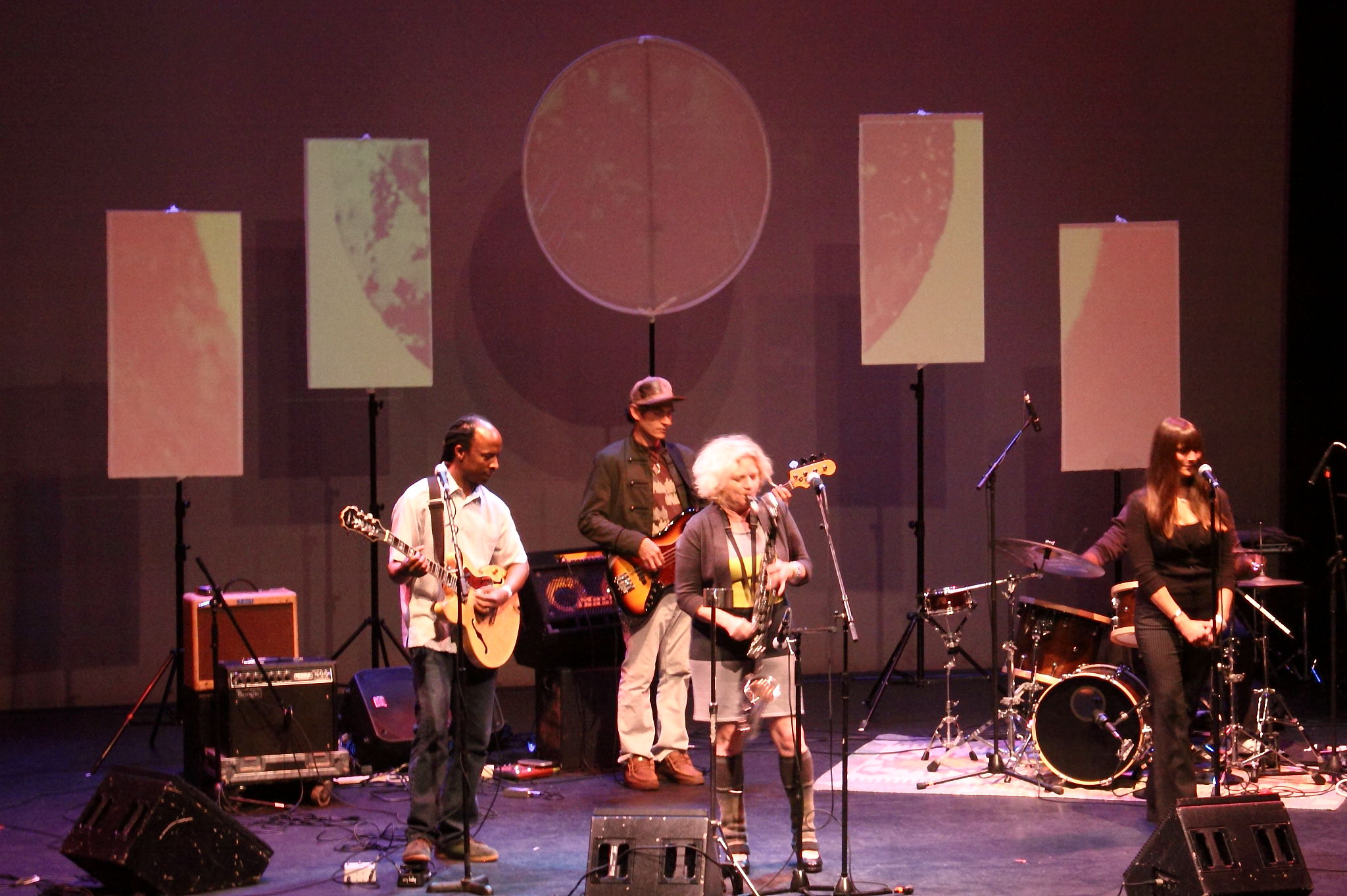
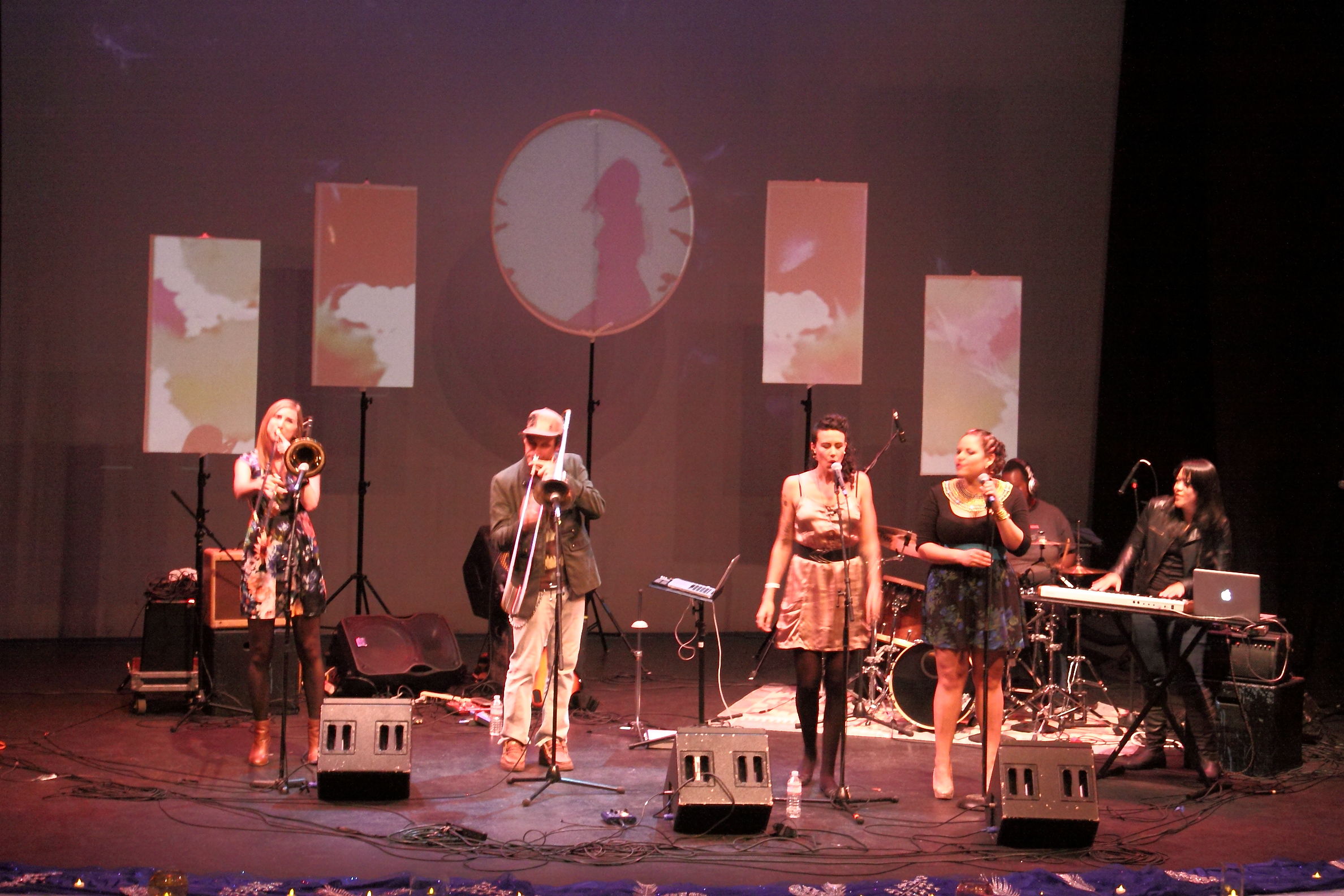
Jazz/funk/hip-hop/R and B Jazz Mafia with  Aima the Dreamer and Erica Dee did a raucous version of ‘This Flight Tonight’.

Cajun/blues/southern fiddler and singer with her band did a country blues version of ‘River’.

The Seshen is an electro-pop ensemble that, like the other musicians in this show, is hard to categorize.  They did an ecstatic cover of ‘A Case of You’.

Katy Stephan and her group Classical Revolution ended the evening with ‘The Last Time I Saw Richard’.

All the musicians barely crowded on to the stage to acknowledge the standing ovation from the very appreciative crowd.

Whether you know the original Joni Mitchell album or not you can’t fail to find something exciting, eye-opening and enjoyable in these performances.  The range of creativity and talent is staggering.  The bands played with a subtle but effective visual display that unified their efforts and added another aspect to both the music and the performance.  I’m sure Joni would be pleased.

Did I say that the ticket price includes a free download of the studio album?  Well it does and it serves as a great reminder of a truly unique bay area experience.  Maybe I’ll see you there.