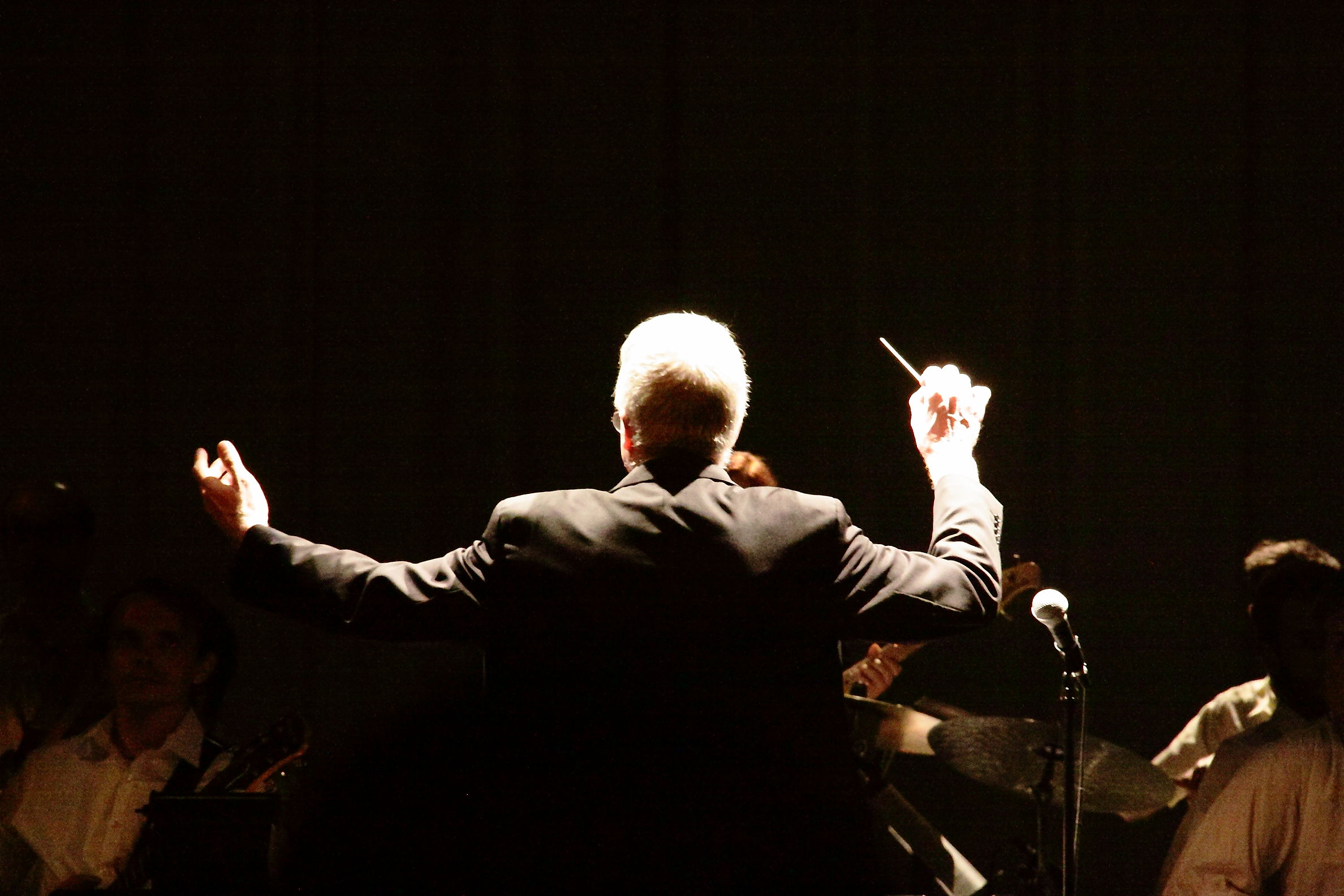
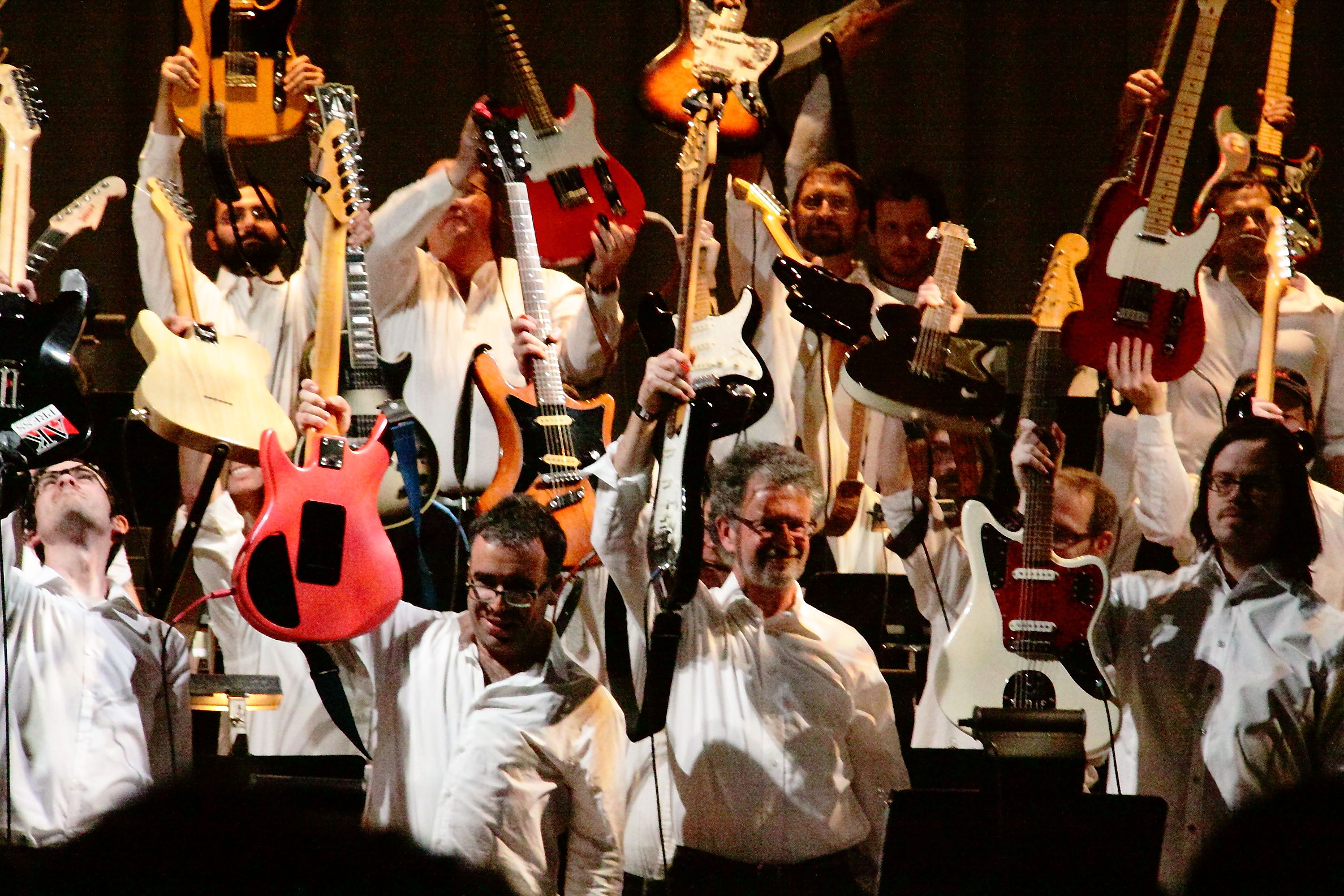
Composers of Northern California, Other Minds 19


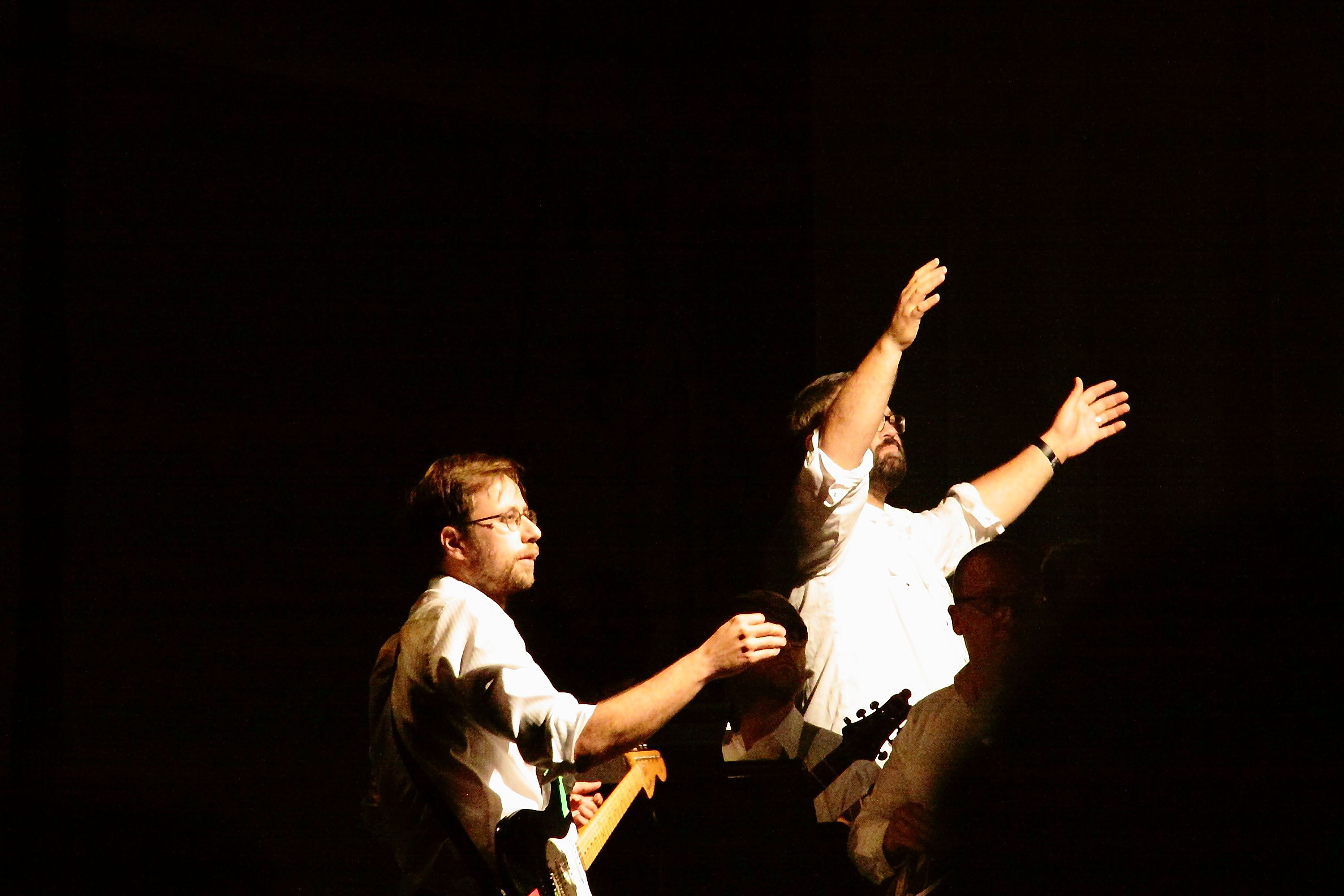
OM 19, the final bow.  Left to right: Charles Amirkhanian, Charles Celeste Hutchins, Joseph Byrd, Wendy Reid, Myra Melford, Roscoe Mitchell, John Schott, Mark Applebaum, John Bischoff, Don Buchla

OM 19, the final bow. Left to right: Charles Amirkhanian, Charles Celeste Hutchins, Joseph Byrd, Wendy Reid, Myra Melford, Roscoe Mitchell, John Schott, Mark Applebaum, John Bischoff, Don Buchla

This past Friday and Saturday the San Francisco Jazz Center hosted the 19th annual Other Minds Festival concerts.  This is the first year not to feature an international roster.  Instead the focus was on composers from northern California.  (Strictly speaking these composers’ creative years and present residence is northern California.)  It was not a shift in policy but a focus on a less generally well known group of artists who have not enjoyed the exposure of east coast composers but have produced a formidable body of work that deserves at least a fair assessment.  In fact these concerts presented a fascinating roster of composers from essentially three generations.

The first generation represented was one which came of age in the fabled 1960s and included electronic music pioneer Don Buchla, AACM founding member Roscoe Mitchell and proto-minimalist Joseph Byrd.  The second was represented by Wendy Reid, Myra Melford and John Bischoff.  And the youngest generation by Mark Applebaum and Charles Celeste Hutchins.

The program opened on Friday night with a sort of pantomime work by Stanford associate professor of music Mark Applebaum.  The piece, called Aphasia (2010) consists of an electronic score to which the composer, seated in a chair, responds with a variety of carefully choreographed gestures.  The result was both strange and humorous.  The audience was both amused and appreciative.

Applebaum's Metaphysics of Notation (2008) performed by the Other Minds Ensemble.  Left to right: Myra Melford, John Bischoff, Wendy Reid, John Schott, Joseph Byrd, Charles Amirkhanian and Charles Celeste Hutchins

Applebaum’s Metaphysics of Notation (2008) performed by the Other Minds Ensemble. Left to right: Myra Melford, John Bischoff, Wendy Reid, John Schott, Joseph Byrd, Charles Amirkhanian and Charles Celeste Hutchins

Applebaum’s graphic score Metaphysics of Notation (2008) was projected overhead while the ensemble played their interpretations of that score.  The ensemble, dubbed the Other Minds Ensemble, consisted of most of the composers who participated in the festival including Mr. Amirkhanian displaying his facility with  a percussion battery among other things.  (Presumably Roscoe Mitchell, who was reportedly not feeling well, would have joined the ensemble as well.)  Mr. Applebaum was conspicuously absent perhaps so as to not unduly influence the proceedings.
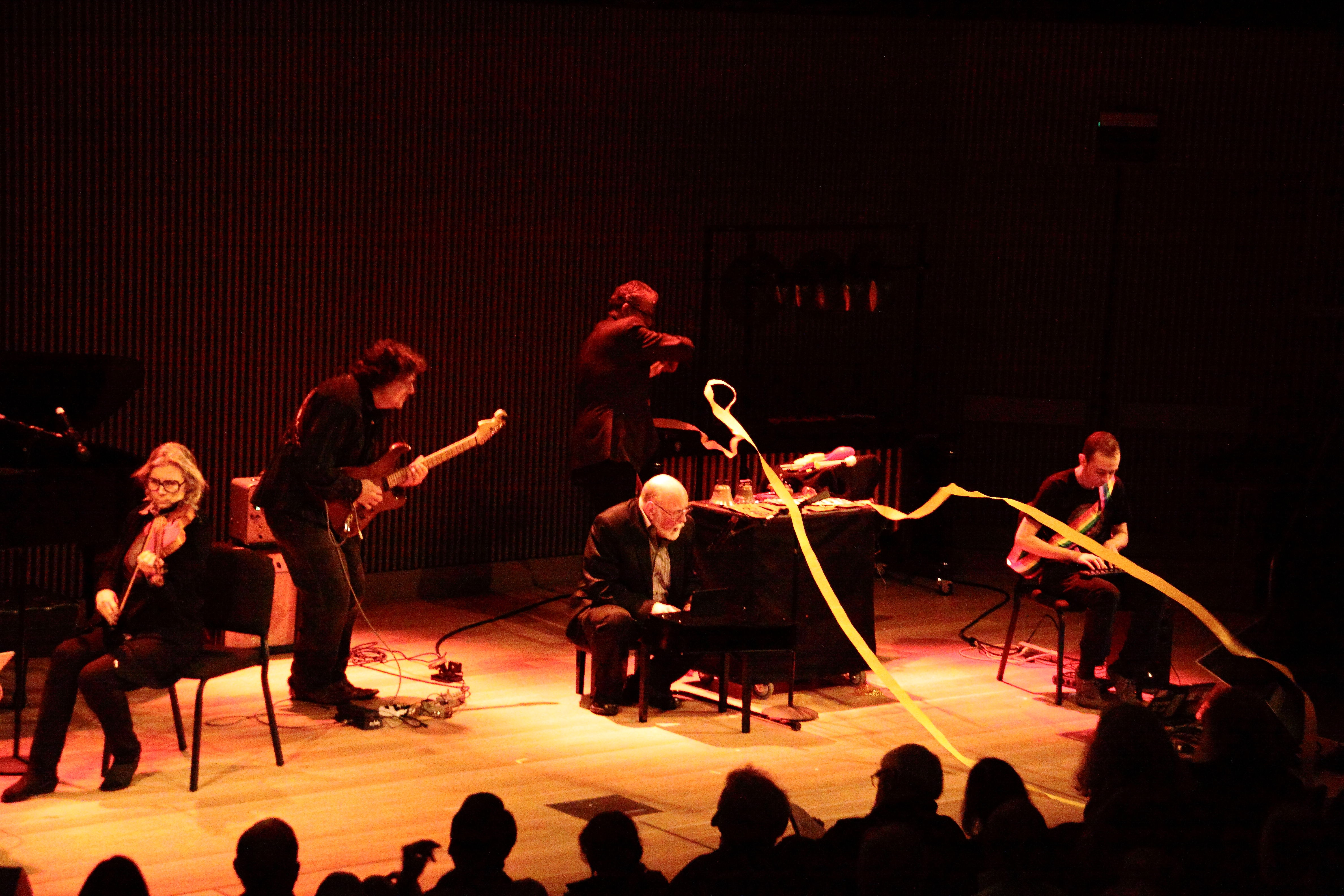
Ribbons strewn across the stage, a part of the Other Minds Ensemble's interpretation of the Metaphysics of Notation

Ribbons strewn across the stage, a part of the Other Minds Ensemble’s interpretation of the Metaphysics of Notation

The piece was full of minimal musical gestures, humorous events like ribbons strewn across the stage and the popping of little party favors that emitted streamers.  The ensemble appeared to have a great deal of fun with this essentially indeterminate score which they are instructed to interpret in their own individual  ways.  It was a rare opportunity to see and hear Mr. Amirkhanian (who is a percussionist by training) as well as an opportunity for the other composer/performers to demonstrate their skills and their apparent affinity for this type of musical performance.  Again the audience was both amused and appreciative.

Mark Applebaum performing on his invented instrument.
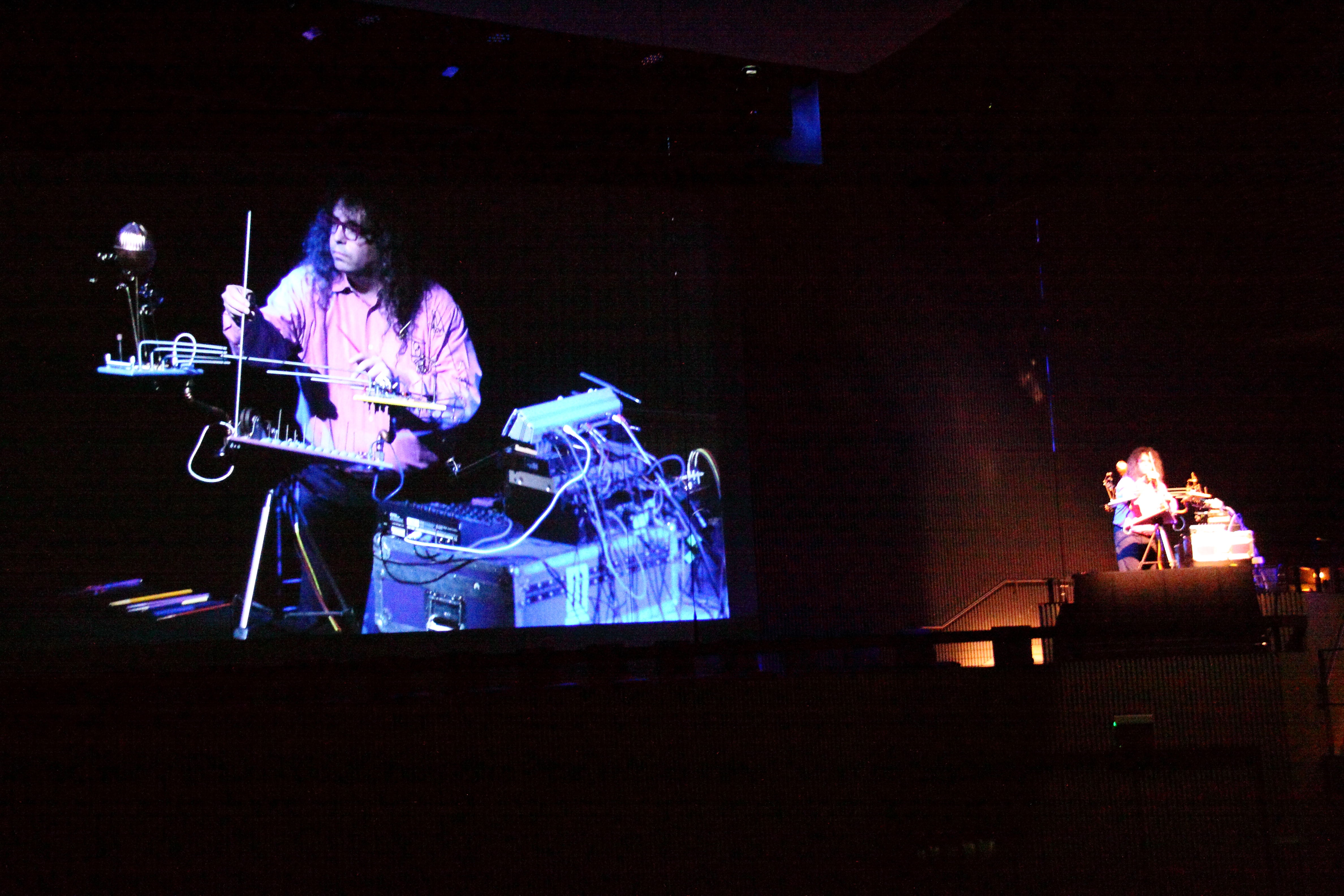
Mark Applebaum performing on his invented instrument.

Projection of Applebaum performing with view of the composer/performer stage right as well.

Projection of Applebaum performing with view of the composer/performer stage right as well.

The third piece by Applebaum featured the composer with his invented instrument and electronics playing on a balcony stage right with a projection of himself on the big screen.  He produced a wide variety of sounds from his fanciful computer controlled contraption that seemed to please the audience.  This is the kind of unusual genre-breaking events which tend to characterize an Other Minds concert.

The second composer of the night was the elusive Joseph Byrd who is perhaps best known for his cult classic album The American Metaphysical Circus by Joe Byrd and the Field Hippies from 1969.  A previous band, The United States of America released a self-titled album which received critical acclaim in 1968.  Both are apparently out of print but available through Amazon.

Joe Byrd studied music with Barney Childs and worked with La Monte Young, cellist Charlotte Moorman, Yoko Ono and Jackson Mac Low.  Byrd went on to produce a great deal of music by others and also wrote music for films and television but his own compositions have only come to light again recently with the release of a New World CD released in 2013 which presents his work from 1960-63.  Mr. Amirkhanian said that it was this disc that got him interested in inviting Byrd to Other Minds (Byrd also taught at the College of the Redwoods in Eureka, California.).

This is the sort of musical archeology for which Other Minds has become known.  Amirkhanian is known for his ability to find and bring to performance and recordings music which has been unjustly neglected.  Hopefully this appearance will be followed by more releases of Byrd’s other music as well.

Byrd was represented here by performances of Water Music (1963) for percussionist and tape with Alan Zimmerman (who was one of the producers of the New World album) played the spare percussion part which integrated well with the analog electronic tape.

Alan Zimmerman performing Joe Byrd's Water Music.

Alan Zimmerman performing Joe Byrd’s Water Music.

A second piece, Animals (1961) was performed by the brilliant and eclectic bay area pianist Sarah Cahill with Alan Zimmerman and Robert Lopez on percussion and the fiercely talented Del Sol String Quartet (Kate Stenberg and Richard Shinozaki, violins, Charlton Lee, viola and Kathryn Bates Williams, cello).  This was another piece with soft, mostly gentle musical gestures involving a prepared piano and predominantly percussive use of the string players.  It was interesting to contemplate how this long unheard music must have sounded in 1961 but it was clear that it communicated well with the audience on this night.

Animals (1961)
Animals (1961)

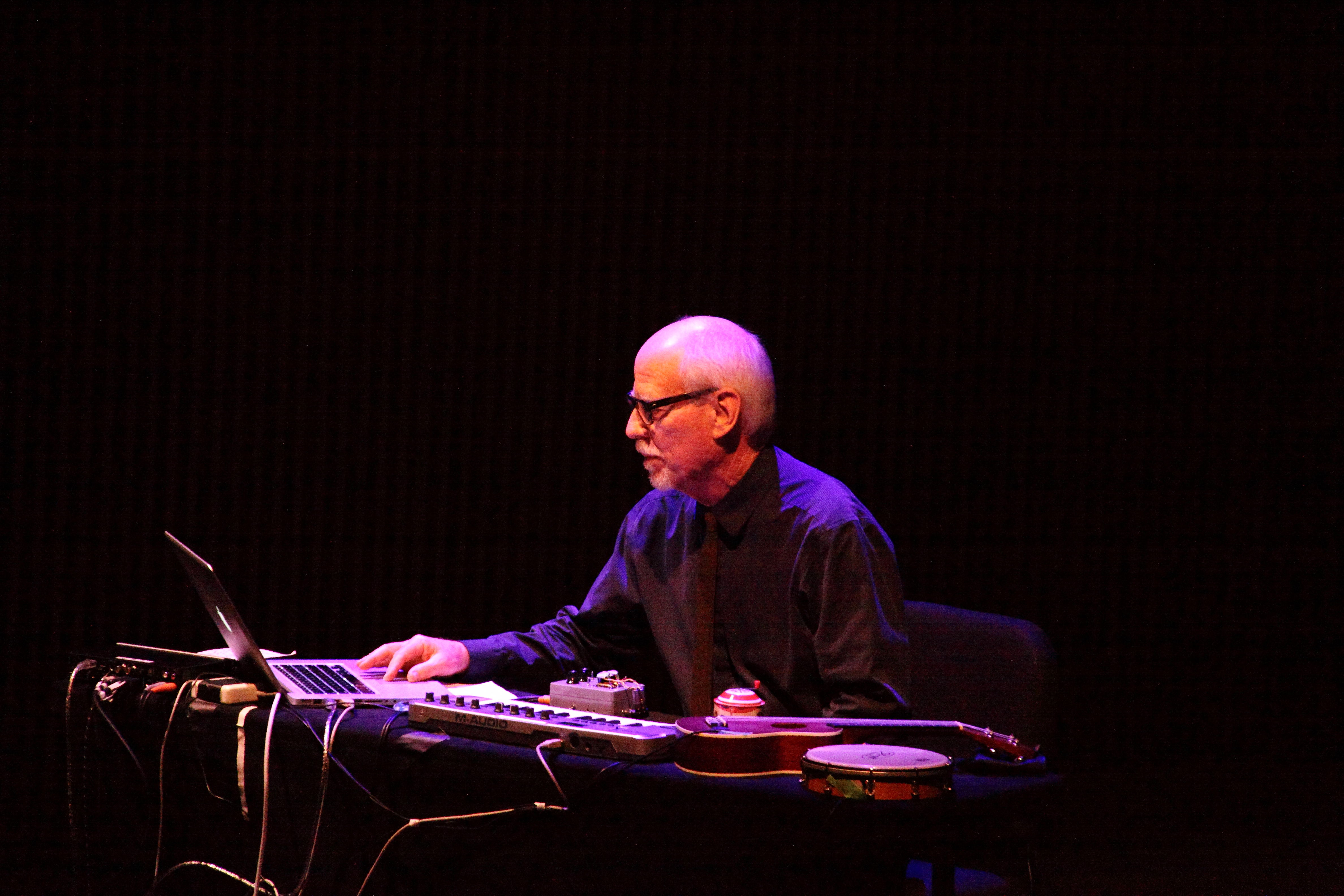
John Bischoff performing his work Audio Combine (2009)

John Bischoff performing his work Audio Combine (2009)

Following intermission we heard two pieces by Mills composer/performer John Bischoff.  The first was Audio Combine (2009) which featured Bischoff on this laptop producing a variety of digitally manipulated sounds.  It was followed by Surface Effect (2011) with creative lighting effects/animations that nicely complemented the laptop controlled analog circuitry.  Bischoff’s music is generally gentle and clear.  It belies the complexity of its genesis in state of the art computer composition and performance for which he is so well known.
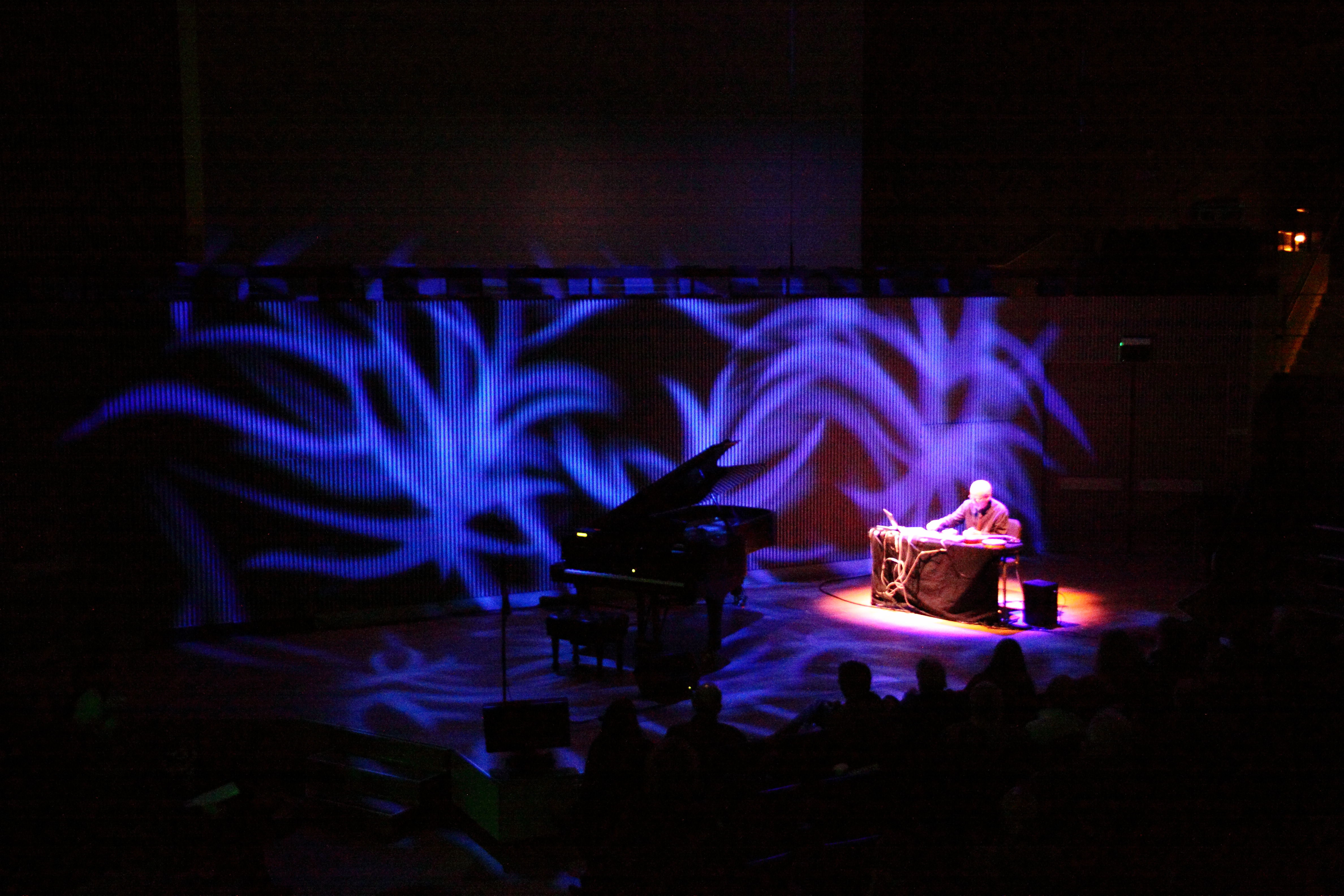
John Bischoff performing Surace Effect (2011)

John Bischoff performing Surace Effect (2011)

All this led to the final performance of the evening by Don Buchla whose modular synthesizers were developed in the early 1960s with input from Ramon Sender, Morton Subotnick, Pauline Oliveros and Terry Riley at the legendary San Francisco Tape Music Center (which later became the Mills Center for Contemporary Music).  Buchla also designed the sound system for Ken Kesey’s bus “Furthur” which featured in the Electric Kool-Aid Acid Test.

Don Buchla on the Buchla Bos and Nannick Buchla on the piano with film projection performing Drop by Drop (2012) in its American premiere.

Don Buchla on the Buchla Bos and Nannick Buchla on the piano with film projection performing Drop by Drop (2012) in its American premiere.

The conclusion of Friday’s program consisted of the American premiere of a Drop by drop by Don Buchla for Buchla 200e, electronically controlled “piano bar”  (another Buchla invention) and film projection.  The film was made in collaboration with bay area film maker Sylvia Matheus.  The sequence of images began with a dripping faucet and proceeded to a waterfall and then to emerging pictures of birds all the while accompanied by the various sounds from the synthesizer and the piano.

OM190028

Nannick and Donald Buchla receiving warm applause from the audience.

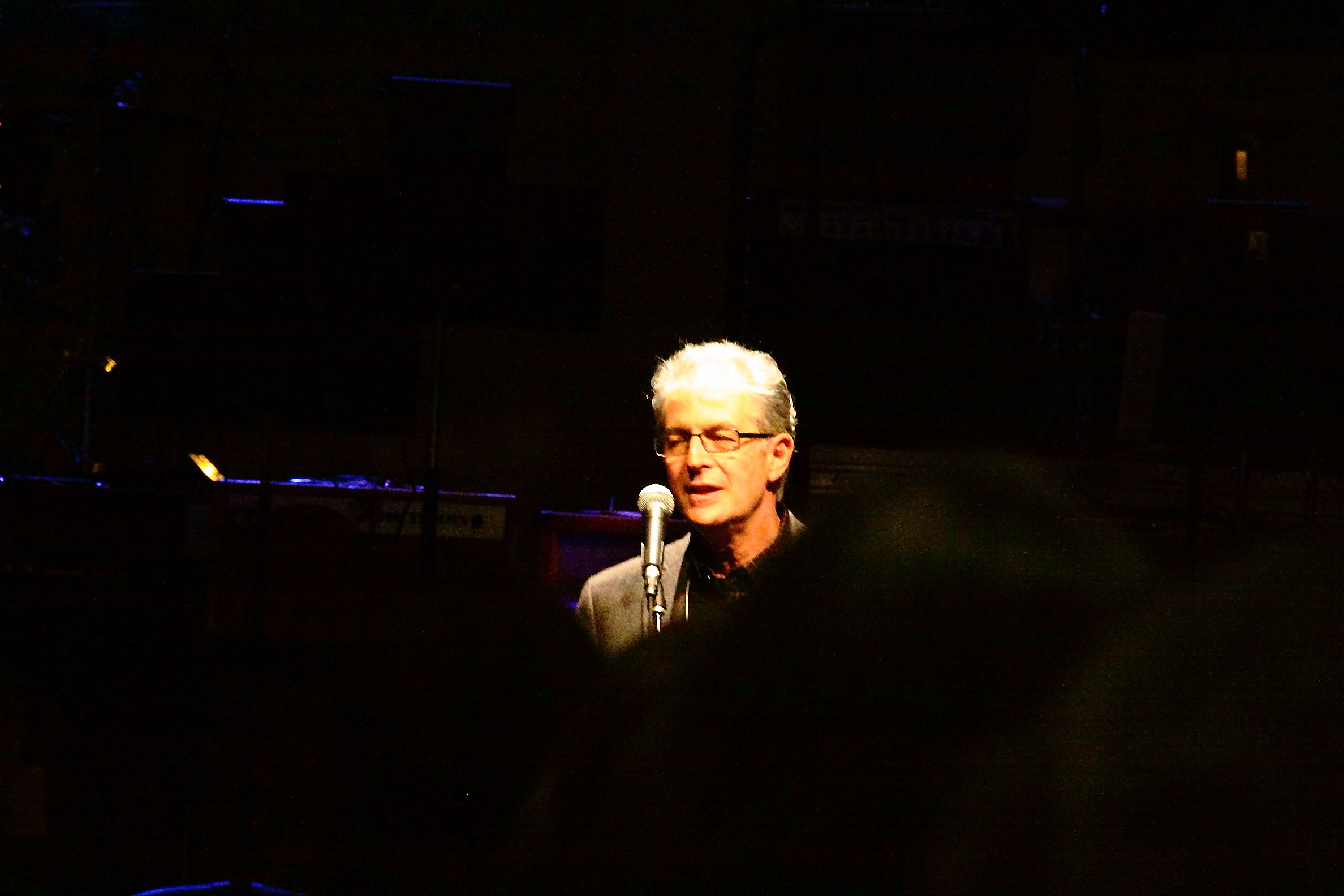
The Saturday night performances began with Charles Celeste Hutchins and his laptop improvising system.  Hutchins, a San Jose native, describes his system as related to Iannis Xenakis’ UPIC system and utilizes a live graphic interface which the computer uses to trigger sound events.

Charles Celeste Hutchins at his laptop performing Cloud Drawings (2006-9)

Charles Celeste Hutchins at his laptop performing Cloud Drawings (2006-9)

The drawings were projected onto the overhead screen.  There seemed to be a somewhat indirect correlation between the drawings and the resultant sounds and much of the tension of this performance derived from wondering what sounds would result when the cursor reached that particular drawing object.  The audience is basically watching the score as it is being written, a rather unique experience and the Other Minds audience clearly appreciated the uniqueness.

The projected graphic score for Cloud Drawings.

The projected graphic score for Cloud Drawings.

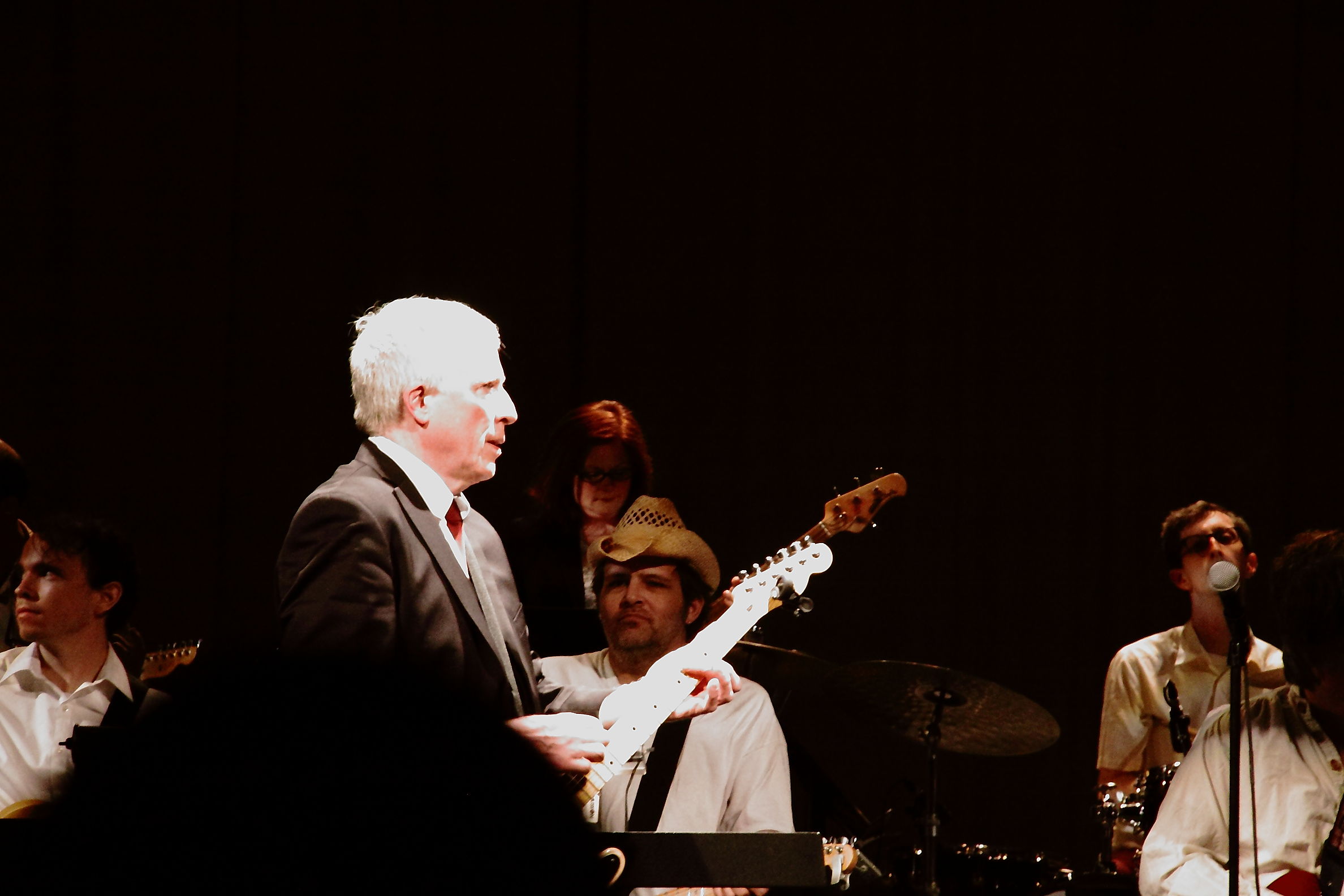
The Actual Trio: John Schott, guitar, Dan Seamans, bass, John Hanes, drums.

The Actual Trio: John Schott, guitar, Dan Seamans, bass, John Hanes, drums.

John Schott and his Actual Trio then took the stage to perform his own brand of jazz which seemed to be a combination of free jazz, Larry Coryell and perhaps even Jerry Garcia.  But these descriptions are merely fleeting impressions and are not intended to detract from some really solid and inspired music making.  After the conclusion of the set this listener half expected an encore.

But the program moved on toWendy Reid’s performance as we watched the stage being set up with music stands, some electronic equipment and a parrot in a cage.

Tree Piece #55 "lulu variations" with Tom Dambly, trumpet, Wendy Reid, violin and electronics and Lulu Reid on vocals.

Tree Piece #55 “lulu variations” with Tom Dambly, trumpet, Wendy Reid, violin and electronics and Lulu Reid on vocals.

Reid’s Tree Pieces are an ongoing set of compositions incorporating nature sounds with live performance.  This is not unlike some of Pauline Oliveros’ work in that it involves careful listening by the musicians who react within defined parameters to these sounds.

Lulu the parrot appeared nervous and did a lot of preening but did appear to respond at times.  The musicians responded with spare notes on violin and muted trumpet.  It was a whimsical experience which stood in stark contrast to the more declarative music of the previous trio but at least some of  the audience, apparently prepared for such contrasts, was appreciative.
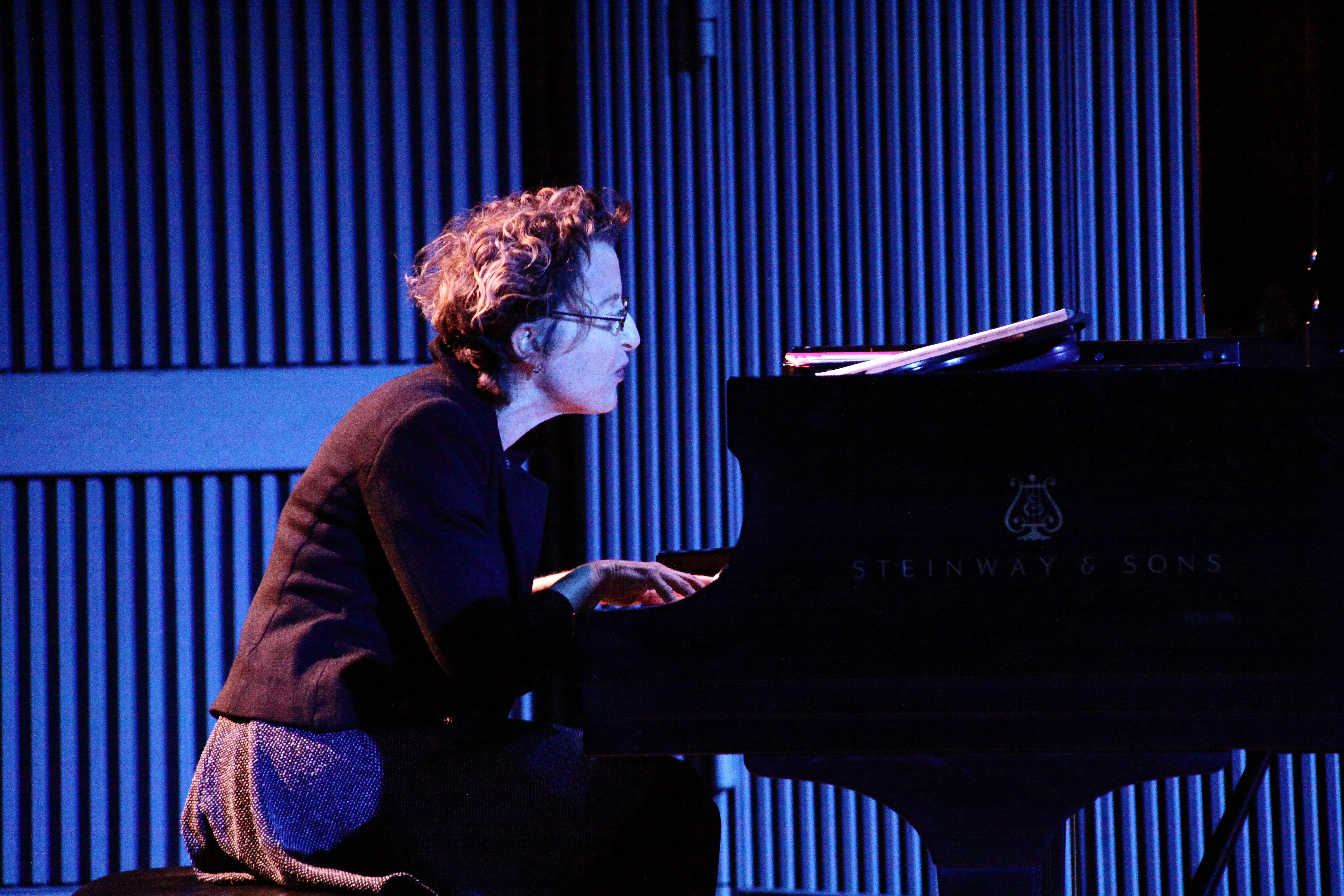
Myra Melford performing selections from Life Carries Me This Way (2013)

Myra Melford performing selections from Life Carries Me This Way (2013)

The diminutive figure of Myra Melford took command of the piano and the hearts of the audience in her rendition of several pieces from her recent CD.  She played sometimes forcefully with thunderous forearm cluster chords and sometimes with extreme delicacy but always with rapt attention to her music.  Her set received a spontaneous standing ovation from a clearly roused audience.  She is a powerful but unpretentious musician who clearly communicates well with her audience.
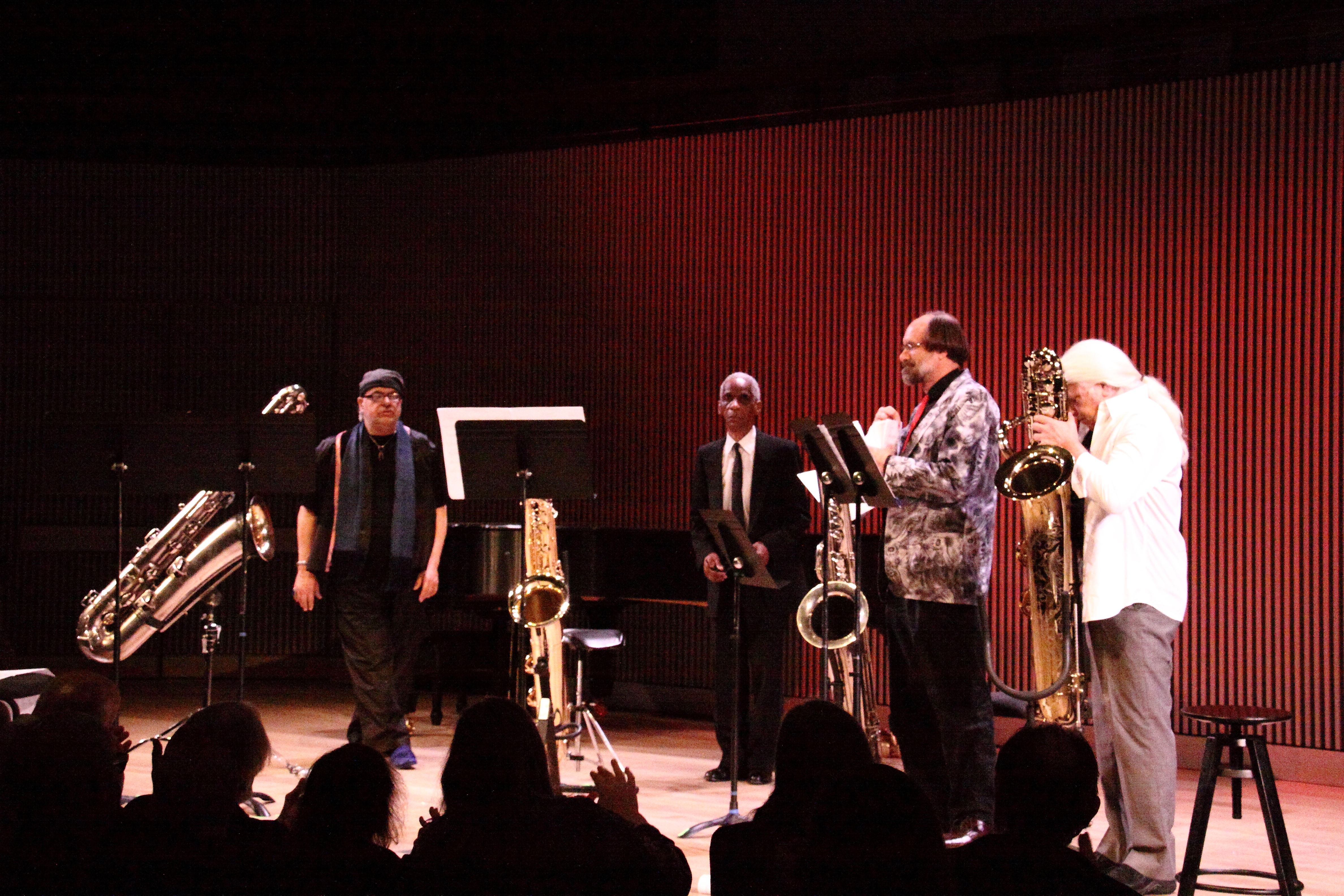
Roscoe Mitchell, Vinny Golia, Scott Robinson and J.D. Parran  following their performance of Noonah (2013)

Roscoe Mitchell, Vinny Golia, Scott Robinson and J.D. Parran following their performance of Noonah (2013)

The finale of OM 19 was the world premiere of an Other Minds commission, the version for four bass saxophones of Roscoe Mitchell’s Noonah (pronounced no nay ah).  It is the latest incarnation of a piece of music that Mitchell describes as having taken on a life of its own.  It exists now in several different versions from chamber groups to orchestra.

The piece is vintage Roscoe Mitchell, a combination of free jazz and sometimes inscrutable compositional techniques which clearly enthralled the very focused performers.  What the piece seemed to lack in immediate emotional impact it made up in mysterious invention which was brought out grandly by the very experienced and committed players.

Mitchell, who was not able to attend on the previous night, appeared rather tired but played with a focus and enthusiasm that matched his fellow musicians.  Like all of Mitchell’s music there is a depth and complexity that is not always immediately evident but does come with repeated listenings and performances.

Thus concluded another very successful edition of Other Minds.  Now we look forward to the gala 20th anniversary coming up in March, 2015.


Enhanced by Zemanta

Coming Up, Other Minds 19 at the SF Jazz Center


Official Other Minds logo

Official Other Minds logo (Photo credit: Wikipedia)

On February 28 and March 1 the SF Jazz Center will host Other Minds for the first time.  OM 19 is the latest incarnation of this annual festival which presents an amazing range of new music.

The Other Minds Festival, brainchild of filmmaker/producer Jim Newman and musician, composer and broadcaster Charles Amirkhanian, was first heard in 1993 and, except for the years 1994, 1998 and  2007, has been an annual event in San Francisco  gathering mostly new but  always innovative composers to share their inspirations and innovations with each other and with bay area audiences.  Being curious about those apparent gaps in this festival I sent a query to the Other Minds office and received a prompt reply from none other than Charles Amirkhanian.  He stated as follows:

Executive Director Charles Amirkhanian in his ...

Executive Director Charles Amirkhanian in his office with ASCAP award in background (Photo credit: Wikipedia)

“Hi Allan,
Here’s the story:
After our first festival in November 1993, we needed time to raise more funds to produce OM 2 and get back on the Yerba Buena Center’s schedule. So we postponed until March 1995, the next available spot in the Djerassi schedule. Our timing for the festival is determined by when we have access to empty rooms at DRAP, so we need to be there either in Feb/March or November.
In 1997, once again, we needed time to raise more funds and simply postponed to the next available Djerassi time. Same for OM 13.
In each case, the delay was about eight months (for a November event) or four months (for a March event), giving us a festival in succeeding concert seasons, but not “annual” events. (A concert season is Fall ’07 through Spring ’08, for example.)
Thus the mysterious gaps.
Charles”

This internationally known festival is not just a series of concerts.  The diverse selection of composers gathers first for an artistic residency at the Djerassi Resident Artist Program (DRAP in Mr. Amirkhanian’s note), a pastoral setting nestled between the Pacific coastline and the hills west of Palo Alto, where the invited composers live, work and share ideas for a week prior to the public concerts. The Djerassi Foundation for the Arts was founded by biochemist Carl Djerassi whose daughter, an artist, committed suicide in 1978.  The area is a sculpture park and the facility operates all year round with residencies for artists of all media.  Charles Amirkhanian is one of the former directors of this venerable artist colony and is now the executive and artistic director of Other Minds. The selection process for OM artists is based on the incredible range of interests of the Other Minds Operating Board and in consultation with their advisory board which are very open to suggestions from the general public.  Just e-mail them.  They actually read all their e-mails and respond. This along with New Music America, the ONCE festival, the Telluride Festival (also one of Amirkhanian’s efforts) are among the important music festivals which have yet to receive adequate treatment and exposition of their histories. This year’s OM 19 (which also looks forward with eager anticipation to a very promising gala OM 20) includes Mark Applebaum, John Bischoff, Donald Buchla, Joseph Byrd, Charles Celeste Hutchins, Myra Melford, Roscoe Mitchell, Wendy Reid and John Schott.  For the first time in the history of the festival all the composers will be from northern California.  The dates for the festival, which moves this year to the new SF Jazz Center, are Friday February 28 and Saturday March 1. One might think that limiting the selection of composers would be limiting in the variety of artistic efforts to be had but one would be quite wrong.  In fact it would not be difficult to argue that music by musicians from northern California have been unjustly neglected in favor of the more dominant musical cultures of New York City, Chicago and Los Angeles.  A quick look at the roster for OM 19 reveals a great deal of variety:

Mark Applebaum at TEDx Stanford

Mark Applebaum at TEDx Stanford (Photo credit: Tamer Shabani Photography)

The Chicago born Mark Applebaum is currently associate professor of composition and theory at Stanford University.  He counts Brian Ferneyhough, Joji Yuasa, Rand Steiger, Roger Reynolds and Philip Rhodes among his teachers.  He also performs as a jazz pianist. He appears to be the first composer at these concerts to have given a TED talk.  In this talk he speaks of being “bored with music”, at least with traditional music and how he used that boredom to break through to another level of creativity creating new instruments and elaborate scores.  He is an engaging speaker and his presentation will no doubt be fascinating.

John Bischoff (1949- )

John Bischoff (1949- )

John Bischoff studied at the California Institute of the Arts and Mills College.  His teachers include Robert Moran, James Tenney and Robert Ashley.  He is currently visiting professor and composer at Mills College. He is one of the pioneers of live computer performance and he is a frequent performer at the Garden of Memory concerts held annually on the summer solstice at Oakland’s beautiful Chapel of the Chimes. Mills College with its Center for Contemporary Music can be said to be the primary life blood of northern California composers.  Bischoff is part of a long line of composers who  have guided musical pedagogy in the Bay Area and have included Chris Brown, Luciano Berio, Darius Milhaud, Lou Harrison, Steve Reich, Terry Riley, Pauline Oliveros, Morton Subotnick, Ramon Sender, John Cage, Chris Brown, Maryann Amacher, Maggie Payne, Larry Polansky, Robert Ashley, and many others. Bischoff has released 16 albums and numerous publications.  He founded the League of Automatic Composers, the first computer network band and continues to be a driving force in the computer music scene. Don_Buchla_and_200e

Donald Buchla is one of the elder statesmen of new music in California.  His collaboration with Ramon Sender and Morton Subotnick produced one of the first modular synthesizers in 1963.  He continues to develop synthesizers with his Buchla and Associates corporation (founded in Berkeley in 1962) . He studied physics, physiology and music.  His importance in the field of electronic music and music synthesis cannot be underestimated.  His electronics have driven many classical, rock and jazz music.  He and his corporation continue to make new electronic instruments such as the marimba lumina and the piano bar and has made available again some of the classic analog electronics which first made his name familiar to musicians worldwide. I was able to find very little about his musical compositions but it is worth noting that his electronics will power the performances of several of the artists in this concert series in addition to his own.

Joe Byrd in 1968

Joe Byrd in 1968

Kentucky born Joseph Byrd is an electronic musician, composer and producer.  His album, “The American Metaphysical Circus” (1969) is legendary and considered a cult album which has been reissued on CD and can also be heard on You Tube.  His band, Joe Byrd and the Field Hippies never performed live but this work of 60s psychedelia has established itself as a landmark recording and a cult classic.  He also did an album of synthesized Christmas Carols in 1975. Byrd has also been a producer with estimable credits such as producer and arranger of Ry Cooder’s amazing ‘Jazz’ album from 1978.

I can’t imagine how his latest work sounds but I am looking forward to it.

Charles Céleste Hutchins at SOUNDkitchen

Charles Céleste Hutchins at SOUNDkitchen (Photo credit: hellocatfood)

Charles Celeste Hutchins is, as far as I can tell, the first instance in which an Other Minds operating board member has been featured as a composer in this series.  The advisory board consists largely of composers who have already been featured on OM concerts.  Until this booking I was not aware of this man’s work.

Hutchins worked in the dot com business for a time and is now working on his musical interests.  His work involves the digital music program called Supercollider which he uses to manipulate sounds.  Discogs lists an MP3 compilation of some of his work in this area.

Melford in Helsinki, 1993

Melford in Helsinki, 1993

Myra Melford is an internationally known jazz pianist and composer with some 17 albums and some 20 years of playing.  Melford is originally from Illinois.

She has played with AACM musicians like Leroy Jenkins, Joseph Jarman and other musicians including Marty Ehrlich, Henry Threadgill, Mark Dresser, OM alumni Han Benink and Tyshawn Sorey.  Currently she teaches at the University of California Berkeley.

saxophonist Roscoe Mitchell at the Pomigliano ...

saxophonist Roscoe Mitchell at the Pomigliano Jazz Festival (Photo credit: Wikipedia)

Roscoe Mitchell is one of the founding members of the venerable AACM (American Association of Creative Musicians) which redefined both jazz and contemporary classical music from its founding in 1965 to the present.  Other notable members include Anthony Braxton, Lester Bowie, Malachi Favors, George Lewis and Lester Bowie among others.  Mitchell is currently professor of music at Mills College where he holds the Darius Milhaud chair.  He has collaborated with Frederic Rzewski, George Lewis, Anthony Braxton, Joseph Jarman, Malachi Favors, Muhal Richard Abrams, Albert Ayler, Henry Threadgill, Thomas Buckner and many others.

Mitchell is one of the acknowledged living masters of American music and he plays and teaches widely.  In 2012 her performed at the “All Tomorrow’s Parties” festival in Minehead, England.  Any performance by this musician is an event.

Wendy Reid is a new name for me.  She is a composer who works with nature sounds.  I did buy her CD entitled “Tree Music” which features 5 of her Tree Pieces with various combinations of violin, percussion, piano, mandolin, oboe and Don Buchla on “thunder” interacting with nature sounds.  For her OM performance she will be sharing the stage with a parrot.  Yes, it does sound like a Monty Python sketch, but this promises to be interesting if not revelatory.  Her work is clearly concerned with the sounds of nature and is at least distantly related to the work of Pauline Oliveros whose album ‘Troglodyte’s Delight’ involves musicians responding to the sounds of water in a limestone cave.

John Schott is another name with which I am not familiar.  But lack of familiarity spells adventure in this series of concerts.  A quick internet search reveals that he is a Berkeley based composer, guitar player and banjo player.  His web site is a blog which reveals his interest in a wide range of musical styles and literary interests.  He lists 8 CDs which feature his work.  He also lists his “compositions in the classical grain”.  It’s anyone’s guess as to what he will present at Other Minds but if the preceding artists are any indication it will be unique and interesting.

All in all this promises to be a very exciting event with the ‘revelatory’ music which Other Minds uses as a tag line in their publicity materials. I won’t miss it and neither should you.

Enhanced by Zemanta

Rhys Chatham: Harmonie du Soir


Rhys Chatham performing in Richmond, CA 2013

Rhys Chatham performing in Richmond, CA 2013

Chatham’s new CD “Harmonie du Soir” on Northern Spy records was thoughtfully made available for sale at the ‘Secret Rose’ performance this past November. Of course I had to buy it but after that concert I found I needed time to digest the performance before I dare move on to listening to another of his deceptively simple sounding compositions. The CD consists of three compositions, Harmonie du Soir (2012), The Dream of Rhonabwy (2012) and a bonus track Drastic Classicism Revisited (1986/2012).  All the pieces represent aspects of the artist’s output which will be familiar to fans of his work.

rhys_chatham_-_harmonie_du_soir_2

The first track Harmonie du Soir (after the poem of the same name by Charles Baudelaire) was premiered and subsequently recorded in France in 2012.  In his liner notes Chatham points out that he uses tunings like those used previously in An Angel Moves Too Fast to See (1986) and Crimson Grail (2007).  It reminds this listener of Die Dönnergetter (1986).  It employs the same configuration of 6 electric guitars, electric bass and drum kit.  It is not, however, a reworking of the 1986 piece but rather a new piece which developed from similar methods.  Harmonie clocks in at 22’26”, similar in length.  The comparison ends there.  The difference between Dönnergetter and Harmonie is more like the difference between a Beethoven middle string quartet and a late string quartet.  Same ensemble, similar gestures but an overall very different impact. Like all of Chatham’s guitar pieces this is best heard at a substantial volume level if you want to appreciate the harmonics which result from the tuning system he uses.  This is post-punk after all and the wall of sound is frequently an essential part of the piece.  It begins with a minimalist type repeating of a 2 note pattern punctuated after a few repeats by the drum kit and on to some droning harmonies aching for a melody in an insistent rhythm.  This moves on to a faster section which takes on not the dance-like character like he does in Die Dönnergetter, rather it is a sort of deconstruction.  It is consists of guitar tremolos and rolls on the drum kit and moves into a new somewhat pointillistic  guitar figure accompanied by a throbbing bass line and a steady rhythm on the drum kit.  This  is followed by a return to the music which opened the piece.  Clearly this is a composer whose work continues to develop and show variety.

The second piece is another with precedents in the composer’s previous compositional efforts.  This is essentially a piece for a wind and brass orchestra with percussion.  No strings, no guitars or bass.  It marks a return for Chatham to writing for and playing trumpet.  The piece was written for a 70 piece brass band called Harmonie de Pontarlier, named for the town of their origin. It is 20’26” in length and Rhys plays trumpet along with the band.  One is reminded of pieces like his Waterloo No. 2 (1981) which appeared on his CD “Die Dönnergetter”.  The composer takes his approach to writing for band but here expands into symphonic proportions.  According to the liner notes this was written as a soundtrack to a film.   After multiple listenings I came to hear this as though it were an homage to grand romantic symphonists like Bruckner or Mahler.  This is a briefer symphony than those ancestors would have written but the spirit is there if dressed in more contemporary guise.  The music relies on sustained tones and intervals which, like Chatham’s guitar pieces, produce cascades of harmonics, a mesmerizing experience.

The last piece is listed as being a “bonus track”.  It is Drastic Classicism Revisited and is a sort of reworking of Chatham’s earlier work Drastic Classicism from 1981.  It was originally written for a dance choreographed by Karole Armitage and was performed by the musician live on stage with the dancers.  Post-punk for modern dance.  At 9’36” it is the shortest track but well worth its inclusion on this beautifully produced disc. I can’t wait to hear more from the Northern Spy  (http://northernspyrecords.com/artist/rhys-chatham/) catalog.  All in all a great listening experience by this wonderful expatriate American composer.  I highly recommend it.

Enhanced by Zemanta

Belated Happy New Year and My Personal Best


Having taken a bit of a hiatus in blogging I am now preparing to get back to work on several projects languishing in the digital storage of WordPress and the recesses of my own mind.

2014 is the 50th anniversary of the enactment of the 1964 Civil Rights Act as well as the 50th anniversary of the “war on poverty”.  As I read further I’m sure I will find many more such milestones and, in the spirit of this blog, will explore connections to music and musicians.

Among the issues pressing for my attention in the beginning of this year are Black History Month, the upcoming Other Minds 19 and some overdue reviews of recent recordings.  I haven’t looked further into 2014 as yet.

I have actively avoided creating one of those “best of” lists that are ubiquitous at the end of every year.  I do read those lists but have no desire to compete at this point by creating yet another.  I have, however, taken a look back at the most viewed blog posts published in this blog.

Aside from my Home Page, About Page and Archives the top ten posts for the past year have been:

1. Secret Rose Blooms: Rhys Chatham at the Craneway Pavilion (actually my all time most viewed post)

2. Other Minds 18, three nights on the leading edge

3. Black Classical Conductors (Black Classical Part Two)

4. Far Famed Tim Rayborn Takes on the Vikings

5. Alvin Curran at 75, Experimentalism with an Ethnic and Social Conscience

6. Political Classical Music in the Twentieth and Twenty First Centuries

7. Annie Lewandowski, Luciano Chessa and Theresa Wong in Berkeley

8. A Fitting 100th Birthday Celebration for Conlon Nancarrow

9. Undercover Performance Practices in the Bay Area

10. The Feeling of the Idea of Robert Ashley: Kyle Gann‘s Appreciation of the Composer

You can certainly expect me to address some of the subject matter in these most read posts.  Revisiting the site of the crime is a time-honored tradition.  I responded with “shock and awe” at the amount of hits that the Chatham article evoked (418 hits in one day, my top score).  My follow-up gallery of some of those 100 guitars did become my 11th top viewed of the past year.

But as intoxicating as that boost of views was  I will not be able to resist focusing on that which finds its way into my attention for whatever reason.  I am grateful for the support and encouragement I have received from Adam Fong, Charles Amirkhanian, Steve Layton, David Toub, Tom Steenland, Tim Rayborn, Philip Gelb and all of my readers.  I apologize in advance if I have left someone out of this impromptu list but hope that my gratitude is understood among you as well.


Enhanced by Zemanta

The Petals of the Secret Rose


Even before I saw the impressive response to my last post I had decided to do an addendum for the main purpose of showing some pictures that didn’t make the cut in the original article.  No, really, I did.

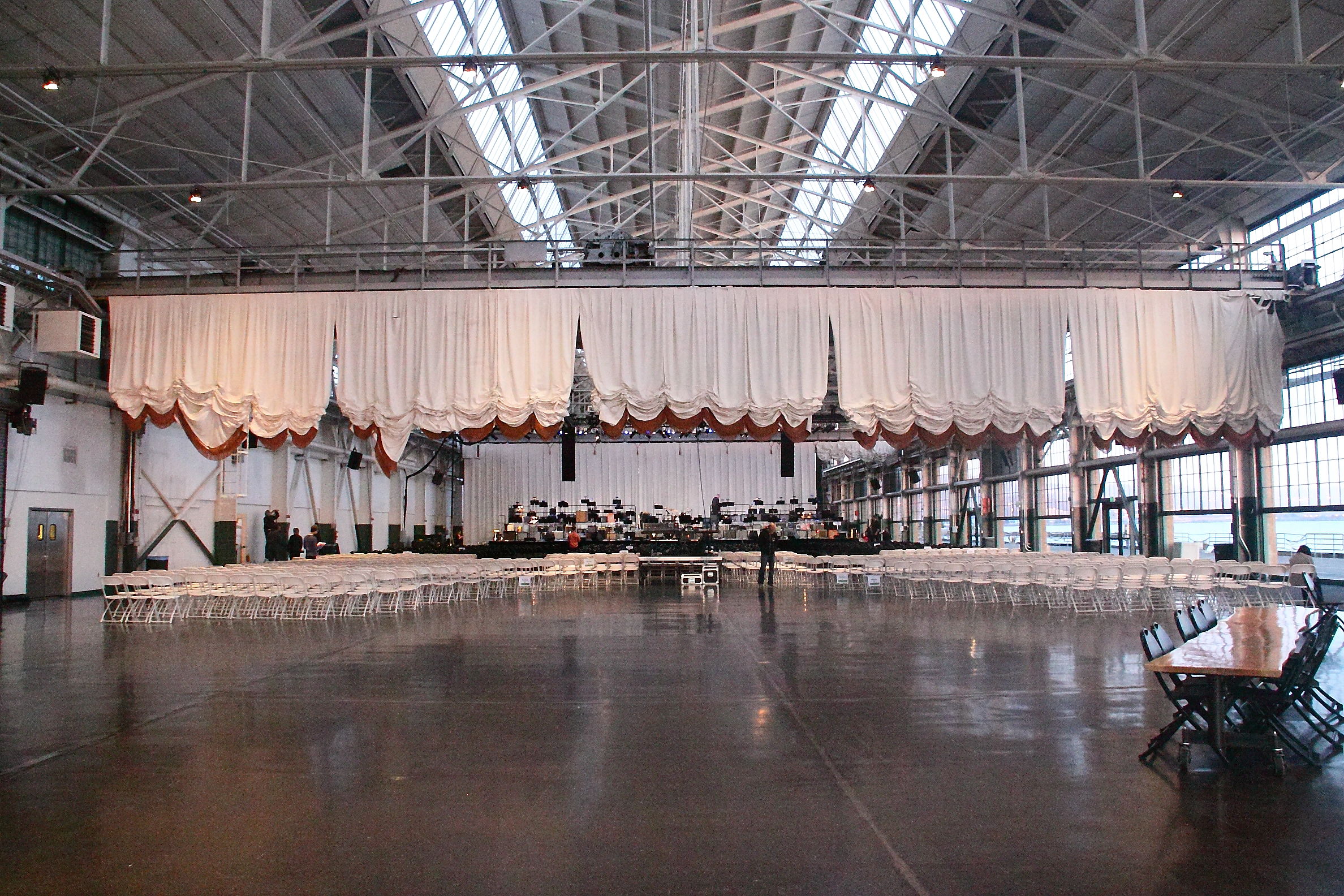
I arrived at the Craneway Pavilion in Richmond, CA at about 4:30PM.  The performance wasn’t til 7PM so that gave me some time to survey the scene.

OMChathfinal0003OMChathfinal0002

It was open so I went inside.

Looking toward the seating and the stage in the performance space at Craneway Pavilion.

Looking toward the seating and the stage in the performance space at Craneway Pavilion.

OMChathfinal0018There was an opportunity to check backstage.

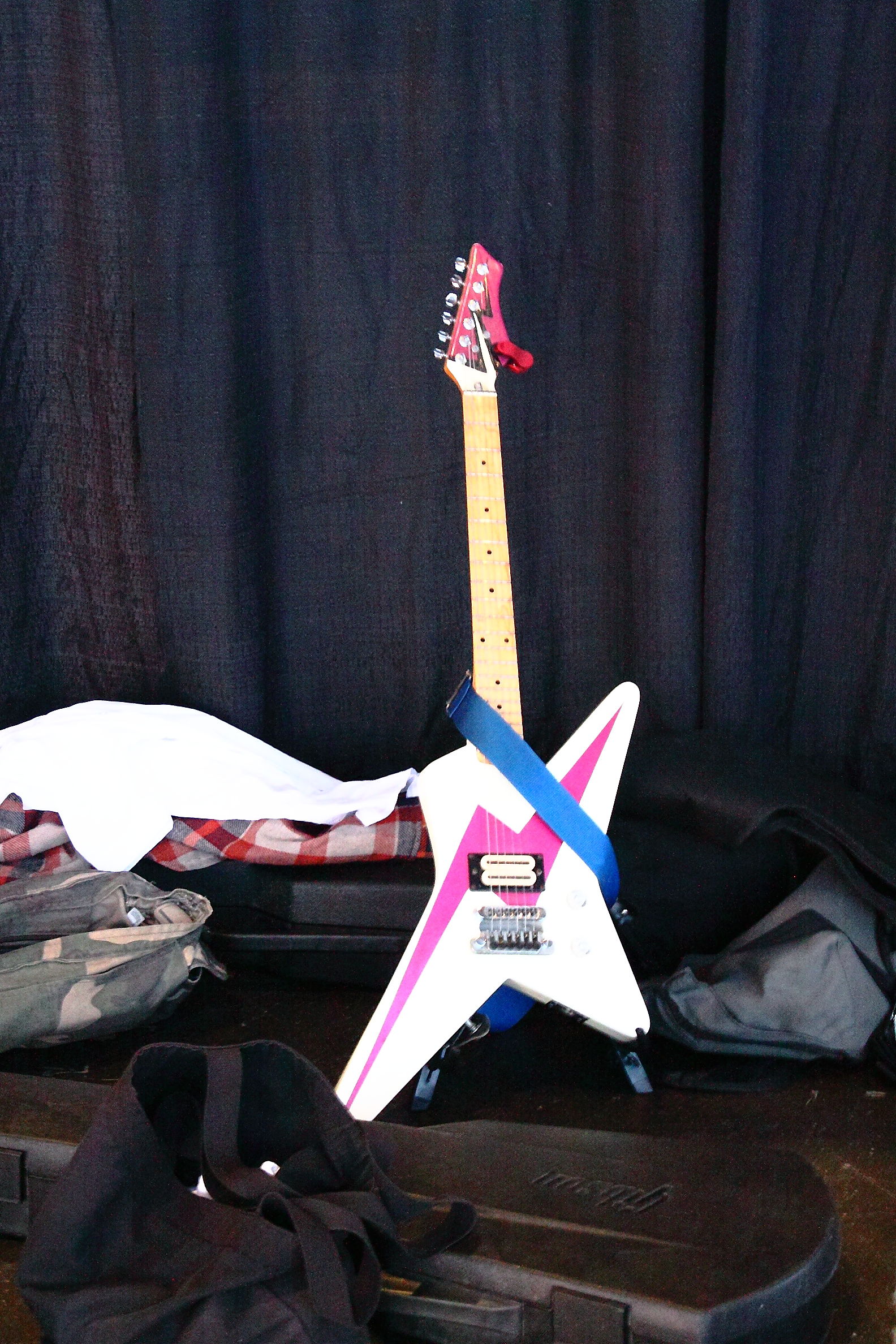
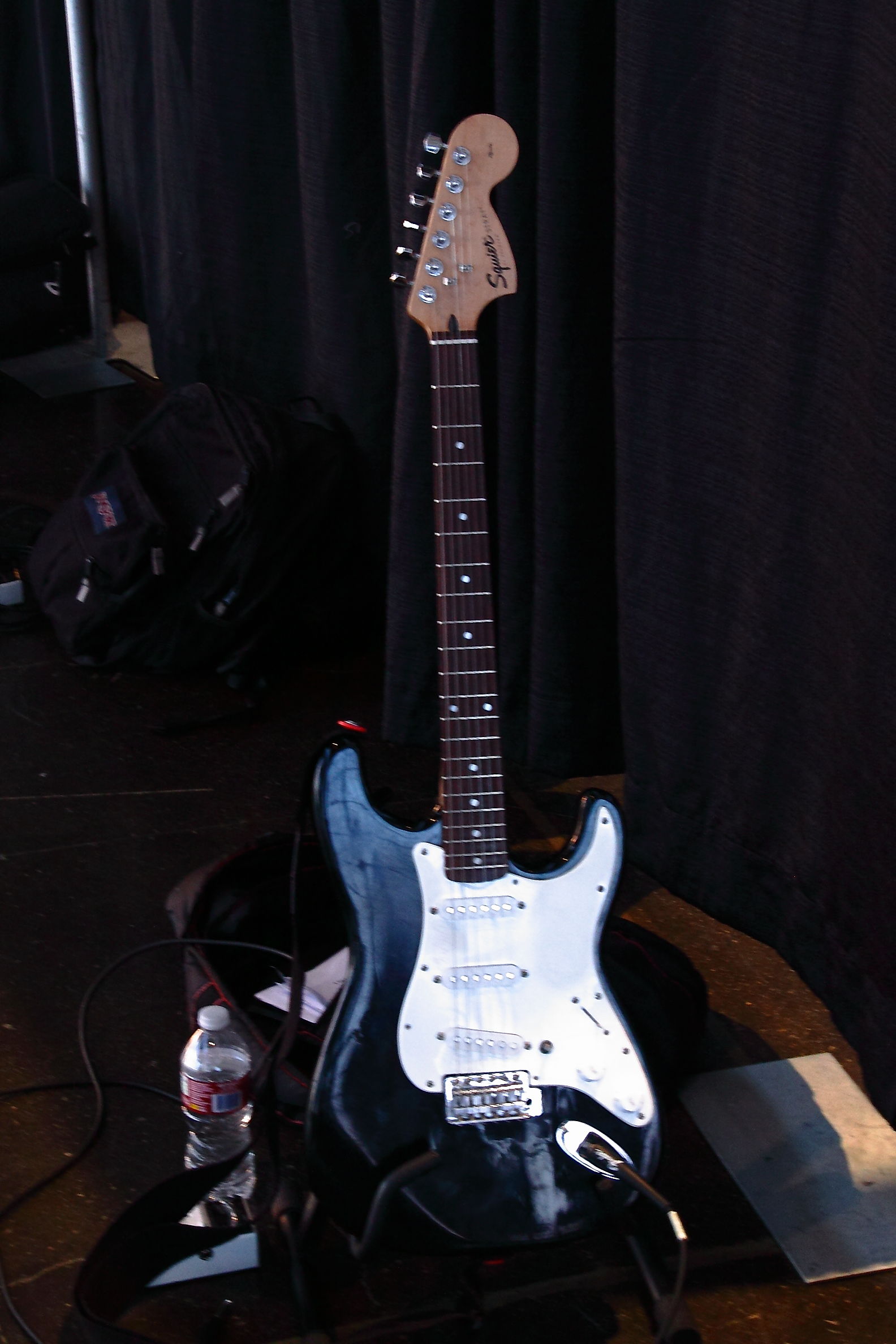
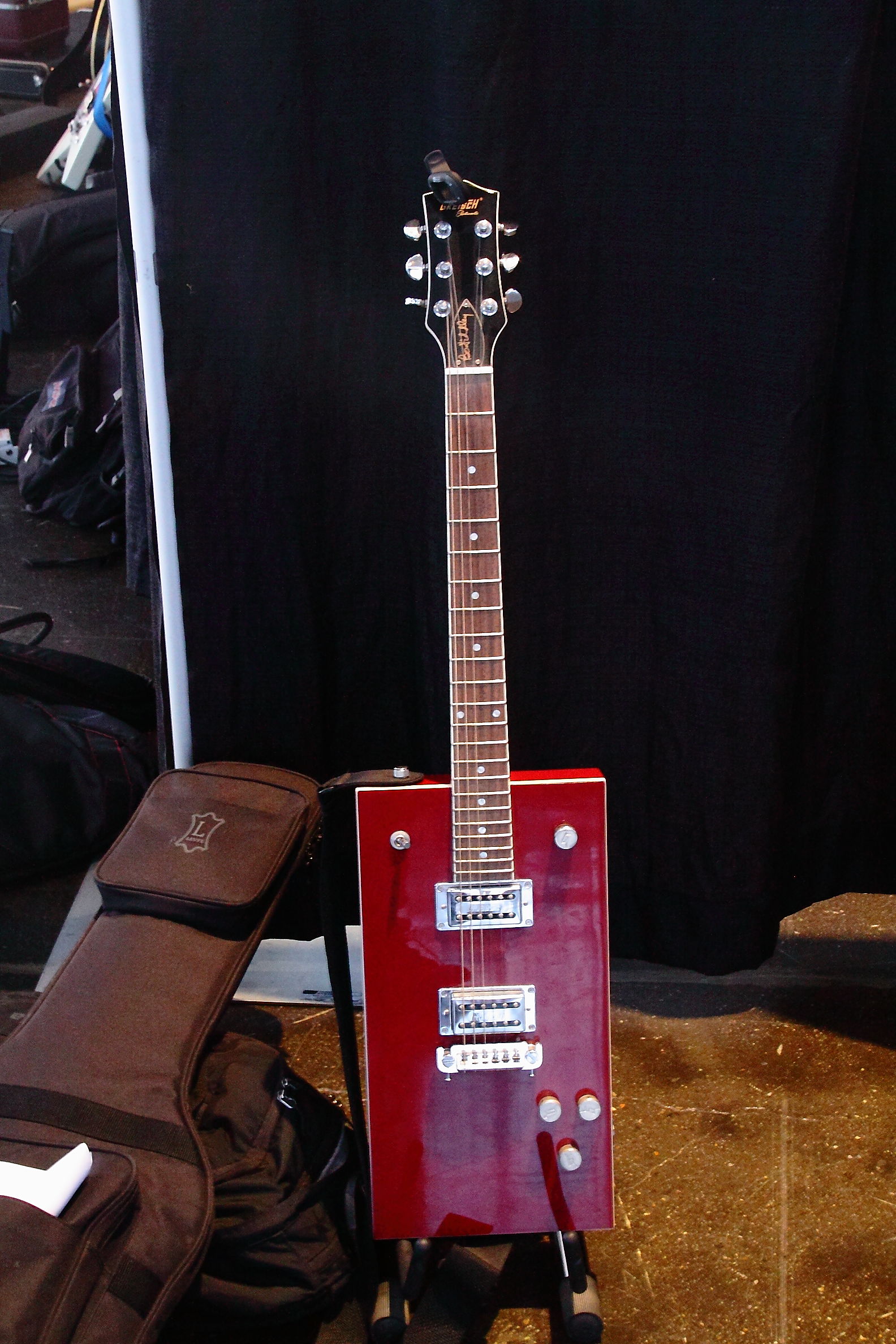
Lo and behold, the petals of the Secret Rose:

OMChathfinal0014

OMChathfinal0015

OMChathfinal0016

OMChathfinal0017

OMChathfinal0019

OMChathfinal0021

OMChathfinal0022

OMChathfinal0023

OMChathfinal0025

OMChathfinal0026

OMChathfinal0027

OMChathfinal0028

OMChathfinal0029

OMChathfinal0030

OMChathfinal0031

OMChathfinal0032

OMChathfinal0033

OMChathfinal0034

OMChathfinal0035

OMChathfinal0037

OMChathfinal0038

OMChathfinal0040

OMChathfinal0045

OMChathfinal0049

OMChathfinal0044

OMChathfinal0074

As the sun set it was time to find my seat.

OMChathfinal0077

OMChathfinal0071

Secret Rose Blooms: Rhys Chatham at the Craneway Pavilion


Craneway Pavilion

Craneway Pavilion

On Sunday November 17th I attended one of the most unusual concerts in my experience.  The performance of Rhys Chatham‘s ‘A Secret Rose’ at the beautiful Craneway Pavilion in Richmond was produced by Other Minds and the eclectic bay area new music bloodhound Charles Amirkhanian.

Charles Amirkhanian speaking briefly to introduce the performance.

Charles Amirkhanian speaking briefly to introduce the performance.

Rhys Chatham is an American musician and composer who has spent much of his career in living in France.  He was a part of the New York post-punk downtown music scene in the 70s working with musicians like Glenn Branca, La Monte Young and Charlemagne Palestine.OMChathfinal0131

English: Rhys Chatham at Islington Mill, Salford

Sunday’s concert was the west coast première of this piece which is scored for 100 electric guitars, bass guitar and drum kit.  It is sufficiently complex as to require at least 3 conductors in addition to the principal conductor (Chatham).  In this respect it brings to mind the work of Charles Ives and Henry Brant.  But this music resembles neither of these composers, at least not precisely so.  Beginning with his work with drones and harmonics Chatham has developed compositional techniques and honed them to a point of mastery.  The multi-movement work was microtonal, polymetric, aleatory/improvisatory, dissonant, melodic and enthralling.  Did I mention that it was loud?  No?  Well loudness may be the most obvious aspect of this music but that loudness is organic to the music.  The volume paired with the very live acoustics of the cavernous performance space elicited a wide range of harmonics which, through Chatham’s skillful techniques evoked a variety of timbres.  (Complementary ear plugs were provided.  I took a pair but did not use them.)  I heard guitars, certainly and drums and bass.  But at times it sounded like there were brass instruments and even vocals.  (I swear I heard words being sung.)

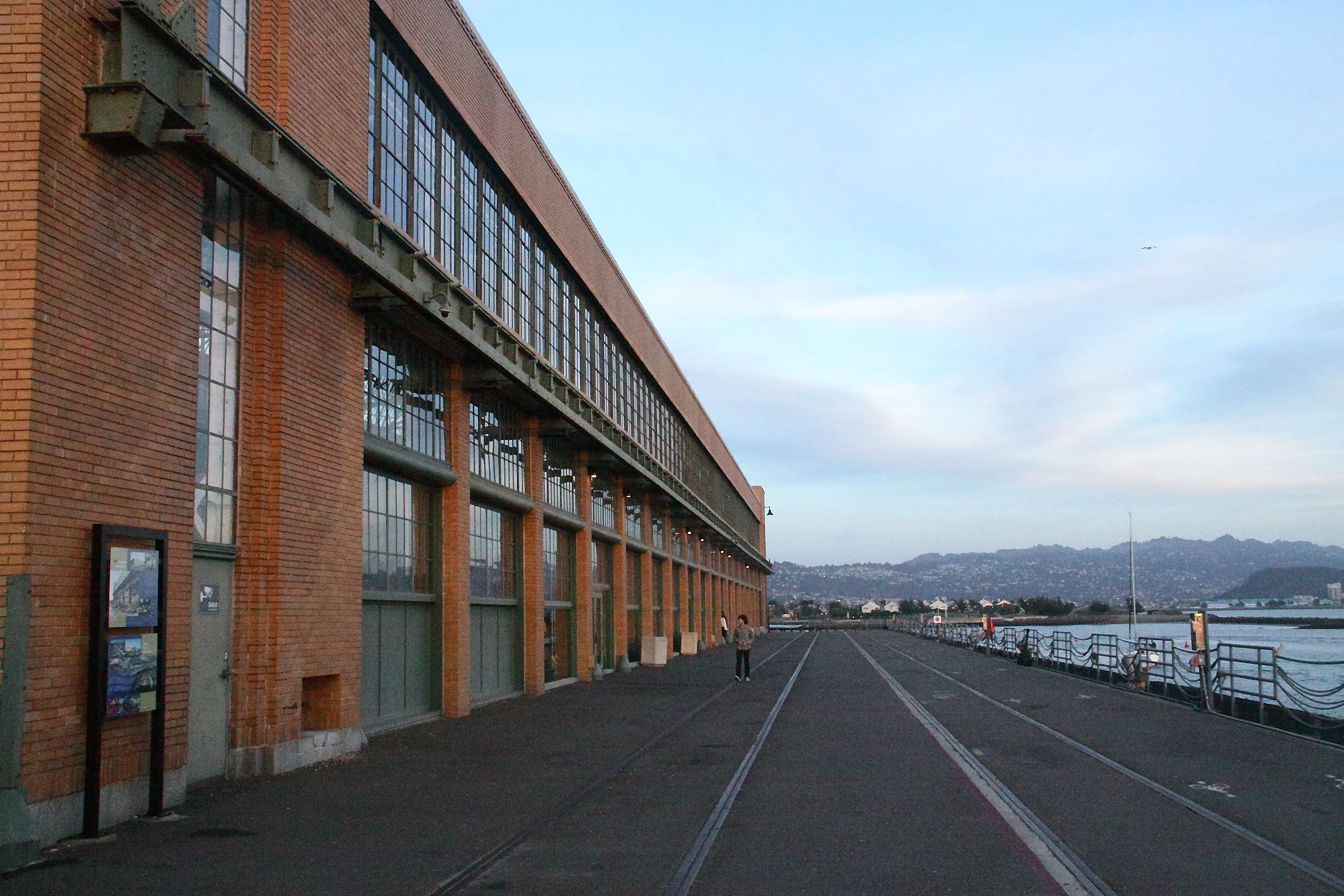
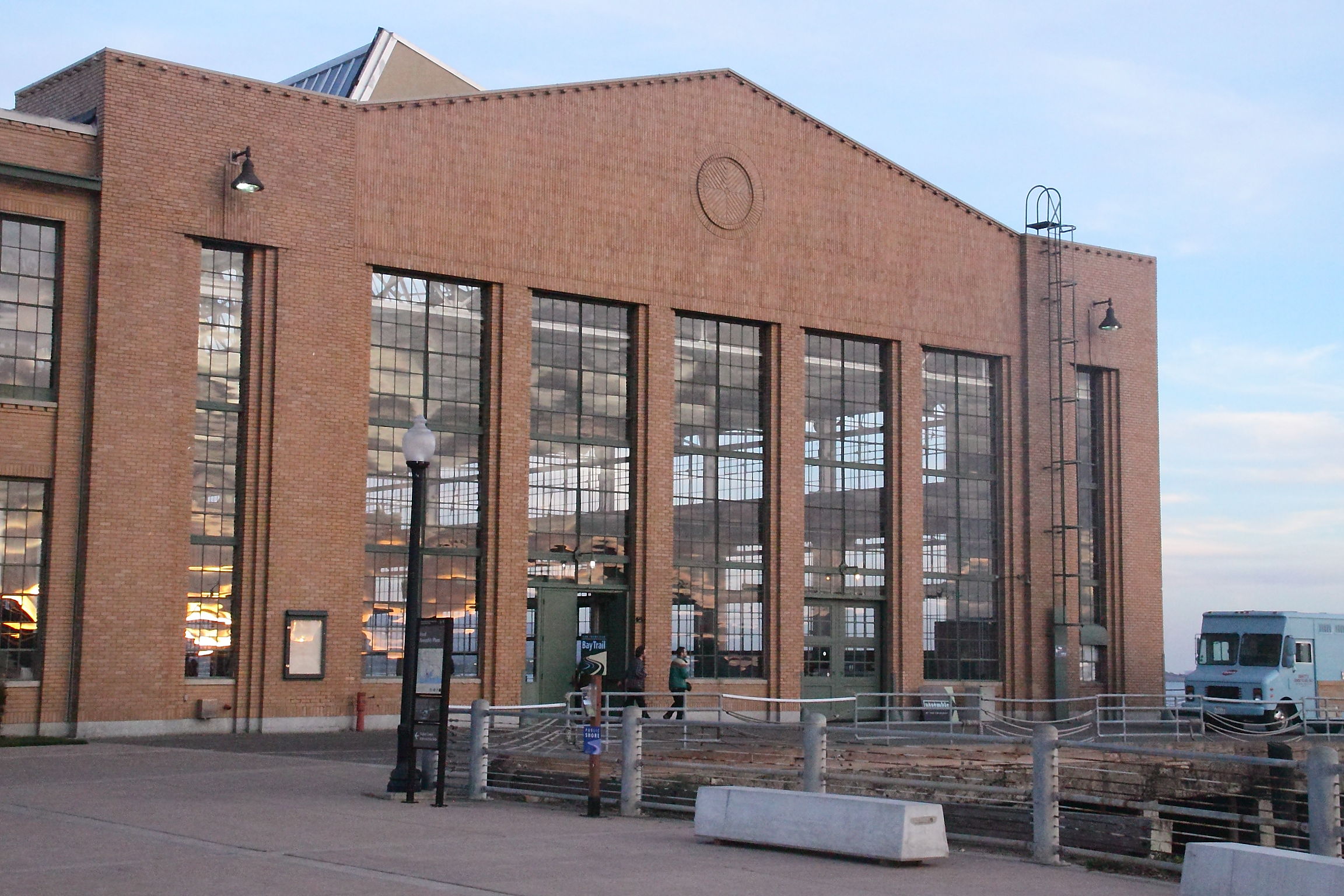
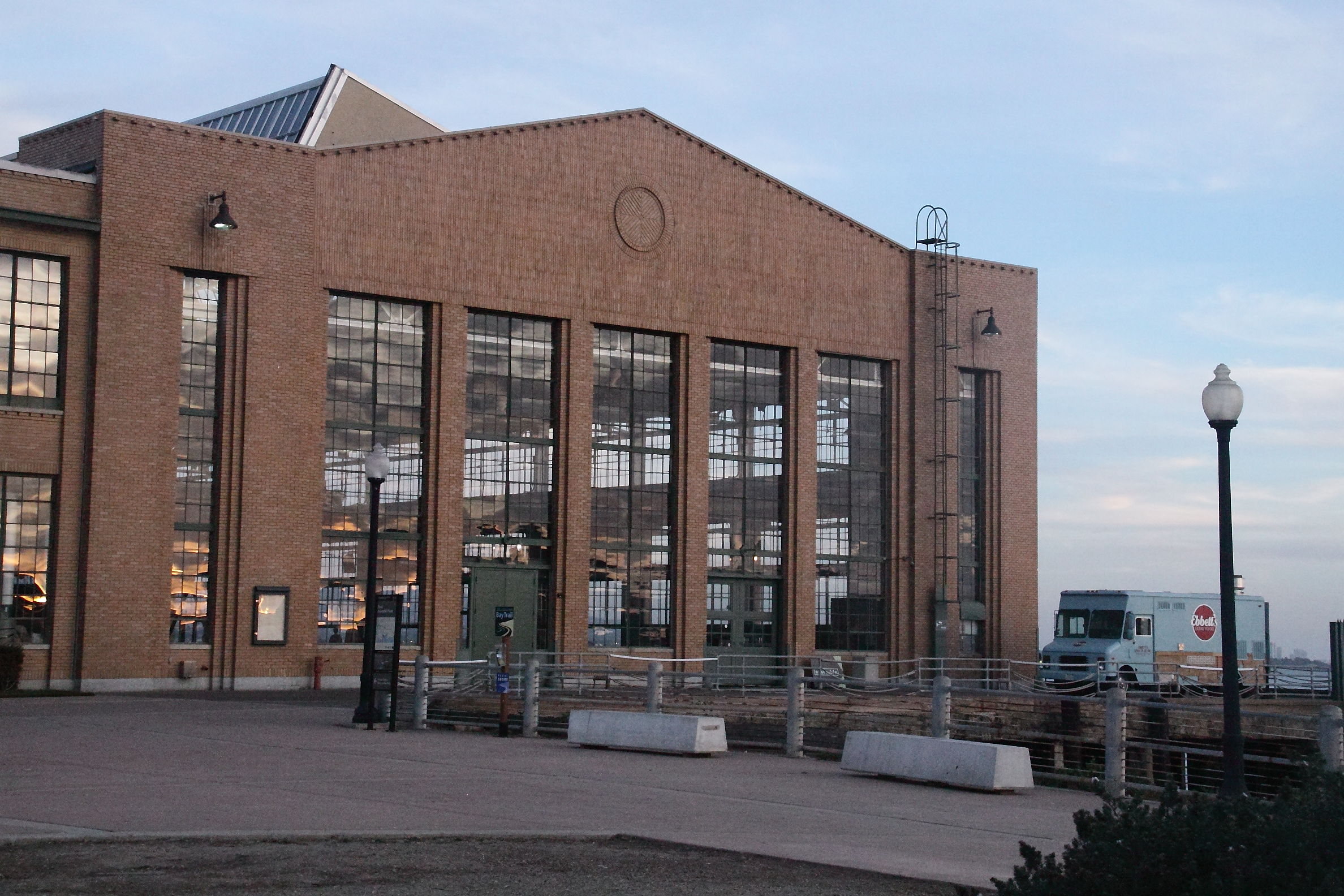
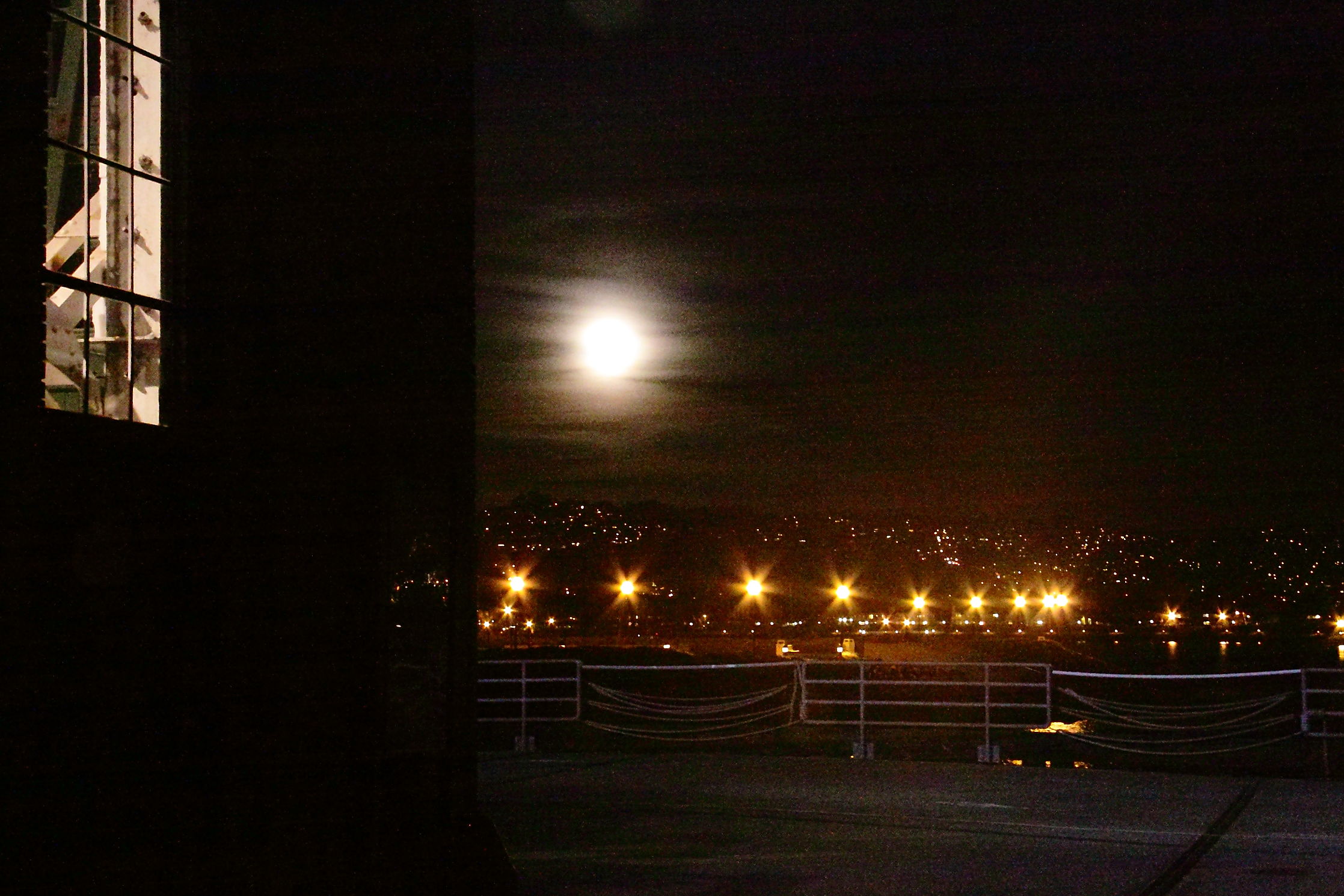
Craneway Pavilion is a 45,000 square foot former Ford assembly plant that was remodeled for use as a performance space and conference center.  Its size and waterfront location remind me of Chicago’s ‘Navy Pier’ on  the lakefront.  Craneway is on San Franciso Bay and faces south with a view of the bay bridge eastern span as well as views of San Francisco.  The appearance is that of a large loft space with metal beams and a general industrial appearance.  Its floor, walls and ceiling are surfaces that are highly reflective of sound and therefore ideal for this performance.  As promised in the promotional materials the full moon rose in the east over the bay before the performance began.

Full Moon rising over the bay just before the performance.

Full Moon rising over the bay just before the performance.

Looking toward the seating and the stage in the performance space at Craneway Pavilion.

Looking toward the seating and the stage in the performance space at Craneway Pavilion.

Chatham’s music was not about complexity for the sake of complexity.  His compositional strategies required the complex goings on we heard on Sunday.  The room itself became a sounding chamber itself amplifying, canceling and propagating the swirling harmonics that resulted from specialized tunings in addition to the other techniques mentioned.OMChathfinal0101

OMChathfinal0100

The multiple movements ranged from drone-like structures to more rhythmically complex sections and even melody.  Yes, melody. Chatham writes catchy melodies and motives that sound like they’ve been taken from one rock album or another.  Sonic gestures evoked impressions of Ozzie Osbourne, Eric Clapton, and many others depending on your personal listening experiences.  This music was ritual as much as expository.  His techniques were not limited to rock music but extended to free jazz and classical techniques as well.  Taken as a whole the piece was a multi-movement symphony, each movement sustaining its own argument in service of the whole.  For the finale Chatham set aside his conductor’s baton and picked up his guitar, not for a solo as one might expect in an ordinary concert, but to participate in the ecstasy of performance.

Chatham conducting.

Chatham conducting.

It is tempting, if a bit cliché, to suggest that this ritual music stirred the ghosts of the past.  While standing in the ticket line one gentleman said to me, “I walked out of a Jimi Hendrix concert in 1967 because it was too loud”.  Almost immediately someone else said, “I was at that concert…”.  Perhaps the Grateful Dead, Jefferson Airplane and Pretty Things were stirred from their slumbers.  They were certainly evoked.  I don’t know if the aforementioned gentleman ultimately stayed for the performance but I suspect he probably did, maybe in honor of Jimi.

Chatham playing guitar in the finale of 'A Secret Rose'

Chatham playing guitar in the finale of ‘A Secret Rose’

The crowd was several hundred strong ranging in age from about 5 to 85.  Most appeared to be enjoying this loud and driving rhythmic composition.  Some rocked or nodded to the beat.  Some sat entranced and/or perplexed but attentive.  At the end there was a standing ovation and, from Mr. Chatham, a welcome encore featuring seriously de-tuned guitars.

The encore piece was also captivating and inventive though certainly not as long.   Chatham’s music is not easy to categorize or describe.  Even having heard a fair amount of his music on recordings over the years I could not have anticipated what I heard at this concert.  I now understand how some music cannot be adequately represented even by our best recording technology.

I’m not sure of the significance of the title but it does bring to mind William Butler Yeats’ book, ‘The Secret Rose’.  Its stories steeped in Irish mythology are introduced by an opening poem which reads in part:


Far of, most secret, and inviolate

Rose,

Enfold me in my hour of hours; where

those

Who sought thee at the Holy Sepulchre,

Or in the wine-vat, dwell beyond the stir

And tumult of defeated dreams; and deep

Among pale eyelids heavy with the sleep

Men have named beauty.

OMChathfinal0140

OMChathfinal0138OMChathfinal0141

Not Another Minimalist! (NAM): New and Lesser Known Minimalists


Philip Glass portrait

Philip Glass portrait (Photo credit: DailyM = Differentieel + JeeeM)

I have been a fan of so-called minimalist or pattern music for quite a number of years.  Since my first encounter with this type of music in the late 1970s I have listened with interest and been fascinated to hear how each composer expressed their own voice within that general rubric.  Though many have eschewed the label ‘minimal’ and argued over the alternate label ‘pattern music’ there are recognizable characteristics which continue to bind, however loosely,   Perhaps that is just another way of saying that I “know it when I hear it” but I think readers tend to get the general idea and I am open to discussion on what music I should include or exclude from these categories.

Kyle Gann

Kyle Gann (Photo credit: Wikipedia)

Anyway the point of this rambling little  post is to introduce a recurring series of posts about my personal discoveries in said genre.  You can be assured that I have scoured high and low but lay no claim to being either definitive or comprehensive.  What will follow will be an ongoing series of posts identifying the music of one composer or group whose music sounds minimalist or pattern based at least to my ears and which I find pleasing and/or significant in some way.  I will head each post with the identifying acronym NAM (Not Another Minimalist!).

Michael Nyman in Sant Cugat del Vallès

Michael Nyman in Sant Cugat del Vallès (Photo credit: Wikipedia)

The most useful books for me on this subject for me are those by Kyle Gann, Tom Johnson, Michael Nyman, Wim Mertens and Robert Fink.  I am listing these as my primary influences and do not mean to discount important works by other writers on the subject.  Gann’s ‘American Music in the Twentieth Century'(1997) and the collection of articles, ‘Music Downtown'(2006) remain among the most lucid descriptions and analyses of minimalist music.  He also maintains a blog with pretty regular posts at (http://www.artsjournal.com/postclassic/).  Gann’s work might not have been possible without the work of fellow composer and journalist Tom Johnson whose collection of reviews, ‘The Voice of New Music’ (1991) is one of the most important collections of reviews of the burgeoning ‘downtown music’ scene in New York in the 70s and 80s where purveyors of this genre first displayed their wares .  Both ‘Music Downtown’ and ‘The Voice of New Music’ are collections of reviews of concerts and events written for the Village Voice.

UCLA professor and music critic Robert Fink on...

UCLA professor and music critic Robert Fink on the “Different Strokes” panel at the 2009 Pop Conference, Experience Music Project, Seattle, Washington. (Photo credit: Wikipedia)

Michael Nyman’s book, ‘Experimental Music: Cage and Beyond'(1974) is among the earliest to describe this music and its context.  Wim Merten’s ‘American Minimal Music'(1988) is a great analysis of the essential canon.  Unfortunately these have been difficult to find lately and hopefully some reissues including digital formats may be forthcoming.

Robert Fink is a musicologist at UCLA.  His book, ‘Repeating Ourselves’ provides one of the most wide-ranging and comprehensive analyses of the concept of minimalism and pattern music.  He works across all music genres and cultural practices to identify a sort of minimalist ethic and has done much to shape my thinking in this area.

There are certainly many other fine books on the subject and that itself may need to be the subject of a future post.

I don’t like all music in this category (or any category for that matter) but it is the one which feels kind of like a personal discovery to me and a genre that continues to interest me.   And I can report that there is a good deal of music  outside the classic canon of minimalism that is definitely worth the effort to find.  And there are pieces of music written before the 1960s which appear in hindsight to have been sorts of precursors to this style.

This will be an occasional series of posts and I have decided to gather them under the somewhat facetious acronym of NAM (Not Another Minimalist) for the sake of easy reference should any reader actually find these posts useful.  My intent is both to share my discoveries and to generate debate and comment about this type of music.  I want to explore and share artistically interesting developments that lie outside the Reich/Glass/Riley/Young canon of minimalism.  As always I welcome discussion and feedback.

In the Mood for Food, a unique underground dinner/concert series returns to the east bay


The door is open to the underground restaurant.

The door is open to the underground restaurant.

This past Monday October 7th there was a gathering of twelve people at a small loft space in West Oakland.  This is not a neighborhood known for about anything but light industry and cheaper rents.  But there are gems to be found in nasty old Oakland, CA and this is one of them.  It was the return of an irregular (approximately monthly) series of dinners and dinner concerts hosted by local vegan caterer and chef extraordinaire (and shakuhachi teacher as well) Philip Gelb.  These concerts, according to Mr. Gelb, were inspired by the Creative Music Studio which flourished in Woodstock, New York from 1971 to 1984 which featured many of the brightest and most innovative musicians in jazz, free improvisation and experimental music.  But the inclusion of such high quality creative cooking is unique here.

View through a glass, lightly.

View through a glass, lightly.

It has been many months since he last hosted one of these at his loft space.  Phil has chosen to combine his substantial cooking talents with his interest and connections with the music community to create this unique blend of freshly shopped and created vegan dishes with local and visiting musical talent.  This series, dubbed “In The Mood for Food”, is named after one of his favorite films, “In the Mood for Love” by Wong Kar-Wai.  The series has occurred more or less monthly for the last 8 years. To date I have enjoyed the creative and varied multi-course meals (which are frequently themed to the season or to the performer’s preferences) and have enjoyed both dinner conversation and performances by Pauline Oliveros, Terry Riley, Stuart Dempster, Gyan Riley, Tim Rayborn, Michael Manring, Barre Phillips, Mark Dresser, Amy X Neuberg and Pamela Z to name just a few.

The meals are always multi-course, locally created, sourced and shopped meticulously by Phil himself.  He serves only farm fresh ingredients, never canned or packaged and the recipes are his personal creations.  Food is served by the chef and one or two assistants depending on the size of the audience (maximum capacity is about 20 people).  Cost ranges from $40 to $60 per person, about what you would pay at a good area restaurant.  The musicians are either people with whom Phil has collaborated or found by word of mouth from other musicians and friends.  He has had many musicians call him to ask if they can play at his venue.  Why would that be?  There is no significant publicity or profit to be had here.  The answer, I believe, is the intimacy which is a combination of the loving creation of both food and music, both raised to an art form by their execution as well as their content.

There is reportedly a cook book in the works which, in addition to many carefully tested vegan recipes, will tell some of the history of this series.  Phil is occasionally soliciting recipe testers via Facebook.  He is also known for his hands on cooking classes.

As it happened, Monday’s event did not include music but it did include some familiar faces who I frequently encounter at these dinners as well as an overall interesting collection of guests who make for great conversation and frequently share their BYOB offerings.  In fact the bartender from the great San Francisco vegan restaurant, ‘Millenium’, asked to attend and to prepare some delicious cocktails specially designed by him and incorporating some of the food ingredients to enhance the experience.  Two of the guests were the operators of a local new tempeh making business called Rhizocali and their superior product was featured in the night’s food offerings.

Unfortunately I forgot to get a picture of the wonderful dessert course which consisted of pumpkin waffles, spiced pumpkin sorbet and maple tea poached pears.  Characteristically the attentive chef went around offering more scoops of the refreshing pumpkin sorbet which no one appeared to refuse as they engaged each other in pleasant conversations.  It is good to have this series back again and, well, let’s just say no one walked away unsatisfied.

Appetizer- Fresh rice noodles wrapped with apple smoked tofu and miso glazed, grilled pumpkin hijiki salad

Appetizer- Fresh rice noodles wrapped with apple smoked tofu and miso glazed, grilled pumpkin hijiki salad

First course- Kim chi soup with rice cakes, homemade kim chi in a seaweed/pumpkin broth and a little side dish of Pumpkin tempura brushed with gochujang

First course- Kim chi soup with rice cakes, homemade kim chi in a seaweed/pumpkin broth and a little side dish of Pumpkin tempura brushed with gochujang

Entree- Dumpling pumpkin stuffed with Thai red curry with Rhizocali Tempeh, gai fan, snap peas and Thai eggplant; jade pearl rice, green mango salad and lotus root pickles

Happy diners chatting after a fantastic dinner.

Happy diners chatting after a fantastic dinner.

Guitar Gods Go Classical? Give them a ‘Secret Rose’


Cover of "Crimson Grail"

Cover of Crimson Grail

The implicitly condescending appellation “Guitar God” has been perhaps somewhat jealously applied to virtuosic guitarists in various popular rock bands. Whether your taste runs to Eric Clapton, Jimmy Page, Jimi Hendrix or Eddie Van Halen you cannot discount the technical skill of these and so many other rock/pop guitar players.

Rock and pop artists have distanced themselves from the classical music circles who initially disdained and even condemned their work. But that did not and does not mean that they eschew classical music. Many were initially schooled in classical performance technique and/or were provided a favorable view of some classical masterpieces.

Ian Anderson’s group ‘Jethro Tull’ utilized a movement from a Bach Lute Suite (taking a few rhythmic liberties) in their piece, ‘Bouree’. Roger McGuinn of ‘The Byrds’ acknowledged channeling Bach when he created the now instantly recognizable intro to their version of Bob Dylan’sMr. Tambourine Man‘. Rick Wakeman, keyboardist of the band ‘Yes’ as well as a solo artist peppers his work with snippets of classical melodies no doubt learned in his piano lessons that served him so well. Keith Emerson of ‘Emerson, Lake and Palmer‘ went as far as to write a piano concerto.

From the classical side of the aisle there have been composers who wanted to utilize some of the techniques and ideas of rock and pop within the context of their classical training. Stanley Silverman wrote an opera titled, ‘Elephant Steps’ which was championed by the ever eclectic Michael Tilson Thomas. (This piece deserves at least a second hearing and I hope that Columbia will some day release it as a CD.)

Leonard Bernstein, no stranger to popular musical theater, embraced rock and blues including such ensembles alongside the orchestra in major works such as his ‘Mass’. Similar, though less successful collaborations occurred when symphony orchestras were added to the production of albums by the likes of ‘Deep Purple and, more notably, ‘The Moody Blues’.

Many such collaborations have been and occasionally continue to be attempted but the end result most often appears to keep the division between classical and ‘pop’ rather separate. That is not necessarily a bad thing either. Philip Glass‘ work appears to have been pretty heavily informed by rock music. He played piano in a couple of tracks on one of the New York punk rock band, ‘Polyrock’. The driving rhythms of rock are endemic to much of Glass’ music. Steve Reich’s work as a jazz drummer seems to be evidenced in his intricate use of rhythm patterns in his music.

So while ‘pop’ musicians incorporated some of their classical training and influences and ‘classical’ musicians acknowledged and collaborated with their pop counterparts the classical aspects remained for better or worse more decorative than organic. Jazz became an organic part of many classical works starting in the 1920s. And, as mentioned before, rock influences have certainly found an organic role in the music of Philip Glass and, more recently in the music of Michael Daugherty.

Along came Glenn Branca, Rhys Chatham, Jeffery Lohn and their various collaborators. These musicians with strong roots in rock music began to explore what has become, in this writer’s opinion, the epitome of the organic implementation of classical music into the ‘pop’ medium. Using primarily guitars (in ever-increasing numbers) as well as drum kits and the usual accoutrements of rock bands these musicians began writing music that is definitely not pop or rock (neither does it actually resemble classical at times).

English: A self-portrait photograph by and of ...

English: A self-portrait photograph by and of Rhys Chatham. (Photo credit: Wikipedia)

Branca who had worked with Jeffrey Lohn began writing his Symphonies in the 1970s. They now number 12 or 13. Working with multiples of guitars, modified keyboard instruments, alternate tunings and basking in the glory of loud he has created an arguably classical set of works grown out of clearly rock/pop beginnings.

Rhys Chatham, a trumpet player initially, worked with Branca and Lohn for a while and began to develop his own classical path within the rock ethic. Beginning with Guitar Trio (1977).   And continuing into increasingly massive multiple guitar works he has created another distinct set of works that are clearly not rock or pop. He does not use the classical form titles like ‘symphony’ favored by Branca but these pieces like, ‘An Angel Moves Too Fast to See’ and ‘Crimson Grail‘ feature large numbers of guitarists which by necessity must be locally sourced. Even without classical form or titles these are clearly not pop or rock pieces. And perhaps they can’t be called classical either but they are certainly of symphonic proportion.

Both Branca’s and Chatham’s works have been recorded and I highly recommend the recordings. But these musics cannot be fully captured by current recording technology. The acoustics of the space in which they’re performed and the volume levels which elicit their own effects are best experienced live because of the volume levels and also because of the overtones which are elicited by the instruments in the performing space and more audible because of the overall volume and the characteristics of the listening space.

Such a rare opportunity awaits Bay Area audiences this November when Rhys Chatham comes to town under auspices of ‘Other Minds’ and the delightfully insightful and eclectic producer Charles Amirkhanian. They have engaged the architecturally and sonically fascinating space of the Crane Pavilion in Richmond (a few miles north of Berkeley and Oakland) with sweeping views if San Francisco Bay and enlisted many locally sourced musicians to produce the west coast premiere of Chatham’s “A Secret Rose” (2011) for 100 guitarists.

Official Other Minds logo

Official Other Minds logo (Photo credit: Wikipedia)

Tickets can be purchased through the Other Minds website (www.otherminds.org).

This is a rare opportunity to hear a uniquely different music in a visually stunning and acoustically interesting space.  Hope to see you there.