Two Sono Luminus Discs of New Music by Icelandic Composers (mostly)


DSL- 92267

There are, by my count, at least 8 discs on this fine audiophile label dedicated to music by composers from Iceland. That country’s musical prowess deserves to be better known as does their world class orchestra. I’m reviewing these back to back releases together because they are both Iceland Symphony recordings presenting new music by (mostly) Icelandic composers. And they have a secret connection.

This first disc is a nice mix of music by five different composers in works that really give the orchestra an opportunity to shine. Under the direction of composer/conductor Daniel Bjarnason we are availed of the sound of now, or at least Bjarnason’s “now”.

Track list

This disc, which seems to have a “outer space”theme in large part, opens with a large orchestral work from the most deservedly best known Icelandic classical composer, Anna Thorvaldsdottir. “Catamorphosis” is a 20+ minute work for full orchestra and then some. Her style initially reminded this listener of the sound mass of music like Ligeti and Penderecki. But her harmonic language is more lush and romantic. She has an astounding skill in writing for large orchestra, producing at times the modern equivalent of Impressionism. Her use of motives suggest she has digested ideas from minimalist/pattern composers. And at the end of the day (or the review), one realizes that she has developed her own voice.

The subtle colors of this work are well defined by the orchestra under Bjarnason’s truly expert guidance but also via the sonics that the Sono Luminus engineers are able to capture. This sounds like a difficult work to perform but Bjarnason manages to create a definitive performance and Sono Luminus’ sonics are, as always first rate.

Catamorphosis (2022) is typical of Thorvaldsdottir’s writing for large orchestra reflecting her skills as an orchestrator as well as her imagination, her ability to create a wide palette of subtle sound forms that suggest a sort of post impressionist style. The poetic and metaphorical titles tell little about the musical content (or structure for that matter). But her ability to create cohesive and compelling compositions such as this provide an experience that will likely evoke images for the listener, a sort of movie for the mind. So feel free to conjure your own images in this 7 part (played without pause) work and/or listen and watch a recent Elephilharmonie performance on YouTube here.

Missy Mazzoli’s comparatively brief “Symphony for Orbiting Spheres” (2014 rev 2016) taps into a vein of inspiration seemingly related to the cosmic images of Thorvaldsdottir. Mazzoli incorporates an electronic keyboard and harmonicas, among several less common instruments used in symphony orchestras, to create her own sonic cosmic fantasy. Please click the link on her name above to learn more about this rising star from her nicely designed website.

Daniel Bjarnason demonstrates his own formidable compositional chops with “From Space I Saw Earth” (2019). And this track also provides a link of sorts to the other album reviewed in this blog entry. This work, written on commission for the 100th anniversary of the LA Philarmonic, is a work that requires three conductors. The premiere was led by Zubin Mehta, Gustavo Dudamel, and Esa-Pekka Salonen, all of whom have significant connections to the orchestra (Mehta as conductor Emeritus, Dudamel as present chief conductor, and Salonen as conductor laureate). That was the premiere but this recording is conducted by Bjarnason along with Kornilios Michalaidis, and the then incoming chief conductor of the Iceland Symphony, Eva Ollikainen. Therein lies the “secret connection” to which I referred earlier.

María Huld Markan Sigfúsdóttir (1980- ) is a violinist and composer. Her orchestral work, “Clockworking” is a sort of post minimalist work with a gently driving Ostinato in the percussion. It reminds this reviewer variously of Birtwistle’s “Chronometer”, Ligeti’s “Poeme Symphonique”, to name a few but it is not derivative of these in any way. It is a very listenable and enjoyable orchestral work.

Bára Gísladóttir (1989- ) is a composer, vocalist, and double bass player based in Copenhagen. This, the briefest work on the album is at times the quietest and at others the loudest work here. I would add that it is also the most avant garde. Relying on a battery of percussion and what appears to be some extended instrumental techniques the composer creates a world that to this reviewer’s ears sound a bit like Gyorgy Ligeti’s work “Atmospheres” (1968). That’s not meant to say it’s derivative, just that it could conceivably be used for that famous psychedelic sequence from Stanley Kubrick’s masterful “2001, A Space Odyssey” where my own young ears first heard the Ligeti work.

DSL- 92268

As fabulous as that first disc is, this release, dedicated entirely to the work of Anna Thorvaldsdottir, is a worthy endeavor. In addition to that we are treated to the sublime and insightful artistry of the first female principal conductor of the Iceland Symphony, Eva Ollikainen who leads the Iceland Symphony on this disc.

Like the above release, the Iceland Symphony Orchestra demonstrates their world class artistry. This is not easy music to play but, under Ollikainen, as they have under her predecessor, they are able to articulate the intricately orchestrated sounds by this really astounding composer.

Just two works here. “Archora” (2022) and “Aion” (2018). Both are works of grand concept and could easily be called symphonies but the composer seems fond of metaphoric poetic titles. Regardless of the names given these works they demonstrate the composer’s grand sonic visions and her mastery of the orchestra, a mastery grasped very clearly by the Iceland Symphony’s new artistic director and conductor, Eva Ollikainen (1982- ). She holds the distinction of being the first woman to hold the post to which she was appointed in 2019.
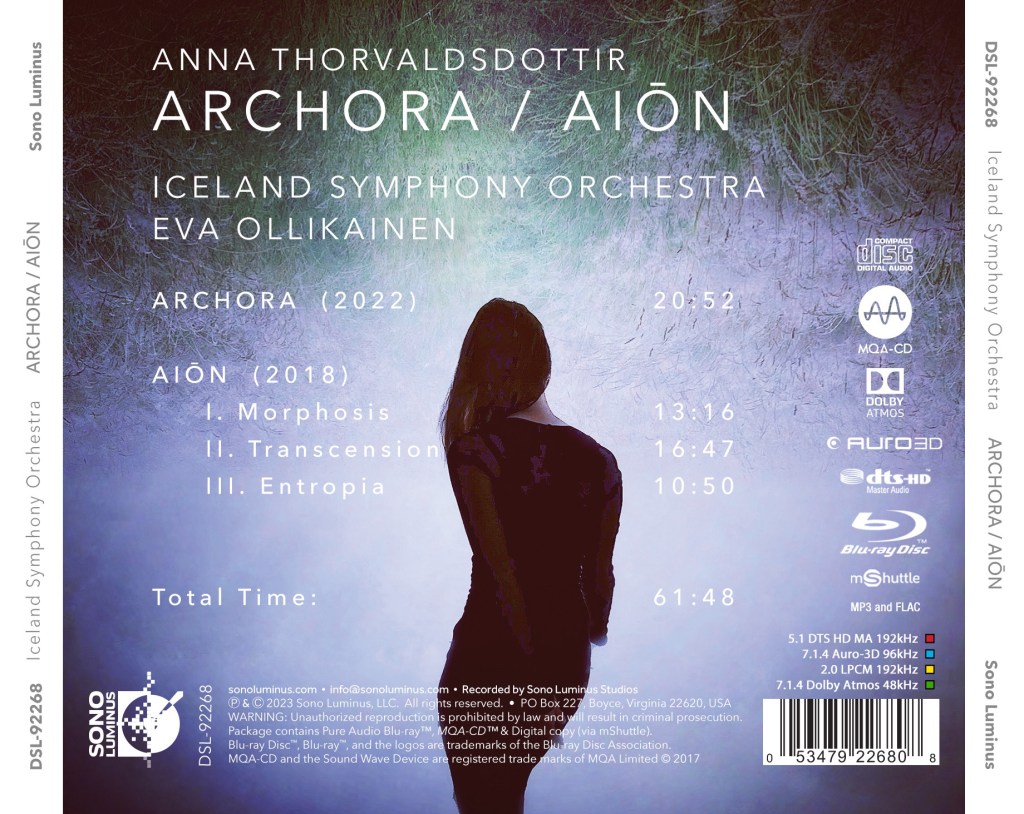
Track list

There are only two works presented but both are stunning examples of some of the finest new music being produced today. Yes, it’s great to see women having a greater presence (both as composers and conductors) but, truly, Thorvaldsdottir is “the bomb”, so to speak. Her creativity, her mastery of the orchestra are simply a revelatory as well as entertaining listening experience.
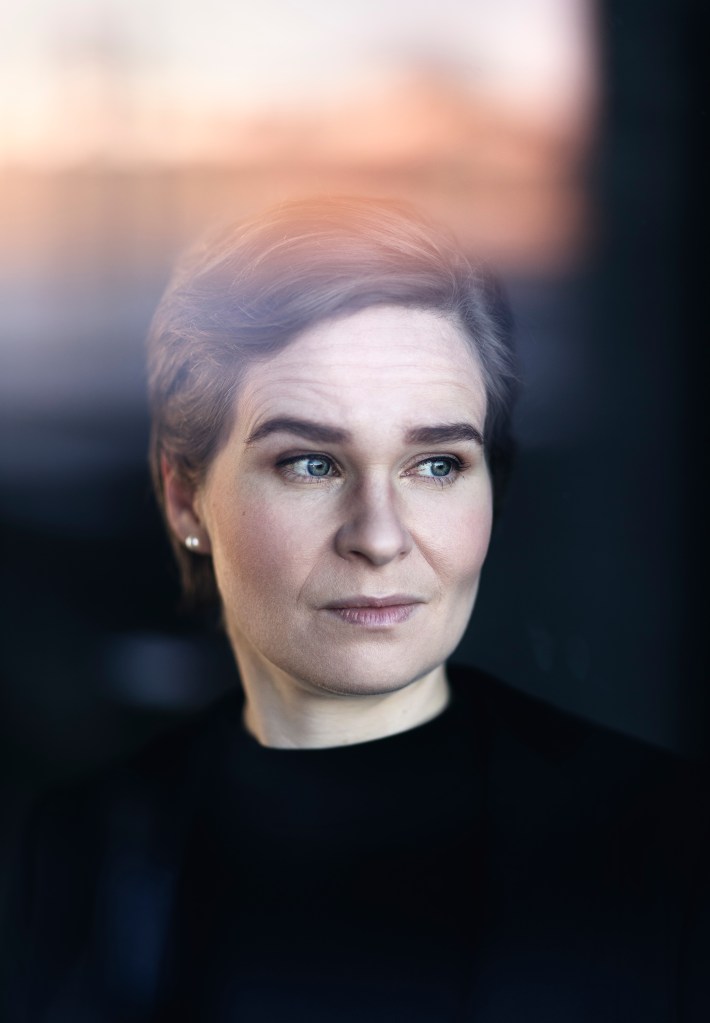
Eva Ollikainen

This release is also a landmark which showcases the formidable talent of the Icelandic Symphony’s new conductor. In addition to breaking gender barriers she is quite simply a rising star and one of the finest interpreters of new music today.

“Archora” (2022) is the most recent work here and it’s another of Thorvaldsdottir’s sprawling cinematic tone poems. No specific story here but the composer’s mastery of orchestral color will doubtless evoke images and feelings in the listener. Thorvaldsdottir is creating a sort of sonic (as opposed to literal) mythology. Her reference points seem to be largely in Greek and Roman mythology but also in Nordic and Northern European myths. Eva Ollikainen conducted the world premiere at the 2022 BBC Proms. You can hear that performance on YouTube here. But the Sono Luminus recording captures more of the subtle sound colors of this engaging work.

The composer’s three movement, “Aion” (2018) concludes this recording. Aion is a Greek God of time. The composer is concerned with various aspects of time in her work. This large three movement work is virtually a symphony with an augmented orchestra, extended instrumental techniques, and an optional choreographic accompaniment. (Tell me that’s not cinematic). There is an example of the optional choreography here.

This recording is also a fine introduction to conductor Eva Ollikainen who clearly has a grasp of this music. Various examples of her interpretive genius can be found on YouTube ranging from Beethoven to new contemporary masters.

These are two truly fine discs both musically and for sheer sonic detail. They’re available in streaming and hard copy CD as well as Blue Ray Audio. These are a fabulous listening experience. Enjoy!

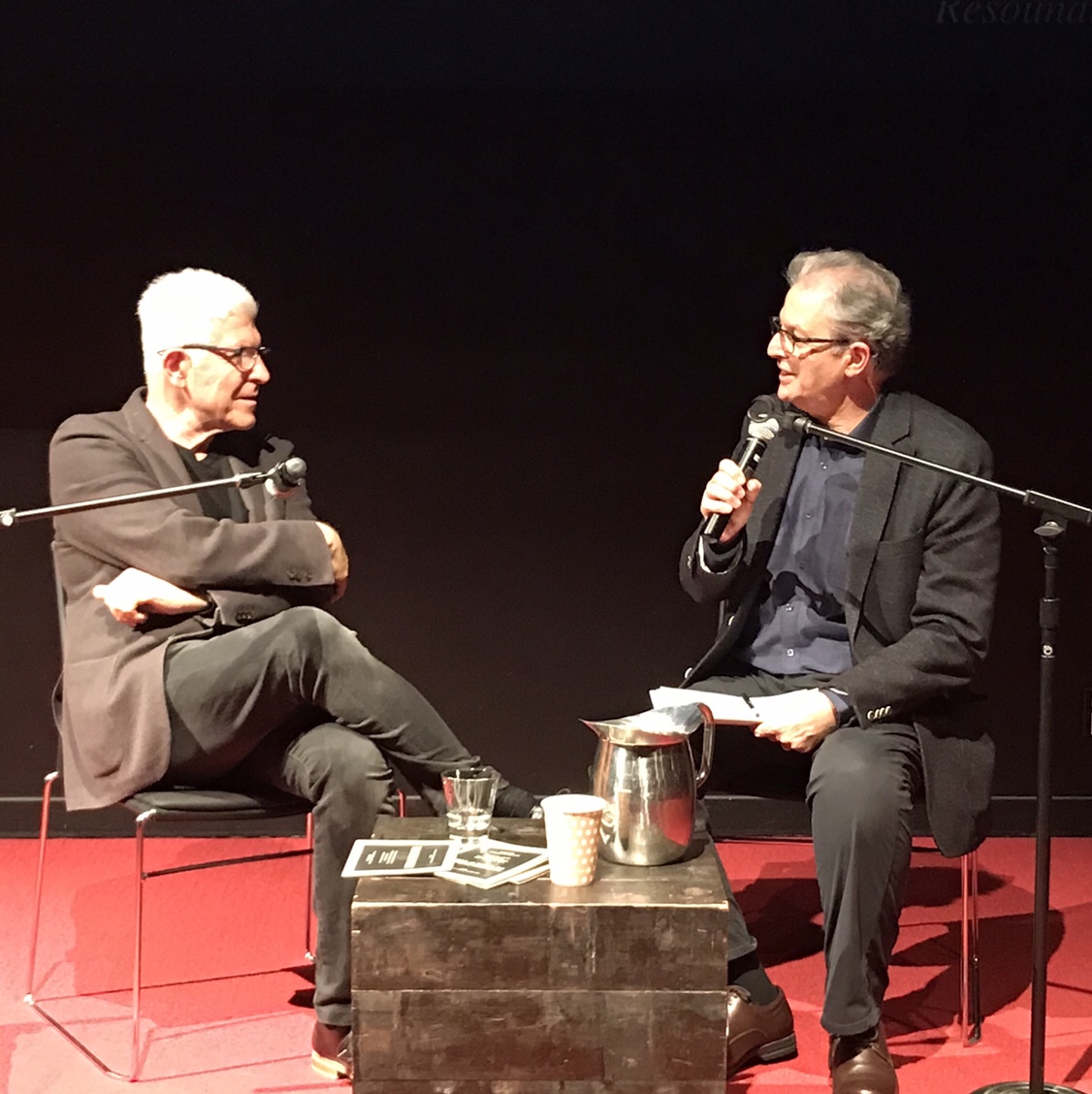
More Than the Ears Can Hear: Bill Fontana in Conversation


img_0200

Despite being possessed of a rabid and eclectic interest in all music I had not been aware of Bill Fontana until I found this presentation sponsored by Other Minds and curated by Charles Amirkhanian (whose radar seems to capture just about everything).  This entry into the Nature of Music series last night featured this artist who extends the very meaning of composition and the very reach of our ability to hear.

This series is hosted by the David Brower Center in Berkeley, CA.  The center is a state of the art environmentally friendly building which serves, appropriately, as a center for ecological awareness and hosts various organizations within its walls (including the Berkeley office of Other Minds) whose missions serve various environmental concerns.  The Nature of Music series attempts to address ecological concerns and indeed the featured artists have all demonstrated connections to the environment in various creative ways.

Bill Fontana (1947- ) is a San Francisco resident but his art takes him all over the world.  He presented audio and video excerpts from his installation works in Kyoto, Lisbon, San Francisco, London, and Iceland.  The basic concepts behind his work seem to be the extension of hearing and, to some degree, of seeing.  He uses multiple microphones and transducers to extract sound from objects such as bridges, bells (when not ringing), musical instruments (not playing), etc.  His multi-layered video experiments are at least partly analogous to this.

The first presentation was perhaps the most striking.  Fontana showed a video of an old Zen Temple bell which was just hanging there in a still video recording.  He had attached a sonic transducer to pick up the subtle vibrations of the bell as it reacted to the ambient sounds around it, something it had been doing for its entire existence (though no one knew until this).  He quipped that the monk whose job it was to care for said bell was somewhat anxious about what Fontana was doing.  When the monk heard the sound that this “silent” bell made he was astonished.  What one learns is that there are sounds made which our ears do not hear.

img_0199

Another “not ringing” bell in a New York tower revealed its reactions to its environment sonically and in a still video overlooking Manhattan from the high atop the lonely tower.

One installation involved 8 microphones arranged around San Francisco Bay which transmitted the sounds they captured to an installation of 8 loudspeakers located at Fort Mason.  The effect was of having ears that could hear all of these sounds which were so geographically distant that one pair of ears could not hear them in this way.  This 1982 installation is scheduled to have the recordings of those captured sounds from the original presentation played continuously in a permanent installation at Fort Mason.

Other installations included a bridge and a river in Lisbon and some hydrothermal installations in a couple of places.  What these all had in common was this extension of hearing (and vision) and how this increases one’s awareness of the environment both sonically and visually.  The artist acknowledged a passion for environmentalism and took the time to answer the questions of a medium sized but very engaged audience.

There are things in his work that echo the work of John Cage, Annea Lockwood (who appeared on a previous Nature of Music program), Pauline Oliveros, and any number of drone/noise composers.  But his vision is clearly a unique one and it was revelatory to have been able to hear/see this little exposition.  Fontana is truly a phenomenon whose roots fit comfortably on the west coast but whose vision is global.

It is well worth your time to peruse Fontana’s web site which is full of videos and sound files depicting his unique visions from various locations all over the world.  Fontana seemed a warm and unpretentious figure led all these years and still going with a child-like sense of wonder and a spectacular imagination.  All in all a mind-blowing and entertaining evening.

LA Percussion in High Definition


Having been a bit overwhelmed with a LOT of percussion recordings lately I placed this Los Angeles Percussion Quartet recording a bit further back in my review queue.  My apologies but I did it because I really wanted to give this recording my full attention and then to have something useful to say.

So I listened.  I put this on in my car when making a trip long enough to allow me to hear one of the two discs without interruption.  And I chose a relatively non-distracting drive in which I could actually pay attention to the music without incurring some danger on the road.

Of course the first thing that strikes the listener here is the lucidity of the recording.  Sono Luminus is showing off their signal processing prowess as well as their sensitivity with things like microphone placement and all the things that only great engineers know.

Let me make one thing very clear.  I am not a fan of sonic spectacle for its own sake.  I recall one incarnation of vinyl/analog fetish releases which a friend drooled over but whose content bored me to death.  Fortunately Sono Luminus seems to be steering clear of that sand trap.

This two disc set (well, three if you count the Blu-Ray Audio disc) collects music by largely little known composers (at least to these ears).  But fear not, this is not music that sounds like someone knocked over the stainless steel pot rack at Sur le Table.  Quite the opposite.  This is some intelligent music which compels the listener to stick with each piece and follow its development.  This is apparently the fourth album by LAPQ, the previous three also being Sono Luminus productions.

The first disc begins with the first of two Icelandic composers both of whom were represented on a previously reviewed discDaniel Bjarnason is a conductor and composer and his Qui Tollis, a work of wide dynamic range and a variety of moods from more assertive to more contemplative.  The second work is by the current darling of Icelandic classical music.  I am speaking, of course, of the very talented Anna Thorvaldsdottir.  Her work, Aura, is more consistently contemplative in nature and, like all her work, the listener is rewarded for paying close attention as she weaves magical impressionistic tapestries.

Memory Palace by Brooklyn based Christopher Cerrone piqued serious interest in this listener.  This man would seem to be a composer whose work deserves watching/listening.  This five movement suite for percussion indeed makes for compelling listening as he moves through a variety of moods and isn’t afraid of frank melodic invention during the journey.  This does not strike this reviewer as run of the mill percussion music (not that the preceding two works did either).  Rather this work suggests a distinctive compositional voice worthy of further attention.  Mr. Cerrone’s collection of awards including a Rome Prize and a runner up for a Pulitzer Prize suggests that he will be heard from again soon.

Fear-Release by Ellen Reid is a shorter though no less rewarding journey down yet another compositional path for percussion.  At just short of nine minutes this is a compact movement which relies on a fairly wide dynamic range and strategic use of silences and is a fitting close to the first disc.

The brief, rather poetic, liner notes draw a parallel between the multiplicity of languages found in the Los Angeles area and the multiplicity of musical languages found on this recording.  Indeed these are distinctive voices that extract a wide variety of sound from this percussion quartet.  This reviewer is somehow strongly reminded of Nexus, the Canadian percussion group which dominated the 1990s for a bit.  The similarity is in their enthusiasm and in their musical skills.  LAPQ is a distinct ensemble in its way and is a group that is not shy to be innovative.

I have to say, though, that I could have used a great deal more info and commentary on these compositions.  As one would benefit from multilingual dictionaries in Los Angeles the listener could gain much from learning more about the structure and intentions behind these fascinating compositions.  And, unless I have failed to find them (I looked closely) the liner notes carry lovely photos but fail to name the musicians whose sound was so lovingly preserved.  They are: Matt Cook, Justin DeHart, Nick Terry, and Justin Hills.

The concluding work coming in at almost 40 minutes is divided into tracks but is in fact one large movement.  It is probably the most contemplative work here though it has some pretty assertive moments.  I Hold the Lion’s Paw by Andrew McIntosh is a great show piece for demonstrating the range of these musicians.  Though continuous this piece delves through a variety of moods and uses apparently a wide variety of instruments as well.

Fans of percussion will love this disc as will fans of audio porn (there is something erotic about technology for the ears).  This is not easy listening and though seeking innovation makes no moves toward populism.  This is serious music making.


Recurrence: New Icelandic Orchestral Music


“Well I’ve never been to Iceland, but I really like the music.”  Please excuse the Hoyt Axton paraphrase but this music brings joy to this listener’s heart.

Wow!  Even as a writer with an avowed fondness for music from the Nordic regions I am pleased to say that I am just stunned at this recording.  This is all new music written in the last few years by Icelandic composers and performed by the Iceland Symphony which seems well prepared to handle these large works.

These seven tracks document five works by living composers and, I dare say, rising stars in the classical orchestral realm as well.  Only one of these composers is likely to ring a bell in all but a few listeners and that is Anna Thorvaldsdottir, probably the best known musician from Iceland since Björk.  And it is worth noting that three of the five works are by female composers.

There is a consistency in the large orchestral sounds from these composers that provide a unity for the listener and a challenge for the recording engineers.  In fact this is ideal to show off the sonic facility of the Sono Luminus label and the skills of producer Dan Merceruio and recording engineer Daniel Shores.  This is the sort of album that stereo salons use to show off the range of their amps and speakers.  It is indeed thrilling to hear and the better your sound system, the more exciting this will be.  Those blessed with Blue Ray Audio capability will doubtless get the best sound of all.  Both standard CD and Blue Ray Audio discs are included in this package.

In order of appearance the composers are: Thurídur Jónsdóttir (1967- ), Hlynur Vilmarsson, María Huld Markan Sigfúsdóttir (1980- ), Daniel Bjarnason (1979- ), and Anna Thorvaldsdottir (1977- ).  Bjarnason is also the very capable conductor of the Iceland Symphony in this recording.

The music, Flow and Fusion, bd, Aequora, Emergence (three movements), and Dreaming are not given composition dates but are presumably recent compositions by these young artists.  There are liner notes which are useful to the listener but the main point here seems to be the glorious sound.  One hears influence and/or homage to some of the great sonic experimenters of the late 1950s and 60s like Penderecki, Xenakis, Lutoslawski and probably some Icelandic composers whose works have yet to be heard outside of Iceland.

The album has the notation below the title of “ISO Project 1” so here’s hoping that there will be at least a second volume and that we be given the opportunity to hear more from the rich musical landscape of Iceland.  Bravo!  Brava!  Keep it coming.


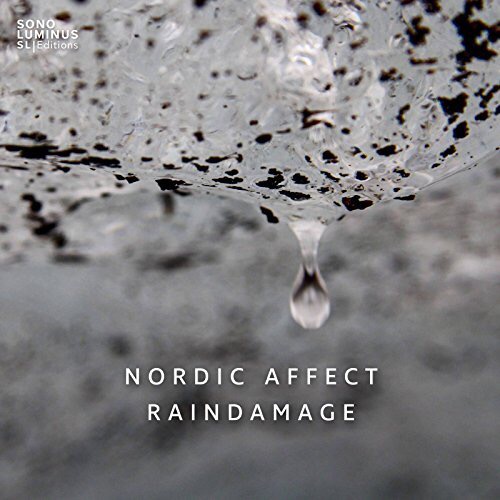
Nordic Affect: Raindamage, Wonderful Music from Iceland


Sono Luminus SLE-70008

Definitely an unusual beginning to this sonorous album of chamber music from the happy, creative place called Iceland.  Some of these tracks are electroacoustic combining some sort of electronic sound producing and/or manipulating components along with the live musical performance.

Nothing familiar here but a lot worth listening to.  This is a collection of recent chamber music from what is apparently some of the finest composers working in Iceland today. And as a Sono Luminus product it is a sound object of the highest order.  It is a beautifully recorded set of pieces that goes a long way to demonstrate the high quality and creativity of both the compositional and performance to be found in this distant corner of the world.

There are six works represented here.  Three are exclusively electronic, one for acoustic instruments with electronics and two are for acoustic instruments alone.  All seem to share the eclecticism of modern composers and, to this writer’s ear, a rather distinct style which seems to come out of the Nordic regions these days.

Iceland has a long and proud musical history and has amassed a large creative classical repertoire in (at least) the 20th and 21st centuries.  Perhaps one can hear the “sounds of the north” in these works or perhaps that is simply the analogous associations of this listener’s mind but there does seem to be some affinity between the lovely cover photograph of melting ice and some of the sounds herein.

At any rate this is fascinating music beautifully performed by Nordic Affect, a more or less fixed ensemble of violin, viola, cello, and harpsichord with occasional electronic supplementation.  Performers include Halla Steinun Stefásdóttir, Violin; Guòrún Hrund Haróardóttir, Viola; Hanna Loftsdóttir, Cello; Guòrún Óskarsdóttir, Harpsichord with Nava Dunkelman on drum in the last track.

The composers Úlfur Hansson, Valgeir Sigurðsson, and Hlynur Aðils Vilmarsson are completely unknown to this writer though it is noted that Hansson studied at Mills College in California, itself quite a hotbed of new music innovation.  No matter, though, these are some amazing composers doing cutting edge work and deserve your attention.

All in all this is one fine disc of chamber music.


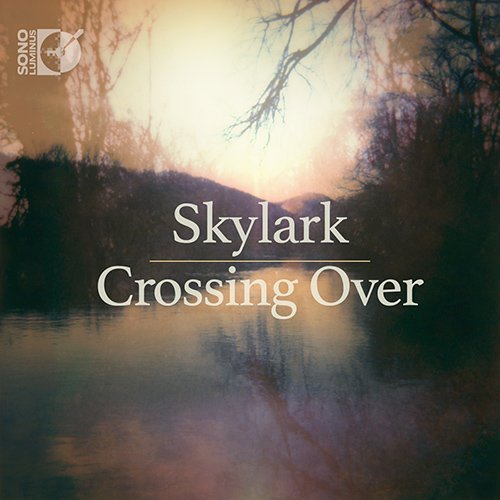
Skylark: Crossing Over, bringing the chamber choir to the mainstream


skylark

Sono Luminus continues their dedication to high quality performances and recordings of a wide variety of music from the 20th and 21st centuries.  In this lovely  disc we are treated to a great deal of interesting and very listenable a capella choral music from the mid-twentieth century to the present.

It is this reviewer’s perception that a capella choral music is somewhat of an outlier in the classical music field and is generally not as well known as solo instrumental, orchestral, chamber music and such. (Band music is a similarly neglected area which is not frequently explored by many composers and not as familiar to audiences.)   It is not an area very familiar to me but this recording appears to be one that can expand this niche considerably by virtue of the sheer beauty of these recordings.

There are eight pieces by seven composers of varying levels of familiarity.  The most familiar names here are those of the late John Tavener (1944-2013) and William Schuman (1910-1992).  (Schuman was also no stranger to writing for band music.)  Some listeners may have heard of Jon Leifs (1899-1968), an Icelandic composer who should definitely be better known.  (Curiously the only comprehensive information available in English on this composer is in Wikipedia.)

The remaining composers, Daniel Elder (1986- ), Nicolai Kedrov (1871-1940), Robert Vuichard (1985- ) and (fellow Icelander) Anna Thorvaldsdottir (1977- ).  Thorvaldsdottir may be familiar to listeners via her earlier Sono Luminus release (reviewed here) as well as numerous other releases which definitely mark her as a rising star.

The disc opens with Elegy (2013) by Daniel Elder.  It is the only piece which features soloists and is a touching piece which demonstrates the composer’s skill with this specialized genre.

Butterfly Dreams (2002) by John Tavener is a series of eight choral meditations based on Chuang Tse known for his “…Am I a man dreaming he is a butterfly or a butterfly dreaming he is a man?”.  Tavener’s work has pushed the solo choral genre more to the mainstream than nearly any composer of the last 50 years and this piece is a good example of how he has managed to do this.  Tavener’s inspiration comes in part from the choral styles of eastern rite church music, a rich and sonorous sound.

Otche Nash by Nicolai Kedrov is apparently a classic in sacred music circles.  In Latin this would be Pater Noster and in English, Our Father.  This is a beautiful setting of the classic Christian Prayer.

Requiem (1947) by Jon Leifs is based on Icelandic folk poetry.  It was written in response to his grief at the loss of his daughter who drowned at the age of 18.  While not exactly representative of Leifs’ modern style it is a good example of the power of his invention in this heartfelt homage.  This is perhaps the composer’s best known work.

Heliocentric Meditation by Robert Vuichard is another example of the deep knowledge of the specialized techniques available to composers in this genre.  Vuichard appears to be a niche choral composer and one who has considerable skill.  There is a rather modernist feel to this powerful meditation.

William Schuman’s Carols of Death (1958) is a sort of modern classic which has been recorded many times.  There are three movements, each on a separate track.  It is curious how well these pieces fit in style with the rest of the disc given the date of composition.

Beyond the Veil (2005) is a setting by Anna Thorvaldsdottir of an old Icelandic psalm.  It is a prayer which is, in part, a meditation on death.  The composer has a mystical/impressionistic style that suits this music particularly well.

Funeral Ikos (1981) by John Tavener is definitely a modern classic.  This piece pretty much marks the beginning of the change from his early modernist style to the sort of “holy minimalist” (if you will) style that followed his conversion to and immersion in eastern rite sacred music.

Skylark is a chamber choir (five voices to each part, SATB) and this is their second album.  They were formed in 2011 and are under the direction of Matthew Guard.

This review is basically about the music but I have to say that this is also one of the most beautiful booklets I have seen.  It is short on info about the music but the photography and graphic design by Collin J. Rae and Caleb Nei deserve special recognition as well.  Each page features a photograph and texts of these pieces are tastefully printed across the photos.  This really enhances the experience and seems to be in harmony with the overall production.

Dan Mercurio, producer, has definitely made something special here and one hopes that this will help promote this compositional and performance niche to a more common experience and will encourage composers to write for a capella choir as well.  Daniel Shores is the recording and mastering engineer.  I am unable to assess the DVD audio and can only imagine how it must sound.  The CD itself is amazing to hear.

For an album ostensibly about death there is great joy and beauty to be found here.  Highly recommended, and not just to fans of choral music.


ICE in Iceland, Music of Anna Thorvaldsdottir


In the Light of Air Sono Luminus DSL 92192

In the Light of Air
(Sono Luminus DSL 92192)

For some years now I have greatly enjoyed the contemporary music coming out of the Nordic countries.  Norway, Sweden, Denmark, Finland and the Faeroe Islands.  But I have also been aware of the truly rich musical culture of neighboring Iceland which, it seems, is less well known for its musical heritage.  Composers such as Jón Leifs and Thorkell Sigurbjornssen (among others) have created some wonderful music in the twentieth century that definitely needs to be heard more often and the present composer Anna Thorvaldsdottir is certainly a rising star in the twenty-first century, a proud example of Iceland’s best

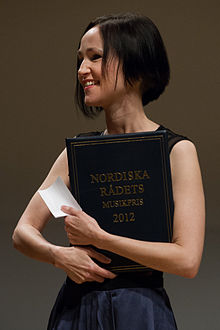
Þorvaldsdottir (in Icelandic script) was born in 1977 in Iceland.  She earned a B.A. in music composition at the Iceland Academy of the Arts in 2004 and went on to an M.A. and Ph.D. in composition at the University of California, San Diego finishing in 2011.  She has received numerous awards, most recently the Nordic Council Music Prize in 2012 for her orchestral work, “Dreaming” (2008).

Anna Thorvalsdottir accepting the Nordic Council Music Prize in 2012.

Anna Thorvalsdottir accepting the Nordic Council Music Prize in 2012.

Her music can be found on 8 CD releases of which three, including the present disc, are devoted entirely to her works. The other two discs devoted to her music can be found on Deutsche Grammaphon  and, now only available as a digital download, a disc originally released on Bandcamp and now also available on Innova.  Worth noting is another disc on the Sono Luminus label that contains her chamber work, “Shades of Silence” (2012).  Here her work is presented along with that of several other Icelandic composers placing her in context with her peers.

In the Light of Air (2013-2014) is a five movement suite written for and performed by ICE (The International Contemporary Ensemble).  The work is scored for viola, piano, cello, percussion, fixed electronics and installation. There is an intended visual component here and there is a high definition video of a performance of this work on Vimeo.  It puts this reviewer in the mind of the work of George Crumb some of whose chamber works (Black Angels and Vox Balenae for example) require various stagings that are not conventional in standard chamber music performances.  You can judge for yourself as to whether the staging enhances the work but the music does stand on its own.

The five movements, Luminance, Serenity, Existence, Remembrance and Transitions flow seamlessly into one another evoking a dream-like, even impressionistic feeling.  It would appear that this composer has studied a great deal of compositional techniques and has integrated those most useful to her in her work.  We hear microtones, glissandi, harmonics, alternate tunings, vocalizations, drones, even some spectral passages.  But throughout these techniques do homage to the past by their use in this clearly 21 st Century music.  There is an overall mysterious, somber and meditative tone that seems to evoke the sometimes barren landscapes of the composer’s native Iceland.  She seems  to travel in sound worlds not too distant from Morton Feldman but also Pauline Oliveros with a dash of Debussy perhaps. I don’t know, but quality (and sometimes lack) of light north of the Arctic Circle must certainly affect the way people think and create.  But keep in mind that Iceland consistently makes the top ten lists for happiest countries in the world. Perhaps funding for the arts, such as they provide, contributes to that happiness.  When the result is music like this one can’t help but feel at least hopeful.

ICE executes the performance with their usual virtuosity and care adding another significant work to their large and growing repertoire of contemporary music.  The recording, in keeping with the Sono Luminus mission is lucid and detailed.  (Unfortunately I was unable to evaluate the DVD 5.1 audio which is included in this release.  I have no doubt that this is a great listening experience but that will have to wait until I upgrade my sound system.)

Having heard this disc and some of the excerpts of other works available on the composer’s web page I think this is an artist whose work certainly deserves attention and one whose star will no doubt rise further.   Kudos to Sono Luminus on promoting this music.  Highly recommended.