This release appears to be as much about the musician as it is about the music. Ives’ second piano sonata has had numerous recordings since John Kirkpatrick’s landmark recording of 1948. It is a gargantuan work that requires formidable technical skills simply to play it and interpretive skills at a very high level. Here is a recording by an artist who certainly possesses the skill sets required.
Philip Bush
Pianist Philip Bush has spent over twenty years playing, teaching and recording. He is well known in new music circles as a versatile and committed artist very familiar with Charles Ives’ music. Doubtless many have heard his work but his name is far better known among his peers than his listeners. Why? Well despite at least 24 releases his role as accompanist or ensemble member leaves his name recognition to his fellow artists and to fans who read credit listings on those recordings. This writer is reminded of another artist of a previous generation whose skills were unquestioned but his name less known. I’m talking about the wonderful Gerald Moore whose work as an accompanist graced many recordings of the 50s, 60s, and 70s where he worked alongside many different instrumentalists and singers. Moore’s charming album, “The Unashamed Accompanist” (1955) is a good humored tour of the hard work of the accompanist, the unsung hero. I don’t mean to suggest that Mr. Bush is an exact match for this analogy, but this album certainly puts him more in that soloist spotlight than any other he has done.
Despite many recordings of this masterpiece, ostensibly a landmark of American modernist composition, this work has yet to achieve the prominence it deserves in the recital hall. Bush’s performance along with his very clever inclusion of lesser known Ives contemporary, Marion Bauer’s Six Preludes for Piano, Op. 15 (1922) helps to provide context for the listener. Bauer was later the first American to study with Nadia Boulanger whose pedagogy would shape the careers of many of the great composers of the 20th century in many countries. The preludes are apparently included here as representing American music played more commonly in recitals of that time.
Kyle Gann’s perspectives on the Concord
For a thorough summary and perspective on the Concord Sonata I have found Kyle Gann’s recent book on the subject to be illuminating. Ives himself felt the need to “explain himself” when he wrote a little book to be published concurrently with the sonata. Ives’ title for his book “Essays Before a Sonata” provide the inspiration for Gann’s subtitle (Essays After a Sonata). Ives’ near constant revisions add to the difficulties in even determining a final version of the score itself. The composer’s revisions and the partial recordings he did of the work add to the performer’s burden in the performance of the work. There’s even optional parts for flute (included in Bush’s recording played by Jennifer Parker-Harley) and for viola (not in Bush’s recording).
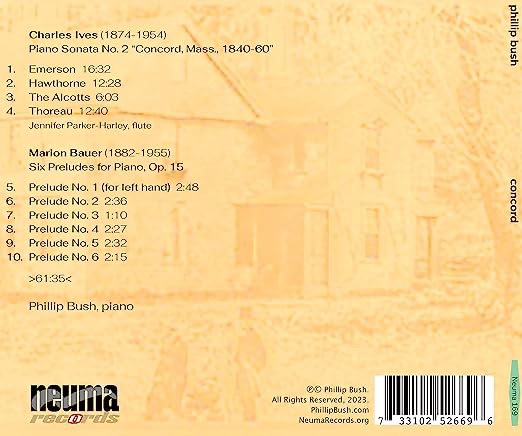
Track listing.
The Bauer preludes are far more conservative musically than the Ives of course but one could argue that nearly everything contemporary with the Concord Sonata sounds conservative by contrast. Bauer’s Op, 15 are relatively early works in her output. She lived and worked another 33 years after these little works which were apparently influenced by French Impressionism. There is no indication that Bauer and Ives ever met or discussed music but her work was the new music more commonly heard than that of the roughly concurrent work of Ives. The use of the stereopticon style slide on the album cover, a current technology of the time, also serves to provide a charming nostalgic reference to an era about to experience many rapid changes historically, technically, and conceptually in which the Concord becomes an American work analogous to The Rite of Spring (1913) as a signpost of the beginning of another era.
Despite the complexities, Bush’s reading of the Concord and the Bauer preludes are eminently listenable. That clarity is ultimately the value of this release. This recording is a wonderful opportunity to hear the artistry of a dedicated artist and academic. It helps make a case for the Concord to be recognized as an important work whose complexities are made clearer with each interpretation. Bravo, Professor Bush!
Let me start with a positive image from a brief photography trip which I managed this year. It was one of the highlights of what has been a difficult year for many of us. Weather, politics, COVID, itinerant employment issues, financial, and personal difficulties were an encumbrance but now stand in relief to the many positive aspects of 2022.
First, let me say that nothing musical fell into the category of “worst of” so fear not, what follows is essentially my “best of” from 2022. In my head I blame the aforementioned encumbrances for delays and sheer lack of production on my part. Whether that is the ultimate truth does not matter really so here, for better or worse, is my celebration of the positive experiences enumerated in this music blog in 2022.
This is one of the albums that stoked my interest.
My first post for the year struck a sad note. It was my personal tribute to a composer, A Belated Fan Letter: Homage to George Crumb described George Crumb, who had been one of my “gateway drugs”, so to speak, which helped put me on the exciting roads of new music upon with I continue to travel with great joy. Recordings of his complete works are still being released on the visionary Bridge Records.
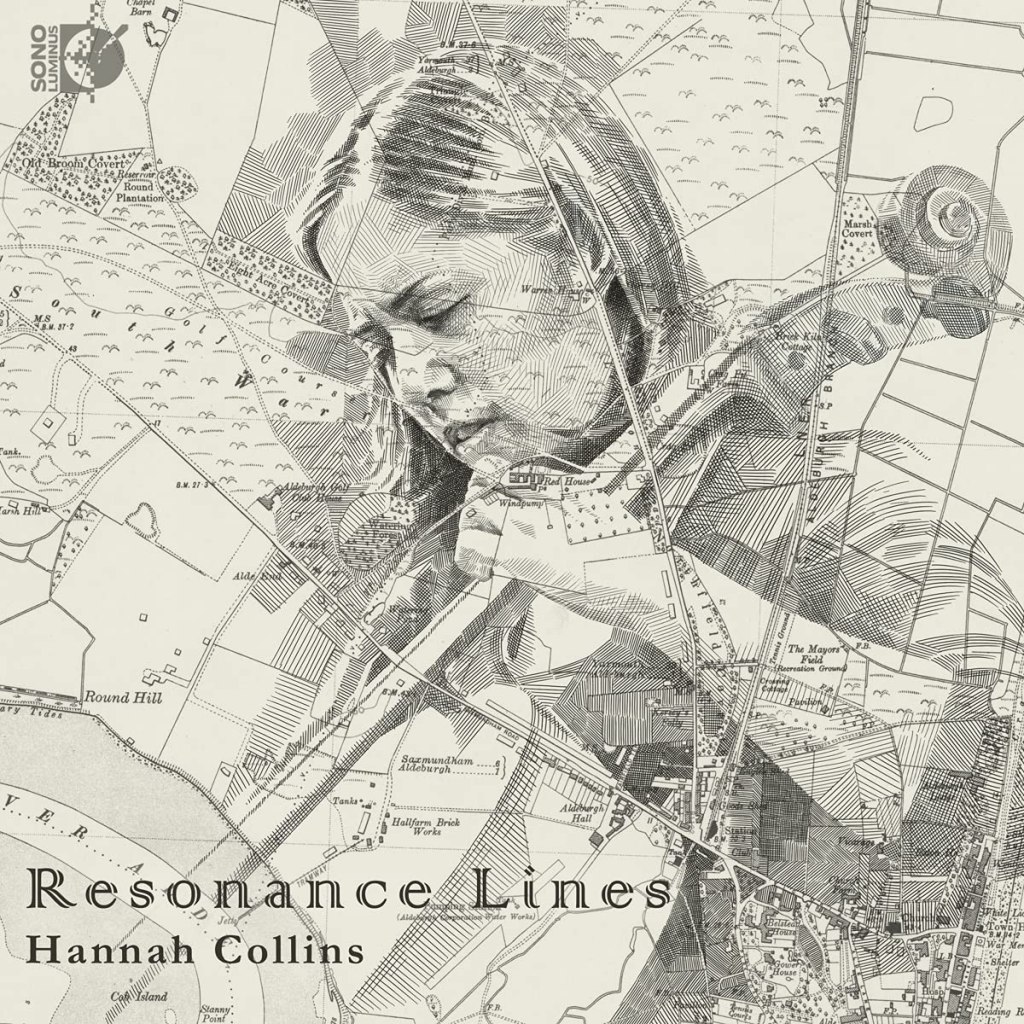
Hannah Collins debut on Sono Luminus was a compelling offering from this rising star.
Carolyn Shaw’s striking and much performed “In Manus Tuas” (on solo viola as well as solo cello) was originally written for Collins. Her selections on this album, including that Shaw work, suggest to this writer/listener that she has both vision and an encyclopedic knowledge of music, especially that written for her instrument. She will be among the major shapers of this repertoire via her vision as well as her interpretive talents. And Sono Luminus’ superb sonics certainly helps make this a great release.
The first volume of Sarah Cahill’s landmark trilogy of piano music by women composers.
I have followed the work of Sarah Cahill since her first solo CD (music of Ravel). Like Collins, she has been an artist who, by her intelligent selection of repertoire, serves as a guide to listeners (and musicians) as well. She has championed many composers as a pianist and as a broadcaster on her weekly KALW broadcasts. Her curation of concerts throughout the Bay Area, such as her solstice concerts at Oakland’s Chapel of the Chimes, have showcased a large variety of creative performers.
As she focuses her lens on women composers (neglected is implied) she embraces a stunning range of styles from the baroque era to the present and it seems as though she can play anything she chooses well. She is also collaborative with an amazing ability to discern the substance in the works she chooses to play. And she has discovered (or rescued?) much music from obscurity via scholarship and intelligent collaboration. Can’t wait for the next release. She is consistently interesting and relevant.
This release on Lars Hannibal’s OUR records was a brilliant new recording of some of Ligeti’s music and introduced me to Kodaly’s solo choral works.
This album was sent to me by a friend. I knew the Ligeti pieces but heard them with new ears in this release and I was amazed by the Kodaly works too. Marcus Creed may not be as well known in the U.S. as he is across the pond but he should be.
Another debut album by a cellist.
This album was kindly sent to me for review by John Schneider of Microfest records. Read the review. Listen to this album. And watch for more from Chris Votek, another rising star in 2022.
Dan Lippel’s virtual manifesto displaying his vision and skill as he furthers the mission of the guitarist in all their guises.
Dan Lippel is one of the founders of the fabulous new music label, New Focus Recordings. Here he is acoustic, electric, conventional, and experimental but always interesting. Keep his name on your radar.
Languishing no longer.
This is a gorgeously designed, very collectible art object. It is a beautiful hard cover, full color book which also contains a CD of a recording (from acetate masters) which had languished in the archives of the Eastman/Rochester Music School where Harry Partch gave this lucid lecture/performance in 1942. Mr. Schneider, who sent me the Votek release as well, fronts an ensemble called PARTCH which, in addition to performing Harry Partch ‘s work, is recording Partch’s complete works for David and Becky Starobin’s Bridge label. This one is both eye and ear candy to my ears.
Rescuing those acetate masters from obscurity is a major find that rises in significance (in the musical sense) almost to the level of the archeological discovery of Tut’s Tomb. Schneider is a musician, a composer, a radio broadcaster, and an archivist and now a sonic archeologist I suppose. He also sports a collection of authentic copies of Partch’s curious instruments which were built to play the microtonal scales required. Partch is a major American composer whose work is now gaining its rightful place among the best of American classical music.
Seminal work by an American post minimalist composer.
I first discovered Mr. Susman’s work when I was asked to review a performance of another composer’s work. I heard one of his works played by the remarkable San Jose Chamber Orchestra on that same concert. Here we have another multi volume release of these lovely and significant piano works. The remarkable pianist (mentioned often in these pages) has contracted to record all 4 books of this sort of “Well Tempered Clavier” type gesture which effectively provides much insight to this composer. Nicolas Horvath, known for marathon concerts performing (and subsequently recording) all of Philip Glass’ piano music, among others. (We’re talking 15 hours or so. There is also a 35 hour live rendition of Erik Satie’s “Vexations” on you tube.) Who better to record these? The remaining three volumes are due some time this year. Who better to take on this post minimalist set of pieces? Can’t wait for the next volume.
Kondonassis’ new music manifesto for the Harp (and the earth).
Yolanda Kondonassis is about as household a name that you can find among harpists. These five minute (more or less) pieces are a significant addition to the solo harp repertoire. They are forward looking works for her instrument. Very interesting work, excellently performed.
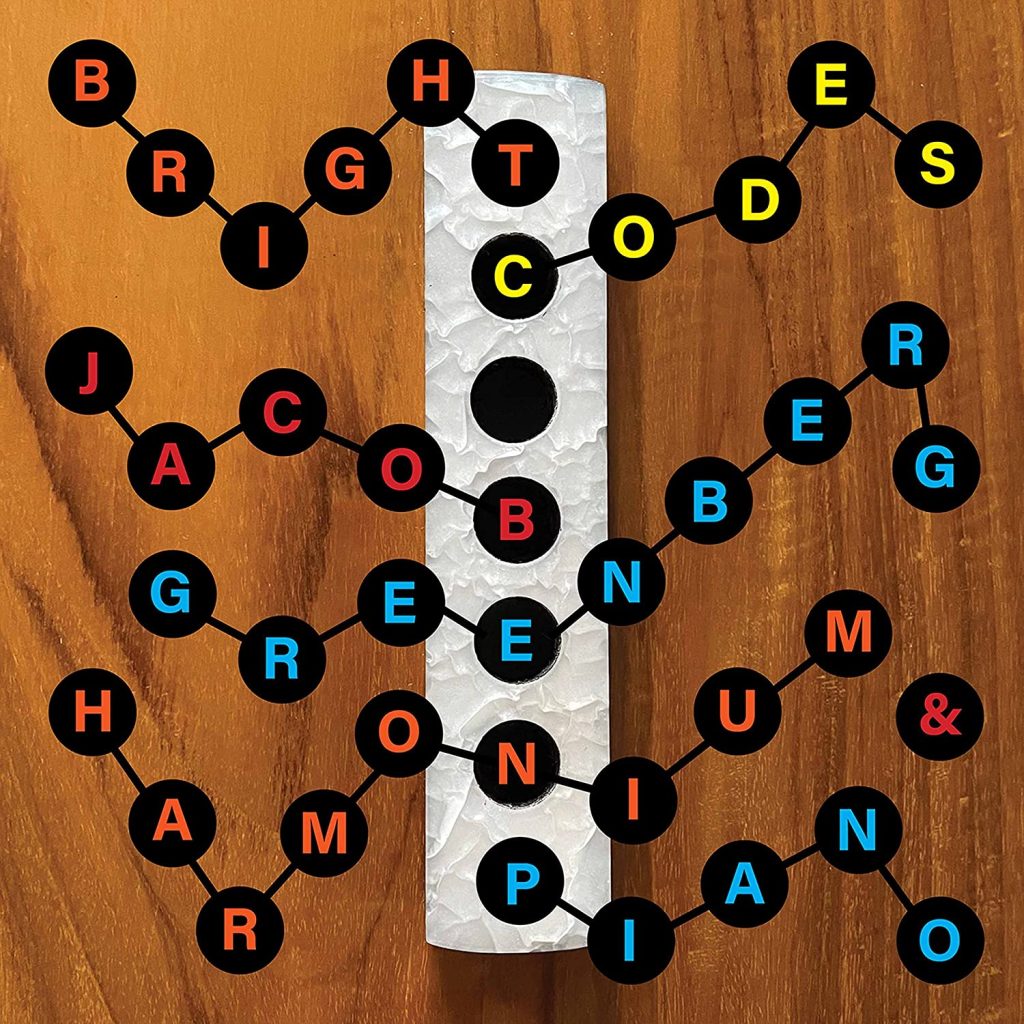
New piano music written for Jacob Greenberg
I remain in awe at the curatorial and historically aware work of this truly fine pianist. Greenberg helped me grasp the historical context of the Second Viennese School in a new way with his earlier release “Book of the Hanging Gardens”. In that release he played all the Debussy Preludes along with Schoenberg’s pre twelve tone song cycle, Webern’s Variations, and the Berg Sonata which helped this listener to better grasp the historical context of this music. This small collection of works written for him reflects a collaborative and visionary ethic akin to that of Sarah Cahill’s. Keep an ear out for this guy.
Lou Harrison’s brief Solo Violin Sonata
I have received some good natured teasing about the fact that this, one of my longer reviews, is of a 15 minute piece of music. But this act of musical archeology by the bay area’s Kate Stenberg (who is a regular collaborator with Sarah Cahill BTW) has made the first recording of this little work. It’s Webernian duration belies a style very much in character with this beloved composer’s other work. My review was as much about the music and the recording as it was about the dedication of Stenberg to new music. This release is from Other Minds, another shining example of advocacy of new music and collaboration among composers and performers. Get it. Listen to it. And don’t miss a chance to hear Stenberg live performances or to hear anything Harrison has written.
Music between the wars
The Chicago based Cedille label is one of my favorite classical music labels. Producer James Ginsburg has a golden ear and Cedille is the finest Chicago based classical label since the justly fabled Mercury records. All their releases deserve attention but this two disc set of little known works for String Trio written between the world wars is a feast of substantive, if slightly conservative, voices. This one is a great listen and, trust me, none of this music is in your collection.
Other Minds Executive and Artistic Director of Other Minds Charles Amirkhanian applauds a rare performance of his own music at OM 26.
While circumstances conspired to limit my attendance to only one of the three days of OM 26, I would be loathe to leave this world class music festival off my “best of” list. My first published blog of 2023 was of the 30th anniversary celebration which showcased Marc-Andre Hamelin’s stunning reading of Charles Ives’ massive Concord Sonata. Anything OM does deserves your attention but the roughly annual festival continues to present composers and performers from around the world. Not to be missed.
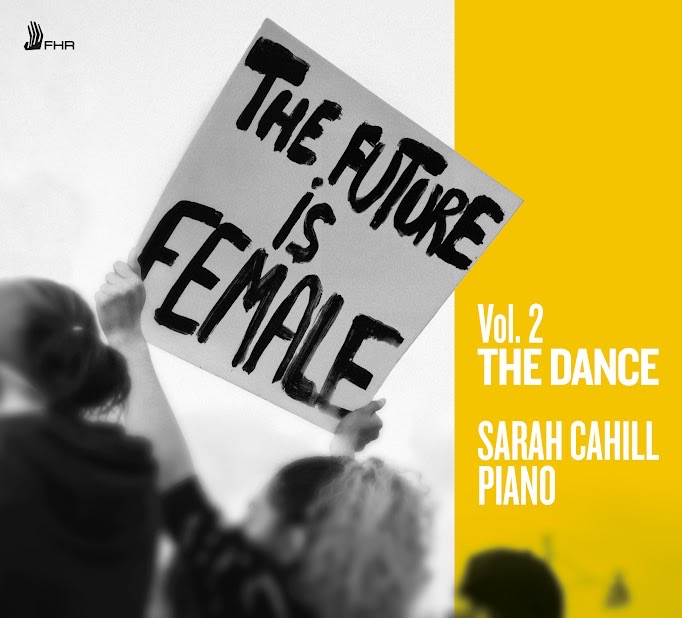
Volume two of three
Another exciting release of Cahill’s visionary series. Like the previous volume (and the aforementioned Cedille release) the consumer will suffer no unnecessary duplications if the music herein. Fascinating and expertly done. This set (the third volume due this year) is a testament to Cahill’s encyclopedic knowledge of piano music as well as her collaborative nature and, of course, her skills as a pianist.
A new voice in electroacoustic composition Kataro Suzuki.
I’m cheating a bit here since I wasn’t able to complete my review until 2023 but this Starkland disc was released in 2022 and definitely earns its place in my “best of” list. This rising star is another one to watch. Starkland, run by the dynamic Tom Steenland is one of those labels that reliably finds interesting and substantive new music. This one is no exception. It goes a long way to alleviating my skepticism of the electroacoustic genre.
DVD OM 4001
And, in order to be fair I must cheat equitably. Charles Amirkhanian kindly sent me this exciting and excellent DVD of his collaboration with his partner in life and in artistic crimes, Carol Law. My more extensive review will appear shortly but this was a major release in 2022. Amirkhanian spends far less time promoting and performing his own unique compositions so this is an especially welcome release.
Neuma
Last but not least of my best of 2022 is this wonderful Neuma release which, when I began my research to write a cogent and informed review, left me stunned at how little I actually knew about composer David Tudor and the astounding dimensions of this unusual piece that evolves with every performance. After gathering a whole ton of data I finally decided that I could not write a comprehensive review without more research so I settled on a tasteful (I hope) summary with the expectation that I will write a larger piece on Tudor and his work. The review will be out very shortly. This is an amazing and significant release.
Happy 2023 to all my readers and thanks to those who kept reading my blog during more fallow times. I have many blogs currently in preparation that I look forward to sharing in the months to come. Peace, health, and music to all.
On the back of the CD case, in the right upper hand corner, like a warning on the back of a medicine bottle, an entreaty:
“Binaural Recording: Please use headphones.”
Even those of you who think they know this masterpiece of experimental electronics by David Tudor (1926-1996) will find here a unique and important collaboration in this production initiated by Pauline Oliveros, then director of the Center for Music Experiment (CME) at UCSD. She invited a group called CIE (Composers Inside Electronics). And the resulting product of that collaboration documented here advances the understanding of this music and will henceforth be an influence on all future performances.
Unfortunately for this writer’s timing, the wealth of information gathered in the course of researching this review, the sheer volume of possibilities in performance and the wider scope of historical and technical elements embraced by this work required a deeper reading and contemplation on my part. In short, it has taken some time for this reviewer to get a grasp of how to express the significance of the deeply substantive work at hand. I simply didn’t know enough about the history of electronic music and the work of this seminal musician.
So now, after some serious study, this is my perspective on this landmark composition and, in particular, the deeper significance of this performance. In short, there will likely be many more performances of this work but this one will always be a standout. Not the ultimate version perhaps, but one of the most memorable.
David Tudor ca. 1950
David Tudor was a pianist who championed contemporary piano music and then began a career as a composer. But he was no ordinary composer. Taking inspiration from the composers whose work he championed, Tudor developed musical ideas with structures that contain indeterminate elements within a larger structure. Such is the case with Rainforest which was first developed in 1968 against a cultural backdrop of the height of the psychedelic sixties and the political “days of rage”, a time of artistic innovation like Allen Kaprow’s “happenings” which expanded the concepts of what constituted art, a time of wild experimentation. His work crossed paths with the San Francisco Tape Music Center (which later became the Mills College New Music Center). Tudor traversed some of the same territory as Donald Buchla, Pauline Oliveros, Maggie Payne, Morton Subotnick, Ramon Sender, as well as many others.
The first iteration of Tudor’s innovative and experimental “Rainforest” was in 1968. It is a testament to Tudor’s creativity to have created a structure that contains the indeterminate sonic events called for in the score (not a formal score but a set of performance instructions) in such a way that the piece evolves with each iteration, each performance. That, rather than the varying sonic content, is the heart of this major work of contemporary sonic art.
First, this is a binaural recording, meaning that it was recorded with a technology intended to deliver the sound directly to headphones of the listener hopefully producing an experience much as would have been experienced by sitting in the audience. Earlier versions of this technology involved, basically, microphones embedded in the ear canals of an anthropomorphic head which is placed in front of the performance as a listener would sit in their seat. However, the present recording recording involved another generation of this technology which is particularly well suited to this music. Here the microphones are worn in the ears of the recordist(s) as they meander through the space in which the piece is being performed. The result is the listener being able to (almost literally) get inside the head of the person wandering within the space and listening to the sounds created, sometimes at a distance, sometimes more closely.
Despite the entreaty that the listener wear headphones when listening to this recording (you really should try that at least once), one can play this recording as one would any other musical recording. It can also be appreciated by playing it on speakers in any space as a sort of sound installation. This piece challenges conventional concepts of music and its audience.
The Julliard Quartet is a hallowed name in classical music. This release reflecting its current generation of musicians is consistent with their practice of playing established classics alongside the modern. These are interesting choices of string quartets from the 18th, 20th, and 21st centuries.
Many will likely speculate on the motivations for these choices but it is a typical set of choices for a Juilliard Quartet recital, an intelligent mix of standard repertoire, not the “usual suspects” or most popular but musically solid pieces. And, of course, there is their all important embrace of the modern.
The Beethoven and the Barton are lovely choices intelligently played but the real draw, at least for this reviewer is the Davidovsky. Mario Davidovsky (1934- ) is a major American composer who deserves more performances and documentation of his work. Fortunately Bridge Records has taken on this task.
He is best known for his “Synchronisms” series pairing electronics with various acoustic instruments. This won him a Pulitzer Prize. But his music sans electronics is just as substantial and this 2016 String Quartet, his sixth, provides ample evidence of that substance.
Near as I can tell this is only the second recording of any of his quartets but it is sufficiently intriguing to whet the appetite for the other 5.
As a recital disc this one is thoroughly enjoyable and it’s inclusion of the Davidovsky is gloriously consistent with the overall image of the hallowed name of the Juilliard Quartet.
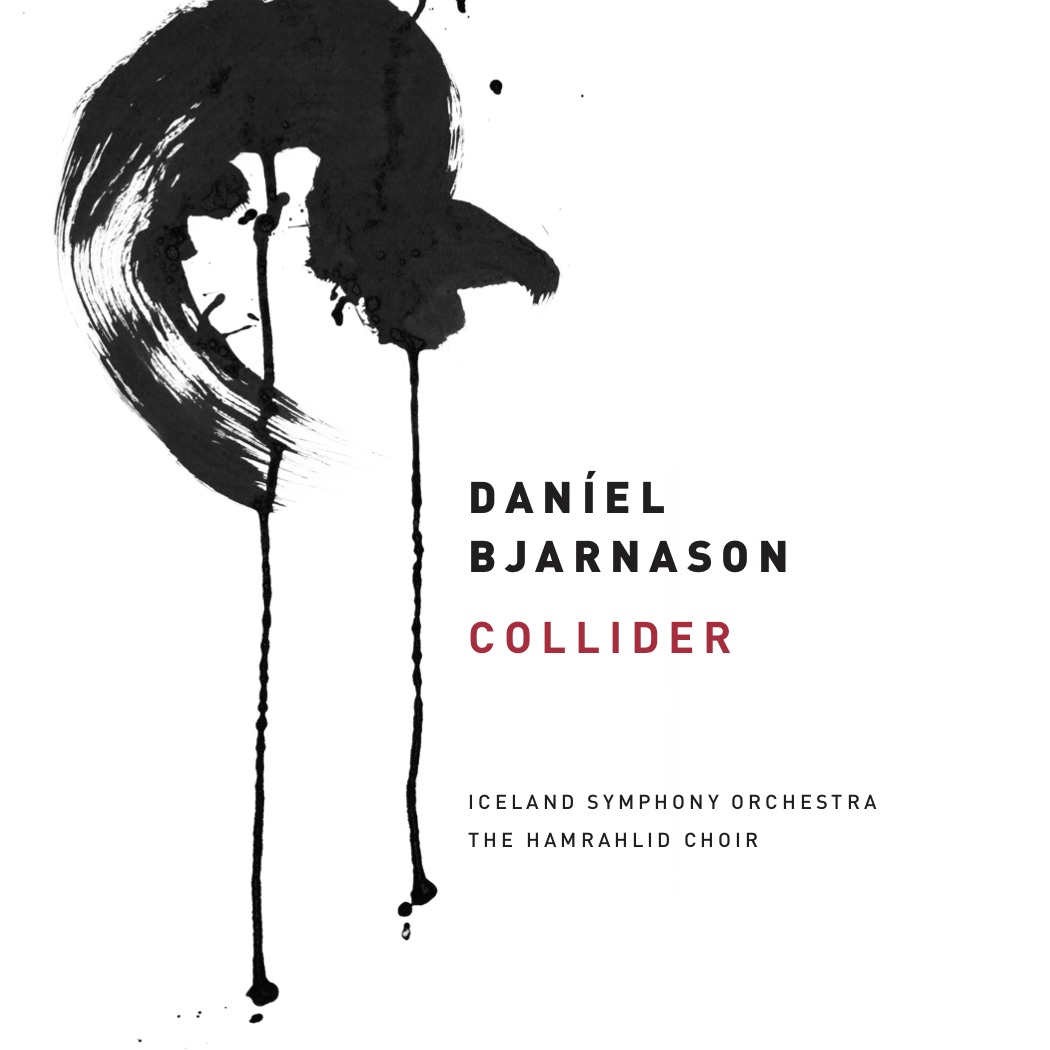
This is the second album I’ve had the pleasure of reviewing by this wonderfully talented composer and conductor from Iceland. The other album which put his name forever into my watch list was Recurrence. Daniel Bjarnason conducted on that recording which features his work as well as that of fellow Icelandic composers.
The present release is also conducted by Bjarnason and features three amazing works by this young composer and conductor. The works include, “Blow Bright” (2013) for orchestra, “The Isle is Full of Noises” (2012) for chorus and orchestra, and the title work, “Collider” (2015).
Blow Bright and Collider are performed by the lucid Icelandic Symphony. They are joined by the Hamrahild Choir for the three movement, Isle Full of Noises. The recording is also listener friendly (with detail that sent this listener to find headphones to hear them).
It is a mark of genius that this composer already has a clearly defined sound all his own. Hearing these left this listener wanting to hear these pieces again and to hear more of this man’s work.
Blow Bright and Collider are significant contributions to the modern orchestral repertoire and Isle Full of Noises is an opportunity to hear Bjarnason’s vocal writing with orchestra. This listener, no surprise was charmed. His facility in melodic invention, judicious use of modern harmonies make for very listener friendly music that challenge gently but always entertain. Classical music is alive and well…at least in Iceland.
Kenji Bunch (1973- ) is a musician whose name has made it to my personal orbit many times but this is my first encounter with his music and what an encounter it is! This two disc set comprises a full length ballet commissioned and performed by the Eugene (Oregon) Ballet.
Kenj Bunch
Bunch is an American composer who hails from Portland, Oregon the child of a Japanese mother and a Scottish father. He studied at Julliard and this is approximately the 18th CD release to contain his music (if I counted correctly). A prolific composer, one can find a decent listing of his compositions on his website. And he was a violist performing with the esteemed Portland Youth Philharmonic from 1986-1991/
There are at least two symphonies, numerous soloists and orchestra pieces as well as solo instrumental music. Though I’ve heard just snippets of his music aside from the disc under review here I think I can safely say that his style can be described as essentially tonal, even perhaps somewhat conservative, but the accessible qualities of his music do not translate into mediocrity. Quite the contrary, he is a very exciting composer and his style seems very well suited to an undertaking such as this ballet. Bunch appears to be a master of orchestral color and he uses it to great effect here.
The two discs comprise 23 tracks much like one would expect of most classical ballets. The individual movements are 3-10 minutes approximately and they correspond to specific scenes that tell the classic story of the classic Hans Christian Andersen story. No doubt cost is the barrier which precluded a DVD release which looks like it was a gorgeous production.
It is at least this writer’s impression that much of classical ballet music does not do well without the visuals of the dance. I am referring to 19th century models such as Coppelia whose music might be best performed in excerpted suites if dancers are not a part of the performance. Bunch’s ballet is more in the spirit of perhaps Prokofiev or Stravinsky wherein the music stands quite well on its own and even does a great job of evoking the images of the given scenes. Basically the music stands on its own as a narrative.
Orchestra NEXT is a training orchestra and resident ensemble with the Eugene Ballet Company. They handle this complex and musically challenging score with seeming ease under music director Brian McWhorter.
There is little doubt that those who were fortunate enough to see this fully staged production will appreciate the opportunity to relive their memories by hearing again the recorded score. But this will likely appeal to most fans of new music as well. It is a major work by a composer who deserves serious attention. This writer will certainly be listening.
The choice of repertoire, performers, and the quality of their recordings make any BIS records release worthy of attention. This two disc set is a fine example. Three major choral/orchestral works which celebrate the justly proud Finnish culture are given very fine performances in this live recording from 2016.
The earliest work, Jean Sibelius’ Kullervo Op. 7 (1892) is one of the less recognized masterpieces by Finland’s best known composer. Based on the Finnish national epic, The Kalevala, this massive symphony has acquired a bit of its own mythology. Though several recordings of this work now exist the world world premiere recording by the late Paavo Berglund (1929-2012) from the early 1970s brought this neglected masterpiece to a larger listening audience. The intelligent liner notes by Andrew Barnett (and Olli Kortekangas) document and dispel the myths that Sibelius suppressed all or portions of this work which was premiered in 1892 yet had to wait until after the composer’s death in 1957 to receive its first twentieth century performance.
In fact it seems more likely that the large forces required along with programmers’ preference for the composer’s later masterpieces were responsible for the unfortunate neglect of the present work. It was the more romantically inclined myth of mysterious oppression that greeted Berglund’s triumphant premiere recording and this reviewer recalls being both charmed and intrigued by it. Whatever the story the music is now a recognized early triumph by its creator and it is given a gorgeous reading by Finnish conductor Osmo Vänskä, (principal conductor of the Minnesota Orchestra which plays powerfully and definitively.
So why a second disc? Well, Maestro Vänskä saw fit to commission a new work by contemporary Finnish composer Olli Kortekangas to serve as a companion piece to Kullervo and, then include a version with chorus of Sibelius’ best known work, Finlandia. Together these three works would very satisfyingly fill an entire concert program.
Olli Kortekangas (1955- ) chose poetry by Finnish-American poet Sheila Packa and composed a 7 movement work (three are interludes for orchestra alone) in celebration of the 150th anniversary of modern Finnish migration to the United States. The work, Migration (2014), is similar in orchestration with its use of male chorus and two soloists backed by a large orchestra. The composer’s style is a sort of 21st century romantic style with tasteful modern touches.
The focus of this fine new work is an affirmation of Finnish culture and its impact on the United States. It seems both fitting and satisfying then that this program conclude with the landmark work of Finnish pride and nationalism, Sibelius’ best known work, Finlandia (1899). But rather than just another reading of this classic of the concert hall Vänskä chooses to do a version with chorus. This was not the composer’s original intent but this version fits remarkably well in the context of this album.
This is a very enjoyable album, well conceived and executed in every way. Soloists Lilli Paasikivi and Tommi Hakala sing their roles with skill and passion as does the YL Male Voice Choir. The applause track at the end of the Finlandia performance echoed the emotional experience of this reviewer and will likely do so for anyone who chooses to avail themselves of this fine example of recording art.












 New Music Buff