Rising Star Seth Parker Woods’ “Difficult Grace” is a Classic in the Making


Cedille CDR 90000 019

Every solo artist, regardless of what instrument they play seeks to define themselves. Generally that means setting limits. Some set limits by specializing in an era (baroque, classical, etc.). Some specialize in working with electronics, some with jazz, some with experimental music, some with standard recital repertoire, etc. Seth Parker Woods (1984- ) seems almost unaware of such limits. He plays what he chooses. And, oh, what choices. From standard classics to the leading edge of musical creativity woods is poised at the beginning of a very promising career.

Seth Parker Woods (photo from his faculty page at USC Thornton School of Music)

This album is in fact the musical portions of what was produced as a staged presentation with Woods playing, singing, talking. No doubt something is lost without the staging but Woods’ asserts himself with great clarity on the sonic aspect alone. Think of this as a sort of cast album, though it is more than just a souvenir. It is Woods’ second album and it has this writer enthralled at where he may go next. You will be too.

Parker’s first solo release “asinglewordisnotenough” available on bandcamp reveals his dedication to new and recent music.

I feel privileged to have known this artist via digital media and to have watched with increasing interest his development as a true rising star in the new music world. I only recently acquired his first album via bandcamp. It was released “across the pond” when he was completing his Ph.D. at the University of Huddersfield.

Born in Houston, his father, a jazz and gospel singer, Woods was exposed to a great deal of music. He rehearsed in a home studio and somehow came to a fascination and deep appreciation for a wide variety of repertory.

His affiliations continue to be wide ranging from Peter Gabriel to George Lewis. He has appeared on many recordings but this is only the second disc dedicated entirely to Woods as performer and the first such solo efforts on a US label. Woods is apparently able and willing to tackle music of all eras and genres including the wildly experimental, like his “Ice Cello” homage to Charlotte Moorman and the theatrical, which brings to the the album at hand.

Track listing.

Four of the seven works presented are world premieres. And, despite this being a sort of “cast album” which lacks the visuals, this is a major release that presents a characteristic variety of musical choices and is a fine calling card for the artist. This is one classy production.
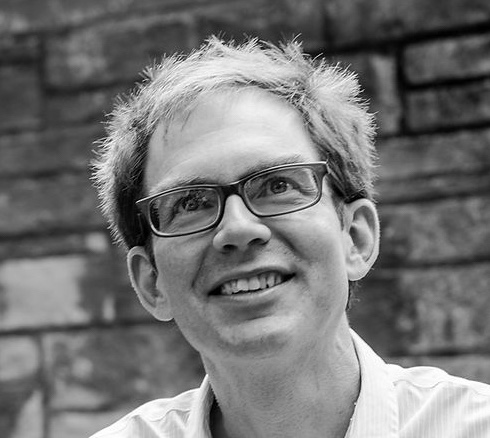
Frederic Gifford (photo from composer’s website)

He begins with the title track, “Difficult Grace” by Chicago based composer Frederic Gifford (1972- ). It is a setting of poetry by Dudley Randall subjected to some Cageian mesostic like manipulation. This first track tells us we are dealing with modern music and sort of sets the tone of this project. This is a complex work in concept (lucidly described in the composer’s notes) and involves projections of the texts onto the performer as well as electronics which, by careful use of both the sounds and the spoken text (spoken by the cellist) which then contributes to the musical structure. Photographs in the booklet show some of the striking visual design for this project.
Coleridge Taylor Perkinson (photo from Wikipedia)

Woods follows with what is to this listener a stunningly beautiful piece, “Calvary Ostinato” (1973) by the late, sadly neglected Coleridge Taylor Perkinson (1932-2004), a black American composer (actually represented admirably in a fine earlier Cedille release CDR 90000 087). The Ostinato is one movement from Perkinson’s “Lamentations: Black/Folk Song Suite For Solo Cello” (1973). Woods’ performance is available on YouTube. It’s truly enthralling. One gets the feeling that Woods really gets inside the music he performs and that deep feel for the music is delightfully obvious in this track, the second oldest work on the disc and one that is for the solo cello sans electronics or vocals but using a dazzling variety of extended instrumental techniques, none involving a bow.

Monty Adkins (photo from electro cd website)

Then we hear Monty Adkins’ (y. 1972- ) “Winter Tendrils” (2019) written for cellist who, in addition to playing his instrument, is asked to use his voice and work with electronics, albeit in a different manner than the title track. Adkins worked closely with Woods on the creation of this work. The work essentially an impressionistic piece with clever use of counterpoint to depict fresh fallen snow on the branches of a tree.

Nathalie Joachim (photo from Elysian Magazine)

Nathalie Joachim (1983- ), a Haitian-American vocalist, flautist, and composer, is represented by two works. The first, “The Race 1915” (2019), a work that contributes to the Chicago centered Cedille label by its use of historical quotations from The Defender, a major and influential black newspaper in Chicago. Woods is again asked to use his vocal skills in this work which celebrates efforts to undo social inequalities.

The multitalented Joachim lends her vocal skills to Woods’ performance in Joachim’s second piece on the album, “Dam Men Yo” (2017). The title is Haitian Creole for “they are my ladies”. It is a sort of black feminist peaen celebrating the strength of the women with whom the composer was raised in her native Haiti. (NB: Haiti is the site of the only successful slave revolt in history, a fact that continues to be reflected in their turbulent politics).

Alvin Singleton (photo from Schott website)

In between those two pieces we get to hear perhaps the best known composer in this mix, Alvin Singleton (1940- ). Singleton is represented by “Argoru II” (1970) for solo cello (the Argoru series is a set of pieces for solo instruments akin to Luciano Berio’s “Sequenza” series). The title is from the Twi language (spoken in Ghana) and translates as “to play”. It is a virtuosic piece employing extended instrumental techniques which Woods accomplishes with almost supernatural ease. He does honor to this living elder statesman of American music.

Ted Hearne (photo by Jen Rosenstein from composer’s website)

And here we are back in Chicago now with Maestro Woods’ performance of a work by Chicago born composer Ted Hearne (1982- ), a name which did make it to this writer’s musical radar but one whose work I have just begun to explore. But this is a fine example of one of the reasons for my admiration for Woods’ scope of musical interest. I think he is one of those artists to whom I will turn to look for good new music. His instincts for repertory choices are amazing.

This is perhaps the most unusual entry on this disc as well as one that, if any controversy is forthcoming, it will likely originate with this set of songs to poetry by Keri Alabi. A casual listen to some of Hearne’s music on YouTube suggests a sort of post minimalist ethic but this last work is not discernibly minimal. Like the music that preceded it, this cycle is overtly about politics and equality.

Hearne’s little 6 movement song cycle is a combination of poetry, electronics, cello (of course), and the voice of said cellist. Hearne’s expletive title, “free fucked”, is apparently very much in line with the composer’s assertive and playfully humorous style.

We return in these tracks to the avant garde and complex with which the album opened. Again we have a multitasking role for the cellist demanding his vocal participation and working in a distinctly electroacoustic genre. Hearne lends his voice to the final track of this unusual work.

While political themes and references abound in this release it is as much about black politics and civil rights as well as feminist, gender, and global equality issues. But ultimately this recording is a landmark in the career of this fine young musician who works fearlessly with a variety of composers, poets, designers, political activists, progressive ideas, and new music in general.

Cedille is one of my top favorite new music record labels and has been since they first started in 1987. Their releases (not limited to new music) are consistently well recorded and produced but producer James Ginsburg really pulls out all the stops on this one. From concept to recording, from lucid liner notes to gorgeous package design this has all the marks of a classic and collectible release. I mean, the music is great, but the whole package is something you’ll want to own. That’s right, I’m calling for “collector’s item” status here. Now is the time to get your copy.

The Lincoln Trio Plays Contemporary Piano Trios from Chicago


Cedille CDR 90000 211

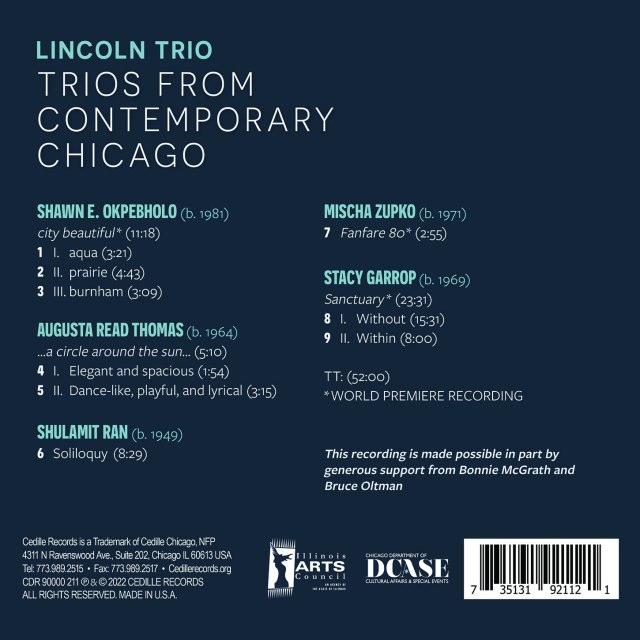
This is another entry in an ongoing series of music for piano trio by the tried and true Lincoln Trio. In this fine release they play a delightful collection of five works (three are world premiere recordings) by living composers. This is their eighth Cedille release by my count. It is the second recording of piano trios from Chicago based composers, a follow up to their previous survey of early to mid-twentieth century piano trios, Trios from the City of Big Shoulders.

back cover

The five works presented here are but a sampling of the available repertoire from Chicago based composers. That said it is a fine sampling of the current state of the art and one would do well to explore more of the music of all these composers.

The first selection is the three movement, “city beautiful” (2021) by the American composer of Nigerian/American Heritage, Shawn E. Okpebholo (1981- ), a world premiere recording. The title is taken from that of the 19th century initiative that helped build the now familiar skyline which had been ravaged by the 1871 Chicago Fire.

Okpebholo is no stranger to this blog. His fine album of spiritual arrangements Steal Away (2016), and his contributions to Will Liverman’s album, “Dreams of a New Day” (2021) revealed his interest in and expertise with spirituals and art song. “city beautiful” by contrast is essentially three tone poems inspired by Chicago architecture, perhaps one of the city’s finest distinctions. The three movements, aqua, prairie, and burnham are effectively homages to architects Jeanne Gang (whose Aqua Tower is a most recent major addition to the famous skyline), Frank Lloyd Wright (whose Robie House is a classic example of the “prairie school” design), and Daniel Burnham (whose 19th century designs define the famously beautiful lakefront and the iconic Union Station).

Opkebholo’s idiom is basically tonal and could be characterized as post romantic. But regardless of how you categorize it the music is eminently listener friendly and a fine vehicle for the estimable Lincoln Trio. This is the work of a rapidly emerging composer with both substance and style. Keep his name on your radar. I expect to hear much more from this talented and prolific composer who currently holds a professorship at Wheaton College in that western suburb of Chicago.

Next is a two movement work by Augusta Read Thomas (1964- ) entitled, “…a circle around the sun” (2021). This work was a commission by the Children’s Memorial Foundation for the Amelia Piano Trio in honor of George D. Kennedy. Thomas has long been a fixture in Chicago’s music life where she was a composer in residence with the Chicago Symphony from 1997-2006. She is currently professor of music at the University of Chicago and a former professor at Northwestern University. Her work also tends toward the tonal idiom and this rather brief two movement work is a fine example of her writing for chamber ensemble.

“Soliloquy” (2003) by the truly fine, if still too little known, Shulamit Ran (1949- ), an Israeli born American composer. She was a student of the esteemed Ralph Shapey (1921-2002) to whom she dedicated her Pulitzer Prize winning Symphony (1990). The composer states in her liner notes that the origins of this work come from her opera “Dybbuk”. It is a pleasant piece perhaps less complex and more lyrical in sound than some of her larger works. Ran was professor of music at the University of Chicago from 1973 to her retirement in 2015.

Mischa Zupko (1971- ) contributes the briefest work to this collection. Clocking in at just under three minutes, “Fanfare 80” (2010) was written in celebration of the 80th anniversary of the Music Institute of Chicago. The brevity here belies the complexities within this ear catching piece.

The album concludes with a substantial two movement work (just over 23 minutes), “Sanctuary” by Stacy Garrop (1969- ) is the work of another prolific composer whose work is, happily, getting much deserved recognition. The 2016 recording of her wonderful orchestral work was reviewed in these pages. Garrop’s work is invariably kinetic and deeply felt with a dramatic flair. Garrop was on the composition faculty of Roosevelt University in Chicago from 2000 to 2016 and is now a freelance composer.

The usual audiophile production (Bill Maylone, engineer) which characterizes Cedille releases is evident here. This is a fine sampling of music which is roughly representative of the musical riches producer James Ginsburg has mined from the “city beautiful”.

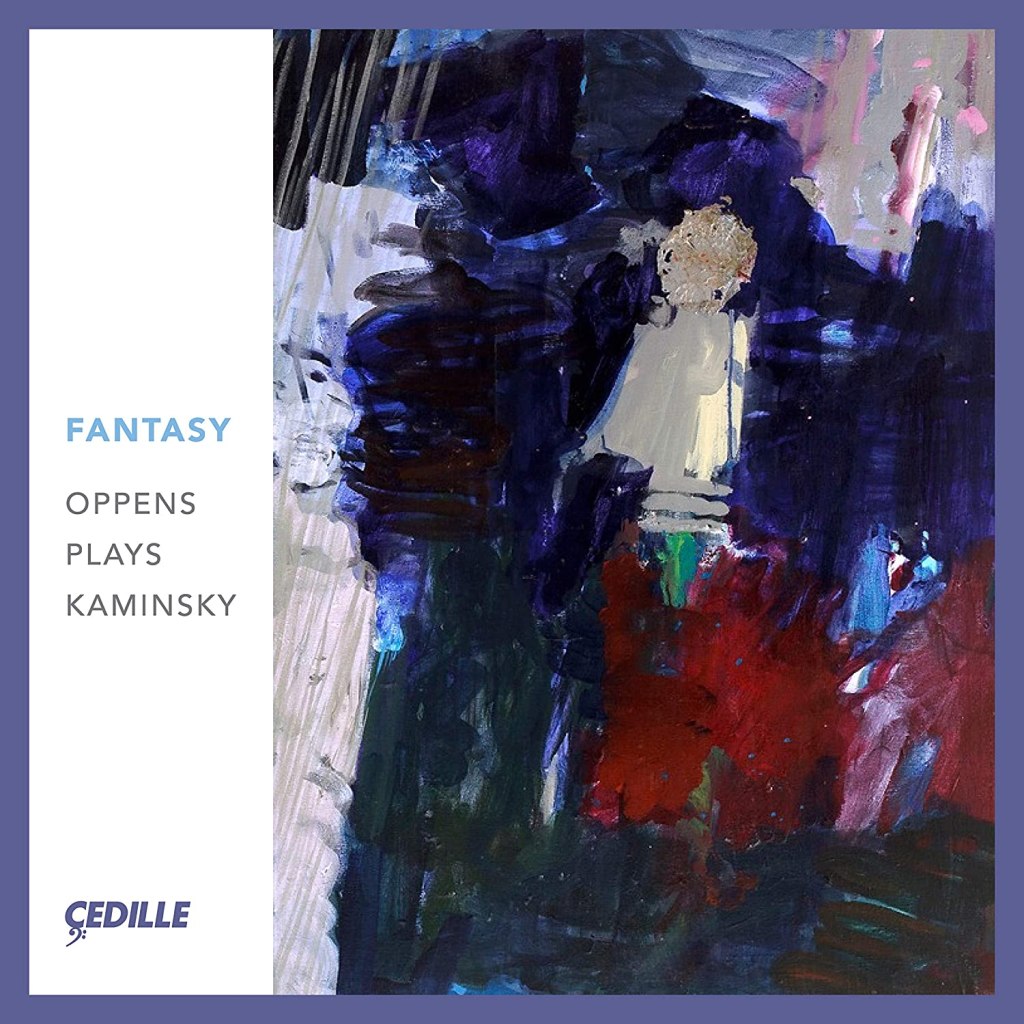
Fantasy: Ursula Oppens (et al) Play the World Premieres of Five Major Works by Laura Kaminsky


Cedille CDR 90000 202

Laura Kaminsky (1956- ) is a native New Yorker and has plied her trade there for some time. So how does she wind up on a label so intimately dedicated to Chicago music and musicians? Well, the answer is simple, Ursula Oppens. Oppens (a member of the American Academy of Arts and Sciences) is also a New Yorker but her 14 year tenure as Distinguished Professor of Music at Northwestern University (1994-2008) certainly qualifies her as a valued Chicago artist. Realistically she is a highly accomplished and world renowned musician with an admirable history of supporting new music through her many definitive performances and recordings. With the exception of Fantasy, all the music here was commissioned by and/or written for Ursula Oppens, (Reckoning written for Oppens and Lowenthal destined for this recording).

This very welcome disc features three major works: Piano Quintet (2018), Fantasy (2010), and Piano Concerto (2011). as well as Reckoning: Five Miniatures for America (2019), a set of miniatures for piano four hands. As noted on the back cover, all are world premiere recordings. And these are very fine, actually definitive recordings. The Quintet, Fantasy, and Reckoning were all recorded at Brooklyn College, the concerto at Arizona State University. All were produced by the wonderful Judith Sherman and mastering was done by the equally wonderful Bill Maylone.

While Kaminsky works in a largely tonal post-modern idiom, this is not populist music, rather it is music by an accomplished composer who works well within such a medium. Her work is compelling and intriguing as well as entertaining.

Let’s start with the Piano Quintet. This medium is strongly associated with the romantic era. Piano Quintets by the likes of Franz Schubert, Robert Schumann, and Johannes Brahms largely define the genre and there are many lesser known examples which were produced well into the early 20th century. The genre seems to be enjoying a re-emergence and even modernists like Elliott Carter and Iannis Xenakis have penned masterworks in this form.

Kaminsky’s Piano Quintet is very much in the classical/romantic style. It is cast in three movements some of which reflect the variety of influences in her compositional palette. Her compositional skills allow her to evoke pretty much whatever emotion she chooses. Her style shows influences and echoes from classical forms, jazz, pop, minimalism all integrated into a largely tonal/post romantic style which easily engages listeners and manages to be highly expressive. The three movements are generally modeled on classical forms but Kaminsky manages to personalize her wide stylistic gestures and create a work that is celebratory rather than derivative. That said this piece is quite a ride for the listener as well as a significant addition to the repertory.

The Fantasy is a large and challenging work which ventures through a variety of styles and moods. This is a big work whose pianism reminds this writer of Rzewski and his rather Lisztian virtuosity. It might as easily be called, “rhapsody” for its rapid transitions of mood and style. Oppens manages to give form to this complex piece that does not appear to be easily interpreted by any but the best musicians.

The five miniatures that comprise Reckoning are brief but powerful statements written for Oppens and her sometime collaborator, Jerome Lowenthal, another highly skilled artist whose collaboration on a previous Cedille release, the Rzewski “People United” variations. These two are a good match of technical skills as well as interpretive ability.

The concerto is the big work here. Cedille saves the best for last notwithstanding the preceding masterful compositions. Here in a large orchestral piece with piano, Kaminsky demonstrates even more clearly her facility with instrumental colors which she uses to great effect in this grand concerto.

It is a piano concerto very much in the tradition of the classical soloist/orchestra which features the pianistic skills of the soloist. The orchestral “accompaniment”, if one can even call it by that name, derives more from the grand romantic tradition utilizing a large orchestra to which is given the role of coordinating with the pianist. But here the orchestra is given technical challenges nearly equal to the solo piano part. This is as grand as a Brahms concerto with the orchestra given a great deal to do and for the listener to enjoy. In addition to the nearly athletic, fingerbusting piano part, there are delightful passages in the orchestral playing that sort of sneak up on and charm the listener.

Kaminsky’s Piano Concerto was reportedly inspired by visual images of sunlit rivers in New York City and St. Petersburg, Russia. Oppens gave the world premiere with the St. Petersburg Chamber Philharmonic led by its artistic director Jeffery Meyer. On this world-premiere recording, Meyer, who is also director of orchestras at Arizona State University, conducts the ASU Symphony Orchestra and, like Oppens, meets a very challenging task with both grace and insight.

Kaminsky is a solid, disciplined composer who produces music of substance which intelligently engages audiences. This is a fine introduction to her work or a fine addition to an already established collection of her music. Her music was unknown to this writer’s ears before hearing this album and now leaves me wanting to explore more of the work of this fine American composer.