I know this review is “late out the gate” but this disc really needs to be heard. When I did finally listen to this disc in its entirety while on a long drive I was positively mesmerized. This odd mixture of 1/4 tone tunings along with post minimalist repeating patterns takes on the character of drone as well as its own take on minimalism and even spectralism to some degree. These three homages are gestures of respect to three composers whose work obviously has great meaning for Georg Friederich Haas (1953- ). The composers selected for these homages are György Ligeti (1923-2006), Josef Matthias Hauer (1883-1959), and Steve Reich (1936- )
It echoes a similar work by Ligeti, Three Pieces for Two Pianos – Monument – Selbstportrait mit Reich und Riley (und Chopin ist auch dabei) – Bewegung (1976) but with conventional tunings. Haas has had a long interest in microtonal music by composers like Ivan Wyschnegradsky, Alois Hába, as well as the music of Pierre Boulez and Luigi Nono.
It is easy to see why he chose Ligeti for the first homage (written in 1984). Haas’ work owes much to Ligeti’s influence including dissonant harmonies and micropolyphony. This first homage is the longest, clocking in at about 30 minutes. And Steve Reich has met with admiration and homages from many fellow composers but I must admit to having been stumped at the inclusion of Hauer’s work. This one I had to look up. Hauer was a Austrian composer whose substantial oeuvre is not really well known in the United States but deserves at least a second look. Hauer created his own 12 tone system apparently in parallel with Arnold Schoenberg but achieved little recognition despite a large catalog of works. That appears to be the reason why he was chosen. Hauer’s homage is placed second in this performance and Reich’s is last. Both the Hauer and Reich homages were written in 1982. And though this piece requires 2 pianos it also requires only the two hands of a talented pianist.
Mabel Kwan‘s recording is the world premiere of this work which is among Haas’ earliest published works (having heard it a couple of times it is difficult to imagine why it waited so long for a recording). Kwan, a founding member of the Chicago based Dal Niente (whose name literally means, “from nothing” but is used in music to indicate basically a long diminuendo, a fade) is no stranger to new and experimental music.. Her musical credentials are extensive and this world premiere recording is a major feather in her musical cap and a demonstration of her formidable interpretive and performing skills. Brava! Ms. Kwan.
I make reference to “Gabriel’s Oboe” (from the Morricone score to The Mission) in a slightly ironic way to introduce an album in which the artist, Dr. Catherine Lee is on a Mission of a different sort from that of Gabriel in the film. Lee’s mission is the liberation and expansion of the role of her chosen instrument(s).
While many instruments fit comfortably into a solo role such as keyboard instruments, violins, and cellos this is not the case with the oboe and it’s double reed relatives the oboe d’amore and the english horn (Lee is a master of all of these). Indeed many instruments which have populated orchestras and chamber groups for ages have seldom if ever stood on their own. In a phenomenon which I term, “refugees from the orchestra” there have been many instances in which artists have taken their instruments out of the context of those ensembles and began to establish a performing tradition and commission a repertoire suitable for such a venture. In fact there are two west coast musicians who are renowned for their work in liberating their respective instruments from orchestras and into their own domains: Bertram Turetzky (professor emeritus at UC San Diego literally wrote the book on expanded techniques for double bass) and Stuart Dempster (trombonist extraordinaire who also “wrote the book” on the modern trombone). Dr. Lee is poised to make a similar mark on the musical world.
Lee’s previous album reviewed here, “Social Sounds” (2013) focused on music by Canadian composers. The present album (released May, 2021) parallels the tenor of these crazy pandemic times in both title and content. Recorded mostly in 2019 it arguably has some prescience the way good art tends to achieve. Here she includes composers whose milieu includes northern California and the Pacific Northwest in addition to Canada. The six compositions represented here touch on many mythological and actual beings from whom the artists derive their inspiration. Dr. Lee was apparently pleased with my review of her first solo disc graciously sent me a copy of this new effort.
Hurricane Ridge
Now for the last 18 months I have been on a travel contract living and working near Tacoma, Washington. My tenure in my “day job” has run pretty much concurrently with the rise of the pandemic and its attendant restrictions. As a result I had not explored this beautiful area of the world until recently. I decided to remedy this by taking a car trip to explore a bit of the Olympic Peninsula, the westernmost portion of the lower 48 states, and I took this CD along to provide a soundtrack for my trip. This journey of two days took me around and through parts of the Olympic National Park and through various tribal lands where native peoples have lived for thousands of years. Throughout the drive I let the disc play repeatedly and found it curiously satisfying as a soundtrack for the images I saw through my windshield (I did not bring music along on my hikes). Metaphorically Lee accompanied me on this journey.
Mount Baker, WA
This disc also appears to derive inspiration from several musical mythologies and persons which are also associated with the regions which span from the San Francisco Bay Area north into the Oregon, Washington, and Canada. John Cage, Pauline Oliveros (Lee holds a certification in Oliveros’ “Deep Listening” techniques), Harry Partch, Lou Harrison, Henry Cowell, spectralists (Wyschnedgradsky, Haba, Radulescu, etc.), Morton Feldman, Raymond Murray Schaeffer, Henry Brant and professor Lee who shares one of her own compositions much as she did on the first disc. There are six tracks containing six compositions which, though of different character, share a connection via the historical and mythological dimensions that comprise their roots. This is more about drones than rhythmic complexity and about images more than linear narratives.
The recording begins with the only actual solo composition, Jordan Nobles‘ “Nocturne” (2013). This is in fact a realization of a composition for a “spatialized” chamber group in which the instruments play “self paced melodies”. This track is a somber Cagean etude realized from this material for solo oboe. Spatial dynamics are the realm of both Raymond Murray Schaeffer as well as Henry Brant.
The second track is by the only composer on this recording with whom I have some familiarity, Dana Reason, a pianist and sound artist with roots in (the now mythological) Mills College and who is also certified in Oliveros’ “Deep Listening”. It is Pauline Oliveros whose spirit presides in this work. Her “Chanson de Fleurs: Eleanor of Aquitaine” (2017) is a sort of sonic narrative for oboe and soundscape evoking the mythology of the medieval French Queen. This is music that skirts the boundaries between didacticism and program music. It evokes images of the archetype of the eternal feminine. It is a lush and evocative work that brought images to this listener’s mind.
Taylor Brook‘s “Alluvium” (2017) is for oboe d’amore, a slightly lower pitched version of the modern oboe which was popular in the baroque era. It includes an electronic accompaniment and plays on the tuning problems common to these woodwind instruments. The recorded tape is the foil against which the soloist plays and deals with the tuning issues which in turn results in spectral harmonies which are rich and beautiful.
Julian Snow‘s “Red Eyes, Green Lion’s Teeth, Golden Heads” (2017) is also for oboe d’amore and recorded sounds. Here is a piece which ostensibly evokes the sprites and devas of “the flies and dandelions” of the composer’s back yard. Snow seems to channel the world music explorations of Henry Cowell and Lou Harrison in spirit.
Matt Carlson‘s “Chiasmus” (2018) for English Horn and Synthesizer attempts to metaphorically use the literary device of Chiasmus (a type of repetition for emphasis like “all for one and one for all”). This piece is, at 14:20, the longest piece on the disc. It consists of several short movements utilizing a minimalist dearth of materials to create variation structures. It is virtually a concerto whose virtuosic demands are interpretive rather than technical. It is a highly engaging piece that gave this listener joy in both passive and active listening. He seems to channel musical deities like Morton Feldman and Alan Hovhaness, a lovely experience.
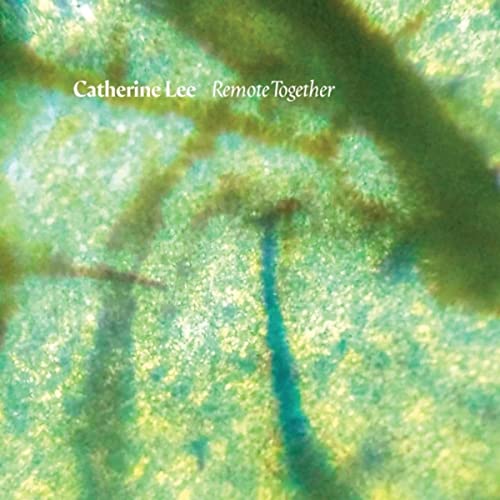
The final conjuring on this disc is by Catherine Lee who presents “Silkys” (2020) a meditation for oboe and environmental sounds, a collaboration with sound artist Juniana Lanning. This is a meditation on the life of the domestic silk moth, again a soundscape rather than a narrative. Dr. Lee’s fascination with the natural world is also reflected in the cover art which is the artist’s own photomicrograph of the exoskeleton of a bombyx mori.
This is a subtle but widely embracing collection of music seems to be a logical next installment in Professor Lee’s mission to lead her tribe of double reeds to a new vision appropriate to the new century. Brava! Long live Catherine’s Oboe.
I admit to some trepidation as I proceeded to the beautiful War Memorial Opera House in downtown San Francisco. While I had heard of this composer, Ivan Wyschnegradsky (1893-1979), it was only through one work which was contained on a disc with other microtonal works by John Cage and Harry Partch performed variously by Joshua Pierce, Dorothy Jonas, and Johnny Reinhard (among others). And microtonal music can be tedious in some hands.
This helpful sign in the elevator directed concert goers to the 4th floor recital room known as the Dianne and Tad Taube Atrium Theater
Adding to the sense of obscurity, the concert was in a small chamber music hall on the fourth floor. Other events ran concurrently on this night. The hall was nearly filled to its capacity of just under 300 people most of whom I would guess have never heard of this composer. But they likely had heard of the Arditti Quartet and clearly put their trust in the amazing ear and mind of executive and artistic director Charles Amirkhanian to deliver a satisfying musical experience which he does most reliably. This concert was no exception.
The stage awaits the performers with that OM logo projected on the floor.
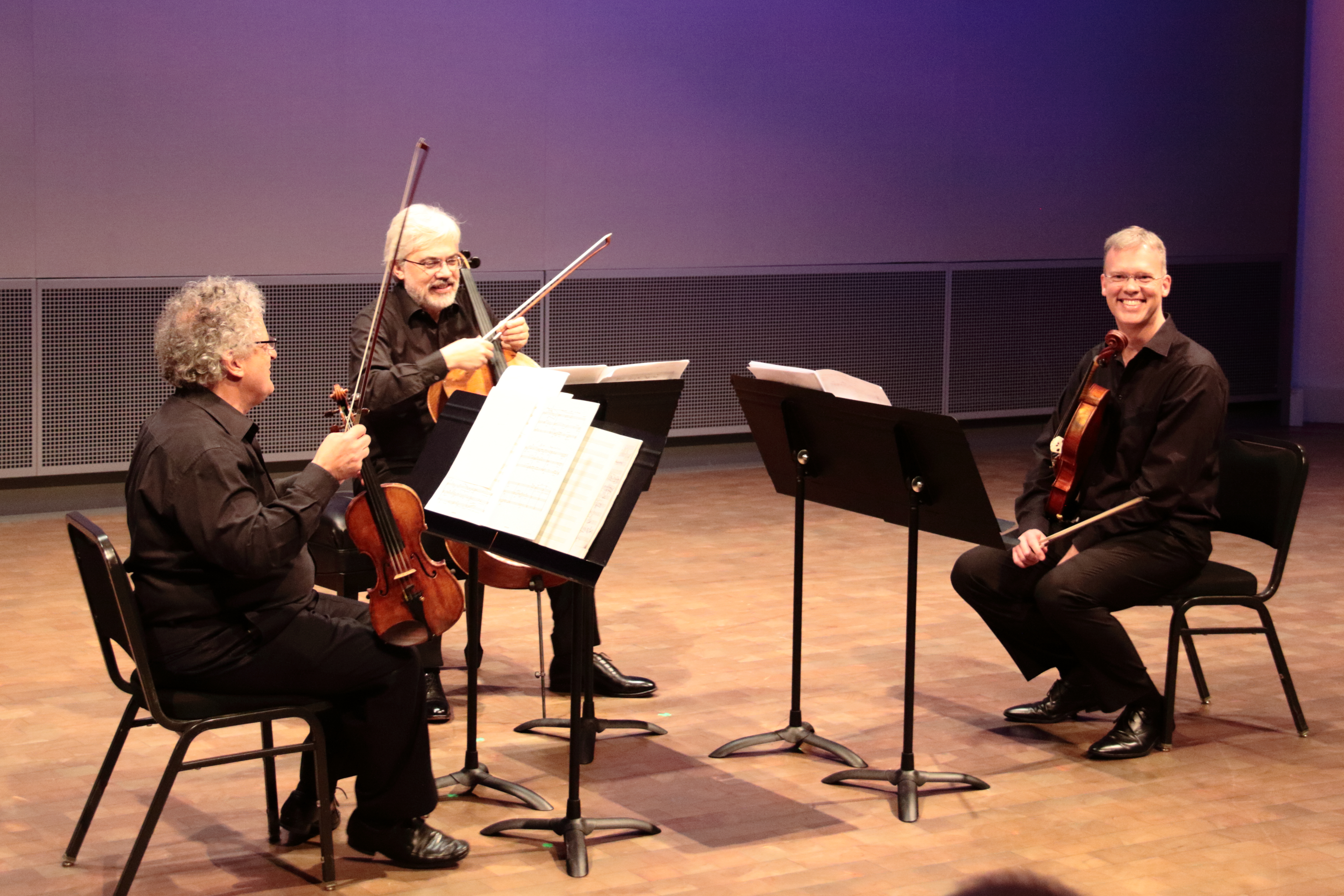
The Arditti Quartet was formed in 1974 and quickly became known as one of the finest interpreters of contemporary string quartet music. Their repertoire is vast and they do not shy away from technical difficulty or other artistic challenges. In fact they had recorded the Wyschnegradsky Quartets but, sadly, that recording is out of print. Even more interesting is the fact that tonight’s performance constitutes U.S. premieres for all the works on this concert except for the Haas Quartet (included at the suggestion of Mr. Arditti to fill out the program). Another astonishing fact shared by Amirkhanian is that this is the only time that the quartet has been asked to play this music in concert. There are plans to release those recordings in the near future pending negotiations with record companies.
Amirkhanian reminded the audience to silence those pesky cell phones.
Mention needs to be made of the talents of OM’s graphic designer (and stage manager among other duties), Mark Abramson. His work on this and last year’s program booklets take things to a new level of excellence. The program notes by Charles Amirkhanian, Randall Wong, and Blaine Todd are both lucid and comprehensive (a very necessary thing in dealing with new and obscure music). And the photos of the composer and the performers along with some of the composer’s own art work make this another true collector’s item. Previous programs were certainly well done but this is a step up.
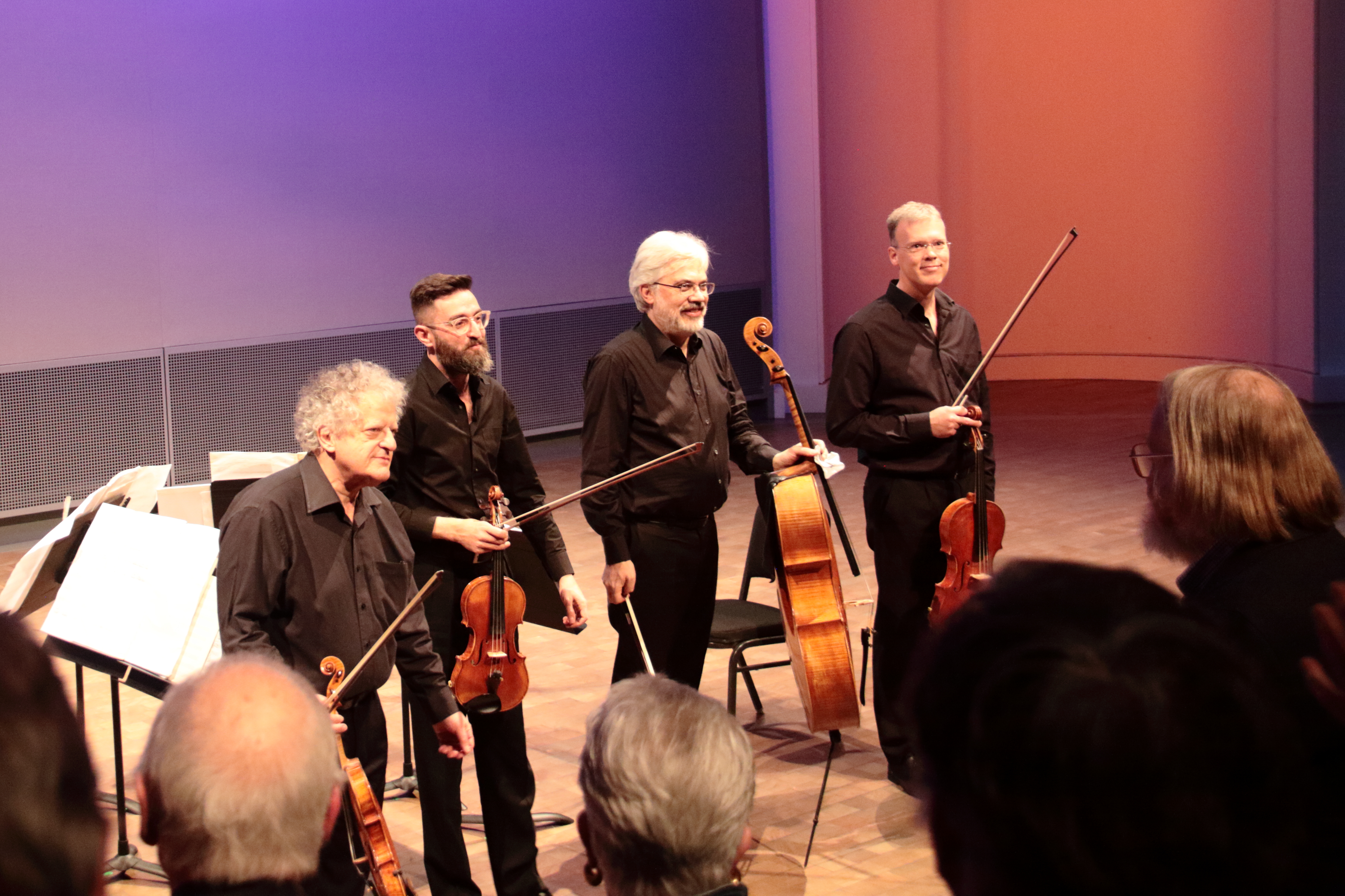
The Arditti Quartet
I chose to just listen and to read the notes later rather than get caught up in details. Indeed that was a good choice. Wyschnegradsky’s approach to the use of microtones seems more focused on the possibilities of extending melodic language than the harmonic and my understanding of complex harmony is admittedly limited anyway. Of course the harmony is necessarily different than the western models of the 18th and 19th centuries but the music, at least in the hands of such talented interpreter’s such as the Arditti speaks rather directly to the listener.
The music was presented chronologically in order of the years these pieces were composed (String Quartet No.1, 1923-4, rev. 1953-4), (String Quartet No. 2, 1930-1), (String Quartet No. 3, 1945, rev. 1958-9), and (Composition for string quartet, 1960, rev. 1966-70) completed the first half of the program. There was surprisingly little in the way of dissonance and the quartet played with a palpable intensity and concentration creating very convincing performances.
Blaine Todd holds the OM bag (a Carol Law design) as Amirkhanian picks two raffle winners after intermission.
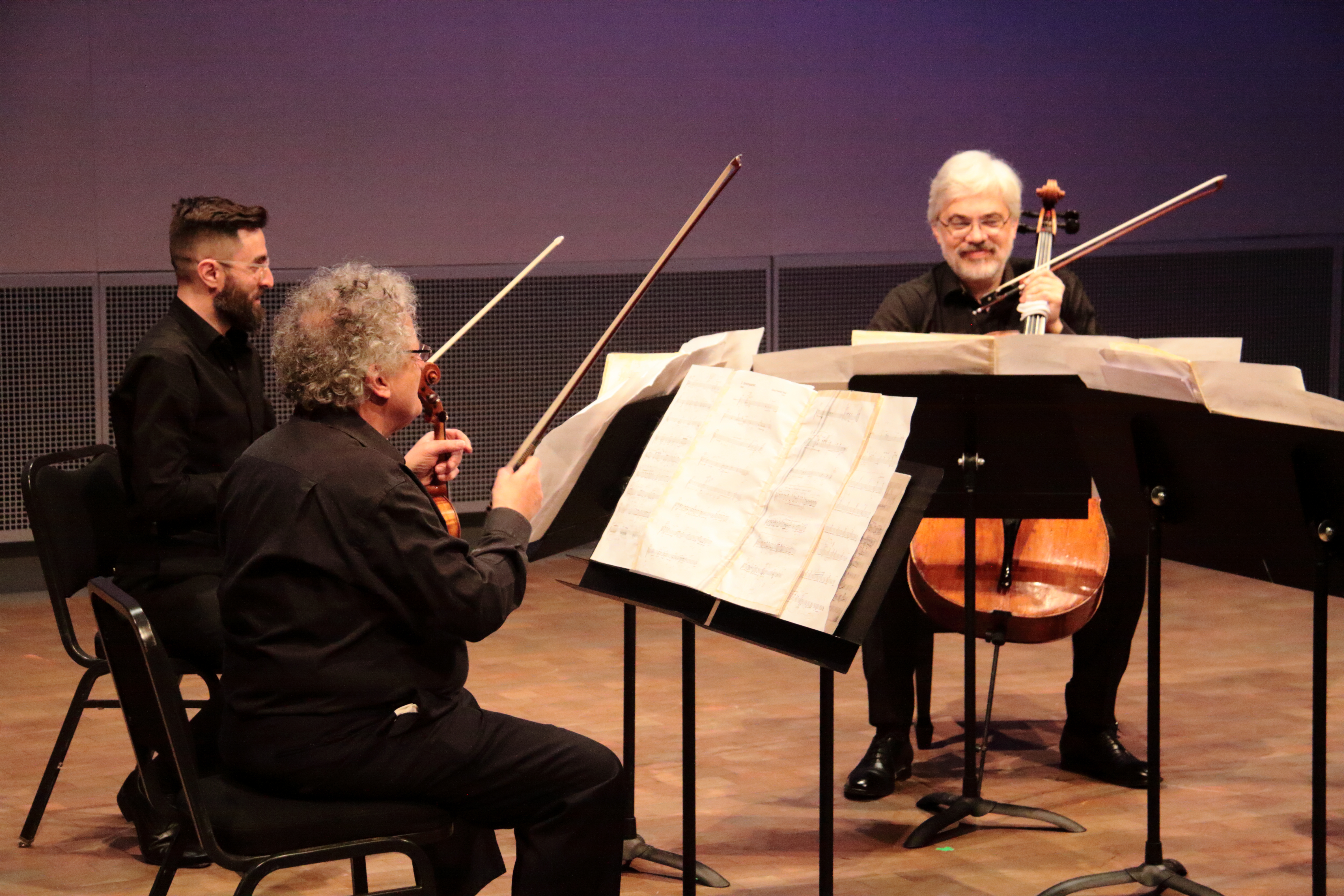
The second half began with Wyschnegradsky’s last composition, a String Trio (1978-9). Incomplete at the time of his death the trio was revised completed by Claude Ballif. Again what one hears is not what you might expect from microtonality. The composer has realized a uniquely effective way to use microtones. Hearing this survey makes the composer’s vision clear and places him in the company of such as AloisHába (1893-1973), Harry Partch (1901-1974), and Ben Johnston (1926- ) to name a few.
The Arditti Quartet sans second violin Asot Sarkissjian on stage to play the Wyschnegradsky Trio
The revelation for this listener was hearing a good sampling of the composer’s vision and a creative way to use microtones unlike any other composer really. And it became clear too why Charles chose to revive this unique voice in the musical world. This is beautiful music.
As mentioned earlier Mr. Arditti had remarked that the Wyschnegradsky Quartet and Trio music would not quite fill an evening and he suggested they play the Second String Quartet (of about 6 now I believe) by Austrian born composer Georg Friedrich Haas (1953- ). It was the only work which was not a U.S. premiere.
Arditti’s ear for programming was finely as tuned as ever and this quartet provided a very satisfying finale to the evening filled with wonderful discoveries. While this particular quartet uses some microtones the style is denser and more dissonant overall than the preceding music. This is not to say that it was not entertaining, rather it is illustrative of the rich possibilities of microtonal composition. The Arditti again shows itself to be at the forefront of the finest interpreters of the modern string quartet and clearly Haas is a name worth knowing as well. Bravo!
The musicians acknowledge the standing ovation and warm applause
Save the dates June 15 and 16 for the last two concerts in this year’s Other Minds 24 program.





 New Music Buff