Charles in Charge, Composer/Producer/Impresario Charles Amirkhanian at 80


Charles Amirkhanian (photo by Carol Law, all rights reserved)

An overflow crowd packed the lovely auditorium at Berkeley’s David Brower Center this past January 19th. Octogenarians (and younger folks as well) populated both stage and audience in a show of appreciation for a man whose work as music director of KPFA (1969- 1992) and subsequently as an arts promoter and curator of new music in California’s Bay Area continues to enhance the artistic reputation of the Bay Area.

A rare and exciting aspect of this evening were the rare opportunities to hear Charles’ music, including representative sound poetry classics and a recent major opus capped off by a world premiere of a new work.
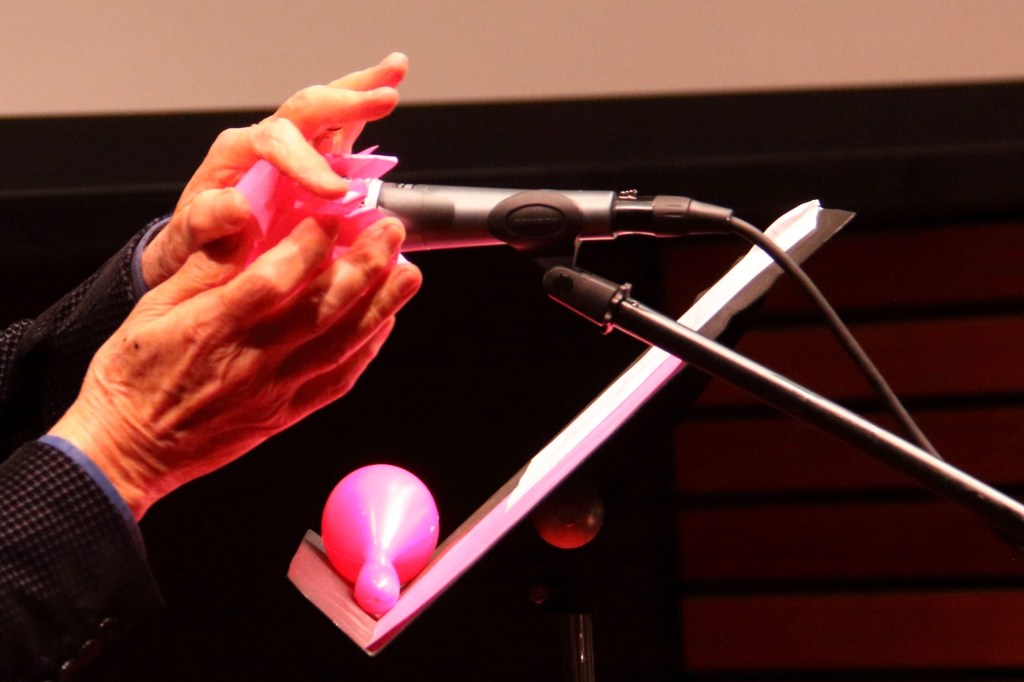
The hands of the artist. Photo by Allan J. Cronin

The genuine affection, appreciation, and respect was palpable as the honored guest demonstrated his skill at hosting when a couple of technical glitches slowed (but did not stop) the amiable birthday celebration. The audience waited calmly and quietly.

Both the guest of honor and the host (Liam Herb) used a well honed, self effacing humor used most skillfully to entertain the sympathetic audience while the technical difficulties were surmounted in real time.

Panel discussion featuring (left to right) Susan Stone, Anthony Gnazzo, Paul Dresher, Charles Amirkhanian, Sarah Cahill, and Liam Herb (Photo by Allan J. Cronin, Creative Commons license)

Herb, a composer and performer, introduced himself in the midst of the technical resolutions, graciously announcing that, as producer, he accepts responsibility for the glitches. Charles maintained his familiar master of ceremonies crowd pleasing good humor as Herb worked goodnauturedly (if that’s a word) with the rest of the crew to resolve the issues and get on with the show.

The formal opening remarks were given by Other Minds’ associate director, Blaine Todd. And the evening began in force.

Blaine Todd (photo by Allan J. Cronin, Creative Commons license)

The program glided past the initial hiccup to present a film about our guest of honor. The bevy of fans and bona fide new music professionals sat with rapt attention as the film, featuring the familiar faces of several “Bang on a Can” artists.
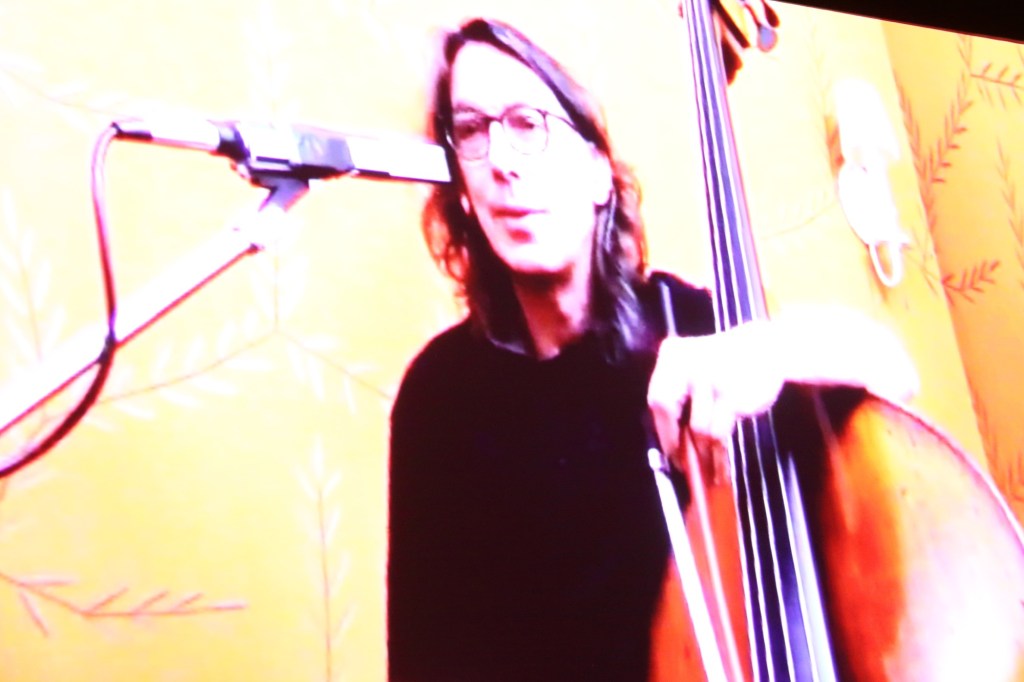
The late great Robert Black interviewed by Amirkhanian in the streaming premiere of Audible Autopsy. (Photo of film appearance by Allan J. Cronin)

Excerpts from the 2015 Other Minds 20 documentary featured Julia Wolfe, David Lang, and Peter Gordon (now, it seems elder statesmen (and women) in their own right.

Production manager Liam Herb then served as moderator for a conversation or live interview (with Amirkhanian) for the next segment. This was followed by some videos with music by the guest of honor:

Real Time/T.V. Time Video with Amirkhanian’s “Muchrooms”

The film, presented in its entirety was accompanied by “Muchrooms”, from the CD recording of that standalone work.

Next was Amirkhanian’s and Carol Law’s classic collaboration: History of Collage (1981). This is a major work and a great collaboration with his partner in life and arts. I’m pleased to add my own shot from the performance at the Other Minds 23 experience, my favorite OM festival(so far).

History of Collage (1981) photo by Allan J. Cronin taken at the Other Minds 23 wonderful live performance of this work (Photo by Allan J. Cronin is Creative Commons license 2015)

We also heard and saw Audience (1978) with photography by Law and music/poetry by Amirkhanian followed by Chairs with photography by James Petrillo and music/poetry by Amirkhanian (excerpts from Seat Belt, Seat Belt (1973).

There followed a panel discussion led by Carol Law with Betsy Davids discussing David’s’ work and her connections via her work as a book artist. These two embody the experimental visual arts that characterize the skills of these fellow artists both onstage and off tonight. In fact, interactive collaboration and both respect and friendship were everywhere to be seen in this warm and pleasantly nostalgic evening.
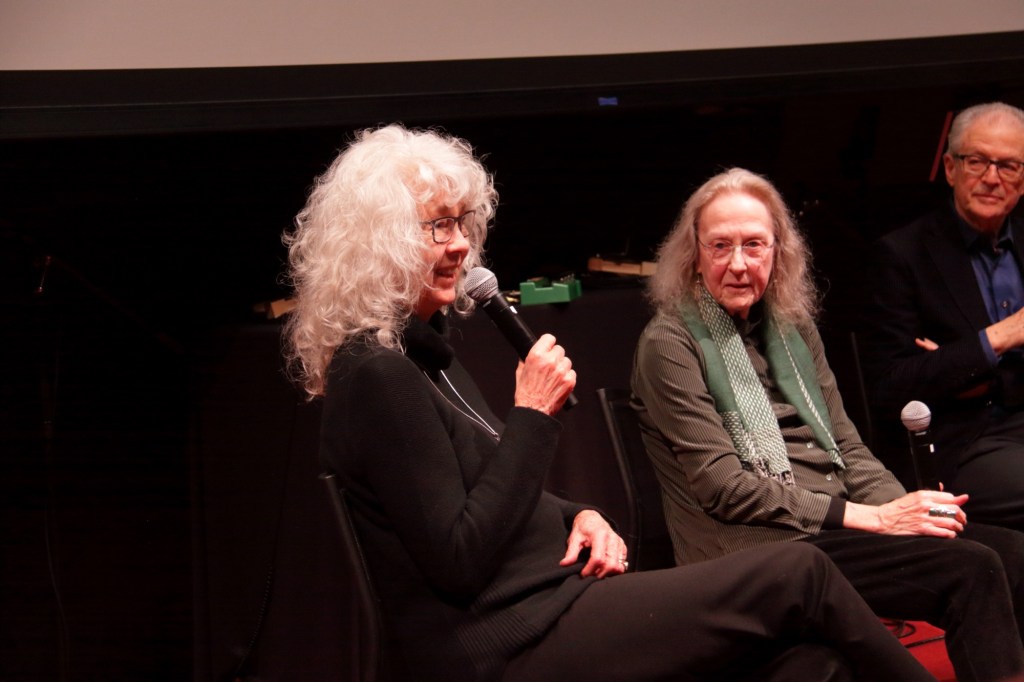
Carol Law speaking with Betsy Davids (Photo by Allan J. Cronin, Creative Commons license)

This was followed by a recording of a major opus, Ratchet Attach It (2021) recently played at one of the (still ongoing) Other Minds Festival. This work is a major opus by Mr. Amirkhanian, one I’m pleased to say I heard live at the Chinese Theater in San Francisco a few years ago. Scored for a huge percussion ensemble, with audio recordings, and a conductor who moves between the podium and a space among the performers playing with the ensemble. It is perhaps one of his most integrated and evolved compositions. Stunning to hear it live. Glad to hear the (always too short) excerpts.

In fact Mr. Amirkhanian, a fixture in the arts of the Bay Area, continues to influence musical taste and present new and interesting music as he has for well over 50 years. His work as Executive Director of Other Minds includes the fabulous OM Records as well as the annual Other Minds Festival and a continual flow of carefully curated concert events by luminaries (or soon to be luminaries) throughout the Bay Area and beyond. There is also the huge archive of thousands of hours of interviews and concerts that are available in streaming audio and video via the Other Minds website.

Many of the artists featured in the Other Minds concert series continue to work, innovate, and expand musical concepts. An Other Minds commission, Henry Brant’s Organ Concerto, Ice Field, earned him a Pulitzer Prize. Many have gone on to greater achievements in their respective careers. Of course not every composer started their musical careers at Other Minds concerts. Many mid or late career musicians have joyfully been represented over the years. Its one of those festivals that innovative musicians seek to participate.

Such achievements reflect on Amirkhanian’s leadership and curatorial acumen, but more importantly his relationships with his fellow artists. Charles has earned a reputation for his support and his collaborative nature. Arguably, everyone in the house (and the overflow in the lobby) all have a degree of connection to Charles and his guests. It is why we’re all here tonight.

Charles Amirkhanian and Joseph Bohigian performing with Liam Herb’s electronics (Photo by Allan J. Cronin, Creative Commons license)

Following a brief intermission we were treated to a world premiere of a new work by our guest of honor, Noose Ratchet (2025) for two percussionists and electronics. Amirkhanian performing and/or promoting his own music is a relatively rare event and this alone was certainly worth the trip.

The work is arguably a trio for two percussionists playing ratchets, a curious instrument whose sound, if not entirely ubiquitous, is familiar. And the two play interactively with the electronics (the third member of the trio). Extended techniques and other duties get assigned (when in doubt it’s responsibility of the percussion section, right)?

There followed a lively and friendly panel discussion amongst frequent and past collaborators Susan Stone, Anthony Gnazzo, Paul Dresher, Sarah Cahill, and Liam Herb. This truly felt like a gathering of friends.

Happy Birthday, Charles.

The Agony and the Ecstasy of “Bang on a Can”, a Socioeconomic History of Major New Music Innovators


William Robin is a musicologist whose credentials (nicely enumerated on his web site) are more than adequate to the task at hand. This is a socioeconomic and political perspective on the seminal Bang on a Can organization. At its core, Bang on a Can is the foundational work of three people now recognized as major American composers: Julia Wolfe, David Lang, and Michael Gordon, all of whom met as students at Yale University.

Julia Wolfe, image from composer’s web site

This is the (much needed) first book on the history of the collaboration of these composers and how their work helped transform and move ahead the new music scene. First in New York, then nationally, and now internationally these individuals experimented and embraced innovative ideas while navigating the labyrinth of of social, political and economic hurdles involved in the production and promotion of non-pop new music. Therein lies the “agony” referenced in my title. This essential background information makes for some slow going reading but also serves to demonstrate how daunting their task has been.

David Lang, image from composer’s web site

The book documents the early efforts both to define their concepts and to learn the politics of the new music economy. But, painful as they are, these efforts are ultimately instructive for anyone involved in the production of new music. This reader comes away with a new found respect for those who wrangle with the varied and complex elements behind the production of concerts in general, and new music in particular. It is “how the sausage is made” so to speak. And it is a useful perspective for the average listener to better understand the incredible complexity of new music production and promotion.

Michael Gordon, image from the composer’s web site

The book is divided into 7 chapters and an epilogue which focuses not just on the trials and tribulations of the gestation of Bang on a Can but also its context among several other new music initiatives that preceded BOC. Meet the Composer, New Music America, and the New York Philharmonic’s New Horizons Festival loomed large in their time and the “downtown” loft scene which nurtured the likes of Philip Glass, Meredith Monk, Rhys Chatham, etc. contributed to the promotion of new music during their respective eras.

Robin identifies the innovative efforts by BOC in their use of marathon open air concerts to showcase their innovative programming which effectively blurred the lines of genres like jazz, free jazz, classical, pop, rock, etc. But their challenges were essentially the some, the politics of concert production, funding, advertising, etc. They characterized their efforts in contrast to the economically dominant Lincoln Center. The evolution of BOC from its beginnings through the establishment of the Bang on a Can All Stars touring ensemble, the establishment of a record label (Cantaloupe) and their later performances at Lincoln Center, the stodgy institution against which they railed dubbing their music as “downtown” as an alternative to the “uptown” mainstream. There is the beginnings of a history of new music in recordings that remains to be written but the point here is context and the socioeconomic and political motivations involved.

Author William Robin does his work well in this academic tome which is richly annotated and referenced with a bibliography to take the interested reader to a wealth of information on new music and its production. And while this is more about “how the sausage is made” so to speak, it is a necessary exposition which provides both history and context, something to think about the next time you buy a ticket to hear new music. Admittedly its not a pretty picture but it certainly illuminates the side of new music virtually unknown to the average listener.

While this reader had hoped for more information on the music performed (which deserves a book unto itself) this book takes its place alongside Tom Johnson”s “The Voice of New Music”, Kyle Gann’s “Downtown Music”, Renee Levine Packer’s wonderful history of the Buffalo New Music scene, “This Life of Sounds”, Benjamin Piekut’s “Experimentalism Otherwise”, George Lewis’ “A Power Stronger than Itself”, Luciano Chessa’s “Luigi Russolo, Futurist”, and David Bernstein’s “The San Francisco Tape Music Center” (to name a few) as an essential history of new music.

Coming Out Electric: Trevor Babb’s Warmth


Steve Reich’s masterful Electric Counterpoint (1987) opens this disc.  That work originally written for Pat Metheny  and has become pretty much a classic as well as a fine way to demonstrate a musician’s facility with multi-tracked guitar music.

Trevor Babb is a doctoral student at Yale and this appears to be his first album.  And what an album it is.  The choice of the opening work serves to demonstrate Babb’s ability to interpret, in his own individual manner, a work that has been recorded many times.  It remains a classic and very listenable work which belies the difficulties inherent in its performance.  Babb seems to take a bit more of a legato approach than previous interpretations but is definitely highly effective and this is a wonderful recording of the work.

It also serves to set the tone for the rest of this truly fine solo guitar and electronics debut album.  Electric Counterpoint is the first of 6 total works represented on this disc.  The remaining five selections fit the rubric of this collection in the overall sense but are definitely unique and challenging in their ways.

Paul Kerekes is not a familiar name to this writer and perhaps a new name to many.  His inclusion here introduces many to this composer and places him in the context of this interesting collection.  This young composer is apparently well known in the New York scene and seems to travel in the circles that include some of the most interesting artists currently working.  Trail is a very different piece than the Reich but demonstrates the range of the solo guitar and electronics genre.  This is a gentler, more meditative piece overall and one which piques interest in hearing more.

David Lang is a well known and very welcome name in new music and is here represented by Warmth, a classic Langian post-minimalist work which delights the listener while challenging the performer.

Septet by the late great James Tenney is one of those masterful compositions that is respected as a masterpiece but not often programmed.  This is due at least in part to it’s critical use of alternate tuning.  The effects intended by the composer can only be heard if the performer can play accurately the tuning involved.  It is a wonderful and listener friendly experience typical of the finest of Tenney’s grasp of how to use such tunings in the compositional process.  Babb executes this piece lovingly and this performance will likely help to nudge this work to a more frequent experience in the concert hall.

Babb introduces himself as a composer in Grimace, an impressionistic exercise in which he attempts to imitate both the style of Ligeti and evoke the image of a mask seen in an art exhibit.  Long tones and extended techniques predominate in this meditative drone-like work that demonstrates fine technique in both composition and instrumental facility.

The album concludes with Slope 2 by the emerging bass player and composer Carl Testa.   Again Babb introduces a new voice for the listener to explore.  This extended composition, more drone than pattern based, is one that deserves multiple hearings to discern its substance and to demonstrate its position in the larger rubric of this collection.

Babb produces a great debut here and makes a strong case for the genre of electric guitar with supporting electronics as being a viable format for a live concert.  He also seems to be defining that genre much the way that many solo artists are doing these days.  He seems to be constructing a repertoire establishing the classics (Reich, Tenney) and promoting the viability of works that he feels deserve a place in that repertoire.

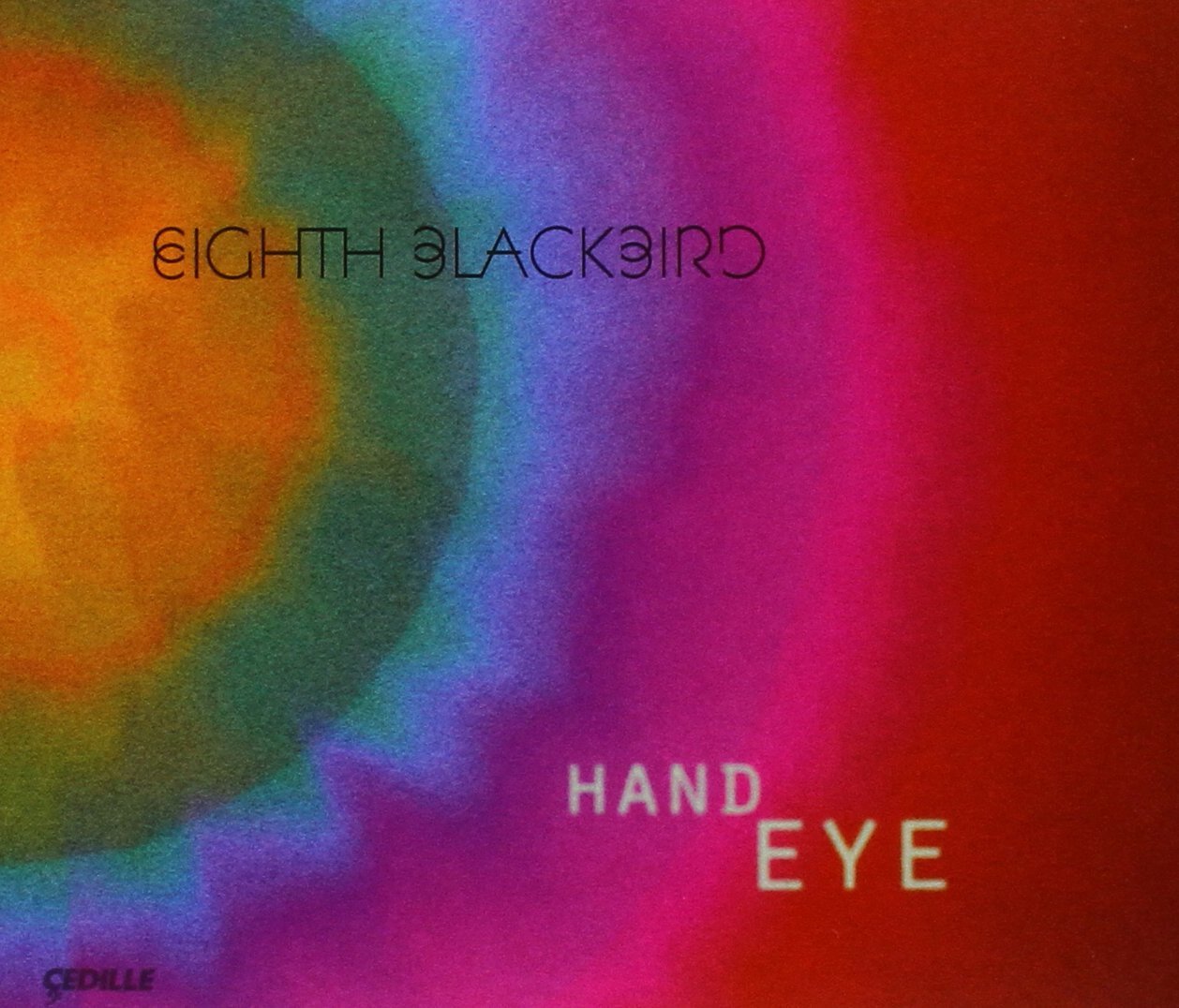
This is a really delightful album and that extends, at least in this writer’s eye, to the cover design as well.  Again I will bemoan the loss of the 12  inch square format of LPs which could have made more prominent this lovely design by Colin Meyer and Trevor Babb.  Perhaps a 12 inch vinyl release may happen.  But until then the listener can settle most comfortably in the warmth of this truly fine release even in the smaller CD format or even as a digital download.


Pictures at a Post-Minimalist Exhibition: Eighth Blackbird’s Hand Eye


handeye

Eighth Blackbird is Chicago’s more than adequate answer to New York’s Bang on a Can and this album is solid proof of that.  The liner notes tell us that this is “a collection inspired by a collection” and these 9 tracks are sonic impressions by the individual composers of an art exhibit.  The end result is very much like the romantic/impressionistic Mussourgsky gem updated to the post-minimalist era.

It is well worth your time to check out the artwork which inspired this music (here) and this writer imagines that this piece could really work well as a film score, a DVD perhaps of these images.  The music invokes various minimalist and post-minimalist composers and styles.  It is almost a sonic tour of post-minimalism.  And apparently there are plans for a multimedia tour of this piece as well.  Sounds like a wonderful idea.

This album is the work of a composer’s collective called Sleeping Giant and consists of Timo Andres, Andrew Norman, Robert Honstein, Christopher Cerrone, Ted Hearne and Jacob Cooper.  Each has chosen a selection of art to which they wrote a piece of music providing their musical impressions.  The result is a remarkably coherent set of pieces which, while each different, seem to flow into a unity.

Casual listeners may be familiar with the names of Timo Andres or Andrew Norman but all these composers are basically new to these ears and it appears to be a talented lot that deserves some serious attention as they may very well be THE ones to watch/listen to in the coming years. They utilize a variety of techniques in their compositions but there is never a feeling of this being experimental or tentative.  These are fully fleshed out works by master composers.

The music is appealing immediately upon first listen.  One hears the influences of Terry Riley here, John Adams there, David Lang, etc.  In short these pieces are informed by the preceding generations of minimalists much as they also address their debt and do honor to their mentors.  It has some of the character of Lang’s “Child” in that this is essentially a suite of pieces of post-minimalist chamber music (though this music has an almost symphonic quality at times).

The recording is superb and up to the high standards of Cedille releases and the musicianship, as always, is superb.  The liner notes by Sleeping Giant along with Tim Munro are lucid and the album design by Karl Jensen is eye-poppingly psychedelic.  This project was funded by the Maxine and Stuart Frankel Foundation for the Great Lakes Chamber Music Festival, Carnegie Hall, the Andrew W. Mellon and the Texas Performing Arts at the University of Texas at Austin.