Opus 961, Violist Noémie Chemali’s Auspicious Debut: New Music Activism From Emerging Lebanese Composers


There are many ways to debut on the world stage and there are many ways to represent political activism. Violist Noémie Chemali has chosen, as her important first impression in her recorded debut, a selection of music from young composers whose heritage includes political oppression. The albums profits are promised to MSF, also known as Doctors Without Borders. These works are not directly political, rather they are a carefully curated selection of new works produced by composers who, in varying degrees, have experiences of dealing with or having friends and family whose lives are negatively impacted by political conflicts and oppression. This is gorgeous music by emerging talents.

The good news is that these wonderfully creative artists persevere in creating great art and it is the celebration of that creative drive that lies at the heart of this fine release. While the pieces here variously reference tunings, rhythms, and melodies representative of their individual ethnic heritages, they are not confrontational. Rather the music here stands as evidence of the beauty of artistic invention which stands defiantly in contrast to the cruelty of oppression and warfare. That gentle activism casts a kinder and gentler image of people more commonly represented in the media as terrorists (actually a numerical minority) in a culture with ancient roots and a powerful artistic soul (the better descriptor of the actual majority).

Links to the composers’ web sites can be accessed by clicking the names of said composers.

The album’s contents are as follows:

Wajdi Abou Diab (1991- )

1. “The Moraba’ Dance” (2020)

This, the composer’s Opus 13C, is based on an Arabic rhythm called “Al Mouraba”. It is for solo viola and is cast in the unusual meter of 13/4, using an Arabic scale. The music imitates traditional music which ostensibly enticed horses to dance in times past.

Sami Seif (1998- )

2. “La’ib an-nard / The Dice Player” (2019)

This musical impression of a poem of the same name by Mahmoud Darwish. It is, in the composer’s description, a meditation on the random elements that affect our lives. It is scored for viola, cello, and double bass.

Layale Chaker (1990- )

3. Cadenza from “The Brown Texts”; movement one (2017-2020)

4. Cadenza from “The Brown Texts”;movement two

The term “cadenza” derives from the word “cadence” and it generally refers to the improvisations (by the soloist) in a concerto. The notion of a solo cadenza does not appear, as far as this listener’s encounters, until the mid to late twentieth century. Penderecki’s Cadenza for Viola is the only example that immediately comes to mind. Though that work is sometimes performed separate from the viola concerto from which it derives, its origin is in the classical/romantic tradition of a virtuoso work that displays the skills of the soloist. As with the previous work, this one is a musical rendition of originally poetic ideas, those of the late Nadia Tueni. And, unlike any other cadenza I’ve known, it is cast in two separate movements. The piece is a fine showcase for Ms. Chemali’s technical and interpretive skills.

Noemie Chemali:

5. “Kadishat” (2021)

Delightfully, Ms. Chemali has chosen to include one of her own compositions. She describes this as a set of variations on the ancient Aramaic Trisagion “Qadishat aloho”, a tune which has been firmly ensconced in the composer/performer’s consciousness from having heard it since her childhood. One could characterize it as one of the greatest hits of the Eastern Orthodox Church and one of its most deeply felt pieces. Chemali casts this work for violin, viola, and cello. This writer is reminded of another fine example of the incorporation of sacred hymns into the classical music tradition, that of Carolyn Shaw’s fine “In Manus Tuas” which mines that composer’s memory of hearing a sacred chant. Both works reflect the composer’s internal process of hearing and attempt to convey that spiritual experience to the listener.

Mary Kouyoumdjian (1983- ):

6. “The Revolt of the Stars” (2018/2020)

This piece, another musical expression of a literary work, namely, the Armenian fable that provides the title for this work which is cast for cello, voice, and electronics. It is presented here in a transcription for viola by the soloist. The fable deals with the strength in numbers that rise up against those in positions of power. It is a delightful work with dark implications.

Saad Haddad (1992- ):

7. “Dohree” (movements 1&2)

8. “Dohree” (movement 3)

This work, scored for viola, harp, and flute is cleverly written in three movements which, in turn, each give a solo to each of the musicians who are, in turn, accompanied by the others in the group. “Dohree” is an Arabic word which translates as “my turn”.

Six pieces over eight tracks with chamber groups ranging from solo viola to viola with electronics (in the Kouyoumdjian work) and small chamber groupings in the others. All in all a fine and engaging selection of music that bear witness to the beauty and creativity of people living with oppression. This music reflects the human experience that can get erased by merely identifying ethnicity.

In addition to Ms. Chemali this recording includes the following musicians: Shaleah Feinstein, violin; Raffi Boden, violoncello; Kebra-Seyoun Charles, double bass; Lauren Scanio, flute; Deanna Cirielli, harp. They really do honor to the spirit of this music and this album is beautifully recorded as well.

Kouyoumdjian was the only composer known to this reviewer prior to hearing this album but she is apparently in very good company here and listeners would do well to make note of these rising stars. We will doubtless hear from them again. Here’s hoping.

Noemi Chemali (from the Orchestra of St. Luke’s web page)

This is the artist’s biography as it appears on her website (linked above):

French-Lebanese-American violist Noémie Chemali received her Bachelor’s degree from McGill  University’s Schulich School of Music, her Artist Diploma from the Robert McDuffie Center for Strings at Mercer University, and her Master’s Degree from The Juilliard School. Her principal teachers include Becca Albers, Hsin-Yun Huang, and Carol Rodland.

During her time at Juilliard, she made her Carnegie Weill Hall solo debut in the UN Chamber Music Society’s Arabic Language Day concert and collaborated with dancers of the New York City Ballet. During her time at the McDuffie Center for Strings, she performed alongside faculty members of the Cavani and Ehnes String Quartets. In 2019, she also performed in “A Night of Georgia Music,” a tour the American South with violinist Robert McDuffie,  guitarist Mike Mills of the band R.E.M., and pianist Chuck Leavell of the Allman Brothers Band/Rolling Stones. Some performance highlights from McGill include playing a concert with clarinetist David Krakauer in a program of Klezmer music, being selected to perform a chamber work by John Rea in a concert presented by the Société de musique contemporaine du Québec (SMCQ) alongside Schulich faculty and students, and participating in the 2018 Musical Chairs Chamber Music Festival, where she collaborated with students from the Mozarteum (Austria) and the Yong Siew Toh Conservatory of Music (Singapore).

Noemie has spent her summers at music festivals such as The Music Academy of the West, Sarasota Music Festival,  Orford Musique, The Lunenburg Academy of Music Performance (LAMP), Scotia Festival of Music, Manhattan in the Mountains, and Green Mountain music festivals. While Ms. Chemali was a fellow at the Music Academy of the West, she played under the baton of esteemed conductors Larry Rachleff, Stéphane Denève, Gustavo Dudamel, and James Conlon. While at Sarasota Music Festival, she served as principal violist of the festival orchestra under the baton of Jeffrey Kahane and performed in a faculty concert as a member of a quintet with bassoonist Frank Morelli. She has, throughout the years, participated in various masterclasses with artists such as Joseph Silverstein, Ida Kavafian, Cynthia Phelps, Karen Dreyfus, Richard O’Neill, James Dunham, Jutta Puchhammer and the Pacifica String Quartet.

Passionate about diversifying musical audiences, she co-founded the Hildegard Project, which aims to bring music written by women composers to women’s shelters in the greater Montreal area and was invited to speak about her work at the Classical Evolution/Revolution Conference in Santa Barbara, CA. Most recently, she founded Music@Daybreak, an interdisciplinary performance and research project which features performances at homeless shelters in collaboration with the Sociology department at Mercer University.

Noémie is the recipient of a Juilliard Career Grant, George J. Jakob Global Enrichment Grant, Gluck Community Engagement Fellowship, Juilliard Entrepreneurship Grant, Barenboim-Said Foundation (USA) Grant, and a Lower Manhattan Cultural Council Creative Engagement Grant. In January 2024, she will be releasing Opus 961, her debut album of music written by contemporary Lebanese composers.

Her website includes some YouTube videos reflecting the artist’s fascinating choices of repertory. Along with fervent activism, she demonstrates a pretty unique take on what she chooses to play. Her biography evidences an eclectic group of collaborators and influences that will likely characterize her career.

This is quite an impressive first impression from an artist who greets us at the beginnings of what this reviewer believes will be a long and interesting career representing a new generation of musicians with a unique and (hopefully more effective) approach to the ills of our age. Great art inspires, if not action, at least hope. And we desperately need hope. Thanks for that Ms. Chemali.

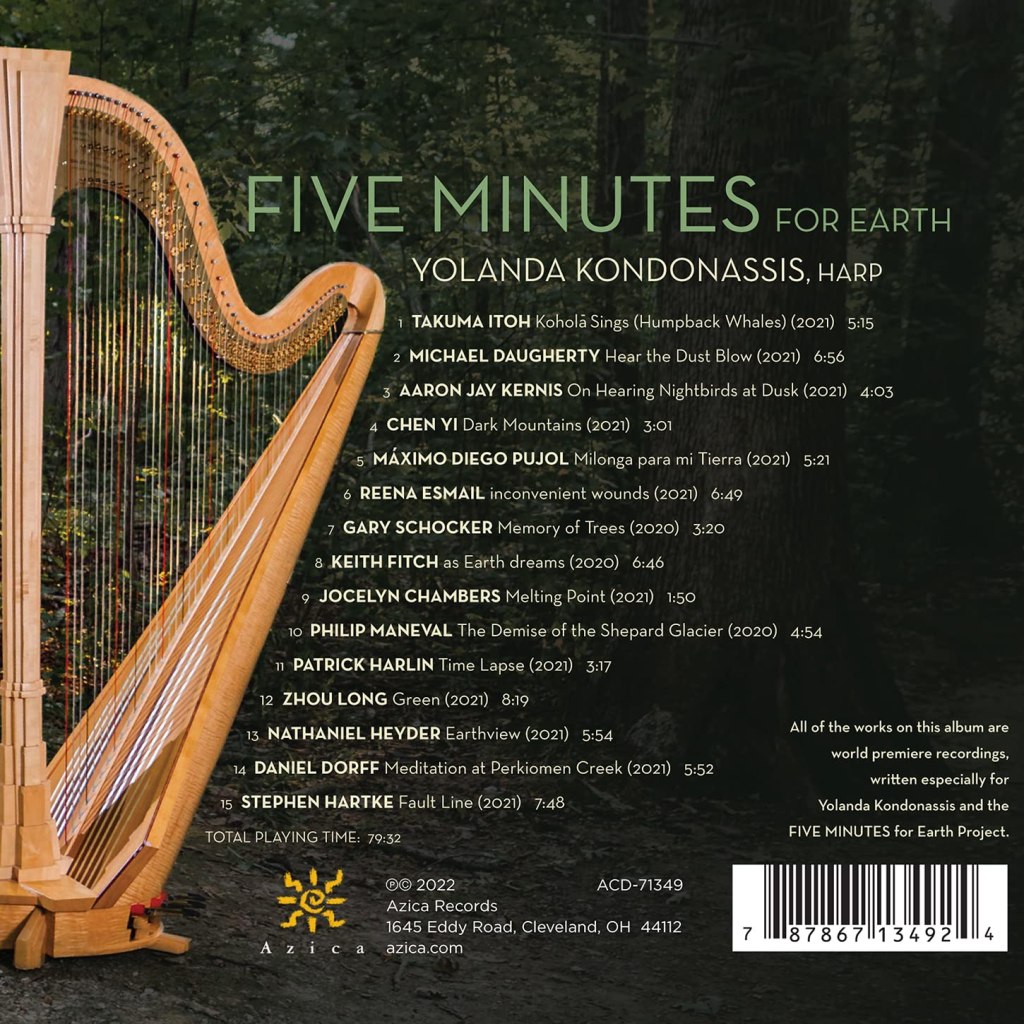
The Ecological Harp, Yolanda Kondonassis’ Five Minutes for Earth


Azica ACD-71349

Yolanda Kondonassis‘ name is practically synonymous with her instrument, the classical concert harp. Her discography (via discogs) numbers over 50 albums, most of which demonstrate her interest and dedication to music of our time. She has played both as soloist and as orchestral musician with many major orchestras and has had many works written for her. If you collect new music recordings you probably have one or more of her recordings (I certainly do).

So this album continues her ongoing legacy promoting new music for her instrument. But it also demonstrates her interest in ecology with these 15 compositions written for her, at her instigation, on the theme of Earth in many of its guises as chosen by the composer. The project begun in 2020 features compositions written over the last two years in response to her request.

The project, by her description, has grown beyond its original plans and has included videos, live performances of these works, publication of these pieces as well as a collection of works for younger musicians. Each time one of these pieces is reported as having been performed a donation is made via the Kondonassis’ charity organization Earth at Heart to various ecological organizations.

These 15 composers are a delightfully diverse group, some well known, some rising stars. All reportedly responded quickly with 15 similarly diverse compositions (2-8 minutes in duration) inspired by the theme of the commission, all with the composers’ unique perspectives on the subject. This writer hopes that more composers will participate in this worthy project which promotes ecology, the harp, and expands the repertoire for her instrument. No electronics, no other instruments. Just the lone harp in all its glory.

This beautiful and thoughtful production includes useful liner notes (which enhance the listener’s perspective on the music) from Ms. Kondonassis and brief biographies of each of the composers (with more notes available on her website). Technical analysis of this music is beyond this writers expertise so let me just say that each of these works are compelling additions to the solo harp repertory and are concise, carefully conceived pieces that benefit from repeated hearings. You might be challenged but you won’t be bored. Here’s hoping that this disc gets many hearings and furthers the artist’s goals for the instrument and the planet upon which she plays it. Brava!

The Jack Quartet Plays Music of Hannah Lash


Hannah Lash‘s name began appearing on my radar about two years ago but this is my first actual encounter with her music.  This recent (2011) Harvard graduate’s star seems to be rising quickly and this is a fine place as any to start to get to know her work.  New Focus Recordings is a label with good instincts regarding new and important music and this one is typical of their collective acumen.

This release features 4 works. One is for harp (Lash’s instrument) with string quartet and the rest are for string quartet alone. I find it difficult to describe Lash’s work concisely. Like many in her generation she seems to have been exposed most comprehensively to a huge range of styles and techniques and she appears to be selecting judiciously among those to apply those techniques by which she can achieve her compositional goals.

The works include the single movement, Frayed followed by Suite: Remembered and Imagined (in 6 short movements), the single movement Pulse-Space, and the three movement Filigree in Textile which features Lash on harp along with the Jack Quartet.  The rather sparse liner notes are by the composer.  They may lack detail as to composition date, commissioner, etc. but they do reflect what the composer’s thought processes were with each piece.  She is clearly more concerned with conveying her metaphorical ideas than the technical aspects of her work.  That is perhaps best left to future musicologists.

Her work is direct, one might even say concise.  Using a basically tonal palette, the composer explores a variety of musical and metamusical ideas.  These are intimate and interesting works that seem very much to the point.  Keep in mind too that this is simply a disc of recent chamber music which gives no idea as to how she handles larger forms.  But from the perspective of this album alone her brevity has an almost Webernian quality (not the thorny harmonies or difficult rhythms, just the brief and direct statements she makes with the music here).

The always wonderful Jack Quartet plays in two different configurations here.  Tracks 1-8 feature Christopher Otto and Ari Streisfeld, violins; John Pickford Richards, viola; and Kevin McFarland, cello.  Tracks 9-11 feature: Austin Wullman and Christopher Otto, violins; John Pickford Richards, viola; Jay Campbell, cello; and Hannah Lash, harp.

As usual with well written new music multiple listens reveal more detail.  The music is both interesting at first listen as well as compelling enough to provoke yet another listen.  Lash is a rising star who deserves the attention of a new music audience who will learn the subtleties of her musical language.  There is great beauty here.

Michala Petri in the 21st Century


amerecorder

OUR Recordings 8.226912

Since her debut in the mid 1970s Michala Petri has proven herself as one of the great masters of the recorder.  The recorder is an instrument which, until the 20th century was pretty much only heard in music written before 1750 or so.  Many previous masters such as David Munrow and Franz Brüggen restricted their playing to early music.  Petri has certainly broken that mold.  She has mastered baroque, renaissance and contemporary music for her instrument as her recent releases demonstrate.  And her skills as a musician have only grown stronger and more convincing.

This disc is her celebration of American music for the recorder.  We hear four 21st century concerti for the recorder.  Composers include Roberto Sierra (1953- ), Steven Stucky (1949-2016), Anthony Newman (1941- ), and (a new name to this reviewer) Sean Hickey (1970- ).  These are fine compositions but they are basically mainstream sort of neo-romantic/neo-classical/neo-baroque works.  These are all finely crafted compositions but nothing here is experimental.  Despite the names all are basically concerti which highlight the interplay between soloist and ensemble.  Therein lies the joy.

The disc begins with Roberto Sierra (1953- ) wrote his “Prelude, Habanera, and Perpetual Motion (2016) as an expansion of an earlier recorder and guitar piece but, obviously, with a great deal of expansion and orchestration.  Despite its colorful title the work is basically a concerto and a fine one at that.  Petri here performs with the Tivoli Copenhagen Philharmonic under Alexander Shelley.  From Sierra’s web page there is a link to a video of the premiere here.  Sierra, born in Puerto Rico, affirms his skills as a composer in this exciting work.

Next up is music of the late Steven Stucky (1949-2016) sadly known almost as much for his recent demise as for his compositions.  However Petri’s performance of his “Etudes” (2000) for recorder and orchestra goes a long way to affirming some of the gravity of the talent we lost and the wonderful legacy he left.  The Danish National Symphony under Lan Shui do a fine job of handling the complex orchestral accompaniment and Petri shines as always.  This concerto is in three movements titled: Scales, Glides, and Arpeggios respectively.

Anthony Newman (1941- ) is a name that must be familiar to classical recording buyers in the late 1970s into the 1980s when Newman’s exciting recordings of Bach dominated record sales.  It is no wonder that he composed an essentially neo-baroque concerto pitting the recorder against an ensemble consisting of a harpsichord (deliciously played by Newman) and a string quartet (in this case the Nordic String Quartet).  Clearly a more suitable sized ensemble that might have been used in the 18th century.  This is the only piece on this album that is actually called a concerto by its composer.  Concerto for recorder, harpsichord, and strings (2016) in four movements (Toccata, Devil’s Dance, Lament, and Furie) shows this performer, musicologist, and composer at the height of his powers in this lovingly crafted work.

Last (and certainly not least as the cliché goes) least is by a composer unfamiliar to this reviewer, Sean Hickey (1970- ) is also the youngest composer here.  His A Pacifying Weapon (2015) is subtitled, “Concerto for Recorder, Winds, Brass, Percussion and Harp” which tells you about the rather gargantuan dimensions of his work.  While not representing a specific “program” the work is the only one on this CD that espouses some political content.  The title reflects the composer’s desire to use this concerto to represent some of his response to “current events”.  The three movements are simply numbered 1, 2, and 3.  I can only begin to imagine the problems of balancing the little recorder against such a huge and loud ensemble but the Royal Danish Academy of Music under conductor Jean Thorel are clearly up to the task.

Hickey originally hails from Detroit and is now based in New York.  A quick perusal of his web page suggests that listeners like your humble reviewer have much to hear from this up and coming young composer.

All these are world premiere recordings which show Michala Petri at the height of her powers.  Indeed she is an international treasure whose instrumental skills and her range of repertory continue to amaze and entertain her audience.  The recording under Lars Hannibal’s direction is, as usual, lucid and very listenable.  Joshua Cheeks liner notes save this writer a great deal of research time and pretty much answered all this listener’s questions.

Happy listening all.  This recording has it going on at many levels.


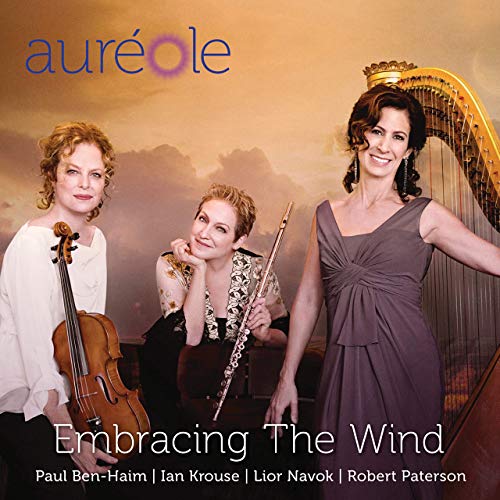
Auréole: Embracing the Wind and the Strings


aureole

American Modern Recordings AMR 1050

Auréole consists of Laura Gilbert, flute; Mary Hammann, viola; and Stacy Shames, harp.  It is an ensemble seemingly based on the instrumentation of Debussy’s justly famed sonata (1916) for that combination of instruments.  It is like the instrumentation of Schoenberg’s Pierrot Lunaire (1912) whose instrumentation (flute, clarinet, violin, piano, and voice and/or percussion) has become a sort of standard grouping and has had much written for it (much more than the flute, viola, and harp combo).

Nevertheless this ia a charming chamber ensemble and they’ve chosen their repertoire well for this recording.  Here are four works which share the instrumentation of the aforementioned Debussy sonata.  They also share a similar musical aesthetic in their basically tonal and romantic style. This ensemble has chosen works dating from therapy twentieth century to the early twenty first. Two are by Israeli composers and two by Americans. 

The album opens with a trio simply entitled, “Chamber Music” (1978) by the late Paul Ben-Haim (1897-1984).  He was born Paul Frankenberger and was born in Germany. He, like many Jewish refugees from the horrors of WWII, settled in what was then Palestine where he became known (for better or worse) as the Israeli Aaron Copland.  His music is overdue for a new reckoning and this is a fine example of his work. This lovely trio is cast in three movements and is bound to please and entertain. 

Next up is Robert Paterson’s (1970- ) “Embracing the Wind” (1999).  Cast in one movement it has a touch of modernism but remains a predominantly post-romantic work which takes its inspiration from the wind and the way it moves objects. It traverses several moods as it spins its tale but remains compelling throughout, a very strong piece of music which fits the general sound and ethic of this program.  And it leaves this listener wanting more.

“Veiled Echoes”(2000) is the second work by an Israeli composer on this disc.  Lior Novak (1971- ) would seem to be a worthy successor to Mr. Ben-Haim.  This three movement trio is a meditation on the composer’s perception of links between mountains, sky, and other nature phenomena. Very enjoyable music.

The album concludes with what is described as a tone poem.  It is based on one of Frederico Garcia Lorca’s (1898-1936) stories, “Thamar y Amnon”. The composer is Ian Krouse (1956- ).  This rather harrowing romance is in a single movement with many moods which evoke the tale.  In a nice touch the story is reproduced in its entirety in both Spanish and English.

This is a beautifully conceptualized and performed disc which introduces music which would compliment the Debussy sonata in spirit as well as instrumentation.  Brava and now tell us of your next project.

Captain Kirk and the Buddha Speak Esperanto: Other Minds 22 Commemmorates Lou Silver Harrison at 100


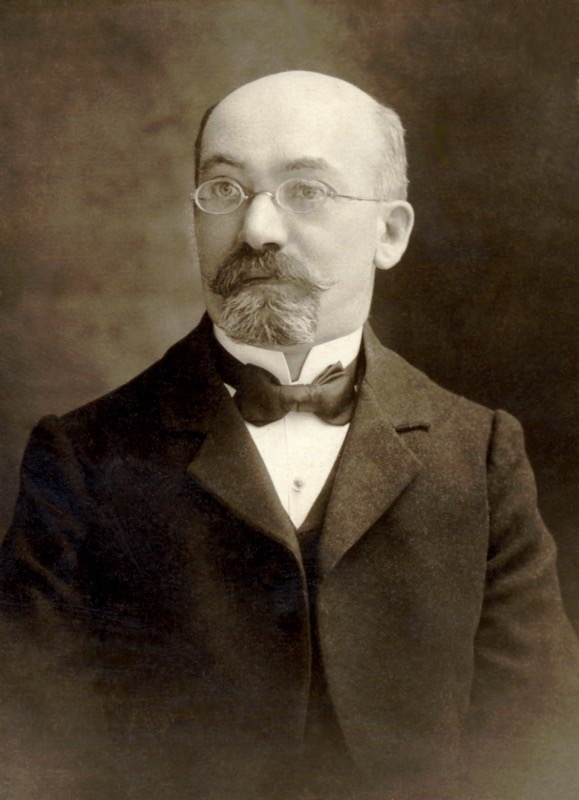
Esperanto is a constructed language brought into being in an 1887 book by a Polish-Jewish doctor by the name of L. L. Zamenhof (1861-1917).  This constructed language was intended in part as an intellectual exercise which might contribute to greater international discourse and perhaps understanding.  He outlined his intentions as follows:

  1. “To render the study of the language so easy as to make its acquisition mere play to the learner.”
  2. “To enable the learner to make direct use of his knowledge with persons of any nationality, whether the language be universally accepted or not; in other words, the language is to be directly a means of international communication.”
  3. “To find some means of overcoming the natural indifference of mankind, and disposing them, in the quickest manner possible, and en masse, to learn and use the proposed language as a living one, and not only in last extremities, and with the key at hand.

Esperanto did gain a great deal of popularity and there are still adherents today (an estimated 2 million people worldwide).  Lou Harrison was one of the users of this language (users are known as “Esperantists”).

L. L. Zamenhof (1859-1917)

In 1966 a horror film, “Incubus”, written and directed by Leslie Stevens (of Outer Limits fame) was released starring the just pre-Star Trek William Shatner.  Once thought lost, this film was restored from a copy found in a French film library.  It was only the second (and apparently last) feature film done entirely in Esperanto (the first being the 1964 French production, “Angoroj” or Agonies).  It was thought that the use of Esperanto would add a mysterious dimension to the production though detractors challenged the actors’ ability to properly pronounce the dialogue.  A link to a Shatner scene is here.  https://www.youtube.com/watch?v=accFmyaOj7o

And if you want to sit through the entire film (definitely a cult film experience) you can find it here: https://www.youtube.com/watch?v=LHUfHj2lTaM

Curiously 1917, the year of Dr. Zamenhof’s death, is also the birth year of Lou Harrison, the principal subject of this essay.  This patriarch of 20th century modernism was a composer, conductor, musicologist, performer, teacher, dancer, calligrapher, and Esperantist.  He used Esperanto to title many of his works and set some Esperanto texts to music.

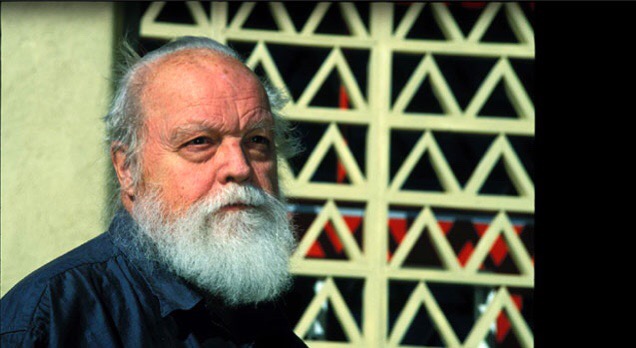
Lou Silver Harrison


And the Buddha Becomes an Esperantist

In his masterful big composition, La Koro Sutro (1972) translated portions of the text of the Buddhist Heart Sutra (into Esperanto) are set for mixed chorus and American Gamelan.  Gamelan is an Indonesian mostly percussion orchestra which Harrison studied extensively following the example of pioneering Canadian ethnomusicologist and composer Colin McPhee (1900-1964).

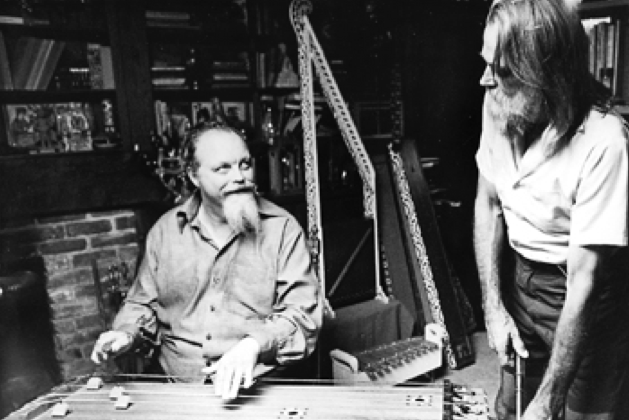
Gamelan was first introduced to western audiences at the 1889 Paris World’s Fair where composers such as Claude Debussy and Erik Satie heard the instruments and later incorporated some of those sounds in their music.  (That Gamelan now resides in Chicago’s Field Museum of Natural History.) Harrison’s life partner Bill Colvig, an instrument maker, constructed a percussion ensemble which they called the American Gamelan to differentiate it from the traditional Indonesian ensemble.  The American Gamelan, consisting of five percussion instruments (augmented with organ, harp, and chorus) was first used in the cantata La Koro Sutro.

Harriso (left) with Bill Colvig


This composition is very much a synthesis of the composer’s musical and philosophical ideas.  Harrison was an avowed pacifist and the Heart Sutra is a key Buddhist scripture which supports introspection and non-violence.  Here he uses his expertise as an esperantist, his knowledge of Indonesian as well as western classical music to create one of his largest and finest works.

Lou Harrison with Charles Amirkhanian (curator of this concert series) in 1966


It is a testament to Harrison’s influence that this is the fourth performance of La Koro Sutro in the Bay Area.  It was written for an Esperanto conference in Seattle in 1972 with a translation by fellow esperantist Bruce Kennedy and was premiered that same year at Lone Mountain College  in San Francisco (now part of the University of San Francisco).  Additional performances (available on You Tube) were staged in Berkeley in 1973 and again in 2012.  This is truly an American masterpiece as well as a prayer for our times.

The performances will take place in the Mission San Francisco de Asís Basilica, better known as Mission Dolores.  The mission was founded in 1776 and the still active small adobe church next to the Basilica, built in 1791, is the oldest surviving building in San Francisco.  The much larger Basilica next to the adobe church (and the actual location of said concert) was dedicated in 1918.

Interior of the historic Mission Dolores Basilica


For the record, a Basilica is a reference to both architectural and spiritual aspects of any church so designated.  In the Catholic Church a Basilica is a pilgrimage site, a place to which the faithful travel in a spiritual quest.  I don’t believe it is too much of a stretch to view this event as a musico-spiritual pilgrimage open to all ears and minds, and hearts.  You won’t come out speaking Esperanto but you will never forget what you’ve heard.
The program will include:


Threnody for Oliver Daniel for harp (1990) 

Suite for Cello & Harp (1948)

Meredith Clark, harp

Emil Miland, cello

Pedal Sonata for Organ (1987/1989) Praises for Michael the Archangel (1946-47)

Jerome Lenk, organ

Suite for Violin & American Gamelan (1974, composed with Richard Dee) 

Shalini Vijayan, violin

William Winant Percussion Group

La Koro Sutro (The Heart Sutra, 1972)

For large mixed chorus, organ, harp, and American Gamelan

The Mission Dolores Choir, Resound, Jerome Lenk, organ, Meredith Clark, harp, and the William Winant Percussion Group conducted by Nicole Paiement.
Saturday, May 20, 2017- 7:30 p.m. 

Mission Dolores Basilica

3321 16th St.

San Francisco, CA
The very affordable tickets ($12-$20) are available at:

http://om22concerttwo.brownpapertickets.com/

Revido tie. (See you there.)
 

Alberto Ginastera at 100


ginastera

Oberlin Conservatory OC 16-04

Let me start by saying that the only thing wrong with this album is that it is only one CD. Alberto Ginastera (1916-1983) is without doubt one of the finest composers of the twentieth century.  Stylistically he holds much in common with composers like his contemporaries Aaron Copland (with whom he studied), Carlos Chavez, Leonard Bernstein and others who incorporated the spirit if not always the literal music of his homeland’s folk culture into his music.  In additional to these nationalist works he wrote a substantial amount of traditional concert music which touched on the edges of modernistic trends.

He wrote three operas, two ballets. two piano concertos, two cello concertos, a harp concerto, three string quartets, a bevy of piano music and sundry other items.  It is simply not possible to contain a fair representation of his work on a single CD.  Despite that this disc is not a bad retrospective.  It is lovingly played and recorded and if it does not represent the whole of Ginastera’s oeuvre it is a nice sampling.

The disc begins with the wonderful Harp Concerto Op. 25 (1956, rev. 1968).  Though originally commissioned by Edna Phillips (principal harp of the Philadelphia Orchestra) she had retired before she could perform it and it was premiered in 1965 by the amazing Spanish harpist Nicanor Zabaleta.  This three movement work is certainly one of the composer’s finest works and is beautifully played by Yolanda Kondonassis with the Oberlin Orchestra under Raphael Jiménez.  This piece is one of the finest modern harp concertos and is representative of the composer’s international style with perhaps just a taste of modernism.

Next up is the single movement Pampeana Op. 16 (1947) with the great Gil Shaham on violin and his sister Orli Shaham on piano.  This is a sort of window on Ginastera’s earliest nationalist style full of melody and virtuosity.

The next work is the Sonata for Guitar Op. 47 (1976) played by Grammy winning virtuoso Jason Vieaux.  I had not heard this work and my first hearing was indeed a revelation.  This is a major work for guitar and a wonderful sonata in the classical form.  I gave these four tracks a few listens in an attempt to digest some of their beauty and complexity and I will doubtless give them many more listens.  This is a major piece that belongs in the repertory.

And, finally, we move to the earliest utterance here with the Danzas Argentinas Op. 2 (1937) in an exciting and dedicated performance from Orli Shaham.

The sound is wonderful and there are a geekily satisfying set of liner notes which include a useful analysis by James O’Leary, Frederick B. Selch Assistant Professor of Musicology, Oberlin Conservatory of Music.  All in all a beautiful production and a great introduction to Ginastera’s work but please, don’t stop here.  Make sure you get to hear his other work and perhaps the wonderful folks at Oberlin will consider a volume two?

Couloir, a Wonderful New Cello and Harp Duo


couloir

This is an beautiful album.  The main attraction is the world premiere recording of Serere (2012) by James B. Maxwell in two versions separated by a shorter piece by Nico Muhly.  Ravello Records brings us a wonderful Canadian duo, Couloir consisting of Ariel Barnes on cello and Heidi Krutzen on harp.

Maxwell, a Canadian composer, is new to this writer but the present work suggests that there is good reason to pay attention to this artist.  I’m not sure of the wisdom of two versions of the same piece on one disc but it does allow for close comparison.  It is basically an intimate and episodic piece of chamber music which is filled out with some electroacoustic material in the second version.  I don’t mean to sound dismissive because this is an engaging and enjoyable listen and a piece which seems to contain a certain depth and wisdom which suggests a well crafted work.  Both versions are clearly challenging from a technical aspect but all seems to be integrated in service of the music and not simply empty effects.  The second version of course has a fuller sound due to the augmentation of the electronics.  Both versions benefit from multiple listens and I certainly don’t intend to set this disc aside for a bit.

This is actually my first encounter with Nico Muhly’s work.  I have certainly heard of him but I am not familiar with any of his other work so I have nothing against which to compare the present piece except in the context of this disc.  Given that, this briefer piece, Clear Music (2003) is also finely wrought and engaging.  Maryliz Smith plays celeste on this track.  It functions basically as an interlude here but it does help clear the palate (so to speak) without taking the listener too far out of the musical context.

The recording from 2012 in Vancouver, British Columbia is clear and pleasant and the performances are simply wonderful.