Program Berio:Wasserklavier Schubert: Fantasia in F minor for Four Hands Cage:Experiences No. 1 Nancarrow (arr. Thomas Adès): Study No. 6 John Adams:Hallelujah Junction Arvo Pärt:Hymn to a Great City Rachmaninoff:Symphonic Dances
From the very beginning this concert defied convention in so many ways. The Granada Theater hosted a sold out crowd for these two distinctly different rock stars. The two pianos were arranged so that the artists were sitting next to each other, Wang was seated slightly upstage and stage right while Òlafsson was stage left and a bit downstage (the conventional staging for two piano concerts has the pianists facing each other and equally center stage). Also noted was Wang using the iPad score reader whilst Òlafsson had a page turner for the hard copy paper score.
On the surface these two artists have distinctly different personas. Both are possessed of a high level of technical skill along with interpretive abilities that communicate with their audiences. But the juxtaposition of these two pianists is a pairing that had this listener wonder if they could occupy the same space. Òlafsson the contemplative man in the dapper blue suit and the introspective facade contrasted just a bit with Wang’s more extroverted showmanship. And Wang’s fashionable but characteristically flashy outfit (which was even “flashier” after intermission).
The concert began with a brief and generally lesser known piece by the great Italian composer, Luciano Berio (1925-2003), his Wasserklavier (1965). This short, contemplative work functioned as an appetizer as the duo segued directly to Franz Schubert’s (1797-1828) gorgeous Fantasy in F minor (1828). This work originally written for one piano, four hands, was played here on two pianos. The work, written in the year of Schubert’s death is of symphonic dimension. The duo played rather uptempo but delivered a very convincing performance.
After acknowledging applause they gave us a sort of brief palate cleanser, John Cage’s (1918-1997) Experiences No. 1 (1945-8), a work for two pianos. The soft and sparse texture segued to Thomas Adès arrangement of Conlon Nancarrow’s Player Piano Study No. 6 (ca. 1962). This study, one of about 50 studies, sounds gentle and bluesy but belies the actual rhythmic complexities which characterize all the studies. This team handled the complexities most deftly.
This was followed by another work of symphonic dimension, that of John Adams’ (1960- ) Hallelujah Junction (1996). It was this writer’s first hearing of the work and it was a charming and engaging post minimalist work that challenged the virtuosity of the artists and gave ample evidence of how well they performed together. The rousing ovation then took us to intermission.
(Photo by David Bazemore, all rights reserved)
The second half included Wang in a more revealing outfit more characteristic of much of the publicity photos I’ve lately seen of her. But most important is the artist’s virtuosity and interpretive power. She is a force of nature. Òlafsson is just a gentler expression that managed to link most successfully with his upstage partner on this night.
They began with Arvo Pärt’s (1955- ) Hymn to a Great City (1984-2004). This ca. 3 minute work (the city of greatness is not named) was a soft meditative work, perhaps echoing the Berio work which opened the concert.
It led without pause into Rachmaninoff’s (1873-1943) Symphonic Dances (1940) I had only been familiar with the lovely version for large orchestra (apparently written concurrently with the orchestral version) so it took a bit to grasp the intricacies that suggest that this music was written for two skilled pianists. Òlafsson and Wang traded moments to shine in this truly symphonic work but it worked very successfully with these two artists in their respective driver’s seats.
A standing ovation brought the two back to the stage where they sat next to each other for a rendition of Schubert’s bouncy Marche Militaire. A second encore two dances, by Dvorák and Brahms, eased into a calmer Brahms’ familiar Waltz in A-flat Major capped off a truly fine concert, not a union of opposites but rather a collaboration of genius.
Though this was ostensibly Randall Goosby ’s show, the music making was a wonderfully integrated duo with pianist Zhu Wang, These two fine young musicians shared the virtuosic duties that the music in this concert demands. Both are clearly hard working and dedicated artists. Both have technical and interpretive prowess. And they clearly embody a mutual respect for each other.
Pianist Zhu Wang
The music on the program served to demonstrate the duo’s creative selection of music:
Coleridge-Taylor: Suite for Violin and Piano, op. 3 Brahms: Violin Sonata No. 2 in A Major, op. 100 (“Thun”) Still: Suite for Violin and Piano Price:Two Fantasies Strauss: Violin Sonata in E-flat Major, op. 18
Curiously, due to this reviewer’s lack of familiarity with the violin and piano repertoire and having written some recent reviews of black composers’ music, the only familiar pieces were two of the three pieces by black composers. Now, overall, this is a marvelously chosen set of pieces that reflect the eclecticism and technical skill of both of these musicians.
The classic Paul Freeman conducted set of music by black composers.
The Brahms was perhaps the most familiar to audiences but the other works were equally substantive and worthy of being heard. It is these rather visionary choices that characterizes this duo as fresh and innovative. In addition their obvious knowledge of the music along with their enthusiasm and affection for it conspired to make for a delightful evening and even nudged this reviewer to try to become more familiar with the violin and piano repertory in general.
Samuel Coleridge-Taylor (1875-1912) was a black British composer who has of late had a much needed revival of his music. He was named in honor of the celebrated British poet Samuel Taylor-Coleridge (1772-1834). During his rather brief lifetime, Samuel had been hailed as “the British Mahler but, after his death, his music lay largely fallow until revived by the late, great American black conductor, Paul Freeman (1935-2015). His revelatory series for Columbia records (now Sony) opened listeners’ ears to a fascinating selection of music by black composers internationally.
The Coleridge-Taylor opus 3 Suite for violin and piano (1893) is an early work cast in the high romantic late 19th century style of broad melodies and virtuosic demands. It served as the introduction to an intoxicating evening of (partly) seldom performed works alongside some fairly established works in the repertoire.
The Johannes Brahms (1833-1897) second violin sonata (of three) was written in 1879 and was named “Thun” after the Swiss city where he composed it. The three movements follow the classical fast, slow, fast structure common to this genre.
It is a product of high romanticism and it remains a staple of the repertoire. It, as with most of this composer’s music, is technically challenging for both instrumentalists. It was a fine vehicle to confirm the incredible technical skills of these young artists.
William Grant Still (1895-1978) was one of the finest composers of the early to mid twentieth century. Like Coleridge-Taylor and Florence Price (1887-1953), his music was lauded during his lifetime but was neglected until fairly recently in the aforementioned Black Composers set. These musical choices revealed another aspect of this delightful pair of musicians, that of being essentially musical archeologists uncovering forgotten gems much as Lord Carnarvan’s work availed the world to the marvelous Egyptian art of King Tut’s tomb.
Still’s Suite for Violin and Piano was inspired by three sculptures–Richmond Barthé’s African Dancer, Sargent Johnson’s Mother and Child, and Augusta Savage’s Gamin. Written in 1943, it synthesizes elements of blues, pop, and classical music to create musical description of this ethnically inflected visual art.
Richmond Barthé’s African Dancer
Sargent Claude Johnson’s Mother and Child (ca. 1932)
Augusta Savage’s Gamin
The three movements comprise essentially tone poems based on the visual artwork. It was after the second piece, depicting the Mother and Child sculpture that the spell cast by the duo’s that revealed the “Thrall” of this blog’s title.
Goosby embodies a calm and casual confidence and he let the audience know early on that it is OK to applaud after a single movement if you are so inclined. He has a warmth that put the audience at ease, embracing us in a most genial manner. There is, of course, nothing wrong with musicians who might seem more aloof but Goosby’s warmth was both generous and welcome. However, it became clear that this audience, after hearing that gorgeous second movement so beautifully played, paused in a seemingly hypnotic response to the impassioned performance that captured the beauty of the music. It felt as though we had become collectively and deeply engaged. That is the meaning of “thrall” and that was a beautiful experience that spoke of connections between composer, performers, and audience that represent the pinnacle of the art of chamber music performance. All three movements were wonderfully executed but that moment and the collective reaction was a truly moving experience.
Following a brief intermission we got to hear both of Florence Price’s two Fantasies for Violin and Piano (1933, 1940). Though I’ve become familiar with much of Price’s work (her three surviving symphonies and Goosby’s own reading of her two violin concerti have been released in the last couple of years) I had not heard these fantasies before.
Though written only seven years apart, the works embody distinctively different qualities. Both are certainly “capricious”, embodying a variety of moods, but the second is a bit longer and seemed to reflect the composer’s maturing style. Both works were enjoyable and seemed to please the audience.
This led us to the final work on the program, the Violin and Piano Sonata (1888) by Richard Strauss (1864-1949). Best known for his big orchestral tone poems and his grand operas, this was an early work which has found an audience due to its lyrical and friendly character.
It is cast in three movements, and it was at the end of the slow movement that we again saw/heard a sort of “agreed upon” silence in which the audience seemed to have shared a deep impact from that lovely movement played so passionately. No one applauded as a reverent silence came upon us.
The much busier third movement again presented the virtuosity and broad melodies of high romanticism. And there was applause and, much deserved standing ovations. It was a joy to have heard these talented and hard working musicians in an ecstatic night of chamber music.
This Lou Harrison (1917-2003) concerto is one of his lesser known works largely due to the unusual instrumentation and the labors needed to tune the piano to the gamelan orchestra. A quick search revealed previous recordings, one by its dedicatee, Belle Bulwinkle with the Bay Area New Gamelan (BANG) recorded at Mills College (and overseen by Jody Diamond) from 1992 (now out of print) and one by pianist Adrienne Varner with Gamelan Pacifica (artists who participated with Harrison during his residency at the Cornish College of the Arts in Seattle) on New World records from 2012.
As a dedicated Harrison fan, I can’t imagine why this work is not better known. It is, in fact, Harrison’s second piano concerto, the first being his 1985 concerto for piano and orchestra. This first concerto has received two recordings by Keith Jarrett (the concerto’s dedicatee) and, more recently by Joanna MacGregor. This concerto also requires tuning the piano but to a just intonation scale, not to the orchestra as in the second concerto. All these recordings were made with significant collaboration with the composer. And here now is a chance to hear this second concerto in a new and defining recording by the next generation of musicians, all of whom have had significant and long term relationships with Mr. Harrison.
The details and complexities of tuning and notation are beyond the scope of this review and, indeed, beyond the expertise of this writer. But suffice it to say that though the performers must run quite a gauntlet of complexity, the listener will likely find this music very accessible. I have included a link here to a PDF of the original score for those who want that sort of detail but this is simply beautiful music when well executed as it is here in this performance.
This new recording of the Concerto for Piano and Gamelan was performed and recorded at the Cleveland Museum of Art in 2017, part of the celebration of Harrison’s centennial. It was one of many such celebrations worldwide of a true American master.
Copy of the title page of the score which also shows the composer’s skillful calligraphy.
This 1986-7 work is from a very productive period in Harrison’s life and demonstrates his deep understanding of writing music for Javanese Gamelan which he studied for many years in Indonesia and later with Jody Diamond. His mixing of western classical music with that of other cultures is one of his claims to fame as is his interest and application of non-traditional tunings and scales. This concerto is one of many pieces he wrote for gamelan and western instruments during the aforementioned residency at the Cornish School in Seattle, Washington.
One of the most striking things about Lou Harrison for this writer has been his connectedness. He was collaborative and very inclusive. He touched many lives via his composition, his teaching, and his general openness to others. Harrison was born in 1917 in Portland, Oregon and this recording is a document of one of the many centennial celebrations of his music which occurred world wide. At one of those events, Other Minds 22, held at the beautiful Mission Dolores Basilica in San Francisco (a church where Harrison went to learn to sing Gregorian Chants as a young man) the master of ceremonies, Charles Amirkhanian took an informal poll of the large audience. He simply asked how many people there had met Lou Harrison. Indeed about 2/3 of the audience raised their hands (this writer included).
Harrison was very connected and his influence continues, a fact very much in evidence in this release. This is one of those discs I would buy just for the performers. Sarah Cahill, Jody Diamond, and Evan Ziporyn are all highly accomplished performers, all with deep connections to Mr. Harrison. Cahill, a very fine pianist with an encyclopedic knowledge and real feeling for modern repertoire, can always be counted upon to provide definitive, exciting interpretations of music which deserves to be heard. Her facility with west coast composers as well as her collaborative relationship with many of them makes her an ideal choice to play scores by the likes of Terry Riley, Dane Rudhyar, Henry Cowell, John Adams, Frederic Rzewski, Pauline Oliveros, Ingram Marshall, and Lou Harrison to name just a few.
Cahill writes in the wonderful liner notes:
“One of the great pleasures of studying Harrison’s music involves his community, as his friends and colleagues have continued his legacy and performance practice. For the Concerto for Piano with Javanese Gamelan, I consulted Belle Bulwinkle, to whom the concerto is dedicated, and met with musicians with the most intimate knowledge of Harrison’s music, including Robert Hughes and William Winant. Best of all was performing the piece with Jody Diamond, who worked so closely with Harrison on his gamelan compositions and was so essential to the premiere in 1987, and with Evan Ziporyn, who has championed Harrison’s music for decades. Our work together culminated in performing and recording at the Cleveland Museum of Art, which brings together its extraordinary collections of Eastern and Western art “for the benefit of all the people forever.” It’s hard to imagine a better home for Lou Harrison’s concerto.”
The Pasadena, CA born Jody Diamond is a composer/performer and scholar who has worked with Gamelan for many years. She was one of the founding members of Gamelan Son of Lion, an American Gamelan ensemble which continues to play traditional music and collaborations with western contemporary composers. She studied gamelan in Indonesia on a Fulbright Fellowship. Diamond writes in the liner notes regarding her relationship with Harrison:
“Jody, you better go help Lou, because he won’t know what all the instruments are supposed to do.” This instruction from my teacher, the eminent K. P. H. Notoprojo, followed his 1976 invitation to Lou Harrison to compose for a Javanese gamelan. This was the beginning of my relationship with Lou, one that would continue until his death in 2003. During that time, I was Harrison’s gamelan teacher, orchestrator, music director, publisher, and friend. Lou and his life partner, Bill Colvig, were the witnesses at my wedding and “honorary Grandpas” to my daughter.
Evan Ziporyn, born in Chicago, Illinois, is the only Midwesterner in the group but his connections and musical proclivities make him a very comfortable fit with Diamond and Cahill. He is a composer, clarinet and saxophone player and, wait for it, a gamelan player. He studied gamelan in Indonesia with the same person who introduced Colin McPhee (1900-1964) to gamelan. McPhee is known for having been the first westerner to do an ethnomusicological study of gamelan. Ziporyn is the founder and director of MIT’s Gamelan Galak Tika which counts Jody Diamond as a former member.
The concerto is cast in three movements much as in the classical style. The first movement is entitled “Bull’s Belle” and is the longest of the three movements. The piano takes the lead and the gamelan enters at first almost unnoticed as its gentle tinkling notes seem as if they come from the piano. This is not the classical call and response between soloist and orchestra best displayed in the classical era (think Mozart) but rather an integration much closer in ways to a baroque concerto grosso where the solo instrument is not as clearly differentiated from the other instruments (think Bach). The piano writing is generally rather muscular and Brahmsian but the sound will remind listeners of the music of Alan Hovhaness and even echoes of Keith Jarrett’s solo improvisatory efforts.
The second movement is without a title. The gamelan opens with its gentle chime like percussions and the piano enters almost surreptitiously mirroring the entrances which occurred in the first movement. Like a classical concerto this is a slower movement with a more lyrical and overall less virtuosic feel.
The third and final movement is entitled, “Belle’s Bull”, begins with the gamelan entering first and then the piano. This movement has a lighter feel overall than the grand first movement and even introduces some minimalist repetition passages.
All told this is a performance against which all subsequent performances should be measured. It is a fitting tribute to Lou Harrison, his instrument builder and life partner Bill Colvig as well as a landmark in the performing careers of Cahill, Diamond, and Ziporyn.
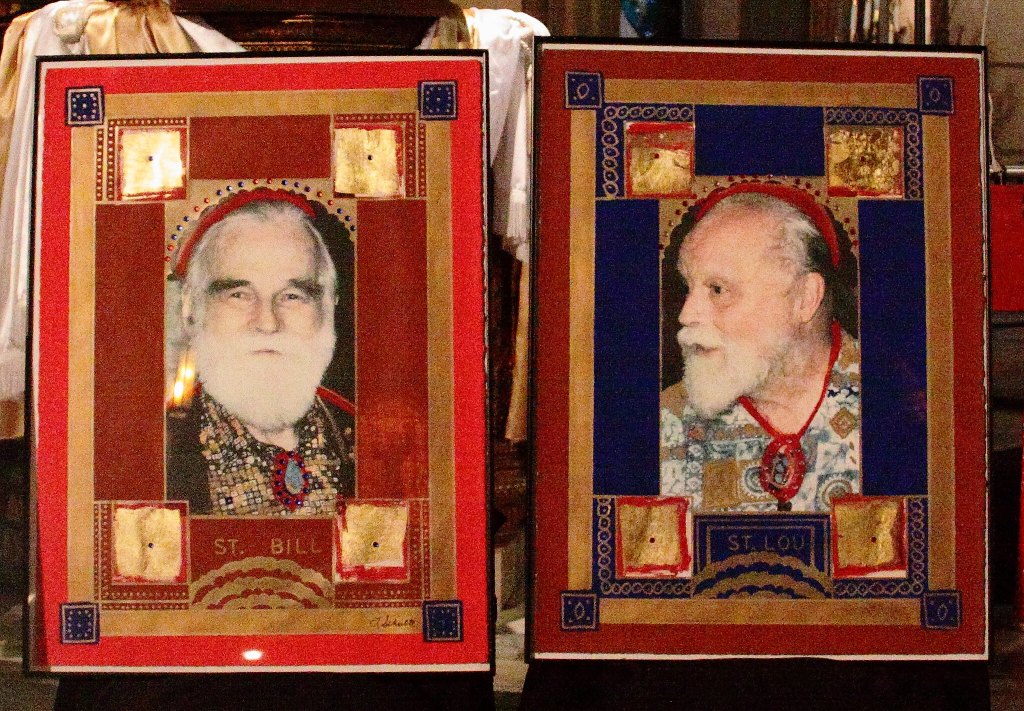
Portraits of William Colvig (l) and Lou Harrison (r) displayed at the Lou Harrison centennial celebration at Mission Dolores Basilica in San Francisco in 2017.
Let me begin with a confession. The Brahms Concerto for Violin, Cello and Orchestra is not my favorite Brahms concerto. Think about it. All his other concertos and certainly the symphonies get many live performances. Not so with this double concerto. Nonetheless it pretty much has served as THE model for this particular configuration of multiple soloist concerto. That said we find ourselves confronted by this really delightful Sony release which effectively contains possibly the three finest examples of this genre (though it would be nice to include Lou Harrison’s double concerto).
The disc opens with a single movement concerto by the prolific German composer Wolfgang Rihm (1952- ). This busy piece seems to be basically post-romantic in its harmonic language and more like a concerto grosso in terms of the more embedded solo materials. It is a tour de force for both orchestra and soloists. The classic three movement concerto format is abandoned in favor of one twenty minute allegro which contains a very large and interesting world of musical ideas. Yes, there are some harsher sounding harmonies but this assertive music brings the listener along with its rush of ideas.
Next is the Brahms Concerto. Now I am a Brahms fan and have tried to “get” this concerto for many years. As beautiful as this performance is I still find the first movement way too long and ponderous. The second movement is pleasant but not as memorable as I wish it were. But if you make it through those two you are treated to a scherzo-like finale which is one of the finest things the composer wrote.
The disc concludes with another 21st century concerto. This one is by the venerable John Harbison is an arresting and powerful piece. Unlike the Rihm and even the Brahms Harbison relies upon a great deal of solo and duo material for the featured soloists with the orchestra participating when it is allowed. This is a multiple movement piece with many moods. It is a virtuosic venture for orchestra and soloists.
The performers in this recording, though not familiar names to this reviewer, are clearly world class performers who go fearlessly into new music and have mastered the old. Jan Vogler is on cello and Mira Wang is on violin. The orchestra is the Royal Scottish National Orchestra. They are up to the seemingly considerable challenges under the guidance of Peter Oundjian. And the recording is lucid and warm.
Helmut Lachenmann (1935- ) is a composer who has been “on my radar” for some years now but, like a lot of names I get, I had yet to hear much of his music. Along comes Gregory Oakes from, of all places, Iowa. The Midwest in the United States doesn’t have much of a reputation for embracing the avant garde (though they actually do). So into the CD player goes this one and…wow, I really need to hear more Lachenmann and whoever this Oakes guy is I want to pay attention to what he is doing with that clarinet.
Admittedly this disc languished a bit before I heard it but I am now glad I did.
This disc consists of only three tracks comprising three works by this major German composer from three different periods in his career. Dal Niente (Interiur III), Trio Fluido, and Allegro Sostenuto.
Dal Niente (1970) is for solo clarinet and, as the title prescribes, the music is to be played as “from nothing” the meaning of the title. In fact this seems to be practically a textbook of extended techniques for the clarinet. But far from being a dull accounting of dry techniques, this is a tour de force which will challenge the skills of even the most experienced players. It is quite musical and listenable but the virtuosity will knock your socks off. Oakes pulls it off with a deceptive ease that demonstrates his rather profound knowledge of his instrument. It is easy to see the seeming cross pollination between the avant garde and free jazz here.
Next up is Trio Fluido (1966-68) which is a respectably avant garde trio for clarinet, viola, and percussion with Matthew Coley, percussion, and Jonathan Sturm, viola. Like the previous work this one is also about extended techniques (for all three instruments this time). This is a fine example of mid-twentieth century modernism and deserves a place in the repertoire. All three musicians are challenged to play their instruments in unconventional ways and the effect is almost like some of the electronic music of the era. It is a complex and pointillistic texture that has a strong and serious content.
Finally Allegro Sostenuto (1986-88) is another trio, this time for clarinet, cello, and piano. So while this work would make a fine companion work to the Brahms clarinet trio the work is unambiguously avant garde in the finest Darmstadt traditions. It is, at about 30 minutes, the longest piece here and it reflects the further maturity of the composer as he creates another challenging but almost surprisingly satisfying work.
This album serves as a nice way to be introduced to Helmut Lachenmann and to get to know some major new champions of the avant garde. And one would do well to stay informed about the work being done by this fine new music clarinetist.




 New Music Buff