Salt, the Residue of Looking Back. Maya Beiser Casts Her Unique Gaze


Denise Burt’s beautiful design effectively encompasses the scope and meaning of this album in arresting images

Maya Beiser, cellist, Bang on a Can member, listener, composer, innovator, interpreter, and producer. Beiser’s hats are many and each new album traces the musings of a truly interesting artist, ever evolving, revisioning, thinking, growing. She cuts a singular, intelligent, and deeply felt path that is both monolithic and definitive.

Looking back and forward

This latest release on her own Islandia label is another exposition of a powerful musical mind bringing fascinating perspectives, the artist’s singular take on music spanning some 500 years. Beiser is not about “authentic” interpretation (mostly) but rather about lucidly sharing her perspective, her musical visions.

Previous releases gave us her take on living musical icons like Philip Glass and Terry Riley. She also dares to look back upon some of the “sacred cows” of the repertoire like the Bach Cello Suites and Riley’s seminal “In C” among others. Her revisionings are respectful homages and insightful performances that challenge and inform her listeners to maybe hear in a new way. As T.S. Eliot said,

“We shall not cease from exploration
And the end of all our exploring
Will be to arrive where we started
And know the place (or the piece) for the first time”

So it is with the carefully curated selections on this disc. Beginning with a Missy Mazzoli composition featuring vocalist and performance artist Helga Davis (featured most visibly in the most recent iteration of Glass’ “Einstein on the Beach”). Her vocal skills drive these settings of texts by Erin Cressida Wilson. And this piece sets the tone for this album which is both lament and celebration for the experiences of women in history, mythology, and memory.

The first five tracks contain the bittersweet song cycle, Salt, from which the album takes its name. Here the listener is brought into the context of the Biblical story of Lot’s wife, forever imprisoned in a pillar of salt. But, rather than a pedestrian retelling of the tale, this cycle appropriates the context of the story to establish, with painful directness, the tone and direction of what will follow.

Helga Davis (photo from WNYC)

From her mineral prison, a mineral ironically known for its preserving properties, she sings of her crime of looking and remembering. She sings of pain, anger, and sadness, but never with remorse for her “crime”. It is an image that Beiser says lives powerfully in her personal memory. Mazzoli, Davis, and Beiser recontextualize the prisoner as victim, not criminal.

The ghostly images of the women we meet on this album are lamented as well as celebrated for their stories which burn deeply into our collective mythology, into our personal memories. Beiser lovingly dedicates this release first to her daughter, Aurielle Kaminsky, then to the principals whose creativity and energy pervade this album: Missy Mazzoli, Clarice Jensen, Meredith Monk, Erin Cressida Wilson, Helga Davis, Odeya Nani, Beth Morrison, and Christina Jensen.

In Lament to Phaedra, a work by the late British composer John Tavener is heard in an arrangement by Beiser. The 1995 work is sung by Phaedra’s sister Ariadne in response to Phaedra’s suicide by hanging. But here we have a wordless arrangement for cello and electronics that focuses on Tavener’s unique harmonic style and lyrical melodic construction. The result is effectively an affirmation of the lament for her fate.

Then we are treated to yet another transcription of a curiously difficult but very effective use of the early music concept of “hocket”, an interactive counterpoint of two voices. The eponymous Hocket, though vocal in its original form is, like much of Meredith Monk’s work, without a text. Monk’s work is about the voice, or the voices. And her revisioned operatic creations are fed by the mythological streams of women’s stories. This creative arrangement by this artist is an homage to Monk and, by extension, to the women she so beautifully celebrates in her work.

Meredith Monk with Allison Sniffin after a performance of Hocket at the Other Minds Festival in San Francisco (copyright Allan J. Cronin)

Another arrangement follows. It is a Melody from Orfeo ed Euridice, from the late baroque opera by Christopher Willibald Gluck. It is, of course, another ill fated relationship ended by the same infraction of looking and remembering that sealed the fate of Lot’s wife. Here Beiser chooses the gorgeous “Dance of the Blessed Spirits”, another wordless homage that imprints on the listener most effectively.

Next up is yet another wordless work, this one by fellow cellist and composer, Clarice Jensen, whose work has graced these blog pages before in reviews of her singular, drone, minimalist, meditative albums. Whether you call her work “drone” or “minimalism” or whatever you choose, your ears will bask in her meditative sonic ministrations. Jensen’s work, while related by its medium (that of cello and electronics), is a distinctly different style, immersive, meditative, evocative, a sound bath for the listener.

Clarice Jensen (from Jensen Artists page)

From the 21st century we are now transported to 17th century Venice and the work of the early baroque master Claudio Monteverdi. In the only surviving music from his second opera, we hear Ariadne, sister of Phaedra, singing the lament for the sister who had taken her life in shame and sadness.

The penultimate track brings us to this artist’s cultural roots with a song by Yedidya Admon to lyrics by Yitzchak Shenhar.

My Field (Shedemati)

My field,
At dawn I sowed it in tears,
Let the prayer of the farmer be heard!
My field,
It is saturated with dew,
It is intoxicated by the light of the sun.
The grain bends low in front of the reaper.
The strides are long,
The burnished scythe is raised high.

Odeya Nini provides the voice in this “reimagining“ of this classic song of sadness and lament by the lowly farmer imagined by the poet.

Odeya Nini (unknown copyright)

Fittingly, this last track is about death, endings. It is Beiser’s arrangement of Henry Purcell’s “When I am laid in the earth” from his opera, Dido and Aeneas. The text:

When I am laid, am laid in earth, May my wrongs create
No trouble, no trouble in thy breast;
Remember me, remember me, but ah! forget my fate.
Remember me, but ah! forget my fate.

But forgetting is not allowed here. Beiser begs us to remember. And we cannot avert our ears or eyes.

Two Sono Luminus Discs of New Music by Icelandic Composers (mostly)


DSL- 92267

There are, by my count, at least 8 discs on this fine audiophile label dedicated to music by composers from Iceland. That country’s musical prowess deserves to be better known as does their world class orchestra. I’m reviewing these back to back releases together because they are both Iceland Symphony recordings presenting new music by (mostly) Icelandic composers. And they have a secret connection.

This first disc is a nice mix of music by five different composers in works that really give the orchestra an opportunity to shine. Under the direction of composer/conductor Daniel Bjarnason we are availed of the sound of now, or at least Bjarnason’s “now”.

Track list

This disc, which seems to have a “outer space”theme in large part, opens with a large orchestral work from the most deservedly best known Icelandic classical composer, Anna Thorvaldsdottir. “Catamorphosis” is a 20+ minute work for full orchestra and then some. Her style initially reminded this listener of the sound mass of music like Ligeti and Penderecki. But her harmonic language is more lush and romantic. She has an astounding skill in writing for large orchestra, producing at times the modern equivalent of Impressionism. Her use of motives suggest she has digested ideas from minimalist/pattern composers. And at the end of the day (or the review), one realizes that she has developed her own voice.

The subtle colors of this work are well defined by the orchestra under Bjarnason’s truly expert guidance but also via the sonics that the Sono Luminus engineers are able to capture. This sounds like a difficult work to perform but Bjarnason manages to create a definitive performance and Sono Luminus’ sonics are, as always first rate.

Catamorphosis (2022) is typical of Thorvaldsdottir’s writing for large orchestra reflecting her skills as an orchestrator as well as her imagination, her ability to create a wide palette of subtle sound forms that suggest a sort of post impressionist style. The poetic and metaphorical titles tell little about the musical content (or structure for that matter). But her ability to create cohesive and compelling compositions such as this provide an experience that will likely evoke images for the listener, a sort of movie for the mind. So feel free to conjure your own images in this 7 part (played without pause) work and/or listen and watch a recent Elephilharmonie performance on YouTube here.

Missy Mazzoli’s comparatively brief “Symphony for Orbiting Spheres” (2014 rev 2016) taps into a vein of inspiration seemingly related to the cosmic images of Thorvaldsdottir. Mazzoli incorporates an electronic keyboard and harmonicas, among several less common instruments used in symphony orchestras, to create her own sonic cosmic fantasy. Please click the link on her name above to learn more about this rising star from her nicely designed website.

Daniel Bjarnason demonstrates his own formidable compositional chops with “From Space I Saw Earth” (2019). And this track also provides a link of sorts to the other album reviewed in this blog entry. This work, written on commission for the 100th anniversary of the LA Philarmonic, is a work that requires three conductors. The premiere was led by Zubin Mehta, Gustavo Dudamel, and Esa-Pekka Salonen, all of whom have significant connections to the orchestra (Mehta as conductor Emeritus, Dudamel as present chief conductor, and Salonen as conductor laureate). That was the premiere but this recording is conducted by Bjarnason along with Kornilios Michalaidis, and the then incoming chief conductor of the Iceland Symphony, Eva Ollikainen. Therein lies the “secret connection” to which I referred earlier.

María Huld Markan Sigfúsdóttir (1980- ) is a violinist and composer. Her orchestral work, “Clockworking” is a sort of post minimalist work with a gently driving Ostinato in the percussion. It reminds this reviewer variously of Birtwistle’s “Chronometer”, Ligeti’s “Poeme Symphonique”, to name a few but it is not derivative of these in any way. It is a very listenable and enjoyable orchestral work.

Bára Gísladóttir (1989- ) is a composer, vocalist, and double bass player based in Copenhagen. This, the briefest work on the album is at times the quietest and at others the loudest work here. I would add that it is also the most avant garde. Relying on a battery of percussion and what appears to be some extended instrumental techniques the composer creates a world that to this reviewer’s ears sound a bit like Gyorgy Ligeti’s work “Atmospheres” (1968). That’s not meant to say it’s derivative, just that it could conceivably be used for that famous psychedelic sequence from Stanley Kubrick’s masterful “2001, A Space Odyssey” where my own young ears first heard the Ligeti work.

DSL- 92268

As fabulous as that first disc is, this release, dedicated entirely to the work of Anna Thorvaldsdottir, is a worthy endeavor. In addition to that we are treated to the sublime and insightful artistry of the first female principal conductor of the Iceland Symphony, Eva Ollikainen who leads the Iceland Symphony on this disc.

Like the above release, the Iceland Symphony Orchestra demonstrates their world class artistry. This is not easy music to play but, under Ollikainen, as they have under her predecessor, they are able to articulate the intricately orchestrated sounds by this really astounding composer.

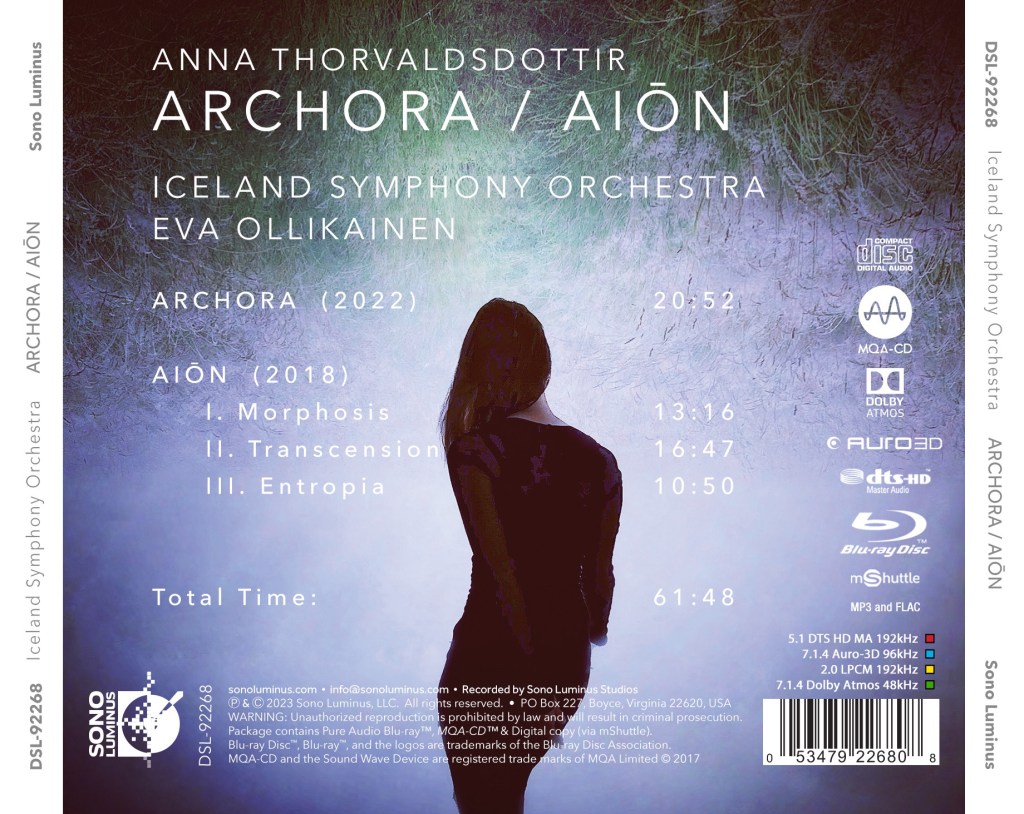
Just two works here. “Archora” (2022) and “Aion” (2018). Both are works of grand concept and could easily be called symphonies but the composer seems fond of metaphoric poetic titles. Regardless of the names given these works they demonstrate the composer’s grand sonic visions and her mastery of the orchestra, a mastery grasped very clearly by the Iceland Symphony’s new artistic director and conductor, Eva Ollikainen (1982- ). She holds the distinction of being the first woman to hold the post to which she was appointed in 2019.

Track list

There are only two works presented but both are stunning examples of some of the finest new music being produced today. Yes, it’s great to see women having a greater presence (both as composers and conductors) but, truly, Thorvaldsdottir is “the bomb”, so to speak. Her creativity, her mastery of the orchestra are simply a revelatory as well as entertaining listening experience.

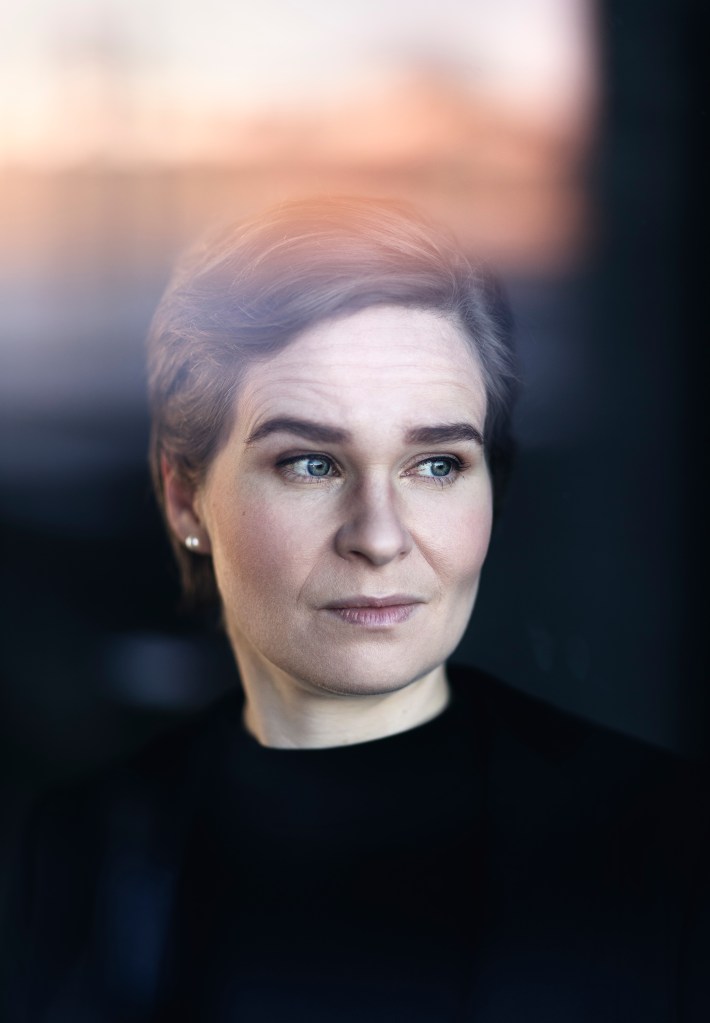
Eva Ollikainen

This release is also a landmark which showcases the formidable talent of the Icelandic Symphony’s new conductor. In addition to breaking gender barriers she is quite simply a rising star and one of the finest interpreters of new music today.

“Archora” (2022) is the most recent work here and it’s another of Thorvaldsdottir’s sprawling cinematic tone poems. No specific story here but the composer’s mastery of orchestral color will doubtless evoke images and feelings in the listener. Thorvaldsdottir is creating a sort of sonic (as opposed to literal) mythology. Her reference points seem to be largely in Greek and Roman mythology but also in Nordic and Northern European myths. Eva Ollikainen conducted the world premiere at the 2022 BBC Proms. You can hear that performance on YouTube here. But the Sono Luminus recording captures more of the subtle sound colors of this engaging work.

The composer’s three movement, “Aion” (2018) concludes this recording. Aion is a Greek God of time. The composer is concerned with various aspects of time in her work. This large three movement work is virtually a symphony with an augmented orchestra, extended instrumental techniques, and an optional choreographic accompaniment. (Tell me that’s not cinematic). There is an example of the optional choreography here.

This recording is also a fine introduction to conductor Eva Ollikainen who clearly has a grasp of this music. Various examples of her interpretive genius can be found on YouTube ranging from Beethoven to new contemporary masters.

These are two truly fine discs both musically and for sheer sonic detail. They’re available in streaming and hard copy CD as well as Blue Ray Audio. These are a fabulous listening experience. Enjoy!

Quantum Koh: Jennifer Koh’s “Limitless”


kohlimit

Cedille 9000 191

Watching the flowering career of this wonderful violinist has been both a joy and a labor.  First, the labor: she is so consumed with projects that it is difficult to keep up sometimes.  Second, the joy:  All her projects and recordings are fascinating in concept and satisfying to the attuned listener’s ear and to her collaborators.

So it is with this marvelous 2 disc set from Cedille Records (now celebrating its 30th anniversary as one of the finest independent classical labels) which consists of duos with composers.  She partners with a variety of up and coming composers in this varied but always interesting collection. These sincere and intimate collaborations exude quantum sparks of creative genius.

Eight composers and nine compositions span two discs demonstrating the Chicago native’s eclectic interests and marvelously collaborative nature. These compositions represent some of the cutting edge nature of her repertory choices as well as the respect earned from these composers.

It begins with The Banquet by Qasim Naqvi who is perhaps best known for his post minimalist acoustic group, Dawn of Midi. Here Naqvi works with a modular synthesizer utilizing that instrument’s quirks to create a sort of drone with minimalistic effects created by his exploitation of those quirks (this could even be classified as a species of glitch). Koh’s part interacts in ways that seem quasi improvisational, doubtless the product of close collaborative efforts.

Next are the lovely Sanctuary Songs by Lisa Bielawa, a fine singer whose solfege singing was for years part of the defining sound of the Philip Glass Ensemble. (Koh masterfully played the solo violin dressed in costume in the title role in the recent revival of Einstein on the Beach.)  She comes to us on this disc as a both composer and singer in this lovely cycle.

Bielawa has developed her own compositional voice and this little song cycle is a fine example. Both voice and violin are given challenging roles in exploring this unusual combination of musical timbres.  Bielawa compositional voice is entirely her own and her gift for it is evident in this and all that this writer has heard.  The work is in three short movements.

Du Yun, whose astounding work was recently reviewed here is represented by her voice and violin duo, Give me back my fingerprints.  The link on her name will take the curious listener through this composer’s amazing accomplishments but nothing can prepare the listener for the raw energy that characterizes her work.

Rapidly rising star Tyshawn Sorey uses his amazing ear to create this memoriam for one of his mentors, Muhal Richard Abrams. Sorey uses a glockenspiel as a counterpoint to Koh’s violin in this all too brief memorial piece written on the passing of AACM (a gaggle of brilliant musicians whose grouping reminds this writer of France’s “Le Six”, the “Russian Five”, and the early twentieth century “American Five”) founding member, a truly great composer, collaborator, and performer.  The AACM was founded in Chicago.

I had the pleasure of meeting the genial and quick minded Sorey at OM 17.  The link to my blog review is provided for the curious listener.  The concert took place in 2012.  Here is the shortcut to the Other Minds archival page.  Sorey provides no liner notes perhaps because he has succeeded in saying everything he wanted to say in the music (Koh seems quite appropriately tuned in here.

Nina Young‘s Sun Propeller involves the composer on electronics which interact to some degree with the solo acoustic instrument to extend the range of what the audience hears from the violin.  The title refers to the rays of sun one sees when the sun is behind a cloud and the sunbeams radiate out in glorious fashion.  This serves as a metaphor for the process involved in the composition.  But not to worry, the complexity does not hide the beauty of the music itself.

As if all the preceding weren’t enough there is a second disc continuing this collaboration.  First up is another name new to this writer, Wang Lu .  This Chinese American composer uses electronics alongside acoustic instruments in much of her work.  Her digital sampling reflects the eclectic nature of her world comprising everything from Korean pop to Chinese opera and a host of environmental sounds.  This piece also contains an opportunity for the composer to do some free improvisation as well as provide accompaniment to Koh’s violin part.  It is a dizzying and mind manifesting experience.

Next up is Vijay Iyer.  Iyer is perhaps best known as a jazz pianist and, as such, he is a fine example but his south Asian heritage doubtless has had an influence on him musically though that is but one aspect of his work. The American born Iyer, like many of his generation, mine their and our collective heritages as needed for inspiration. The present composition, “Diamond” also draws from his rich cultural background as it refers to the Buddhist Diamond Sutra and utilizes the structure of that religious parable to create the piece.  It is probably the most conventional sounding work here but that tells the listener little given the wide ranging eclecticism.  It is a piece which gives homage to jazz filtered through the experience and the person that is Vijay Iyer and, in this case, shared with the violinist.

The last composer is Missy Mazzoli, an established American composer.  She is represented by two works, “A Thousand Tongues” and (the now Grammy nominated) “Vespers”.  The composer provides accompaniment with piano and electronics.  The first piece has more the ambiance of a pop song though an avant garde one.  The last piece, the Vespers, feels deeper and more haunting.  Both provide more than adequate writing to keep soloist Koh both busy and happy.  

Indeed this album will keep the astute listener happy for its musical content, its progressive interest in new music, its wonderful soloist and beautiful sound.