Not Just Another Black Composer Compilation: Kellen Gray Revives Neglected American Masterpieces


LINN CKD 731

For the humble listener, a musician’s technical and interpretive performance skills are one of the most compelling reasons to buy a concert ticket or a recording of said musician. But your humble reviewer has another, perhaps equally important reason for investing time and money in the work of a musician. And that skill is what I like to call “musical radar”. It is the (sometimes uncanny) ability of such gifted musicians to intelligently choose repertoire.

Conductor Kellen Gray demonstrates a keen sense of what music sounds good and also has the weight of substance. Following in the footsteps of incisive conductors like Leopold Stokowski (1882-1977), Dean Dixon (1915-1976), and Paul Freeman (1936-2015) Gray is clearly a champion for contemporary music and is now into the second volume of what this listener hopes will be many more releases of substantive music by black composers whose work has lain fallow for reasons unrelated to quality.

The first volume included early to mid twentieth century masterworks like William Levi Dawson’s 1934 “Negro Folksong Symphony”, William Grant Still’s First Symphony “Afro American” (1930), and George Walker’s “Lyric for Strings” (1946, orch 1990). These are certainly great and foundational works that deserve a place in concert programs but these works have had at least some exposure via recordings. Nonetheless they are fine foundation on which to build this series. Gray demonstrates a depth of understanding for these works and his skills as a conductor were displayed well here. But that was just the first volley in an exciting survey in progress.

In this second volume we see more deeply the acumen of this conductor’s musical radar. These are new commercial recordings of orchestral works by mid to late 20th century black composers, works of obvious substance that remain unjustly neglected. It is this “not the usual suspects” angle that finds this enterprising conductor demonstrating his personal perspective and respect for music history. And they are revelatory. Hearing these definitive performances will leave listeners wanting more as we get to hear some very exciting music that deserves at least a reckoning if not a place in the repertoire.

The four victims of the Birmingham Church bombing.

The disc begins with Margaret Bonds’ “Montgomery Variations” (1964), a classical set of variations, in this case on a gospel tune, “I want Jesus to walk with me”. But this work was “lost” and was only rediscovered in 2017. Its neglect was likely due both to the work being by a black woman, and the fact that it is a response to the 1963 Birmingham church bombing, a hate crime that killed four little girls. So, here it is, Bonds’ only surviving purely orchestral work getting a truly fine hearing. And what a great piece it is.

Margaret Bonds (1913-1972)

The work is structured in distinct sections with titles (Decision, Prayer Meeting, March, Dawn in Dixie, One Sunday in the South, Lament, Benediction). Each title is reflected in the musical mood of each section. It is an overt and powerful denunciation of a horrific hate crime. It is harrowing at times, somber and reverent at others, but Bonds’ composition is also effective in the metaphorical quality of the music itself. It is also very nearly a concerto for orchestra in its broad symphonic dimensions and clever orchestration most deftly handled in this recording.

The genre of “variations” is common throughout musical practice but only took on the guise of monolithic large orchestral works in the late 19th century. Well known examples include, Elgar’s “Enigma Variations”, Britten’s “Variations and Fugue on a theme of Henry Purcell”, Brahms’ “Haydn Variations”, etc. It’s hard to say if this work will find a place in the concert hall alongside those proven classics but Maestro Gray and the talented musicians of his Royal Scottish National Orchestra really make a strong case to do just that.

Ulysses Kay (1917-1995)

Next we are introduced to Ulysses Kay’s “Concerto for Orchestra” (1948). This work, first performed by the similarly incisive conductor, Leopold Stokowski has been sorely in need of a new recording and Maestro Gray serves up a taught and insightful performance that, like all the works on this release, stand as a challenge to performers, broadcasters, and listeners to not let this music fade into obscurity. The “Concerto for Orchestra” genre was first heard in a 1925 Hindemith work with that title and the work best known in the genre is without doubt Bartok’s 1943 “Concerto for Orchestra”. Where Kay’s work will stand in relation to other concerti for orchestra remains to be seen/heard (as with the Bonds work) but at least it now has a chance to be heard in all its glory.

It is one of Kay’s major works and it is of grand symphonic scale. This neoclassical work was written in 1948 and is cast in three movements. The work is eminently listenable but it puts challenges to the orchestra which this orchestra handles quite well.

Coleridge Taylor Perkinson (1932-2004)

The disc concludes with a rather brief work by a composer with whom even adventurous listeners (including myself) have limited familiarity. Coleridge Taylor-Perkinson. It is the only work here that comes from the 21st century. This 2001 Concert Overture subtitled, “Worship” reflects Perkinson’s exposure to black church music which he utilizes in this tone poem written for a sizable orchestra.

Gayle Murchison’s fine liner notes help guide the listener by providing context and by understandable descriptions of the compositional processes. This is an exciting release that builds nicely on the first volume and leaves this listener excitedly anticipating Kellen Gray’s next installment.

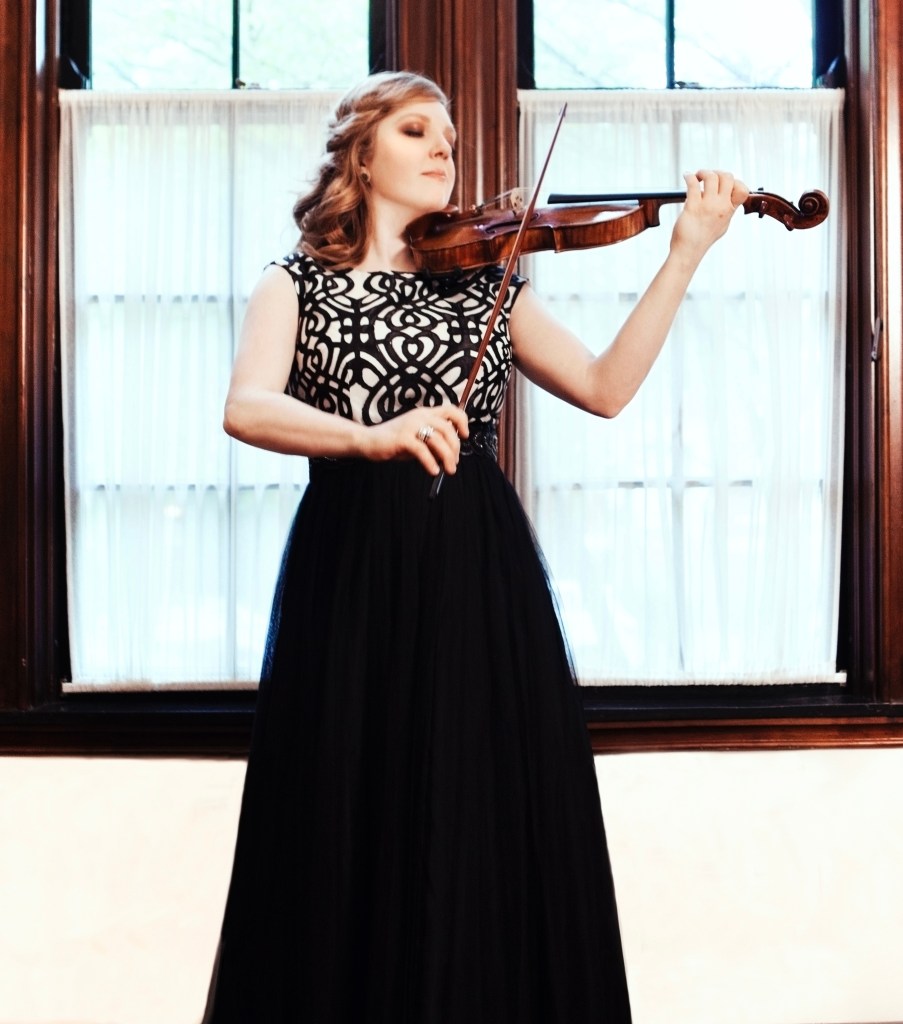
The Metallurgy of Sadness: Rachel Barton Pine’s “Dependent Arising”


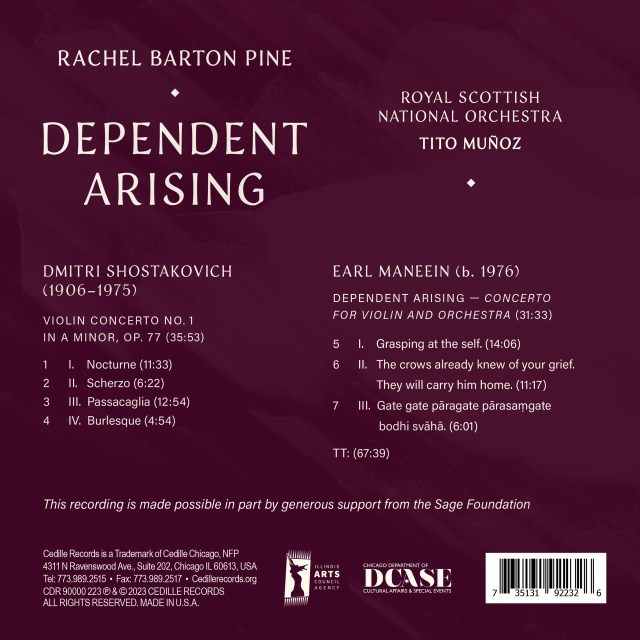
Dependent Arising

Rachel Barton Pine (1974- ) appears to have an incredibly wide range of musical interests and has managed to successfully integrate those into her musical career. Ranging from early, frequently little known, baroque composers to an expanded appreciation of grand romantic works, an intelligent selection of post 1900 composers (many little known) and some remarkable works commissioned by and for her, and heavy metal rock. And the single thread that seems to characterize, in this listener’s ear, her strength is the ability to choose music of substance and to then create insightful performances of those works.

Here she explores the sonic geography of angst and redemption in these two violin concertos written some . And this album embodies some of the qualities that make this violinist one that stands out distinctly in the crowd but in a way that is about identity rather than hierarchy. Her wide ranging musical interests are a part of her sonic autobiography. Here she reveals her interest and engagement with “heavy metal” music, a rock genre that began around 1970. In her liner notes she discusses this and manages to convincingly demonstrate a sort of “proto-metal” aspect in the first selection, the Shostakovich (1906-1975) First Violin Concerto of 1947-8 , a work notorious for its censure (the second of several such denunciations of the composer’s career) under the Zhdanov Doctrine. It was not premiered until 1955.

This somber masterpiece was written in the shadow of the horrors of the Second World War (ended only about three years before he completed this work) and reflects the composer’s deeply felt emotional memories. It was not remotely in compliance with the strictures enforced by the oppressive regime. tThey didn’t want to be reminded, much less honor, the atrocities and horrors of the war. Its premiere in 1955 (some two years after Josef Stalin’s death) by its dedicatee, the great David Oistrakh, saw the concerto earn a place in the respected repertoire of violin concertos. The four movement work is not what you want at a party unless you’re trying create a funereal vibe but it is quite beautiful in a modernist tinged, grand romantic idiom with all the hallmarks of the composer’s wry humor and his profound empathy.

Earl Maneein

The second selection, written some 80 years after the Shostakovich concerto, is a commission from a self described, “heavy metal” violinist named Earl Maneein. His is a name new to these ears but one clearly steeped with expertise in classical composition and heavy metal music both inflected with his spiritual practice of Buddhism.

Here is music from a composer who truly understands classical composition and his integration of “metal” elements is an expansion of classical composition, not a parody or an amateurish effort. This is a major concerto which gives the soloist an opportunity to show their technical and interpretive skills. I don’t know this musician and I’m not quite sure of the meaning of “metal music” as practiced now but I am positively enthralled by this work.

So we have another typical Rachel Barton Pine album, a fine reading of a classic (the Shostakovich one a bit under appreciated still) and a new work which strives to become a part of that repertoire and is likely to get their. Rachel’s virtuosity and interpretive skills are clearly evident as always and he journeys are effectively rethinking the canon of works for violin. Brava!

Rachel Barton, Uncovering Valuable Legacy


Cedille Records CDR 90000 214

This album, largely a re-release of Barton’s groundbreaking recording of 1987 without the Violin Concerto No. 4 in D Major by CHEVALIER J.J.O. DE MEUDE-MONPAS (FL. C. 1786) but with the wonderful addition of Florence Price’s Second Violin Concerto of 1952. That alone is worth the price of this disc.

Rachel Barton

Rachel Barton Pine who made her debut at age 10 with the Chicago Symphony is a world renowned violinist and activist. With this, her 22nd release for Cedille she is clearly a darling of that fabulous hometown label. Her wide range of repertoire reflect a unique sensibility and a revelatory exploration of the work of black composers.

Cedille records has a pretty amazing history of paying attention to black composers. Four of their releases featured the late great black conductor Paul Freeman (1936-2015) whose groundbreaking survey of black composers for Columbia records remain indisputable evidence of their inexcusable neglect as artists. The Cedille recordings mentioned are an extension of Freeman’s original survey.

So let’s take a look at this new release.

JOSEPH BOLOGNE, CHEVALIER DE SAINT-GEORGES (1745-1799)
Violin Concerto in A major, Op. 5, No. 2 (1775) (23:44)

1 Allegro moderato (10:22)
2 Largo (8:35)
3 Rondeau (4:35)

The new lavish biopic will happily reignite interest in this composer. The late conductor Paul Freeman (1936-2015) is the person who really first rescued this man’s work from oblivion. In the first volume of his landmark Black Composers series released March 8th, 1974. He devoted an entire disc to four works by this composer, a contemporary of Mozart and every bit the Austrian’s equal both as composer and performer. Freeman released recordings of his first (of two) symphonies, the first (of some 18) string quartets, one of the few surviving arias from his first opera, “Ernestine”, and the last of his eight symphonies concertante. Barton’s beautiful reading of the A major violin concerto of 1775 (he wrote 14) is her entry into this much needed and ongoing revival. Her reading is warm and very much up to the challenge of the virtuosity of the writing.


JOSÉ WHITE LAFITTE (1835–1918)
Violin Concerto in F-sharp minor (21:32)

4 Allegro (11:39)
5 Adagio ma non troppo (4:50)
6 Allegro moderato (4:58)

This composer, also first brought to light by Maestro Freeman in its premiere recording in volume 7 of the Black Composers series released in June, 1975. The wonderful Aaron Rosand played the violin. Barton’s, released in 1997 is only the second recording of this little known Afro-Cuban composer. The concerto fits with her passion for the high romantic era where virtuosity was (nearly) all.


SAMUEL COLERIDGE-TAYLOR (1875–1912)
Romance in G major for Violin and Orchestra, Op. 39
(12:32)

Encore Chamber Orchestra
Daniel Hege, conductor

This brief Romance for violin and orchestra mirrors similar works by Beethoven and Dvorak. Again her facility with high romanticism serves her well in one of this black English composer’s best known works.


FLORENCE PRICE (1887-1953)
Violin Concerto No. 2 (1952) (14:42)

Royal Scottish National Orchestra
Jonathon Heyward, conductor

This, along with Price’s first concerto, fourth symphony we’re found in 2009 in a now abandoned house that once belonged to Price. The second concerto is presented in its second recording (both concerti were released on Albany Records in 2018. I haven’t heard that one but after hearing this performance from 2022 it’s hard to imagine it being done better.

Rachel Barton Pine Restoring Neglected Masterpieces to the Repertoire: Dvorak and Khachaturian


bartonpinedvorak

Avie AV-2411

Rachel Barton-Pine is one of the finest and most interesting performers working today.  Her unique look at the performing repertoire for her instrument continues to be one of the most salient features of her artistry.  Certainly her interpretive abilities are foremost but her choices of neglected repertoire make any release of her recordings a reason to pay close attention.

In the past she has recorded many a neglected piece based on her interest in the music.  She has featured black composers from the baroque to the present and has managed to resurrect unjustly neglected concerti from composers of pretty much every racial and national description.  Here she features two lovely seldom heard concertos.  The Dvorak concerto from 1789 and the Khachaturian concerto from 1941.  Both are major works and a challenge to the soloist and both fit pretty much into the late romantic genre (arguably that would be “post romantic” for the Khachaturian).

The present recording is released on the Avie label which is a progressive independent label which itself boasts an impressive selection of musical works in very fine performances.  This disc is a fine example of the work they do and is a great selection for the listener’s library.  These two concertos were popular in their day but have not seen inclusion in live performances or recordings as much as other romantic concertos.  One could speculate endlessly on why this is so or one could simply celebrate the fact that we are getting to hear them in these fine and definitive recordings.

The Dvorak from 1879 is as tuneful and entertaining as any of its contemporaries (Bruch, Tchaikovsky, Brahms, etc) but for whatever reason has not received as much attention.  Regardless of why this is so I would recommend just listening and drawing your own conclusions.  This three movement work is as challenging technically and as entertaining a concerto as any currently in regular performance.  This work is one of the finest examples of the high romanticism of the late 19th century and one hope this recording will help cement the piece into a more frequent visitor to both concert halls and recordings.

The Khachaturian (from 1940) began its life during the throes of the WWII under the oppressive political scrutiny of Josef Stalin and his regime.  Khachaturian, who is now recognized quite properly as an Armenian composer, was then subsumed into the mix of the vast gaggle of countries and cultures under the rubric of the USSR.  And while this is not particularly or obviously ethnic as other music from this region it is important to know that the composer’s identity was “Russian” by default and not by choice.  Regardless of those considerations one must be grateful for the fact that the oppressive regime was able to recognize a quality work (also one in three movements) and give it the “Stalin prize”.  Doubtless there are influences gleaned from the composer’s efforts to not offend the conservative tastes of the ruling elite but the bottom line here is that we have a true masterpiece of the concerto genre and one which deserves serious attention and continued performances.

The useful liner notes are by the soloist, a fact which spotlights her musicological interests and her ability to communicate with an audience verbally as well as musically.  In fact a quick perusal of Rachel’s web site will lead the interested to some of her more pedagogical efforts featuring scores of some of these lesser known masterpieces.

And, oh yes, there are large orchestral duties here too.  The wonderful Royal Scottish National Orchestra is led by the rising star conductor/composer Teddy Abrams who recently took over leadership of another supporter of new and/or neglected musics, the venerable Louisville Orchestra.  Founded in 1937 they have carried the torch for new music and celebrated the inclusion of all genders and ethnicities in their musical vision, an embodiment of the very intent of the phrase, “E Pluribus Unum” especially in this musical context.

All in all a great disc which is unlikely to duplicate anything in your collection but one to which you will doubtless return for sheer entertainment and joy.

From the Simpsons to the Concert Hall,Classical Gems by Danny Elfman


Album Art

Danny Elfman (1953-) has had a varied and successful musical career working in diverse areas.  From his days as lead singer and songwriter for Oingo Boingo, he has cultivated his love of film music into a successful career having scored numerous films and television shows.

Now a great divide seems to exist between composers who score films and composers who compose for the concert hall.  Few have demonstrated the ability to be successful in both arenas.  Erich Wolfgang Korngold is a notable exception as is Aaron Copland.  Both men have succeeded rather famously in both film and classical concert hall music.  In fact John Williams, though known primarily as a film and television composer has written quite a bit for the concert hall as well.

Now here comes Danny Elfman, known best perhaps as the composer of the Simpsons them for the long running animated series.  He has gotten the bug to write for the concert hall and this recording presents two major works.  The first is his violin concerto “11/11)(2017) with soloist Sandy Cameron.  You can read the liner notes about the composer’s obsession with the number 11 or you can relax and enjoy a genuine violin concerto, not a reworking of themes as one might expect from a lesser composer.  The second is a nice addition to the chamber music repertoire, a piano quartet (2017).

The concerto is played by the wonderful Royal Scottish National Orchestra under the direction of the esteemed John Mauceri.  Sandy Cameron is the soloist who handles the concertos four movements flawlessly and does justice to Elfman’s work.  It’s really a beautiful piece.  Only time will tell the work’s eventual place in history but we can certainly enjoy it for what it is, a good and entertaining violin concerto.

The Piano Quartet is played by the Philharmonic Piano Quartet Berlin which consists of Andreas Buschatz, violin ; Matthew Hunter, viola; Knut Weber, cello; and Marcus Groh, piano.  This five movement work would happily grace any chamber music recital.  It is in turn pithy, melodic, humorous, and serious.

This is stronger music than this reviewer had imagined would come from this composer’s pen.  I can’t say, “If you like his film scores you’ll like his music” but there are, perhaps inevitably, snippets of his film music style which work actually quite well.

Double, Double: Three Double Concertos


rihmdoppel

Let me begin with a confession.  The Brahms Concerto for Violin, Cello and Orchestra is not my favorite Brahms concerto.  Think about it.  All his other concertos and certainly the symphonies get many live performances.  Not so with this double concerto.  Nonetheless it pretty much has served as THE model for this particular configuration of multiple soloist concerto.  That said we find ourselves confronted by this really delightful Sony release which effectively contains possibly the three finest examples of this genre (though it would be nice to include Lou Harrison’s double concerto).

The disc opens with a single movement concerto by the prolific German composer Wolfgang Rihm (1952- ).  This busy piece seems to be basically post-romantic in its harmonic language and more like a concerto grosso in terms of the more embedded solo materials.  It is a tour de force for both orchestra and soloists.  The classic three movement concerto format is abandoned in favor of one twenty minute allegro which contains a very large and interesting world of musical ideas.  Yes, there are some harsher sounding harmonies but this assertive music brings the listener along with its rush of ideas.

Next is the Brahms Concerto.  Now I am a Brahms fan and have tried to “get” this concerto for many years.  As beautiful as this performance is I still find the first movement way too long and ponderous.  The second movement is pleasant but not as memorable as I wish it were.  But if you make it through those two you are treated to a scherzo-like finale which is one of the finest things the composer wrote.

The disc concludes with another 21st century concerto.  This one is by the venerable John Harbison is an arresting and powerful piece.  Unlike the Rihm and even the Brahms Harbison relies upon a great deal of solo and duo material for the featured soloists with the orchestra participating when it is allowed.  This is a multiple movement piece with many moods.  It is a virtuosic venture for orchestra and soloists.

The performers in this recording, though not familiar names to this reviewer, are clearly world class performers who go fearlessly into new music and have mastered the old.  Jan Vogler is on cello and Mira Wang is on violin.  The orchestra is the Royal Scottish National Orchestra.  They are up to the seemingly considerable challenges under the guidance of Peter Oundjian.  And the recording is lucid and warm.